The Whisper by Chelsea Iversen Summary, Characters and Themes
The Whisper by Chelsea Iversen is a supernatural mystery about three women drawn back to the mountain town of Whisper Ridge fifteen years after the unexplained death of their childhood friend, Quinn Winter.
Their reunion revives a secret they once shared: the aspens outside town contain real magic, guarded by generations of women and governed by strict rules. When Joey hears Quinn’s voice whispering through the trees, an old accident begins to look like murder. What follows connects buried teenage secrets, forbidden spells, grief, friendship, and a dangerous outsider who discovered how magical power could be stolen through blood.
Summary
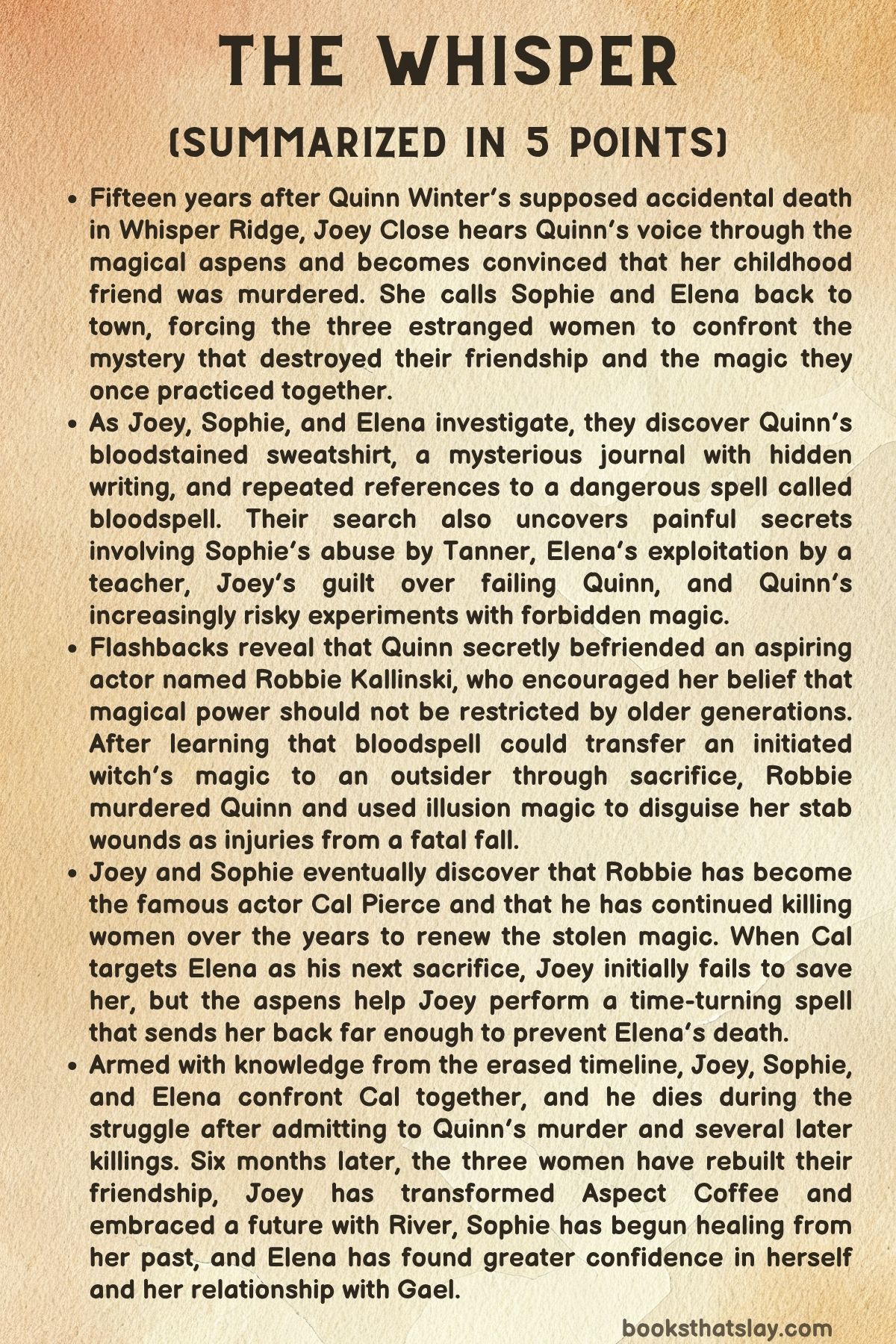
Fifteen years after Quinn Winter supposedly died by falling from a rocky crag near Whisper Ridge, Joey Close remains unable to accept that her death was accidental. Joey has stayed in town, inherited Aspect Coffee, lost her mother Carly, and devoted much of her adult life to collecting information about Quinn’s final day.
On the anniversary of Quinn’s death, Joey runs near the aspen grove where she, Quinn, Sophie, and Elena once practiced magic. The trees suddenly fall silent, and Joey hears Quinn’s frightened voice apparently saying, “Dad? No!”, convincing her that the aspens have preserved some fragment of her friend’s final moments.
Joey contacts Sophie and Elena, who have both built lives away from Whisper Ridge. Sophie lives in Denver with her wife Talia and their daughter Leah, while Elena lives in Los Angeles with her teenage son Gael and struggles to establish herself as an actor.
Both women reluctantly return. Sophie comes because Joey’s message awakens memories she has spent years avoiding, while Elena initially tells herself that a movie production in Whisper Ridge offers a career opportunity.
Their reunion is uneasy because Quinn’s death destroyed the friendship they once shared. Joey resents being the person who stayed behind, while Sophie and Elena carry private reasons for leaving that extend beyond their grief.
The women once belonged to a line of magical stewards connected to the aspens. When they were thirteen, Quinn’s mother Barbara and Joey’s mother Carly introduced them to the grove, the Book of Aspens, and five rules designed to keep the magic from becoming dangerous.
Flashbacks reveal that Quinn gradually became dissatisfied with those restrictions. Her father Tom was an alcoholic, Carly suffered from severe emotional instability, Sophie was being threatened by Tanner with intimate photographs taken without her consent, and Elena was being exploited by teacher Mark Collingswood.
Quinn wanted magic that could solve problems ordinary healing spells could not touch. She began searching the Book of Aspens for spells deliberately hidden by earlier generations and eventually practiced alone, violating the rules intended to protect her.
In the present, Sophie discovers Quinn’s old pink journal in her childhood bedroom. Its pages initially appear blank, but mysterious writing begins reappearing, including the words “IT DIDN’T WORK” and repeated references to something called “bloodspell.”
Joey, Sophie, and Elena also discover a carving of the word beneath Barbara’s deck. Their questions turn toward Tom, especially after they break into his house and find the bloodstained pink sweatshirt Quinn wore when she died.
The sweatshirt contains seven holes resembling stab wounds. No such injuries appeared in Quinn’s official autopsy, providing the first strong evidence that her death was deliberately disguised.
Other clues complicate the investigation. River, Quinn’s former teenage boyfriend and Joey’s secret adult partner, possesses a bloodstained deer antler and a mysterious note referring to bloodspell, making Joey briefly fear that someone she loves may be involved.
Joey eventually confronts the memory she has most carefully avoided. River could not have murdered Quinn because Joey was with him during the critical period on the day Quinn died, when Quinn had urgently asked Joey to meet her.
Joey had been angry at Quinn for keeping secrets and chose River instead. She has spent fifteen years believing that if she had answered Quinn’s request, her friend might still be alive, turning her investigation into both a search for justice and a prolonged act of self-punishment.
Sophie has her own hidden trauma. Tanner had secretly taken intimate photographs of her and threatened to distribute them, and Quinn had promised to stop him.
When Elena reveals that Quinn possessed copies of the photographs and once claimed she was in love with Sophie, Sophie initially feels betrayed. Later evidence reveals that Quinn had summoned the photographs from Tanner’s phone and kept them as leverage while trying to protect Sophie.
Quinn had lied about loving Sophie because Elena discovered the images and Quinn refused to expose Sophie’s private ordeal. Her actual secret relationship involved an older man whom she met at the glass house above Whisper Ridge.
That man introduced himself as Robbie Kallinski. He had grown up partly in Los Angeles, wanted to become an actor, and told Quinn that his late mother had once possessed magical power connected to Whisper Ridge.
Robbie’s ideas appealed directly to Quinn’s frustration with the restrictions placed on the grove. He argued that magic should be used more freely to help people, encouraging Quinn to reveal the secrets she believed earlier witches had selfishly concealed.
Quinn eventually discovered powerful forbidden spells involving curses, manipulation, transformation, and bloodspell. Robbie became especially interested in the last of these and persuaded Quinn to investigate how it worked.
The first attempt involved a deer and failed. Quinn then realized bloodspell required the blood of an initiated witch and understood that Robbie did not want to heal anyone; he wanted to steal magical power for himself.
Terrified, Quinn tried to prepare for escape. She scattered clues among her friends, hid her journal in Sophie’s room, left the bloodied antler at River’s house, and asked Joey to meet her because Joey had always been the person best at solving problems.
Joey never arrived. Quinn waited before finally leaving with supplies, hoping to draw Robbie away from the town and the grove.
Robbie caught her before she could escape. He repeatedly stabbed her, using Quinn’s blood to take the aspen magic, then employed an illusion to conceal her wounds and make her death look like a fatal fall.
The stolen magic helped Robbie create an entirely new life. Fifteen years later, he has become the successful actor Cal Pierce.
The connection emerges through Nicola Bianco, an actress working on the film in Whisper Ridge. Joey notices that Nicola possesses Quinn’s distinctive black-and-gold ring and later discovers an old film featuring Nicola and a young Robbie Kallinski.
Nicola admits she stole the ring years earlier from a man who never acknowledged knowing Quinn or Whisper Ridge. When Joey and Sophie see Robbie’s image on the old DVD, they recognize him as Cal.
Barbara explains that bloodspell transfers magical power to someone outside the initiated group through sacrifice. Sophie realizes that Cal’s stolen magic has required renewal and that his concealment spells have begun fading, which is why Quinn’s hidden writing and physical injuries are reappearing.
The timing also reveals that Quinn was not Cal’s only victim. He has killed other initiated women over the years to replenish the power he stole.
Elena is now alone with Cal at the glass house. Cal has encouraged her acting career and earned her trust, but his friendliness has been calculated because Elena carries the same magical blood Quinn once carried.
Joey and Sophie rush to the house but arrive too late. Cal attacks Elena, drains her blood for the ritual, and kills her before escaping toward the grove with the Book of Aspens.
Cal’s magic alters the evidence around Elena’s body just as it once altered Quinn’s injuries. Joey and Sophie now understand exactly how Quinn’s murder escaped detection, but knowledge does nothing to undo the second devastating loss.
Joey pursues Cal into the forest during a violent storm. At the spell circle, she discovers that the Book of Aspens was never the true source of their abilities because the trees themselves can communicate spells directly to their stewards.
With Cal approaching, Joey asks the aspens for help. They guide her through an unfamiliar incantation, and Joey unknowingly performs the time-turning spell Quinn once tried unsuccessfully.
Reality shifts backward to an earlier point that evening. Sophie finds herself again in Barbara’s kitchen, but Joey retains memories of the timeline in which Elena died.
Joey explains that Cal is Robbie and that Elena will be murdered unless they act immediately. Barbara recognizes the Kallinski name because Robbie’s mother Tammy belonged to her own generation of magical stewards and became obsessed with forbidden power.
Joey and Sophie return to the grove, where Joey again listens directly to the trees and summons the Book of Aspens into her hands. They then reach the glass house before Cal attacks Elena.
Elena is horrified but refuses simply to escape. Knowing what Cal did to Quinn and what he did to her in the erased timeline, she wants to confront the man responsible alongside her friends.
Cal eventually realizes they know his identity and takes Elena hostage at gunpoint. He admits that Tammy taught him to regard the magic as his inheritance and confesses not only to killing Quinn but also to murdering Carly and another woman, Eliza Hunstad, in later sacrifices.
His crimes have repeatedly been concealed through illusion. The stolen magic also became part of the life and success he built as Cal Pierce.
Sophie, Elena, and Joey attack together when an opportunity appears. Cal breaks free but slips during the struggle and falls backward onto the crystal Three Elks sculpture, suffering a fatal head injury.
The women use illusion magic to make his death appear to have resulted from a brain aneurysm. The choice mirrors Cal’s concealment of his murders, although they are protecting themselves after a confrontation with the man who intended to kill them.
Tom finally learns that Quinn was murdered, ending fifteen years of uncertainty about his daughter’s death. Joey, Sophie, and Elena spend the night together in Quinn’s old room, beginning to restore the friendship that grief and secrecy destroyed.
Sophie returns to Talia and Leah with a healthier understanding of family, fear, and control. She tells Otto what Tanner did to her and decides that Whisper Ridge no longer has to remain a place she permanently avoids.
Elena recognizes that raising Gael matters more than the acting success she has spent years chasing. She also takes steps to expose Collingswood, refusing to continue protecting another adult who preyed upon teenage girls.
Joey finally dismantles the emotional prison she created around Quinn’s death. She chooses River because she wants a future with him, redesigns Aspect Coffee according to her own vision, and allows herself to imagine happiness without treating it as betrayal.
A final hidden note from Quinn becomes visible once Cal’s old illusion completely fades. Quinn explains what happened with Robbie, apologizes for keeping secrets, gives Joey her blessing regarding River, and tells all three friends how deeply she loves them.
Six months later, Aspect Coffee has been transformed into a thriving gathering place filled with friends and family. Joey, Sophie, and Elena stand together again, their friendship no longer defined only by the girl they lost, while Joey finally understands that preserving Quinn’s memory does not require giving up her own life.
Characters
Joey Close
Joey is the emotional center of The Whisper, a woman whose adulthood has been shaped by the belief that she failed Quinn at the moment her friend most desperately needed her. Remaining in Whisper Ridge has allowed Joey to turn grief into a permanent way of living, preserving both Aspect Coffee and her investigation room as physical expressions of a life that stopped moving forward.
Her obsession with Quinn’s death is therefore more complicated than determination to solve a crime. Joey is trying to prove that Quinn’s death mattered enough for someone to keep asking questions, while also punishing herself because she chose to spend time with River instead of meeting Quinn that afternoon.
Her relationship with River exposes the same contradiction. Joey genuinely loves him, but because he once dated Quinn, she has convinced herself that being happy with him is somehow disloyal, leaving their relationship private and emotionally incomplete.
Joey is also defined by her instinct to investigate, question, and connect apparently unrelated details. That quality made Quinn believe Joey was the friend most likely to help her escape Robbie, and it ultimately enables Joey to recognize the significance of Nicola’s ring, the old DVD, the hidden notes, and the pattern behind bloodspell.
Her greatest development occurs when investigation stops being an excuse for self-destruction. Listening to the trees allows her to turn back time and save Elena, but the more important second chance is psychological: Joey finally accepts that she cannot rewrite the afternoon when she failed Quinn, only choose differently in the life still available to her.
By the end, rebuilding Aspect Coffee and openly choosing River signal that Joey is becoming an active participant in her own future. Quinn remains central to her memories, but no longer controls every decision she makes.
Sophie
Sophie initially appears to have escaped Whisper Ridge more successfully than Joey because she has a loving wife, a young daughter, a career, and a stable home in Denver. Beneath that stability, however, she has spent fifteen years avoiding a town associated not only with Quinn’s death but also with Tanner’s violation of her privacy.
Her instinctive response to fear is control. She wants to manage Leah’s safety, her family responsibilities, Joey’s emotional state, and even the investigation itself because uncertainty makes her feel vulnerable.
That tendency explains why Sophie first questions Joey’s claim about hearing Quinn. Rather than immediately embracing the supernatural explanation, she researches grief and trauma because she wants an explanation that can be understood and managed.
The reappearing writing in Quinn’s journal gradually forces Sophie to reconsider the limits of that approach. She becomes one of the strongest interpreters of the magical evidence and ultimately understands that fading illusion spells explain both Quinn’s hidden writing and the concealed injuries from her murder.
Sophie’s relationship with Quinn becomes emotionally complicated when she learns about the intimate photographs. Believing Quinn kept them for personal reasons feels like a second violation until Sophie recognizes that Quinn obtained them to protect her from Tanner.
Confronting Tanner and finally telling Otto what happened allow Sophie to reclaim a part of herself that remained trapped in adolescence. By returning home to Talia and Leah without once again rejecting Whisper Ridge, she learns that moving forward does not require abandoning everything connected to her past.
Elena
Elena presents herself as confident, ambitious, sexually independent, and adaptable, but much of that personality has developed out of survival. She left Whisper Ridge under painful circumstances, raised Gael largely alone, struggled professionally in Los Angeles, and learned to seek opportunities even in situations where powerful people might exploit her ambitions.
Her initial motivation for returning is partly selfish because the movie production offers access to actors and filmmakers who might help her career. That ambition leads her to Phillip Granger and a sexual encounter she almost immediately regrets, forcing Elena to confront how desperation for professional recognition has influenced her choices.
Her experiences also make her highly sensitive to coercive men. She eventually recognizes Cal’s threatening behavior because she has spent years navigating situations in which men connect professional opportunity with personal access.
As a teenager, Elena was exploited by Collingswood, and the unresolved experience remains one reason Quinn’s protectiveness became so intense. Adult Elena finally recognizes the seriousness of that relationship and later asks Barbara to help ensure that evidence of Collingswood’s conduct toward underage girls is investigated.
Her relationship with Gael reveals a gentler, more grounded side. Elena often measures herself by auditions and career failures, while Gael quietly understands that raising him has required courage and persistence that she rarely gives herself credit for.
In the erased timeline Elena becomes another victim of Cal’s bloodspell, but Joey’s time-turning magic restores her life. Given that second chance, Elena refuses to hide and joins Joey and Sophie in confronting Cal, showing that fear no longer automatically means escape.
Quinn Winter
Quinn is physically absent from most of The Whisper, yet her choices shape almost every major conflict in the novel. The investigation initially presents her as a mysterious victim, but the flashbacks gradually restore her as an intelligent, compassionate, reckless teenager whose desire to protect other people becomes dangerously absolute.
She sees pain everywhere around her. Tom’s alcoholism, Carly’s emotional collapse, Tanner’s treatment of Sophie, and Collingswood’s exploitation of Elena convince Quinn that ordinary adults are either incapable of protecting vulnerable people or unwilling to do enough.
Magic therefore becomes more than an exciting secret. Quinn begins regarding it as a moral tool, believing that possessing extraordinary power creates an obligation to use it against suffering.
That belief also creates her central flaw. Quinn assumes responsibility for fixing problems that are too large for one teenager and gradually decides that rules can be ignored whenever her motives are good enough.
Her relationship with Robbie grows out of this vulnerability. He tells her precisely what she wants to hear: that magical power should not remain restricted when it could be used for the greater good.
Quinn’s compassion is genuine, but Robbie redirects it toward secrecy and forbidden magic until she gives him access to information he could never have discovered alone. When she finally understands his intentions, she realizes that every protective lie has left her increasingly isolated.
Her final actions reveal both her courage and the limits of her thinking. She scatters clues, attempts to draw Robbie away from the people she loves, and prepares to face danger alone rather than immediately exposing everything.
Quinn dies because Robbie exploits her trust, not because she deserves punishment for breaking rules. Her tragedy lies in trying so desperately to save everyone that she refuses to let anyone help save her.
Cal Pierce / Robbie Kallinski
Cal is the novel’s principal antagonist, first appearing in Quinn’s past as Robbie Kallinski. His transformation from an obscure aspiring actor into celebrity Cal Pierce mirrors his theft of magic: both identities are built upon taking power that does not belong to him.
Robbie carefully studies Quinn’s frustrations and presents himself as an idealistic ally. By claiming that magic should benefit everyone, he makes his hunger for power sound like a moral principle.
His manipulation succeeds because he rarely demands everything at once. He encourages Quinn’s curiosity, validates her criticism of the older witches, learns about the concealed spells, and focuses increasingly on bloodspell once he realizes it can give an outsider permanent access to magic.
Killing Quinn reveals his actual priorities. Once he learns that an initiated witch must provide the required blood, the teenager who trusted him becomes a resource rather than a person.
The later murders of Carly and Eliza prove that Quinn’s death was not an isolated act of panic. Cal repeatedly kills women to renew his stolen abilities, hides the evidence through illusion, and continues enjoying a successful public life built partly upon those crimes.
His treatment of Elena follows the same pattern he used with Quinn. He offers professional attention, encouragement, and apparent respect until the moment manipulation is no longer necessary.
Cal’s death is appropriately mundane compared with the supernatural power he sought. After years of using magic to dominate circumstances, he dies because he loses control during a physical struggle and falls onto the crystal sculpture in his own house.
River
River occupies an emotionally difficult position because he connects Joey directly to Quinn. He was Quinn’s boyfriend as a teenager but later became Joey’s secret adult partner, making him both a source of genuine companionship and a focus for Joey’s guilt.
For much of the book, River appears potentially suspicious because of the bloody antler and his proximity to several pieces of evidence. His secrecy and brief attempt to stop Joey from leaving his house intensify that suspicion.
The crucial revelation that Joey was with River during the period when Quinn needed her removes him as the murderer. It also reveals why Joey has never been able to experience their relationship without shame.
River repeatedly asks Joey to imagine a future instead of living entirely through Quinn’s death. His frustration is understandable because he has offered consistent companionship while remaining hidden inside a relationship Joey refuses to define publicly.
Their temporary separation becomes necessary because Joey must distinguish love from guilt. When they later reunite, Joey chooses River as himself rather than as a surviving connection to Quinn.
Barbara Winter
Barbara is both Quinn’s mother and one of the older magical stewards responsible for teaching the girls about the aspens. Her life after Quinn’s death is dominated by grief, but unlike Joey, she responds by trying to close the subject rather than continually investigate it.
Her insistence that Quinn died accidentally initially appears frustrating. Barbara has already survived the destruction caused by the loss and fears Joey’s investigation will reopen wounds without changing anything.
Her knowledge becomes essential once Sophie asks about bloodspell. Barbara explains that earlier generations deliberately concealed dangerous spells and reveals Tammy Kallinski’s obsession with unrestricted magical power.
Barbara’s eventual relationship with Otto shows that grief has not completely prevented her from seeking companionship. Their romance quietly demonstrates that surviving loss and forming new attachments are compatible rather than contradictory.
She also responds protectively when Elena asks for help exposing Collingswood. Barbara therefore ends the story not simply as Quinn’s grieving mother but as someone prepared to use adult authority where the teenagers once lacked it.
Tom Winter
Tom is one of the investigation’s earliest suspects because Joey hears Quinn apparently saying “Dad? No!” through the trees. His alcoholism, poor relationship with Quinn, and strange collection of her belongings make him easy to view as dangerous.
The bloodstained sweatshirt found in his house intensifies that suspicion. Yet Tom’s grief during his confrontation with the women reveals a father whose life has been damaged by addiction and loss rather than a calculated murderer concealing his crime.
Quinn’s flashbacks show that she loved Tom deeply and wanted forbidden magic partly because she believed it might cure his alcoholism. His inability to save himself becomes one of the forces pushing Quinn toward increasingly dangerous experiments.
Learning that Quinn was actually murdered is devastating but also gives Tom the truth he has been denied for fifteen years. His character represents the difference between being deeply flawed and being responsible for the worst thing others suspect.
Gael
Gael initially seems separated from the central mystery because he arrives as Elena’s teenage son, unaware of much of his mother’s history. His photography unexpectedly makes him important because he repeatedly captures the mysterious watcher following the women.
Those images eventually identify Cal as the person monitoring Elena. Gael therefore contributes to solving the mystery simply by paying close attention to the world around him.
He is also emotionally important to Elena’s development. His maturity regarding questions about his father challenges Elena’s assumption that protecting him requires controlling when and how difficult truths can be discussed.
Gael helps Elena recognize that motherhood is not the part of her life that prevented her from becoming successful. Raising him is one of the strongest demonstrations of what she has accomplished.
Talia
Talia remains physically distant from much of the action but represents the stable adult life Sophie has built after leaving Whisper Ridge. Sophie loves her deeply, yet initially withholds the truth about the grove, Quinn, and the reasons she returned home.
Talia’s handling of Leah’s fever becomes especially important. By reassuring Sophie that their daughter is safe, she challenges Sophie’s belief that responsible love requires her personal control over every crisis.
Talia also represents the future Sophie fears the past might disrupt. By the end, Sophie understands that reconnecting with Joey, Elena, Otto, and Whisper Ridge does not threaten her marriage or family.
Leah
Leah is young and does not participate directly in the mystery, but her presence shapes many of Sophie’s decisions. Sophie’s intense fear whenever Leah is sick or beyond her immediate reach reveals how strongly past helplessness influences her parenting.
The child also symbolizes the life Sophie created after escaping Whisper Ridge. Returning home eventually allows Sophie to imagine bringing Leah there, transforming the town from a place associated only with trauma into somewhere her daughter can safely know.
Otto
Otto is a loving but somewhat private father whose preserved home demonstrates how strongly he has continued carrying Sophie’s childhood with him. His excitement when Sophie returns makes her recognize how much her long absence has affected him.
The women’s clothes Sophie discovers initially create another apparent mystery, but they simply belong to Barbara. Otto’s relationship with her shows two older adults finding companionship after years of family loss.
His response when Sophie finally tells him what Tanner did is important because she spent years fearing shame and judgment. Otto’s protectiveness gives her a very different adult response from the silence and confusion surrounding the original abuse.
Tanner
Tanner represents one of the ordinary human dangers that convinced Quinn stronger magic was necessary. He secretly photographs Sophie, threatens to distribute the images, and uses humiliation as a means of control.
Quinn’s reaction to Tanner becomes a turning point in her ethical relationship with magic. Rather than merely retrieve the photographs, she begins using supernatural power to frighten and hurt someone she believes deserves punishment.
Adult Tanner remains intimidating enough to trigger Sophie’s old fear. Confronting him allows her to understand that avoiding Whisper Ridge has allowed his past actions to retain influence over her long after their teenage years ended.
Marissa
Marissa begins as part of the social network surrounding the teenage group and later becomes a police officer. Her adult position gives her authority, but she has accepted Tanner’s version of past events and initially treats Sophie’s experience through that distorted perspective.
She is also protective of the original investigation because her father participated in it. Her defensiveness illustrates why Joey faces difficulty persuading anyone that Quinn’s death was mishandled, especially when supernatural interference made the physical evidence appear convincing.
Marissa is not malicious, but her assumptions show how harmful narratives can survive when the person harmed remains silent and other people accept the easier version.
Carly
Carly, Joey’s mother, belongs to the older generation of magical stewards and struggles with severe emotional distress. A frightening incident involving a knife exposes Joey to the painful reality that magic can heal a physical injury while leaving deeper suffering untouched.
Carly’s condition becomes another reason Quinn searches for forbidden spells. Quinn cannot accept that extraordinary power should exist while people she loves continue suffering in ways ordinary spells cannot repair.
Cal eventually reveals that Carly was also one of his victims and that he disguised her murder as suicide. The revelation radically changes Joey’s understanding of another defining loss and demonstrates how extensively Cal’s crimes penetrated her life.
Nicola Bianco
Nicola initially appears suspicious because she possesses Quinn’s distinctive ring and shows unusual interest in the old murder. Her connection to Cal eventually becomes one of the investigation’s most valuable breakthroughs.
Nicola admits she compulsively steals small objects and took Quinn’s ring from Cal years earlier. Her knowledge that Cal denied any connection to Quinn becomes significant once Joey realizes the ring could only have reached him through his involvement in Quinn’s death.
She functions as an accidental keeper of evidence. Without intending to investigate Quinn, Nicola preserves the object that eventually helps connect Robbie Kallinski to Cal Pierce.
Mark Collingswood
Collingswood represents institutional betrayal and adult exploitation rather than supernatural evil. As Elena’s teacher, he becomes sexually involved with her while she is still a teenager, taking advantage of the imbalance in age and authority.
Quinn recognizes the relationship as dangerous before Elena is prepared to understand it that way. It becomes another problem Quinn believes powerful magic should be able to correct.
Adult Elena’s decision to push for an investigation into Collingswood demonstrates how her perspective has changed. Rather than carrying the secret privately, she chooses to create the possibility that other victims might be protected.
Tammy Kallinski
Tammy belongs to Barbara and Carly’s generation of magical stewards and becomes obsessed with the forbidden abilities concealed within the Book of Aspens. Her dissatisfaction with the restrictions surrounding magic anticipates Quinn’s later curiosity, although Tammy’s ambitions appear far more openly self-interested.
Her greatest influence occurs through Robbie. By teaching her son that magical power was effectively his inheritance, Tammy gives him the sense of entitlement that later allows him to justify murder as reclamation.
Tammy therefore links two generations of magical conflict. The restrictions Barbara defended were partly designed in response to people like Tammy, while Robbie becomes the proof that fears about unrestricted access were justified.
Themes
Grief, Guilt, and the Decision to Keep Living
Loss does not affect Joey, Sophie, and Elena in the same way, and their different responses explain why their friendship collapses after Quinn dies. Joey remains physically close to the source of her grief, Sophie creates distance and control, while Elena runs toward reinvention and professional ambition.
Joey provides the clearest example of guilt becoming a substitute for mourning. Because she failed to meet Quinn on the day of the murder, she begins treating personal happiness as something she has forfeited.
Her investigation room, neglected home, stagnant management of Aspect Coffee, and hidden relationship with River all reflect the same belief. Solving the murder becomes important, but refusing to live also becomes a form of punishment Joey believes she owes Quinn.
Sophie and Elena reveal less obvious forms of avoidance. Sophie builds a loving family but refuses to confront Tanner or fully explain her past, while Elena turns ambition into a way of proving that leaving Whisper Ridge produced something worthwhile.
The time-turning spell gives Joey the literal second chance she has spent fifteen years wanting. Significantly, however, she cannot travel far enough back to save Quinn.
She can save Elena, expose Cal, and make different decisions in the present, but Quinn’s death remains permanent. Healing therefore comes not through erasing grief but through accepting that love for someone who died does not require endless loyalty to suffering.
Friendship, Secrecy, and Shared Responsibility
The friendship at the center of The Whisper is strongest when the girls understand themselves as a unit and weakest when each person begins protecting everyone else through secrecy. Quinn’s fatal mistake is not simply breaking magical rules; it is assuming that responsibility for every crisis belongs to her alone.
She hides Tanner’s actions to protect Sophie, lies about her relationship to avoid revealing those photographs, keeps her investigation of forbidden magic secret, and refuses to confess what Robbie knows. Each decision has compassionate reasoning behind it, yet together they isolate Quinn precisely when cooperation might save her.
The surviving women repeat the same pattern as adults. Joey conceals the depth of her relationship with River, Sophie hides Tanner’s abuse and much of her emotional history, and Elena does not tell her friends about Gael or the circumstances surrounding her departure.
Their investigation initially exposes these secrets in destructive ways. Arguments erupt because each woman has interpreted the others through incomplete information for fifteen years.
Reconciliation begins when they finally allow knowledge to become shared rather than privately managed. Sophie explains Tanner, Elena admits her mistaken assumptions, and Joey confronts the guilt surrounding River.
The confrontation with Cal completes that restoration. Quinn faced Robbie alone, but Joey, Sophie, and Elena face Cal together, transforming friendship from a nostalgic memory into an active source of protection.
Power, Rules, and the Ethics of Good Intentions
Magic is introduced through rules designed to make extraordinary power safe. Quinn initially accepts those restrictions, but real suffering gradually makes obedience feel morally inadequate.
If magic can close a wound, Quinn naturally asks why it cannot cure addiction, emotional illness, predatory behavior, or cruelty. Her questions are reasonable, which is exactly why her movement toward forbidden magic is so dangerous.
The book does not present rules as automatically wise simply because older people created them. Barbara and her generation withheld information, and their secrecy indirectly leaves Quinn unable to understand the dangers she begins uncovering alone.
At the same time, Quinn demonstrates how easily good intentions can become justification for increasingly serious violations. She uses magic against Tanner because he harmed Sophie, practices alone because she believes the hidden spells might help people, and tells Robbie about the grove because he seems to share her ideals.
Cal represents the opposite extreme: power completely separated from responsibility. He regards magic as an entitlement and other people as resources whose deaths can maintain it.
Joey’s later discovery that the trees can provide magic without the book suggests a different model. Power becomes safest not when controlled through possession or secrecy but when approached through listening, cooperation, and respect for what cannot simply be owned.
Trauma, Silence, and the Recovery of Truth
Much of the story depends on events that were hidden rather than forgotten. Quinn’s wounds are concealed through illusion, her journal is made unreadable, Sophie never publicly explains Tanner’s actions, Elena suppresses the truth about Collingswood and her departure, and Joey avoids admitting why she knows River could not have killed Quinn.
Silence protects people temporarily while allowing distorted explanations to harden into accepted reality. Quinn becomes the victim of an accidental fall, Sophie appears to have had an ordinary teenage relationship with Tanner, and Elena’s sudden departure becomes a fact without its painful context.
The investigation gradually reverses that process. As Cal’s old magic weakens, the physical world begins revealing what has been concealed: writing returns to the journal, blood reappears on clothing, and Quinn’s hidden note finally becomes visible.
Emotional truth requires a similar process. Sophie must name what Tanner did, Elena must reconsider the exploitation she once normalized, and Joey must admit that her obsession with Quinn is partly rooted in guilt.
Truth does not repair every injury. Quinn remains dead, and the surviving women cannot recover the fifteen years they lost to separation.
What truth does provide is freedom from false explanations. Once the characters understand what happened and speak openly about their own experiences, the past stops controlling them through uncertainty, shame, and silence.