Who Hears the Waters’ Call Summary, Characters and Themes
Who Hears the Waters’ Call by Sophia St. Germain is a fantasy novel centered on inheritance, power, political violence, and the cost of leadership. Elvara Sweengard begins the story trying to preserve a lie after the deaths of her father and brother leave her clan without the magical strength that protects its position.
What begins as a desperate attempt to survive a royal training season gradually expands into a crisis involving hidden ancestry, manipulated rulers, conquered peoples, forbidden loyalties, and competing ideas about what leadership should mean. Elvara’s growing bond with Darcke A’lian forces her to reconsider the society that raised her and decide whether inherited traditions deserve obedience simply because they are ancient. It’s the 1st book of the Zeal of the North series.
Summary
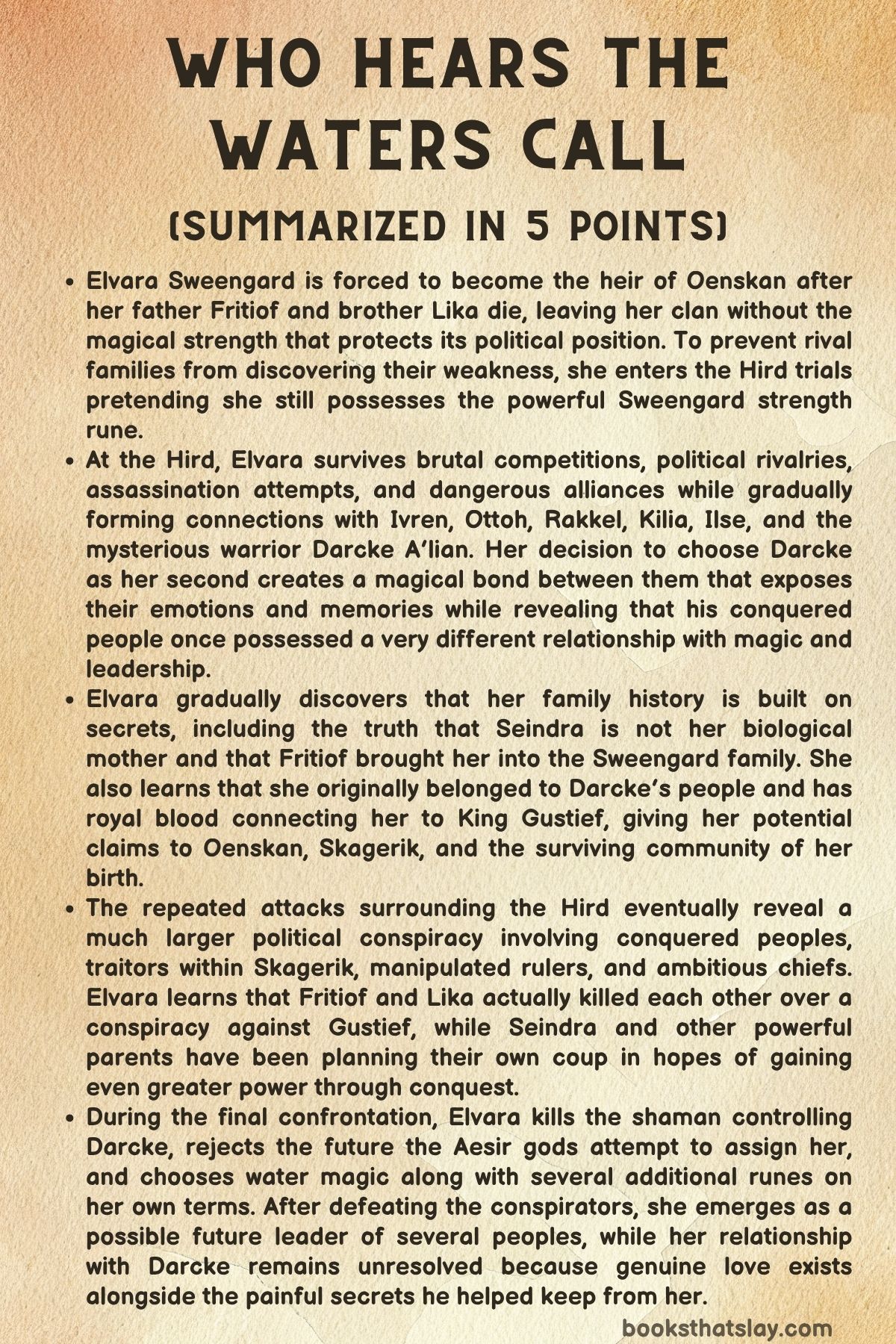
Elvara Sweengard’s life changes when she learns that her father, Chief Fritiof, and her elder brother Lika have been killed. Fritiof’s death also destroys the magical strength that protected the Sweengard clan, leaving their people vulnerable to rivals who could seize Oenskan, execute the ruling family, and enslave the population.
As the eldest surviving child, Elvara takes Lika’s place as heir and travels to the Hird, where the heirs of the great families will compete in brutal summer trials. She hides the deaths by claiming that Fritiof and Lika are conquering new lands for King Gustief, while her loyal guard Viljan accompanies her despite the danger.
From the moment she arrives, Elvara becomes a target. Her reputation rests on the extraordinary Sweengard strength rune, yet that power vanished with Fritiof, forcing her to survive through deception, intelligence, nerve, and carefully performed arrogance.
She meets the other heirs: Rakkel Rafenskol, Ottoh Briggen, Ivren Solsken, and Adrion Leskog. She also repeatedly clashes with Darcke A’lian, a dangerous royal warrior whose hostility toward her seems strangely personal, although his living bog-oak ship accepts Elvara with an ease that neither of them understands.
Elvara avoids public demonstrations that might expose her missing magic, but Ivren eventually helps her fake a combat display by pretending that her blows carry supernatural force. His willingness to protect her turns him into a valuable ally, although Darcke watches the performance closely enough that Elvara suspects he may already doubt the truth of her supposed strength.
The first major trial sends participants to the prison island of Svartoarna, where each competitor is physically tethered to a partner. Elvara is paired with Kilia Havskold, who hates the Sweengards because he believes Lika’s treatment of his sister ultimately caused her death.
Their relationship begins violently, but survival forces cooperation. Elvara saves Kilia from drowning, helps defend his twin Oscri, and later tries desperately to save Oscri when chained wolves drag him toward death during the trial.
Oscri dies despite their efforts, and Elvara and Kilia damage their tether while trying to rescue him. Darcke unexpectedly replaces the damaged rope and conceals the violation, allowing them to remain in the competition and further complicating Elvara’s understanding of him.
Outside threats soon become as dangerous as the trials themselves. Heirs and initiates are repeatedly attacked by outsiders who somehow gain access to supposedly secure areas, suggesting that someone within Skagerik is helping them.
Meanwhile, Elvara discovers troubling information about Darcke’s past. He came from a conquered nation whose people worshipped Njord and possessed water magic available to the wider community rather than restricted to ruling families; although Viking society considers him a traitor who helped destroy his homeland, his behavior suggests that the accepted version of events is incomplete.
When the heirs must choose their iron-bound companions, Elvara expects to make Viljan her second. Ivren unexpectedly chooses Viljan first, believing that separating Elvara from her guard will prevent her from sacrificing herself.
Forced to improvise, Elvara shocks everyone by choosing Darcke as her second. His foreign origins make the decision strategically useful because nobody expects him to inherit Sweengard strength, allowing Elvara to continue hiding her lack of magic. She chooses Kilia as her third and Ilse as her fourth.
The bond between Elvara and Darcke proves unlike anything either expected. During the bonding ceremony they enter a shared supernatural experience in which Elvara sees fragments of Darcke’s past, including the violent suppression of his water rune and the destruction of his people.
Njord himself appears and blesses their bond. Afterward, Elvara and Darcke can sense each other’s emotions, fears, desires, physical needs, and movements, creating an intimacy that makes both secrecy and emotional distance increasingly difficult.
Darcke gradually challenges Elvara’s assumptions about Skagerik. He explains that his homeland distributed magic among its people, selected leaders differently, and believed rulers could be removed when they endangered the community.
At the same time, evidence from Oenskan shows that the weapon used to kill Lika was probably made by Sweengard people rather than foreign enemies. Elvara is forced to consider that her family’s deaths may have resulted from internal betrayal rather than external attack.
The trial of wood brings further revelations. Elvara and Darcke enter Morkskog, survive magical manipulation by the forest, and grow increasingly dependent on one another.
Elvara also begins forming genuine friendships with Ottoh and Vero. Most importantly, memories crossing through her bond with Darcke reveal that the king’s shaman suppressed parts of Darcke’s mind and that Elvara herself may have a hidden connection to Darcke’s destroyed homeland.
Darcke finally tells Elvara that she was originally one of his people. This revelation becomes even more serious when Viljan admits that he has long known Elvara was not born into the Sweengard family as she believed.
Seindra confirms that Fritiof brought Elvara home and that she is not Seindra’s biological daughter. Despite the humiliation and betrayal, Elvara refuses to surrender her claim to Oenskan and begins defining leadership through responsibility rather than blood alone.
The next trial takes the heirs to the frozen battlefield of Gravsgard to recover ancestral swords. Inside a collapsing cave, Ottoh and Vero become trapped beneath stone, leaving Elvara with no choice but to reveal to Darcke that she has no strength rune.
Darcke calmly tells her that he already knew. Instead of condemning her, he agrees to help, and Elvara ultimately discovers an ancestral sword whose power allows her to break the obstruction and rescue her friends.
During the battle that follows, Elvara falls beneath the ice and hears countless voices carried through the water. She also sees a supernatural golden collar around Darcke’s neck and realizes that the king and shaman are controlling him through magic.
After Darcke rescues her, the fear of losing one another finally breaks down their remaining resistance. They kiss despite the strict prohibition against romantic relationships between heirs and their seconds.
By now, Elvara and several other heirs have begun openly questioning Gustief’s reign. Years of conquest have created enemies across Skagerik’s territories, and the younger generation increasingly believes that continued expansion will destroy the kingdom rather than strengthen it.
Ivren proposes removing Gustief when they enter the Great Halls, where ordinary rune magic is expected to disappear. Elvara supports the plan partly because she hopes the same conditions might also weaken the control imprisoning Darcke.
Before they can act, the heirs face another coordinated attack. Elvara encounters a young foreign woman whose sister had been forced into service at the Hird and realizes that many supposed enemies are people whose families have suffered under Skagerik’s conquests.
Geord kills the woman before she can reveal more. Elvara is then badly wounded, while Ottoh is murdered by someone who turns out to be a karl from the Hird rather than a foreign attacker, confirming that betrayal exists within their own ranks.
The surviving heirs travel to the Great Halls believing they are preparing to oppose Gustief, only to discover that their parents have been organizing a separate coup. Seindra and the other conspirators do not want peace; they want even greater power and expansion.
The truth about Fritiof and Lika is finally exposed. Lika supported the conspiracy, Fritiof tried to stop him, and father and son killed one another during the confrontation, with Fritiof destroying his own strength rune to prevent Lika from inheriting its power.
Another revelation changes the political picture. Ivren’s mother had previously used influence magic against the shaman, damaging his mind and indirectly causing him to manipulate Gustief toward increasingly destructive conquest.
Rakkel admits that she was forced into spying for the conspirators because the shaman held her brother’s mind captive. Once violence erupts, the heirs choose one another over their parents, showing how thoroughly their loyalties have changed.
Elvara reaches the shaman and kills him, immediately freeing Darcke from magical control. When she then tries to kill Gustief, Darcke stops her voluntarily, proving that his defense of the king is no longer compelled.
Elvara soon discovers another concealed part of her identity: Gustief is her half uncle through Fritiof’s hidden royal blood, placing Elvara in the succession to Skagerik’s throne. Gustief, Darcke, and Fritiof had all understood that Elvara’s mixed heritage might eventually allow her to connect Skagerik with survivors of Darcke’s homeland.
Elvara feels betrayed by Darcke’s participation in the secrecy, and the destruction of the shaman also ends their magical emotional bond. During the final conflict, Ivren is badly wounded, Gustief falls, and Darcke forces Elvara through the gates of the Great Halls so that the gods can judge her.
The Aesir show Elvara a future in which she accepts the traditional strength rune, becomes a successful but isolated ruler, and ultimately executes Darcke. She rejects that destiny and refuses to let inherited authority dictate her future.
Njord then appears and offers another path. Elvara carves the water rune into herself and takes five additional runes, creating a form of power that does not fit the limitations previously imposed upon her.
Returning to the battle, she uses water magic against the conspirators while Darcke regains his own rune. Seindra is killed, the coup collapses, and the survivors begin rebuilding a political system shattered by betrayal.
Elvara ends the story carrying several possible futures. She remains Fritiof’s successor in Oenskan, stands in line for Skagerik’s throne, and may become an important leader for the surviving people of Darcke’s homeland.
Her relationship with Darcke remains unresolved because she cannot easily forgive the lies he kept from her, even though her feelings for him remain powerful. The conclusion leaves Elvara preparing for academy training and for the much larger responsibility of deciding what kind of world should replace the one she has helped break apart.
Characters
Elvara Sweengard
Elvara is the central character of Who Hears the Waters’ Call, and nearly every major conflict develops from the pressure placed upon her after Fritiof and Lika die. She begins as a young woman forced to perform strength she no longer possesses, making deception necessary not for personal advancement but for the survival of Oenskan.
Her defining quality is adaptability. When physical superiority is unavailable, she uses nerve, improvisation, observation, strategic arrogance, and an increasingly sophisticated understanding of other people’s motives.
Elvara’s relationship with honor changes considerably. Early in the book she is uncomfortable with lying and manipulation, but she gradually recognizes that rigid ideas about honor can become dangerous when they protect unjust systems or encourage meaningless death.
Her development eventually becomes political as well as personal. Discovering that she is not Seindra’s biological daughter, that her ancestry connects her to both Skagerik and Darcke’s people, and that the traditions surrounding her have been built on concealed violence forces her to decide whether identity comes from blood, upbringing, obligation, or choice.
By the end, Elvara rejects both the role others designed for her and the future offered by the Aesir. Her decision to claim water magic and additional runes reflects her determination to construct authority on her own terms rather than merely inherit it.
Darcke A’lian
Darcke is Elvara’s most important counterpart in Who Hears the Waters’ Call, functioning simultaneously as antagonist, protector, teacher, political challenge, romantic interest, and living evidence of the damage caused by Skagerik’s conquests. His early hostility appears personal because he believes Elvara knows more about her connection to his destroyed homeland than she actually does.
His harshness is rooted in trauma and captivity rather than simple cruelty. He has lost his community, had his water rune severed, witnessed his homeland burn, and lived under magical control that limits both his choices and what he can reveal.
Darcke repeatedly challenges Elvara’s assumptions about government and power. His people shared magic broadly, selected leaders through collective structures, and believed rulers could be removed if they endangered those they governed, ideas that undermine Elvara’s inherited belief in permanent elite authority.
His relationship with Elvara changes because neither can maintain the original roles of enemy and target. Their bond exposes emotions that words can hide, and Darcke repeatedly protects her when she is physically, magically, or emotionally vulnerable without exploiting that dependence.
Darcke nevertheless participates in the larger deception surrounding Elvara’s ancestry and political importance. His decision creates the deepest fracture between them because his genuine feelings do not erase the fact that he helped other people decide what truths she was permitted to know.
Viljan
Viljan represents continuity between Elvara’s old life and the dangerous political world she enters. His first instinct is always protection, and his loyalty is strong enough that he follows her to the Hird despite knowing how easily the deception surrounding the Sweengards could collapse.
That loyalty can become possessive or violent. His reactions to Ivren and Fedic show that he sometimes allows protectiveness to override Elvara’s independence, forcing her to remind him that loyalty does not give him ownership of her decisions.
Viljan also carries secrets entrusted to him by Fritiof. His later admission that he knew Elvara’s origins were not what she believed complicates their relationship because even one of the people she trusted most participated in controlling her access to the truth.
His eventual bond with Ivren removes him from the role Elvara had planned for him and forces both characters to develop independently. Viljan remains important precisely because his devotion is real even when his decisions do not always match what Elvara wants.
Ivren Solsken
Ivren emerges as one of Elvara’s earliest and most dependable allies. His previous friendship with Lika gives him reasons to investigate the sudden change in the Sweengard succession, yet when he recognizes that Elvara is hiding something, he chooses protection rather than exposure.
His influence rune makes him politically powerful, but his most important strength is his ability to think beyond immediate rivalry. Ivren increasingly recognizes that the attacks against the heirs, uprisings in conquered territories, and failures of Gustief’s rule are connected.
His decision to choose Viljan as his second is one of his greatest mistakes in Elvara’s eyes. Ivren believes he is protecting her from self-sacrifice, but his actions demonstrate the danger of making choices for another person merely because the intention is benevolent.
By the later stages of the story, Ivren becomes a major advocate for political change. His willingness to consider removing Gustief shows how far he has moved from simply competing within the existing structure toward questioning whether that structure should continue at all.
Ottoh Briggen
Ottoh begins as an irritating rival who embarrasses Elvara and repeatedly probes the weaknesses in her story. His gift for precision matches his personality: he watches closely, notices inconsistencies, and understands that every interaction at the Hird carries strategic value.
His development gradually transforms competition into genuine loyalty. Shared danger during the trials allows him to see beyond Elvara’s performance, while Seindra’s treatment of her helps convince him that she deserves support rather than ridicule.
Ottoh’s friendship becomes particularly important during Morkskog and Gravsgard, where cooperation replaces the suspicion that defined their first meetings. Elvara ultimately risks exposing her lack of magic because Ottoh and Vero are suffocating behind fallen stone, showing how much their relationship has changed.
His murder is therefore one of the most damaging losses late in the story. Ottoh dies just as the younger heirs are beginning to form a coalition capable of imagining a different political future, and his death makes the internal betrayal at the Hird impossible to ignore.
Vero Briggen
Vero initially enters the story through Ottoh but becomes an important figure in her own right. She is confident, capable, and able to use humor around Elvara without reproducing the cruelty of many other competitors.
Her bond with Ottoh is one of her defining relationships. The trials repeatedly test their dependence upon one another, particularly when magical forces separate them and force each sibling to function without immediate access to the other.
Vero’s vision of herself as a future chief foreshadows the responsibility later placed upon her. After Ottoh’s death, Gustief treats her succession almost mechanically, but the personal cost is enormous because she inherits a political role at the exact moment she loses the person most closely connected to it.
By the conclusion, Vero occupies Ottoh’s position among the heirs. Her future represents both continuity and the possibility that the new generation can govern differently from those who preceded them.
Rakkel Rafenskol
Rakkel is introduced as a formidable competitor whose concealment magic makes her dangerous in combat. Unlike several openly hostile figures, however, she often approaches Elvara with warnings rather than threats, creating an uneasy relationship built on mutual evaluation.
Her growing instability becomes more understandable once the truth about her family is revealed. Rakkel lives under immense pressure because her brother’s mind is being held captive, allowing others to manipulate her loyalty.
Her role as a spy for the conspirators makes her morally complicated rather than simply treacherous. She acts against the other heirs, but her actions occur under coercion, showing how political systems can turn family love into a weapon.
When the full conspiracy is exposed, Rakkel ultimately closes ranks with the younger heirs instead of remaining aligned with their parents. Her character demonstrates the difference between betrayal motivated by ambition and betrayal produced by fear for someone vulnerable.
Kilia Havskold
Kilia enters Elvara’s life through hatred. He believes Lika’s conduct led to his sister’s death, and his anger toward the Sweengards becomes even stronger after the trial on Svartoarna claims the life of his twin, Oscri.
His relationship with Elvara changes through shared danger rather than conversation. She saves him from drowning and tries to save Oscri, making it increasingly difficult for Kilia to reduce her to the family name he despises.
Kilia later discovers that Elvara has no strength rune and uses that knowledge as leverage. Yet his eventual decision not to expose her marks an important moral shift because he recognizes that destroying Elvara would also place innocent people in Oenskan at risk.
His place in her iron-bound eventually becomes genuine rather than purely strategic. Respect does not erase his anger or grief, but he learns to judge Elvara according to her own choices instead of permanently treating her as Lika’s representative.
Ilse
Ilse becomes Elvara’s fourth and brings a quieter form of competence to the iron-bound. Her knowledge of espionage and political suspicion makes her especially useful once the attacks against the heirs begin revealing signs of internal assistance.
Unlike characters whose loyalty becomes unquestioning, Ilse continues asking uncomfortable questions. Her willingness to suggest that Darcke himself might be connected to the attacks shows that she prioritizes Elvara’s security over emotional convenience.
She also provides physical support during dangerous moments, including rescuing Elvara after the cliff jump. Her role demonstrates that reliable allies do not simply agree; they also challenge assumptions when evidence requires it.
Seindra
Seindra is one of the harshest personal influences on Elvara. Rather than providing affection or reassurance after Fritiof and Lika die, she consistently treats Elvara as inadequate and later reveals that she never considered her a biological daughter.
Her cruelty is eventually connected to political ambition. Seindra has participated in a long-running conspiracy designed to overthrow Gustief, not to end conquest but to expand the ruling families’ power.
The truth about Fritiof and Lika also reveals how much Seindra allowed political ideology to shape family relationships. Lika became part of the conspiracy, while Fritiof ultimately died attempting to stop him.
Seindra therefore represents an older generation willing to sacrifice children, spouses, loyalty, and stability for inherited ideas of power. Her final opposition to Elvara makes their conflict both political and deeply personal.
Fritiof Sweengard
Fritiof is dead before most of the novel’s central events unfold, but his decisions influence almost everything Elvara encounters. Initially he appears to have been murdered by an enemy, and Elvara’s entire deception begins because his death destroys the clan’s strength.
Later revelations complicate his legacy considerably. Fritiof had concealed Elvara’s ancestry, knew something of her connection to both Skagerik’s royal line and Darcke’s people, and arranged for Viljan to protect her.
His final confrontation with Lika reveals a man willing to oppose his own son when he believes the son has joined a dangerous conspiracy. Destroying his own rune before dying prevents Lika from gaining the inherited strength, making Fritiof’s death an act intended to limit the conspirators’ power.
Fritiof therefore combines genuine protection with damaging secrecy. He helped preserve Elvara’s life, but his refusal to tell her the truth leaves her vulnerable to revelations that later destabilize her identity.
Lika Sweengard
Lika initially exists in Elvara’s memory as the elder brother whose position she is forced to inherit. Because he was prepared for leadership while Elvara was not, his death creates both the political crisis and Elvara’s feeling that she is occupying a role never intended for her.
Accounts of Lika gradually become less flattering. Kilia accuses him of abandoning his sister after she believed he would marry her, suggesting that Lika’s private conduct may have caused serious harm.
The final revelation shows that he was also involved in the conspiracy against Gustief. His confrontation with Fritiof ends with father and son killing one another, replacing the original assumption of foreign murder with a family tragedy produced by political division.
Lika’s legacy functions as a warning for Elvara. Inheriting a powerful position does not automatically produce moral leadership, and loyalty to family can become dangerous when it prevents honest judgment.
King Gustief
Gustief initially appears as the embodiment of Skagerik’s violent political order. His reign is associated with repeated conquest, harsh trials, a rigid hierarchy of magical families, and an expectation that young leaders prove themselves through suffering.
The later discovery that the shaman has been influenced by Ivren’s mother complicates responsibility for the worst years of expansion. Gustief had apparently sensed that something was wrong without completely freeing himself from manipulation.
That revelation does not completely absolve him. A king remains responsible for the political system he governs, and the suffering experienced by Darcke’s people and numerous conquered communities occurred under Gustief’s authority.
His connection to Elvara further complicates his position. Learning that he is her half uncle places the conflict between them inside the same hidden family history that has shaped much of the story.
Guner Krigstad
Guner is Gustief’s feared second and represents the institutional brutality of the Hird. His authority allows him to mock, intimidate, threaten, and physically punish people who cannot easily retaliate.
He is particularly dangerous to Elvara because he threatens to investigate Oenskan, where even limited scrutiny could expose the deaths of Fritiof and Lika. His announcement that several candidates from her island have already died increases her sense that her political support is being systematically reduced.
Guner’s importance lies less in personal development than in what he represents. He shows how violence becomes normalized when institutions reward obedience and treat fear as an acceptable method of leadership.
Geord Palsjo
Geord consistently represents the ugliest side of competition within the Hird. He seeks opportunities to exploit Elvara’s weakness, becomes increasingly powerful after Adrion’s death, and repeatedly treats other people as obstacles or tools.
His most disturbing actions involve attempts to manipulate Elvara’s vulnerability. He is involved in pursuing her after she is drugged and later contaminates wine with an aphrodisiac in hopes that she and Darcke will violate the rules governing their bond.
Geord also kills the foreign woman Elvara is attempting to communicate with, destroying a potential opportunity to learn more about the attackers. His behavior repeatedly favors immediate dominance over truth, cooperation, or honor.
Oscri Havskold
Oscri is introduced as an exceptionally dangerous fighter, capable of killing an opponent with his bare hands. His physical power makes him an obvious symbol of the brutal expectations placed upon candidates at the Hird.
His death on Svartoarna changes that image. Trapped by the rules of the tether and dragged toward wolves because of his injured partner, Oscri ultimately accepts that he cannot be saved.
The loss has lasting consequences for Kilia and Elvara. Elvara’s attempt to rescue him helps Kilia recognize that she is not indifferent to his family, while Oscri’s death exposes how the Hird’s trials can transform arbitrary rules into fatal judgments.
Fedic
Fedic stands out among the initiates because he combines physical ability with intelligence and skill in negotiation. He approaches Elvara without the immediate hostility shown by many others, making him a plausible ally from their first interaction.
His value increases because the political environment requires more than combat skill. Characters capable of negotiation become increasingly important as the younger heirs realize that future stability will depend on cooperation across old rivalries.
Fedic later joins Rakkel’s iron-bound after one of her companions is killed. His inclusion places him closer to the political core of the story and reinforces the importance of adaptable people in the leadership structure that may eventually replace Gustief’s system.
Torden
Torden is one of Darcke’s trusted companions and belongs to the smaller circle able to understand some of the pressures surrounding him. He provides information to Elvara about the growing belief that someone inside the Hird is helping the attackers.
During the final confrontation, Torden helps defend Darcke while magical control prevents Darcke from acting for himself. That loyalty becomes especially significant because it is directed toward Darcke as a person rather than toward the institutions that have controlled him.
By the conclusion, Torden is among the warriors trusted with temporary leadership while the younger heirs continue their training. His appointment suggests that competence and loyalty may begin mattering more than simple inheritance.
Borje
Borje is another of Darcke’s closest warriors. The tattoo associated with betrayal where his missing eye once was immediately indicates that his history, like Darcke’s, contains experiences that Viking society has reduced to simple labels.
He becomes important during the confrontation in the Great Halls when his attack helps ignite the battle between the younger heirs and the older conspirators. His actions show that Darcke is not the only person carrying complicated loyalties beneath an apparently straightforward role.
Borje later joins Torden among the interim leaders. His survival and promotion suggest that people once defined by suspicion or outsider status may become important contributors to the political reconstruction that follows.
Adrion Leskog
Adrion is initially one of the five heirs and represents the defense rune. Compared with the other heirs, the provided material gives him relatively little personal development before his death.
His importance is mainly political. Once Adrion dies, Geord moves closer to replacing him, altering the balance among the heirs and giving a dangerous rival greater legitimacy and access to power.
Adrion’s limited presence also reinforces the constant instability of the Hird. Positions that appear permanent can change suddenly because the system treats death as an expected part of political advancement.
Marion
Marion is a high-ranking servant whose early interactions with Elvara emphasize the importance of appearance and ceremonial expectations at the Hird. She is horrified by Elvara’s dirty clothing and immediately tries to make her presentable before the king.
Although her role is small, Marion helps establish the social pressure surrounding Elvara. Survival at the Hird requires more than physical ability because clothing, manners, reputation, and ceremonial behavior can all influence how an heir is judged.
Stefen
Stefen receives limited development in the material, but his actions during the aftermath of Svartoarna establish him as someone willing to protect injured companions. He carries a badly wounded Rakkel toward safety after the attacks surrounding the trial.
His brief role contributes to the contrast between cooperative participants and those who treat the Hird solely as an opportunity for advancement. Even within a violent system, individuals can choose responsibility toward one another.
Themes
Power, Leadership, and the Right to Rule
Authority throughout Who Hears the Waters’ Call is repeatedly separated from genuine fitness to lead. Skagerik organizes power through inheritance, magical bloodlines, royal authority, and traditions that present violence as proof of worth, yet the people occupying those positions frequently reveal how unreliable inherited legitimacy can be.
Elvara begins by accepting this system because she believes protecting Oenskan requires maintaining the appearance of Sweengard strength. Her experiences gradually force her to distinguish responsibility from entitlement.
Darcke’s homeland provides an alternative model. Magic belonged to the broader population, leaders were chosen differently, and rulers could be removed when they harmed their communities, making political authority something conditional rather than sacred.
The younger heirs eventually reach a similar conclusion through their own suffering. Ivren, Elvara, and others begin questioning whether Gustief should remain king once they understand how endless conquest has destabilized the kingdom.
The older conspirators provide the opposite lesson. Seindra and her allies also want to remove Gustief, but their objective is greater conquest rather than reform, proving that rebellion is not automatically moral merely because it opposes an existing ruler.
Elvara’s final rejection of the future chosen by the Aesir completes this argument. Leadership becomes meaningful only when the person holding power can question the system that granted it and choose responsibility over inherited privilege.
Identity, Blood, and Chosen Belonging
Elvara’s identity initially seems straightforward because she understands herself as Fritiof and Seindra’s daughter, Lika’s sister, and a Sweengard heir. Almost every part of that identity is later complicated by secrets that other people decided she was not ready to know.
The revelation that Seindra is not her biological mother destabilizes Elvara’s understanding of family. Learning that Gustief is her half uncle and that she also belongs to the people of Darcke’s destroyed homeland makes her identity politically important to multiple communities.
Yet the story consistently refuses to suggest that blood alone determines belonging. Fritiof raised Elvara, Oenskan depends upon her, Darcke recognizes a connection to his people, and the younger heirs gradually become a chosen community created through trust rather than ancestry.
Kilia’s development strengthens this idea. He begins by judging Elvara according to Lika’s actions and the Sweengard name but eventually learns to evaluate her as an individual.
Elvara’s final position therefore contains several identities without requiring one to erase the others. She can remain connected to Oenskan while acknowledging her origins, claim a place in Skagerik while criticizing its political traditions, and potentially represent Darcke’s surviving people without pretending she fully understands their experiences.
Belonging becomes something created through responsibility, memory, choice, and mutual recognition rather than simply inherited through blood.
Truth, Secrecy, and the Cost of Protection
Nearly every important relationship is damaged by someone deciding that secrecy is justified because the truth would be dangerous. Elvara herself begins the novel with a massive deception, hiding Fritiof and Lika’s deaths because revealing them could lead to the destruction of Oenskan.
Her lie is therefore understandable, but the story gradually exposes how easily protective secrecy can become control. Fritiof hides Elvara’s ancestry, Viljan knows more than he admits, Darcke understands parts of her history without explaining them, and Gustief participates in a larger plan that treats Elvara’s life as something to be managed.
Even Ivren’s decision to take Viljan as his second follows this pattern. He believes he is saving Elvara from herself, yet he denies her agency in the process.
Darcke’s deception becomes especially damaging because genuine love develops alongside concealed information. Elvara can accept that he was constrained by magic in some situations, but she cannot immediately forgive every secret simply because his motives included keeping her alive.
The story therefore treats truth as inseparable from autonomy. Protecting someone physically while denying that person information about their own identity can still become a form of control.
Elvara’s development increasingly depends on reclaiming the right to know, judge, and choose for herself, even when the truth is painful.
Conquest, Violence, and Breaking Cycles of Revenge
Skagerik has transformed warfare into culture. Trials celebrate survival, chiefs build authority through magical power, death in battle is romanticized, and Gustief’s campaigns have turned expansion into an almost permanent condition.
The consequences appear gradually through the foreign attackers. At first they seem like faceless enemies threatening the Hird, but Elvara eventually encounters people whose families have been conquered, killed, displaced, or forced into service.
Her meeting with the sister of the captive servant is especially important because it destroys the comforting distinction between innocent Vikings and irrational foreign enemies. The attackers are not simply invading Skagerik; many are responding to violence Skagerik inflicted first.
Darcke embodies the same cycle on a much larger scale. His homeland was destroyed, his magic was taken, and he has every reason to hate the society that conquered his people, yet he repeatedly refuses to reduce every Viking to a target for revenge.
The generational conflict creates another version of this problem. Seindra and the older conspirators believe greater conquest will solve political weakness, while Elvara, Ivren, and their allies increasingly understand that further violence will simply create more enemies.
Elvara’s rejection of a destiny built on inherited strength therefore carries political meaning. The future cannot improve if every generation treats domination, retaliation, and sacrifice as unavoidable traditions; meaningful change requires leaders willing to interrupt the cycle rather than inherit it.