Wild Goose Chase Summary, Characters and Themes
Wild Goose Chase by Sarah Adler is a contemporary romantic comedy built around an absurd but surprisingly useful mystery: a potentially illegal taxidermy goose that keeps changing hands across Baltimore.
Beneath that comic premise is a story about two people trying to understand what love looks like when it is chosen freely rather than shaped by habit, fear, duty, or performance. Cal Leitner is attached to preservation, routine, and the people he has already lost, while Annie O’Neill is determined to stop changing herself for others. Their chaotic search for the goose gradually becomes a test of trust, independence, change, and emotional honesty.
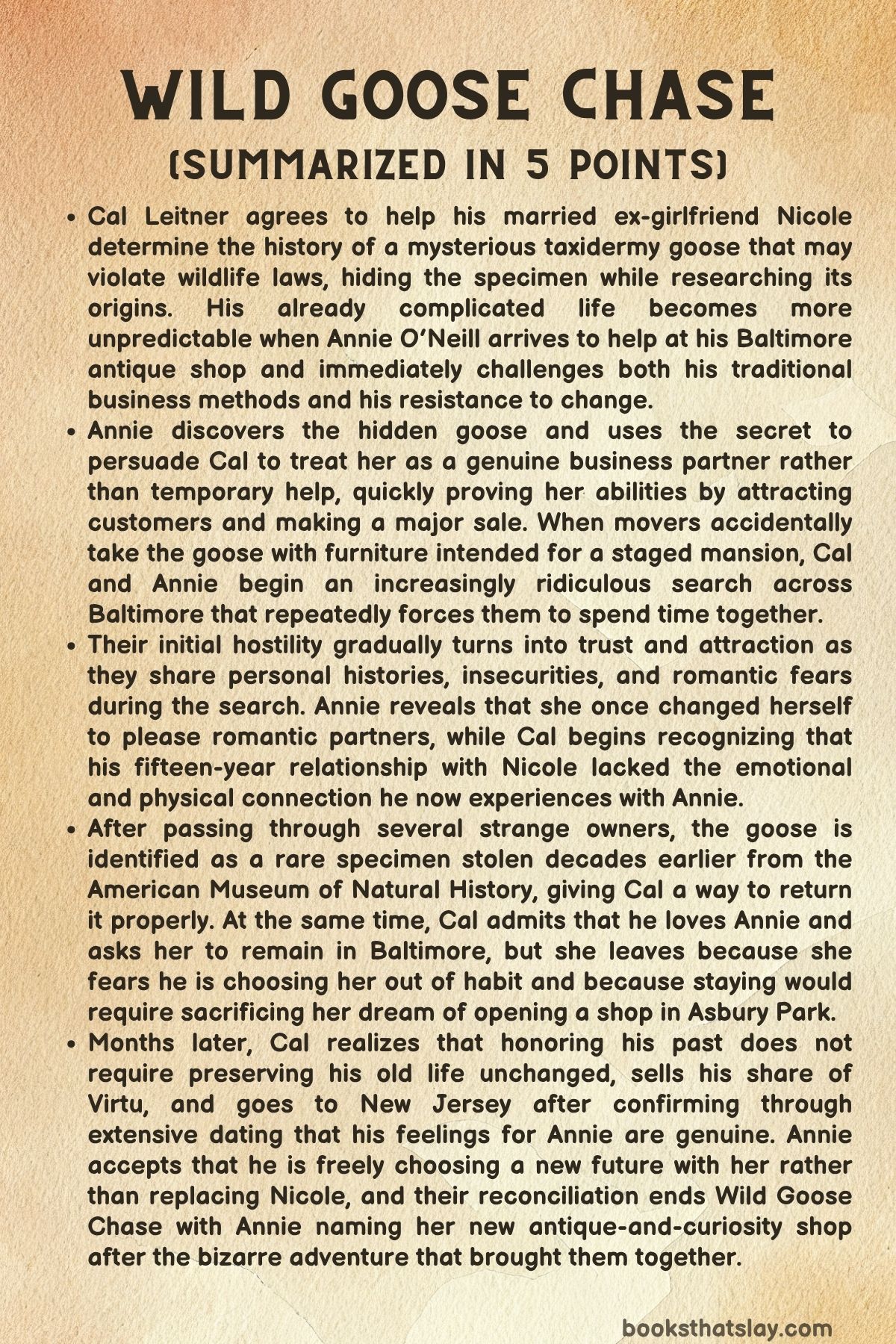
Summary
Callahan “Cal” Leitner’s unusual problem begins when his ex-girlfriend Nicole calls him late at night, even though their fifteen-year relationship ended seventeen months earlier and she has since married someone else. Nicole has inherited the house of her great-aunt Vera and discovered a large pale taxidermy goose in the attic, and Cal immediately recognizes that possessing a protected migratory bird without documentation could create serious legal trouble.
Nicole wants the bird donated to a museum if its history can be established, and Cal agrees to investigate because helping her remains almost automatic after so many years together. He transports the goose to his home above Virtu Antiques and Collectibles, the Baltimore shop he co-owns, even though he already knows that merely appearing to traffic in illegal wildlife could damage the business.
His situation becomes harder when his business partner Harold suddenly announces that he is marrying their bookkeeper and operations manager, Inés, in Italy and leaving for a month. Harold arranges for his niece Annie O’Neill to help Cal during the busy holiday period, bringing into Cal’s ordered world a woman whose personality, business philosophy, and energy oppose nearly everything he thinks he prefers.
Annie has experience selling vintage objects and her own repurposed creations online, and she hopes eventually to open a physical store in Asbury Park. She arrives determined to behave as her genuine self after years of romantic relationships in which she constantly altered her personality to become whatever she believed men would want.
Cal immediately frustrates her. He treats her upcycling work as less serious than traditional antiques, assigns her menial cleaning and photography duties, and prevents her from handling customers because he assumes his formal education and professional training make him better qualified.
Their disagreements are intensified by Annie’s belief that Virtu needs to change. She proposes a more inviting window display made from broken porcelain and argues that the shop’s traditional presentation discourages younger and less affluent customers, while Cal hears criticism of Virtu as criticism of Graham, his deceased mentor and father figure.
The relationship begins shifting after Annie breaks a pitcher and badly cuts her palm. Cal takes her upstairs, carefully removes the glass, treats the injury, tells stories about Graham to reduce her guilt, and sincerely apologizes for his dismissive behavior, allowing Annie to see the patient and protective man beneath his rigid exterior.
While alone in Cal’s apartment, Annie discovers the hidden goose. Knowing enough about antique law to understand the danger, she uses the discovery as leverage and jokingly blackmails Cal into letting her handle customers and make changes at Virtu, although the arrangement soon becomes genuine cooperation rather than hostility.
Cal installs Annie’s redesigned window display and finally allows her to operate independently. She proves herself almost immediately by attracting new customers and making a sale worth roughly forty thousand dollars, but the successful day produces a new disaster when movers accidentally collect the hidden goose along with furniture being sent to a mansion for staging.
Cal and Annie travel together to recover the bird and become trapped overnight in the mansion after its security system is activated. Forced to remain in one bedroom, they share food, childhood memories, insecurities, and a revealing game of Truth or Dare in which Cal explains his history with Nicole and Annie describes how years of reshaping herself for older partners taught her to hide behind manufactured versions of herself.
The night changes their relationship because both begin recognizing that their attraction rests on emotional intimacy rather than simple physical interest. The goose, meanwhile, has remained on the moving truck and is taken by Nevin, who uses it as a prank on Gustav, only for a purple-haired woman to remove it from Gustav’s porch before Cal and Annie arrive.
During this part of the search, Annie confesses that she had already been attracted to Cal after seeing him on Antiques Roadshow before coming to Baltimore. Back at Virtu, she asks directly to kiss him, and their long-building attraction becomes physical, giving Cal an experience very different from his emotionally empty attempt to date Mindy after Nicole left.
Annie is exhilarated but frightened because being with Cal as her real self means rejection would hurt more than it did in relationships where she was performing a role. She therefore tells him their encounter must remain a one-time event, while Cal hides his disappointment because he has already begun imagining that their connection could become something lasting.
Their goose search repeatedly undermines that attempt at distance. The purple-haired woman, Lylah, explains that she took the bird hoping to impress her crush Shannon, then gave it to her roommate El, who passed it to photography student Roland Eady after members of her burlesque troupe objected to using a dead animal in a show.
Roland refuses to reveal where the goose went until Cal and Annie help with a photography assignment. During the strange shoot, he directs them to pose together and eventually kiss, making it obvious that neither has successfully reduced the relationship to friendship.
Annie then proposes that they continue sleeping together while treating the relationship as temporary practice. She claims Cal can gain romantic experience and she can learn how to remain herself with a partner, but both quickly recognize that their arrangement already contains emotional attachment that cannot be explained as practice.
For Cal, intimacy with Annie finally clarifies why his relationship with Nicole had always lacked something he could never identify. His feelings for Annie combine friendship, desire, curiosity, trust, and emotional excitement, and the experience even prompts him to apologize properly to Mindy for the insensitive way he handled their failed date.
Their contrasting philosophies about antiques also begin influencing Cal’s view of life. When Annie finds an old painted Baltimore window screen and wants to incorporate it into a transformed piece of furniture, Cal initially argues for conventional restoration but eventually understands Annie’s belief that preserving history does not always mean returning something to its original state.
Francis, Graham’s longtime partner, reinforces that lesson when Cal admits how strongly he feels about Annie. Through an analogy about unsuccessfully recreating his late mother’s ginger cookies, Francis encourages Cal to stop judging new love against an idealized model of the past and instead value it for what it actually is.
The goose mystery finally advances when Roland’s cousin Beau examines the bird. Beau identifies it as a rare leucistic goose that once belonged to the American Museum of Natural History and disappeared decades ago, which means Cal has not merely been carrying potentially illegal taxidermy but unknowingly transporting stolen museum property.
Beau’s conversation also exposes a problem between Annie and Cal when Annie casually mentions the antique-and-curiosity shop she intends to open in Asbury Park. Cal had not understood how concrete her plans were, and suddenly the end of Annie’s temporary stay in Baltimore becomes impossible for him to ignore.
After arranging to return the goose to New York, Cal tells Annie that she has transformed his understanding of romantic connection and asks her to remain in Baltimore. Annie loves him but worries that staying could mean abandoning the independent future she has worked toward, particularly because Cal’s history suggests that he has difficulty letting go of relationships and structures once they become familiar.
Driving toward New York with the goose, Cal finally sees the similarity between his approach to antiques and his approach to grief. After Nicole left and Graham died, he tried to restore his life to its previous condition rather than accept that change might create something valuable that was different from the past.
His insight is interrupted when a police officer stops him for speeding and notices the goose. Cal’s increasingly complicated explanation makes him sound like someone admitting to transporting stolen protected wildlife, and he is detained while the authorities investigate whether his story is true.
At the same time, Nicole visits Virtu and Annie discovers that the unnamed friend for whom Cal has been risking so much was his former partner. Nicole makes it clear that she is happily married and wants Cal to be happy, but Annie is unsettled by Cal’s decision to conceal Nicole’s involvement and begins wondering whether his declaration of love reflects true choice or his tendency to hold tightly to whatever becomes part of his life.
Officials eventually confirm Cal’s story, take custody of the goose, and release him without charges. When he returns to Baltimore, however, Annie has already gone back to New Jersey, leaving a letter explaining that she is falling in love with him but cannot trust a future in which she may simply become another person he refuses to release because change frightens him.
Cal is devastated, and his grief over Annie reawakens his grief for Graham. On Thanksgiving he discovers a book containing a message Graham intended to give him before his death, and the note reveals that Graham never wanted Cal to preserve Virtu unchanged as a monument to him; Cal himself had been one of Graham’s greatest sources of purpose.
That message allows Cal to understand that honoring the people and places he loves does not mean refusing to move forward. Rather than asking Annie to alter her dream to fit his existing life, he realizes that he must decide what future he wants and be willing to change his own circumstances to pursue it.
Five months later, Annie is preparing to open her antique-and-curiosity shop in New Jersey while helping Bridget adjust to life with her newborn daughter. She still loves Cal but believes leaving Baltimore protected the future she had spent years learning to claim for herself.
Cal suddenly appears in Annie’s unfinished store with several revelations. Further research has established that ornithologist Dr. Ora Belmont Worthy originally discovered the rare goose but had her achievement stolen by Guy Ledford, and museum records have now been corrected so that Worthy receives proper credit.
Cal also tells Annie that he went on fifty-two dates in four months to test her fear that he loved her merely because he lacked experience with other people. Rather than changing his feelings, the dates confirmed that his attachment to Annie is specific, intentional, and unrelated to habit.
Most importantly, Cal has stopped asking Annie to enter the empty spaces of his existing life. He is selling his share of Virtu to Inés, leaving Baltimore, and choosing to join Annie in Asbury Park so they can create something new without requiring her to surrender the dream that belongs to her.
Annie finally believes that Cal is choosing her rather than clinging to her. Their reconciliation closes the emotional journey while also completing the comic circle of the mystery when Annie reveals that she has named her new shop Wild Goose Chase, turning the ridiculous bird that repeatedly disrupted their lives into a symbol of the future they have decided to build together.
Characters
Callahan “Cal” Leitner
Cal is the central male character of Wild Goose Chase, and much of his development comes from recognizing that loyalty can become unhealthy when it turns into resistance to change. His professional identity, relationship history, grief, and sense of responsibility are all governed by the belief that valuable things should be protected by keeping them as close as possible to their earlier condition.
That philosophy explains his devotion to Virtu and his instinctive willingness to help Nicole long after their relationship ends. Graham gave Cal stability, knowledge, confidence, and a place where he belonged, so after Graham’s death Cal treats preserving the shop’s traditions almost as a moral obligation rather than a business decision.
His relationship with Nicole reflects the same pattern. They spent fifteen years together, and even after she marries Isaiah, Cal automatically responds to her problems because rescuing her has become part of his identity.
Annie unsettles this entire system because she cannot be understood through his existing categories. Her approach to antiques challenges his ideas about preservation, her business instincts challenge his assumptions about professionalism, and his attraction to her forces him to admit that his long relationship with Nicole lacked a kind of emotional and physical compatibility he did not previously know how to name.
Cal’s growth is gradual rather than immediate. He first learns to trust Annie professionally, then becomes emotionally vulnerable with her, later accepts that transformation can create value, and finally understands that love cannot mean asking someone to occupy a predetermined space in his existing life.
His final decision to sell his share of Virtu and move toward Annie’s future is therefore important because it is not simply a romantic gesture. It proves that he has stopped treating change as damage and has learned that honoring Graham, Nicole, and his own past does not require remaining permanently attached to the life they once represented.
Annie O’Neill
Annie is the emotional and philosophical counterweight to Cal in Wild Goose Chase. Where Cal instinctively preserves, Annie transforms, and where he initially protects himself through routines and inherited expectations, she is trying to protect herself by refusing to become another version of what someone else wants.
Her confidence hides a complicated history of romantic insecurity. Annie spent years dating older men and changing her behavior, appearance, and personality to become desirable to them, which allowed her to believe that any rejection was directed toward a role rather than toward her actual self.
By the time she reaches Baltimore, she has worked deliberately to abandon that habit. Her exuberance, humor, unusual ideas, direct speech, creativity, and willingness to appear excessive are not accidental quirks; they represent an active choice to live without constantly editing herself for approval.
Her conflict with Cal therefore begins on two levels. She resents his professional condescension, but she is also sensitive to any suggestion that her unconventional methods or personality should be reduced in order to fit someone else’s standards.
Annie’s growing love for Cal becomes frightening precisely because he knows the person she normally would have hidden. Physical intimacy with him feels different because she is participating honestly rather than performing, which makes the possibility of rejection far more dangerous than it was in her earlier relationships.
Her decision to leave Baltimore is painful but essential to her development. She refuses to prove love by abandoning the business she dreams of building, and she also refuses to accept Cal’s certainty until he has demonstrated that his feelings come from active choice rather than his established habit of holding onto people and institutions.
When Cal finally comes to Asbury Park after changing his own life rather than asking her to change hers, Annie can accept his love without losing herself. Their reconciliation works because it no longer requires her to choose between intimacy and independence.
Nicole
Nicole is important because she represents Cal’s past without functioning as a conventional romantic rival. Her fifteen-year relationship with him was built on loyalty, companionship, familiarity, and shared history, but she eventually recognized that something essential was absent and had the courage to end a relationship that was comfortable but incomplete.
Her late-night request concerning the goose demonstrates that Cal and Nicole have not yet established healthy boundaries after the breakup. Nicole instinctively turns to him because she knows he will solve problems, while Cal responds because being useful to her remains embedded in his sense of responsibility.
Significantly, Nicole does not try to reclaim Cal. She is happily married to Isaiah, treats Annie with kindness, and appears genuinely pleased by the possibility that Cal has found a connection better suited to him.
Her role also forces Annie to confront Cal’s past directly. Annie’s insecurity is not caused by Nicole behaving badly but by the realization that Cal concealed Nicole’s involvement and by the intimidating weight of a fifteen-year relationship that appears to confirm his tendency to remain committed for very long periods.
Nicole ultimately helps Cal reinterpret their breakup. Once he experiences his relationship with Annie, he becomes grateful that Nicole refused to allow both of them to settle for a partnership that lacked the kind of connection each deserved.
Graham
Graham is dead before the main events begin, yet he remains one of the most influential figures in Cal’s life. He was Cal’s mentor, employer, father figure, and the person who helped transform an uncertain teenager into a skilled antique professional.
Cal initially misunderstands Graham’s legacy. Because Virtu represents the place where Graham gave him purpose and belonging, Cal assumes that honoring Graham requires maintaining the shop according to inherited methods and resisting changes that might make it feel less like the business Graham knew.
The message Cal discovers after Annie leaves corrects that belief. Graham reveals that mentoring Cal gave his own life renewed purpose and that his pride came from seeing Cal’s inherent worth rather than from successfully molding him into a particular kind of person.
This revelation releases Cal from a burden Graham never intended him to carry. Graham’s true legacy becomes not an unchanged antique store but Cal’s ability to build a meaningful life of his own.
Harold
Harold is Cal’s business partner, Annie’s uncle, and one of the characters who unknowingly creates the conditions for the central romance. His sudden decision to marry Inés in Italy leaves Cal overwhelmed during a busy period and brings Annie into Virtu as temporary help.
Unlike Cal, Harold appears relatively comfortable with disruption. His marriage, travel plans, trust in Annie, and eventual willingness to accept changes at Virtu contrast with Cal’s initial desire to keep everything stable.
Harold also knows Cal well enough to recognize almost immediately that his vague questions about wildlife law concern actual questionable merchandise. Although he warns Cal about the reputational risk, he remains loyal and practical rather than judgmental.
His return with Inés near Thanksgiving helps reinforce Cal’s final realization. Harold belongs to the circle of people who care more about Cal’s well-being than about preserving Virtu exactly as it once existed.
Inés
Inés begins as Virtu’s bookkeeper and operations manager before her relationship with Harold is revealed. Her importance grows quietly because she represents competence, continuity, and a possible future for Virtu that does not depend on Cal remaining permanently responsible for the business.
Her marriage to Harold initially creates a crisis for Cal because their absence leaves him without the operational structure he depends upon. By the end, however, Inés becomes part of the solution that allows him to leave Baltimore.
Cal’s decision to sell his share of Virtu to her shows that he finally trusts the business to survive without him. It also acknowledges that preserving something meaningful can sometimes require transferring responsibility to another capable person rather than remaining personally attached forever.
Francis
Francis is Graham’s longtime partner and one of Cal’s most important emotional supports. Their regular meetings after Graham’s death provide a space where both men can maintain their connection to someone they loved while slowly learning how to live beyond the loss.
Francis understands Cal’s emotional habits better than Cal understands them himself. His ginger-cookie analogy challenges Cal’s tendency to compare new experiences against idealized memories and encourages him to judge his relationship with Annie according to its own qualities rather than by how closely it resembles his past with Nicole.
He also becomes the person physically present when Cal finally breaks down after Annie leaves. Francis offers emotional safety without trying to solve the problem for him, making him a stabilizing figure whose love is patient rather than controlling.
Bridget
Bridget is Annie’s sister and one of the few people who understands the full extent of Annie’s history of changing herself for romantic partners. She therefore recognizes quickly that Annie’s relationship with Cal is different because he has encountered the genuine version of her from the beginning.
When Annie tries to classify her intimacy with Cal as a mistake that should never be repeated, Bridget identifies fear beneath the explanation. She points out that Annie is allowing the possibility of future rejection to determine present choices even though Cal already knows the personality she worries nobody will choose.
Bridget functions as an emotional reality check rather than someone who dictates Annie’s decisions. Her later motherhood also places Annie’s own romantic transition beside another form of life change, reinforcing the broader idea that meaningful futures often require moving beyond familiar versions of oneself.
Mindy
Mindy is the woman Cal briefly attempted to date after Nicole, and the failure of that encounter initially appears to confirm that he remains emotionally stuck. In reality, Cal later understands that he cannot manufacture physical desire without a meaningful emotional connection.
Mindy is also important because Cal treats her badly during and after their failed experience. His first attempts to explain himself are defensive, while his later apology accepts responsibility without trying to control how she should feel.
That apology demonstrates growth beyond his romance with Annie. Cal is becoming more capable of recognizing another person’s emotional reality rather than treating good intentions as sufficient justification for his behavior.
Isaiah
Isaiah is Nicole’s husband and appears only briefly, but his existence clarifies the status of Cal and Nicole’s relationship. Nicole has genuinely moved forward, and Isaiah’s willingness to help move the strange goose into Cal’s vehicle emphasizes how little romantic rivalry exists between the men.
He also highlights Cal’s emotional delay. Nicole has established a new life while Cal remains connected to old habits, making his later transformation more noticeable.
Genevieve Gladhill
Genevieve is the designer whose staging project accidentally carries the goose away from Virtu. She becomes part of the comic chain of errors that turns a simple provenance investigation into a citywide search.
Her role also creates the mansion episode that significantly changes Cal and Annie’s relationship. Because they become trapped after entering the staged property, the mistake indirectly gives them the uninterrupted time in which they begin sharing personal histories and recognizing their emotional compatibility.
Makayla
Makayla works for Genevieve and oversees the collection of staged objects from Virtu. She unknowingly helps remove the goose because Cal has placed it in the wrong area and Annie has no reason to know it should not be taken.
Her later emergency departure from the mansion leaves Cal and Annie trapped behind an activated security system. Although she does not deliberately cause their problems, her actions repeatedly advance both the goose chase and the romance.
Marvin
Marvin is the mover who confirms that the goose remained on his truck after the staging furniture was unloaded. He is embarrassed by the situation created by his brother and cooperates with Cal and Annie rather than attempting to hide what happened.
His willingness to explain Nevin’s prank gives the pair their next useful lead. He represents one of several ordinary people whose minor decisions keep extending a problem that should have been easy to solve.
Nevin
Nevin is Marvin’s younger brother and the person responsible for turning the misplaced goose into a deliberate joke. After finding the specimen on the truck, he decides that leaving a goose at Gustav’s home would be amusing because of Gustav’s name.
His drunken prank demonstrates the escalating absurdity of the bird’s journey. Nevin has no understanding of the legal or historical importance of the object, showing how easily valuable things can be reduced to curiosities when their stories are unknown.
Gustav
Gustav is the intended victim of Nevin’s goose prank and is characterized by strong suspicion of government authority and extensive home-security measures. His cameras become unexpectedly useful because they record the purple-haired woman removing the bird from his porch.
Although eccentric, Gustav is cooperative once Cal and Annie explain what they need. His surveillance footage changes their search from speculation into a pursuit with a recognizable suspect and vehicle.
Lylah
Lylah is the purple-haired waitress who takes the goose from Gustav’s porch because she assumes it has been discarded. She brings it to the Lucky Duck Diner hoping that the unusual object will impress Shannon, the owner she likes.
Her failed romantic gesture provides a comic parallel to the main relationship. Lylah attempts to create attraction through a bizarre gift, while Cal and Annie are learning that genuine connection cannot be manufactured through strategy.
Shannon
Shannon owns the Lucky Duck Diner and is the object of Lylah’s affection. Her refusal to be impressed by the stuffed goose ends Lylah’s plan and sends the specimen toward another temporary owner.
Her limited role supports the recurring idea that intention does not guarantee the reaction someone hopes to receive. Lylah may believe the goose will charm Shannon, but genuine attraction cannot be created merely by choosing what seems like the perfect gesture.
El
El is Lylah’s roommate and a burlesque performer who intends to use the goose during a Mother Goose-themed show. Her plan collapses when other performers object to incorporating a dead animal because of their vegan principles.
El then gives the goose to Roland, extending its strange route through Baltimore. Her role contributes to the comic structure while also placing Cal in another unfamiliar environment where he notices that his sexual attention remains focused specifically on Annie.
Roland Eady
Roland is a photography student who temporarily acquires the goose for an artistic project. Once his cousin Beau warns him that the bird might create legal problems, Roland quickly removes himself from responsibility for it.
He uses Cal and Annie’s need for information to recruit them into a photography assignment about aliveness. His decision to pose them together and ask them to kiss forces the pair to confront the attraction they have unsuccessfully tried to suppress.
Roland therefore becomes an accidental catalyst. His project does not create their desire, but it strips away the temporary rules they constructed to pretend that their earlier intimacy could remain isolated.
Beau
Beau is Roland’s cousin and a knowledgeable taxidermy enthusiast. His expertise finally gives Cal and Annie the historical information they have lacked throughout their search.
He recognizes the bird as a leucistic goose associated with the American Museum of Natural History and determines that it disappeared from the museum decades earlier. This changes the legal problem from uncertain wildlife possession into the transportation of stolen institutional property.
Beau also unintentionally causes the central romantic conflict to become unavoidable when Annie mentions her planned Asbury Park shop in his presence. Cal’s surprise reveals that the couple has allowed intimacy to develop without honestly discussing the incompatible futures they still assume they will follow.
Jeff
Jeff is the museum employee who responds after Cal and Annie report the missing specimen. His request that the goose be brought to New York gives Cal a clear opportunity to end the legal problem responsibly.
Although Jeff is a minor character, his involvement converts the goose from something Cal must privately investigate into an object whose institutional ownership has finally been verified. His confirmation later helps protect Cal when law enforcement questions why the bird is in his vehicle.
Trooper Dominic Vincenti
Trooper Vincenti stops Cal for speeding and initially intends to issue only a warning. Once he notices the taxidermy goose, however, his knowledge of wildlife law makes Cal’s extraordinary explanation impossible to dismiss casually.
Vincenti is not portrayed as malicious. His suspicion is reasonable because Cal admits that the bird belongs to a museum and was stolen decades earlier while simultaneously insisting that he is innocently transporting it.
The arrest fulfills Cal’s worst fear about the goose, but it also ends the secretive stage of the problem. Once authorities verify the museum’s claim, responsibility for the specimen passes to the proper institutions.
Dr. Ora Belmont Worthy
Ora Belmont Worthy appears through the historical research completed after the goose is recovered. She was an early Smithsonian ornithologist who actually discovered the unusual specimen but did not receive proper credit.
Her story gives the goose a deeper meaning beyond its comic role. Recovering the bird also allows historical records to be corrected so that the scientist responsible for the discovery is finally recognized.
Guy Ledford
Guy Ledford is the man who took credit for Ora Belmont Worthy’s discovery and killed the rare bird. His actions represent the distortion of history that can occur when an object survives but the truth surrounding it does not.
The correction of museum records reverses part of that injustice. The goose therefore becomes valuable not only as a specimen but as physical evidence through which an overlooked person’s achievement can finally be restored.
Themes
Change, Preservation, and the Meaning of Moving Forward
Cal’s work with antiques gives Wild Goose Chase a natural language for examining emotional change. He begins from the assumption that preservation means returning valuable objects as closely as possible to their original state, and he applies almost the same logic to Virtu, his memories of Graham, and his life after Nicole.
That belief gives him stability, but it also traps him. He treats any alteration to Virtu as a betrayal of Graham because he mistakes loyalty for maintaining the exact conditions that existed before loss occurred.
Annie challenges that philosophy through her creative work. Her instinct is to take damaged or forgotten materials and give them new functions, as shown by her plan for the old Baltimore painted screen.
She does not argue that history should be erased. Instead, she believes the past can remain visible while an object acquires a different future, and this becomes the model Cal eventually applies to himself.
The central transformation occurs when Cal recognizes that his life cannot be restored to what existed before Nicole left or Graham died. Those experiences remain part of him, but their value does not depend on his permanent attachment to the same relationship, business structure, apartment, or city.
By choosing a future with Annie that requires him to leave Virtu rather than preserve his previous life unchanged, Cal proves that moving forward can honor the past without being controlled by it.
Authenticity and the Fear of Being Fully Known
Annie’s emotional conflict centers on the difficulty of allowing someone to know her without first creating a more acceptable version of herself. Her earlier romantic experiences taught her to observe what partners wanted and then shape herself accordingly, giving her the illusion of protection because rejection could be blamed on a false persona.
Her effort to stop doing this makes her outwardly confident but internally more vulnerable. Every unusual joke, opinion, creative idea, and direct expression of desire carries greater emotional risk because she can no longer tell herself that people are responding to a character she invented.
Cal becomes uniquely important because their relationship begins with conflict rather than performance. Annie does not successfully charm him, soften herself for him, or present the version she thinks an antique expert would admire.
By the time attraction develops, Cal has already seen her impatience, ambition, creativity, stubbornness, humor, insecurity, and unconventional habits. That is precisely why Annie becomes frightened when he says he loves her.
Leaving Baltimore is therefore not simply avoidance. Annie needs evidence that Cal is choosing the actual person he knows rather than attaching himself to whoever happens to fill the emotional space created by Nicole’s departure.
Their reunion works because both have acted independently before choosing each other again. Annie builds her shop rather than surrendering the dream, while Cal tests his assumptions and restructures his own future, allowing their relationship to become a decision made by two distinct people rather than an identity one person adopts for the other.
Love as Choice Rather Than Habit
Cal’s history with Nicole raises a difficult question about the difference between devotion and inertia. Fifteen years together create habits so strong that even after the relationship ends, Cal automatically responds when Nicole needs help, and he initially interprets this behavior simply as evidence that he is loyal.
Annie gradually sees another possibility. Cal may remain connected to people, routines, and institutions partly because letting go requires him to confront uncertainty, making his declaration that he loves her difficult for her to trust.
Her concern is strengthened when she discovers that Nicole was the friend behind the goose problem. Nicole herself behaves kindly, but the secrecy forces Annie to recognize how thoroughly Cal’s past continues to influence his present choices.
Cal cannot solve that problem through another declaration. He has to establish for himself whether he wants Annie specifically or merely wants to avoid another loss.
His decision to go on fifty-two dates is exaggerated and comic, but its emotional purpose is serious. He deliberately exposes himself to alternatives instead of accepting the first new relationship that becomes available, and none of those experiences changes what he feels.
Even more persuasive is his willingness to leave Virtu and Baltimore. Earlier Cal asked Annie to remain inside his existing life, but later he chooses to alter that life and join the future she has independently created.
Love therefore becomes meaningful when it is accompanied by freedom. Cal and Annie can trust their relationship only after both demonstrate that they are capable of walking away, building separate futures, and still deliberately choosing to return to one another.
Grief, Legacy, and Releasing the Past
Graham’s death shapes Cal long before Annie arrives. Virtu is not simply a workplace to him because it represents the teenager Graham helped, the profession Graham taught him, and the stable adult identity Cal eventually built.
After losing Graham, Cal turns preservation into a form of mourning. Keeping Virtu unchanged allows him to imagine that he is protecting something essential about the man who gave him a future.
The problem is that this interpretation freezes Cal inside grief. He begins defending inherited methods even when they are no longer good for the business because changing them feels emotionally equivalent to admitting that Graham’s era is over.
Francis gently challenges this tendency, but Graham’s unread birthday message finally breaks it. Cal learns that Graham himself had once considered leaving Virtu and that mentoring Cal gave the shop renewed meaning.
More importantly, Graham valued Cal as a person rather than as someone responsible for maintaining his legacy. This reverses Cal’s assumption that he owes Graham an unchanged business.
The healthiest way to honor Graham becomes living fully rather than remaining permanently attached to the structure Graham left behind. Selling his share of Virtu is therefore not abandonment but acceptance.
Cal keeps Graham’s influence, skills, affection, and lessons while releasing the belief that grief requires physical or professional permanence. By the end, memory becomes something he can carry into a changing life instead of something that dictates where and how that life must remain.