With Friends Like You Summary, Characters and Themes
With Friends Like You by Amy Chozick is a psychological novel about motherhood, friendship, trauma, identity, privilege, and the stories people construct to survive their own pasts. What begins as Emily’s obsessive search for Daisy, the college friend she believes vanished after addiction and sex work, gradually becomes something far more unsettling as Daisy reenters her life and transforms the lonely world Emily has inhabited since giving birth.
The novel uses Emily’s postpartum isolation and dissatisfaction to question where one version of a person ends and another begins. Its later revelations force both Emily and the reader to reconsider nearly everything that seemed certain about friendship, memory, marriage, and personal responsibility.
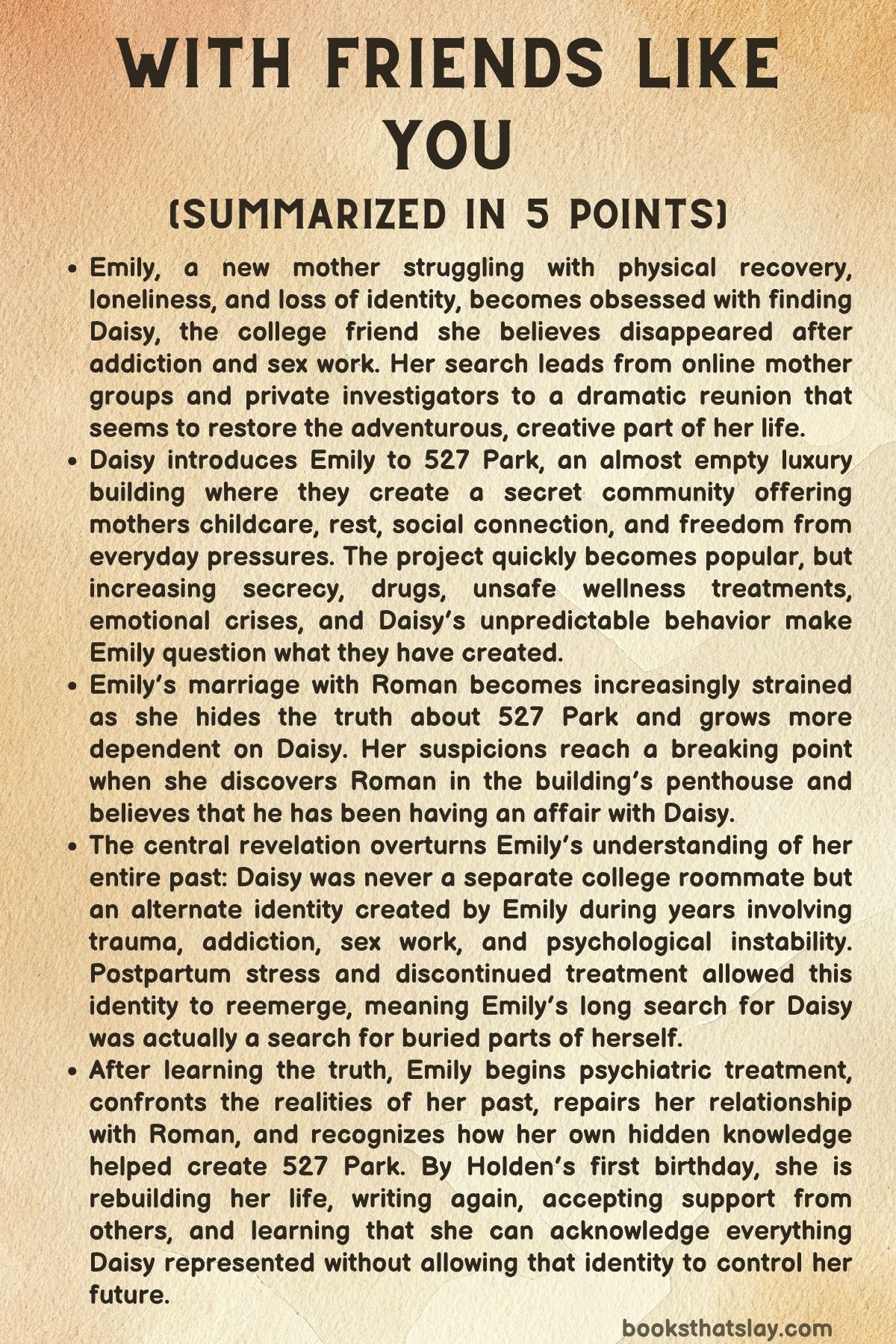
Summary
Emily remembers Daisy Laramie as the most important friend of her youth. They met as college roommates in Texas at eighteen, when Emily was shy and uncertain while Daisy appeared artistic, worldly, fearless, and capable of imagining an exciting creative future for both of them.
Their friendship deteriorated after Daisy’s abusive stepfather stopped paying her tuition. Daisy began working in an adult club, became involved with drugs and sex work, dropped out of college, and developed a heroin addiction until Emily finally separated herself from her after a frightening confrontation involving money and threats of suicide.
Fifteen years later, Emily is living in New York with her Australian husband Roman and their infant son Holden. She loves her baby intensely, but childbirth has left her physically injured, exhausted, sexually fearful, financially stressed, and unsure what remains of the ambitious woman she used to be.
Motherhood makes Emily reconsider Daisy’s youth. She begins thinking of her former friend not as the reckless woman who frightened her but as somebody who had once been young, frightened, neglected, and unable to find anyone willing to protect her.
Emily turns to Juju Bean, an anonymous community for mothers, both for emotional reassurance and for help finding Daisy. When her first search produces little information, she exaggerates the relationship by claiming that Daisy is her estranged sister, drawing more attention and eventually producing possible sightings around Atlantic City.
Roman worries about Emily’s growing fixation, yet Emily feels that finding Daisy has become inseparable from recovering the version of herself that disappeared beneath routine work, marriage, medical recovery, and constant childcare. She travels to Atlantic City, visits adult clubs, and finally meets a man called Jersey who says Daisy is alive.
Jersey remembers Daisy from the adult industry and explains that she eventually entered an expensive world of discreet companionship for wealthy men. He cannot give Emily a location, but he tells her that Daisy remained connected to her grandmother Queenie.
Emily flies to Texas and finds Queenie living with dementia in a retirement community. Queenie cannot provide a reliable address, but she gives Emily a valuable yellow diamond ring that once belonged to the family, leading Emily to promise that she will find Daisy and return it to her.
Back in New York, Emily’s life continues to expose the contradictions of modern motherhood. She is surrounded by women who appear more competent than she feels, including corporate lawyer Olivia, outspoken Audrey, enthusiastic Brit, and nanny Marcela, yet she gradually discovers that each woman carries pressures or losses that are largely invisible.
Emily eventually seeks help from wealthy friend Penelope, whose money and connections allow her to arrange a professional investigator. The search again produces fragments rather than certainty, including traces of rehabilitation, luxury escorting, and wealthy international men, but nothing conclusively establishes where Daisy is.
Then Emily unexpectedly sees Daisy in Washington Square Park.
Daisy looks healthy, sophisticated, self-assured, and almost impossibly comfortable stepping back into Emily’s life. She claims she learned about Emily’s investigation through Queenie and the private investigator, and she explains that she has spent years working as a highly compensated companion and household manager for extremely wealthy men.
Daisy says she currently has access to an enormous luxury apartment at 527 Park, supposedly connected to a Greek billionaire. She refuses Queenie’s diamond but embraces Holden easily, and Emily is astonished by how naturally her missing friend fits into her present life.
Daisy also recognizes how thoroughly Emily has abandoned writing. She insists that Emily can still become a writer and begins encouraging her to reclaim the creative ambitions that once defined her.
As Emily worries about returning to work and paying for childcare, Daisy offers to help care for Holden. Roman distrusts the arrangement because he has never met Daisy, but Emily becomes increasingly convinced that her friend has solved problems that money, parenting advice, and marriage have failed to solve.
Daisy then introduces Emily to the unused facilities inside 527 Park. The nearly empty luxury building contains pools, wellness rooms, childcare spaces, entertainment facilities, staff, vehicles, and extraordinary resources that exist largely for wealthy owners who are rarely present.
Daisy proposes inviting other mothers into the building. She argues that exhausted parents have been forced to survive alone while enormous resources sit unused, and Emily gradually accepts the idea of turning 527 Park into an informal community for women and children.
They advertise it anonymously through Juju Bean as a free, exclusive Park Avenue wellness and childcare space. What begins with a small number of suspicious mothers rapidly grows into a secretive social network where women can sleep, exercise, drink, work, receive childcare, pursue creative interests, or simply exist without constantly performing motherhood.
Emily thrives inside this environment. She writes again, enjoys motherhood more when responsibility is shared, and becomes Daisy’s practical counterpart, solving problems while Daisy supplies confidence, charisma, and radical ideas.
Yet 527 Park becomes increasingly unstable. Medical treatments are offered without enough oversight, drugs become common, distressed women remain for longer periods, secrecy increases, and Daisy reacts badly to anyone who questions the arrangement.
Brit disappears after becoming suspicious. Olivia deteriorates after losing her job and eventually tries to injure herself, forcing Emily to intervene while Daisy dismisses the crisis.
Other women experience overdoses, pregnancy loss, emotional breakdowns, and dangerous behavior. Emily begins to understand that 527 Park is no longer simply a community created to help mothers survive; it has become dependent on Daisy’s unpredictable authority.
At the same time, Emily is hiding more from Roman. She refuses to let him visit 527 Park, conceals the drugs and unsafe activities occurring there, and protects her relationship with Daisy even when Roman reasonably questions the person caring for their son.
Returning to her grant-writing job makes Emily even less tolerant of the safe but unsatisfying career she accepted years ago. Reawakened creativity eventually turns into open rebellion against her employer, and she manipulates her boss into allowing her to work remotely.
Her confidence also changes her relationship with Penelope. Emily finally recognizes that Penelope has long treated her partly as a friend and partly as unpaid assistance, assuming Emily will perform errands and labor simply because enormous wealth makes Penelope unaware of the imbalance between them.
The more empowered Emily becomes, however, the more troubling Daisy becomes. Emily discovers hidden security material at 527 Park and begins investigating the penthouse where Daisy frequently disappears.
There she sees footage suggesting Daisy is having sex with a mysterious man. When Emily secretly reaches the penthouse, she discovers that the man is Roman.
Believing her husband and best friend have betrayed her, Emily collapses. She eventually decides to take Holden to Texas, but Daisy confronts her before she leaves, and the two women exchange cruel accusations about abandonment, dependence, betrayal, and the destructive history between them.
Then Holden looks at Daisy and says “Mama.”
Emily reaches her childhood home and finally tells her estranged mother everything. Instead of responding with disbelief, her mother retrieves Emily’s old locked journals and reveals a fact that destroys Emily’s understanding of the past: Emily never had a college roommate.
She lived alone.
The journals reveal that Daisy is not an independent person. Emily herself was the young woman who danced at the Landing Strip, entered pornography, became addicted to drugs, and later worked as a high-end escort for extremely wealthy men.
“Daisy” was a separate identity through which Emily contained memories, desires, behaviors, and experiences that she could not integrate into the ordinary identity she later constructed. After leaving the escort world, Emily deliberately rebuilt herself in New York, pursued conventional employment, met Roman, and established a stable life.
Emily had also been treated for serious psychiatric problems and had previously received medication that helped keep her stable. Pregnancy led her to discontinue much of that treatment, while traumatic childbirth, sleep deprivation, isolation, bodily pain, and the psychological disruption of early motherhood created conditions in which Daisy could become active again.
Emily is diagnosed with dissociative identity disorder and begins recognizing that nearly every strange clue in her search had pointed back toward herself. Jersey recognized her, investigators could not locate Daisy as a separate person, staff at 527 Park behaved strangely around the two identities, and Daisy was never independently present when Emily appeared to others.
The supposed affair with Roman is also reinterpreted. Roman explains that he followed Emily to 527 Park, witnessed the Daisy identity emerge, and eventually became sexually involved with that side of his wife.
From Roman’s perspective, he was having sex with Emily, although he understood that she was operating through a different identity. From Emily’s conscious perspective, however, those encounters were inaccessible, making the emotional consequences complicated even after she understands what happened.
Another revelation follows. The luxury apartment never belonged to Daisy’s fictional Greek billionaire.
Roman recognizes 527 Park as Penelope’s investment property. Emily had access to Penelope’s financial information, codes, accounts, staff, and apartment because Penelope had spent years treating her as a trusted helper.
As Daisy, Emily had used Penelope’s almost invisible wealth to establish the entire community. When Penelope arrives expecting to inspect an empty property, she instead finds dozens of mothers occupying it.
Penelope threatens to evict and sue everyone. Daisy retaliates by using private knowledge about Penelope’s finances and affair, and their confrontation becomes physical.
When police arrive, Emily identifies the women as long-term occupants rather than simple trespassers. Immediate removal becomes legally complicated, allowing the community to remain temporarily while Penelope is forced into a formal process.
The episode raises one final disturbing question about how separate Emily and Daisy truly are. Emily had spent years learning how Penelope’s family managed wealth and had known about the unused property, suggesting that the takeover may have emerged from desires and knowledge shared across different parts of Emily rather than from Daisy alone.
By Holden’s first birthday, the most dangerous period has passed. Emily resumes psychiatric treatment and physical therapy, repairs her relationship with Roman, leaves grant writing, and begins writing a book about what happened.
The women who met through 527 Park also retain meaningful relationships even after the reckless behavior surrounding the community diminishes. Audrey separates from her husband, Olivia becomes healthier and returns to professional life under better conditions, Marcela remains involved in Holden’s care, and both Sue and Emily’s mother become more present in the family.
The yellow diamond is sold, allowing Emily and Roman to reduce medical debt while also helping Emily’s mother escape financial pressures connected with the deteriorating family house. What once symbolized failure to help a vulnerable young woman becomes something that materially assists the people still trying to rebuild their lives.
Emily finally returns alone to the apartment, where Daisy appears once more within her mind. Emily fears that without Daisy she will become ordinary, but Daisy rejects the idea that she was ever a heroic rescuer.
Daisy existed because a desperate part of Emily needed to survive experiences she could not otherwise endure. Emily now possesses relationships, community, treatment, self-knowledge, and the possibility of creating a future without splitting herself apart to survive.
In the final internal image, Daisy steps from the balcony and disappears. Emily remains, not cleansed of her past and not separated from everything Daisy represented, but able to recognize that those experiences belong to one life she can finally acknowledge as her own.
Characters
Emily
Emily is the psychological and emotional center of With Friends Like You, and nearly every major conflict emerges from the distance between the life she believes she has lived and the life her mind has prevented her from fully remembering. At first she appears to be an exhausted new mother searching for a lost friend, but her apparent investigation gradually reveals itself as an indirect search for parts of her own identity.
Motherhood exposes every weakness in the stable adult self Emily has constructed. Physical injury, sleep deprivation, loss of sexual confidence, financial pressure, professional dissatisfaction, isolation, and the enormous responsibility of caring for Holden strip away many of the routines that had allowed her to feel ordinary and controlled.
Her fixation on Daisy therefore serves several purposes at once. She believes she is seeking redemption for abandoning a vulnerable friend, but she is also seeking youth, creativity, sexual confidence, rebellion, power, and freedom from the timid identity she has adopted.
Emily is frequently judgmental toward other mothers because their apparent confidence intensifies her own feelings of inadequacy. As she learns more about Brit, Olivia, Audrey, and the others, she becomes less willing to interpret people through appearances alone and gradually develops genuine empathy for private suffering.
Her greatest strength is her capacity to care when confronted directly with another person’s pain. During the crises at 527 Park, Emily responds to women in danger with attention and patience even when Daisy dismisses them, revealing an emotional maturity that distinguishes the adult Emily from the frightened young woman who once could not cope with her own distress.
The final stage of her development requires neither destroying Daisy nor pretending that Daisy never existed. Emily instead accepts that the experiences associated with Daisy are part of her own history, allowing responsibility, trauma, creativity, sexuality, motherhood, and survival to exist within a single identity rather than remaining psychologically separated.
Daisy
Daisy initially appears to be the most magnetic character in With Friends Like You because Emily constructs her as everything Emily believes she has lost. Daisy is daring where Emily is cautious, sexually confident where Emily is physically fearful, socially dominant where Emily feels invisible, and creatively fearless where Emily has settled into safe professional mediocrity.
The revelation that Daisy is an alternate identity does not make her emotionally meaningless. She represents a psychological strategy developed during periods when Emily faced exploitation, addiction, unstable relationships, and experiences that her ordinary consciousness could not absorb.
Daisy refuses to define herself only as a victim. She interprets survival, adaptability, sexuality, intelligence, and access to wealthy circles as forms of achievement, even when those qualities emerged within environments that were dangerous and exploitative.
Her strengths become dangerous when survival instincts are applied to ordinary relationships. Daisy mistrusts rules, dismisses vulnerability, becomes contemptuous of people who appear weak, and responds to resistance by manipulating, humiliating, threatening, or excluding others.
At 527 Park, Daisy initially supplies exactly what Emily lacks: confidence, practical help, social imagination, and permission to challenge unfair expectations. Yet the same personality increasingly pushes the community toward secrecy, recklessness, intoxication, medical risk, and emotional instability.
Daisy ultimately becomes understandable as neither villain nor rescuer. She is the part of Emily that learned to survive through performance, control, seduction, defiance, and emotional distance, and her final disappearance symbolizes Emily’s attempt to retain those capacities without allowing them to govern her entire life.
Roman
Roman begins as the stable counterweight to Emily’s psychological instability. His accounting career, practical habits, dependable family background, and emotional directness initially attract Emily precisely because he seems removed from the unpredictable worlds that shaped her earlier life.
His childhood abuse complicates that appearance of conventional stability. The emotional-support turtle he keeps from childhood demonstrates that Roman understands trauma as something that cannot simply be thrown away, even when a person has built a functional adult life around it.
That history later becomes crucial to his ability to comprehend Emily’s dissociation. Although he is shocked and angry when he learns how much of her past she concealed, he has enough experience with trauma to recognize that secrecy can emerge from survival rather than deliberate deception.
Roman is not presented as an ideal husband. His return to work leaves Emily carrying far more of the emotional and physical burden of early parenthood, and he initially fails to understand the depth of her isolation because the domestic system works more easily for him.
His relationship with Daisy creates one of the book’s most ethically complicated situations. He understands that Daisy is another identity within his wife and engages sexually with that identity, while Emily herself has no conscious memory of those encounters.
Roman nevertheless grows after the truth emerges. He becomes more active in childcare, more respectful of Emily’s physical boundaries, more assertive about family leave at work, and more willing to build a marriage based on difficult knowledge rather than the comforting assumption that both partners have always fully understood one another.
Holden
Holden is an infant and therefore does not possess the psychological complexity of the adults, yet he is essential to nearly every major transformation in the story. His birth destabilizes Emily’s body, marriage, routines, medication, professional identity, and understanding of her own past.
Emily’s love for Holden is intense enough to create both fear and clarity. She constantly worries that she will fail him, but caring for him also makes her reconsider how vulnerable she herself was when she entered adult work and addiction at nineteen.
Holden becomes one of the reasons Emily seeks community. Her inability to manage childcare, work, medical recovery, and household responsibilities alone makes the appeal of 527 Park immediately understandable.
His first use of “Mama” while looking toward Daisy provides one of the strongest clues about Daisy’s identity. What Emily experiences as evidence that Daisy is replacing her is actually an innocent recognition that both figures occupy the same maternal body.
Holden also gives Emily a reason to choose continuity over destruction when the truth becomes unbearable. Relationships fail, memories change, careers disappear, and identities fracture, but her responsibility toward her son repeatedly pulls her back toward the life she must consciously inhabit.
Penelope Keaton
Penelope represents privilege expressed less through cruelty than through profound insulation from ordinary consequences. She genuinely cares about Emily in certain moments, yet her enormous wealth prevents her from understanding the financial and practical realities controlling Emily’s choices.
She can arrange a private investigator with a phone call, suggest that Emily quit working without considering lost income, and offer expensive solutions without recognizing that these gestures also reinforce the unequal structure of their friendship. Emily often functions simultaneously as Penelope’s confidante, assistant, fixer, and social subordinate.
Their relationship becomes one of the novel’s clearest examinations of invisible labor. Penelope assumes that Emily will perform tasks because Emily historically has done so, while Emily accepts the arrangement because proximity to privilege occasionally gives her access to resources she could never obtain independently.
The revelation that 527 Park belongs to Penelope transforms that imbalance into open conflict. The very habits that allowed Penelope to forget an almost unused luxury apartment also allow Emily and Daisy to occupy it for months without immediate detection.
Penelope is therefore not simply a wealthy antagonist. She demonstrates how extreme privilege can produce ignorance about money, property, labor, and dependency until the supposedly invisible people maintaining that system begin using its resources for themselves.
Olivia
Olivia initially appears to represent the successful version of modern motherhood. She is professionally accomplished, disciplined, ambitious, and committed to optimizing parenting with the same intensity she brings to her legal career.
That apparent competence gradually collapses. Lack of sleep, professional loss, alcohol, drugs, and emotional exhaustion expose how fragile her high-functioning identity actually is.
Her crisis at 527 Park becomes especially important for Emily because Olivia reaches a point of self-harm that echoes Emily’s memories of the suicidal confrontation she once attributed to Daisy. This time Emily remains physically and emotionally present instead of retreating.
Olivia therefore becomes part of Emily’s opportunity to respond differently to suffering. Emily cannot rewrite the past, but she can choose not to abandon someone whose pain frightens her.
By the end, Olivia is rebuilding both personally and professionally. Her improvement reinforces the idea that women do not necessarily need escape from work or motherhood itself; they need conditions that make both humanly sustainable.
Brit
Brit first irritates Emily because she seems cheerful, relaxed, and naturally suited to motherhood. Emily initially interprets that ease as proof that other women possess an instinct or competence she lacks.
Learning that Brit lost a pregnancy and a son named Wyatt changes that judgment. Brit becomes one of the earliest reminders that visible behavior reveals very little about the grief another person may be carrying.
Her later suspicion of Daisy gives Brit another important role. Unlike Emily, she eventually recognizes that something about 527 Park is unsafe and begins asking questions.
Brit’s abrupt departure appears sinister from Emily’s perspective because Daisy reacts defensively and the staff refuses to explain what happened. Later evidence shows Brit chose to leave with Quinn, confirming that distrust rather than disappearance protected her.
Her eventual cooperation with the press also reveals that she never accepted the community’s secrecy as completely as Emily did. Brit functions as an external moral warning that Emily repeatedly ignores because belonging has become more emotionally important than skepticism.
Audrey
Audrey initially represents the competitive, opinionated side of modern parenting culture that makes Emily feel constantly evaluated. Her confidence, judgments, and parenting advice irritate Emily because they resemble the standards Emily already uses to punish herself.
Her difficulties with Sloane gradually reveal that she is no more secure than the women around her. The image of effortless maternal authority weakens as Audrey struggles to manage ordinary emotional and domestic problems.
Her marriage contains another disturbing element through Sebastian’s voyeuristic behavior toward Emily. Emily’s eventual confrontation with him becomes part of her broader rejection of passivity and shame.
Audrey’s medical emergency after an intravenous wellness treatment also exposes the dangerous direction of 527 Park. Emily responds responsibly while Daisy remains detached, helping Emily recognize that confidence without accountability can become destructive.
By the end, Audrey is separated and returning to work. Her movement away from the identity initially defined by judgment and marriage suggests a more independent future.
Marcela
Marcela offers one of the most grounded perspectives on childcare. While many mothers at 527 Park debate parenting philosophies and struggle with guilt about work, Marcela already understands care as labor that has economic value.
Her competence makes Emily trust her, but her position also exposes class differences inside supposedly supportive communities of women. Mothers may speak about solidarity while depending on lower-paid caregivers whose own families require sacrifice and financial planning.
Marcela’s decision to seek better-paid work challenges Emily’s assumption that caregiving should be driven primarily by affection. She has responsibilities beyond the child she is employed to care for and must make decisions based on her own family’s needs.
Her later appearance at 527 Park initially comforts Emily, although the unexplained higher salary reveals how Daisy has been manipulating resources without Emily’s full awareness. Marcela therefore becomes both a trusted caregiver and another clue that Emily is not actually controlling the system she believes she helps manage.
Sue
Sue represents the kind of maternal presence Emily wishes she had experienced. She is practical, affectionate, reliable, and deeply connected to her children, making Emily initially imagine that Sue will guide her through the frightening early months of motherhood.
Circumstances prevent that support because Sue must remain in Australia caring for Gigi. Her absence is not abandonment but another example of how caregiving responsibilities compete with one another across generations.
Emily’s longing for Sue therefore contains both admiration and resentment. She wants someone experienced to tell her what to do, yet Sue is already exhausted by responsibility for an elderly parent.
When Sue finally becomes physically present later in the story, her relationship with Holden helps expand the family network Emily lacked during the most unstable postpartum period. Sue embodies supportive caregiving, but the novel also refuses to pretend that even loving caregivers possess unlimited time and energy.
Emily’s Mother
Emily’s mother is initially defined through absence, neglect, and emotional distance. Emily avoids discussing her childhood partly because she has built adulthood around not needing the mother who failed to provide consistent care.
Her importance changes dramatically when Emily reaches Texas after believing Roman and Daisy betrayed her. For once, her mother listens instead of immediately centering herself.
She then provides the fact that destroys Emily’s existing narrative: there was no college roommate named Daisy. By preserving the old journals, she becomes the person capable of reconnecting Emily to evidence that her own mind has hidden from her.
Their reconciliation remains incomplete because longstanding habits and financial tensions do not disappear simply because a crisis produces one good conversation. The relationship becomes more realistic precisely because recovery does not transform her mother into the nurturing figure Emily always wanted.
Selling Queenie’s diamond later helps both households financially. This practical connection suggests that Emily and her mother may be able to build a more functional relationship without pretending their history was different from what it was.
Queenie
Queenie initially appears to belong entirely to Daisy’s history, which makes the later revelation especially significant. Her dementia prevents her from clearly correcting Emily’s distorted understanding of the past, allowing Emily to interpret fragmented remarks according to the story she already believes.
The preserved artwork, old address book, childhood memories, and yellow diamond all become physical objects linking Emily to a life she has psychologically assigned elsewhere. Queenie therefore functions as a bridge between buried memory and present investigation.
The yellow ring carries particular symbolic weight because Emily cannot understand why family wealth failed to protect the young woman she thinks was Daisy. Once the truth is known, the question becomes even more personal: why did resources exist while Emily herself was struggling so desperately?
Queenie’s eventual significance lies less in what she consciously reveals than in what she preserves. Objects and memories survive even when individual recollection becomes unreliable.
Jersey
Jersey serves as one of the earliest figures who knows more than Emily understands. His claim that Daisy is alive encourages Emily to continue searching, but his hesitation and strange familiarity later make sense once the identity revelation occurs.
His knowledge of adult entertainment and wealthy clients gives Emily information she interprets as Daisy’s biography. In reality, he is helping her reconstruct fragments of her own history.
Jersey also represents an outside observer who does not share Emily’s memory barriers. His concern about Daisy’s state becomes important retrospectively because he is responding to behavior that Emily herself cannot fully perceive.
Dr. Elaine Horowitz
Dr. Horowitz provides the clinical framework Emily needs after the truth becomes impossible to deny. She confirms that Emily has dissociative identity disorder and connects the return of symptoms with postpartum stress and discontinuation of stabilizing treatment.
Her role is deliberately less dramatic than Daisy’s. Recovery requires appointments, medication, memory work, difficult conversations, and gradual integration rather than the intoxicating transformation Daisy offers.
Dr. Horowitz therefore represents sustained responsibility. She helps Emily understand that acknowledging trauma does not require allowing the identity formed around that trauma to make every decision.
Carleigh
Carleigh, Emily’s physical therapist, represents another form of recovery Emily repeatedly postpones. Pelvic-floor treatment is painful and slow, while the relief Daisy offers feels immediate.
Emily’s missed appointments show how psychological escape begins replacing practical healing. Instead of continuing work on the body that childbirth injured, she increasingly uses 527 Park to avoid discomfort.
Returning to Carleigh near the end therefore matters because Emily is choosing recovery that requires patience. Physical healing becomes part of the same movement toward acknowledging reality rather than disappearing into another identity.
Bianca
Bianca helps turn 527 Park from an improvised gathering into an organized operation. Her knowledge of the building and willingness to work for higher pay provide Daisy with the practical structure required to expand the community.
Her presence also shows how quickly unconventional systems begin reproducing administration, hierarchy, and secrecy. What begins as rebellion against institutional structures soon develops rules, staff, nondisclosure agreements, access procedures, and internal authority.
Bianca is not portrayed as the ideological center of the operation. Instead, she demonstrates how employees adapt to whoever controls resources, especially when better wages and opportunities are offered.
Molly Gibson
Molly is the reporter who introduces external scrutiny into a community sustained by secrecy. Her questions initially irritate Emily because she interprets them as sensationalism and intrusion.
Yet Molly notices precisely what Emily is refusing to investigate. Missing women, unclear ownership, hidden activities, unexplained authority, and rumors about coercion are all legitimate reasons for journalistic concern.
Her eventual article transforms 527 Park into a public story. Although the coverage presents the women as privileged squatters and Daisy as a mysterious leader, the publicity also prevents the community from disappearing quietly.
Molly therefore represents the uncomfortable value of outside observation. Insiders often normalize the systems they depend upon, while outsiders may notice contradictions that belonging makes difficult to confront.
Leo
Leo represents the creative life Emily once imagined pursuing. As a former writing teacher and occasional lover, he belongs to an earlier version of Emily who associated identity with literature, ambition, and possibility.
Emily goes to him after discovering Roman in the penthouse because she cannot face either marriage or 527 Park. Leo does not solve the crisis, and his value in the scene comes largely from his refusal to demand immediate explanation.
Seeing his old literary world also forces Emily to consider the difference between imagined futures and actual lives. She eventually leaves because Holden, rather than nostalgia, provides the strongest reason to return to reality.
Phil
Phil embodies the uninspiring professional system Emily tolerated because stability seemed safer than creative risk. His grant-writing workplace rewards predictability and discourages the humor and experimentation Emily begins introducing after reconnecting with writing.
Emily’s confrontation with him shows her newly aggressive relationship with authority. She uses his inappropriate behavior and office affair to force a remote-work arrangement rather than continue accepting conditions she dislikes.
The scene demonstrates genuine growth but also reflects Daisy’s influence. Emily is learning to stop obeying automatically, though her new confidence sometimes depends on manipulation rather than straightforward negotiation.
Sebastian
Sebastian’s repeated voyeurism represents a quieter violation within Emily’s domestic environment. His behavior leaves Emily uncomfortable and exposed at a time when she already feels alienated from her postpartum body.
Her decision to confront him marks a shift away from shame. Instead of changing her own behavior to accommodate his misconduct, she identifies the problem as his responsibility.
The encounter is small compared with the larger identity crisis, but it reflects Emily’s increasing willingness to establish boundaries rather than silently adapt to other people’s entitlement.
Themes
Identity, Memory, and the Self
The central question of With Friends Like You concerns whether a person can truly escape a past by assigning it to somebody else. Emily constructs Daisy as a separate woman who carries everything she cannot reconcile with her adult identity: addiction, sex work, reckless sexuality, aggression, fearlessness, and survival under extreme pressure.
The psychological separation protects Emily for years, but it also prevents her from understanding herself. Once motherhood disrupts the routines and medication that helped maintain stability, the divided past begins returning through obsession, memory fragments, unexplained behavior, and the physical presence Emily experiences as Daisy.
The late revelation works because the earlier investigation already contains repeated signs that memory cannot be treated as objective evidence. Investigators cannot locate Daisy, other characters respond strangely to Emily’s questions, photographs create ambiguity, and Daisy consistently knows things she should not know.
Recovery therefore depends on integration rather than erasure. Emily cannot heal by declaring Daisy unreal because the experiences associated with Daisy genuinely happened.
She must accept that one person can contain contradictory histories without reducing herself to any single version. Mother, wife, writer, addict, survivor, sex worker, frightened young woman, ambitious adult, and psychologically ill patient are all parts of one continuous life, even when memory once made them feel incompatible.
Motherhood, Isolation, and the Need for Community
Motherhood is presented as a profound relationship shaped by love but also by bodily cost, invisible labor, economic pressure, fear, and relentless responsibility. Emily adores Holden while simultaneously mourning the autonomy, creativity, sexuality, and professional identity that seem to have disappeared after childbirth.
The Juju Bean mothers reveal how widespread that contradiction is. Women anonymously confess exhaustion, resentment, medical fears, sexual difficulties, strange habits, grief, and feelings they would hesitate to admit publicly.
527 Park succeeds because it addresses a real need. The women are not primarily transformed by luxury products or expensive wellness services; they respond to childcare, companionship, rest, practical help, shared space, and the ability to stop performing perfect motherhood for a few hours.
Daisy correctly recognizes that isolation is making many women miserable. The danger appears when genuine community becomes dependence on a secret system controlled by an unstable leader.
The novel therefore distinguishes support from escape. Healthy community distributes responsibility while still allowing people to maintain judgment, boundaries, treatment, work, and outside relationships.
Emily’s later life suggests a more sustainable version of the original dream. The women remain connected after the dangerous culture of 527 Park weakens, demonstrating that the most valuable thing they created was not unrestricted access to wealth but a network in which care no longer had to be carried alone.
Wealth, Class, and Invisible Labor
Extreme wealth shapes the novel long before Emily understands how directly she is using it. Penelope can solve problems through money without noticing that the same problems could threaten another family’s stability, while empty luxury apartments exist beside medical debt, childcare anxiety, homelessness, and caregivers struggling for better wages.
527 Park exposes the absurdity of those contrasts. Pools, wellness facilities, childcare rooms, drivers, staff, expensive products, and vast residential spaces sit almost unused because property functions as an investment rather than a home.
Daisy’s decision to redirect those resources toward mothers initially feels almost morally persuasive. The women are exhausted, the facilities are empty, and the owners are wealthy enough not to notice ordinary expenses.
Yet the scheme never becomes ethically simple. Emily and Daisy manipulate employees, hide ownership, misuse accounts, encourage secrecy, and ultimately occupy property that does not belong to them.
Penelope is therefore both exploited and exposed. Her anger is understandable because her property has been taken over, but her ability to forget the apartment existed illustrates the extraordinary distance between ownership and need.
Marcela adds another dimension by showing that caregiving itself has a class structure. Wealthier women often gain freedom through labor performed by women whose own families remain elsewhere, meaning that conversations about female liberation are incomplete unless they also consider who is being paid, protected, and recognized.
Trauma, Survival, and Recovery
Trauma shapes behavior throughout the story without producing identical responses. Emily dissociates, Roman preserves symbolic reminders of childhood abuse, Brit carries pregnancy loss beneath apparent cheerfulness, Olivia collapses under cumulative pressure, and Daisy responds to vulnerability by becoming harder, more controlling, and less willing to acknowledge pain.
Daisy’s existence demonstrates how survival strategies can remain useful long after the danger that created them has passed. Confidence, sexual adaptability, emotional distance, manipulation, and aggression helped Emily endure situations she could not otherwise psychologically absorb.
Those same defenses become destructive within marriage, friendship, motherhood, and community. What protects a young person during exploitation can damage an adult who now needs trust, continuity, accountability, and treatment.
The story repeatedly rejects the idea that survival automatically equals recovery. Emily survived her earlier life, built a marriage, maintained employment, and became a mother, yet unprocessed experiences remained active beneath that stability.
Her eventual improvement requires much less dramatic work than Daisy’s solutions. She returns to psychiatric treatment, resumes physical therapy, tells Roman the truth, accepts help, repairs relationships, writes, and stops treating ordinary vulnerability as failure.
The ending does not suggest that trauma can simply disappear. Daisy’s symbolic departure instead marks Emily’s recognition that the survival identity can become part of remembered history without continuing to control the present.