Autumn at the Cat Café Summary, Characters and Themes
Autumn at the Cat Café by Kathleen Fuller is a contemporary small-town romance centered on Octavia “Via” Dalton, the owner of a cat café in Pecan Corner, Ohio, and Leo Brewster, a Los Angeles hedge fund manager who unexpectedly inherits his estranged uncle’s bookstore.
What begins as a conflict over property gradually becomes a story about trust, family estrangement, grief, emotional risk, and the possibility of choosing a different kind of life. Autumn traditions, an eccentric bookstore, a lively group of cats, and a close community provide the setting as Via and Leo confront the experiences that have taught each of them to guard their emotions.
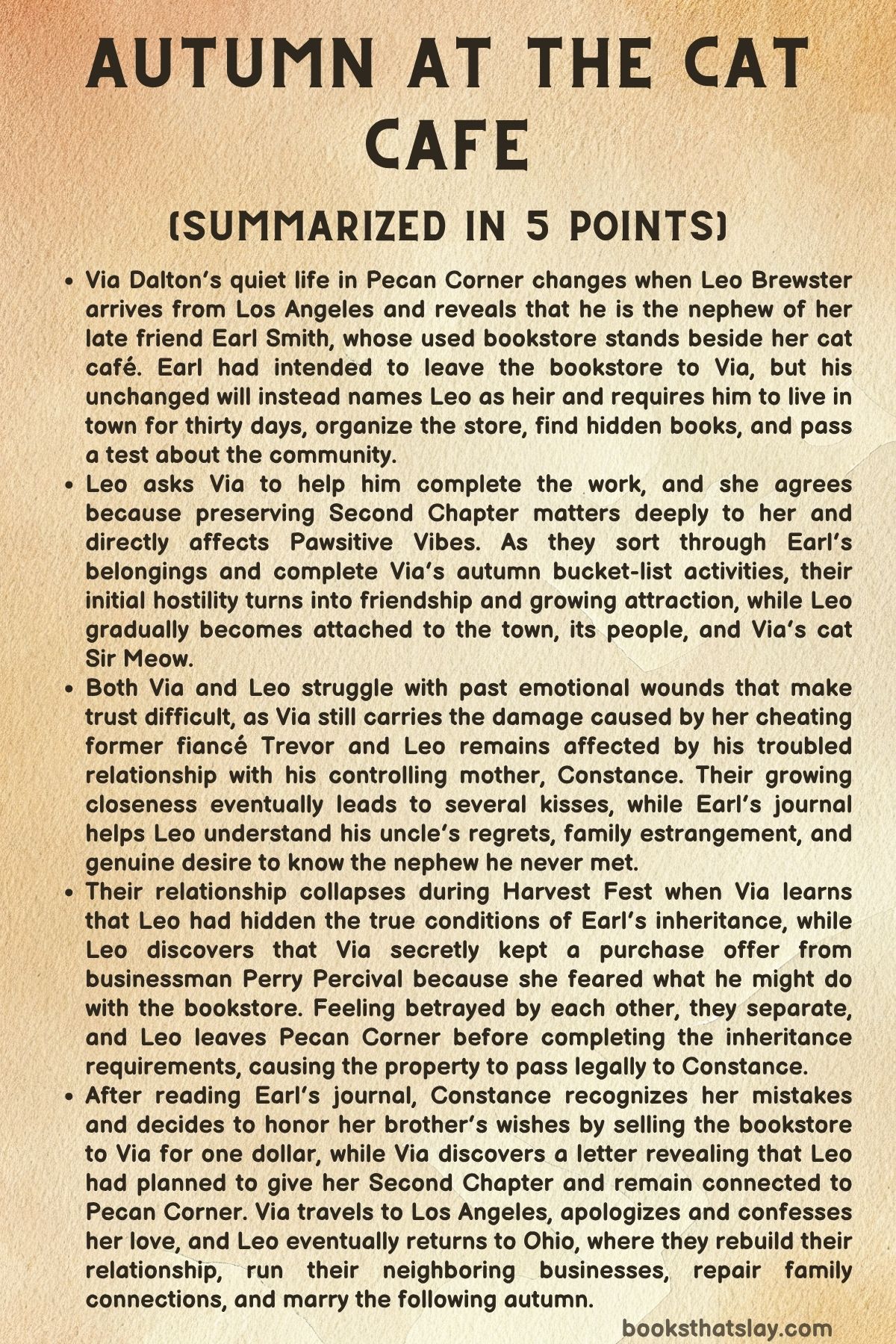
Summary
Octavia “Via” Dalton has built a satisfying life in Pecan Corner, Ohio, where she owns Pawsitive Vibes, a cat café located beside Second Chapter, the used bookstore that belonged to her elderly friend and landlord, Earl Smith. Earl died unexpectedly nine months earlier, leaving Via grieving both the man who had become important to her and the uncertain future of the bookstore he had once discussed combining with her café.
One autumn morning, Via sees an unfamiliar man entering Second Chapter and confronts him, assuming he is trespassing. The stranger is Leo Brewster, a wealthy, polished hedge fund manager from Los Angeles who announces that Earl was his uncle and that he has come to deal with the property.
Their first encounters are chaotic rather than romantic. Via later mistakes Leo for an intruder inside the apartments above the businesses and swings a lamp at him, while Leo, exhausted after driving across the country without enough food or rest, collapses shortly afterward.
Via calls Birdie Gunnerson, her café employee and a retired nurse and EMT, who determines that Leo is dehydrated and badly fatigued rather than seriously injured. As Via helps him recover, she learns that Earl was the brother of Leo’s mother, Constance, although Leo knows almost nothing about the uncle whose property he has apparently inherited.
At Earl’s lawyer Bennett Pipkin’s office, both Via and Leo discover that the inheritance is far more complicated than expected. Earl had intended to revise his will and leave Second Chapter to Via, but he died before completing the necessary legal changes, leaving an older will that names Leo as the beneficiary.
The will also contains unusual conditions. Leo must live in Earl’s apartment for thirty consecutive days, organize the bookstore’s enormous collection, locate ten specified books, and pass a test about Pecan Corner with a score of at least eighty percent; failure means the property passes to Constance instead.
Leo initially sees Pecan Corner as an interruption to his successful California life. He expects to complete Earl’s requirements, dispose of the property, and return to the career and expensive lifestyle he understands, but Via asks him not to destroy what Earl spent decades building.
When Leo receives a low offer from businessman Perry Percival, he refuses partly because Percival’s dismissive attitude toward Earl’s bookstore irritates him. He later asks Via to help organize the building and learn about Pecan Corner, and although Via cannot afford to purchase the bookstore herself, she agrees because its future is tied closely to her café and to Earl’s memory.
Their cooperation brings them into constant contact. Via also proposes using her autumn bucket list as a way of introducing Leo to Pecan Corner, and he agrees to accompany her on activities such as visiting a pumpkin patch, apple picking, camping, seasonal crafts, a corn maze, and eventually watching a Lake Erie sunset.
Via has her own reasons for being cautious around him. Her former fiancé, Trevor, cheated shortly before their wedding and had spent much of their relationship discouraging her interests and opposing her dream of opening the café, so Via now associates romantic trust with the possibility of humiliation.
Leo carries a different kind of emotional damage. His childhood was dominated by wealth, distance, boarding schools, and a controlling mother who frequently treated affection as something conditional, and after his father’s death, his conflict with Constance intensified when she assumed control of Brewster Development rather than allowing Leo to lead the company as he believed his father had intended.
As they organize Second Chapter, townspeople stop to share stories about Earl. These encounters begin transforming Earl from an inconvenient dead relative into a real person for Leo, while Via starts seeing Leo as more than the arrogant outsider who arrived in an expensive car.
Sir Meow, Via’s Highland cat, accelerates that change. Despite Leo’s early claim that he is allergic to cats, Sir repeatedly seeks him out, and Leo gradually becomes openly affectionate toward him and increasingly comfortable among the animals at Pawsitive Vibes.
The autumn outings further soften the hostility between Via and Leo. A planned trip to a pumpkin patch nearly goes wrong when Via assumes Leo has broken his promise after he fails to appear on time, only to learn that he is struggling with a mechanical problem involving his beloved Gran Turismo.
Leo tells her firmly that he does not break his word, forcing Via to recognize how quickly she has judged him according to Trevor’s behavior. They travel in Earl’s old truck, Gold Yeller, and spend the day with Dora, Charlie, Phoenix, and Sir Meow, becoming increasingly comfortable together.
Their attraction becomes difficult to deny. Via apologizes after another defensive argument, and the two finally acknowledge that they are physically attracted to one another, but because Leo plans to return to California, they agree that friendship is safer.
That agreement fails almost immediately on an emotional level. Leo helps Via with a speed-dating event at the café, listens seriously when she talks about creating Pawsitive Vibes, tells her she is beautiful without making the compliment theatrical, and becomes more relaxed and ordinary around her than he has been in years.
The arrival of Constance exposes another side of Leo. She comes to Pecan Corner claiming she had intended to see Earl without knowing he had died, but Leo suspects that she is interested in the inheritance and reacts with intense resentment.
Although shaken by the confrontation, Leo keeps his promise to go camping with Via. Their campground turns out to be the fenced backyard of Via’s parents, where Leo experiences the warmth of her family and tells Via about being sent to boarding school in Switzerland at twelve.
Desperate to return home, young Leo deliberately set fire to a dumpster in hopes of being expelled. Instead of understanding the act as a sign of loneliness, his mother punished him afterward by refusing to speak to him for months, an experience that helps Via understand why adult Leo is so reluctant to depend emotionally on anyone.
Their relationship soon reaches a point that friendship cannot contain. During a nighttime corn maze, the lights fail, leaving them together in darkness, and Via finally tells Leo to kiss her.
The kiss is followed by another in Gold Yeller, and both realize that whatever exists between them has become much more serious than temporary attraction. Yet Leo’s planned departure remains an unavoidable deadline hanging over their growing relationship.
Leo then discovers Earl’s journal among his belongings. It reveals Earl’s estrangement from his family, his regrets about never knowing Leo, and the loneliness created by years of silence between Earl and Constance.
The journal also shows that Earl had followed Leo’s life from a distance and deeply regretted the absence of a relationship between them. Leo begins reconsidering both the uncle he never knew and the kind of isolated future he has been building for himself.
He also confesses to Via that his supposed cat allergy was a lie invented because he initially wanted Sir Meow to leave him alone. More importantly, he announces that he wants to reopen Second Chapter during Harvest Fest as a tribute to Earl and the community rather than leaving the store closed until it can be sold.
Meanwhile, Perry Percival gives Via a written offer to purchase the property. His plans could threaten Pawsitive Vibes and destroy the character of Earl’s bookstore, so Via hides the envelope instead of immediately giving it to Leo.
Leo continues reading Earl’s journal and discovers that Earl had intended to change his will so that Via would eventually own Second Chapter. Rather than protect his own inheritance, Leo contacts Bennett because he is willing to risk the property in order to honor Earl’s wishes.
Harvest Fest initially appears to confirm how much has changed. Second Chapter is crowded with customers again, Leo has become part of the town, and Via finally recognizes that she loves him.
Then Bennett casually reveals the conditions of Earl’s will. Via is furious that Leo never told her his stay in Pecan Corner, his search for books, and his study of the town were requirements attached to the inheritance, and because Trevor’s deception still shapes her reactions, she feels that Leo has manipulated her.
Their confrontation becomes worse when Perry calls and mentions his purchase offer. Leo immediately realizes that Via hid important information about his own property, and he sees her decision as the same kind of control and withheld truth she is accusing him of practicing.
Leo leaves Pecan Corner before completing Earl’s final requirements. Via is miserable until Fergus forces her to examine the conflict more clearly, helping her understand that Leo is not Trevor and that her fear of being betrayed caused her to violate Leo’s trust.
Because Leo failed to finish the inheritance conditions, Second Chapter legally passes to Constance, who promptly places it on the market. Via fears she has lost both Leo and Earl’s bookstore.
Constance then arrives at Pawsitive Vibes with Earl’s journal. Reading her brother’s words has forced her to confront the cost of her own ambition, her estrangement from Earl, and the emotional distance she created between herself and Leo.
She explains that she had actually come to Ohio hoping to apologize to Earl, only to discover that he had died before reconciliation became possible. Wanting to honor him now, she agrees to sell Second Chapter and the apartment to Via for one dollar.
Via later discovers a letter Leo wrote to Earl before leaving. In it, Leo admits that he loves Via and explains that he intended to complete the inheritance conditions, transfer Second Chapter to Via, and keep Earl’s apartment so he could retain a place in Pecan Corner.
Realizing how completely she misjudged him, Via travels to Los Angeles. She apologizes without trying to excuse her decision, tells Leo that she has read his letter, and admits that she loves him too.
Leo accepts that trust between them will require continued honesty, and the life he has resumed in Los Angeles suddenly feels empty compared with the relationships he found in Ohio. He returns to Pecan Corner, plans to operate Second Chapter while continuing some financial consulting remotely, and begins cautiously repairing his relationship with Constance.
Via and Leo finally complete one of the most meaningful items on her autumn list by watching the sunset over Lake Erie together. The moment represents a change in both of them: Via is willing to trust without demanding guarantees, while Leo is willing to build a life around people rather than professional achievement alone.
A year later, Pawsitive Vibes and Second Chapter host their wedding. Leo now runs the bookstore, Via continues operating the café, their families and friends surround them, Constance remains part of Leo’s life with healthier boundaries, and Sir Meow participates in the celebration.
Earl’s legacy survives not simply through ownership of the building but through the connections his unusual will helped create. Via and Leo enter their marriage with their familiar teasing intact, choosing to enjoy the community and family around them before beginning the next stage of their life together.
Characters
Octavia “Via” Dalton
Via is the emotional center of Autumn at the Cat Café, combining independence, entrepreneurial ambition, loyalty, humor, and considerable emotional caution. Her creation of Pawsitive Vibes demonstrates that she has already rebuilt her life once, turning the collapse of her engagement into an opportunity to pursue a dream Trevor had discouraged.
Her greatest internal problem is not that she remains in love with Trevor but that his betrayal has altered how she interprets uncertainty. When Leo is late, secretive, concerned about her workload, or otherwise difficult to read, Via repeatedly fills in missing information with the assumption that another betrayal is approaching.
Her relationship with Earl also reveals her capacity for lasting attachment. Second Chapter matters to her partly because of its business potential, but more deeply because preserving it feels like preserving Earl’s presence and the faith he placed in her.
Via’s decision to hide Percival’s offer is therefore understandable in motivation but wrong in execution. She convinces herself that she is protecting Earl’s legacy and her café, yet the act shows how fear can transform self-protection into controlling behavior.
Her eventual growth comes from acknowledging this without excuses. By traveling to Los Angeles, apologizing directly, and admitting her love, she chooses vulnerability while accepting that love cannot be made completely safe.
Leo Brewster
Leo begins Autumn at the Cat Café as a man whose identity is based on achievement, money, professional competence, and emotional self-sufficiency. His expensive car, tailored appearance, Harvard education, and financial career initially make him appear completely mismatched with Pecan Corner.
Behind that controlled exterior is a childhood shaped by emotional neglect. His boarding-school story, his memories of Constance’s silent punishments, and his habit of avoiding dependence show that he learned early that wanting affection could leave him powerless.
His month in Pecan Corner gradually changes what he considers valuable. The cats, Via’s family, local friendships, Earl’s belongings, and ordinary community routines expose him to relationships that are neither transactional nor based on professional advantage.
His development is particularly clear in his treatment of Second Chapter. At first it is an asset to be organized and sold, but eventually he reopens it for Harvest Fest, studies Earl’s journal with genuine emotion, and becomes willing to surrender ownership so that Earl’s wishes for Via can be honored.
Leo’s love for Via ultimately becomes part of a larger transformation rather than an isolated romance. Returning to Ohio means choosing a life where career remains important but no longer has to substitute for belonging.
Earl Smith
Although Earl has died before Autumn at the Cat Café begins, his decisions shape nearly every major relationship in the story. Through Via’s memories, local stories, his belongings, and especially his journal, he gradually becomes a fully realized figure rather than merely the deceased owner of Second Chapter.
Earl carried deep regret over his estrangement from Constance and his failure to know Leo. His unusual inheritance conditions show that he understood simply leaving the bookstore to his nephew would not be enough; Leo needed time inside Earl’s world before he could understand what the property represented.
His relationship with Via reveals another side of him. He admired her determination, believed in Pawsitive Vibes, and eventually intended to leave the bookstore to her because he trusted her to preserve its spirit and connect it with her café.
The tragedy of Earl’s story is that many of his reconciliations remain unfinished. He dies before changing his will, before meeting Leo, and before resolving matters with Constance, yet his journal and estate unexpectedly create opportunities for the living characters to repair relationships he himself could not repair.
Constance Brewster
Constance is one of the most complicated figures in Autumn at the Cat Café because she has caused substantial emotional damage without being reduced to a simple antagonist. Leo experiences her as controlling, ambitious, withholding, and willing to use silence as punishment, particularly during childhood.
Her relationship with Earl follows a similar pattern of pride and prolonged estrangement. Years of unresolved family resentment become so entrenched that she waits too long to attempt reconciliation, arriving in Pecan Corner only after Earl has died.
Reading Earl’s journal forces Constance to confront the consequences of the life she built. She recognizes that money, education, social position, and opportunity were not substitutes for the emotional security Leo needed from her as a child.
Her decision to sell Second Chapter to Via for one dollar is therefore significant because it is an action based on someone else’s wishes rather than her own advantage. It cannot erase the past, but it demonstrates a willingness to stop repeating the patterns that damaged both her brother and her son.
Trevor
Trevor never dominates the present-day action of Autumn at the Cat Café, yet his influence over Via’s behavior is considerable. His infidelity shortly before their wedding destroyed the future Via believed she was building and left her embarrassed that she had trusted him.
His earlier opposition to her café dream also suggests that their problems went beyond cheating. Trevor regularly discouraged Via’s preferences and helped create a relationship in which she was adapting herself to someone else rather than freely building the life she wanted.
The importance of Trevor lies in the way Via unconsciously allows his actions to become a template for interpreting Leo. She expects broken promises, hidden motives, and eventual abandonment even when the evidence in front of her does not justify those conclusions.
Via’s development requires separating past experience from present judgment. Fergus’s reminder that Leo is not Trevor becomes crucial because it helps her recognize that caution is useful only until it becomes a refusal to see another person as an individual.
Dora Dalton
Dora is Via’s sister, confidante, and one of the people most willing to challenge her self-deception. She notices Via’s attraction to Leo almost immediately and responds with teasing, but her humor is accompanied by genuine understanding of her sister’s emotional history.
Her relationship with Charlie provides a useful contrast to Via’s fear of romance. Dora is comfortable allowing affection and commitment into her life, and her presence shows Via that a relationship does not necessarily require surrendering independence.
Dora also performs an important practical role in Via’s life. She helps at the café, participates in autumn activities, gives advice about Percival’s offer, and refuses to pretend that hiding the envelope is harmless simply because Via has understandable reasons for fearing the consequences.
By the epilogue, Dora’s marriage to Charlie strengthens the sense that the Dalton family continues to expand through chosen relationships. Her role as Via’s matron of honor reflects the closeness that has made her both supporter and truth-teller throughout the story.
Fergus Dalton
Fergus is Via’s protective older brother, and his early attitude toward Leo is shaped by concern rather than hostility for its own sake. When he repairs the plumbing at Earl’s apartment, he uses the opportunity to question Leo and assess whether he poses an emotional risk to his sister.
His protectiveness could easily become intrusive, but Fergus ultimately respects Via’s ability to make her own decisions. More importantly, he is willing to revise his opinion of Leo after observing him rather than judging him permanently as an outsider.
His most important contribution occurs after Leo leaves Pecan Corner. Fergus tells Via that Leo had privately expressed genuine concern for her and helps his sister recognize that she has been interpreting the present through the damage Trevor caused.
That conversation allows Fergus to function as more than the stereotypical protective brother. He becomes a source of moral clarity, asking Via to take responsibility without condemning her and helping her understand the difference between being cautious and refusing to trust.
Birdie Gunnerson
Birdie brings humor, competence, and affectionate bluntness to Pawsitive Vibes. As a retired nurse and EMT, she is the person Via calls when Leo collapses, and her calm handling of the situation immediately establishes her as dependable.
She also recognizes the attraction between Via and Leo long before either wants to admit its importance. Her nicknames, including “Smitten Kitten” and “Harvard Boy,” turn their obvious chemistry into a running joke while also showing how visible their growing attachment is to those around them.
Birdie represents the informal support network surrounding Via. She is not related to her, but she participates in the café as more than an employee and contributes to the atmosphere of chosen family that eventually draws Leo toward Pecan Corner.
Her presence also keeps the romantic story connected to everyday life. Business continues, cats create problems, customers arrive, and Birdie remains part of the dependable structure that allows Pawsitive Vibes to feel like a community space rather than merely a commercial venture.
Perry Percival
Perry Percival represents a purely commercial attitude toward Second Chapter. He sees the property mainly in terms of purchase price, redevelopment, and potential profit, placing him in direct opposition to Via’s emotional connection with Earl’s bookstore.
His early attempt to make Leo a poor offer immediately creates distrust. Later, his larger written proposal becomes more dangerous because it could transform the property into a coffee business that competes directly with Pawsitive Vibes.
Perry is especially important because his offer creates the conflict that exposes Via’s remaining trust problem. By hiding the envelope, she decides that her judgment about the bookstore’s future gives her the right to control information that legally belongs to Leo.
The character therefore functions less as a deeply developed personal antagonist than as a pressure point. His financial interest forces Via and Leo to confront whether their growing relationship is actually founded on honesty when property, fear, and self-interest become involved.
Bennett Pipkin
Bennett is Earl’s lawyer and the person responsible for explaining the unusual inheritance structure to Leo. His knowledge of Earl’s intentions makes him a crucial link between the dead man’s wishes and the people left to deal with their consequences.
He treats the conditions seriously even though they are unconventional. Through Bennett, Leo learns that living in Pecan Corner, organizing the store, locating the books, and passing the town quiz are not optional eccentricities but legal requirements attached to ownership.
Bennett also becomes unintentionally important during Harvest Fest when he mentions the inheritance conditions in front of Via. His casual comment reveals information Leo had withheld and triggers the confrontation that separates the couple.
He is therefore not responsible for their conflict, but his presence demonstrates how concealed information eventually becomes difficult to control. Legal truth remains unchanged regardless of whether the people involved are emotionally prepared to hear it.
Charlie Swenson
Charlie is Dora’s partner and later husband, as well as a mechanic who becomes part of Leo’s gradual integration into Pecan Corner. His practical, uncomplicated presence contrasts with Leo’s tendency to intellectualize his emotions and manage life through planning.
His willingness to help with Leo’s expensive car reflects the town’s culture of practical assistance. Leo initially worries about allowing anyone outside an authorized specialist to touch the Gran Turismo, but Charlie becomes another example of a local person whose competence challenges Leo’s assumptions.
A casual remark from Charlie about what men do for women they love also pushes Leo toward recognizing the meaning of his own behavior around Via. Charlie does not deliver a grand lesson; the observation matters precisely because it arises naturally from ordinary conversation.
By the wedding, his place beside Leo and his marriage to Dora show how completely the different social circles have merged. He becomes part of the extended family Leo once lacked.
Via’s Parents
Via’s parents provide the stable family environment that stands in sharp contrast to Leo’s childhood. They are affectionate without being controlling, interested in their adult children without demanding complete authority over their decisions, and willing to offer both practical and emotional support.
Via’s mother is particularly perceptive about her daughter’s fear following Trevor’s betrayal. She reminds Via that trusting someone was not evidence of stupidity and expresses pride in the independent life her daughter created afterward.
Their backyard camping night gives Leo direct experience of this family atmosphere. He is welcomed without being interrogated into submission, allowed to participate naturally, and given the kind of ordinary domestic inclusion that has been largely absent from his life.
Their role is therefore quietly important. They demonstrate the kind of secure family connection that Via already possesses and that Leo gradually learns he is allowed to want for himself.
Sir Meow
Sir Meow is more than comic decoration because the cat repeatedly acts as a bridge between Via and Leo. He is immediately fascinated by Leo, ignores Leo’s supposed allergy, and continually creates reasons for the two humans to interact.
Leo’s changing response to Sir charts his broader emotional development. Initially he complains about fur and invents an allergy to avoid the cat, but he eventually allows Sir onto his lap, keeps him while Via works, carries him comfortably, and shows genuine affection.
Sir also makes Leo’s transformation visible before Leo can fully articulate it himself. A man determined to remain detached gradually becomes attached to a cat, a bookstore, a town, a dead uncle he never met, and finally the woman whose life is connected to all of them.
By participating in Via and Leo’s wedding, Sir becomes an appropriate symbol of continuity. The cat who attached himself to Leo during their first difficult encounters remains present when Leo finally commits himself permanently to the life he once intended to leave.
Themes
Trust After Betrayal
Trust in Autumn at the Cat Café is presented as something more complicated than simply deciding whether another person is honest. Via’s experience with Trevor has taught her that apparent security can collapse without warning, so she tries to protect herself by anticipating deception before it occurs.
That strategy causes problems because suspicion begins replacing evidence. When Leo is late for the pumpkin-patch outing, Via assumes he has abandoned her; when he expresses concern about her workload, she hears rejection; and when she discovers the inheritance conditions, she immediately interprets the omission through the emotional framework created by Trevor.
Leo has his own difficulty with trust. His childhood with Constance taught him that affection could disappear as punishment, while his professional life rewarded self-reliance and control, making emotional dependence uncomfortable.
Their central conflict exposes the contradiction in both characters. Via condemns Leo for withholding information while simultaneously hiding Percival’s offer, and Leo, who wants to be trusted, has failed to explain the complete reason he needs her assistance.
Reconciliation becomes possible only when both stop treating perfect behavior as a requirement for intimacy. Via apologizes without defending herself, while Leo accepts that trust can be damaged and rebuilt rather than either guaranteed or permanently lost.
Belonging Versus Achievement
Leo begins the story with nearly every conventional sign of professional success. He has wealth, elite education, an impressive financial career, expensive possessions, and enough confidence in his professional abilities to structure his life around measurable results.
What he lacks is meaningful belonging. His Los Angeles life appears efficient and luxurious, but emotional relationships occupy little space within it, and his childhood has taught him to view independence as protection.
Pecan Corner challenges that definition of success through ordinary experiences rather than dramatic arguments. People help one another with plumbing, car trouble, local events, businesses, family responsibilities, and grief, while townspeople share memories of Earl simply because they cared about him.
Leo gradually notices the difference between being respected for what he can accomplish and being valued because people genuinely want him present. Sir Meow’s affection, Via’s family dinners, Zander’s friendliness, Earl’s journal, the Harvest Fest crowd, and Via’s companionship all create forms of connection that cannot be measured through salary or status.
His final decision does not require abandoning ambition completely. By continuing selected financial work remotely while running Second Chapter, Leo creates a life in which professional competence remains part of his identity without being the entire purpose of it.
Grief, Regret, and Unfinished Relationships
Earl’s death leaves nearly every important character facing something that can no longer be resolved directly with him. Via loses a dear friend before their plans for Second Chapter can be completed, Leo discovers an uncle only after the possibility of meeting him is gone, and Constance arrives hoping for reconciliation after time has already removed that opportunity.
The journal becomes important because it preserves Earl’s private regret. His words reveal a man who understood that years of estrangement had cost him relationships he wanted but never managed to restore.
Constance’s response demonstrates one possible reaction to irreversible loss. She cannot apologize to Earl or recover the years they lost, so she chooses to change what remains within her control by honoring his intentions for the bookstore and attempting a healthier relationship with Leo.
Leo responds differently but reaches a similar conclusion. Learning that Earl had cared about him from a distance allows him to replace some of his anger with curiosity and compassion, even though he can never receive explanations directly from his uncle.
The story therefore treats regret as meaningful only when it affects present choices. The past cannot be rewritten, but acknowledging its damage can prevent another relationship from ending with the same permanent silence.
Choosing a Life on One’s Own Terms
Both central characters spend significant parts of Autumn at the Cat Café learning to separate their genuine desires from identities shaped by other people. Via’s former relationship with Trevor had gradually limited her preferences, including her enthusiasm for autumn traditions and her dream of creating Pawsitive Vibes.
After the engagement ends, her seasonal bucket list becomes a playful expression of recovered freedom. Activities such as pumpkin picking, camping, crafts, and watching the Lake Erie sunset matter because she is reclaiming experiences she once minimized or postponed.
Leo faces a different version of the same challenge. His life has been structured by family wealth, expectations surrounding Brewster Development, resentment toward Constance, and a career in which achievement offers a reliable substitute for emotional uncertainty.
Pecan Corner gives him enough distance from that structure to ask whether the future he has been pursuing is actually one he wants. His decision to return is meaningful because he does not simply exchange finance for romance; he deliberately constructs a mixed life involving Second Chapter, remote financial work, Via, the cats, and the community.
The ending brings their choices together without requiring either person to disappear into the other’s life. Their marriage represents two independent lives becoming shared because both characters consciously choose the future they are building.