Devil Inside Summary, Characters and Themes
Devil Inside by Clay McLeod Chapman is a supernatural horror novel centered on Jordan, a Richmond bicycle courier whose near-death experience leaves him psychologically damaged and spiritually altered.
His attempt to rebuild his life changes when he meets Lilith, a demon who moves from body to body through possession and becomes fascinated by the strange emptiness inside him. Their relationship begins as an attraction between two damaged beings but gradually develops into something far more dangerous, raising questions about consent, identity, trauma, desire, morality, and whether love can survive when possession becomes both literal and emotional.
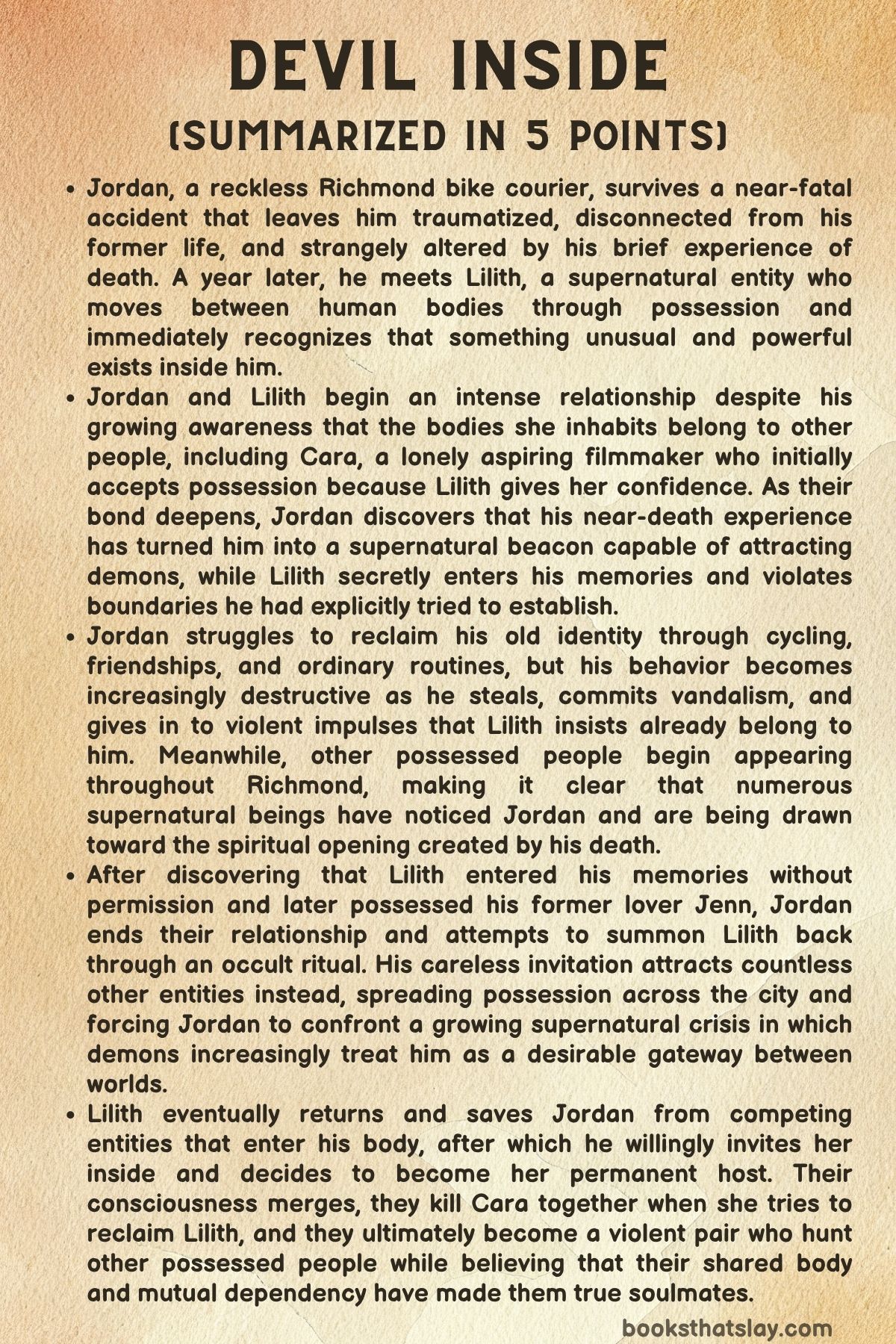
Summary
Before his life changes, Jordan is a fearless Richmond bike courier who thrives on speed, danger, and the freedom he finds while riding through traffic. He belongs to a close group of couriers called the Saddle Sores alongside Deak, Lysistrata, and Freel, while secretly maintaining a casual sexual relationship with Jenn that he refuses to acknowledge as anything more serious.
Jordan’s recklessness eventually catches up with him during an urgent delivery. Racing through traffic while trying to beat an impossible deadline, he ignores a changing light and is struck by an SUV, leaving him clinically dead for more than two minutes before doctors manage to bring him back.
Survival does not restore the person Jordan used to be. A year later, he is physically recovering but suffers panic attacks, disturbing visions, nightmares, depression, and a persistent sense that something went wrong when he crossed the boundary of death.
At a crowded concert, Jordan meets a mysterious woman who calls herself Lilith. She appears strange and slightly disconnected from ordinary life, but she also understands Jordan’s darkness in a way no one else does, and their immediate attraction leads to an intense night together.
Jordan does not know that the woman he sees is only a body Lilith has borrowed. Lilith is a supernatural entity who enters people through emotional vulnerability, experiencing their memories, desires, pain, and physical sensations while controlling their bodies.
Human beings have always been temporary vessels to her. She moves between them through touch, indulges in physical experiences unavailable in her natural state, and often encourages the resentment, desire, anger, and selfish impulses she discovers inside her hosts.
Jordan is different. Lilith senses that his death created something unusual within him, an enormous spiritual opening that resembles a beacon connecting the human world with the darkness from which she came.
After their first encounter, Lilith leaves the body Jordan recognizes and resumes moving through Richmond. Jordan becomes obsessed with finding her, but when he encounters the original woman whose body Lilith had used, the woman has no idea who he is.
His confusion begins turning into aggression. Jordan nearly starts a violent confrontation and realizes that the anger developing inside him cannot simply be blamed on trauma or on the supernatural woman he met.
Lilith eventually finds Jordan again and demonstrates the truth by transferring through several people in front of him. Jordan is terrified because he finally understands that Lilith does not have a single human body and that every person she occupies remains an independent individual beneath her control.
Wanting Jordan to recognize her again, Lilith returns to Cara, the woman whose body she originally occupied. Cara is an insecure aspiring filmmaker who feels trapped in an unremarkable life, and she willingly allows Lilith inside because surrendering control seems to offer the confidence she lacks.
Jordan gradually accepts Lilith’s nature despite his fear. Their relationship resumes, and he becomes increasingly interested in discovering the being beneath the bodies she borrows rather than treating Cara’s appearance as Lilith’s true identity.
Lilith becomes equally fascinated with him. During an intimate encounter she secretly enters Jordan and examines his memories, seeing his dying mother, his courier years, Jenn, his accident, and the rage hidden inside him.
The violation becomes important because Jordan later explicitly tells Lilith that she must never possess him without permission. She agrees without admitting that she has already crossed that boundary.
Their connection nevertheless deepens. Jordan helps Lilith experience music through physical vibration, allowing her to perceive sensation in a way that briefly separates her awareness from the limitations of her host.
During that experience, Lilith sees Jordan’s supernatural condition more clearly. His encounter with death has made him shine like a dark lighthouse to entities from her world, turning him into something closer to a gateway than an ordinary human being.
Jordan also begins sensing Lilith independently of the bodies she uses. During a game at an art museum, he learns to recognize the presence inside different strangers, suggesting that their connection has developed beyond appearance.
The same outing reveals that Jordan himself possesses supernatural influence. When he touches an ancient object associated with imagery resembling Lilith’s kind, it suddenly breaks apart, showing that whatever returned with Jordan from death can affect the physical world.
Jordan continues trying to recover his former identity. He enters a bicycle race with his old friends, hoping to rediscover the freedom he once felt while riding, but trauma overwhelms him and forces him to stop.
His failure is followed by another disturbing encounter with an apparently supernatural stranger who knows his name. The incident strengthens Jordan’s growing fear that more than one supernatural being has noticed him.
At the same time, Lilith begins changing because of Jordan. Manipulating ordinary hosts no longer provides the satisfaction it once did, and she starts questioning whether remaining attached to another being might offer something greater than endless movement.
Jordan’s transformation goes in the opposite moral direction. He experiments with stealing and later destroys parked cars with a golf club, discovering that violence gives him a sense of excitement rather than guilt.
Lilith eventually gives Jordan a custom bicycle based on the fixed-gear bike destroyed in his accident. With her support, he manages to ride through the city again, temporarily overcoming the panic that has controlled him since the collision.
Their happiness is threatened by increasingly obvious supernatural activity. People around Richmond begin behaving in impossible ways, and possessed individuals appear to be searching for a lighthouse or beacon without understanding that Jordan is the signal attracting them.
Jordan encounters another entity while undergoing physical therapy with Gil. Soon afterward he realizes that demons may be inhabiting ordinary people throughout the city and that many of them already know who he is.
This discovery forces Jordan to question the ethics of his relationship with Lilith. He asks her to limit her body-hopping, avoid hurting hosts, remain honest with him, and treat their relationship as exclusive, but these demands conflict with the freedom that defines her existence.
Jordan then insists on speaking directly with Cara. Cara admits that she originally accepted Lilith because possession gave her confidence and relief from the insecurity governing her life, although Jordan remains uncertain whether her continuing consent can truly be separated from Lilith’s influence.
The relationship finally breaks when Lilith appears inside Jenn. Jordan realizes that she could only have identified his former lover by entering his memories without permission, exposing the betrayal she had concealed.
Jordan accuses Lilith of violating the boundaries of both hosts and lovers. Lilith responds that Jordan’s insistence on seeing himself as morally superior ignores the rage, cruelty, and destructive impulses that already belong to him.
Their argument ends with Jordan ordering her away. Yet separation does not weaken their connection, because Jordan can now recognize Lilith even when she hides inside an unfamiliar person.
Without her, Jordan becomes desperate. Drinking heavily and studying occult material, he decides that if his damaged soul truly functions as a lighthouse, he might be able to summon Lilith deliberately.
His ritual succeeds far too well. Instead of calling only Lilith, Jordan sends an open invitation to countless entities, drawing them toward himself and unleashing a surge of possession throughout Richmond.
People begin experiencing horrifying supernatural disturbances as demons exploit their fears, anger, exhaustion, and vulnerabilities. Jordan becomes the central attraction for these entities, which recognize the spiritual opening created by his death.
Jordan himself is pursued by possessed adults and even a possessed child. At a bar, numerous demons reveal themselves and surround him, offering themselves as alternatives to Lilith and treating him as something desirable enough to fight over.
Meanwhile, Lilith discovers that returning to her old habits no longer satisfies her. Moving through strangers only reminds her that Jordan is the one person capable of recognizing her without depending upon a particular body.
Jordan eventually attends the final major gathering of the Saddle Sores. There he apologizes to his friends for withdrawing after the accident and gives Jenn the sincere apology he failed to offer before his life changed.
The gathering is already filled with supernatural danger. Several people are possessed, and Jordan deliberately uses the crowded dance floor to call Lilith while rejecting the other entities drawn toward him.
The demons finally overwhelm his weakened defenses and begin entering him. Lilith arrives and follows them inside, but instead of claiming Jordan for herself, she attacks the competing entities and drives them from his body.
She then releases him. Jordan, now understanding what her presence inside him feels like, willingly asks her to return.
Back at his apartment, possession becomes consensual for the first time between them. Jordan allows Lilith inside knowingly, and both experience their union as something fundamentally different from the domination she previously practiced.
Jordan feels that the emptiness created by his death has finally been filled. Lilith discovers that possession can involve shared identity rather than simply controlling a temporary vessel.
The following morning, Jordan asks to see Lilith’s real form. She leaves Cara and reveals herself as a radiant, inhuman entity surrounded by darkness and strange energy, yet Jordan responds with admiration rather than fear.
Jordan then offers himself as Lilith’s permanent home. Their consciousness begins merging until they increasingly think of themselves as a shared “we” rather than two completely separate beings.
Cara awakens abandoned and realizes that Lilith has chosen Jordan. Angry and desperate after becoming dependent upon the confidence Lilith provided, she attacks them and demands that Lilith return.
Jordan and Lilith respond together. Sharing Jordan’s body and responsibility, they strangle Cara to death, transforming their union from unconventional intimacy into a partnership capable of murder.
Their relationship continues after Cara’s death. Jordan can detect supernatural entities inside human beings, while Lilith provides the power and knowledge needed to confront them.
They begin hunting possessed people together, strangling hosts in an attempt to force demons out or destroy them. What began with Cara as a chaotic killing develops into a repeated practice that they justify by claiming they target only the possessed.
Jordan has stopped resisting the darkness he feared inside himself, while Lilith has stopped searching endlessly for temporary vessels. Each believes the other supplies what was missing: Jordan gives Lilith a permanent human home, while she fills the emptiness death left inside him.
By the end of Devil Inside, possession, love, violence, identity, and dependency have become inseparable for them. They consider themselves mutually possessed rather than victim and invader, continuing through the world as lovers, killers, and self-defined soulmates.
Characters
Jordan
Jordan is the central human figure of Devil Inside, beginning as a reckless bicycle courier whose identity depends on speed, danger, independence, and the belief that he can control the risks he takes. His collision destroys that confidence because survival leaves him with a damaged body, severe anxiety, alienation from his friends, and the disturbing suspicion that part of him never returned from death.
His relationship with Lilith gives him a temporary answer to that emptiness, but it also reveals qualities he initially refuses to accept as his own. His theft, vandalism, aggression, fascination with destruction, and eventual participation in Cara’s murder show that Lilith does not simply corrupt an innocent man; she helps Jordan stop denying impulses that were already developing within him.
Jordan’s deepest conflict concerns identity rather than simple supernatural survival. He spends much of the story asking whether he remains the person he was before the accident, and his final merger with Lilith resolves that question in a disturbing manner by allowing him to abandon the need to remain entirely separate.
Lilith
Lilith begins Devil Inside as a being defined by movement, appetite, curiosity, and possession. Human bodies are temporary vessels through which she experiences taste, music, sexuality, memory, physical sensation, and the emotional pain that makes people vulnerable to supernatural influence.
Her greatest fear is permanence because previous deep possession left her trapped inside a host for years. Jordan therefore threatens her established understanding of freedom, since loving him requires the kind of lasting attachment she has spent her existence avoiding.
Her development is morally complicated because emotional growth does not transform her into a benevolent being. She learns attachment, vulnerability, jealousy, and commitment, but she remains capable of violating memories, controlling hosts, manipulating emotions, and killing Cara once Jordan becomes her chosen home.
Cara
Cara occupies a uniquely tragic position in Devil Inside because the romance between Jordan and Lilith depends heavily on her body while repeatedly threatening to erase her status as an independent person. Her loneliness, stalled creative ambitions, and lack of confidence make Lilith’s offer of surrender attractive because possession temporarily allows her to become bolder than she believes she can be alone.
Cara’s initial permission complicates any simple distinction between voluntary and forced possession. She consciously allows Lilith inside, yet her growing dependence raises serious doubts about whether continuing consent remains meaningful once Lilith becomes the source of the confidence and identity Cara believes she lacks.
Her death makes the imbalance unmistakable. When Lilith permanently chooses Jordan, Cara is discarded by the very presence that had made her feel powerful, and her desperate reaction is answered by murder rather than compassion.
Jenn
Jenn represents the ordinary emotional responsibilities Jordan avoids before and after his accident in Devil Inside. At the beginning, she wants honesty and recognition from Jordan, but he treats their sexual relationship as casual and hidden because commitment conflicts with the independence around which he has built his identity.
Lilith’s later possession of Jenn transforms Jordan’s earlier selfishness into a much more serious boundary violation. He is forced to see someone he once treated carelessly being used again, this time literally, by the supernatural partner who claims to love him.
Jordan’s eventual apology to Jenn is therefore one of his clearer moments of accountability. Her ability to move on with her life also contrasts with Jordan’s increasing dependence on Lilith and the supernatural identity he ultimately accepts.
Deak
Deak functions as one of Jordan’s strongest links to his former human life throughout Devil Inside. He does not fully understand Jordan’s supernatural experiences, yet he repeatedly offers friendship, intervention, practical concern, and the possibility of returning to the community Jordan has abandoned.
His engagement to Lys marks the ordinary progression of adulthood occurring around Jordan. While Deak builds a future through commitment and shared responsibility, Jordan initially interprets attachment as something frightening and eventually chooses a far more extreme form of permanent union.
Deak also demonstrates that Jordan is not truly as isolated as he often believes. The tragedy is that Jordan repeatedly overlooks available human support because Lilith seems able to understand the darkness he cannot explain to anyone else.
Lysistrata
Lysistrata, usually called Lys, is another important member of the Saddle Sores and remains connected to Jordan during his difficult recovery. She accompanies him through ordinary activities, encourages his reintegration into life, and participates in the courier culture that once gave him purpose.
Her relationship with Deak represents a stable kind of intimacy based on mutual choice rather than supernatural absorption. That contrast becomes increasingly significant as Jordan and Lilith begin treating the disappearance of boundaries between two individuals as proof of love.
Lys also helps preserve the sense that Jordan once belonged to a functioning community. His movement away from that community is not caused by total abandonment but by his growing conviction that ordinary relationships cannot address what he has become.
Freel
Freel belongs to the core group of couriers who formed Jordan’s social identity before the accident. Although less central than Deak or Lys, Freel contributes to the sense of shared history surrounding Jordan and reminds him of the communal life that continues even while he retreats into trauma and supernatural obsession.
Freel’s presence at the final gatherings emphasizes the gradual disappearance of the courier world Jordan once treated as permanent. The old community is changing naturally, but Jordan interprets change through the more extreme transformation occurring within himself.
Like the other Saddle Sores, Freel also provides evidence that Jordan remains connected to people who care about him. Jordan’s eventual choice of Lilith therefore becomes a decision to prioritize supernatural completion over the imperfect but genuine human bonds already available.
Jordan’s Mother
Jordan’s mother remains psychologically important long after her death. During her final illness she calls Jordan her lighthouse and beacon, words that become embedded in his understanding of himself because he desperately wants to guide her back but cannot prevent her death.
The metaphor later acquires literal supernatural significance. Jordan becomes an actual beacon to demonic entities, turning a loving memory associated with his mother into an explanation for the frightening attention surrounding him.
Her death also helps explain Jordan’s preexisting emptiness. His accident intensifies his disconnection, but the emotional wound created by losing his mother predates his encounter with Lilith and contributes to his attraction toward someone who promises never to leave.
Jordan’s Father
Jordan’s father is less directly developed, but his emotional absence after the mother’s death matters to Jordan’s formation. Jordan receives little help processing grief, leaving him to carry guilt, loneliness, and unresolved fear without meaningful parental guidance.
This absence helps explain why Jordan becomes skilled at avoiding emotional vulnerability. He can perform recklessness easily, but commitment and honest dependence feel far more threatening until Lilith offers a relationship so extreme that ordinary emotional boundaries effectively disappear.
Gil
Gil, Jordan’s physical therapist and a former combat medic, initially represents structured recovery. He understands pain, pushes Jordan toward greater physical strength, and belongs to the ordinary medical world attempting to repair the consequences of Jordan’s accident.
His sudden possession destroys the safety associated with that relationship. Once another entity speaks through Gil, Jordan realizes that demons are not confined to isolated encounters and may be hidden inside familiar people throughout Richmond.
The scene therefore changes Jordan’s understanding of the supernatural problem. Lilith is no longer an extraordinary exception because Jordan recognizes that an entire unseen population has become aware of him.
Sean
Sean appears early as one of Lilith’s hosts and demonstrates the emotional conditions through which possession becomes possible. Raised by intolerant religious parents, he longs for acceptance, freedom, and the ability to live without fear, making Lilith’s presence attractive because it appears to offer release.
His role establishes that possession does not always begin through obvious force. Lilith enters people through their unmet desires and emotional wounds, which allows supernatural control to resemble liberation from the host’s perspective.
Sean also illustrates Lilith’s original attitude toward people. Before Jordan changes her priorities, she treats individual human lives primarily as opportunities to experience sensations, memories, and impulses.
Kim
Kim is introduced through the horrifying transformation observed by her husband Greg. The entity occupying her claims that Kim’s resentment toward marriage, motherhood, and her constrained life created the opening through which possession became possible.
Whether every statement made through her body accurately reflects Kim’s own feelings remains uncertain, which makes the episode especially disturbing. The possessing entity may be expressing buried truths, manipulating Greg, or combining both strategies.
Kim demonstrates how supernatural forces exploit emotional dissatisfaction rather than creating it from nothing. Her ordinary frustrations become the raw material through which violence and possession are justified.
Greg
Greg experiences Kim’s transformation without fully understanding the unhappiness preceding it. His tendency to minimize his own infidelity and focus on restoring the marriage to normal suggests that he has not seriously confronted his contribution to their problems.
His death nevertheless places him among the clear victims of supernatural violence. Whatever failures existed within the marriage, the possessed Kim’s brutal attack transforms unresolved domestic resentment into lethal punishment.
Greg’s final concern for the children adds another layer to the scene. Even while dying, his thoughts turn toward protecting them, emphasizing how possession turns a troubled household into something far more destructive than the existing family conflict.
Laura
Laura is lonely, burdened by responsibility for her demanding mother Samantha, and attracted to Michael, the home health aide involved in her mother’s care. These frustrations initially make her exactly the sort of person Lilith would normally manipulate for entertainment.
Lilith begins encouraging Laura to pursue impulses she has restrained, but her growing attachment to Jordan interrupts the process. Laura therefore becomes significant less for what she does than for revealing how thoroughly Lilith’s priorities have changed.
Before Jordan, Lilith would have considered Laura’s loneliness another opportunity for temptation. Her decision to abandon the manipulation shows that random corruption has begun losing its appeal.
Michael
Michael serves primarily as the focus of Laura’s suppressed romantic and sexual interest. Because Laura is lonely and constrained by caregiving responsibilities, her attraction to him becomes an emotional vulnerability Lilith can exploit.
His importance therefore comes from what he represents rather than from extensive independent development. Michael symbolizes the ordinary desires Lilith once enjoyed amplifying whenever people denied themselves what they wanted.
Samantha
Samantha is Laura’s demanding mother and contributes to the burden shaping Laura’s loneliness and frustration. Her dependence on her daughter creates an environment in which Laura experiences duty as a restriction on personal desire.
Samantha is not presented as supernatural or malicious. Instead, her role demonstrates that possession often finds openings in ordinary forms of exhaustion, resentment, and emotional confinement rather than requiring extraordinary evil.
Josh
Josh’s disappearance and horrifying return provide some of the strongest evidence that Jordan’s supernatural beacon is affecting people beyond his immediate relationships. He returns obsessed with finding a lighthouse and behaves as though the person his parents knew has been displaced by another presence.
The entity inside him weaponizes family tension by claiming that parental pressure contributed to Josh’s vulnerability. His body is then twisted and destroyed in a grotesque display of supernatural control.
Josh becomes an innocent casualty of a larger process Jordan initially does not understand. His suffering demonstrates that Jordan’s altered state is becoming dangerous not only to himself but also to strangers drawn into the consequences surrounding him.
Cam
Cam is Jenn’s new partner when Jordan encounters her again near the end of the story. His presence confirms that Jenn has continued living after Jordan and has formed a new relationship without remaining emotionally trapped in their past.
The discovery that Cam is possessed immediately contaminates that appearance of normality. Even Jordan’s attempt to make peace with Jenn occurs in an environment already infiltrated by the beings attracted to him.
Cam therefore represents how thoroughly the supernatural problem has spread. By this stage, Jordan can no longer separate ordinary social encounters from the invisible world following him.
Themes
Possession, Consent, and Personal Boundaries
Devil Inside repeatedly treats possession as a question of consent rather than merely a supernatural attack. Lilith can enter people through vulnerability, desire, fear, loneliness, and emotional exhaustion, but the circumstances under which hosts accept her vary enough to make every case morally different.
Cara illustrates the problem most clearly because she initially invites Lilith into her body. She wants confidence, freedom from hesitation, and relief from the insecurity preventing her from pursuing filmmaking, so surrender seems empowering rather than frightening.
That permission becomes less reliable as Cara grows dependent on what Lilith provides. Once another consciousness supplies the courage she cannot find within herself, deciding whether later cooperation is freely chosen becomes increasingly difficult.
Jordan initially recognizes this problem and creates explicit boundaries. He tells Lilith not to enter him without permission, only to discover that she has already explored his memories and used private knowledge to locate Jenn.
His anger is therefore about more than jealousy or supernatural fear. Lilith has treated intimacy as justification for access, while Jordan believes closeness requires the preservation of personal limits.
Their eventual consensual possession deliberately reverses that earlier violation. Jordan knowingly invites Lilith inside, and the experience becomes meaningful precisely because consent transforms what had previously been intrusion into a chosen union.
The novel never allows that solution to remain morally clean. Once Jordan and Lilith begin thinking as a shared identity, their union contributes directly to Cara’s murder, suggesting that mutual consent between two people does not excuse the harm they inflict upon a third.
Death, Trauma, and the Reconstruction of Identity
Jordan’s accident divides his existence into two incompatible versions of himself. Before the collision he defines himself through physical confidence, speed, risk, independence, and the belief that danger can always be mastered through skill.
After returning from clinical death, those qualities become inaccessible. Riding causes panic, crowded spaces feel threatening, his body seems unfamiliar, and ordinary experiences are repeatedly interrupted by visions that may represent trauma, supernatural perception, or both.
His recovery therefore involves more than healing damaged bones. Jordan must decide whether the person he once was still exists and whether returning to that identity is even possible.
The custom bicycle Lilith gives him temporarily suggests that restoration might succeed. Riding with her allows Jordan to experience movement and exhilaration again, but the moment does not recreate his old independence because he now needs another person beside him.
Death has also produced a literal supernatural transformation. The same emptiness Jordan experiences psychologically appears spiritually as a beacon that attracts entities, turning internal trauma into an external force capable of affecting an entire city.
His mother’s earlier description of him as a lighthouse strengthens the connection between grief and supernatural identity. A metaphor associated with his inability to save her becomes the defining image of what death has made him.
Jordan ultimately stops trying to recover the person who existed before the accident. By accepting permanent union with Lilith, he constructs an entirely new identity based on the belief that the emptiness within him should be filled rather than healed.
Freedom, Desire, and Moral Responsibility
Freedom initially means different things to Jordan and Lilith, yet both characters use it to justify harmful choices. Within Devil Inside, Jordan associates freedom with speed, physical risk, independence, and resistance to emotional obligation, while Lilith defines it as the ability to move endlessly between bodies without becoming attached.
Both eventually discover that unrestricted desire carries consequences. Jordan’s refusal to commit to Jenn hurts her, his thrill-seeking nearly kills him, and his later experiments with theft and vandalism expose how easily freedom can become an excuse for avoiding responsibility.
Lilith faces a parallel conflict. She treats body-hopping as essential to her nature, but each transfer involves using another person’s body, memories, sensations, and vulnerabilities for purposes that may not belong to the host.
Their relationship forces both to negotiate limitations. Jordan asks Lilith to reduce possession and avoid harming hosts, while Lilith challenges Jordan’s habit of imagining himself as morally superior despite the aggression growing inside him.
The book repeatedly refuses to make supernatural influence the sole explanation for wrongdoing. Jordan enjoys destruction before he willingly becomes Lilith’s host, and Lilith discovers darkness inside him that she did not create.
This distinction makes responsibility central to the story. External forces may encourage desire, but individuals still participate in what follows.
By the ending, Jordan and Lilith embrace their choices rather than claiming helplessness. Their shared killings are particularly disturbing because they have stopped treating darkness as something imposed upon them and instead converted it into a moral system they believe they can justify.
Love, Dependency, and the Loss of Separate Identity
Jordan and Lilith are attracted to each other partly because each possesses something the other lacks. Jordan wants relief from the emptiness created by death, while Lilith wants a lasting home without losing the ability to exist as herself.
Their romance gradually turns that compatibility into dependency. Jordan begins feeling fully alive only around Lilith, while Lilith discovers that moving through countless strangers no longer satisfies her once she has experienced being recognized independently of a borrowed face.
This creates a central contradiction. Both initially value freedom, yet each increasingly wants a form of intimacy so complete that ordinary boundaries between partners disappear.
Lilith fears permanent attachment because deep possession once trapped her inside a host. Jordan fears abandonment and emotional emptiness, making permanence attractive precisely because separation has become unbearable to him.
Their eventual merger appears to solve both problems. Jordan provides the stable body Lilith wants, and Lilith fills the spiritual and psychological vacancy Jordan believes no ordinary relationship can reach.
The cost is the erosion of individual identity. Their language shifts toward a shared consciousness, and Cara’s death occurs at the moment when neither wants to accept sole responsibility for their collective action.
Calling themselves soulmates gives this arrangement romantic meaning, but their union also demonstrates how easily devotion can become destructive when love is defined as the elimination of separateness. The final relationship satisfies both characters precisely because each no longer has to exist completely alone, yet their happiness depends on a bond that has transformed intimacy into possession, dependency, and shared violence.