John Grebble Is Gone Summary, Characters and Themes
John Grebble Is Gone by Peter James is a darkly comic psychological crime story about identity, bureaucracy, betrayal, and the unexpected possibilities created when a living person is officially declared dead.
John Grebble has built his existence around caution, predictability, and financial security, only to discover that modern systems can erase him almost instantly. What begins as an absurd administrative mistake becomes a calculated attack carried out by someone close to him. As John loses access to the ordinary structures that prove who he is, he must reconsider the value of the life he has protected so carefully and decide what kind of future he wants.
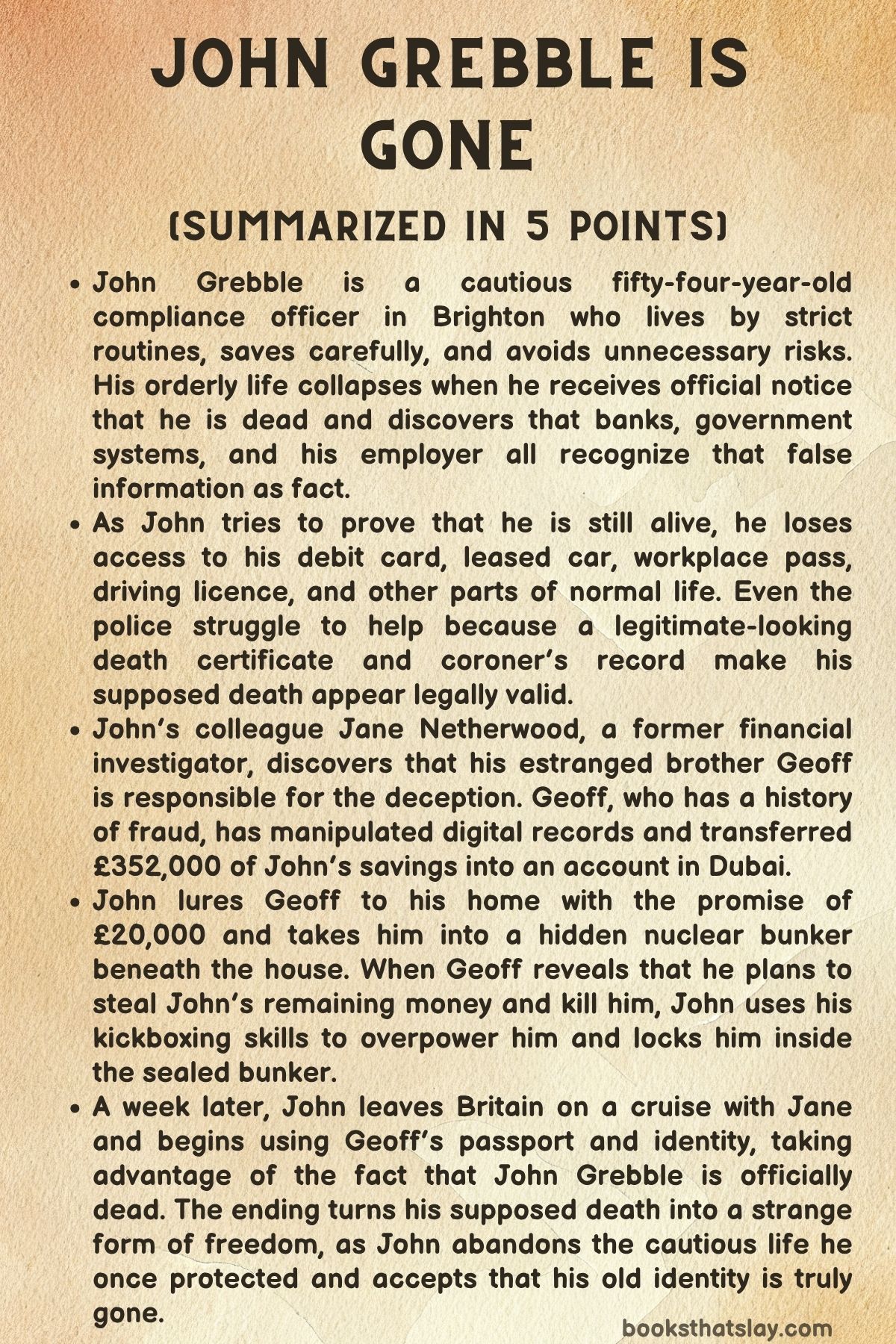
Summary
John Grebble is fifty-four years old and lives alone in Brighton, where he has constructed his life around routine, economy, and control. He works as a compliance officer, a profession suited to his cautious nature because it depends on rules, procedures, and the careful avoidance of risk.
His personal life is similarly organized. John watches his spending, protects his savings, thinks seriously about his health, and avoids emotional complications that might disturb the stability he has created.
His closest companions are his cat, Winston Smith, and his budgerigar, Mary. They provide him with company without placing the unpredictable emotional demands on him that human relationships often do.
John is not presented as a man searching for excitement. He has spent years attempting to make his future secure, believing that discipline and careful financial planning can protect him from the uncertainties faced by less cautious people.
That confidence is shaken when a strange letter arrives from his bank. The correspondence is addressed to his estate and states that John William Grebble has died.
John naturally assumes there has been some administrative error. Since he is physically alive and able to read the letter, the mistake initially appears ridiculous rather than threatening.
He contacts the bank expecting the problem to be corrected quickly. Instead, he discovers that the institution’s computer systems have received apparently legitimate confirmation of his death.
The absurd situation becomes increasingly serious because the bank cannot simply accept John’s spoken assurance that he is alive. Official records carry more authority than the living man standing before them, and those records say that John Grebble is dead.
Soon the consequences spread beyond the bank. His debit card stops functioning, cutting him off from money that legally belongs to him.
His leased vehicle is repossessed because the contractual relationship connected to John is treated as having ended with his supposed death. At work, his access pass is cancelled, creating another obstacle to the ordinary life he previously took for granted.
Government databases also reflect his death. His driving licence has been revoked, not because he committed an offence but because dead people cannot legally drive.
John gradually realizes that modern identity depends not only on physical existence but on interconnected records held by banks, employers, government agencies, and other organizations. Once those systems agree that he is dead, merely appearing alive does not immediately restore his legal existence.
He turns to the police, expecting the authorities to recognize the obvious truth. Yet the situation is more complicated than he anticipates because the records supporting his death appear authentic.
There is a formal death certificate associated with his name. There is also a coroner’s record, providing institutional confirmation that John William Grebble has died.
The police therefore face an unusual problem. John can stand in front of them claiming to be himself, but the documents suggest that the man identified by that name no longer exists.
The experience becomes increasingly disturbing for John because everything he has valued depends upon systems that now reject him. His money, mobility, employment, identity, and independence are all threatened by information stored in databases he cannot personally control.
The mystery begins to clear when Jane Netherwood becomes involved. Jane is John’s colleague and has previous experience as a financial investigator, giving her skills that become essential once it is clear that the situation is more than an accidental clerical mistake.
Jane examines what has happened and recognizes signs of deliberate financial manipulation. The false death has been constructed for a purpose, and John’s disappearance from official systems has allowed someone else to gain access to his assets.
The investigation leads directly to John’s estranged brother, Geoff. Their relationship is already damaged, and Geoff has recently been imprisoned for fraud.
Geoff possesses both the criminal experience and the willingness to manipulate institutional systems for financial gain. Rather than confronting John openly, he has attacked his brother through the administrative structures on which modern life depends.
By arranging for John to be registered as dead, Geoff has effectively stolen his identity by destroying it. Once John becomes legally deceased, his finances and accounts become vulnerable to fraudulent control.
Jane discovers that Geoff has transferred £352,000 of John’s savings into an account in Dubai. The revelation is devastating because those savings represent years of John’s discipline and self-denial.
John has spent much of his adult life limiting himself in order to build financial security. Geoff has taken that security away by turning John’s greatest strength—his faith in orderly systems—against him.
The crime also becomes intensely personal. Geoff has not merely stolen money; he has attempted to erase his brother’s legal existence.
John now understands that the strange series of cancellations and institutional refusals is part of an intentional scheme. His supposed death is not an unfortunate technical problem but an act of betrayal.
Rather than remain passive, John decides to confront Geoff. He uses the promise of money to bring his brother to his home, offering £20,000 as bait.
The arrangement gives Geoff a reason to appear, and John prepares for the encounter knowing that his brother may be dangerous. The situation has moved beyond bureaucratic frustration into direct physical risk.
John possesses a secret advantage beneath his house: a nuclear bunker. The hidden structure, originally associated with protection and survival, becomes the location where the conflict between the brothers reaches its decisive point.
John leads Geoff into the bunker. Once there, Geoff’s intentions become unmistakable.
Geoff is not satisfied with what he has already stolen. He plans to obtain John’s remaining cash and then kill him.
His actions reveal the full depth of the betrayal. Geoff’s scheme has prepared the world to accept John’s disappearance because the official systems already consider John dead.
If Geoff murders him, the crime could potentially be concealed behind the false administrative reality he has created. The man he intends to kill has already been erased from legal life.
John, however, proves less helpless than Geoff expects. His cautious personality has never meant that he is physically incapable or completely passive.
John has kickboxing skills, and when the confrontation turns violent, he uses them effectively. He overpowers Geoff and gains control of the situation.
Rather than allowing his brother to continue threatening him, John locks Geoff inside the sealed bunker. The reversal is complete: the man who attempted to erase John from the world becomes the one physically removed from it.
This decision marks a dramatic change in John’s character. The carefully obedient compliance officer abandons the assumption that formal rules will necessarily protect him.
The institutions around him have already accepted a false version of reality. John begins to recognize that his supposed death may provide an opportunity as well as a disaster.
A week after the confrontation, John leaves Britain with Jane on a cruise. The journey represents a sharp departure from the restricted existence he previously maintained.
For years, John has saved money and avoided unnecessary risks because he wanted security in the future. Yet the experience of being declared dead forces him to confront how easily that future can disappear.
He now begins taking advantage of the unusual freedom produced by Geoff’s crime. Since John Grebble has effectively ceased to exist within official records, John can step away from the identity that governed his former life.
He travels using Geoff’s passport and assumes his brother’s identity. The transformation contains a bitter irony because Geoff originally manipulated identity records in order to steal from John.
Now John uses Geoff’s identity to create a new existence for himself. The criminal who attempted to benefit from John’s disappearance has instead created the circumstances that allow John to escape his old life.
Jane accompanies John, suggesting that the experience has also opened him to companionship and a less isolated future. His previous existence was based on self-protection, but his new one begins with another person beside him.
Meanwhile, the real Geoff remains trapped underground. The roles of the brothers have been reversed both practically and symbolically.
Geoff tried to make John disappear, but John becomes the one moving freely through the world. Geoff, despite still possessing his original identity, is the person who has effectively vanished.
The conclusion gives the title John Grebble Is Gone a double meaning. John Grebble has supposedly died according to official systems, but the cautious and tightly controlled version of John also disappears through his own choices.
His former life had been built around delaying pleasure and protecting himself against future uncertainty. The experience teaches him that complete security is impossible when something as fundamental as identity can be altered through fraudulent records.
John therefore accepts rather than resists the strange opportunity created by his false death. Instead of devoting himself entirely to restoring the existence he previously had, he chooses a different path.
The ending does not simply restore normality after an unusual crime. It transforms the entire crisis into an unexpected escape from the limitations John had placed upon himself.
The declaration that John Grebble is gone consequently becomes true in a way Geoff never intended. The legally dead John abandons his old identity, leaves Britain, travels with Jane, and starts living beyond the routines that had defined him.
Characters
John Grebble
John Grebble is the central character of John Grebble Is Gone, and much of his characterization comes from the contrast between the man he is at the beginning and the person he becomes by the end. At fifty-four, he has organized his existence around caution, financial discipline, physical well-being, and strict routine, suggesting someone who believes that careful preparation can reduce life’s dangers to manageable proportions.
His profession as a compliance officer reinforces this personality because his working life depends on procedures, correct records, and obedience to systems. Being officially declared dead is therefore especially damaging to John because it destroys not only his practical circumstances but his belief that orderly institutions produce dependable outcomes.
John initially responds logically by contacting the relevant authorities, but each failed attempt to prove his existence exposes how powerless individuals can become when official records contradict reality. His development begins when he stops assuming that institutions will solve his problem and starts acting independently.
The confrontation with Geoff reveals abilities that his ordinary lifestyle conceals. His kickboxing skills show that caution is not the same as weakness, while his decision to imprison Geoff demonstrates how far he is prepared to move outside conventional rules once those rules have failed him.
By leaving Britain under Geoff’s identity, John completes a personal transformation. He moves from preserving life to actually experiencing it, accepting uncertainty rather than devoting every decision to preventing it.
Geoff Grebble
Geoff functions as the principal antagonist of John Grebble Is Gone, but his importance goes beyond his role as a fraudulent brother. His actions challenge John’s assumptions about family, identity, money, and the reliability of institutions.
Already associated with financial crime and imprisonment for fraud, Geoff understands how systems can be manipulated. His plan is disturbing because he does not simply steal John’s money directly; he first creates an administrative reality in which John has ceased to exist.
The theft of £352,000 shows Geoff’s greed, but his willingness to kill John exposes a much deeper moral corruption. The fraud is therefore not merely financial opportunism but part of an escalating attempt to remove his brother permanently.
Geoff also serves as John’s opposite. John saves, follows rules, and avoids unnecessary risks, while Geoff exploits rules, steals, deceives, and treats other people as obstacles to his interests.
The bunker confrontation reverses their positions. Geoff begins as the person controlling John’s identity from a distance, yet he ends as the powerless brother trapped underground while John takes possession of the freedom Geoff’s crime accidentally created.
Jane Netherwood
Jane Netherwood provides the investigative intelligence and practical support that help John understand what has happened in John Grebble Is Gone. Her background as a former financial investigator allows her to recognize patterns that John, despite his own professional experience in compliance, cannot immediately uncover.
Jane’s role is especially important because she gives John something he has largely avoided: dependable human companionship. His life has been intentionally solitary, but the crisis demonstrates that independence does not always mean handling every problem alone.
She helps expose Geoff’s scheme and the transfer of John’s savings, turning a bizarre collection of administrative problems into a coherent criminal explanation. Her ability to connect the financial evidence provides John with knowledge he needs before he confronts his brother.
Jane’s presence at the end also changes the emotional meaning of John’s escape. He does not simply disappear alone into another carefully isolated existence; he begins his new life with someone who has supported him through the destruction of his former identity.
Her journey with John therefore suggests that his transformation involves more than adventure. It also includes a new willingness to trust another person and share the uncertain future he once attempted to control completely.
Winston Smith
Winston Smith, John’s cat, plays a smaller but revealing role in John Grebble Is Gone because the animal helps establish the domestic life John has built for himself. His attachment to Winston shows that John is capable of affection even though he keeps most people at an emotional distance.
The choice to live with animals fits John’s controlled lifestyle. Pets provide companionship, routine, and responsibility while allowing him to maintain the independence he values.
Winston consequently contributes to the portrait of John’s solitary existence before the crisis. The cat represents the familiar household world in which John has felt safe, a world based on predictable routines rather than complicated interpersonal relationships.
The character’s importance is therefore largely symbolic and emotional rather than plot-driven. Winston helps readers understand that John’s isolation is not complete emotional emptiness; it is a carefully selected form of attachment that feels safer to him than relying on people.
Mary
Mary, John’s budgerigar, is another minor character who helps define the private world surrounding John in John Grebble Is Gone. Alongside Winston Smith, Mary reflects the small, regulated domestic environment in which John has chosen to live.
Her presence reinforces the idea that John’s routines include responsibility and care. Although he avoids many close human relationships, he is not entirely detached from other living beings.
Mary also contributes to the contrast between John’s peaceful home life and the extreme events produced by Geoff’s fraud. The ordinary details of pets, savings, work, and household routine make the destruction of John’s legal identity feel more disruptive because his previous existence has been intentionally uneventful.
As with Winston, Mary’s function is less about influencing the criminal plot and more about revealing John’s temperament. She belongs to the safe structure of his former life, highlighting how radically that structure changes once he is forced to confront uncertainty.
Themes
Identity and the Power of Official Records
Identity in John Grebble Is Gone is presented as something both deeply personal and surprisingly dependent on external systems. John knows who he is, can physically appear before other people, and possesses his own memories, yet those facts become insufficient when institutional databases say he is dead.
The conflict creates an unsettling distinction between being alive and being officially recognized as alive. Banks, employers, police systems, government agencies, and licensing authorities operate through records, meaning that an incorrect or deliberately manipulated entry can have enormous consequences.
John’s experience demonstrates how modern individuals are partly constructed through information stored beyond their direct control. His legal and financial existence depends on organizations accepting his identity, and Geoff exploits precisely that dependence.
The ending complicates the theme further because John eventually chooses to abandon the identity he fought to prove. By using Geoff’s passport, he accepts that official identity can be manipulated from the opposite direction as well.
Identity therefore becomes both a vulnerability and a form of freedom. John loses his former self through fraud, but that loss gives him the unexpected possibility of deciding whether he still wants the life associated with his name.
Security, Routine, and the Illusion of Control
John’s lifestyle is built around the assumption that discipline can create security. He saves carefully, monitors his health, avoids unnecessary relationships, follows rules, and structures his days in ways intended to minimize risk.
Yet the central crisis shows that even extreme caution cannot remove uncertainty. John does not lose his savings because he has behaved irresponsibly; he loses access to them because someone deliberately manipulates systems he trusted.
The irony is central to his development. He has sacrificed present enjoyment in order to protect his future, but the future he is preparing for can be disrupted without warning.
His false death therefore forces him to reconsider the cost of excessive caution. The problem is not that saving money or valuing routine is inherently wrong, but that John has allowed protection from possible future problems to dominate his present existence.
His decision to take a cruise and adopt a new identity represents a rejection of total control. He begins accepting that uncertainty is unavoidable and that life cannot be reduced to a perfectly managed set of risks.
Betrayal, Greed, and Family
The conflict between John and Geoff gives John Grebble Is Gone much of its emotional and moral tension. Geoff’s actions are especially damaging because they come from a brother, someone whose connection to John should ordinarily imply a basic level of loyalty.
Geoff treats that family relationship as an opportunity for exploitation. His knowledge of John helps him attack not merely his finances but the foundations of his existence.
The stolen £352,000 has significance beyond its monetary value. It represents years of John’s restraint, work, and planning, meaning Geoff is effectively stealing accumulated years of his brother’s life.
His willingness to kill John confirms that greed has replaced any meaningful sense of familial obligation. Once John becomes an obstacle to obtaining more money, Geoff sees murder as a practical solution rather than an unacceptable betrayal.
The bunker confrontation creates a harsh reversal of power. Geoff’s willingness to remove his brother from the world ultimately places him in the position of disappearance, while John gains a future that Geoff never intended to give him.
Freedom Through Loss
John’s apparent disaster gradually becomes an opportunity for liberation. Being declared dead initially strips away almost everything he values: access to money, employment, transportation, legal recognition, and the stability of his routine.
Yet those losses also separate him from obligations and habits that have limited his life. Once his previous identity has been destroyed, John is forced to ask what he actually wants rather than simply restoring everything automatically.
His decision to leave Britain with Jane shows that freedom emerges from a situation he originally experiences as terrifying. Instead of rebuilding the exact same life, he chooses to act in ways his former self probably would have considered reckless.
The theme is intentionally morally complicated because John’s freedom depends on assuming Geoff’s identity and leaving his brother imprisoned. His transformation is therefore not a simple lesson about personal growth but a darker examination of how extreme circumstances can alter a person’s understanding of acceptable choices.
By the end, John has lost the official identity he spent decades maintaining, but he has gained a willingness to live beyond fear of uncertainty. The man who once prepared endlessly for the future finally chooses to inhabit it.