International Relations Summary, Characters and Themes
International Relations by Zac Hammett is a contemporary romantic comedy centered on Max, a British diplomat competing for a prestigious embassy posting, and Hunter Moretti, an American actor whose right to remain in Britain is about to expire.
Their lives collide when Max hires Hunter to impersonate his boyfriend, beginning an arrangement that soon expands into a marriage designed to benefit them both. What starts as calculated deception gradually becomes a story about ambition, honesty, grief, trust, and the difference between performing a life and genuinely choosing one. The book uses diplomatic mishaps, theatrical humor, and emotional vulnerability to follow two men learning what partnership can actually mean.
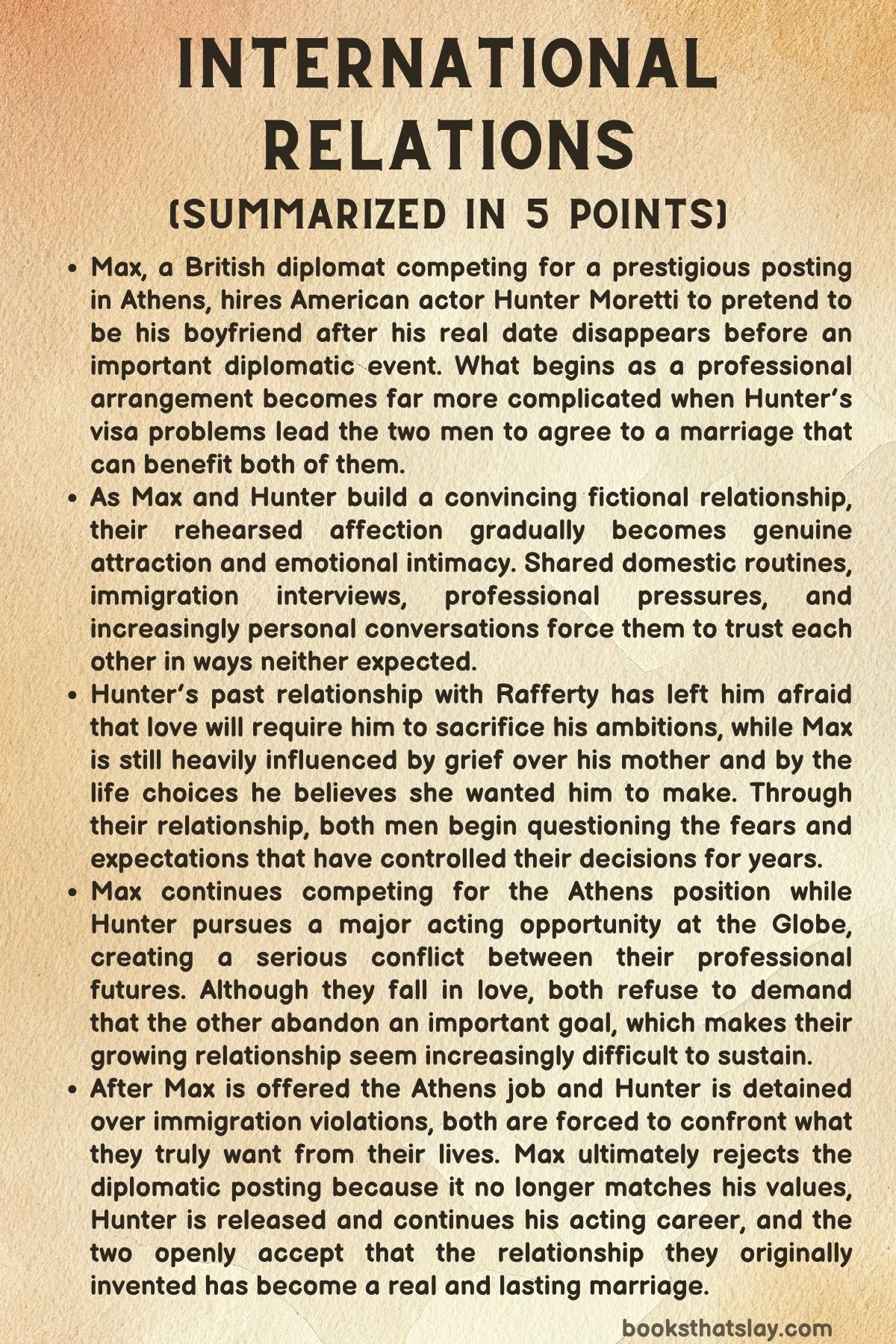
Summary
Max is a British diplomat determined to secure an embassy position in Athens. At a major Buckingham Palace state dinner celebrating a trade agreement with Greece, his professional ambitions collide with personal embarrassment when Edwin, the man he expected to attend as his date, fails to appear.
The situation becomes worse when Max’s colleague and rival, Quentin, takes advantage of the seating disruption. Quentin volunteers to change places with Max and succeeds in positioning himself beside Ambassador Wrettham Gibbons, one of the people with influence over the Athens appointment.
Max initially sees the maneuver as merely irritating, but his director, Mariam, explains that Quentin possesses another advantage. His girlfriend Flora is intelligent, socially polished, multilingual, and exceptionally effective at diplomatic events, making Quentin appear ideally prepared for the social responsibilities accompanying an embassy post.
Max objects to the implication that having the right romantic partner should influence a professional appointment. Nevertheless, when Quentin humiliates him by discussing Edwin’s absence in front of senior officials, Max impulsively claims that Edwin will attend the next diplomatic function.
He now needs to produce a convincing boyfriend almost immediately. Realizing that he does not require a genuine relationship so much as someone capable of performing one, Max decides to hire an actor.
That actor is Hunter Moretti, an American living in London whose career has nearly collapsed. His visa will expire within weeks, and repeated auditions have failed to provide employment capable of allowing him to remain in Britain.
Hunter’s career problems are closely connected to Rafferty, his former boyfriend and a theater director. Hunter once had considerable promise, including a successful performance as Rizzo in a gender-flipped production of Grease, but he sacrificed opportunities to protect Rafferty’s ego.
After their relationship ended, Rafferty damaged Hunter’s reputation within theatrical circles by portraying him as difficult. Hunter moved to London hoping to rebuild his career, but time is now running out.
Through Hunter’s eccentric agent Doily, Max and Hunter are brought together. A misunderstanding involving Greece and Grease initially leaves each man believing the meeting concerns something entirely different.
When Max finally explains that he wants Hunter to impersonate Edwin at a government reception, Hunter feels insulted. He insists that he is an actor rather than an escort, but Max clarifies that he is offering a professional acting job requiring charm, improvisation, and social skill.
Hunter eventually accepts because his immigration situation leaves him with few options. He also begins considering a much more ambitious solution: marriage to a British citizen might allow him to remain in the country.
Max and Hunter invent a fictional relationship history and prepare Hunter to appear as Edwin. Hunter approaches the task with remarkable seriousness, while Max quickly realizes that the actor’s ability to create convincing emotional intimacy is far greater than he expected.
Their attraction also becomes immediately apparent. While shopping for appropriate clothes, Max struggles not to stare at Hunter while he changes, and Hunter notices exactly what is happening.
At the British Museum reception, Hunter performs brilliantly. He charms difficult guests, responds naturally to Max, and convincingly presents himself as an affectionate partner.
Hunter even wins over museum director Montgomery Pim while privately disagreeing strongly with his attitude toward the return of the Parthenon Marbles. Max realizes that Hunter may genuinely strengthen his chances against Quentin and Flora.
Wanting Hunter to continue appearing beside him throughout the recruitment process, Max asks whether he can remain available. Hunter then reveals that his visa is about to expire and proposes the extraordinary solution he has been considering: they should get married.
Max initially refuses. Marriage to someone he has just met feels far beyond anything he can justify, even as part of his increasingly reckless plan.
Yet Max cannot stop thinking about Hunter. During the final event of the Greek state visit, he watches Quentin and Flora present themselves as the perfect diplomatic couple and begins reconsidering the advantages of Hunter’s proposal.
Max eventually leaves the prestigious function and goes to the theater where Hunter is performing. Carried away by the atmosphere, he gets onto the stage and proposes publicly, using his late mother’s signet ring because he has no conventional engagement ring.
Hunter accepts. To the audience it appears romantic, but the agreement privately serves practical purposes: Hunter can attempt to remain in Britain, while Max can maintain the appearance of a stable relationship during the Athens competition.
Their engagement soon creates something neither anticipated. Wedding preparations force them to spend significant time together, and a ridiculous adventure involving the theft of a garden gnome belonging to Elton John makes them feel like partners rather than two strangers cooperating in a fraud.
Their wedding further destabilizes the distinction between acting and reality. They expect their ceremonial kiss to be merely another convincing performance, yet both linger because they genuinely want the contact.
Their attraction quickly becomes physical. Although they understand that sex could make their already complicated arrangement even harder to manage, they eventually give in to what has been building between them.
The morning after the wedding brings an immediate reminder of reality. Immigration officials have decided to interview them separately to determine whether the marriage is genuine.
Max and Hunter create an elaborate fictional romantic history and rehearse details so that their answers will match. The process ironically forces them to become far more honest about their genuine lives.
Hunter remains especially guarded about Rafferty. His previous relationship taught him that intimacy could involve manipulation, jealousy, and professional sabotage, while Max admits that he has never truly been in love.
During their separate immigration interviews, Hunter relies partly on acting but discovers that the most convincing answers come from authentic experiences with Max. Max likewise gives surprisingly truthful answers about his fear of vulnerability and his habit of hiding uncomfortable parts of himself.
The marriage continues becoming emotionally real even as they maintain its fraudulent legal foundation. Max grows more honest with friends and colleagues, while Hunter gradually begins trusting Max with ambitions he would previously have hidden.
Hunter receives an opportunity to audition for Shakespearean work, something deeply important to him because Shakespeare originally inspired his desire to become an actor. His experience with Rafferty makes him afraid that sharing the opportunity will invite jealousy.
Instead, Max enthusiastically supports him. Hunter begins understanding that a relationship does not necessarily require one person to make himself smaller so the other can succeed.
Their domestic intimacy increases as well. They begin sharing a bed under the excuse that doing so will help them convincingly portray married life.
One night, sexual tension gives way to something quieter when Max speaks about his late mother. Hunter offers to hold him until he falls asleep, creating an intimacy based entirely on comfort and emotional security.
The next stage of Max’s embassy competition takes them to a country estate alongside Quentin and Flora. During the journey, Hunter finally tells Max the truth about Rafferty’s emotional manipulation and the damage inflicted on his career.
Max does not dismiss Hunter’s pain or try to force him to look at the experience positively. He simply listens and confirms that Hunter was treated badly.
At the estate, Hunter also becomes acquainted with Flora and discovers that the supposedly perfect diplomatic partner Max has envied is deeply unhappy. Flora has repeatedly subordinated her ambitions to Quentin’s career and is exhausted from constantly presenting herself as the ideal supporting partner.
Meanwhile, Max faces an important diplomatic exercise. He mistakes actor Gerald Pope for someone merely playing a Greek official within the assessment and responds to the simulated negotiations with increasing bluntness.
Influenced partly by Hunter’s insistence on honesty, Max eventually abandons tact and says exactly what he thinks about problems within the trade agreement. His assessors react badly, leaving him convinced that he has destroyed his chance of obtaining the Athens position.
Outside, Max and Hunter argue. Hunter challenges Max’s habit of structuring his life according to a final letter from his mother, suggesting that Max has transformed loving advice from a dead parent into permanent instructions governing his future.
Max initially reacts angrily, but the criticism eventually forces him to distinguish between what his mother wanted for him and what he actually wants. He decides that he still genuinely desires the Athens job and returns to continue fighting for it.
Later, Max discovers a more balanced understanding of honesty. When Baroness Sharon faces a political problem involving accidentally distributed documents, Max advises her to acknowledge the mistake while presenting it tactfully.
He begins realizing that honesty and diplomacy do not have to be opposites. Truth can be expressed thoughtfully instead of either hidden completely or delivered without regard for consequences.
That same evening, Max and Hunter finally stop pretending that their attraction can remain contained. They leave the party, discover an indoor swimming pool, and spend the night together in an experience marked as much by laughter and trust as physical desire.
The consequences are emotionally complicated. Max understands that Hunter’s future is in London, while his own possible appointment would take him to Athens.
Rather than allow physical intimacy to conceal the problem, Max asks Hunter to return to his own bedroom while they determine what their relationship actually means. Hunter is badly hurt but recognizes that Max is confronting the issue instead of avoiding it.
Max later confesses the truth about the marriage to his father. The admission demonstrates how much Hunter has changed him, because Max would once have done almost anything to avoid disappointing someone he loved.
Hunter then earns a callback for Hamlet at the Globe. During the audition, he nearly loses confidence until he sees Max watching from the audience and draws strength from knowing that someone genuinely wants him to succeed.
At the same time, Max reaches the final stage of the Athens competition against Quentin. Mariam finally admits that she has always considered Max an excellent diplomat but did not want to lose him from her team.
Their immigration problems unexpectedly return when officials make an unannounced visit to their home. Max and Hunter improvise an absurd story about a decorative badger, demonstrating how naturally they now operate together.
They eventually travel to Greece for the final embassy assessment. There, their emotional and physical relationship deepens even while both understand that professional success may separate them.
Hunter realizes that he loves Max and, because of that love, sincerely wants Max to receive the position he has worked so hard to obtain. Max likewise refuses to expect Hunter to abandon his theatrical ambitions.
A real protest connected to the trade agreement erupts during the final assessment, confronting Max with people whose problems cannot simply be resolved through diplomatic reassurance. Soon afterward, Max receives the offer he once desperately wanted.
Instead of feeling triumphant, he feels devastated. The achievement forces him to confront not only the possibility of losing Hunter but also his changing relationship with diplomacy itself.
Hunter flies back to London alone and is detained at Heathrow for violating immigration rules. He faces possible deportation and realizes that the apparently comic scheme now carries very serious consequences.
While Hunter waits in detention, he thinks about how completely Max has changed his understanding of relationships. Max has encouraged him to trust his talent, accept support, and stop expecting every intimate relationship to end in betrayal.
Max, meanwhile, concludes that he does not actually want the Athens position anymore. His decision is not simply about remaining close to Hunter; he recognizes that his old career ambitions were tied to habits of pleasing people, smoothing over problems, and following expectations he no longer accepts.
When Max learns that Hunter has been detained, he mobilizes everyone available to help, including Doily, his father, and Baroness Sharon. Instead of hiding the scandal, he is willing to expose the truth and accept consequences if doing so can help Hunter.
Hunter is ultimately released. Returning home, he initially assumes that Max’s Athens appointment still means their relationship cannot continue.
Max reveals that he has rejected the position because it no longer represents the life he wants. Hunter finally tells Max that he loves him, and Max returns the declaration.
Six months later, their lives have changed dramatically. Max now works as Baroness Sharon’s Chief of Staff, allowing him to remain in London while still participating in international affairs.
Hunter’s theatrical career has revived through an unconventional production of Hamlet that combines Shakespeare with musical performance. Flora has left Quentin’s shadow and become Hunter’s agent, while Doily and Max’s father have formed their own unexpected relationship.
Watching Hunter perform, Max finally understands his mother’s final advice differently. She was never demanding that he follow one fixed career path; she wanted him to live fully and recognize the importance of human connection.
The supposedly fraudulent marriage has therefore produced something unexpectedly authentic. Max and Hunter began by performing love for other people, but through trust, conflict, honesty, friendship, and mutual encouragement, they created the very relationship they had originally pretended to possess.
Characters
Max
Max is the emotional center of International Relations, and much of his development comes from recognizing how often his cheerful personality functions as protection. He appears socially confident, optimistic, professionally ambitious, and capable of talking his way through almost any awkward situation.
Underneath that polished surface, however, he is afraid of disappointing other people and deeply uncomfortable with exposing his insecurities. This habit explains why his first solution to Edwin’s disappearance is not simply admitting that he has been ghosted but inventing a story that eventually requires an actor, an engagement, and a marriage.
Max’s relationship with his late mother is central to understanding him. Her adventurous personality encouraged him to travel and engage with the wider world, while her death left him searching for a way to preserve her influence permanently.
Her final letter becomes almost a private instruction manual. Max interprets her encouragement to see the world and care for his father as obligations rather than loving wishes, which prevents him from asking whether the career he has built still reflects his own desires.
His diplomatic career mirrors his emotional habits. Max is skilled at reassuring people, maintaining pleasant relationships, and presenting difficult situations in acceptable ways, but those same talents can become methods of avoiding uncomfortable truths.
Hunter gradually teaches him that honesty sometimes requires risking embarrassment, disappointment, or conflict. Max initially takes that lesson too far during the assessment exercise, becoming recklessly blunt, but he later learns that truth does not have to mean cruelty or tactlessness.
His relationship with Hunter changes his understanding of vulnerability most dramatically. He begins their arrangement intending to control appearances but eventually discovers that being known by another person is more satisfying than successfully managing how everyone sees him.
By the conclusion, Max has not abandoned diplomacy or his optimistic nature. Instead, he has learned to use those qualities without allowing them to become substitutes for emotional honesty, making his eventual career with Sharon far more suitable to the person he has become.
Hunter Moretti
Hunter initially appears in International Relations as Max’s opposite: direct where Max is evasive, openly argumentative where Max is accommodating, and deeply skeptical where Max prefers optimism. His confidence, however, is partly defensive.
Years of professional rejection and his damaging relationship with Rafferty have taught him to expect disappointment. Hunter therefore protects himself by assuming that situations will fail before they have the opportunity to hurt him.
His identity as an actor makes the fake relationship especially significant. Hunter is professionally trained to create believable emotions and relationships, yet performing Max’s boyfriend produces feelings that cannot be confined to acting.
He approaches the role of Edwin seriously, constructing details and emotional logic so that the deception will remain convincing. Ironically, the better he becomes at pretending to know Max intimately, the more genuinely intimate their relationship becomes.
Rafferty’s influence explains many of Hunter’s fears. His former boyfriend treated Hunter’s success as competition, encouraged him to sacrifice opportunities, and later damaged his reputation.
As a result, Hunter initially believes that trusting another person with his ambitions gives that person power to undermine him. Max’s enthusiastic response to his Shakespeare audition challenges that belief and shows Hunter that love can involve celebrating another person’s success even when that success creates practical difficulties.
Hunter also has a tendency to confuse pessimism with realism. When he concludes that his London career and Max’s diplomatic future make a relationship impossible, his friends recognize that he is protecting himself from uncertainty.
His development involves accepting that hope is not necessarily foolish. By the time he is detained, he has begun consciously adopting some of Max’s optimism, proving that the relationship has altered the way he imagines his own future.
Quentin
Quentin functions as Max’s professional rival in International Relations, but he also represents an alternative version of ambition. He is strategic, competitive, socially opportunistic, and willing to exploit Max’s weaknesses whenever doing so improves his own position.
His maneuver at the palace dinner establishes this immediately. What appears to be a generous offer to solve a seating problem actually places Quentin beside the ambassador while pushing Max farther from professional influence.
Quentin’s relationship with Flora initially makes him appear even more formidable. She is intelligent, multilingual, polished, and highly effective at diplomatic functions, allowing Quentin to present the image of a perfectly prepared future ambassador.
Yet the book gradually exposes how dependent that image is on Flora’s unpaid emotional and social labor. Quentin’s professional ambitions have expanded to the point that Flora’s independent desires are treated as secondary.
His relationship therefore serves as a contrast to the partnership Max develops with Hunter. Quentin benefits from Flora’s talents but often assumes that those talents exist in service of him, while Max eventually learns that supporting Hunter means wanting Hunter to succeed independently.
Quentin is not merely a comic villain. His presence reveals the culture surrounding elite professional competition, where personal relationships can become extensions of career strategy.
His declining relationship with Flora demonstrates the cost of treating partnership primarily as an asset rather than as a reciprocal bond between two individuals.
Flora Forbes
Flora first appears in International Relations largely through Max’s jealous perception of her. To him, she seems impossibly accomplished: socially confident, linguistically talented, professionally impressive, and capable of rescuing Quentin from almost any awkward situation.
Max consequently treats Flora as evidence that Quentin possesses an unfair advantage. Hunter’s later conversation with her reveals that the apparently effortless image depends on considerable sacrifice.
Flora is exhausted from continually performing the role of ideal diplomatic partner. She smooths over Quentin’s mistakes, manages social situations, and uses her intelligence to advance a career that is not actually hers.
Her frustration gives her story an important connection with Hunter’s past. Like Hunter with Rafferty, she understands what happens when one person’s ambitions are expected to shrink so another person’s ambitions can dominate the relationship.
Flora’s eventual independence is therefore significant. By leaving the role she has been performing and becoming Hunter’s agent, she redirects her abilities toward work that belongs to her.
Her transformation also exposes the weakness in Max’s original belief that Quentin’s relationship automatically represents stability. What looks perfect from a professional distance may contain resentment and imbalance that outsiders cannot see.
Rafferty
Rafferty never dominates the immediate action of International Relations, yet his influence is present throughout Hunter’s emotional development. He represents the lasting effects of a relationship in which affection became inseparable from control.
As a director and Hunter’s romantic partner, Rafferty possessed both personal and professional power. Hunter sacrificed opportunities to protect him, including career possibilities that might have brought greater success.
When the relationship ended, Rafferty damaged Hunter’s reputation by portraying him as difficult within theater circles. The betrayal therefore attacked both Hunter’s emotional confidence and the profession central to his identity.
Hunter carries Rafferty’s influence into his marriage with Max. He expects jealousy when he discusses auditions, assumes success might threaten his partner, and hesitates to expose ambitions that another person could later use against him.
Max’s responses gradually allow Hunter to separate intimacy from competition. He learns that a partner can encourage achievement without demanding ownership over it.
Rafferty consequently functions less as a conventional present-tense antagonist than as an emotional shadow Hunter must stop allowing to shape his expectations of love.
Mariam
Mariam is Max’s director and occupies an ambiguous position between mentor, friend, and professional obstacle. She understands the realities of diplomatic culture and warns Max that social expectations surrounding partners can influence appointments even when those expectations are unfair.
Her advice is often practical rather than comforting. She recognizes Quentin and Flora’s advantages and forces Max to confront institutional attitudes he would rather dismiss.
Later, however, Max learns that Mariam’s behavior has also been influenced by self-interest. She does not want him to obtain the Athens role partly because she values him highly and does not want to lose him from her team.
Her affection is genuine, but Max correctly recognizes that genuine affection does not justify restricting another person’s ambitions. Their confrontation becomes another stage in his growing ability to challenge people rather than automatically accepting what they want from him.
Mariam therefore illustrates one of the novel’s recurring ideas: caring about someone does not automatically make every action taken on that person’s behalf fair or correct.
Doily
Doily is Hunter’s eccentric agent and one of the strongest sources of comic energy in the story. Her misunderstanding about Greece and Grease accidentally brings Max and Hunter together, making her confusion one of the most consequential mistakes in the entire plot.
Despite her eccentricity, Doily is deeply loyal to Hunter. She provides him with somewhere to live, finds him opportunities where possible, and becomes one of the first people he contacts when his immigration situation collapses.
Her later romance with Max’s father reinforces the story’s interest in unexpected relationships. The two appear temperamentally mismatched, yet their connection demonstrates that compatibility does not always follow obvious patterns.
Doily’s eventual retirement also gives her an independent conclusion rather than reducing her entirely to Hunter’s professional helper. She chooses a new stage of life involving travel and companionship, mirroring the broader pattern of characters reconsidering the roles they assumed they were supposed to continue playing.
Max’s Father
Max’s father represents caution, predictability, and fear of loss. A retired air traffic controller, he has been profoundly affected by his wife’s death and responds by attempting to minimize future emotional risk.
His worldview contrasts with that of Max’s mother, whose adventurous nature encouraged exploration and uncertainty. Max’s career originally becomes a compromise between these parental influences: international enough to satisfy his mother’s example but controlled enough to reassure his father.
His relationship with Doily eventually forces him to confront his own avoidance. He develops feelings for her but considers withdrawing because loving someone again creates the possibility of another devastating loss.
Max recognizes his father’s behavior because he has been making comparable choices himself. Seeing his father hesitate helps Max understand that emotional safety purchased through permanent avoidance is not really safety.
The father’s acceptance of Doily provides a hopeful parallel to Max and Hunter’s relationship. Both men eventually decide that uncertainty is worth accepting when the alternative is refusing meaningful connection.
Nessie
Nessie plays a smaller but important role in Max’s development by showing how his new approach to honesty affects relationships beyond romance. Max has spent years giving colleagues an edited, upbeat version of himself while keeping anxiety and disappointment private.
When Nessie confides in him about her own difficulties, Max understands that vulnerability is not simply a burden placed on another person. It can be an act of trust that makes friendship deeper.
Although he is not immediately ready to confess the truth about Hunter and the marriage, his willingness to consider doing so marks genuine progress. Nessie therefore helps demonstrate that Max’s transformation is not limited to becoming a better romantic partner.
Baroness Sharon
Baroness Sharon combines eccentricity with considerable political intelligence. She initially appears during the embassy assessment process, where her informal behavior contrasts sharply with the stiff professionalism surrounding Max and Quentin.
Her importance grows when Max advises her about dealing with accidentally distributed sensitive documents. Their conversation helps him understand that honesty and tact can work together rather than existing as absolute opposites.
She becomes even more significant during Hunter’s detention. Sharon uses her political knowledge and connections while also warning Max realistically about the potential consequences of turning the case into a public battle.
Her eventual decision to employ Max as Chief of Staff provides him with a professional future better aligned with the person he has become. The role allows him to remain internationally engaged without forcing him back into exactly the habits he has spent the story questioning.
Mr Peanut
Mr Peanut, Max’s dog, is a small but recurring source of emotional stability and domestic warmth. His presence helps establish Max’s private life outside diplomacy and later becomes part of the household Hunter gradually joins.
As Hunter begins walking him and caring for him, Mr Peanut becomes one of the everyday elements through which the fake marriage starts resembling a real domestic partnership. He is present during moments that show Hunter becoming integrated into Max’s home rather than merely appearing beside him at official functions.
Mr Peanut also contributes to the story’s humor, particularly when he becomes involved in the chaotic group assembled during the campaign to help Hunter after his detention.
Themes
Performance, Identity, and Authenticity
Performance operates far beyond Hunter’s professional life as an actor. Nearly everyone in the story is performing some version of themselves for employers, partners, institutions, or society, making authenticity a constantly shifting question.
Hunter is the literal performer, yet his acting often produces unexpected truth. He is hired to impersonate Edwin, learns invented details about Max, and later rehearses a fabricated romantic history, but the emotional closeness created while maintaining those lies becomes increasingly genuine.
Max performs in a different way. His cheerful optimism and diplomatic charm allow him to appear confident even when he is embarrassed, grieving, frightened, or uncertain.
Diplomacy itself requires carefully chosen language, and Max has become so accustomed to managing other people’s reactions that he often struggles to distinguish tact from avoidance. His development involves realizing that authenticity does not require saying every thought immediately, but it does require refusing to construct his entire life around what will keep others comfortable.
Flora provides another version of performance through her role as Quentin’s supposedly perfect partner. Her elegance at official events conceals exhaustion and frustration because the public image depends on her continually suppressing her own ambitions.
International Relations therefore complicates the simple opposition between truth and acting. Performance can conceal reality, but it can also give characters a safe space in which unexplored parts of themselves emerge.
Max and Hunter begin by pretending to possess trust, affection, and commitment. Through repeatedly practicing those qualities, they discover that they are capable of building them genuinely.
Love as Partnership Rather Than Sacrifice
Hunter’s history has taught him to associate relationships with unequal sacrifice. Rafferty expected Hunter to limit his success, placed his own ego above Hunter’s ambitions, and punished him professionally after their relationship ended.
Flora faces a related problem with Quentin. Her considerable abilities are repeatedly directed toward advancing Quentin’s diplomatic career while her own goals become secondary.
These relationships establish a model of love based on imbalance: one person advances while the other performs support. Hunter initially assumes that serious relationships inevitably operate this way, which explains why he considers a future with Max impossible once their professional paths appear to diverge.
Max and Hunter gradually construct something different. Max supports Hunter’s Globe audition even though Hunter’s success makes remaining in London increasingly important and therefore complicates Max’s potential move to Athens.
Hunter likewise tells Max that he genuinely hopes he receives the embassy position despite knowing that it may separate them. Neither wants love to become a justification for restricting the other.
The conclusion preserves this principle. Max does not reject Athens simply to prove his devotion to Hunter; he independently recognizes that the position no longer suits his changing values.
Likewise, Hunter continues pursuing acting rather than abandoning his career to follow Max. Their relationship becomes sustainable because both men are able to grow rather than deciding that commitment requires one person to disappear into the other’s future.
Honesty, Diplomacy, and Emotional Courage
Max initially treats honesty almost as a threat because uncomfortable truths create reactions he cannot control. His instinct is to smooth over embarrassment, reassure people, and produce socially convenient explanations.
The entire plot begins because he cannot simply admit that Edwin ghosted him. One lie leads to another until Max is participating in a fabricated relationship and fraudulent marriage.
Hunter pushes Max toward greater honesty, but International Relations does not present bluntness as automatically virtuous. Max’s disastrous assessment exercise demonstrates that saying everything without considering timing or consequences can be as irresponsible as hiding the truth.
His later conversation with Baroness Sharon produces a more mature understanding. She does not need either a complete fabrication or a humiliating confession; she needs a truthful response expressed with judgment.
That lesson also applies to Max’s emotional life. Honesty requires him to tell his father about Hunter, confront Mariam, admit uncertainty about his career, and explain to Hunter that physical closeness cannot solve their unresolved future.
Hunter undergoes a parallel development. He must speak openly about Rafferty, acknowledge how fear continues shaping his expectations, and finally admit that he loves Max.
Emotional courage in the story therefore involves more than confession. It means accepting that truthful communication may change relationships in ways the speaker cannot control.
Grief, Fear, and Choosing a Life for Yourself
Max and Hunter are both living according to decisions shaped by earlier pain. Max organizes his future around his mother’s death, while Hunter organizes much of his emotional behavior around what happened with Rafferty.
Max’s mother’s letter is especially powerful because it represents both love and grief. Her encouragement to travel, care for his father, and embrace life becomes sacred after her death.
The problem is not the advice itself but Max’s interpretation of it. He gradually stops treating the letter as encouragement and begins treating it as a permanent set of instructions, allowing a moment from his past to determine choices his mother could never have anticipated.
Hunter recognizes this before Max does because he understands what it means to let another person’s influence continue shaping your future. His own fear of professional jealousy, emotional manipulation, and eventual disappointment survives long after Rafferty has left his life.
Both men eventually learn that recovering from pain does not require rejecting the people or experiences that shaped them. It requires deciding which lessons still deserve authority.
Max can love his mother without pursuing Athens simply because he once believed that was what she wanted. Hunter can acknowledge the damage Rafferty caused without assuming every future partner will repeat it.
By the end, both characters have replaced inherited fear with conscious choice. Max interprets his mother’s message as permission to live fully rather than as an obligation to follow one predetermined path, while Hunter allows himself to hope for both professional success and a secure relationship.
International Relations by Zac Hammett is a contemporary romantic comedy centered on Max, a British diplomat competing for a prestigious embassy posting, and Hunter Moretti, an American actor whose right to remain in Britain is about to expire. Their lives collide when Max hires Hunter to impersonate his boyfriend, beginning an arrangement that soon expands into a marriage designed to benefit them both. What starts as calculated deception gradually becomes a story about ambition, honesty, grief, trust, and the difference between performing a life and genuinely choosing one. The book uses diplomatic mishaps, theatrical humor, and emotional vulnerability to follow two men learning what partnership can actually mean. Pasted text
Summary
Max is a British diplomat determined to secure an embassy position in Athens. At a major Buckingham Palace state dinner celebrating a trade agreement with Greece, his professional ambitions collide with personal embarrassment when Edwin, the man he expected to attend as his date, fails to appear.
The situation becomes worse when Max’s colleague and rival, Quentin, takes advantage of the seating disruption. Quentin volunteers to change places with Max and succeeds in positioning himself beside Ambassador Wrettham Gibbons, one of the people with influence over the Athens appointment.
Max initially sees the maneuver as merely irritating, but his director, Mariam, explains that Quentin possesses another advantage. His girlfriend Flora is intelligent, socially polished, multilingual, and exceptionally effective at diplomatic events, making Quentin appear ideally prepared for the social responsibilities accompanying an embassy post.
Max objects to the implication that having the right romantic partner should influence a professional appointment. Nevertheless, when Quentin humiliates him by discussing Edwin’s absence in front of senior officials, Max impulsively claims that Edwin will attend the next diplomatic function.
He now needs to produce a convincing boyfriend almost immediately. Realizing that he does not require a genuine relationship so much as someone capable of performing one, Max decides to hire an actor.
That actor is Hunter Moretti, an American living in London whose career has nearly collapsed. His visa will expire within weeks, and repeated auditions have failed to provide employment capable of allowing him to remain in Britain.
Hunter’s career problems are closely connected to Rafferty, his former boyfriend and a theater director. Hunter once had considerable promise, including a successful performance as Rizzo in a gender-flipped production of Grease, but he sacrificed opportunities to protect Rafferty’s ego.
After their relationship ended, Rafferty damaged Hunter’s reputation within theatrical circles by portraying him as difficult. Hunter moved to London hoping to rebuild his career, but time is now running out.
Through Hunter’s eccentric agent Doily, Max and Hunter are brought together. A misunderstanding involving Greece and Grease initially leaves each man believing the meeting concerns something entirely different.
When Max finally explains that he wants Hunter to impersonate Edwin at a government reception, Hunter feels insulted. He insists that he is an actor rather than an escort, but Max clarifies that he is offering a professional acting job requiring charm, improvisation, and social skill.
Hunter eventually accepts because his immigration situation leaves him with few options. He also begins considering a much more ambitious solution: marriage to a British citizen might allow him to remain in the country.
Max and Hunter invent a fictional relationship history and prepare Hunter to appear as Edwin. Hunter approaches the task with remarkable seriousness, while Max quickly realizes that the actor’s ability to create convincing emotional intimacy is far greater than he expected.
Their attraction also becomes immediately apparent. While shopping for appropriate clothes, Max struggles not to stare at Hunter while he changes, and Hunter notices exactly what is happening.
At the British Museum reception, Hunter performs brilliantly. He charms difficult guests, responds naturally to Max, and convincingly presents himself as an affectionate partner.
Hunter even wins over museum director Montgomery Pim while privately disagreeing strongly with his attitude toward the return of the Parthenon Marbles. Max realizes that Hunter may genuinely strengthen his chances against Quentin and Flora.
Wanting Hunter to continue appearing beside him throughout the recruitment process, Max asks whether he can remain available. Hunter then reveals that his visa is about to expire and proposes the extraordinary solution he has been considering: they should get married.
Max initially refuses. Marriage to someone he has just met feels far beyond anything he can justify, even as part of his increasingly reckless plan.
Yet Max cannot stop thinking about Hunter. During the final event of the Greek state visit, he watches Quentin and Flora present themselves as the perfect diplomatic couple and begins reconsidering the advantages of Hunter’s proposal.
Max eventually leaves the prestigious function and goes to the theater where Hunter is performing. Carried away by the atmosphere, he gets onto the stage and proposes publicly, using his late mother’s signet ring because he has no conventional engagement ring.
Hunter accepts. To the audience it appears romantic, but the agreement privately serves practical purposes: Hunter can attempt to remain in Britain, while Max can maintain the appearance of a stable relationship during the Athens competition.
Their engagement soon creates something neither anticipated. Wedding preparations force them to spend significant time together, and a ridiculous adventure involving the theft of a garden gnome belonging to Elton John makes them feel like partners rather than two strangers cooperating in a fraud.
Their wedding further destabilizes the distinction between acting and reality. They expect their ceremonial kiss to be merely another convincing performance, yet both linger because they genuinely want the contact.
Their attraction quickly becomes physical. Although they understand that sex could make their already complicated arrangement even harder to manage, they eventually give in to what has been building between them.
The morning after the wedding brings an immediate reminder of reality. Immigration officials have decided to interview them separately to determine whether the marriage is genuine.
Max and Hunter create an elaborate fictional romantic history and rehearse details so that their answers will match. The process ironically forces them to become far more honest about their genuine lives.
Hunter remains especially guarded about Rafferty. His previous relationship taught him that intimacy could involve manipulation, jealousy, and professional sabotage, while Max admits that he has never truly been in love.
During their separate immigration interviews, Hunter relies partly on acting but discovers that the most convincing answers come from authentic experiences with Max. Max likewise gives surprisingly truthful answers about his fear of vulnerability and his habit of hiding uncomfortable parts of himself.
The marriage continues becoming emotionally real even as they maintain its fraudulent legal foundation. Max grows more honest with friends and colleagues, while Hunter gradually begins trusting Max with ambitions he would previously have hidden.
Hunter receives an opportunity to audition for Shakespearean work, something deeply important to him because Shakespeare originally inspired his desire to become an actor. His experience with Rafferty makes him afraid that sharing the opportunity will invite jealousy.
Instead, Max enthusiastically supports him. Hunter begins understanding that a relationship does not necessarily require one person to make himself smaller so the other can succeed.
Their domestic intimacy increases as well. They begin sharing a bed under the excuse that doing so will help them convincingly portray married life.
One night, sexual tension gives way to something quieter when Max speaks about his late mother. Hunter offers to hold him until he falls asleep, creating an intimacy based entirely on comfort and emotional security.
The next stage of Max’s embassy competition takes them to a country estate alongside Quentin and Flora. During the journey, Hunter finally tells Max the truth about Rafferty’s emotional manipulation and the damage inflicted on his career.
Max does not dismiss Hunter’s pain or try to force him to look at the experience positively. He simply listens and confirms that Hunter was treated badly.
At the estate, Hunter also becomes acquainted with Flora and discovers that the supposedly perfect diplomatic partner Max has envied is deeply unhappy. Flora has repeatedly subordinated her ambitions to Quentin’s career and is exhausted from constantly presenting herself as the ideal supporting partner.
Meanwhile, Max faces an important diplomatic exercise. He mistakes actor Gerald Pope for someone merely playing a Greek official within the assessment and responds to the simulated negotiations with increasing bluntness.
Influenced partly by Hunter’s insistence on honesty, Max eventually abandons tact and says exactly what he thinks about problems within the trade agreement. His assessors react badly, leaving him convinced that he has destroyed his chance of obtaining the Athens position.
Outside, Max and Hunter argue. Hunter challenges Max’s habit of structuring his life according to a final letter from his mother, suggesting that Max has transformed loving advice from a dead parent into permanent instructions governing his future.
Max initially reacts angrily, but the criticism eventually forces him to distinguish between what his mother wanted for him and what he actually wants. He decides that he still genuinely desires the Athens job and returns to continue fighting for it.
Later, Max discovers a more balanced understanding of honesty. When Baroness Sharon faces a political problem involving accidentally distributed documents, Max advises her to acknowledge the mistake while presenting it tactfully.
He begins realizing that honesty and diplomacy do not have to be opposites. Truth can be expressed thoughtfully instead of either hidden completely or delivered without regard for consequences.
That same evening, Max and Hunter finally stop pretending that their attraction can remain contained. They leave the party, discover an indoor swimming pool, and spend the night together in an experience marked as much by laughter and trust as physical desire.
The consequences are emotionally complicated. Max understands that Hunter’s future is in London, while his own possible appointment would take him to Athens.
Rather than allow physical intimacy to conceal the problem, Max asks Hunter to return to his own bedroom while they determine what their relationship actually means. Hunter is badly hurt but recognizes that Max is confronting the issue instead of avoiding it.
Max later confesses the truth about the marriage to his father. The admission demonstrates how much Hunter has changed him, because Max would once have done almost anything to avoid disappointing someone he loved.
Hunter then earns a callback for Hamlet at the Globe. During the audition, he nearly loses confidence until he sees Max watching from the audience and draws strength from knowing that someone genuinely wants him to succeed.
At the same time, Max reaches the final stage of the Athens competition against Quentin. Mariam finally admits that she has always considered Max an excellent diplomat but did not want to lose him from her team.
Their immigration problems unexpectedly return when officials make an unannounced visit to their home. Max and Hunter improvise an absurd story about a decorative badger, demonstrating how naturally they now operate together.
They eventually travel to Greece for the final embassy assessment. There, their emotional and physical relationship deepens even while both understand that professional success may separate them.
Hunter realizes that he loves Max and, because of that love, sincerely wants Max to receive the position he has worked so hard to obtain. Max likewise refuses to expect Hunter to abandon his theatrical ambitions.
A real protest connected to the trade agreement erupts during the final assessment, confronting Max with people whose problems cannot simply be resolved through diplomatic reassurance. Soon afterward, Max receives the offer he once desperately wanted.
Instead of feeling triumphant, he feels devastated. The achievement forces him to confront not only the possibility of losing Hunter but also his changing relationship with diplomacy itself.
Hunter flies back to London alone and is detained at Heathrow for violating immigration rules. He faces possible deportation and realizes that the apparently comic scheme now carries very serious consequences.
While Hunter waits in detention, he thinks about how completely Max has changed his understanding of relationships. Max has encouraged him to trust his talent, accept support, and stop expecting every intimate relationship to end in betrayal.
Max, meanwhile, concludes that he does not actually want the Athens position anymore. His decision is not simply about remaining close to Hunter; he recognizes that his old career ambitions were tied to habits of pleasing people, smoothing over problems, and following expectations he no longer accepts.
When Max learns that Hunter has been detained, he mobilizes everyone available to help, including Doily, his father, and Baroness Sharon. Instead of hiding the scandal, he is willing to expose the truth and accept consequences if doing so can help Hunter.
Hunter is ultimately released. Returning home, he initially assumes that Max’s Athens appointment still means their relationship cannot continue.
Max reveals that he has rejected the position because it no longer represents the life he wants. Hunter finally tells Max that he loves him, and Max returns the declaration.
Six months later, their lives have changed dramatically. Max now works as Baroness Sharon’s Chief of Staff, allowing him to remain in London while still participating in international affairs.
Hunter’s theatrical career has revived through an unconventional production of Hamlet that combines Shakespeare with musical performance. Flora has left Quentin’s shadow and become Hunter’s agent, while Doily and Max’s father have formed their own unexpected relationship.
Watching Hunter perform, Max finally understands his mother’s final advice differently. She was never demanding that he follow one fixed career path; she wanted him to live fully and recognize the importance of human connection.
The supposedly fraudulent marriage has therefore produced something unexpectedly authentic. Max and Hunter began by performing love for other people, but through trust, conflict, honesty, friendship, and mutual encouragement, they created the very relationship they had originally pretended to possess.
Characters
Max
Max is the emotional center of International Relations, and much of his development comes from recognizing how often his cheerful personality functions as protection. He appears socially confident, optimistic, professionally ambitious, and capable of talking his way through almost any awkward situation.
Underneath that polished surface, however, he is afraid of disappointing other people and deeply uncomfortable with exposing his insecurities. This habit explains why his first solution to Edwin’s disappearance is not simply admitting that he has been ghosted but inventing a story that eventually requires an actor, an engagement, and a marriage.
Max’s relationship with his late mother is central to understanding him. Her adventurous personality encouraged him to travel and engage with the wider world, while her death left him searching for a way to preserve her influence permanently.
Her final letter becomes almost a private instruction manual. Max interprets her encouragement to see the world and care for his father as obligations rather than loving wishes, which prevents him from asking whether the career he has built still reflects his own desires.
His diplomatic career mirrors his emotional habits. Max is skilled at reassuring people, maintaining pleasant relationships, and presenting difficult situations in acceptable ways, but those same talents can become methods of avoiding uncomfortable truths.
Hunter gradually teaches him that honesty sometimes requires risking embarrassment, disappointment, or conflict. Max initially takes that lesson too far during the assessment exercise, becoming recklessly blunt, but he later learns that truth does not have to mean cruelty or tactlessness.
His relationship with Hunter changes his understanding of vulnerability most dramatically. He begins their arrangement intending to control appearances but eventually discovers that being known by another person is more satisfying than successfully managing how everyone sees him.
By the conclusion, Max has not abandoned diplomacy or his optimistic nature. Instead, he has learned to use those qualities without allowing them to become substitutes for emotional honesty, making his eventual career with Sharon far more suitable to the person he has become.
Hunter Moretti
Hunter initially appears in International Relations as Max’s opposite: direct where Max is evasive, openly argumentative where Max is accommodating, and deeply skeptical where Max prefers optimism. His confidence, however, is partly defensive.
Years of professional rejection and his damaging relationship with Rafferty have taught him to expect disappointment. Hunter therefore protects himself by assuming that situations will fail before they have the opportunity to hurt him.
His identity as an actor makes the fake relationship especially significant. Hunter is professionally trained to create believable emotions and relationships, yet performing Max’s boyfriend produces feelings that cannot be confined to acting.
He approaches the role of Edwin seriously, constructing details and emotional logic so that the deception will remain convincing. Ironically, the better he becomes at pretending to know Max intimately, the more genuinely intimate their relationship becomes.
Rafferty’s influence explains many of Hunter’s fears. His former boyfriend treated Hunter’s success as competition, encouraged him to sacrifice opportunities, and later damaged his reputation.
As a result, Hunter initially believes that trusting another person with his ambitions gives that person power to undermine him. Max’s enthusiastic response to his Shakespeare audition challenges that belief and shows Hunter that love can involve celebrating another person’s success even when that success creates practical difficulties.
Hunter also has a tendency to confuse pessimism with realism. When he concludes that his London career and Max’s diplomatic future make a relationship impossible, his friends recognize that he is protecting himself from uncertainty.
His development involves accepting that hope is not necessarily foolish. By the time he is detained, he has begun consciously adopting some of Max’s optimism, proving that the relationship has altered the way he imagines his own future.
Quentin
Quentin functions as Max’s professional rival in International Relations, but he also represents an alternative version of ambition. He is strategic, competitive, socially opportunistic, and willing to exploit Max’s weaknesses whenever doing so improves his own position.
His maneuver at the palace dinner establishes this immediately. What appears to be a generous offer to solve a seating problem actually places Quentin beside the ambassador while pushing Max farther from professional influence.
Quentin’s relationship with Flora initially makes him appear even more formidable. She is intelligent, multilingual, polished, and highly effective at diplomatic functions, allowing Quentin to present the image of a perfectly prepared future ambassador.
Yet the book gradually exposes how dependent that image is on Flora’s unpaid emotional and social labor. Quentin’s professional ambitions have expanded to the point that Flora’s independent desires are treated as secondary.
His relationship therefore serves as a contrast to the partnership Max develops with Hunter. Quentin benefits from Flora’s talents but often assumes that those talents exist in service of him, while Max eventually learns that supporting Hunter means wanting Hunter to succeed independently.
Quentin is not merely a comic villain. His presence reveals the culture surrounding elite professional competition, where personal relationships can become extensions of career strategy.
His declining relationship with Flora demonstrates the cost of treating partnership primarily as an asset rather than as a reciprocal bond between two individuals.
Flora Forbes
Flora first appears in International Relations largely through Max’s jealous perception of her. To him, she seems impossibly accomplished: socially confident, linguistically talented, professionally impressive, and capable of rescuing Quentin from almost any awkward situation.
Max consequently treats Flora as evidence that Quentin possesses an unfair advantage. Hunter’s later conversation with her reveals that the apparently effortless image depends on considerable sacrifice.
Flora is exhausted from continually performing the role of ideal diplomatic partner. She smooths over Quentin’s mistakes, manages social situations, and uses her intelligence to advance a career that is not actually hers.
Her frustration gives her story an important connection with Hunter’s past. Like Hunter with Rafferty, she understands what happens when one person’s ambitions are expected to shrink so another person’s ambitions can dominate the relationship.
Flora’s eventual independence is therefore significant. By leaving the role she has been performing and becoming Hunter’s agent, she redirects her abilities toward work that belongs to her.
Her transformation also exposes the weakness in Max’s original belief that Quentin’s relationship automatically represents stability. What looks perfect from a professional distance may contain resentment and imbalance that outsiders cannot see.
Rafferty
Rafferty never dominates the immediate action of International Relations, yet his influence is present throughout Hunter’s emotional development. He represents the lasting effects of a relationship in which affection became inseparable from control.
As a director and Hunter’s romantic partner, Rafferty possessed both personal and professional power. Hunter sacrificed opportunities to protect him, including career possibilities that might have brought greater success.
When the relationship ended, Rafferty damaged Hunter’s reputation by portraying him as difficult within theater circles. The betrayal therefore attacked both Hunter’s emotional confidence and the profession central to his identity.
Hunter carries Rafferty’s influence into his marriage with Max. He expects jealousy when he discusses auditions, assumes success might threaten his partner, and hesitates to expose ambitions that another person could later use against him.
Max’s responses gradually allow Hunter to separate intimacy from competition. He learns that a partner can encourage achievement without demanding ownership over it.
Rafferty consequently functions less as a conventional present-tense antagonist than as an emotional shadow Hunter must stop allowing to shape his expectations of love.
Mariam
Mariam is Max’s director and occupies an ambiguous position between mentor, friend, and professional obstacle. She understands the realities of diplomatic culture and warns Max that social expectations surrounding partners can influence appointments even when those expectations are unfair.
Her advice is often practical rather than comforting. She recognizes Quentin and Flora’s advantages and forces Max to confront institutional attitudes he would rather dismiss.
Later, however, Max learns that Mariam’s behavior has also been influenced by self-interest. She does not want him to obtain the Athens role partly because she values him highly and does not want to lose him from her team.
Her affection is genuine, but Max correctly recognizes that genuine affection does not justify restricting another person’s ambitions. Their confrontation becomes another stage in his growing ability to challenge people rather than automatically accepting what they want from him.
Mariam therefore illustrates one of the novel’s recurring ideas: caring about someone does not automatically make every action taken on that person’s behalf fair or correct.
Doily
Doily is Hunter’s eccentric agent and one of the strongest sources of comic energy in the story. Her misunderstanding about Greece and Grease accidentally brings Max and Hunter together, making her confusion one of the most consequential mistakes in the entire plot.
Despite her eccentricity, Doily is deeply loyal to Hunter. She provides him with somewhere to live, finds him opportunities where possible, and becomes one of the first people he contacts when his immigration situation collapses.
Her later romance with Max’s father reinforces the story’s interest in unexpected relationships. The two appear temperamentally mismatched, yet their connection demonstrates that compatibility does not always follow obvious patterns.
Doily’s eventual retirement also gives her an independent conclusion rather than reducing her entirely to Hunter’s professional helper. She chooses a new stage of life involving travel and companionship, mirroring the broader pattern of characters reconsidering the roles they assumed they were supposed to continue playing.
Max’s Father
Max’s father represents caution, predictability, and fear of loss. A retired air traffic controller, he has been profoundly affected by his wife’s death and responds by attempting to minimize future emotional risk.
His worldview contrasts with that of Max’s mother, whose adventurous nature encouraged exploration and uncertainty. Max’s career originally becomes a compromise between these parental influences: international enough to satisfy his mother’s example but controlled enough to reassure his father.
His relationship with Doily eventually forces him to confront his own avoidance. He develops feelings for her but considers withdrawing because loving someone again creates the possibility of another devastating loss.
Max recognizes his father’s behavior because he has been making comparable choices himself. Seeing his father hesitate helps Max understand that emotional safety purchased through permanent avoidance is not really safety.
The father’s acceptance of Doily provides a hopeful parallel to Max and Hunter’s relationship. Both men eventually decide that uncertainty is worth accepting when the alternative is refusing meaningful connection.
Nessie
Nessie plays a smaller but important role in Max’s development by showing how his new approach to honesty affects relationships beyond romance. Max has spent years giving colleagues an edited, upbeat version of himself while keeping anxiety and disappointment private.
When Nessie confides in him about her own difficulties, Max understands that vulnerability is not simply a burden placed on another person. It can be an act of trust that makes friendship deeper.
Although he is not immediately ready to confess the truth about Hunter and the marriage, his willingness to consider doing so marks genuine progress. Nessie therefore helps demonstrate that Max’s transformation is not limited to becoming a better romantic partner.
Baroness Sharon
Baroness Sharon combines eccentricity with considerable political intelligence. She initially appears during the embassy assessment process, where her informal behavior contrasts sharply with the stiff professionalism surrounding Max and Quentin.
Her importance grows when Max advises her about dealing with accidentally distributed sensitive documents. Their conversation helps him understand that honesty and tact can work together rather than existing as absolute opposites.
She becomes even more significant during Hunter’s detention. Sharon uses her political knowledge and connections while also warning Max realistically about the potential consequences of turning the case into a public battle.
Her eventual decision to employ Max as Chief of Staff provides him with a professional future better aligned with the person he has become. The role allows him to remain internationally engaged without forcing him back into exactly the habits he has spent the story questioning.
Mr Peanut
Mr Peanut, Max’s dog, is a small but recurring source of emotional stability and domestic warmth. His presence helps establish Max’s private life outside diplomacy and later becomes part of the household Hunter gradually joins.
As Hunter begins walking him and caring for him, Mr Peanut becomes one of the everyday elements through which the fake marriage starts resembling a real domestic partnership. He is present during moments that show Hunter becoming integrated into Max’s home rather than merely appearing beside him at official functions.
Mr Peanut also contributes to the story’s humor, particularly when he becomes involved in the chaotic group assembled during the campaign to help Hunter after his detention.
Themes
Performance, Identity, and Authenticity
Performance operates far beyond Hunter’s professional life as an actor. Nearly everyone in the story is performing some version of themselves for employers, partners, institutions, or society, making authenticity a constantly shifting question.
Hunter is the literal performer, yet his acting often produces unexpected truth. He is hired to impersonate Edwin, learns invented details about Max, and later rehearses a fabricated romantic history, but the emotional closeness created while maintaining those lies becomes increasingly genuine.
Max performs in a different way. His cheerful optimism and diplomatic charm allow him to appear confident even when he is embarrassed, grieving, frightened, or uncertain.
Diplomacy itself requires carefully chosen language, and Max has become so accustomed to managing other people’s reactions that he often struggles to distinguish tact from avoidance. His development involves realizing that authenticity does not require saying every thought immediately, but it does require refusing to construct his entire life around what will keep others comfortable.
Flora provides another version of performance through her role as Quentin’s supposedly perfect partner. Her elegance at official events conceals exhaustion and frustration because the public image depends on her continually suppressing her own ambitions.
International Relations therefore complicates the simple opposition between truth and acting. Performance can conceal reality, but it can also give characters a safe space in which unexplored parts of themselves emerge.
Max and Hunter begin by pretending to possess trust, affection, and commitment. Through repeatedly practicing those qualities, they discover that they are capable of building them genuinely.
Love as Partnership Rather Than Sacrifice
Hunter’s history has taught him to associate relationships with unequal sacrifice. Rafferty expected Hunter to limit his success, placed his own ego above Hunter’s ambitions, and punished him professionally after their relationship ended.
Flora faces a related problem with Quentin. Her considerable abilities are repeatedly directed toward advancing Quentin’s diplomatic career while her own goals become secondary.
These relationships establish a model of love based on imbalance: one person advances while the other performs support. Hunter initially assumes that serious relationships inevitably operate this way, which explains why he considers a future with Max impossible once their professional paths appear to diverge.
Max and Hunter gradually construct something different. Max supports Hunter’s Globe audition even though Hunter’s success makes remaining in London increasingly important and therefore complicates Max’s potential move to Athens.
Hunter likewise tells Max that he genuinely hopes he receives the embassy position despite knowing that it may separate them. Neither wants love to become a justification for restricting the other.
The conclusion preserves this principle. Max does not reject Athens simply to prove his devotion to Hunter; he independently recognizes that the position no longer suits his changing values.
Likewise, Hunter continues pursuing acting rather than abandoning his career to follow Max. Their relationship becomes sustainable because both men are able to grow rather than deciding that commitment requires one person to disappear into the other’s future.
Honesty, Diplomacy, and Emotional Courage
Max initially treats honesty almost as a threat because uncomfortable truths create reactions he cannot control. His instinct is to smooth over embarrassment, reassure people, and produce socially convenient explanations.
The entire plot begins because he cannot simply admit that Edwin ghosted him. One lie leads to another until Max is participating in a fabricated relationship and fraudulent marriage.
Hunter pushes Max toward greater honesty, but International Relations does not present bluntness as automatically virtuous. Max’s disastrous assessment exercise demonstrates that saying everything without considering timing or consequences can be as irresponsible as hiding the truth.
His later conversation with Baroness Sharon produces a more mature understanding. She does not need either a complete fabrication or a humiliating confession; she needs a truthful response expressed with judgment.
That lesson also applies to Max’s emotional life. Honesty requires him to tell his father about Hunter, confront Mariam, admit uncertainty about his career, and explain to Hunter that physical closeness cannot solve their unresolved future.
Hunter undergoes a parallel development. He must speak openly about Rafferty, acknowledge how fear continues shaping his expectations, and finally admit that he loves Max.
Emotional courage in the story therefore involves more than confession. It means accepting that truthful communication may change relationships in ways the speaker cannot control.
Grief, Fear, and Choosing a Life for Yourself
Max and Hunter are both living according to decisions shaped by earlier pain. Max organizes his future around his mother’s death, while Hunter organizes much of his emotional behavior around what happened with Rafferty.
Max’s mother’s letter is especially powerful because it represents both love and grief. Her encouragement to travel, care for his father, and embrace life becomes sacred after her death.
The problem is not the advice itself but Max’s interpretation of it. He gradually stops treating the letter as encouragement and begins treating it as a permanent set of instructions, allowing a moment from his past to determine choices his mother could never have anticipated.
Hunter recognizes this before Max does because he understands what it means to let another person’s influence continue shaping your future. His own fear of professional jealousy, emotional manipulation, and eventual disappointment survives long after Rafferty has left his life.
Both men eventually learn that recovering from pain does not require rejecting the people or experiences that shaped them. It requires deciding which lessons still deserve authority.
Max can love his mother without pursuing Athens simply because he once believed that was what she wanted. Hunter can acknowledge the damage Rafferty caused without assuming every future partner will repeat it.
By the end, both characters have replaced inherited fear with conscious choice. Max interprets his mother’s message as permission to live fully rather than as an obligation to follow one predetermined path, while Hunter allows himself to hope for both professional success and a secure relationship.


