Life of M Summary, Characters and Themes
Life of M by Rachel Cusk is a reflective literary work about fame, identity, artistic creation, motherhood, mortality, and the uneasy border between public performance and private existence.
At its center is M, an internationally famous actor whose life has been shaped by being watched from childhood, alongside a narrator who attempts to construct an imagined version of her. Rather than presenting celebrity as glamorous fulfillment, the book examines what constant visibility can remove from a person: privacy, ordinary belonging, stable identity, and confidence in what is genuine. It also asks whether observing another person can ever produce truth, or whether every portrayal ultimately reveals its creator.
Summary
The narrator of Life of M begins by remembering the proposal to write the autobiography of a famous actor known as M. When M casually suggests that the narrator should simply invent the story, the suggestion eventually becomes the governing principle of the entire project, although neither woman initially understands how disturbing that act of invention may become.
Their acquaintance begins in a bookstore, where the narrator is struck by the difference between M’s enormous cultural presence and her surprisingly small physical form. Celebrity appears to have distorted ordinary reality around M, causing strangers, spaces, conversations, and expectations to behave differently simply because she is present.
The narrator feels almost like M’s opposite. Where M has spent her life being noticed, the narrator has developed through an awareness of personal insignificance, and this contrast becomes central to her fascination with the actor.
M speaks about becoming an actor during childhood and about how professional work ended childhood’s ordinary protections. The narrator connects this forced vigilance to other experiences in which children are pushed prematurely into adult awareness, suggesting that early fame can create a strange combination of power and vulnerability.
At the same time, the narrator’s partner becomes gravely ill. Hospital visits confront her with mortality, dependence, bodily weakness, and the frightening possibility that a familiar person can suddenly disappear.
Cinema becomes especially significant during this period. Watching films allows the narrator to experience time as something suspended and preserved, replacing the unstable present with recorded images that can repeat without changing.
Her partner survives, but the experience permanently unsettles her faith in the stability of individual identity. When she sees M again, she begins feeling strangely artificial in M’s company, even though M is the professional actor, and eventually their relationship fades.
The novel then begins moving between perspectives, including a collective “we” that reflects on life in a beautiful city populated by people who have escaped earlier identities. These people have gained the freedom to construct themselves, but liberation creates its own uncertainty because leaving inherited structures behind does not automatically reveal what should replace them.
Artistic work has supplied one answer. Concentration, sacrifice, ambition, and creative projects have given the narrating consciousness direction, even when they have damaged health, relationships, comfort, or security.
Yet the ability to lose oneself safely becomes increasingly difficult. Childhood memories of dressing children suggest a form of trust in which the children could briefly disappear beneath clothing because they knew a parent would bring them back, while adulthood contains no equivalent figure capable of guaranteeing such safe disappearance.
M’s own life repeatedly exposes the instability beneath privilege. Alone in an immaculate foreign hotel, she reads Marcus Aurelius and thinks about reputation, mortality, and the certainty that even immense fame will eventually vanish.
A depressed friend tells M about feeling imprisoned by memory, but M realizes that she has difficulty understanding such suffering from within. Acting has taught her how emotional states look and how they can be reproduced, yet she often experiences herself through external events rather than overwhelming inward feeling.
Her uncertainty about authenticity becomes especially visible during a museum visit while researching a historical woman she is preparing to portray. A carefully reconstructed room initially gives her a powerful sensation of historical reality until she learns that the room itself has been transported and recreated, exposing how easily authenticity can be manufactured.
Soon afterward, M experiences a frightening moment of geographical disorientation during a journey to the airport. Ancient physical structures glimpsed from the car disturb her because they possess a solidity that cannot be rearranged like scenery, editing, or performance.
The roots of M’s professional psychology emerge through memories of a demanding role as a ballerina. Until then, she had largely understood being chosen for a role as acceptance, something that could become praise if she worked hard enough.
Ballet teaches her that selection and criticism can occur simultaneously. Her body is judged unsuitable, and the discipline demanded of her becomes severe, but criticism awakens competitiveness rather than submission.
As M pushes herself further, the distinction between herself and the character becomes unstable. The role exposes fears about inadequacy that she had never consciously recognized, producing an acclaimed performance while permanently changing her relationship to criticism.
She becomes increasingly fascinated by performers whose bodies appear to record actual change rather than perfected appearance. Acting begins to seem less like successful imitation and more like a question of how much of a person’s real existence can survive within representation.
The psychological cost of scrutiny becomes clearer when M meets a man whose relationship with her depends on criticism and control. She becomes physically distressed around him while still attempting to remain pleasant, as though his disapproval has been incorporated into her own understanding of herself.
During their meeting, a young woman asks M for a photograph. When M refuses because she is having a private conversation, the stranger insults her, demonstrating that fame has weakened M’s authority over even the smallest personal boundaries.
M increasingly notices ordinary people whose usefulness seems unrelated to being watched. Teachers, workers, caretakers, parents, bakers, cleaners, nannies, and other people engaged in necessary tasks represent a social reality that she has gradually lost.
The collective voice likewise becomes fascinated with forms of attention that do not depend on celebrity. Bakers concentrating on bread, waste collectors working before dawn, an elderly woman slowly entering a cafe, and people tending to children all acquire significance because their activities have purpose independent of spectacle.
Art and observation complicate this admiration. At a photography exhibition featuring images created by a young woman who later died by suicide, knowledge of the artist’s death changes how the work is perceived, turning her exposed body into evidence of mortality rather than merely an aesthetic object.
Questions of belonging also intensify. Walking in nature, the narrators wonder whether human beings require fixed origins at all, observing that landscapes and living things exist without the national and social categories people use to define themselves.
Attention begins to appear more important than possession. A sunset visible every evening can remain unseen for years, suggesting that people may fail to belong not because a place rejects them but because they have not learned how to notice it.
M’s privileges make this problem more uncomfortable. At an airport she moves past queues and security routines that ordinary passengers must endure, forcing her to recognize how fame separates her from common restrictions.
A bookstore employee who closely resembles M causes her to imagine an alternative version of herself. The woman appears content within an ordinary job and relationship, making M wonder whether a different body and different circumstances might have produced an entirely different life.
Luxury repeatedly promises authenticity while concealing systems of service. A renovated farmhouse once associated with artists appears meaningful because of its past, yet restoration has largely erased the life that created that history.
The severe illness of the property’s elderly caretaker interrupts M’s aesthetic enjoyment. His choking breaths force physical suffering back into a setting designed to remove inconvenience, showing how reality persists beneath controlled appearances.
A sailing holiday produces a similar contradiction. The boat appears to offer direct contact with nature, but insufficient wind requires the engine, while the trip itself depends on professional labor from a nanny and skipper.
M remembers responding efficiently when an elderly relative was injured in an accident, yet she also recalls feeling disturbingly detached. Practical competence enabled her to perform care while leaving part of herself untouched by the emotional event.
She begins envying relationships defined by clear professional roles because they do not require proof of emotional sincerity. From the boat, crowded beaches appear first as anonymous masses and then as separate people engaged in ordinary bodily life, emphasizing how distance alters perception.
Relationships remain equally uncertain on land. The collective narrators acknowledge that conversation never completely reveals another person and that glimpsing friends before being noticed can reveal expressions that vanish the moment social performance begins.
Even personality seems temporary. Social interaction can create a coherent sense of self during the day, while darkness and solitude dissolve it again.
M’s relationship to family becomes particularly complicated because relatives sometimes behave as if her public identity partly belongs to them. Negative publicity affects them personally, while friends who expect less ownership of her often receive greater generosity.
Professional settings offer another kind of performance. During an elaborate corporate meeting about contracts, M notices people enacting authority, importance, attention, and confidence according to conventions that seem almost cinematic.
The contrast between acting and authenticity becomes explicit when M attends a theatre workshop. The director argues that theatre requires real presence because performers cannot rely on editing or cinematic manipulation.
Asked to reveal a secret while holding a burning match, M says that her secret is having no secret and immediately extinguishes the flame. Her refusal reveals how uncomfortable she is with a form of authenticity based on confession.
Film offers M controlled disappearance, while theatre would demand repeated presence before others. She resists that surrender because remaining physically available night after night feels more threatening than being captured and edited into a finished image.
Meanwhile, the collective narrators turn increasingly toward therapy, bodily practice, memory, and acceptance. Healers expose buried aggression, family pain, parental cruelty, fears about children, and unresolved relationships.
Acceptance becomes frightening because it resembles the disappearance of judgement and identity. The narrators imagine becoming part of a building, present but without memory or responsibility, revealing the exhaustion caused by constant self-observation.
Artificiality reaches an almost comic extreme when a bookstore is transformed into a luxury fashion event designed to appear culturally authentic. M, a journalist, a celebrated writer, and a model perform an intellectual conversation for cameras before the real audience arrives.
The staged conversation looks lively in promotional photographs, while the actual event is awkward. Later, a cramped home full of food, books, relatives, and accumulated possessions offers M a far less controlled form of reality.
She envies the emotional history contained in the home while simultaneously fearing it. When a communal pie is divided among the guests, she experiences ordinary participation almost as a threat and quietly avoids eating.
Her encounters with other women sharpen questions about gender, age, motherhood, and emotional responsibility. A young nanny tells M about her estranged relationship with her mother after M asks increasingly personal questions.
M realizes that requesting someone’s vulnerability can create an obligation toward the person who provides it. Her attention has not been neutral, because being invited to reveal pain can lead another person to expect care.
At a spa, M speaks with a younger female actor about unequal pay, commercial work, and opportunities available to men and women. M wants to mentor younger women without becoming maternal, yet the younger woman’s presence suddenly makes her conscious of ageing and professional decline.
Physical experience continues challenging cinematic simulation. During a cold-water treatment, M remembers filming a torture scene with controlled conditions and realizes that performed suffering remains fundamentally different from actual pain.
An old film starring a legendary actor leads her toward another insight. After reading the actor’s daughter’s account of childhood neglect, M becomes less interested in the famous mother’s performances than in the daughter’s ability to observe.
Neglect forced the daughter to become a witness rather than the center of attention. M starts wondering whether a lifetime spent being observed has prevented her from learning how to observe others with comparable clarity.
The collective voice reaches a similar conclusion through work. Intense concentration provides freedom but also requires temporarily forgetting children, partners, friends, and obligations, raising the possibility that artistic dedication can resemble emotional abandonment.
Motherhood once made such forgetting nearly impossible, while later freedom to work produces both exhilaration and guilt. Past romantic conflict is gradually reconsidered not as a simple battle between victim and offender but as a collision between incompatible people.
M eventually meets a respected journalist whose compassionate questioning unsettles her. Their discussion of childhood acting raises the possibility that professional filmmaking may place inappropriate demands on children even when the children themselves want to participate.
M resists interpreting her childhood solely through victimhood because acting gave her the career she wanted. Yet questions about power, sexuality, simulation, and public exposure make her temporarily desire the experience of being genuinely understood rather than merely interpreted.
That desire becomes even more uncomfortable when M unexpectedly watches one of her own earlier films in a small cinema. The film concerns a young survivor who is transformed into a celebrity and later becomes psychologically damaged by public attention.
Watching her older performance, M recognizes aspects of herself that she had not consciously intended to portray. She begins to suspect that fame itself may be sufficient to produce profound personal loss, even as she protects herself by insisting that what she sees was only acting.
A successful artist friend intensifies M’s doubts because the woman’s huge, violent paintings coexist with an apparently stable private self. M envies what she perceives as the artist’s integrity and fears that she herself has always treated integrity as something to imitate rather than something internally secure.
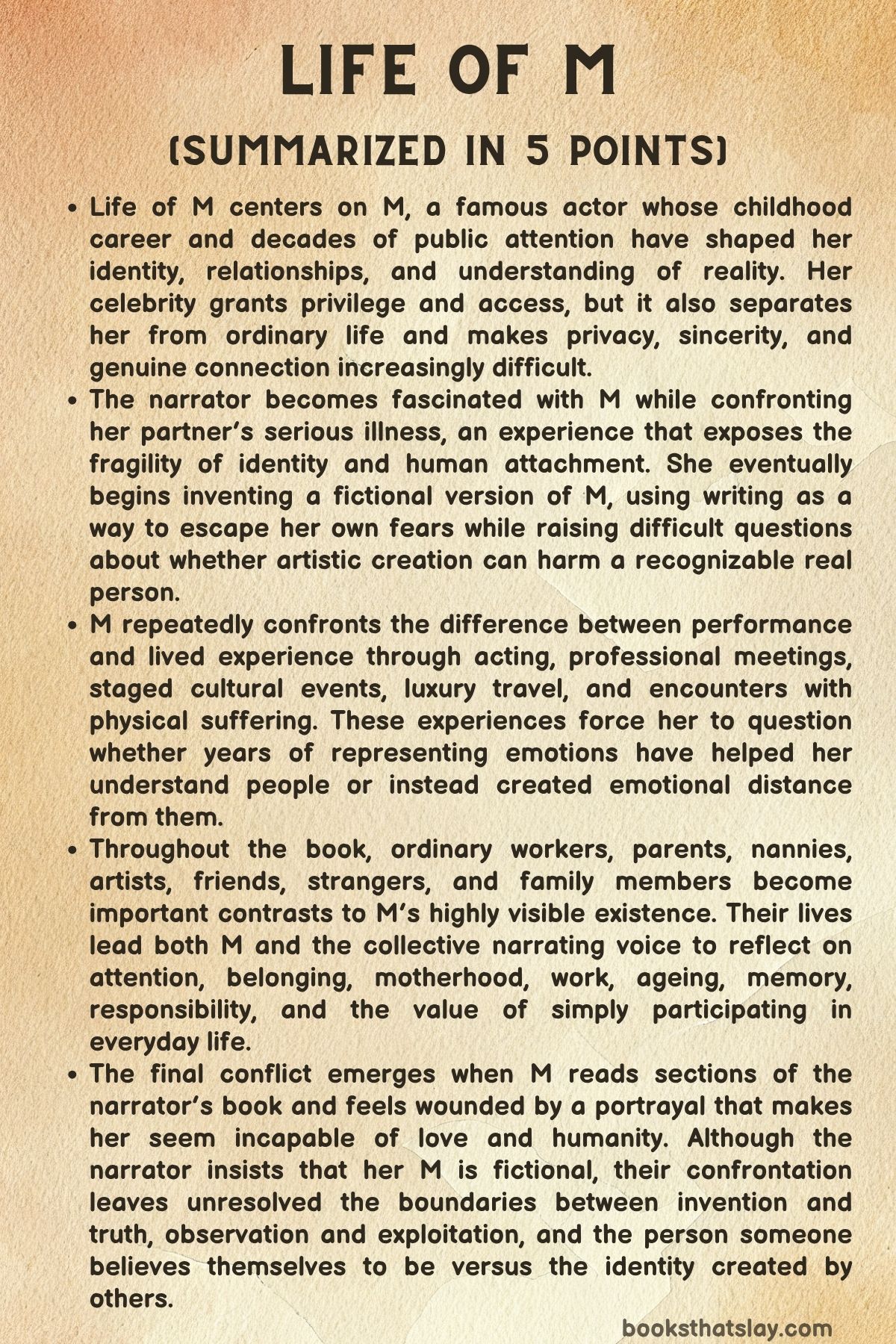
The final confrontation occurs when the narrator gives M pages from the developing book. M is hurt by the fictional version of herself, believing that the portrayal makes her appear incapable of love and genuine humanity.
The narrator defends the work by insisting that the character is invented. She deliberately avoided researching M’s actual private life and instead used films, imagination, observation, and her own experience to construct the fictional figure.
After her partner nearly died, writing M became a method of escaping the frightening vulnerability of personal identity. By inventing another person, the narrator could temporarily abandon herself, although the work eventually damaged her physically through exhaustion, insomnia, headaches, trembling, and obsessive concentration.
She ultimately recognizes M as an extraordinarily gifted actor, but that recognition does not resolve the ethical question at the center of Life of M. An invented character may belong to the writer, yet attaching that character to a recognizable living person makes the distinction between fiction and violation uncertain.
Their final encounter therefore refuses clean resolution. As the narrator leaves, M unexpectedly asks whether the narrator is a man or a woman, reversing the direction of observation and leaving creator and subject facing the instability of identity itself.
Characters
M
M is the central figure of Life of M, a celebrated actor whose public success has given her extraordinary access, wealth, professional power, and cultural visibility while gradually separating her from many conditions of ordinary existence. Because she began acting as a child, she learned unusually early that identity could be observed, judged, repeated, altered, and transformed into professional material.
Her greatest strength is discipline. Criticism rarely causes her simply to retreat; instead, as demonstrated by the physically punishing ballerina role, disapproval can intensify her ambition and push her toward greater control.
That same adaptability creates one of her deepest problems. M knows how to perform emotions, behave correctly during crises, satisfy professional expectations, and survive uncomfortable encounters, yet she repeatedly wonders whether these abilities have replaced a more spontaneous connection with feeling.
Her distance from ordinary life makes her fascinated by people whose identities are connected to practical usefulness rather than visibility. Workers, nannies, parents, shop employees, caretakers, and strangers become reminders of a social existence in which value does not depend upon an audience.
M is not presented simply as emotionally cold. Her detachment often appears to be a survival mechanism produced by decades of observation, mobility, criticism, privilege, and the transformation of private experience into something potentially consumable by others.
Her encounters with younger women, family members, friends, journalists, and ordinary strangers gradually expose the limitations of the protective structure she has created. By the end, she is capable of recognizing that an imagined version of her can still wound her because public identity cannot be cleanly separated from the person living behind it.
The Narrator
The narrator functions as both creator and participant in Life of M, and her relationship with M reveals how writing can become an act of self-displacement. She begins by believing she might write about the actor, but the project eventually becomes less an investigation of M than a method of escaping the narrator’s own unstable sense of identity.
Her partner’s near-death gives this impulse emotional urgency. The crisis makes personal existence appear frighteningly fragile, leading her toward the strange safety of inventing someone else rather than remaining entirely inside her own consciousness.
The narrator considers herself marked by insignificance, which sharply contrasts with M’s experience of extreme visibility. Yet these apparent opposites gradually resemble each other because both women struggle with the burden of selfhood and the desire to disappear into artistic work.
Her greatest ethical conflict comes from claiming that the fictional M belongs to her imagination while still attaching that invention to an identifiable public figure. She knows little about the actor’s private reality because she intentionally avoids researching it, but M’s hurt demonstrates that invention does not eliminate responsibility.
Writing ultimately consumes the narrator physically and psychologically. Her exhaustion, sleeplessness, trembling, headaches, and bodily deterioration reveal how creation can become both freedom and self-erasure.
The Collective Narrating Voice
The collective “we” of Life of M broadens the novel beyond the relationship between one writer and one actor. This voice represents people who have escaped inherited identities and gained the privilege of constructing lives through work, travel, relationships, artistic practice, and personal choice.
Freedom, however, does not give them a stable answer to the question of who they are. Once childhood, family, nationality, and earlier circumstances cease to determine identity completely, self-creation becomes another exhausting responsibility.
The collective voice is deeply observant. Bakers, waste collectors, elderly customers, friends, children, dogs, landscapes, sunsets, bodies, therapists, strangers, and ordinary routines all become occasions for examining how human beings establish connection with the world.
Ageing gradually changes this consciousness. The narrators sense that greater control has reduced chaos and danger, but it may also have reduced the possibility of transformation, creating a quieter life in which hope and surprise have become harder to distinguish.
Their movement toward acceptance is therefore uneasy rather than triumphant. They desire relief from judgement and identity but fear that complete acceptance could resemble disappearance.
The Narrator’s Partner
The narrator’s partner occupies relatively little direct space but has enormous structural importance because the serious illness destabilizes the narrator’s confidence in ordinary continuity. Hospitalization confronts her with the possibility that a familiar person can suddenly become physically dependent, inaccessible, or absent.
The partner’s survival does not restore the narrator’s previous sense of security. Instead, the crisis becomes one of the conditions that drives her toward cinema, imagination, and eventually the construction of M as a fictional figure.
The partner therefore represents the vulnerability of intimate reality. Unlike film, memory, or fictional creation, a loved person’s body cannot be paused, revised, replayed, or protected through artistic control.
M’s Children
M’s children remain largely outside the center of the narrative, yet their presence repeatedly forces questions about motherhood, responsibility, memory, and emotional availability. They belong to an area of M’s life where professional competence cannot automatically substitute for intimacy.
The sailing trip illustrates this tension particularly clearly. Even within a family experience, M often occupies the position of observer while others perform the immediate practical tasks necessary to keep life moving.
Children also carry symbolic importance throughout the wider novel because parenthood restricts the freedom required for total artistic concentration. Caring for a child requires attention that cannot always be suspended when creative work demands complete withdrawal.
The Critical Man
The man who meets M in the brasserie represents the internalized power of criticism. His presence causes intense physical discomfort, yet M remains controlled and accommodating because his judgement has become psychologically connected with her own feelings of disgrace.
His significance becomes clearest when a stranger insults M after she refuses a photograph. Rather than defending her, he appears satisfied, almost as though public humiliation confirms his private assessment of her.
Within Life of M, his relationship with M demonstrates how criticism can cease to be an external opinion and become part of a person’s self-perception. M’s professional success has not freed her from judgement; in some ways, it has trained her to accept judgement as a permanent condition of existence.
The Theatre Director
The theatre director is one of the few figures who challenges M’s preferred form of professional control directly. As her friend and workshop leader, he believes performance should depend upon immediate presence rather than editing, technological manipulation, or repeated reconstruction.
His match exercise asks participants to reveal secrets, turning emotional exposure into a test of authenticity. M’s declaration that she has no secret frustrates the emotional premise of the exercise and reveals her resistance to confession as proof of truth.
His own statement that he possesses a hole where his heart should be creates an ironic contrast with M’s refusal. In Life of M, their exchange raises the possibility that declarations of vulnerability can themselves become performances, making authenticity impossible to identify through disclosure alone.
The Young Eastern European Nanny
The young nanny becomes significant because M’s curiosity accidentally creates an emotional obligation. Attracted initially by the woman’s appearance and photographic qualities, M begins asking about her life and discovers a painful history of separation from her mother.
The nanny was raised by grandparents after her mother left for work, and although mother and daughter communicate affectionately from a distance, physical meetings expose a barrier neither can easily overcome. Her wish to embrace her mother until the distance disappears gives her story an emotional directness that contrasts with M’s controlled relationships.
M realizes too late that asking someone to disclose intimate pain can encourage that person to expect continued care. The encounter teaches her that observation is not morally neutral because receiving another person’s truth can create responsibility.
The Younger Female Actor
The younger actor serves as both professional counterpart and reminder of time. Conversations about advertising, unequal compensation, gender expectations, and industry opportunity allow M to occupy the position of experienced mentor.
M wants to support younger women without appearing maternal, revealing her complicated relationship with ageing and female succession. Beside the younger performer, however, she suddenly feels the instability of her own position and senses that professional life cannot continue indefinitely.
The younger actor therefore makes mortality visible through career rather than illness. She represents continuity within an industry that survives by replacing one generation with another.
The Journalist
The respected journalist becomes one of the rare people whose attention causes M to feel seen rather than merely inspected. In Life of M, his interview challenges her assumptions about childhood acting, power, public exposure, sexuality, and the difference between voluntary ambition and circumstances a child cannot fully evaluate.
His suggestion that placing a child in professional filmmaking might be considered abusive unsettles M because she does not experience her childhood career simply as exploitation. Acting gave her the future she wanted, yet the interview forces her to consider whether desire and harm can coexist.
What distinguishes him from many other observers is compassion. His questioning does not merely attempt to extract material, and M briefly experiences the dangerous temptation to surrender emotionally to someone capable of regarding her without obvious ownership.
The Artist Friend
M’s successful artist friend embodies a form of creative integrity that M fears she lacks. Her huge and emotionally violent paintings contrast with her calm, organized personal presence, suggesting that powerful artistic expression does not necessarily require the destruction of private stability.
M envies this separation between work and self. She suspects that the artist possesses an instinctive integrity, while she herself has spent years treating integrity as another behavior that must be consciously performed.
The friend therefore intensifies M’s fear that professional success may have cost her something fundamental. Artistic achievement alone cannot reassure her if she believes the self producing the achievement has become uncertain.
The Legendary Actor’s Daughter
Although encountered primarily through her memoir, the daughter of a legendary actor becomes important because she demonstrates the power of observation created by neglect. Growing up beneath a famous mother’s beauty and professional importance, she learned to watch closely because attention was directed elsewhere.
M becomes more interested in the daughter’s ability to witness than in the celebrated performances of the mother. The reversal is crucial because M has spent most of her life as the observed person and is only gradually realizing the importance of becoming an observer herself.
The daughter therefore represents a form of knowledge generated from marginality. Being overlooked caused pain, but it also developed an attentiveness that fame may have prevented M from acquiring.
Themes
Fame, Visibility, and the Loss of Ordinary Life
Fame in Life of M operates less as a reward than as an altered condition of reality. M passes airport queues, occupies luxury hotels, enters exclusive spaces, attracts strangers, negotiates valuable contracts, and receives professional accommodation unavailable to ordinary people, yet every privilege increases the distance between her and the unobserved world she finds increasingly attractive.
Visibility also damages boundaries. A stranger expects access to M through a photograph, relatives treat her public identity as partially belonging to them, commercial events transform cultural conversation into advertising, and professional interactions constantly require her to perform the socially acceptable version of herself.
This creates M’s fascination with ordinary workers and practical occupations. Bakers, caretakers, teachers, shop workers, nannies, cleaners, and parents perform activities whose value exists independently of public recognition, giving their lives a solidity she no longer experiences naturally.
Fame also complicates intimacy because M cannot easily determine when another person’s interest is directed toward her as an individual and when it is directed toward the cultural object carrying her face and reputation. Even kindness can therefore feel like another form of observation.
The book refuses to present anonymity as automatically superior, since ordinary existence contains hardship, economic limitation, illness, grief, and invisibility. Instead, it shows how constant recognition can become another kind of confinement, leaving M privileged enough to escape common restrictions but unable to recover the innocence of simply existing without being interpreted.
Performance, Authenticity, and the Construction of Identity
Acting creates a central paradox because M’s professional ability to imitate authentic feeling makes authenticity increasingly difficult for her to identify. She can portray pain, desire, fear, discipline, vulnerability, and collapse, yet encounters with actual suffering repeatedly remind her that representing an experience is not equivalent to enduring it.
The reconstructed museum room captures this problem physically. M feels the authority of history until she discovers that the environment has been artificially assembled, revealing how readily convincing surfaces can produce emotions normally associated with truth.
Her professional world repeatedly operates in the same way. Corporate behavior appears modeled on cinematic conventions, literary discussions are staged before audiences arrive, luxury houses simulate historical authenticity, and even experiences designed to offer contact with nature depend upon engines, employees, planning, and infrastructure.
M nevertheless discovers that artificiality does not automatically mean falseness. Her performance as a damaged celebrity in an earlier film reveals truths about fame that she herself may not consciously have understood while acting, suggesting that performance can sometimes disclose realities unavailable to deliberate self-analysis.
The narrator’s invented portrait of M extends this contradiction into literature. A fictional character may be constructed from imagination, but once attached to an identifiable person, the invention enters that person’s reality and acquires emotional consequences.
Identity therefore becomes something produced between internal experience and external representation. No final version of a person can be guaranteed as authentic because selfhood is repeatedly altered by memory, observation, artistic interpretation, social expectation, and the roles people perform for one another.
Observation, Attention, and the Ethics of Seeing
Attention gradually becomes one of the central moral concerns of Life of M. Much of M’s life has been organized around being looked at, but she increasingly suspects that receiving enormous amounts of attention may have weakened her ability to direct sustained attention toward other people.
The legendary actor’s neglected daughter represents the opposite condition. Because she was not the center of attention, she learned to observe closely, turning emotional marginalization into a powerful capacity for witnessing.
Similar acts of observation recur throughout the story. The collective narrators notice workers before dawn, watch an elderly woman entering a cafe, study friends before those friends realize they are being watched, examine bodies in photographs, follow changing seasons, and suddenly recognize sunsets that had always been present.
Seeing, however, creates responsibility. M’s conversation with the young nanny shows that asking questions about another person’s pain is not harmless curiosity, because disclosure may establish an expectation of care.
The narrator’s relationship with M raises an even greater ethical problem. Observing someone artistically can create insight while simultaneously violating the person being represented, especially when imagination fills the spaces where knowledge is absent.
The novel therefore distinguishes between consuming another person and truly attending to them. Observation becomes ethically valuable only when the observer recognizes that the object of attention possesses a separate life that cannot be reduced to material, entertainment, interpretation, or self-discovery.
Work, Love, Belonging, and the Desire to Disappear
Creative concentration repeatedly demands a temporary disappearance from ordinary obligations. Writers, actors, artists, and other workers achieve intense focus by excluding children, partners, friends, memories, anxieties, and practical responsibilities from consciousness, making artistic freedom inseparable from forms of neglect.
Motherhood makes this conflict especially visible. The collective narrators remember periods when their bodies would not permit them to forget their children, while later independence allows them to return to work with greater intensity.
Freedom therefore contains guilt. The ability to disappear into work may produce artistic achievement, but it can also weaken relationships and encourage the belief that other people are interruptions rather than essential parts of life.
Belonging offers no simple solution because traditional structures can also feel restrictive. Family may demand ownership, national identity may impose inherited meanings, homes may preserve painful history, and romantic relationships may deteriorate into resentment.
Yet complete independence becomes equally frightening. M envies homes filled with accumulated memory while fearing their demands, and the collective narrators imagine forms of acceptance so complete that individuality itself might disappear.
The recurring desire to vanish is therefore not simply a wish for death or isolation. It is a wish to escape the exhausting obligation to maintain an identity while remaining somehow connected to the world.
By presenting artistic work, parenthood, friendship, family, nature, ordinary labor, and intimate conversation as competing forms of belonging, the story suggests that meaningful existence may depend less on finding one permanent identity than on learning how to remain present without needing either total possession or total escape.