Plant Lady Summary, Characters and Themes
Plant Lady by Minyoung Kang is a psychological thriller that explores the dangerous intersection of trauma, revenge, and the desire to protect vulnerable people.
Set in the fictional city of Sejin, the novel follows Yu-hee, a former corporate employee who finds refuge in running a plant shop. Her peaceful surroundings conceal a disturbing secret: she has begun eliminating men who abuse, exploit, or threaten women. As her actions become increasingly deliberate, the boundaries between justice and personal vengeance grow uncertain. Through botanical symbolism, interconnected stories of abuse, and a persistent police investigation, the novel examines the consequences of violence committed in the name of protection.
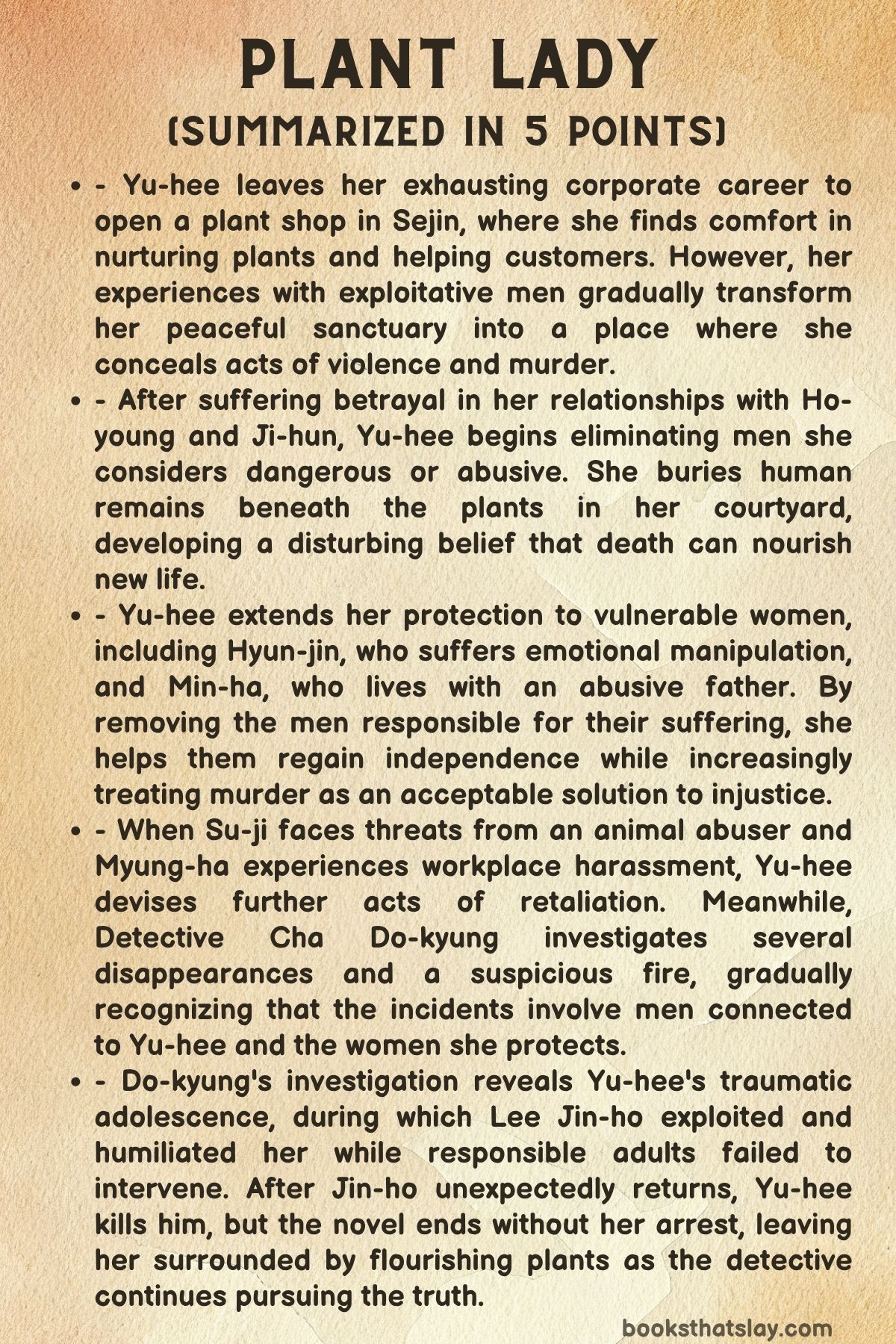
Summary
Yu-hee owns a plant shop in Sejin, having abandoned a demanding corporate career to pursue a quieter existence. Her decision initially brings financial difficulties, but the neighborhood gradually becomes fashionable, attracting customers who appreciate her unusual botanical collection and extensive knowledge.
Plants offer Yu-hee a sense of stability that she has rarely found in human relationships. She believes that even damaged plants can recover when they receive proper attention, nourishment, and protection.
Her experiences with men, however, repeatedly challenge this philosophy. Beneath her composed appearance lies a history of exploitation and humiliation that has gradually transformed her understanding of what protection requires.
One of her early relationships involves Ho-young, a consultant who initially approaches her for professional assistance. Although he appears interested in her expertise, he eventually begins taking credit for her accomplishments and undermining her confidence.
His behavior becomes increasingly destructive, culminating in an argument during which he deliberately damages a treasured palm. Unable to tolerate another violation of something she loves, Yu-hee attacks him with a gardening tool.
The incident reveals the violent impulses concealed beneath her otherwise controlled personality. Rather than confronting exploitation through ordinary means, she has begun responding to perceived threats with physical violence.
Some time later, Ji-hun enters her shop carrying an avocado seed. His apparent sincerity, patience, and interest in cultivating the seed distinguish him from the men who have previously disappointed her.
Their relationship develops gradually, and Yu-hee allows herself to imagine a future built on mutual respect. The avocado becomes associated with her growing willingness to trust another person.
That hope disappears when she overhears Ji-hun speaking contemptuously about her and boasting about exploiting her financially. His apparent affection has concealed selfish intentions, leaving her feeling deceived once again.
When Ji-hun subsequently enters her wet shop, Yu-hee deliberately neglects to warn him about the slippery floor. He falls, strikes his head, and dies.
She disposes of his remains beneath the plants in her courtyard. As the vegetation continues flourishing, she begins associating human remains with the nourishment that sustains botanical life.
Her understanding of death consequently changes. Rather than regarding the bodies exclusively as evidence of violence, she begins incorporating them into her private system of cultivation and renewal.
As her business expands, Yu-hee begins offering paid consultations through email. One inquiry comes from Choi Hyun-jin, who seeks assistance identifying a damaged petunia.
When Hyun-jin visits the shop, Yu-hee notices her anxious behavior and the constant notifications appearing on her phone. These details suggest that the young woman is experiencing difficulties extending far beyond plant care.
Hyun-jin eventually explains that her boyfriend, Sung-min, controls her through intimidation, emotional manipulation, and repeated threats of suicide. His unpredictable outbursts have left her frightened, exhausted, and unable to establish boundaries.
Although Hyun-jin has sought psychiatric treatment, she struggles to describe the relationship openly. She feels responsible for Sung-min’s emotional stability and fears the consequences of leaving him.
Recognizing the destructive situation, Yu-hee devises a plan to remove him from Hyun-jin’s life. She appeals to Sung-min’s artistic ambitions, flattering him until he agrees to visit her shop.
Once he arrives, she leads him into the attic, where an unusual flowering plant has been displayed. As he approaches it, she strikes him from behind with a shovel.
Sung-min’s disappearance releases Hyun-jin from his constant demands. Her appetite and sleep gradually improve, and she begins recovering the independence that the relationship had deprived her of.
Yu-hee introduces her to the common butterwort, a carnivorous plant that captures insects on its leaves. Its ability to eliminate organisms that threaten its environment reflects Yu-hee’s increasingly uncompromising philosophy of protection.
Another visitor, a teenager named Min-ha, frequently travels a considerable distance to spend time in the shop. Although initially quiet about her circumstances, she gradually develops a trusting relationship with Yu-hee.
Yu-hee notices a scar on Min-ha’s arm and recognizes signs of fear in her behavior. Eventually, Min-ha reveals that her father drinks excessively, intimidates her, and makes their home unsafe.
Her situation reminds Yu-hee of her own adolescence, when she experienced humiliation and isolation without receiving meaningful protection from adults. She becomes determined to provide the understanding that she herself once needed.
After Min-ha’s father damages a plant, Yu-hee gives the girl a dangerous botanical specimen associated with poisonous fruit. The man’s subsequent disappearance strongly suggests that he has been fatally poisoned.
While Min-ha gains an opportunity to escape her father’s control, Detective Cha Do-kyung begins investigating several unexplained disappearances.
He discovers connections between the missing men and locations around Sejin, particularly the neighborhood containing Yu-hee’s shop. His colleagues remain skeptical because the investigation lacks bodies and decisive physical evidence.
Yu-hee’s activities become more dangerous when Han Su-ji arrives at her shop on a snowy evening. Terrified and desperate, Su-ji asks whether Yu-hee can arrange for someone to be killed.
Su-ji explains that she helped expose an animal abuser known online as Katpy. After documenting his cruelty toward stray cats, she participated in identifying him as Mun Ji-hwan.
Although he faces legal consequences, his behavior does not end. He begins stalking and threatening Su-ji, leaving her convinced that her life is in danger.
Yu-hee takes particular interest in the situation because she has grown attached to the stray cats visiting her courtyard. The man’s cruelty toward defenseless animals intensifies her determination to intervene.
She investigates Mun Ji-hwan’s movements and creates circumstances that draw him to her shop while keeping Su-ji elsewhere. When he arrives looking for his intended victim, Yu-hee incapacitates him.
She kills him brutally, deliberately reproducing the helplessness experienced by the animals he tortured. The killing demonstrates how her violence has developed beyond immediate self-defense into calculated punishment.
After his disappearance, Su-ji begins recovering from the fear that has dominated her life. She destroys the threatening messages and photographs she had preserved, attempting to regain control over her everyday existence.
Do-kyung’s investigation subsequently leads him to Yu-hee. He examines her shop and courtyard, but her composed behavior and the absence of conclusive evidence prevent him from establishing her involvement.
Meanwhile, Yu-hee discovers corydalis growing in soil associated with the disposal of human remains. The appearance of new vegetation reinforces her disturbing association between destruction and renewal.
Her next intervention concerns Myung-ha, a young woman whose enthusiasm for gardening has established a close friendship between them.
Myung-ha works at a company called Onsem, where she faces discriminatory treatment and harassment. Her supervisor, Kim Young-ho, repeatedly makes degrading remarks about her appearance and background.
The situation becomes unbearable when she discovers a private online chatroom in which male employees circulate photographs and offensive comments about female colleagues.
Devastated by this betrayal, Myung-ha withdraws from her usual activities. Eventually, she confides in Yu-hee, who begins investigating the men responsible.
Using a false identity, Yu-hee gains access to the chatroom and studies its participants. She also examines their routines and workplace surroundings, preparing an operation involving the building’s facilities.
A fire subsequently breaks out at Onsem. Yu-hee reports the incident herself, bringing her into direct contact with Do-kyung.
Although the detective questions her movements, surveillance footage does not establish that she committed a crime. Nevertheless, the circumstances deepen his suspicions.
The fire unsettles the men involved in the harassment, and their private chatroom begins collapsing as they fear exposure. Myung-ha eventually leaves Sejin and establishes a new life elsewhere.
She maintains contact with Yu-hee through messages and photographs of her plants. Their continued friendship suggests that Yu-hee’s protection has created genuine emotional security, even though its methods remain concealed.
Do-kyung gradually recognizes a pattern connecting the incidents under investigation. The missing or threatened men share histories of exploiting, intimidating, or abusing women associated with Yu-hee.
Instead of examining the crimes as isolated events, he begins researching her personal history. His investigation eventually leads him to Ian, the city where she spent her adolescence.
There, Yu-hee experienced events that profoundly shaped her understanding of trust and vulnerability.
As a schoolgirl, she became interested in Lee Jin-ho, a popular student whose attention initially seemed flattering. Their relationship, however, developed into a source of humiliation.
Jin-ho and his companions subjected her to degrading treatment, circulated intimate material without her consent, and encouraged damaging rumors about her sexuality.
When Yu-hee sought assistance, the adults around her failed to protect her. She was left facing harassment and social isolation while those responsible avoided meaningful accountability.
Eventually, she changed schools and left Ian. Physical distance, however, did not eliminate the psychological consequences of what she had experienced.
Years later, Jin-ho unexpectedly contacts her again. His reappearance forces Yu-hee to confront memories she has spent much of her adult life attempting to suppress.
When he visits the plant shop, she initially maintains her composure. Their conversation soon revives the humiliation and fear associated with her adolescence.
Overwhelmed by the encounter, Yu-hee attacks and kills him using the tools and surroundings of her shop.
The killing exposes a fundamental contradiction in her life. Although she has eliminated numerous men she considers dangerous, the violence has not erased her earlier suffering.
Do-kyung subsequently visits the shop and questions Yu-hee about plants, their resilience, and their potential dangers. Their conversation carries an unspoken tension because he has begun connecting her personal history with the disappearances.
Yu-hee remains outwardly calm, carefully observing his questions while concealing evidence of her latest killing.
After he leaves, she returns to the courtyard, disposes of the remains, and restores the surroundings to their familiar appearance.
The novel concludes without a definitive arrest or public exposure. Do-kyung continues to represent the possibility that Yu-hee’s crimes will eventually be discovered, while she maintains the peaceful botanical sanctuary that conceals them.
Her flourishing plants embody the central contradiction of her existence: a woman devoted to nurturing life has constructed her apparent tranquility through repeated acts of death.
Characters
Yu-hee
Yu-hee is the central character of Plant Lady, a woman whose devotion to cultivating plants exists alongside her growing willingness to commit murder. Having abandoned an exhausting corporate career, she establishes a shop that initially appears to represent independence, tranquility, and emotional recovery.
Her knowledge of plants reflects patience, intelligence, and an ability to recognize the conditions necessary for growth. However, her understanding of human relationships becomes increasingly distorted by experiences of exploitation, humiliation, and betrayal.
Yu-hee’s defining contradiction is her capacity for tenderness and extreme violence. She offers vulnerable women practical assistance and emotional understanding, yet she repeatedly concludes that eliminating their abusers is the most effective form of protection.
Her relationships with Ho-young and Ji-hun reveal how personal betrayal contributes to this transformation. Ho-young’s destruction of her cherished palm provokes her violent reaction, while Ji-hun’s deception reinforces her belief that apparently trustworthy men may conceal exploitative intentions.
The encounters with Hyun-jin, Min-ha, Su-ji, and Myung-ha demonstrate that Yu-hee’s violence eventually extends beyond personal revenge. She begins appointing herself protector of women who appear unable to escape dangerous circumstances.
Her actions reveal genuine empathy, but they also expose a desire to exercise absolute control over situations she considers intolerable. Rather than helping others determine their own responses, she frequently makes irreversible decisions on their behalf.
The revelation of her adolescence provides essential context for her behavior. Jin-ho’s exploitation and the failure of responsible adults to protect her leave psychological injuries that continue influencing her adult relationships.
Her eventual killing of Jin-ho suggests that confronting the original source of her suffering does not necessarily produce emotional liberation. Despite her repeated attempts to eliminate threatening men, she remains governed by the experiences that initially damaged her trust.
Yu-hee’s character ultimately embodies the novel’s central moral uncertainty. She is simultaneously a survivor, a compassionate caretaker, and a calculated killer whose understanding of justice has become inseparable from personal vengeance.
Ho-young
Ho-young represents the exploitative dynamics that characterize Yu-hee’s early experiences with men. Initially approaching her for professional assistance, he gradually reveals a willingness to benefit from her expertise while refusing to acknowledge her contributions.
His appropriation of her achievements demonstrates an attitude that treats her abilities as resources available for his advancement. This behavior undermines the professional independence she has worked to establish.
His deliberate destruction of her plants is particularly significant because he attacks the source of her emotional stability. The cherished palm becomes a target through which he can express aggression and assert control.
Ho-young’s conduct helps establish the connection between damage to plants and violence against the men responsible. His treatment of Yu-hee demonstrates how emotional exploitation can become a precursor to overt aggression.
Although his characterization is primarily developed through his relationship with Yu-hee, his actions establish a pattern that recurs throughout the novel. He embodies the entitlement and disrespect that increasingly provoke her retaliatory behavior.
Ji-hun
Ji-hun initially appears to offer Yu-hee the possibility of a relationship founded on mutual respect. His arrival carrying an avocado seed establishes an immediate connection with her botanical interests.
His apparent patience and genuine curiosity encourage her to lower the emotional defenses developed through earlier experiences. The gradual cultivation of their relationship parallels the growth of the avocado plant.
His eventual betrayal therefore carries particular significance. When Yu-hee overhears him boasting about exploiting her financially, she discovers that his affection has concealed selfish intentions.
Ji-hun’s behavior reinforces her suspicion that kindness can function as a disguise for manipulation. The contrast between his apparent gentleness and private contempt makes him an especially damaging presence in her life.
His accidental fall, which Yu-hee deliberately allows to occur, also marks an important development in her violence. Unlike the direct attack against Ho-young, Ji-hun’s death results from her conscious decision not to prevent an avoidable danger.
His character demonstrates how deception can destroy the trust necessary for intimacy. Within Yu-hee’s psychological development, he becomes another example supporting her increasingly rigid belief that betrayal must be answered through punishment.
Choi Hyun-jin
Choi Hyun-jin is one of the most sympathetic supporting characters in Plant Lady, representing the emotional consequences of coercive relationships. Her introduction through a damaged petunia establishes an immediate association between botanical vulnerability and human suffering.
Her nervous behavior and constant attention to her phone indicate that Sung-min’s control extends beyond their physical interactions. Even when she is away from him, his demands dominate her attention.
Hyun-jin’s difficulty leaving the relationship reflects the effectiveness of emotional manipulation. Sung-min’s threats of suicide make her feel responsible for his survival, transforming compassion into a source of psychological captivity.
Her psychiatric treatment demonstrates that she recognizes her distress and seeks assistance. Nevertheless, the fear and confusion created by the relationship prevent her from fully explaining her circumstances.
Yu-hee’s intervention eliminates the immediate source of Hyun-jin’s suffering, allowing her to recover ordinary pleasures and establish greater independence. Her improving appetite, sleep, and emotional stability demonstrate how deeply the relationship had affected her.
Hyun-jin’s character also raises questions about agency. Although she benefits from Sung-min’s disappearance, the outcome results from a decision Yu-hee makes without fully involving her.
Her recovery illustrates the possibility of rebuilding a life after abuse while exposing the troubling methods through which that freedom is obtained.
Sung-min
Sung-min embodies emotional coercion disguised as dependence. His relationship with Hyun-jin is characterized by intimidation, unpredictable anger, and threats that make her feel responsible for his well-being.
His repeated suggestions that he might harm himself operate as instruments of control. By presenting separation as potentially catastrophic, he discourages Hyun-jin from asserting independence.
His artistic ambitions introduce another dimension to his personality. Yu-hee recognizes his desire for professional recognition and uses flattery to persuade him to visit her shop.
His willingness to follow someone who appears to admire his work demonstrates how effectively his ambitions can be manipulated. The strategy mirrors his own exploitation of Hyun-jin’s emotional vulnerabilities.
Sung-min’s death marks a significant turning point because Yu-hee deliberately kills someone whose abuse has been described to her by another person. Her judgment becomes the basis for deciding that his continued existence is unacceptable.
Through Sung-min, the novel examines the destructive consequences of possessiveness and the dangerous transformation of emotional dependence into domination.
Min-ha
Min-ha is a teenage girl whose experiences establish a strong emotional connection with Yu-hee. She frequently travels to the plant shop because it offers a sense of safety absent from her home.
Her reluctance to discuss her family and the scar on her arm indicate the fear governing her daily existence. These details reveal the effects of abuse before she openly describes her father’s behavior.
Her eventual disclosure demonstrates the importance of patient listening and emotional security. Yu-hee earns her trust by allowing her to spend time among the plants without demanding immediate explanations.
Min-ha’s circumstances remind Yu-hee of her own adolescence. Both have experienced fear and isolation while lacking reliable adult protection.
This resemblance makes Yu-hee particularly determined to intervene. Her decision to provide a poisonous plant suggests that she views Min-ha’s father as a threat requiring permanent removal.
Min-ha’s position is morally complicated because she is a vulnerable teenager drawn into circumstances involving potentially fatal consequences. Her opportunity to escape abuse is accompanied by the possibility that she has become implicated in violence.
Her character highlights the vulnerability of children within abusive households and the consequences of systems that fail to protect them.
Min-ha’s Father
Min-ha’s father represents domestic violence exercised through intimidation and unequal power. His drinking and destructive behavior create an environment in which his daughter cannot feel secure.
His authority within the household makes his aggression particularly damaging. Min-ha depends upon the domestic environment he controls, leaving her with limited opportunities to escape.
His destruction of a plant becomes significant because it extends his aggression into the sanctuary where Min-ha finds relief. Through this act, he threatens something associated with her emerging independence.
His subsequent disappearance after encountering poisonous fruit strongly suggests that he becomes another victim of Yu-hee’s interventions.
Although the novel provides limited insight into his inner life, his function is clear. He represents the danger posed by abusive authority when vulnerable family members lack effective protection.
Han Su-ji
Han Su-ji enters the narrative as a woman whose attempts to expose cruelty have placed her in serious danger. Her involvement in identifying an animal abuser demonstrates courage and concern for defenseless creatures.
However, the consequences of her actions reveal the vulnerability of individuals who challenge violent offenders. Despite legal intervention, Mun Ji-hwan continues threatening her.
Her arrival at Yu-hee’s shop illustrates the extent of her desperation. Asking whether someone can arrange a killing suggests that she has lost confidence in ordinary methods of obtaining safety.
Su-ji’s fear is not presented as a momentary reaction. The threatening messages and photographs she preserves demonstrate how thoroughly the stalking has dominated her everyday existence.
Following Ji-hwan’s disappearance, she begins recovering a sense of control. Destroying the material associated with his threats becomes a symbolic rejection of the fear governing her life.
Her character examines the psychological consequences of stalking and the limitations of legal accountability when an offender continues intimidating a victim.
Mun Ji-hwan
Mun Ji-hwan, known online as Katpy, represents cruelty exercised against vulnerable beings. His abuse of stray cats establishes a willingness to inflict suffering on creatures unable to defend themselves.
His hostility subsequently extends toward Su-ji after she helps expose his identity. Rather than accepting accountability, he responds with intimidation and threats.
This progression establishes a connection between his treatment of animals and his treatment of people. Both involve attempts to establish dominance through fear.
His stalking also demonstrates a refusal to acknowledge Su-ji’s autonomy. By continuing to pursue her, he attempts to punish her for challenging his behavior.
Yu-hee’s response is especially severe because of her affection for the stray cats visiting her courtyard. She deliberately subjects him to a death intended to reflect the suffering he inflicted.
Ji-hwan’s character therefore exposes the disturbing relationship between punishment and retaliation. His cruelty provides the immediate justification for Yu-hee’s intervention, but the brutality of her response also reveals how closely vengeance can resemble the violence it condemns.
Myung-ha
Myung-ha represents the psychological consequences of workplace discrimination and sexual harassment. Her enthusiasm for gardening initially establishes her as an energetic presence in Yu-hee’s life.
Their friendship develops through a shared interest in plants, making the shop a space where Myung-ha can express herself without the judgment she encounters professionally.
Her experiences at Onsem reveal a workplace culture in which male employees disregard the dignity and privacy of their female colleagues. Kim Young-ho’s offensive comments contribute to an environment where harassment becomes normalized.
The discovery of the private chatroom is particularly devastating because it exposes hostility operating beyond her immediate awareness. She realizes that colleagues she encounters professionally have been circulating photographs and degrading remarks.
Her withdrawal from ordinary activities demonstrates the emotional damage caused by this betrayal. She struggles to reconcile the workplace’s public appearance with the contempt expressed privately.
By confiding in Yu-hee, Myung-ha establishes the trust necessary to receive support. However, she remains unaware of the full consequences of Yu-hee’s subsequent intervention.
Her departure from Sejin marks an attempt to regain control over her future. The photographs and messages she continues sending Yu-hee indicate that their friendship survives despite the distance.
Myung-ha’s character illustrates the importance of supportive relationships while raising questions about the consequences of protection that operates without the protected person’s informed participation.
Kim Young-ho
Kim Young-ho embodies the abuse of professional authority within Onsem. As Myung-ha’s supervisor, he occupies a position that allows his behavior to influence her working conditions.
His repeated offensive remarks about her appearance and background demonstrate a disregard for professional boundaries. The humiliation he inflicts is particularly damaging because challenging him could expose Myung-ha to further workplace difficulties.
His association with the broader culture of harassment reveals how individual misconduct can exist within an environment that tolerates degrading behavior.
The private chatroom illustrates this atmosphere, allowing male employees to objectify female colleagues without their knowledge or consent.
Young-ho’s role demonstrates how unequal professional power can discourage victims from reporting abuse. His conduct also helps explain why Myung-ha experiences the workplace as threatening rather than merely unpleasant.
Although his individual fate is not fully established, the fire and subsequent disintegration of the chatroom disrupt the environment that previously enabled his behavior.
Lee Jin-ho
Lee Jin-ho is central to understanding the psychological origins of Yu-hee’s violence in Plant Lady. His relationship with her during adolescence begins with apparently flattering attention but develops into exploitation and humiliation.
His popularity provides social influence that makes the abuse especially damaging. Together with his companions, he subjects Yu-hee to degrading treatment and participates in circulating intimate material without her consent.
The rumors surrounding her sexuality further isolate her from her peers. His behavior transforms an experience initially associated with affection into a prolonged source of fear.
The failure of adults to intervene compounds the damage. Yu-hee learns that exposing wrongdoing does not necessarily produce accountability or protection.
Jin-ho’s return years later forces her to confront the experiences she has attempted to escape. His presence revives emotions that remain powerful despite the passage of time.
Her decision to kill him represents an attempt to confront the person associated with her earliest major betrayal. Nevertheless, the act does not establish that she has overcome the consequences of his abuse.
Jin-ho’s character demonstrates how adolescent cruelty can produce lasting psychological injuries. His influence extends far beyond his direct involvement in Yu-hee’s life, shaping her subsequent relationships and increasingly violent understanding of justice.
Detective Cha Do-kyung
Detective Cha Do-kyung functions as the principal investigative counterforce to Yu-hee. His examination of unexplained disappearances gradually brings him toward the plant shop and the woman responsible for maintaining it.
Unlike investigators who concentrate exclusively on individual incidents, Do-kyung begins identifying connections between apparently unrelated cases. He notices that the missing men share histories of harming women associated with Yu-hee.
His persistence distinguishes him from colleagues who remain skeptical because of the absence of bodies or decisive physical evidence. He continues investigating even when his suspicions cannot support an arrest.
His encounters with Yu-hee establish a relationship built on mutual observation. He studies her responses and surroundings, while she carefully evaluates his questions and the extent of his knowledge.
The investigation into her adolescence demonstrates his willingness to examine the personal circumstances underlying the disappearances. His discovery of Jin-ho’s exploitation gives him a possible explanation for her apparent pattern of violence.
Nevertheless, understanding a possible motive does not establish legal proof. This distinction prevents him from resolving the investigation despite his increasingly focused suspicions.
Do-kyung represents the institutional pursuit of accountability that Yu-hee has largely abandoned. Whereas she responds to wrongdoing through private punishment, he must operate within procedures requiring evidence.
His unresolved investigation ensures that her apparent security remains uncertain. He also introduces the possibility that recognizing the suffering behind violent acts does not eliminate the need to examine their consequences.
Themes
Trauma, Memory, and the Persistence of Past Abuse
Yu-hee’s experiences demonstrate how traumatic events can continue influencing a person’s relationships long after the immediate danger has disappeared. Her adolescence is marked by sexual humiliation, social isolation, and the failure of adults to provide meaningful protection.
These experiences damage her ability to trust others and establish expectations that later relationships repeatedly reinforce. Ho-young’s exploitation and Ji-hun’s betrayal become particularly significant because they resemble earlier patterns of disrespect and manipulation.
Her decision to establish a plant shop represents an effort to create a world governed by predictable forms of care. Unlike human relationships, plants respond to identifiable conditions such as light, water, and nourishment.
Nevertheless, the shop cannot completely separate her from the past. Her encounters with vulnerable women repeatedly awaken memories of her own experiences, encouraging her to interpret their suffering through the circumstances of her adolescence.
The return of Jin-ho reveals the persistence of these memories. Despite the passage of time, his presence revives emotions that Yu-hee has never fully resolved.
Her violent response demonstrates the difference between eliminating an immediate threat and overcoming psychological injury. Killing the person associated with her humiliation does not automatically restore the security she lost.
In Plant Lady, trauma operates as both a source of empathy and a force contributing to destructive behavior. Yu-hee’s suffering helps explain her sensitivity toward abused women, but it also shapes her increasingly rigid understanding of justice.
The novel consequently distinguishes between understanding the origins of violence and treating those origins as sufficient justification for its continuation.
Justice, Revenge, and the Moral Boundaries of Protection
Yu-hee’s interventions emerge from situations in which vulnerable people appear unable to obtain effective protection. Hyun-jin faces emotional coercion, Min-ha experiences domestic abuse, Su-ji suffers stalking, and Myung-ha encounters workplace harassment.
Each situation reveals different forms of unequal power. The men involved exploit emotional dependence, family authority, physical intimidation, or professional influence to control others.
Yu-hee responds by rejecting the procedures ordinarily associated with accountability. Instead of relying on legal institutions or negotiated solutions, she assumes the authority to determine who deserves punishment.
Her actions initially appear connected to immediate personal injury. As the story develops, however, her violence becomes increasingly planned and directed toward people whose conduct she learns about through others.
This development complicates her role as a protector. Although the women frequently experience relief after her interventions, their improved circumstances do not resolve the ethical questions surrounding the killings.
The distinction between preventing harm and inflicting punishment becomes particularly significant in her treatment of Mun Ji-hwan. By deliberately reproducing the suffering he inflicted on animals, she transforms retaliation into an expression of her own punitive power.
Detective Do-kyung provides an important contrast. His investigation depends on establishing connections and obtaining evidence rather than acting exclusively on personal conviction.
The tension between these approaches exposes the limitations of both unchecked private vengeance and institutions that may fail to protect victims promptly.
The novel leaves readers considering whether benevolent intentions can justify irreversible violence. It also examines the danger of allowing one individual to define justice without external accountability.
Plants, Death, and the Contradictions of Nurturing
Plants provide the central symbolic language of Plant Lady, reflecting Yu-hee’s understanding of care, vulnerability, and survival. Her shop initially represents a peaceful alternative to the exhausting professional and personal environments she has abandoned.
Cultivation requires patience and careful attention. Through her botanical expertise, Yu-hee demonstrates an ability to identify damage and create conditions that encourage recovery.
The avocado seed embodies the possibility of trust and emotional renewal. Its association with Ji-hun transforms this hopeful symbolism when his betrayal leads to his death.
The common butterwort introduces a more aggressive understanding of protection. Its carnivorous behavior parallels Yu-hee’s belief that destructive intruders must sometimes be eliminated to preserve a vulnerable environment.
The poisonous plant associated with Min-ha similarly transforms botanical knowledge into an instrument of violence. What might otherwise be admired as an unusual specimen becomes a means of removing an abusive authority figure.
The appearance of corydalis in soil associated with human remains creates an especially disturbing connection between death and growth. Yu-hee begins regarding the bodies she conceals as material capable of nourishing new life.
This transformation exposes the contradictions underlying her philosophy. She protects plants and vulnerable people while deliberately destroying human lives.
Her courtyard consequently functions as both a sanctuary and a burial ground. The flourishing vegetation conceals evidence of violence while sustaining her belief that destruction can contribute to renewal.
The botanical imagery does not erase the moral consequences of her actions. Instead, it emphasizes how easily the language of care can be used to rationalize cruelty when protection becomes inseparable from control.
Gendered Violence, Solidarity, and the Failure of Social Institutions
The experiences of Hyun-jin, Min-ha, Su-ji, and Myung-ha demonstrate that violence against women can take many forms. Emotional manipulation, domestic intimidation, stalking, and workplace harassment produce different immediate consequences but share an underlying disregard for personal autonomy.
Hyun-jin’s relationship illustrates how coercion can operate without constant physical violence. Sung-min manipulates her concern for his well-being until she feels incapable of ending the relationship.
Min-ha’s circumstances expose the particular vulnerability of children living with abusive parents. Her dependence upon the household makes escaping her father’s aggression considerably more difficult.
Su-ji’s experiences reveal the limitations of accountability when an exposed offender continues threatening the person who challenged him. Formal consequences do not necessarily guarantee immediate safety.
Myung-ha’s workplace harassment demonstrates how collective misconduct can normalize exploitation. The private chatroom allows employees to participate in degrading behavior while maintaining a respectable public appearance.
Yu-hee’s adolescence establishes the personal foundation connecting these experiences. When responsible adults fail to protect her from Jin-ho and his companions, she develops a lasting distrust of conventional authority.
The relationships among the women offer an alternative source of recognition and emotional security. Yu-hee listens to people whose suffering has been dismissed or inadequately addressed elsewhere.
Nevertheless, the solidarity she provides becomes morally complicated when she substitutes her own decisions for those of the women she intends to protect.
Their subsequent recoveries demonstrate the importance of safety and supportive relationships, but the killings also raise questions about the costs of protection achieved through secrecy and violence.
The novel ultimately examines a society in which vulnerable individuals struggle to obtain meaningful assistance. Through Yu-hee’s disturbing response, it exposes the consequences of institutional failure while questioning whether private vengeance can offer a sustainable alternative.