Prince of the Sun Summary, Characters and Themes
Prince of the Sun by Emma Noyes is a fantasy romance that combines forbidden love, political conflict, ancient magic, and the consequences of a devastating family tragedy.
Set in a world where powerful elves have established themselves on Earth, the novel follows Quinn Kallister, a human linguistics student determined to uncover the truth behind her brother’s disappearance. Her investigation brings her into the life of Daerios Ariar, a rebellious elvish prince whose family holds the answers she desperately needs. What begins as a calculated attempt to exploit his position develops into an unexpected romance, forcing Quinn to reconsider her prejudices, confront painful memories, and discover the extraordinary power hidden within herself.
Summary
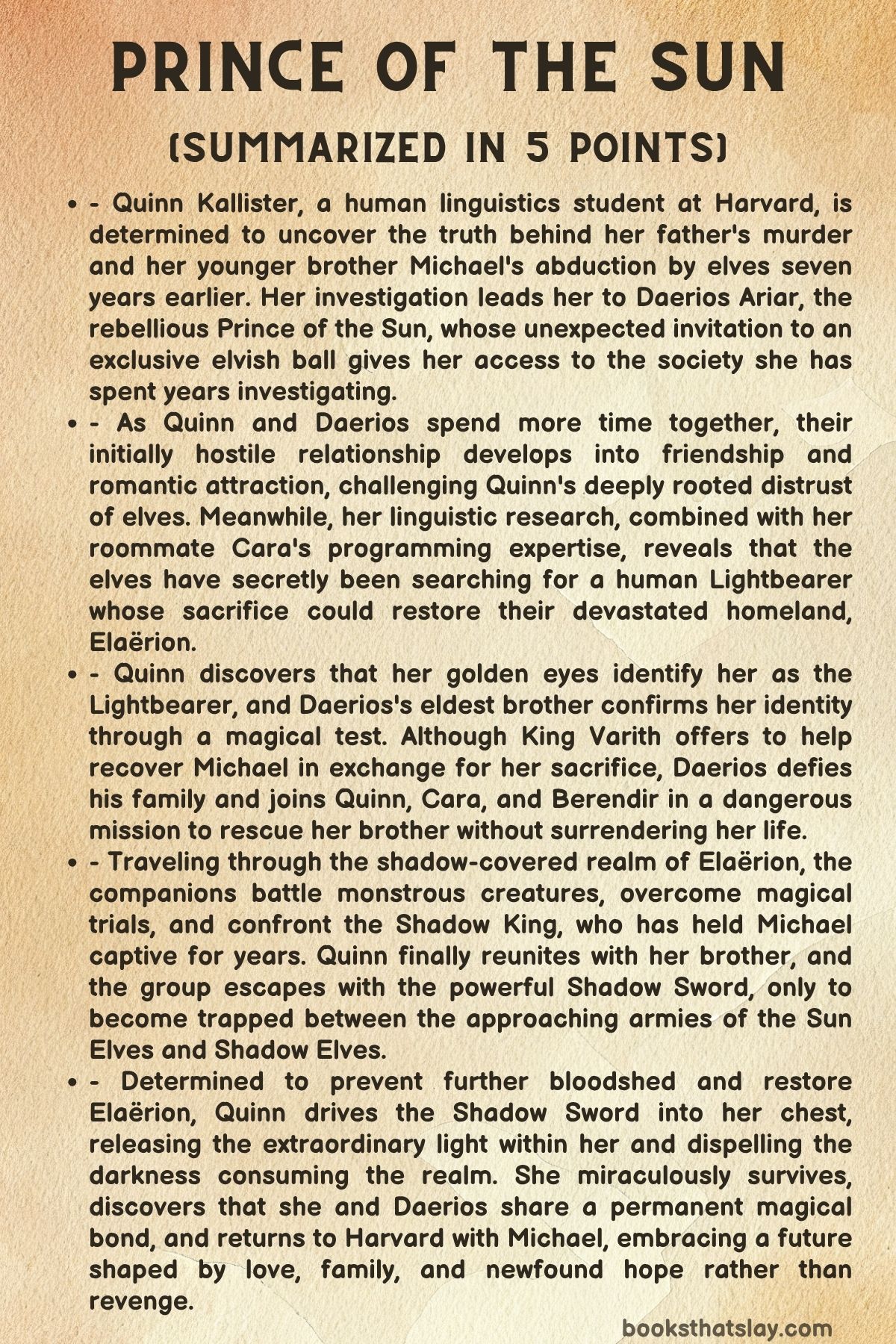
Quinn Kallister has spent seven years preparing to uncover the truth about the elves who destroyed her family. As a linguistics student at Harvard University, she possesses an exceptional understanding of elvish languages, an ability she intends to use against the powerful beings who have dominated human society since arriving on Earth a century earlier.
Her determination originated when she was twelve. During an ordinary family outing in Minnesota, two elves murdered her father, injured her younger brother Michael, and abducted him. The authorities offered no meaningful assistance, leaving Quinn and her mother without answers.
The tragedy devastated Quinn, contributing to emotional withdrawal and an eating disorder. Her recovery began when she recognized that Michael might still be alive. She subsequently devoted herself to learning languages and investigating the mysterious purpose behind the elves’ presence on Earth.
Quinn deliberately enrolls at Harvard because Daerios Ariar, the third-born Prince of the Sun, studies there. His reputation for rebellion makes him appear more approachable than his disciplined royal brothers.
Their first encounter occurs when Daerios repeatedly borrows a textbook Quinn needs. Frustrated, she confronts him in a reading room dominated by elves, speaking fluent Lukkarin and demanding the book.
Daerios is amused by her audacity. He agrees to surrender the textbook on the condition that she grant him a future favor.
When he subsequently demands that Quinn accompany him to the prestigious Ikarith Ball, she recognizes an opportunity to enter the exclusive world she has spent years investigating.
Meanwhile, Quinn secretly monitors the Ikarith final club, where elvish students participate in mysterious reading sessions. Her surveillance reveals that Daerios’s eldest brother, Saechon, oversees an important operation connected to the royal family’s secret search.
Historical research teaches Quinn about Elaërion, the elves’ original homeland, and the Elemental Wars that preceded their arrival on Earth. Nevertheless, she cannot determine what they are searching for or why their mission requires such extensive academic resources.
Her growing association with Daerios complicates matters.
At Harvard, their interactions become increasingly frequent. Daerios and his best friend Berendir begin socializing with Quinn and her roommate Cara, gradually challenging the separation between human and elvish students.
Although Quinn initially regards Daerios as an arrogant representative of an oppressive society, his behavior repeatedly contradicts her expectations. He appreciates her intelligence, accepts defeat during their playful competitions, and seems genuinely entertained by her refusal to flatter him.
At the Ikarith Ball, Quinn discovers another side of the prince.
He encourages her to eat when he notices her discomfort around food, intervenes when another elf treats her disrespectfully, and patiently teaches her traditional elvish dancing.
Their conversations also reveal that Elaërion suffered a catastrophe involving darkness and the Shadow Elves. Daerios remains unwilling to disclose the full truth, but Quinn begins to suspect that the elves’ mission might be connected to their devastated homeland.
As they dance, their attraction becomes undeniable. Frightened by the implications, Quinn abruptly withdraws.
Back at Harvard, Daerios continues seeking her company. Their friendship develops through academic work, teasing exchanges, and increasingly personal conversations.
During a visit to Quinn’s dormitory, he describes Elaërion’s former beauty and the darkness that destroyed its civilization. Their conversation culminates in a kiss, transforming their relationship.
However, Quinn subsequently overhears Saechon questioning whether she might be the person the royal family has been searching for.
Daerios denies that she is their target, but the conversation raises the possibility that his original interest in her was not innocent.
Quinn continues her investigation while struggling with her feelings.
Examining obscure elvish publications, she notices unusual grammatical constructions that seem inconsistent with the writers’ linguistic precision. She suspects the errors conceal messages.
With Cara’s programming expertise, Quinn begins developing a method to decode them.
Her relationship with Daerios also deepens during an excursion to Spot Pond. They ride horseback, walk together, swim in the rain, and eventually retreat to his secluded cabin.
Away from royal expectations and university scrutiny, Daerios reveals his more vulnerable personality. Quinn begins feeling genuinely safe with him, although she remains unable to reconcile their connection with her family’s suffering.
Eventually, Cara’s decoding program exposes the elves’ secret.
Their mission is to locate the Palasolaeva, a human Lightbearer capable of restoring sunlight to Elaërion. The individual can supposedly be identified by golden eyes and confirmed through a wound inflicted with a blade made from Elaërion steel.
The restoration requires the Lightbearer’s sacrifice.
Quinn recognizes that her own golden eyes might identify her as the person the elves intend to kill.
She confronts Daerios, who admits that her unusual eyes initially attracted his attention. Furious, Quinn accuses him of manipulating her to fulfill his family’s mission.
During their argument, she reveals Michael’s disappearance and her belief that the Shadow Elves abducted him.
Before they can resolve their confrontation, Saechon arrives and orders Quinn restrained.
He cuts her palm with the identifying blade. Brilliant light erupts from the wound, confirming that she is the Lightbearer.
Quinn is taken prisoner and brought before King Varith Ariar.
The king reveals that the Shadow King may have abducted Michael because he suspected the boy possessed the same extraordinary power. Although Michael apparently failed the identifying test, he might still be alive in Elaërion.
Varith offers Quinn a bargain: if she agrees to sacrifice herself to restore the realm, his forces will help rescue her brother.
Convinced that Michael’s survival matters more than her own, Quinn accepts.
Daerios refuses to allow the sacrifice.
With Berendir and Cara, he removes Quinn from the royal encampment and takes her to a secure apartment belonging to his younger brother, Lûth.
He explains that he feared confirming her identity precisely because he understood what his family would do to her. Although Quinn remains angry, she begins recognizing that his feelings were genuine.
The group prepares to enter Elaërion independently, rescue Michael, and escape without surrendering Quinn’s life.
Their journey begins at New York’s Unity Tower, where royal guards attempt to prevent their departure. After a dangerous pursuit, Daerios opens a portal into his homeland.
Elaërion is a devastated realm without sunlight, filled with dangerous creatures and abandoned landscapes.
As the companions travel toward Árrion, the former royal home, Quinn and Daerios gradually repair their relationship.
During a night in a cave, Daerios reveals that his mother suffered from an eating disorder following a family tragedy. King Varith responded with cruelty, once threatening Daerios’s life to force his mother to eat.
Quinn finally understands the personal experience underlying Daerios’s sensitivity toward her own struggles. Their renewed intimacy strengthens their relationship.
Their progress is interrupted when monstrous urrath attack.
Daerios is poisoned during the battle, and Berendir explains that he will die without an antidote made from skyberries.
Cara and Berendir search for the fruit while Quinn remains beside the weakening prince. His approaching death forces her to acknowledge how deeply she loves him.
The antidote arrives in time, saving Daerios.
Their journey continues through further dangers, including a river inhabited by monstrous creatures. Daerios rescues Quinn from drowning, while Berendir must save Cara after she nearly dies.
Eventually, the companions reach magical Trial Gates protecting Árrion.
Quinn solves a linguistic riddle, while Cara overcomes a mathematical challenge. Their successes demonstrate that human knowledge is as essential to the mission as elvish strength and magic.
Inside Árrion, they confront Duvainor, the Shadow King.
Quinn demands Michael’s release, while Daerios negotiates using the threat of his father’s approaching army and the importance of the Shadow Sword.
Michael is finally brought before them.
Their reunion fulfills the hope Quinn has sustained for seven years. Although captivity has changed him, he recognizes his sister.
The group subsequently escapes its Shadow Elf escorts. Daerios initiates the confrontation, while Quinn uses her emerging light-based powers to disorient their enemies.
Together, they secure Michael and the Shadow Sword before fleeing toward the portal.
However, the escape brings them into the path of King Varith’s army.
The Shadow King also arrives with his forces, accompanied by terrifying creatures. Both armies prepare for a confrontation that threatens catastrophic bloodshed.
Quinn recognizes that her power might offer another solution.
Having finally recovered Michael and acknowledged her love for Daerios, she faces the possibility of losing everything she fought to regain.
Nevertheless, she chooses to sacrifice herself rather than allow the conflict to continue.
She drives the Shadow Sword into her chest.
An extraordinary release of light spreads through Elaërion. Quinn loses consciousness, experiencing only a vast brilliance and the distant sound of Daerios calling her name.
When she awakens, she discovers that she has survived.
Her sacrifice has restored sunlight to Elaërion, ending the darkness that forced the elves to abandon their homeland.
Daerios is beside her, and their reunion leads to an open declaration of love.
He also reveals that they are mates, bound by a connection that may allow Quinn to share his extraordinary lifespan. Rather than fearing their permanent commitment, she welcomes the possibility of spending centuries together.
The novel concludes at Harvard, where Quinn resumes her studies.
Michael has returned to her life, Cara and Berendir remain close companions, and Daerios has become her partner rather than her enemy.
Although political tensions and future dangers remain unresolved, Quinn no longer believes that happiness depends upon controlling every possible outcome.
Her journey has transformed her understanding of love, family, sacrifice, and the possibility of rebuilding a life after tragedy.
Characters
Quinn Kallister
Quinn Kallister is the protagonist of Prince of the Sun, a determined human linguistics student whose exceptional intelligence conceals years of unresolved grief. Her father’s murder and Michael’s abduction have shaped nearly every important decision she makes.
Her commitment to finding her brother gives her life direction, but it also confines her emotionally. She approaches education, relationships, and personal safety primarily through their usefulness to her investigation.
Quinn’s linguistic abilities establish her as more than an ordinary human challenging a powerful society. Her understanding of elvish languages enables her to obtain information that even experienced royal investigators overlook.
Her discovery of the encoded messages demonstrates the importance of intellectual independence. She succeeds because she questions accepted explanations and recognizes patterns that others dismiss.
Nevertheless, Quinn possesses significant emotional vulnerabilities.
Her childhood experiences contribute to an eating disorder, difficulty trusting others, and a persistent need for control. These struggles reveal the personal cost of organizing her existence around an unresolved tragedy.
Her relationship with Daerios challenges her certainty about the elves.
Initially, she views him primarily as an instrument for recovering Michael. However, his kindness, humor, and willingness to challenge his family’s expectations gradually force her to recognize his individuality.
Her greatest conflict emerges when she discovers that she is the Lightbearer.
The revelation transforms her investigation into a question of survival. She must decide whether recovering Michael and restoring Elaërion justify surrendering her own future.
Quinn’s eventual sacrifice reflects her compassion, but it also demonstrates how readily she prioritizes other people’s lives above her own.
Her survival allows the novel to explore a different possibility: she can protect those she loves without permanently sacrificing her happiness.
By the conclusion, Quinn has not abandoned her intelligence or determination. Instead, she has learned to balance those qualities with trust, intimacy, and the acceptance of uncertainty.
Daerios Ariar
Daerios Ariar is the third-born Prince of the Sun and the central romantic figure in Prince of the Sun. His rebellious reputation initially suggests an irresponsible royal who cares more about pleasure than his obligations.
Yet his defiance conceals an individual deeply affected by his family’s expectations and history.
Daerios has spent much of his life resisting King Varith’s authority. His behavior reflects both resentment toward his father’s cruelty and discomfort with the responsibilities imposed upon him.
His relationship with Quinn reveals qualities that his public image obscures.
He appreciates intellectual competition, enjoys being challenged, and repeatedly treats Quinn as someone whose abilities deserve recognition. His willingness to acknowledge her achievements before other elves distinguishes him from the hierarchical society surrounding them.
His attentiveness to Quinn’s eating disorder also reflects personal experience.
Having witnessed his mother’s suffering and his father’s violent response, Daerios understands that coercion cannot resolve emotional distress. His concern for Quinn emerges from painful memories rather than simple romantic protectiveness.
However, Daerios is not entirely innocent in their relationship.
He initially notices Quinn because her golden eyes suggest that she might be the Lightbearer. His decision to conceal this suspicion creates a betrayal that threatens their developing trust.
His central moral conflict concerns loyalty.
He must choose between obeying a royal family determined to restore its homeland and protecting a woman whose death would accomplish that objective.
By defying Saechon and King Varith, Daerios demonstrates that his rebellion can serve a meaningful ethical purpose.
His actions in Elaërion further challenge his reputation for irresponsibility. He organizes the rescue, confronts dangerous enemies, protects his companions, and repeatedly risks his life.
Ultimately, Daerios matures into a character capable of combining courage with vulnerability.
His relationship with Quinn gives him something beyond royal duty or rebellion: a future defined by mutual affection and personal choice.
Michael Kallister
Michael Kallister is Quinn’s younger brother, whose disappearance provides the central motivation for her investigation.
Although he is absent from much of the narrative, his importance remains constant because nearly every major decision Quinn makes is connected to finding him.
His abduction represents the destruction of Quinn’s childhood security.
The uncertainty surrounding his fate prevents her family from achieving emotional closure. Unlike a confirmed death, his disappearance leaves Quinn suspended between grief and hope.
Michael also demonstrates the human consequences of elvish political conflict.
His captivity results from the Shadow King’s search for the Lightbearer, showing how ordinary individuals become victims of struggles involving powerful rulers.
When Michael finally appears in Árrion, his survival confirms that Quinn’s persistent hope was justified.
However, his years of imprisonment cannot simply be erased by their reunion. His changed appearance and prolonged captivity suggest experiences that the novel does not fully explore.
His return gives Quinn an opportunity to redefine her life.
For seven years, her identity has depended upon searching for him. Once he is safe, she must confront the possibility of living for something beyond that purpose.
Michael consequently represents both the enduring importance of family and the possibility of recovery after prolonged separation.
Cara
Cara is Quinn’s roommate, close friend, and an essential participant in the events of Prince of the Sun. Her humor and practical intelligence provide a contrast to Quinn’s intense, secretive personality.
Unlike Quinn, Cara approaches unfamiliar situations with considerable social confidence.
She is willing to challenge Berendir’s teasing, participate in uncomfortable conversations, and recognize the developing attraction between Quinn and Daerios.
Her most important contribution emerges through her computer science expertise.
When Quinn discovers suspicious grammatical constructions in elvish publications, Cara develops the program that reveals the hidden messages. Without her assistance, Quinn might never identify the Lightbearer’s significance.
Cara’s participation in the rescue mission demonstrates the depth of her loyalty.
She enters a dangerous realm despite lacking the magical abilities and physical advantages of her elvish companions.
Her intelligence proves essential again when she solves the mathematical challenge protecting Árrion.
These achievements reinforce the novel’s rejection of the assumption that magical power necessarily determines an individual’s usefulness.
Cara also develops a romantic relationship with Berendir.
Their teasing gradually becomes emotional attachment, and the danger they experience in Elaërion reveals the seriousness of their feelings.
Her character demonstrates that friendship involves more than offering emotional encouragement. Cara actively shares Quinn’s risks and contributes to her survival.
Berendir Meldë
Berendir Meldë is Daerios’s closest friend and one of the principal supporting characters.
Initially, he appears primarily as a humorous companion who enjoys provoking Quinn and teasing Cara. His relaxed manner complements Daerios’s irreverent personality.
However, Berendir’s loyalty becomes increasingly significant as the narrative progresses.
When Daerios decides to defy his family, Berendir supports him despite the considerable risks associated with opposing royal authority.
His willingness to enter Elaërion demonstrates courage that extends beyond casual friendship.
Berendir also possesses valuable knowledge of his homeland’s dangers. He recognizes the poisonous effects of the urrath attack and identifies the antidote required to save Daerios.
His actions during the journey reveal a capable and dependable individual beneath his playful exterior.
His developing relationship with Cara provides another dimension to his characterization.
Their initial conversations are dominated by sarcasm and competition, but their affection becomes unmistakable when Cara nearly dies during the river crossing.
Berendir’s desperate attempt to revive her reveals emotional vulnerability that contrasts with his earlier confidence.
He ultimately represents friendship as a form of chosen loyalty, demonstrating that devotion to particular people can become more important than obedience to established authority.
Saechon Ariar
Saechon Ariar is Daerios’s eldest brother and one of the principal representatives of the Sun Elves’ political establishment.
His disciplined personality contrasts sharply with Daerios’s rebellious behavior. Where Daerios questions established expectations, Saechon accepts his position within the royal hierarchy.
Saechon oversees an important part of the search for the Lightbearer.
His commitment to restoring Elaërion makes him willing to prioritize the survival of his homeland over the rights of the individual whose sacrifice would accomplish that objective.
His treatment of Quinn reveals the consequences of this outlook.
Once he recognizes that she may be the Lightbearer, he orders her restrained and subjects her to the identifying test despite her protests.
Saechon does not appear to consider Quinn’s consent an essential condition of the mission.
His relationship with Daerios also exposes the emotional pressures within the royal family.
He repeatedly criticizes his brother’s irresponsibility, interpreting rebellion as a failure to fulfill inherited obligations.
However, Daerios’s willingness to protect Quinn suggests that responsibility can involve resisting authority rather than accepting it.
Saechon represents the moral dangers of unwavering commitment to a collective objective when that commitment excludes consideration for individual suffering.
King Varith Ariar
King Varith Ariar is the ruler of the Sun Elves and the central authority behind the search for the Lightbearer.
His desire to restore Elaërion provides a comprehensible political motivation. His people have lost their homeland, and the darkness consuming it threatens their collective future.
Nevertheless, his methods reveal a willingness to sacrifice others for that objective.
His treatment of Quinn demonstrates his utilitarian approach to power. He considers her death an acceptable price for restoring his realm and attempts to secure her cooperation by offering assistance in recovering Michael.
The bargain places tremendous emotional pressure on a young woman who has spent years searching for her brother.
Varith’s treatment of his family reveals similar authoritarian tendencies.
Daerios recounts how his father threatened him to force his mother to eat during a period of severe emotional suffering. The incident shows how Varith responds to vulnerability through control rather than understanding.
His relationship with Daerios is consequently shaped by resentment and fear.
Although he occasionally appears to recognize his son’s abilities, his approval remains connected to Daerios’s usefulness to the royal mission.
Varith embodies the contradiction between a ruler’s responsibility to protect his people and the moral limitations that should govern his exercise of power.
Duvainor, the Shadow King
Duvainor is the ruler of the Shadow Elves and the principal opposing authority in Elaërion.
His actions are directly connected to Quinn’s childhood tragedy because his forces are implicated in Michael’s abduction.
He represents the enduring conflict between the rival elvish factions and the consequences of the catastrophe that devastated their homeland.
Duvainor’s interest in Michael reflects the same determination to locate the Lightbearer that motivates the Sun Elves.
The possibility that Michael might possess extraordinary power makes him valuable to the Shadow King, whose treatment of the boy demonstrates how political calculations can override individual freedom.
When Quinn’s group reaches Árrion, Duvainor approaches their arrival through negotiation and strategic calculation.
His interest in the Shadow Sword reveals the importance of ancient magical weapons to the struggle between the factions.
Although he eventually permits Michael to accompany the group, he imposes conditions intended to preserve his control.
His later decision to bring monstrous creatures into the confrontation with King Varith demonstrates his willingness to escalate the conflict.
Duvainor serves as a reminder that the struggle to control Elaërion involves competing rulers whose ambitions repeatedly endanger those outside their immediate political interests.
Lûth Ariar
Lûth Ariar is Daerios’s younger brother and a comparatively minor but important figure in the novel.
His most significant contribution is the secure apartment that provides shelter for Quinn and her companions after Daerios removes her from the royal encampment.
Because the apartment is unknown to King Varith, it allows the group to organize their independent rescue mission.
Lûth’s role demonstrates that the royal family is not a completely unified political institution.
Even within a powerful ruling dynasty, private relationships and individual resources can create opportunities to resist established authority.
Although his personal motivations receive limited attention, his involvement helps establish the practical foundation for Quinn’s journey to Elaërion.
Brannion Ariar
Brannion Ariar is another of King Varith’s sons and forms part of the royal network responsible for the search.
His assignment to Beijing demonstrates the international scale of the operation and the family’s systematic approach to locating the Lightbearer.
Unlike Daerios and Saechon, Brannion does not receive substantial direct characterization.
His significance lies primarily in showing that the search extends across several important academic and political centers.
His position also reinforces Daerios’s unusual status within the family.
While his brothers appear to fulfill assigned responsibilities, Daerios initially resists the expectations associated with his royal identity.
Agathron
Agathron is an elvish attendee at the Ikarith Ball whose inappropriate treatment of Quinn produces an important confrontation.
His behavior reflects the unequal social environment in which powerful elves can disregard the dignity of human individuals.
Although his appearance is brief, it creates an opportunity for Daerios to demonstrate his principles.
Daerios intervenes, restrains Agathron, and demands that he apologize.
The incident challenges Quinn’s assumption that all elves automatically defend members of their own species against humans.
Agathron therefore serves as a contrast to Daerios, revealing how differently individuals can exercise the same advantages of status and power.
Magrion
Magrion is a member of the Ikarith final club who nearly discovers Quinn during her secret surveillance.
His investigation of a suspicious noise creates an immediate threat to her mission.
Although he is distracted by Saechon’s arrival, the encounter demonstrates the danger of Quinn’s investigative methods.
Magrion’s function is largely connected to the atmosphere of secrecy surrounding the club.
His presence reminds readers that Quinn’s linguistic intelligence does not protect her from every practical danger.
Dr. Infix
Dr. Infix is a linguistics instructor at Harvard whose academic responsibilities help bring Quinn and Daerios together.
The collaborative project assigned in class creates additional opportunities for their friendship to develop.
Although Dr. Infix does not play a substantial role in the political conflict, the character helps establish the academic environment that makes Quinn’s investigation possible.
The instructor’s presence also reinforces the importance of linguistics throughout the novel.
Rather than functioning as a decorative detail in Quinn’s education, language becomes the skill through which she ultimately discovers the truth.
Quinn’s Mother
Quinn’s mother represents the enduring emotional consequences of the violence inflicted upon the Kallister family.
Having lost her husband and younger son in a single traumatic incident, she lives with fear for her surviving daughter.
Her telephone conversations with Quinn reveal continuing anxiety about the elves and the dangers of attending Harvard.
Her warnings are grounded in direct experience rather than abstract prejudice.
Nevertheless, Quinn conceals her growing involvement with Daerios because she knows her mother would oppose the relationship.
This secrecy reveals the conflict between familial loyalty and personal independence.
Although Quinn’s mother remains outside the central adventure, her presence reminds readers that Michael’s disappearance has affected an entire family.
His eventual recovery offers her the possibility of rebuilding relationships that were violently interrupted.
Quinn’s Father
Quinn’s father appears principally through memories of the attack that transformed her childhood.
His murder establishes the personal violence underlying Quinn’s hostility toward the elves.
Because his death occurs while he is accompanying his children on an ordinary family outing, the tragedy destroys the distinction between everyday security and political danger.
His absence continues influencing Quinn’s decisions long after the event.
She associates the elves not merely with Michael’s disappearance but also with the permanent loss of a parent.
Although he receives limited direct characterization, his importance lies in the emotional consequences of his death and the lasting vulnerability it creates within the Kallister family.
Daerios’s Mother
Daerios’s mother is an important figure in understanding his emotional development, although her experiences are primarily revealed through his recollections.
Following a devastating family tragedy, she develops severe difficulties with eating.
Her suffering becomes especially significant because King Varith responds through intimidation and violence.
Daerios remembers being threatened by his father as a means of forcing his mother to eat.
This experience helps explain both his hostility toward Varith and his sensitivity to Quinn’s eating disorder.
Rather than treating Quinn’s struggles as evidence of weakness, he recognizes the importance of patience and emotional safety.
His mother’s experiences also demonstrate that royal privilege does not protect individuals from suffering within their own families.
Her influence continues shaping Daerios’s behavior even when she is absent from the immediate narrative.
Themes
Love, Trust, and the Transformation of Prejudice
Quinn’s relationship with Daerios develops across a division created by historical violence, political inequality, and personal suffering. Her distrust is not simply an inherited opinion about elves; it originates in the murder of her father and the disappearance of her brother.
Daerios initially represents everything she opposes. As a prince belonging to the ruling species, he appears to embody the institutions responsible for her family’s suffering.
Their developing friendship forces Quinn to distinguish between individuals and the political structures to which they belong.
Daerios repeatedly contradicts her assumptions through his respect for her intelligence, concern for her physical well-being, and willingness to challenge other elves when they mistreat her.
However, the novel does not present trust as an uncomplicated emotional achievement.
When Quinn discovers that Daerios originally suspected her of being the Lightbearer, his concealment confirms that affection does not automatically eliminate dishonesty or conflicting obligations.
Their reconciliation consequently requires more than romantic attraction. Daerios must explain his actions, and Quinn must decide whether his subsequent behavior demonstrates genuine commitment.
In Prince of the Sun, love becomes a process through which established beliefs are examined rather than simply abandoned.
Quinn’s transformation does not require her to deny the violence committed against her family. Instead, she learns that acknowledging an individual’s humanity does not mean excusing the injustices of the society surrounding them.
Her eventual commitment to Daerios reflects a more mature understanding of trust, one based on experience, accountability, and the freedom to choose whom she loves.
Grief, Trauma, and the Recovery of Personal Identity
The disappearance of Michael transforms Quinn’s life into an extended attempt to reverse the consequences of a single devastating event.
Her academic achievements, social isolation, and relentless investigation all develop from her determination to recover what was taken from her family.
Although this purpose gives her strength, it also prevents her from imagining a meaningful future beyond the search.
Her eating disorder reveals another dimension of trauma.
The difficulty she experiences around food reflects the lasting effects of grief and her complicated relationship with control. Situations that appear ordinary to others can become emotionally threatening because of experiences that remain unresolved.
Daerios’s account of his mother’s suffering creates a parallel between their histories.
Both characters have witnessed the consequences of trauma, but their experiences differ in the responses they received from those around them. Varith’s coercion illustrates how attempts to impose control can intensify an individual’s suffering.
Quinn’s gradual recovery involves accepting that emotional safety cannot be achieved exclusively through isolation and rigid routines.
Her friendship with Cara and relationship with Daerios introduce companionship into a life previously organized around secrecy.
The recovery of Michael ultimately brings this conflict into focus.
Finding him fulfills Quinn’s original purpose, but it also requires her to develop an identity that extends beyond being the sister who never stopped searching.
The conclusion emphasizes that healing does not erase the past.
Quinn continues carrying the consequences of her childhood, but those experiences no longer determine every aspect of her future. Her willingness to pursue love, education, and ordinary happiness becomes evidence of a life no longer defined solely by loss.
Power, Sacrifice, and Moral Responsibility
The search for the Lightbearer exposes a conflict between collective survival and individual rights.
King Varith believes that restoring Elaërion justifies sacrificing the person whose body contains the necessary power. His position originates in a genuine catastrophe affecting an entire civilization.
Nevertheless, the proposed solution requires the death of someone who bears no responsibility for that catastrophe.
Quinn’s discovery reveals the disturbing consequences of treating individuals primarily as resources.
The royal family has spent a century searching for a human whose identity matters principally because of what can be extracted from them. The victim’s consent becomes secondary to the political objective.
Saechon’s behavior demonstrates this outlook through his willingness to restrain Quinn and confirm her identity by force.
Duvainor’s treatment of Michael provides a related example. The boy’s potential usefulness to the Shadow King overrides his freedom and separates him from his family.
Daerios challenges these assumptions by refusing to accept that restoring his homeland requires Quinn’s involuntary death.
His rebellion reframes responsibility as something more demanding than obedience to established authority.
The eventual sacrifice in Prince of the Sun introduces a significant distinction between coercion and personal choice.
Quinn acts to prevent further bloodshed, but the decision originates in her own assessment of the crisis rather than submission to Varith’s demands.
Her survival prevents the conclusion from suggesting that her worth depends upon dying for others.
Instead, the novel recognizes both the extraordinary compassion involved in risking oneself and the importance of preserving the individual whose life powerful institutions were prepared to discard.
Language, Knowledge, and the Challenge to Established Hierarchies
Language provides Quinn with a form of power unavailable to many of the people who surround her.
Within a society dominated by elves, humans are expected to accept their subordinate position. Quinn challenges this expectation through intellectual abilities that cannot be dismissed by appeals to magical strength or inherited rank.
Her first confrontation with Daerios establishes the importance of linguistic competence.
By speaking Lukkarin fluently, she enters a conversational space that the elves generally assume belongs exclusively to their own species.
Her investigation subsequently demonstrates that knowledge can undermine systems built upon secrecy.
The elves depend upon humanity’s limited understanding of their languages to conceal information inside academic publications. Their confidence in this arrangement becomes a vulnerability because they underestimate the possibility of a human reader recognizing the encoded material.
Quinn succeeds through patience, detailed analysis, and a willingness to question apparent mistakes.
Cara’s contribution extends this theme beyond linguistics.
Her programming abilities transform Quinn’s observations into a practical decoding system, demonstrating that cooperation between different intellectual disciplines can accomplish what either individual might struggle to achieve independently.
The Trial Gates reinforce the same principle.
Quinn’s linguistic interpretation and Cara’s mathematical reasoning allow the companions to overcome obstacles that elvish physical abilities cannot resolve.
These encounters challenge the assumption that supernatural power automatically establishes intellectual superiority.
The novel ultimately presents education as a means of resisting imposed limitations.
Quinn’s achievements do not eliminate the political inequalities between humans and elves, but they expose the weakness of a hierarchy that equates inherited power with individual worth.
Her knowledge becomes essential not only to recovering Michael but also to understanding the catastrophe that has shaped two worlds.