Sunlight Finds You Summary, Characters and Themes
Sunlight Finds You by Laura Moriarty is a historical fiction novel about love, loss, motherhood, and the difficult pursuit of personal freedom.
Set primarily in mid-twentieth-century America, the story follows Eleanor Chesnow, known as Nora, whose youthful romance with Leonard Lifton is disrupted by family expectations, war, and an unexpected pregnancy. Forced into decisions that change the course of her life, Nora must confront the consequences of secrecy, social judgment, and the loss of her first child. Through her experiences, the novel examines how personal relationships are shaped by the restrictions of their time and how a woman can gradually reclaim control over her future.
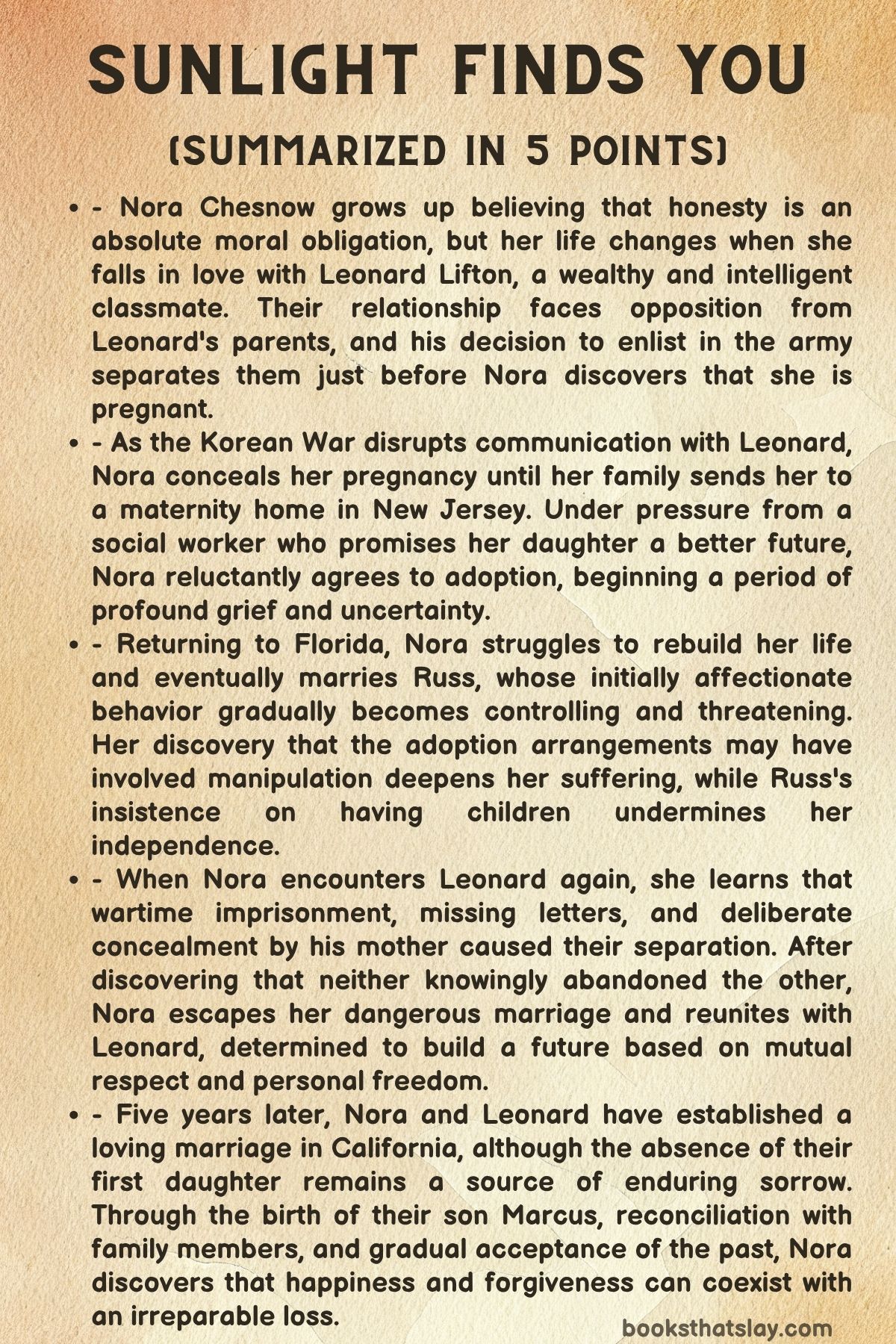
Summary
Eleanor Chesnow, known as Nora, grows up in Rolla, Missouri, with a strong belief in honesty. Her mother teaches her that lying is a serious moral failure, and Nora absorbs this lesson so completely that deception becomes almost impossible for her.
When Nora is in sixth grade, she secretly changes a sign on her teacher’s podium to embarrass him for mistreating vulnerable students. She denies responsibility when questioned, but her satisfaction disappears when her mother unexpectedly dies from a brain aneurysm.
For a time, Nora irrationally believes that her dishonesty caused her mother’s death. Although she eventually recognizes that the two events are unrelated, the experience permanently influences her understanding of guilt and truthfulness.
Her father later marries Mae, a young widow with a daughter named Janet. The family moves to St. Petersburg, Florida, where Nora embraces her new surroundings and develops friendships.
At school, she becomes interested in Leonard Lifton, an intelligent but socially reserved boy from a wealthy family. Their first conversation concerns George Orwell’s Animal Farm, and his willingness to question conventional opinions immediately attracts her.
Their friendship develops into a passionate romance. Leonard introduces Nora to literature and intellectual conversations, while she draws him into social activities, including dancing.
Leonard’s mother, Geneva, initially welcomes Nora into the family. Nora admires her sophistication, education, and literary interests, although she gradually becomes aware of the differences separating their families.
As Nora and Leonard grow closer, their physical attraction becomes increasingly difficult to resist. Their relationship reaches a crisis when Geneva discovers them together in the shower at the Lifton residence.
Fearing pregnancy and the destruction of Leonard’s educational prospects, Geneva demands that Nora end the relationship. She threatens to inform Nora’s father about the incident if Nora refuses.
Terrified of disappointing her father, Nora agrees. Leonard, however, refuses to surrender their future and proposes marriage.
Although Nora loves him, she believes an immediate marriage could damage his opportunities. She encourages him to continue his education and hopes they can reunite afterward.
Leonard interprets her hesitation as rejection. Seeking independence from his controlling father, he enlists in the army, leaving Nora devastated.
Despite their separation, their feelings remain unchanged. Leonard eventually returns during military leave, and they become sexually intimate.
Soon afterward, he is stationed in Japan. Their correspondence offers Nora some comfort, but her world changes when she discovers that she is pregnant.
She had intended to complete high school, attend junior college, and become a teacher. Now she fears that these ambitions will disappear beneath the social consequences of unmarried motherhood.
Nora writes to Leonard about the pregnancy, but the outbreak of the Korean War makes communication increasingly uncertain. As American forces enter the conflict, she becomes terrified that Leonard will be sent into combat.
His letters stop arriving, and Nora cannot determine whether he has abandoned her or simply cannot communicate.
Meanwhile, she conceals her pregnancy beneath oversized clothing. Her distress increases when Mae announces that she is expecting another child, receiving the happiness and approval Nora knows her own pregnancy would not inspire.
Eventually, Mae discovers Nora’s condition and arranges a medical examination. The doctor confirms that the baby is expected in January.
Nora’s father and Mae subsequently meet Leonard’s parents. Mr. Lifton refuses to believe that Leonard is responsible, suggesting that Nora has become involved with another boy.
Nevertheless, the families arrange for Nora to enter Shaded Acres, a maternity home in New Jersey. Her departure is disguised as a visit to help Mae’s mother, preserving the family’s public reputation.
The arrangement assumes that Nora will surrender her child for adoption.
At Shaded Acres, Nora encounters an institution that treats unmarried pregnancy as evidence of moral and psychological failure. Its supervisor, Mrs. Kilgore, interprets Nora’s condition as a consequence of unresolved grief over her mother’s death.
Nora rejects this explanation because it dismisses the reality of her love for Leonard.
Although the institution provides medical care, its atmosphere is dominated by discipline, shame, and expectations of obedience. Nora finds comfort in occasional kindness and in her developing friendship with Carol, a blind young woman whose intelligence and independence challenge her assumptions.
Their conversations about literature, relationships, and motherhood provide relief from the institution’s restrictions. Carol also questions Nora’s continued faith in Leonard, whose silence remains unexplained.
Another influential figure is Miss Berry, the social worker responsible for adoption arrangements. Initially reassuring, she gradually pressures Nora to accept that Leonard has abandoned her.
Miss Berry encourages her to view adoption as the responsible decision and describes an exceptionally suitable family who can provide opportunities Nora cannot offer.
When Nora gives birth, she initially receives little information about her daughter. She eventually holds the baby and notices an injury caused by forceps during delivery.
The experience transforms her feelings. Her daughter becomes a living person whose vulnerability makes their impending separation almost unbearable.
Nora announces that she wants to keep the child. Miss Berry responds by emphasizing Nora’s limited resources and the expectations of the prospective adoptive parents.
Exhausted, isolated, and uncertain how she could support her daughter, Nora eventually signs the adoption papers.
She returns to Florida carrying a grief she cannot discuss openly. Mae has recently given birth to Shirley Ann, and watching her stepmother care for the newborn intensifies Nora’s suffering.
Her family expects her to resume ordinary life, but Nora finds school increasingly meaningless. She eventually leaves her studies and works longer hours at the public library.
Her relationship with her brother Bobby also changes. Although he does not know the full truth, he senses her distress and defends her when other boys spread rumors.
Gradually, Nora begins dating Russ, a friendly young man who offers companionship and stability. His affection helps her experience moments of happiness, although her feelings for Leonard remain unresolved.
Russ eventually proposes marriage. Nora hesitates, partly because she remains uncertain about Leonard’s fate.
Then she discovers Leonard’s name on a published list of American prisoners held during the Korean War. The revelation confirms that he is alive and suggests that his silence may have resulted from circumstances beyond his control.
Nora visits Geneva, hoping to learn more. Although Leonard’s mother expresses relief about his survival, she continues encouraging Nora to build a life without him.
Believing their relationship cannot be restored, Nora marries Russ.
Their wedding appears to establish a secure future. Yet Nora’s grief persists, especially her anxiety about the daughter she surrendered.
An unexpected conversation with Carol challenges her understanding of the adoption. Carol reveals that she kept her son, David, despite receiving the same persuasive description of an ideal adoptive family from Miss Berry.
Nora realizes that the social worker may have used a prepared story rather than information about a particular couple. The discovery destroys one of the principal reassurances that had helped her endure the separation.
Her marriage also becomes increasingly troubled.
Russ initially accepts Nora’s determination not to have children, but he gradually begins pressuring her to reconsider. His jealousy of Leonard intensifies, and his behavior becomes increasingly controlling.
When Nora encounters Leonard at a baseball game, she responds with visible hostility. Russ recognizes the significance of their connection and becomes more determined to establish his own permanent claim on their marriage through parenthood.
His disregard for Nora’s reproductive wishes leaves her desperate. When she becomes pregnant, she deliberately makes herself dangerously ill by eating spoiled chicken, hoping to end the pregnancy.
The experience reveals the extent of her unhappiness and the danger created by Russ’s refusal to respect her decisions.
Later, Nora unexpectedly encounters Leonard working at a supermarket. His injured hand, with fingers missing from wartime captivity, shocks her.
She begins questioning everything she believes about his abandonment.
When Nora confronts Geneva, Leonard’s mother finally admits that vital information was concealed. Leonard had been missing during the war, and correspondence had been lost or interrupted.
Geneva had also withheld news of Nora’s pregnancy and the adoption from Leonard after his return, believing that revealing the truth would cause further suffering.
Nora realizes that both she and Leonard had been living with false assumptions. Neither had knowingly abandoned the other as they believed.
She arranges a private meeting with Leonard.
During their reunion, he describes the terrible conditions of his imprisonment, including hunger, disease, physical injuries, and the deaths of fellow soldiers. He explains that memories of Nora helped him survive.
Nora tells him about their daughter, Shaded Acres, and the adoption.
Their conversation restores their understanding of each other, although it cannot recover the years they lost.
When Nora returns home, Russ discovers that she has met Leonard. His anger becomes threatening, particularly when he takes her onto their motorboat.
Trapped on the water, Nora realizes that honesty could expose her to immediate danger.
She therefore lies, presenting Leonard as a helpless man who approached her for practical assistance. She also suggests that she and Russ might have a child together, knowing the promise contradicts her actual wishes.
Her deception calms Russ sufficiently for him to return them to shore.
That night, Nora secretly collects her belongings and escapes in his truck.
She finds Leonard and tells him that she wants to leave Florida and rebuild her life. He offers his support, but Nora insists that their relationship develop slowly because she needs to recover her independence.
They leave together, beginning a future grounded in choices Nora can finally make for herself.
Five years later, Nora and Leonard are married and living in Los Angeles. She works at a library while Leonard pursues medicine.
Their relationship provides the stability and affection denied to them earlier, but the absence of their daughter remains an enduring sorrow.
During a family visit, Nora speaks openly about the adoption, challenging the secrecy that once governed her life.
She also begins repairing her relationship with Bobby, who explains how confused and hurt he felt when she disappeared and returned emotionally changed.
Nora initially remains determined never to have another child. Leonard respects her decision, understanding that another baby cannot replace their daughter.
Eventually, however, her growing sense of security allows her to reconsider motherhood. The couple have a son, Marcus, whose arrival brings happiness without eliminating their earlier loss.
Leonard also gradually renews contact with Geneva. Their reconciliation begins cautiously, through letters and telephone calls.
When Geneva visits California, she reveals that she once hired a private investigator to search for information about their missing granddaughter. The investigation produced no results.
Nora asks her not to continue searching. She has begun accepting that she cannot protect her daughter by endlessly imagining possible suffering.
The novel closes with Nora, Leonard, and Geneva sitting together beneath the evening sky.
Their daughter remains absent, and the past cannot be repaired completely. Nevertheless, Nora has established a life in which love, autonomy, forgiveness, and enduring grief can coexist.
Characters
Eleanor Chesnow (Nora)
Nora is the central character of Sunlight Finds You, and her development provides the novel with its emotional and moral structure. Beginning as a girl who believes honesty is an absolute obligation, she becomes a woman who understands that personal integrity sometimes requires resisting the expectations of others.
Her childhood experience with Mr. Pile establishes her complicated relationship with deception. Although her prank challenges a teacher’s cruelty, she interprets her subsequent lie as a moral failure, particularly after her mother’s sudden death.
The irrational guilt she associates with this tragedy reveals her tendency to assume responsibility for events beyond her control. This characteristic later influences her reactions to pregnancy, adoption, and romantic disappointment.
Nora’s relationship with Leonard demonstrates her capacity for intellectual curiosity and profound emotional attachment. She admires his independence and intelligence, but she is also willing to sacrifice their immediate happiness because she believes his education deserves protection.
Her pregnancy exposes the limitations of the society in which she lives. Despite being legally an adult, she possesses little meaningful control over the arrangements made by her family and the adoption institution.
Her decision to surrender her daughter becomes the central grief of her adulthood. She struggles to reconcile the belief that adoption was necessary with her continuing desire to protect and know her child.
Nora’s marriage to Russ reveals another aspect of her vulnerability. Her longing for stability encourages her to accept a relationship that gradually restricts her freedom.
Nevertheless, she retains considerable inner strength. Her eventual decision to deceive Russ and escape demonstrates a fundamental transformation in her understanding of morality.
She recognizes that protecting herself from violence is more important than maintaining an unquestioning commitment to literal truth.
By the conclusion, Nora has become capable of establishing boundaries, acknowledging complicated emotions, and making decisions without seeking universal approval.
Her greatest achievement is not simply her reunion with Leonard but her recovery of personal authority. She learns that happiness can exist without requiring her to deny the losses that shaped her.
Leonard Lifton
Leonard is Nora’s first love and one of the principal figures through whom Sunlight Finds You examines independence, class expectations, and the lasting consequences of war.
Initially perceived as arrogant because of his reserved manner, Leonard gradually reveals himself as intelligent, sensitive, and socially uncertain. His connection with Nora develops through conversations that allow him to express ideas he rarely shares with his classmates.
His willingness to challenge established opinions distinguishes him from the more conventional figures surrounding Nora. His criticism of the atomic bombings of Japan demonstrates his resistance to accepting official explanations without questioning their moral implications.
Leonard’s conflict with his parents becomes a defining feature of his youth. Their wealth provides substantial opportunities, but their expectations also make him feel that his future has already been determined.
His enlistment represents an attempt to establish independence through an irreversible decision. Yet the consequences expose the limitations of his understanding of freedom.
The Korean War transforms Leonard’s life through experiences of imprisonment, deprivation, and physical injury. His survival depends partly on memories of Nora, whose imagined companionship helps him endure captivity.
His return reveals that he has suffered far more than Nora previously understood. Their reunion allows him to explain how disrupted communication and family interference distorted their relationship.
Leonard’s later behavior contrasts with Russ’s possessiveness. He respects Nora’s reluctance to have another child and does not demand immediate emotional recovery after her escape.
His development suggests that genuine love requires recognizing another person’s autonomy rather than controlling their decisions.
Although he cannot undo the loss of their daughter, Leonard helps create a marriage in which Nora can finally experience affection without surrendering her independence.
Geneva Lifton
Geneva is among the most morally complicated characters in the novel. Her sophistication, affection, and intellectual curiosity initially make her an important influence on Nora.
As Leonard’s mother, she appears to represent a world of educational opportunity and cultural freedom. Her appreciation of literature encourages Nora’s intellectual ambitions.
Yet Geneva’s apparently progressive outlook exists alongside deeply conventional expectations about class, sexuality, and family reputation.
When she discovers Nora and Leonard together, she responds by prioritizing her son’s future. Her decision to separate them reflects genuine concern, but it also reveals her willingness to disregard Nora’s emotional interests.
Her subsequent concealment of information becomes considerably more destructive. By withholding the truth about Nora’s pregnancy and Leonard’s circumstances, she prevents both young people from making informed decisions.
Geneva repeatedly convinces herself that concealment is a form of protection. In reality, her interventions contribute to the loss of her granddaughter and the prolonged separation of the child’s parents.
Her later confession demonstrates that she is capable of recognizing the consequences of her behavior, although acknowledgment cannot eliminate the damage.
The gradual reconciliation between Geneva and Leonard is significant because it allows their relationship to develop beyond the authority she exercised over him during his youth.
Her unsuccessful attempt to find their missing granddaughter also reveals the persistence of her regret.
By the conclusion, Geneva is neither completely condemned nor entirely absolved. Her character demonstrates how sincere affection can become destructive when combined with paternalism and an unwillingness to respect other people’s choices.
Mae Chesnow
Mae enters Nora’s life as her father’s second wife, bringing warmth and stability to a household still affected by bereavement.
Her relationship with Nora is initially characterized by patience and practical affection. Although she cannot replace Nora’s mother, she makes a genuine effort to establish a supportive family environment.
When Nora’s pregnancy becomes apparent, Mae assumes responsibility for managing the immediate consequences. She arranges medical care and helps organize the discussions between the Chesnow and Lifton families.
Her conduct demonstrates compassion, but it also reveals her dependence on the social expectations governing unmarried pregnancy.
Mae accepts the arrangements that send Nora away and conceal the childbirth from the younger children. Although she understands Nora’s suffering, she does not challenge the system that makes secrecy appear necessary.
Her own pregnancy intensifies the contrast between socially approved motherhood and Nora’s condemned circumstances.
The birth of Shirley Ann places Mae in an especially difficult position. She experiences the happiness of caring for her baby while knowing that Nora has been forced to surrender hers.
Mae’s later respect for Nora’s reluctance to hold Shirley shows emotional sensitivity. Rather than demanding that Nora suppress her feelings, she allows her to establish a private boundary.
Her character illustrates the difference between individual kindness and resistance to harmful social conventions. Mae cares deeply for Nora but remains influenced by the assumptions of her generation.
Nora’s Father
Nora’s father is a loving but emotionally limited parent whose expectations significantly influence his daughter’s decisions.
After his first wife’s death, he struggles with loneliness while attempting to provide stability for Nora and Bobby. His marriage to Mae eventually restores a measure of happiness to the household.
His affection for Nora is sincere, but his idealized understanding of her character becomes a source of pressure.
Because he believes so strongly in her goodness and honesty, Nora fears that revealing her pregnancy will permanently damage their relationship.
His response to her relationship with Leonard also exposes his limited understanding of her experiences. When the romance ends, he assumes Leonard has rejected her and dismisses the young man without knowing what actually happened.
The arrangements surrounding Nora’s pregnancy demonstrate his dependence on conventional ideas of respectability. Rather than openly confronting the situation, he participates in concealing it.
This decision protects the family’s public image but contributes to Nora’s isolation.
Years later, his discomfort when Nora discusses the adoption indicates that he has never completely reconciled himself to the past.
He is not portrayed as an unloving father. Instead, his limitations arise from an inability to recognize how deeply his expectations have influenced his daughter’s silence.
Russ
Russ represents the difference between apparent security and genuine emotional safety. Initially, he appears to offer Nora a stable future after the uncertainty surrounding Leonard and the adoption.
His friendly manner and willingness to pursue Nora despite local gossip help her regain some confidence.
Nevertheless, his assumptions about marriage gradually reveal a possessive understanding of love. He expects Nora to fulfill conventional domestic roles and becomes increasingly frustrated when her wishes differ from his.
His attitude toward pregnancy is particularly revealing. Although Nora makes her reluctance to have children clear before marriage, Russ begins treating her refusal as evidence that she remains emotionally attached to Leonard.
He therefore transforms parenthood into a test of loyalty.
His disregard for Nora’s contraceptive wishes undermines her control over her body and produces increasingly desperate responses.
Russ’s jealousy eventually develops into intimidation and threats. The motorboat confrontation exposes the danger Nora faces when he possesses complete control over their immediate circumstances.
His character illustrates how coercion can develop within a relationship that outwardly appears respectable.
Unlike Leonard, Russ interprets independence as a threat to his authority. Nora’s eventual escape becomes possible only when she abandons the assumption that maintaining marital harmony is more important than protecting herself.
Carol
Carol is one of the most influential supporting characters in Sunlight Finds You, providing Nora with intellectual companionship and an alternative model of female independence.
Her blindness initially shapes Nora’s expectations, but Carol quickly challenges the idea that disability necessarily creates helplessness or dependence.
Her extensive reading, sharp humor, and willingness to question conventional opinions establish her as an intellectually confident woman.
Their friendship develops through conversations about literature and through the unusual amusement they find in reading newspaper obituaries.
Carol also encourages Nora to consider perspectives beyond her immediate emotional experience. Although her comments sometimes irritate Nora, they challenge assumptions that might otherwise remain unquestioned.
Her decision to keep her son, David, becomes especially important.
Unlike Nora, Carol refuses to surrender her child despite institutional pressure. Her experience exposes the weakness of the social worker’s claim that unmarried mothers necessarily provide unsuitable homes.
When Nora learns that Carol received the same description of an ideal adoptive family, their friendship becomes the means through which a painful deception is revealed.
Carol’s later advice about refusing to surrender one’s life to prolonged sadness initially provokes Nora’s anger. Nevertheless, it encourages her to examine the circumstances she has accepted.
Carol represents independence grounded in self-knowledge rather than conformity. Her presence demonstrates that motherhood, disability, and social judgment do not inevitably determine a woman’s possibilities.
Miss Berry
Miss Berry is the social worker responsible for guiding Nora through the adoption process. Her outward kindness makes her particularly influential because she appears to understand the vulnerability of the young women under her supervision.
Unlike the openly judgmental Mrs. Kilgore, she presents herself as compassionate, educated, and committed to the residents’ welfare.
Her methods, however, rely on carefully directing their emotions toward decisions the institution already favors.
She repeatedly encourages Nora to interpret Leonard’s silence as abandonment, despite the uncertainty surrounding his military service.
Her description of an exceptionally suitable adoptive family becomes a central source of reassurance. When Nora later discovers that Carol received essentially the same description, Miss Berry’s credibility collapses.
Her response to Nora’s wish to keep her daughter is especially significant. Rather than helping her investigate practical alternatives, she emphasizes the expectations of the prospective adoptive parents.
By presenting surrender as a moral obligation, Miss Berry transforms Nora’s maternal concern into another source of guilt.
Her character reveals how authority can operate through apparent benevolence. She does not need to threaten Nora openly because she can influence decisions through selective information and emotional pressure.
The novel uses Miss Berry to question whether consent can be genuinely voluntary when those providing guidance control the available information and alternatives.
Mrs. Kilgore
Mrs. Kilgore supervises Shaded Acres and represents the institution’s openly disciplinary approach to unmarried pregnancy.
She believes the residents must confront their supposed moral failures and accept the consequences of their behavior.
Her explanation of Nora’s pregnancy as an expression of unresolved childhood grief demonstrates her tendency to reduce individual experiences to convenient psychological categories.
Rather than listening to Nora’s account of her relationship with Leonard, she imposes an interpretation that supports the institution’s assumptions.
Mrs. Kilgore also treats obedience and emotional restraint as evidence of personal improvement.
Her authority establishes an atmosphere in which the residents are encouraged to feel ashamed rather than supported.
She is significant because she embodies the institutional conviction that unmarried mothers require correction. Her rigid worldview makes it difficult for the young women to express needs that conflict with the home’s expectations.
Bobby Chesnow
Bobby is Nora’s younger brother and one of the clearest examples of how family secrecy affects people beyond those directly involved.
He experiences their mother’s death alongside Nora, creating a bond grounded in shared childhood loss.
As Nora grows older, Bobby remains protective of her. His confrontation with boys who gossip about her demonstrates loyalty even when he lacks the information necessary to understand her circumstances.
Her sudden departure for New Jersey leaves him confused, while her emotionally withdrawn return creates a painful distance between them.
Bobby interprets these changes partly as the loss of the sister with whom he once shared a close relationship.
His later conversation with Nora allows him to explain how deeply the secrecy affected him.
Rather than condemning her, he offers to listen. This response contrasts with the silence and judgment that characterized the family’s earlier handling of her pregnancy.
Bobby’s character demonstrates that honest communication can restore relationships damaged by concealment.
Janet Chesnow
Janet is Mae’s daughter and Nora’s stepsister. Her presence helps establish the blended family created by Mae’s marriage to Nora’s father.
Although she remains a secondary character, she contributes to the domestic environment against which Nora’s experiences unfold.
Like Bobby, Janet is excluded from the truth about Nora’s pregnancy and departure. The adults’ efforts to protect the younger children reinforce the household’s culture of secrecy.
Her later revelation about Bobby’s fight helps Nora understand that her brother has remained loyal despite their emotional distance.
Janet also appears in the later family reunion, demonstrating the continuity of family relationships across the years.
Her character helps illustrate the ordinary domestic life Nora temporarily loses and eventually learns to approach on different terms.
Shirley Ann
Shirley Ann is Mae’s daughter and Nora’s younger half-sister. Her birth occurs almost simultaneously with Nora’s return from the maternity home.
This timing gives her presence considerable emotional significance.
Shirley receives the open affection and recognition denied to Nora’s daughter. Her arrival consequently forces Nora to confront the contrast between celebrated motherhood and motherhood treated as shameful.
Nora’s reluctance to hold Shirley does not arise from hostility toward the child. Instead, the infant’s presence reminds her of the daughter she has lost.
As Shirley grows older, she becomes part of Nora’s continuing relationship with her family.
Nora’s eventual decision to tell her about the adoption marks an important rejection of the secrecy that previously governed their household.
Marcus Lifton
Marcus is Nora and Leonard’s son, born after they have established their life together in California.
His arrival demonstrates that Nora’s feelings about motherhood can change when she experiences security and genuine control over her decisions.
Unlike her first pregnancy, Marcus’s conception results from a choice she makes with a partner who respects her wishes.
Nevertheless, his birth does not erase the loss of her daughter.
Nora recognizes that Marcus is an individual rather than a replacement for the child she surrendered.
His presence also contributes to the reconciliation between Leonard and Geneva. Meeting her grandson gives Geneva an opportunity to participate in the family life from which she has been estranged.
Marcus represents the possibility of renewed happiness without requiring the past to disappear.
Nora and Leonard’s Daughter
Although she remains unnamed and absent from most of the narrative, Nora and Leonard’s first daughter occupies a central position in the emotional structure of the novel.
Her birth transforms Nora’s pregnancy from a social problem into an intensely personal relationship.
When Nora holds her and discovers the forceps injury on her face, she experiences an overwhelming desire to protect her.
The adoption separates mother and child before their relationship can develop, leaving Nora with memories rather than knowledge of her daughter’s life.
This absence generates a distinctive form of grief. Nora cannot confirm whether her daughter is happy, frightened, healthy, or suffering.
The child’s unknown circumstances also influence Leonard and Geneva, whose relationships with Nora are shaped by the consequences of the adoption.
By the conclusion, Nora begins accepting that uncertainty cannot be eliminated through constant anxiety.
Her daughter remains loved even though Nora has no knowledge of her present circumstances.
Helen
Helen is another resident of Shaded Acres whose interactions with Nora reveal the emotional tensions among young women living under institutional restrictions.
Her presence sometimes irritates Nora, particularly when Carol encourages greater patience and understanding toward her.
Nevertheless, Helen’s experiences demonstrate that the residents possess different personalities, resources, and family relationships despite being subjected to similar judgments.
Her return from a Christmas visit with gifts and a record player emphasizes the unequal support available to the young women.
Helen also participates in conversations that expose Nora to experiences beyond her immediate surroundings.
Her character contributes to the depiction of Shaded Acres as a community of individuals rather than an undifferentiated group of unmarried mothers.
Mr. Lifton
Leonard’s father represents parental authority exercised through wealth, expectations, and social status.
He has definite plans for his son’s education and future, regarding Leonard’s independence as a challenge to his judgment.
Their conflict contributes to Leonard’s decision to enlist, which becomes an attempt to escape paternal control.
When Nora’s pregnancy is revealed, Mr. Lifton assumes that Leonard cannot be responsible. His suspicion that Nora is exploiting his son’s absence exposes his prejudices about class and female respectability.
His willingness to contribute financially does not extend to accepting Nora’s account.
By refusing to acknowledge her claims, he reinforces the conditions that allow the adoption arrangements to proceed without Leonard’s participation.
His later divorce from Geneva suggests the eventual breakdown of a marriage already strained by conflict and secrecy.
Roberta and Irene
Roberta and Irene are Nora’s school friends in St. Petersburg. They provide companionship during her adolescence and introduce readers to the ordinary social activities surrounding her romance with Leonard.
Their friendship becomes particularly significant after Nora returns from New Jersey.
Because they believe the invented explanation for her absence, they welcome her back without understanding the grief that separates her from their everyday concerns.
Their conversations about school and social activities emphasize how dramatically Nora’s experiences have changed her.
Neither character is presented as deliberately insensitive. Their limitations arise from a lack of knowledge.
Together, they demonstrate how secrecy can isolate a person even within apparently affectionate friendships.
Buddy and Peg
Buddy and Peg are friends of Russ and Nora who appear during the increasingly troubled period of Nora’s marriage.
Their dinner gathering provides an opportunity for the characters to discuss American prisoners returning from the Korean War.
Buddy participates in the conversation about alleged cooperation between prisoners and their captors, while Russ seeks Nora’s assessment of Leonard.
Nora’s hostile description of her former lover receives little challenge from the men.
Peg, however, appears uncomfortable with the severity of Nora’s judgment.
Their contrasting responses reveal how social conversations can reinforce simplified assumptions about people whose experiences remain poorly understood.
Buddy and Peg also help establish the outwardly respectable social environment surrounding Nora’s unhappy marriage.
Mr. Pile
Mr. Pile is Nora’s sixth-grade teacher, whose habit of humiliating vulnerable students provokes her first significant act of deception.
His conduct encourages Nora to challenge authority through an anonymous prank.
Although the episode occupies a relatively small portion of the narrative, it establishes several characteristics that remain important throughout her life.
Nora possesses a strong sense of fairness, yet she initially struggles to reconcile resistance to cruelty with her mother’s moral rules.
Mr. Pile’s response to the prank also demonstrates that challenging authority can sometimes produce positive consequences.
The incident becomes foundational because Nora’s later guilt distorts her understanding of what she has done.
Her eventual escape from Russ can be understood as a more consequential expression of the same willingness to resist harmful authority.
Nora’s Mother
Nora’s biological mother influences the novel primarily through memory.
Her teachings about honesty become a central element of Nora’s childhood identity, shaping her understanding of moral responsibility.
Her sudden death produces an emotional rupture that Nora initially interprets through the guilt associated with her schoolroom deception.
Although Nora eventually recognizes the irrationality of this connection, her mother’s influence remains powerful.
Her teachings help explain why Nora finds deception so difficult even when revealing the truth may expose her to judgment.
The novel eventually distinguishes the moral value of honesty from the dangers of following an absolute rule without considering circumstances.
Through Nora’s development, her mother’s legacy becomes something Nora must reinterpret rather than simply obey.
Skip
Skip is the youngest member of Nora’s family and appears during the later visit to California.
Although he has a limited individual role, his presence demonstrates how the Chesnow household has continued developing during Nora’s absence.
He belongs to a generation of family members who have not directly experienced the original conflict surrounding Nora’s pregnancy.
His inclusion in the reunion contributes to the sense that Nora’s relationship with her family remains alive despite geographical distance and painful history.
He also reinforces the contrast between the continuing growth of her family and the enduring absence of her first daughter.
Themes
The Conflict Between Honesty, Secrecy, and Self-Preservation
Nora’s understanding of honesty begins as an inherited moral absolute. Her mother’s teachings establish a connection between truthfulness and goodness so powerful that Nora initially interprets an unrelated family tragedy as punishment for a childhood lie.
This early experience demonstrates the danger of assigning moral responsibility without considering actual causes. Although Nora eventually understands that her deception did not cause her mother’s death, she continues measuring herself against an uncompromising ideal.
As she grows older, however, Sunlight Finds You reveals that honesty is not always treated as a virtue by the society surrounding her. The same adults who expect Nora to behave truthfully construct elaborate deceptions to conceal her pregnancy.
Her departure for New Jersey is disguised as a family obligation, while the truth about Leonard’s circumstances is withheld by people who claim to be protecting others.
These contradictions expose the selective nature of conventional morality. Honesty is demanded from vulnerable individuals while those possessing greater authority justify secrecy whenever it serves their interests.
Geneva’s concealment of information demonstrates the destructive consequences of this imbalance. By deciding what Nora and Leonard should know, she deprives them of the opportunity to make informed choices.
Nora’s eventual confrontation with Russ transforms her understanding of deception. When he threatens her aboard the motorboat, telling the complete truth would expose her to immediate danger.
She survives by inventing an explanation that appeals to his jealousy and desire for control.
The episode establishes a distinction between deception used to manipulate others and deception necessary for self-preservation. Nora’s lie does not represent the abandonment of integrity but the recognition that moral rules must account for circumstances.
By the conclusion, she values truthful relationships while understanding that honesty cannot require surrendering personal safety or autonomy.
Motherhood, Adoption, and the Loss of Reproductive Freedom
Motherhood becomes a source of conflict because Nora’s capacity to make decisions about her own body and child is restricted by social expectations.
Her pregnancy occurs within a culture that treats unmarried motherhood as a moral offense rather than a circumstance requiring practical support.
The contrast between Nora’s experience and Mae’s pregnancy makes this judgment particularly visible. Mae receives celebration and assistance, while Nora must conceal her condition and leave home.
Their pregnancies differ in social acceptability rather than in the fundamental responsibilities of motherhood.
At Shaded Acres, institutional authority further restricts Nora’s choices. The residents are encouraged to interpret adoption as evidence of responsibility, while the possibility of keeping their children receives little meaningful consideration.
Miss Berry’s influence demonstrates how apparent compassion can function as coercion. By emphasizing Nora’s disadvantages and describing an ideal adoptive family, she narrows the range of decisions that seem morally permissible.
When Nora holds her daughter, she discovers that her emotional understanding of motherhood conflicts with the arrangements already made on her behalf.
Her attempt to reverse the adoption exposes the weakness of her position. Physical exhaustion, limited resources, and institutional pressure combine to make surrender appear inevitable.
The consequences extend far beyond childbirth. Nora’s inability to know her daughter’s circumstances creates grief that shapes her education, marriage, and later decisions about pregnancy.
Her relationship with Russ introduces another form of reproductive coercion. His refusal to respect her wish to avoid pregnancy transforms marriage into an environment in which her body is treated as subject to his expectations.
Her desperate attempt to end an unwanted pregnancy demonstrates the severity of this loss of control.
Later, Leonard’s respect for her decisions allows Nora to reconsider motherhood without coercion.
Marcus’s birth becomes significant because it follows an autonomous decision. The novel thus distinguishes the experience of motherhood from the social demand that women become mothers regardless of their wishes.
Love, Possession, and the Search for Personal Independence
The relationships surrounding Nora reveal competing ideas about what love requires.
Leonard’s early romance with her is characterized by intellectual companionship, attraction, and a shared desire for a future together. Yet their relationship is also affected by youthful uncertainty and the expectations of their families.
Leonard’s enlistment demonstrates that independence can be pursued impulsively. His attempt to escape paternal authority creates consequences that neither he nor Nora fully anticipates.
Geneva’s behavior reveals another contradiction between affection and freedom. She loves her son, but her determination to protect his future leads her to interfere with his relationship and conceal information.
Her actions suggest that affection becomes destructive when one person assumes the right to determine another person’s happiness.
Russ provides the clearest example of love interpreted as possession.
Initially, his devotion appears reassuring because Nora is lonely and uncertain about her future. Gradually, however, he begins demanding that she demonstrate loyalty by conforming to his expectations.
His insistence on having children turns pregnancy into a measure of ownership rather than a shared decision.
His jealousy of Leonard also reveals his inability to accept that Nora possesses emotional experiences independent of their marriage.
As Russ becomes threatening, Nora recognizes that preserving their relationship requires surrendering her freedom and potentially her safety.
Her escape marks a decisive rejection of this understanding of love.
The later relationship between Nora and Leonard develops differently. Although they wish to reunite, Leonard accepts her need to proceed slowly and establish boundaries.
His respect for her reproductive choices further demonstrates that intimacy does not require control.
Nora’s development ultimately suggests that independence and commitment are not incompatible. A sustainable relationship allows individuals to retain authority over their own lives while choosing to share those lives with another person.
Grief, Forgiveness, and the Possibility of a Meaningful Future
Loss accompanies Nora throughout her life, beginning with her mother’s sudden death.
Her childhood response establishes a pattern in which grief becomes entangled with guilt. She initially searches for a reason for the tragedy and mistakenly identifies her own behavior as its cause.
The adoption of her daughter produces a different form of suffering because the separation lacks the certainty associated with death.
Nora knows that her daughter is alive, but she cannot discover whether the child is safe, loved, or happy. This uncertainty encourages her to imagine countless possible dangers.
Her distress intensifies when she learns that Miss Berry may have misrepresented the adoptive family’s circumstances.
The revelation destabilizes the belief that had helped Nora accept her decision. She must confront the possibility that her daughter was surrendered under misleading conditions.
Throughout Sunlight Finds You, grief becomes especially destructive when Nora believes that continued suffering is necessary to demonstrate the sincerity of her love.
Her reluctance to have another child reflects her fear that future happiness might diminish the significance of the daughter she lost.
Carol challenges this assumption by encouraging Nora to recognize that sorrow need not consume every possibility available to her.
Nora’s eventual reunion with Leonard also requires a reconsideration of grief. Although they discover that neither knowingly abandoned the other, their reconciliation cannot recover the years lost through war and deception.
Their relationship therefore develops through acceptance rather than the restoration of an imagined past.
Forgiveness follows a similarly gradual process. Nora does not immediately absolve Geneva, whose interference contributed to devastating consequences.
Instead, reconciliation becomes possible only after Geneva acknowledges her actions and Nora establishes greater independence.
The birth of Marcus demonstrates Nora’s capacity to welcome new happiness without treating it as compensation for her first daughter’s absence.
The closing scene preserves this distinction. Nora remains separated from her daughter, and the uncertainty surrounding the child’s life continues.
Nevertheless, she recognizes that constant anxiety cannot provide protection or reverse the adoption.
Her eventual peace arises from accepting that love and grief can remain part of her life without determining every future decision.