Sunrise by Téa Obreht Summary, Characters and Themes
Sunrise by Téa Obreht is a literary novel that combines wilderness survival, historical fiction, and psychological suspense.
Set across three different periods, the book follows a young woman stranded in the Montana mountains after a plane crash, a nineteenth-century frontier legend confronting his hidden past, and a troubled man whose devotion to local history conceals disturbing circumstances. Through these interconnected narratives, Obreht examines mortality, love, historical memory, and the stories people construct to understand their lives. As the characters encounter the consequences of violence, secrecy, and uncertainty, the novel challenges conventional ideas about heroism and explores the relationship between survival and the desire to control one’s destiny.
Summary
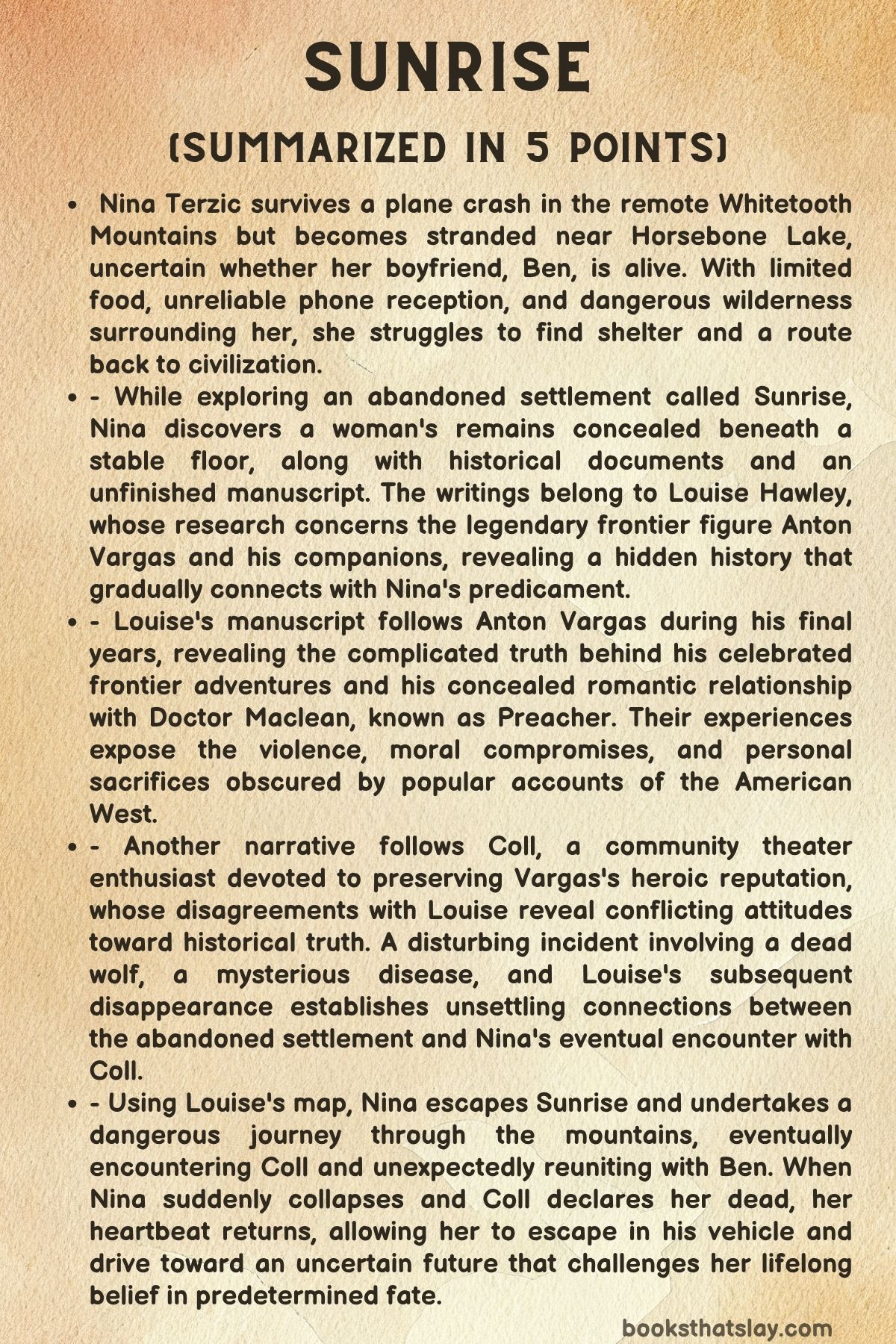
Nina Terzic finds herself struggling to stay alive in the freezing waters of Horsebone Lake after a small aircraft crashes in the remote Whitetooth Mountains. Her boyfriend, Ben, was piloting the plane when a bird strike caused the accident, and although Nina manages to swim ashore, she cannot find him.
Convinced that Ben must have escaped, Nina searches the shoreline and waits for him to appear. Her supplies are limited, her telephone has almost no reception, and the surrounding wilderness offers little protection against the approaching night.
Before the accident, Nina lived in New York, working as a nanny for the wealthy Devander family while pursuing graduate studies in art history. Her relationship with Ben had recently become strained because he wanted them to move west, while she remained attached to the life she had established.
Their journey into the mountains was supposed to provide an escape from these disagreements. Instead, Nina finds herself confronting the possibility that Ben has died and that nobody knows where to find her.
A brief telephone connection proves useless when the call disconnects before she can explain her situation. Later, Nina notices a mysterious reflection on an island and attempts to cross the water, only to discover that the current is dangerously strong.
She barely manages to return to shore. As darkness falls, she faces her first night alone with no certainty that she will survive until morning.
In daylight, Nina notices what appears to be wreckage on the island. Hoping to find Ben, she climbs through the surrounding terrain and eventually discovers an abandoned settlement overlooking the lake.
The decaying buildings initially suggest the possibility of shelter or assistance, but the town has been deserted for years. Nina continues toward the wreckage and discovers that Ben is not there.
Her search produces no clear explanation of his fate. She collects scattered energy bars and begins calculating how long her remaining provisions might sustain her.
A violent storm forces her to seek protection, and her thoughts return to childhood memories of death and superstition. Her mother, Ajda, had once consulted a fortune-teller who seemed to predict the circumstances of Nina’s eventual death.
Nina also remembers believing that every person possesses a predetermined number of heartbeats. Although she eventually learned that this was medically incorrect, the idea encouraged a lifelong habit of monitoring her pulse.
These memories become increasingly significant as she struggles against exhaustion and uncertainty. Her attempts to control her body reveal a deeper desire to control an unpredictable future.
Exploring the abandoned settlement, Nina searches a bar, hotel, church, and stable for useful supplies. Inside the bar, she encounters a collection of preserved deer heads whose unsettling arrangement reminds her of the still-life paintings she studies.
The deserted town also evokes memories of an immersive theatrical performance she attended in New York. Its strange encounters and ambiguous symbolism had left her uncertain whether she was an observer or a participant in a larger narrative.
Nina eventually establishes shelter in the stable. She continues worrying about Ben, her mother, and the Devander children, while hoping that Jones, the friend who lent Ben the aircraft, will eventually report their disappearance.
A telephone call from Violet Devander briefly renews her hope. Violet understands that Nina has survived a plane crash and asks for her location, but the connection fails before Nina can provide useful information.
Nina attempts to leave the settlement, only to encounter a bear. Frightened by the animal and uncertain how to respond, she retreats to the relative security of the abandoned buildings.
Her memories of Violet reveal another complicated relationship. Following a traumatic childbirth experience, Violet had struggled emotionally and become increasingly interested in spiritual guidance, eventually consulting the fortune-teller Nina knew through her mother.
Back in the stable, Nina discovers a concealed compartment beneath the floor. Inside are a suitcase and the remains of a woman.
Despite her terror, Nina returns to examine the belongings. She finds historical documents, newspaper clippings, maps, and an unfinished manuscript written by L. T. Hawley.
The papers concern Anton Vargas, a celebrated nineteenth-century frontier figure associated with the Greyrock Four. Nina begins reading the manuscript, which reconstructs Vargas’s adventures and challenges his heroic reputation.
The historical narrative follows Vargas in 1902, when he is seriously ill and approaching the end of his life. Once famous for his frontier exploits, he returns to familiar territory hoping to reconnect with the people who shaped his past.
His greatest concern is locating Doctor Maclean, known as Preacher, a former companion whose significance extends far beyond their shared adventures.
Vargas remembers traveling with Preacher and Fred Kipley during a dangerous winter expedition. At an isolated stationhouse, they encountered a woman named Sadie, a young girl, and a murdered man.
Armed attackers threatened the building, forcing Vargas and his companions into a violent confrontation. Vargas was wounded, and the stationhouse was eventually set on fire.
The survivors escaped through an underground passage, while Preacher’s medical knowledge proved essential. Their experiences subsequently became part of the popular mythology surrounding the Greyrock Four.
Yet the celebrated accounts concealed the confusion, fear, and moral compromises that characterized the actual events.
The manuscript gradually reveals that Vargas and Preacher shared a romantic attachment. Their relationship developed through years of travel and hardship, but remained hidden beneath their public identities.
Preacher possessed strong moral convictions, particularly concerning the violence committed against vulnerable communities. His opposition to military brutality eventually placed him in dangerous circumstances.
Vargas remembers their disagreements and the choices that separated them. As his health deteriorates, he becomes increasingly concerned with their unfinished relationship rather than his public accomplishments.
Their eventual reunion forces both men to acknowledge what they sacrificed. Vargas must confront his selfishness and compromises, while Preacher reflects on the consequences of resistance and moral responsibility.
The manuscript leaves Vargas’s death unresolved. Louise Hawley, its author, considers several possible endings without deciding which would adequately represent the relationship.
Her uncertainty reflects the difficulty of reconstructing historical lives from incomplete evidence. The distinction between documented events and imagined possibilities remains unresolved.
Another narrative follows Colin, known as Coll, in Sand Draw in 2003. Coll participates in community theater and takes considerable pride in preserving the region’s frontier history.
He is particularly close to his pregnant sister, Freenie, and devotes substantial energy to preparing a reenactment celebrating Vargas and the Greyrock Four.
His life becomes increasingly unsettled after an incident at the Cabin Bar involving Bob Fournier and a dead wolf. Questions emerge about a disease affecting local wildlife and the possibility that humans may also be endangered.
Meanwhile, Louise Hawley arrives to research Vargas. Coll agrees to guide her through historically significant locations, including the abandoned settlement of Sunrise.
Their conversations become contentious because Louise challenges the conventional portrayal of Vargas. She believes the surviving evidence suggests a more complicated life, including his concealed relationship with Preacher.
Coll resents her willingness to question a cherished local legend. For him, the familiar account provides his community with a meaningful connection to its past.
Bob Fournier’s deteriorating condition and Coll’s increasingly disturbing experiences create an atmosphere of uncertainty. The circumstances surrounding Louise’s eventual disappearance remain troubling and unexplained.
Back in 2024, Nina recognizes the abandoned settlement as Sunrise after studying Louise’s documents. A historical map reveals that Hemot City lies to the north, providing her first reliable indication of a route toward civilization.
She recalls visiting Hemot City with Ben and begins preparing to leave. However, worsening weather and physical exhaustion complicate her plans.
During another frightening night, Nina hears someone calling through the deserted streets. Uncertain whether the figure represents help or danger, she hides rather than revealing herself.
Before departing, she returns to the hidden compartment and retrieves Louise’s skull. She cleans it and decides to carry it with her, unwilling to abandon the dead woman completely.
Nina leaves Sunrise with her remaining food, the manuscript, and the skull. Her progress is slow, and the difficult terrain makes her question whether she has interpreted the map correctly.
When she notices smoke in the distance, she abandons her intended route, hoping to find a campsite. Instead, she injures herself, loses a shoe, and discovers that the smoke comes from a burning tree.
Alone near an isolated shack, Nina remembers Andrea, a childhood friend whose sudden death profoundly affected those around her. She imagines her mother’s suffering if she never returns.
These reflections intensify her uncertainty about fate. She wonders whether survival depends on personal decisions or whether her death has already been determined.
Continuing through the wilderness, Nina witnesses wolves attacking an elk. The encounter exposes her to the immediate violence of the natural world, challenging the distance from which she has previously contemplated mortality.
Soon afterward, a man driving through the mountains offers assistance. During their journey, they unexpectedly discover Ben standing beside the road.
Ben has survived the crash and spent the intervening days attempting to escape the wilderness. Although he is delighted to find Nina alive, she remains strangely withdrawn.
Their rescuer identifies himself as Coll. Nina gradually recognizes connections between him, Louise’s research, and the abandoned settlement.
She also notices flowers resembling those associated with the stable. When Coll discusses the disease affecting local wolves and its possible transmission to humans, her unease increases.
Nina suddenly collapses. Ben desperately attempts to revive her, while Coll declares that she has died.
Nevertheless, Nina remains aware of the sounds surrounding her. Her heartbeat eventually returns, and she regains enough strength to move.
Seizing the opportunity, she enters Coll’s vehicle and drives away, leaving both men behind. The narrative concludes with Nina traveling through the brightening canyon toward an uncertain destination, having escaped immediate danger without resolving every mystery surrounding her ordeal.
Characters
Nina Terzic
Nina Terzic is the central character of Sunrise, and her struggle for survival provides the foundation for the novel’s exploration of mortality, uncertainty, and personal independence. An art-history graduate student working as a nanny in New York, Nina initially appears more comfortable interpreting human creations than navigating the natural world.
Her sudden isolation in the Whitetooth Mountains exposes the limitations of her knowledge. Without dependable communication, adequate supplies, or wilderness experience, she must make decisions whose consequences could be fatal.
Nina’s personality is shaped by a longstanding fear of death. Her childhood belief that human beings possess a limited number of heartbeats reveals an early attempt to transform mortality into something measurable and manageable.
Although she eventually understands the scientific limitations of this belief, she never completely abandons its emotional significance. Her habit of monitoring her pulse demonstrates the persistence of anxieties that rational knowledge alone cannot eliminate.
Her relationship with Ben introduces another dimension of her character. Nina values the life she has established in New York, including her studies, employment, and proximity to her mother.
Ben’s desire to move west threatens that stability. Their disagreements reveal Nina’s resistance to decisions that would require surrendering control over her future.
Throughout her ordeal, however, Nina discovers that survival depends on adaptation rather than certainty. She makes mistakes, misjudges dangers, and repeatedly encounters situations for which she has no reliable preparation.
Her decision to carry Louise’s skull is especially revealing. Despite her own vulnerability, she develops a sense of responsibility toward a woman she never knew, suggesting that compassion can persist even under extreme pressure.
By the conclusion, Nina has endured experiences that challenge her understanding of both death and personal freedom. Her escape from Coll and Ben represents an independent decision made without knowing what awaits her.
She does not necessarily overcome every fear that shaped her earlier life. Instead, she demonstrates an increasing willingness to act despite uncertainty.
Ben
Ben is Nina’s boyfriend and the pilot whose aircraft crashes near Horsebone Lake. Although he is physically absent for much of the narrative, his influence remains central to Nina’s memories and emotional struggles.
His enthusiasm for flying, wilderness exploration, and life in the American West contrasts with Nina’s attachment to New York. He imagines relocation as an opportunity for freedom and renewal, while Nina worries about sacrificing her existing commitments.
Their disagreement reveals an important difference in how they approach uncertainty. Ben is attracted to possibilities that Nina experiences as threats to her security.
However, the novel does not present him simply as reckless or insensitive. His desire to establish a different life reflects a genuine vision of their shared future, even if that vision does not adequately accommodate Nina’s priorities.
Following the crash, Ben becomes an absent presence whose fate dominates Nina’s thoughts. Her hope that he survived competes with mounting evidence that he may have died.
His eventual reappearance transforms the situation but does not restore their relationship to its previous condition. Nina has undergone experiences that Ben cannot immediately understand, and her emotional distance complicates their reunion.
Ben’s desperation when Nina collapses demonstrates his attachment to her. Nevertheless, her subsequent decision to leave him behind prevents the ending from becoming a conventional romantic reconciliation.
His character illustrates how love can coexist with incompatible expectations, and how surviving a shared disaster does not automatically resolve the disagreements that existed beforehand.
Anton Vargas
Anton Vargas is the celebrated frontier figure whose reconstructed life forms the historical center of Sunrise. His public reputation rests on the adventures of the Greyrock Four, but the manuscript gradually reveals a man whose private experiences differ substantially from the stories told about him.
In old age, Vargas confronts serious illness and the prospect of death. His declining physical condition reduces the importance of the heroic identity that once defined his life.
Rather than seeking additional public recognition, he becomes preoccupied with finding Preacher. This desire reveals that his most significant unfinished business concerns an intimate relationship rather than his celebrated accomplishments.
Vargas’s memories expose the instability of frontier mythology. Events remembered as courageous victories involved confusion, terror, injury, and morally uncertain decisions.
His relationship with Preacher introduces an additional conflict between public identity and private truth. Their romantic attachment could not easily be accommodated within the conventional heroic narratives through which Vargas became famous.
Vargas also recognizes his own failures. He remembers moments when fear, selfishness, or personal convenience influenced his decisions, particularly when those decisions conflicted with Preacher’s convictions.
His approaching death creates an urgency that public success cannot satisfy. He seeks an opportunity to acknowledge experiences that remained concealed throughout much of his life.
Vargas consequently emerges as neither the uncomplicated hero celebrated by popular history nor a figure defined entirely by his failures. His complexity arises from the distance between what he experienced, what he remembers, and what others chose to preserve.
Doctor Maclean, or Preacher
Doctor Maclean, commonly known as Preacher, is one of the most morally significant figures in the historical narrative. A physician and frontier traveler, he combines practical medical expertise with a powerful commitment to justice.
His ability to treat injuries proves essential during the confrontation at the stationhouse. However, his importance extends beyond the physical assistance he provides to his companions.
Preacher is deeply troubled by violence inflicted on vulnerable populations. He refuses to accept the assumption that military authority or territorial expansion automatically justifies brutality.
These convictions place him in opposition to institutions and individuals who regard such violence as an unavoidable feature of frontier life. His involvement in resistance exposes him to serious danger.
His relationship with Vargas reveals a more private side of his personality. Their attachment develops through shared hardship, but their contrasting priorities create disagreements that neither affection nor loyalty can easily resolve.
Preacher’s moral severity can make him difficult to accommodate. He demands that personal conduct reflect ethical commitments, even when doing so involves substantial sacrifice.
At the same time, his medical work demonstrates a sustained concern for human vulnerability. The coexistence of compassion and severity gives his character considerable complexity.
His reunion with Vargas brings the emotional consequences of their separation into focus. Their relationship becomes an example of how personal love and public responsibility can impose competing demands.
Preacher ultimately challenges the romanticized understanding of frontier heroism. His actions suggest that courage may involve resisting accepted forms of violence rather than merely displaying physical bravery.
Colin, or Coll
Coll is one of the most unsettling characters in Sunrise, partly because his circumstances connect the historical material to Nina’s contemporary struggle for survival. His story begins in Sand Draw, where he participates in community theater and takes pride in preserving local history.
His commitment to reenacting the adventures of Anton Vargas gives him a sense of purpose and belonging. The stories of the Greyrock Four are not merely entertainment to him; they are part of his community’s collective identity.
Louise Hawley’s research challenges this attachment. Her interpretation threatens the uncomplicated heroic narrative upon which his production depends.
Coll’s resentment reveals how deeply historical traditions can become connected to personal identity. He experiences criticism of a familiar legend as something more threatening than an ordinary disagreement over evidence.
His close relationship with Freenie provides another perspective on his personality. Their family connection suggests that his life contains genuine attachments beyond his public interests.
Nevertheless, the incident involving Bob Fournier and a dead wolf introduces increasingly disturbing elements into Coll’s behavior and surroundings. The possibility of a disease affecting humans complicates the interpretation of subsequent events.
His experiences become difficult to separate from illness, memory, and imagination. The novel therefore preserves uncertainty about how much of his conduct can be explained through ordinary human motivations.
His eventual encounter with Nina creates an especially troubling connection between the past and present. His knowledge of Louise and the regional disease intensifies Nina’s suspicions.
Although Coll initially offers assistance, the circumstances surrounding Nina’s collapse and his declaration that she has died make him a source of danger in her eyes.
His characterization demonstrates how devotion to inherited stories can coexist with hostility toward competing accounts. He also embodies the uncertainty that surrounds the novel’s encounters with disease and death.
Louise Hawley
Louise Hawley is the historical novelist whose research allows the three narrative periods to become connected. Although Nina never meets her alive, Louise’s writings and remains have a profound influence on the contemporary storyline.
Her investigation into Anton Vargas begins with a willingness to challenge familiar assumptions. Rather than accepting the conventional heroic accounts, she searches for evidence of personal relationships and ethical conflicts that popular narratives neglected.
Her reconstruction of Vargas and Preacher’s relationship demonstrates an interest in lives obscured by historical convention. She recognizes that the surviving record cannot fully represent the experiences of people who had compelling reasons to conceal aspects of themselves.
Louise’s disagreements with Coll reveal the tension between scholarly inquiry and communal mythology. Her determination to question cherished traditions places her in conflict with someone who considers those traditions essential to local identity.
Her unfinished manuscript also exposes the limitations of her work. She cannot establish a definitive account of Vargas’s death and hesitates to impose an ending unsupported by the available evidence.
This uncertainty gives her character intellectual credibility. She recognizes that fiction can illuminate historical possibilities without transforming speculation into documented truth.
Her unexplained death in Sunrise introduces a disturbing contrast between her literary investigation and her own disappearance. She becomes another person whose life can only be reconstructed through incomplete material.
For Nina, Louise’s belongings offer both practical guidance and an emotional connection. Her maps provide a possible escape route, while her manuscript gives Nina a way to understand the settlement and its history.
Louise’s character ultimately demonstrates that historical investigation is not detached from human consequences. Her search for neglected truths continues to influence events long after her death.
Ajda Terzic
Ajda is Nina’s mother and one of the strongest emotional presences in the contemporary narrative. Although she remains physically distant from the wilderness ordeal, Nina repeatedly returns to memories of their relationship.
Ajda’s beliefs reflect a combination of practical experience and inherited superstition. Her consultation with a fortune-teller introduces Nina to the possibility that death might be predetermined.
The prediction becomes part of Nina’s psychological development, reinforcing her desire to anticipate and control danger.
Ajda’s influence is not limited to superstition, however. She also represents family continuity and the familiar life Nina fears losing through Ben’s proposed relocation.
As Nina struggles through the mountains, thoughts of her mother become increasingly painful. She imagines the consequences of her disappearance and remembers the suffering surrounding her childhood friend Andrea’s death.
These reflections reveal the emotional responsibilities that accompany Nina’s determination to survive. Her fear is not simply that she will die, but that her death will permanently alter the lives of those who love her.
Ajda’s character illustrates how parental influence can provide both security and anxiety. Her beliefs contribute to Nina’s fatalism, while her importance in Nina’s life strengthens Nina’s attachment to survival.
Violet Devander
Violet Devander is Nina’s wealthy employer and the mother of the children Nina cares for in New York. Her character provides an important contrast between the privileged domestic world Nina inhabits professionally and her own more precarious circumstances.
Violet’s traumatic childbirth experience has left her struggling with emotional difficulties. Her subsequent interest in spiritual practices reflects a search for explanations and reassurance.
Through Nina, she becomes acquainted with Mrs. Tima, the fortune-teller who previously influenced Nina’s mother.
The relationship between Violet and Nina reveals differences in social position and personal vulnerability. Violet possesses considerable material security, but that security cannot eliminate her emotional suffering.
Nina, meanwhile, occupies the complicated position of an employee whose responsibilities require emotional closeness to the family. Her concern for the Devander children continues even when she is stranded far from them.
Violet’s unexpected telephone call briefly appears capable of saving Nina. Yet the failed connection demonstrates how easily the systems supporting ordinary life can become useless in an emergency.
Violet represents a world of domestic routines, economic privilege, and spiritual searching that remains psychologically significant even after Nina’s physical separation from it.
Belice Devander
Belice is Violet’s younger daughter and one of the children in Nina’s care. Her brief appearance during the telephone call establishes an immediate connection between Nina’s isolated circumstances and the family waiting in New York.
Although she does not occupy a large portion of the narrative, her presence reminds readers that Nina’s life contains responsibilities beyond her romantic relationship and academic ambitions.
Belice also emphasizes Nina’s role as a caregiver. Even while confronting the possibility of death, Nina remains attached to the children whose everyday lives she helps sustain.
Her character contributes to the emotional significance of Nina’s disappearance by representing an ordinary relationship suddenly threatened by extraordinary circumstances.
Fred Kipley
Fred Kipley is a former companion of Anton Vargas and a member of the legendary Greyrock Four. His presence connects Vargas’s final journey to the adventures that established their collective reputation.
During the remembered stationhouse confrontation, Kipley participates in the dangerous circumstances that later become part of frontier mythology.
His significance lies partly in his position as a surviving participant in events that subsequent generations understand through sensationalized accounts.
Kipley represents the continuity between lived experience and public memory. His existence reminds readers that the celebrated frontier stories originated in situations involving actual people, injuries, and difficult decisions.
His relationship with Vargas also provides a connection to the past at a moment when Vargas’s declining health makes such connections increasingly important.
Freenie
Freenie is Coll’s pregnant sister and one of his closest family relationships. Her presence introduces domestic responsibility and concern into a narrative otherwise dominated by historical performance and disturbing events.
She becomes increasingly worried about the incident involving Bob Fournier and the dead wolf. Her concern suggests an awareness that something dangerous may be developing within their community.
Freenie’s pregnancy also creates a contrast between impending birth and the novel’s recurring encounters with death. While Coll becomes increasingly preoccupied with unsettling circumstances, she represents a future requiring care and protection.
Her character helps establish that Coll’s story is not confined to intellectual disagreements or theatrical ambitions. His actions exist within a network of family relationships that may also be affected by the surrounding danger.
Bob Fournier
Bob Fournier is associated with the disturbing incident at the Cabin Bar involving a dead wolf. His subsequent deterioration introduces the possibility that the disease affecting local wildlife may also threaten human beings.
Bob’s condition creates uncertainty about the relationship between biological illness and apparently inexplicable behavior.
His role becomes particularly significant when Coll later discusses the regional disease with Nina. The earlier incident gives that conversation a disturbing historical context.
Although Bob’s personal history is not extensively developed, his character serves an important structural purpose. His suffering introduces a possible explanation for events that otherwise appear supernatural or psychologically inexplicable.
Sadie
Sadie is the woman encountered by Vargas and his companions during their dangerous winter expedition. Found inside a threatened stationhouse alongside a young girl and a murdered man, she occupies a vulnerable position within the historical narrative.
Her circumstances reveal the human consequences concealed beneath the celebrated accounts of frontier adventure.
The confrontation surrounding her rescue exposes the difference between romanticized heroism and the immediate terror experienced by people caught in violence.
Sadie’s presence also highlights the importance of Preacher’s practical compassion. Protecting endangered individuals becomes a more immediate ethical concern than establishing a heroic reputation.
Mrs. Tima
Mrs. Tima is the fortune-teller whose predictions influence Nina’s understanding of death. Her connection to Ajda places her within a tradition of beliefs that Nina inherits during childhood.
The apparent prediction of Nina’s death becomes psychologically significant because Nina continues to revisit it during moments of extreme danger.
Mrs. Tima later becomes connected to Violet Devander, demonstrating how spiritual beliefs can move between people occupying very different social circumstances.
Her character represents the desire to interpret uncertainty through supernatural knowledge. The novel does not establish that her predictions determine events, but their emotional influence on Nina is undeniable.
Andrea
Andrea is Nina’s childhood friend whose sudden death becomes an important memory during Nina’s wilderness ordeal. Her absence from Nina’s adult life does not diminish the influence of her death.
Remembering Andrea forces Nina to consider mortality as something that affects entire communities of relationships rather than only the person who dies.
The suffering experienced by Andrea’s loved ones provides Nina with a framework for imagining her own mother’s grief.
Andrea consequently becomes a reminder of life’s unpredictability and the lasting consequences of premature death. Her memory strengthens the emotional significance of Nina’s determination to survive.
Jones
Jones is Ben’s friend who lends him the aircraft. Although his direct involvement is limited, he occupies an important position in Nina’s calculations about rescue.
Nina hopes that Jones will recognize their failure to arrive and alert someone to their disappearance.
This possibility gives her a reason to believe that help may eventually come, even when she has no reliable means of contacting civilization.
Jones represents the fragile connection between the isolated wilderness and the ordinary networks of responsibility that continue beyond it.
Themes
Mortality, Fate, and the Limits of Control
Death remains an immediate physical danger and a persistent psychological concern throughout Sunrise. Nina’s struggle begins with a plane crash that destroys her ordinary expectations about safety, exposing her to an environment where even small mistakes can have irreversible consequences.
Her childhood belief in a predetermined number of heartbeats demonstrates how deeply she desires to make mortality predictable. If life can be measured, counted, or anticipated, she imagines that death might somehow become less threatening.
The fortune-teller’s prediction reinforces this belief by suggesting that the circumstances of Nina’s death may already have been established. Even after she develops a more rational understanding of the body, the emotional attraction of predetermined fate persists.
Anton Vargas confronts mortality from a different position. His declining health forces him to reconsider the accomplishments that once gave his life public meaning.
Rather than concentrating exclusively on his celebrated reputation, he returns to unresolved personal relationships. His approaching death makes the distinction between public achievement and private regret increasingly significant.
Louise Hawley’s unidentified remains offer another perspective on mortality. Her death has already occurred when Nina discovers her, leaving behind objects that preserve fragments of a life without providing a complete explanation.
The final scene brings these concerns together through Nina’s apparent death and unexpected recovery. Coll’s declaration that she is dead seems to confirm the inevitability she has long feared, yet her heartbeat returns.
Her subsequent escape does not establish that death can always be defeated through determination. Instead, it challenges the assumption that a person’s future can be understood through predictions, biological measurements, or another individual’s declaration.
Survival emerges as an uncertain process requiring action without guarantees. Nina’s decision to drive away suggests that life remains open to possibilities even when circumstances appear conclusively determined.
Historical Memory, Mythology, and the Construction of Truth
The popular history of the Greyrock Four transforms complicated human experiences into a familiar story of frontier heroism. Anton Vargas becomes a celebrated figure whose public identity depends on simplified accounts of adventures marked by violence and uncertainty.
Louise Hawley’s research challenges this inherited understanding. By investigating Vargas’s relationship with Preacher, she uncovers dimensions of his life that conventional historical narratives failed to preserve.
Their concealed romantic attachment demonstrates how social expectations influence the historical record. Experiences that cannot comfortably fit established public identities may disappear from collective memory, even when they were central to the people involved.
Preacher’s resistance to military violence also complicates the heroic mythology surrounding the frontier. His ethical commitments reveal conflicts that celebratory accounts of territorial expansion can obscure.
Coll’s devotion to historical reenactment demonstrates why such narratives remain powerful. For him, the familiar version of Vargas’s life provides continuity, entertainment, and a sense of communal belonging.
Louise’s alternative interpretation therefore appears threatening because it challenges more than historical accuracy. It questions the cultural identity sustained through repeated performances of the past.
Sunrise also acknowledges the limitations of historical reconstruction. Louise cannot determine precisely how Vargas’s life ended, and her manuscript remains unfinished because the surviving evidence does not support a definitive conclusion.
Her uncertainty reveals that responsible historical imagination requires recognizing the boundaries between knowledge and possibility.
Nina’s discovery of the manuscript adds another dimension to this process. She encounters the past through documents left by a woman whose own death remains unexplained.
The past is consequently neither entirely recoverable nor permanently inaccessible. It survives through fragments that demand interpretation, while resisting the comforting certainty of a single, complete account.
Love, Separation, and the Cost of Personal Choices
Intimate relationships throughout the novel are shaped by the difficulty of reconciling personal desires with the expectations of others. Nina and Ben love one another, but their disagreement about relocating west exposes fundamentally different understandings of the future.
For Ben, leaving New York represents freedom and the possibility of creating a more satisfying life. For Nina, the same decision threatens her education, employment, family connections, and established independence.
Their conflict illustrates how shared affection does not automatically produce compatible ambitions. Each person’s preferred future requires the other to accept significant sacrifices.
The plane crash interrupts their disagreement without resolving it. Nina’s separation from Ben initially transforms romantic conflict into desperate concern for his survival.
Yet their reunion does not restore their former relationship. Nina’s experiences have altered her perspective, and Ben’s relief cannot erase the emotional distance between them.
The historical relationship between Vargas and Preacher offers a parallel examination of love constrained by circumstances.
Their attachment develops through shared experiences, but their public identities and conflicting ethical commitments complicate their ability to remain together.
Vargas’s approaching death intensifies his regret over the choices that separated them. The reunion becomes an opportunity to acknowledge feelings and failures that public success could never compensate for.
Nina’s relationship with Ajda introduces another form of attachment. Her concern about her mother’s suffering gives her survival a significance extending beyond her individual existence.
Similarly, her memories of the Devander children demonstrate the responsibilities created through caregiving.
These relationships reveal that independence does not mean existing without emotional obligations. Personal freedom must continually be negotiated alongside attachment, responsibility, and the consequences of one’s decisions.
The novel resists the assumption that love necessarily produces reconciliation. Instead, it presents affection as a powerful force that can persist even when individuals cannot, or choose not to, share the same future.
Wilderness, Violence, and Human Vulnerability
The Whitetooth Mountains expose Nina to a world that remains largely indifferent to her expectations and desires. The landscape offers extraordinary beauty, but its cold water, unpredictable weather, difficult terrain, and dangerous animals constantly threaten her survival.
Her academic knowledge initially provides little practical protection. Familiar intellectual habits become inadequate when confronted with hunger, injury, and exposure.
The abandoned settlement offers temporary shelter, yet its decaying buildings reveal the fragility of human attempts to establish permanent control over a landscape.
Sunrise was once a place of ordinary human activity. Its deserted structures demonstrate how quickly settlements can become remnants of ambitions that no longer sustain themselves.
Nina’s encounters with the bear and wolves further challenge her assumptions about the natural world. The animals act according to their own needs rather than the moral expectations through which human beings frequently interpret violence.
Watching wolves kill an elk forces Nina to confront death without the comforting distance provided by artistic representation or intellectual reflection.
The historical narrative extends this examination of violence into human society. Vargas and his companions confront armed attackers, while Preacher opposes brutality committed under the authority of powerful institutions.
These episodes reveal that human violence cannot simply be distinguished from natural danger through claims of civilization or moral superiority.
The mysterious disease affecting wildlife creates another connection between humans and their environment. Bob Fournier’s deterioration and Coll’s later account of possible transmission suggest that biological threats can cross boundaries people consider secure.
Nina’s growing unease during her encounter with Coll demonstrates how unfamiliar human behavior can become as threatening as the wilderness itself.
Yet the natural world also provides possibilities for survival. Nina finds shelter, gathers food, identifies routes, and continues moving despite her injuries.
Her experience reveals that vulnerability does not eliminate agency. Instead, it requires recognizing limits, adapting to circumstances, and accepting that complete security is impossible.
The brightening canyon at the conclusion preserves this tension. The landscape remains unpredictable, but Nina’s movement through it expresses the possibility of continuing to live without first mastering everything that surrounds her.