Take What You Can Summary, Characters and Themes
Take What You Can by Naima Coster is a contemporary novel about friendship, motherhood, marriage, and the complicated relationship between love and independence. Moving between France and New York, the story follows Val and Milly, two Black women whose friendship develops through shared adventures, personal losses, and their search for belonging.
Years after a tragedy changes their relationship, they reunite as expectant mothers, hoping to recover the closeness they once shared. However, their different financial circumstances, romantic relationships, and expectations of motherhood challenge their bond. Through their experiences, Coster examines how friendship survives disappointment, how family can be chosen, and how individuals establish identities beyond the people they love.
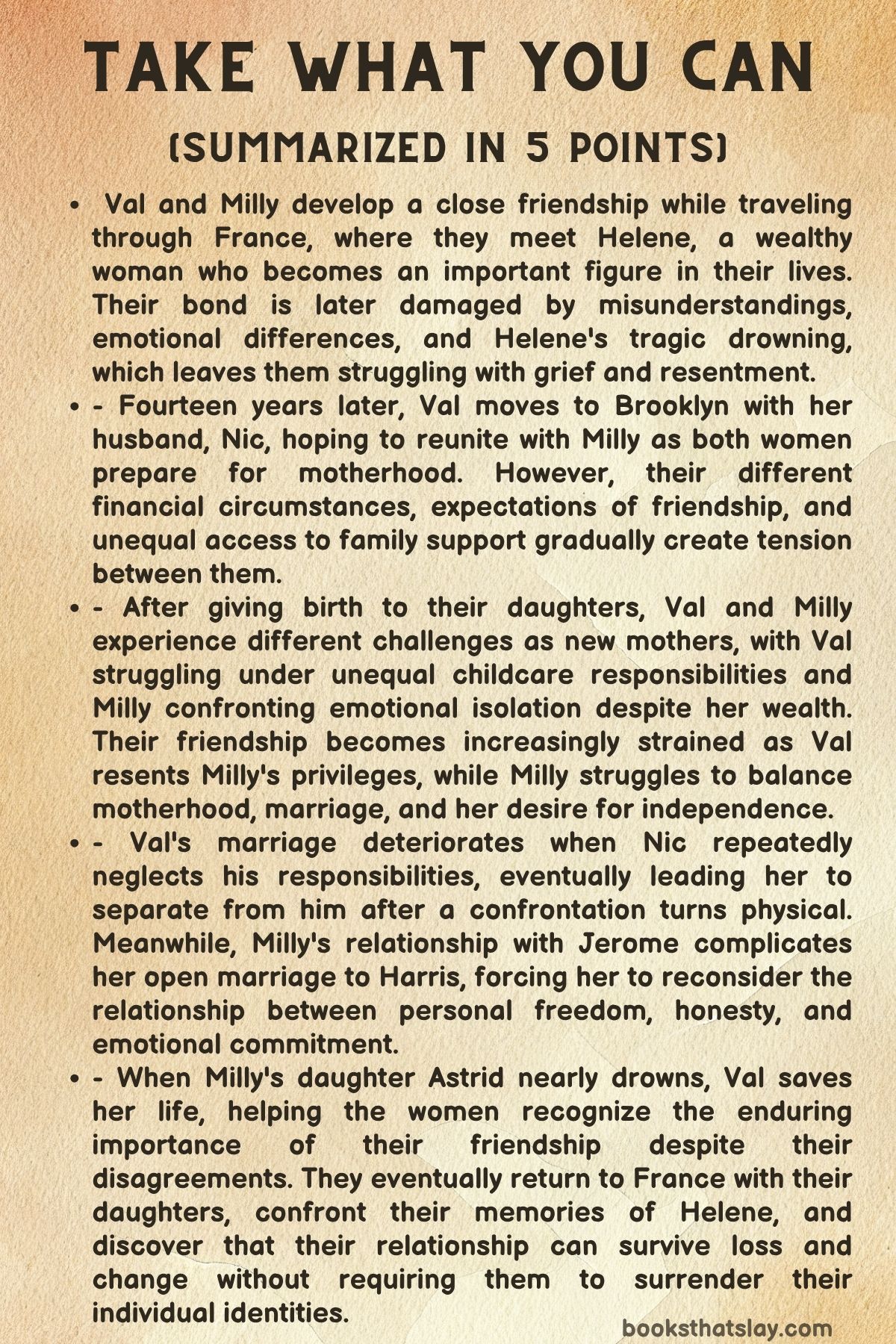
Summary
In August 2004, Val and Milly are two twenty-year-old Black women traveling along the French coast after completing a study-abroad program in Paris. Their friendship is relatively new, but they have already developed a remarkable sense of comfort with each other.
While visiting Cassis, they rent a kayak to explore a secluded swimming spot surrounded by cliffs. After reaching a rocky outcrop, Milly suggests that they jump into the water together.
Val immediately leaps when Milly finishes counting, but Milly hesitates. Although she eventually follows her friend, the incident reveals a difference between them: Milly enjoys imagining extraordinary possibilities, while Val is often more willing to act upon them.
Fourteen years later, Val is preparing to leave North Carolina with her husband, Nic. She is thirty-six weeks pregnant and hopes that moving to Brooklyn will offer her a fresh beginning.
Before leaving, Val visits her estranged parents, carrying an ultrasound photograph and childhood belongings. Despite knowing that they are home, she receives no answer when she knocks.
Their rejection devastates her. She calls Milly, who comforts her from New York, reminding Val that she still has someone who cares about her.
Val and Nic have agreed that their move will allow her to finish writing a book while he works part-time and shares childcare responsibilities. However, during their farewell party, Nic unexpectedly announces that he has accepted a full-time teaching position.
Val feels betrayed because he has made a decision affecting their entire family without consulting her. Their argument continues during the journey north, although she eventually forgives him.
When Val arrives in Brooklyn, Milly welcomes her into her spacious Park Slope brownstone. Milly has become a successful lifestyle influencer and is married to Harris Buchanan, a wealthy restaurateur.
The contrast between their circumstances is immediately apparent. Val and Nic occupy a cramped apartment, while Milly enjoys financial security and considerable freedom.
Nevertheless, the women initially celebrate their reunion. They explore New York together, visiting restaurants, museums, and shops while remembering their youthful adventures.
Their conversations also return to Helene, an older American woman they met in France. Her generosity helped strengthen their friendship, but her death eventually contributed to their estrangement.
Milly takes Val to Queens, where she grew up with her Colombian mother, Gladys. The visit revives memories of Gladys’s sacrifices and her death from cancer.
After losing her mother, Milly traveled extensively, trying to understand her grief and discover what kind of life she wanted. During those travels, she met Harris.
Val suggests visiting Gladys’s grave together, recognizing that Milly still carries considerable sadness. Their friendship has become especially important because both women have lost the dependable family relationships they once desired.
As Val’s pregnancy progresses, Milly and Harris help prepare her apartment. Nic, meanwhile, remains absorbed in his academic responsibilities.
When Val goes into labor, she cannot reach her husband because he has left his phone behind. Milly immediately comes to her assistance, arranges transportation, and ensures that Nic is located.
At the hospital, Milly remains beside Val throughout her contractions. Her practical care recalls the devotion she showed Gladys during her final illness.
Nic eventually arrives, and Val gives birth to a daughter. She names the baby Helene, affectionately called Leeny, after the woman who profoundly influenced both friends.
The narrative returns to France, revealing how Helene entered their lives. She rescued Val during a swimming accident and subsequently introduced the young women to her partner, Elodie.
Helene’s wealth, charisma, and generosity immediately captivated Val. Milly was initially suspicious, fearing that the older woman’s influence might threaten their developing friendship.
However, visits to Helene’s home gradually brought the women closer. Helene discussed her difficult childhood, while Milly opened up about losing Gladys.
Val responded to Milly’s grief with affection rather than demands for explanations. Their shared vulnerability established a powerful emotional connection.
Back in New York, Milly gives birth to her daughter, Astrid. Unlike the immediate maternal fulfillment she anticipated, she experiences physical pain, exhaustion, and emotional distance.
An earlier miscarriage makes these feelings especially difficult to understand. Although Harris and his parents enthusiastically embrace the baby, Milly feels isolated by their expectations.
She withdraws from Val, who repeatedly attempts to visit. Meanwhile, Val is experiencing her own difficulties as Nic returns to work and leaves her responsible for most childcare.
Leeny struggles with nursing, forcing Val to spend considerable time pumping breast milk. Her writing career suffers because she cannot secure uninterrupted time.
When the families gather for dinner, their differences become increasingly apparent. Milly discusses hiring a nanny and expanding her business, while Val struggles to afford basic assistance.
Val challenges Milly’s understanding of her professional success, arguing that wealth and family support have provided opportunities unavailable to many women. Milly resents the criticism, and their relationship becomes strained.
Milly also renews her connection with Jerome, an acquaintance who knew Gladys. Their relationship becomes romantic, offering Milly an identity separate from marriage and motherhood.
Although Harris and Milly have agreed to an open marriage, his growing discomfort with Jerome creates tension. Milly believes she should remain free to pursue meaningful relationships, while Harris fears their arrangement may destabilize their family.
Val attempts to reconnect with Milly by proposing that they attend a support group for women who have lost their mothers. However, Milly chooses to spend the day with Jerome instead.
Val attends alone and discusses her estrangement from her parents. She also experiences an uncomfortable encounter when someone incorrectly assumes that Leeny is adopted because the child looks different from her.
Meanwhile, memories of an earlier Christmas in France reveal the origins of a significant rupture between the friends.
During a visit to Helene and Elodie, Milly privately discussed Val’s emotional dependence and difficult family background. Val overheard the conversation and concluded that Milly regarded her as damaged and burdensome.
Their confrontation exposed conflicting emotional needs. Val desperately wanted reassurance that she would never be abandoned, while Milly feared becoming responsible for another person’s happiness.
In New York, these differences continue affecting their friendship. Milly apologizes for missing the support group, but her privileged circumstances make it difficult for her to understand Val’s financial limitations.
Eventually, the women begin sharing Cleo’s childcare services. For the first time since Leeny’s birth, Val experiences meaningful independence.
She walks through the city, reconnects with her intellectual interests, and begins imagining a return to writing.
Cleo also becomes increasingly important to both households. A talented musician, she hopes to develop her artistic career while maintaining a relationship with Vivienne, a successful performer.
Meanwhile, Milly’s relationship with Jerome grows more serious. He challenges her tendency to keep different parts of her life separate, suggesting that her commitment to privacy conceals deeper emotional uncertainty.
As the new year approaches, Val’s marriage deteriorates further. Nic continues prioritizing his work, leaving Val exhausted and resentful.
During an argument, Nic physically prevents her from leaving, and she sustains an injury requiring medical attention.
At the hospital, Val turns toward Milly, but their encounter develops into another confrontation. Their accusations eventually return to Helene’s death.
The narrative reveals that in January 2010, Val and Milly visited Helene in southern France for her birthday.
During a seaside excursion, Helene encountered difficulties in the water. Milly attempted to reach her, but Val became frightened and struggled in the waves.
Faced with an impossible decision, Milly turned back to help Val. Helene drowned.
The tragedy devastated both women. Their grief became further complicated when Helene’s will revealed that Val would receive substantially more money than Milly.
Milly interpreted the unequal inheritance as evidence of Helene’s greater affection for Val. Val, however, viewed the money as a chance to establish financial security.
Their disagreement intensified existing resentments. Milly eventually traveled abroad, while Val struggled with the possibility that their friendship had permanently changed.
In the present, Val decides that she can no longer continue her marriage under its existing conditions. She asks Nic to leave their apartment.
Although Nic accuses her of abandoning their relationship, Val experiences an unexpected sense of peace. She recognizes that her attempts to secure his attention resemble her childhood efforts to obtain dependable affection from her parents.
Val begins rebuilding her life around Leeny and her writing ambitions. Reconnecting with Ricky, someone from her past, also reminds her of the person she was before marriage.
Milly faces her own decisions. Her agent, Pilar, encourages her to write a book that reveals more of her private experiences.
The opportunity forces Milly to consider whether she can discuss her marriage, her mother, and her emotional struggles without sacrificing the independence she values.
Her circumstances change when Cleo becomes unavailable for work. Caring for Astrid throughout the day gives Milly a new understanding of the exhaustion Val previously described.
During a family gathering, Milly and Harris discuss the future of their marriage. Distracted by their emotional conversation, Milly loses track of Astrid, who is playing near a shallow pool.
Val notices that Astrid has fallen face down in the water. She rushes outside and attempts to resuscitate the unresponsive child.
Astrid begins breathing again and is taken to the hospital. Medical examinations eventually reveal that she has suffered no neurological damage.
The accident profoundly affects Milly. It also creates an opportunity for Val to support her without allowing their earlier disagreements to determine her response.
Once Astrid recovers, the women decide to return to France together, accompanied by their daughters.
Traveling with babies proves considerably more exhausting than their youthful adventures. Nevertheless, the journey allows them to revisit the places where their friendship began.
They reconnect with Elodie, who shares further memories of Helene, including her longing for children and the losses she experienced.
These conversations help Val and Milly reconsider the woman whose death has haunted them. They begin recognizing that Helene possessed a complicated emotional life that neither fully understood.
Meanwhile, Milly considers a future that might accommodate both Harris and Jerome. Harris expresses a willingness to reconsider their marital boundaries.
Val also reveals that she may be pregnant again and that Nic is the father, suggesting that their relationship remains unresolved.
The women discuss Cleo, who has left childcare to pursue music with Vivienne. Her decision reflects another possibility for building a life outside conventional expectations.
During their final days in France, Val and Milly acknowledge that they cannot change Helene’s death or erase the pain surrounding it. They can, however, reconsider how they remember her and understand their own choices.
The novel concludes with the women carrying their daughters into the sea.
The moment recalls their first adventure together, when Val jumped into the water while Milly hesitated. Now they enter the water with a deeper understanding of fear, responsibility, and companionship.
Their futures remain uncertain, but they have recovered a measure of trust. Their friendship endures not because their differences have disappeared, but because they have learned to recognize one another beyond their expectations.
Characters
Val
Val is one of the central protagonists of Take What You Can, and her emotional development is closely connected to her search for dependable love. Growing up in a household where affection was inconsistent, she learned to seek reassurance from relationships that could not always provide it.
Her estrangement from her parents establishes the depth of her unresolved childhood pain. When they refuse to open their door before her departure for New York, their rejection demonstrates how little their relationship has improved despite her attempts at reconciliation.
Val’s friendship with Milly offers an alternative to this painful family history. She considers Milly someone who can provide the emotional security and unconditional acceptance missing from her childhood.
However, her expectations sometimes become overwhelming. She wants Milly to recognize her needs without explanation, and she experiences her friend’s independence as a potential form of abandonment.
Val’s marriage to Nic reproduces similar emotional patterns. She repeatedly forgives his disappointments because she wants to believe that he will eventually become the dependable partner she needs.
The transition to motherhood intensifies these difficulties. With Nic frequently absent, Val becomes responsible for most of Leeny’s care while attempting to preserve her writing ambitions.
Her growing resentment is not simply a consequence of exhaustion. It reflects her recognition that she has repeatedly placed other people’s ambitions and emotional needs ahead of her own.
The conflict surrounding Nic’s physical aggression becomes a turning point. Val finally recognizes that preserving her marriage cannot justify continually sacrificing her safety and well-being.
Her decision to separate demonstrates an emerging capacity to establish boundaries. Instead of waiting for another person to provide stability, she begins creating it herself.
Val also develops a more mature understanding of friendship. Although she remains hurt by Milly’s actions, she gradually recognizes that genuine companionship cannot require another person to abandon her individuality.
Her rescue of Astrid illustrates the strength of her love for Milly. Despite their conflicts, she acts immediately when her friend’s child is endangered.
By the conclusion, Val has not resolved every uncertainty surrounding her marriage or future. Nevertheless, she has developed a stronger understanding of her own needs and responsibilities.
Milly
Milly is the other central protagonist of Take What You Can, representing the complicated pursuit of freedom within relationships that demand commitment. Her personality combines generosity, ambition, emotional independence, and a persistent fear of being consumed by other people’s expectations.
Her childhood in Queens profoundly shapes her understanding of success. Watching Gladys work tirelessly to provide opportunities for her establishes both gratitude and a determination to achieve financial independence.
Gladys’s death creates an enduring emotional absence. Milly responds through travel, personal reinvention, and an effort to construct a life that cannot easily be taken away from her.
Her marriage to Harris provides substantial material security, while her career as a lifestyle influencer allows her to establish a public identity. However, the privileges she acquires do not eliminate her anxiety about dependence.
Motherhood exposes the limits of her carefully constructed independence. Following Astrid’s birth, Milly struggles with pain, exhaustion, and emotional distance from her daughter.
These experiences challenge her expectations of herself. Although she wanted motherhood, she discovers that desire does not automatically produce fulfillment or emotional certainty.
Her relationship with Jerome becomes another expression of her need for personal autonomy. Through him, she reconnects with a part of her history that predates her marriage and professional success.
Yet her insistence on maintaining separate emotional worlds creates difficulties for Harris and Jerome. Both men eventually challenge the boundaries she has established.
Milly’s friendship with Val reveals similar contradictions. She offers tremendous practical care during Val’s labor but sometimes withdraws when emotional obligations become uncomfortable.
Her failure to attend the support group demonstrates how her pursuit of freedom can become inconsiderate. Nevertheless, her willingness to apologize reveals that she does not regard relationships as disposable.
Astrid’s near-drowning transforms her understanding of vulnerability. She discovers that love inevitably involves fear and that complete emotional independence is neither possible nor necessarily desirable.
By the end, Milly begins accepting that commitment and freedom must be negotiated rather than treated as mutually exclusive. Her development involves recognizing the difference between protecting her individuality and refusing to acknowledge other people’s needs.
Nic
Nic is Val’s husband and a significant source of conflict throughout Take What You Can. An academic pursuing his professional ambitions, he frequently fails to recognize how his decisions affect his wife.
His acceptance of a full-time teaching position without consulting Val demonstrates his tendency to prioritize personal advancement. Although their original agreement involved shared childcare, he changes their arrangement unilaterally.
Nic is not presented as entirely indifferent or incapable of affection. He occasionally expresses tenderness toward Val and provides reassurance during moments of distress.
However, his affectionate gestures rarely produce sustained changes in his behavior. This inconsistency encourages Val to forgive him repeatedly without addressing the underlying imbalance in their marriage.
After Leeny’s birth, Nic’s professional responsibilities leave Val carrying most of the practical burden of parenthood. His absence becomes especially consequential because she is attempting to finish a book of her own.
His actions suggest that he treats his career as an essential responsibility while considering Val’s work more negotiable. This assumption reflects unequal expectations surrounding parenting and domestic labor.
The confrontation in which he physically prevents Val from leaving represents a serious escalation. His behavior crosses a boundary that cannot be explained merely as marital frustration.
When Val asks him to leave, Nic responds by accusing her of abandoning their marriage. This reaction demonstrates his difficulty accepting responsibility for the conditions that have made their relationship unsustainable.
Nevertheless, the possibility of Val’s second pregnancy indicates that their connection remains complicated. The novel does not establish a definitive resolution to their marriage.
Nic’s characterization illustrates how affection cannot substitute for accountability. His relationship with Val exposes the consequences of unequal power, inconsistent care, and the failure to respect a partner’s independence.
Harris Buchanan
Harris represents a different approach to partnership from Nic. A wealthy restaurateur, he provides Milly with financial stability while taking an active interest in their domestic life.
His generosity extends to Val and Nic, whom he helps during their move. He also demonstrates considerable attentiveness during Milly’s pregnancy and childbirth.
When Milly experiences difficulties during labor, Harris advocates for her medical needs. His willingness to intervene reveals an understanding of care as practical responsibility rather than merely emotional reassurance.
However, Harris’s marriage is complicated by the couple’s agreement to maintain an open relationship. Although he initially accepts this arrangement, Milly’s growing attachment to Jerome creates unexpected emotional difficulties.
His discomfort reveals that an agreement made under one set of circumstances may require reconsideration when those circumstances change. Harris discovers that intellectual acceptance does not necessarily eliminate jealousy or fear.
He also worries about the stability of their family. His concerns become increasingly significant following Astrid’s birth.
Harris’s reluctance to have their unconventional marriage discussed publicly demonstrates his desire to preserve privacy. Milly interprets this preference as another restriction upon her freedom.
Their disagreements expose different understandings of commitment. Harris wants reassurance that their relationship will remain central, while Milly resists arrangements that seem to limit her individuality.
His eventual willingness to reconsider their boundaries suggests a capacity for emotional adjustment. Rather than insisting that their marriage remain unchanged, he begins acknowledging the complexity of their needs.
Harris is therefore neither simply an obstacle to Milly’s independence nor an entirely accommodating partner. He is a man attempting to reconcile love, vulnerability, and an unconventional vision of marriage.
Helene
Helene is one of the most influential figures in Take What You Can, despite appearing primarily through memories of the past. Her presence shapes the friendship between Val and Milly long after her death.
A wealthy American woman living in France, Helene first encounters the young travelers when she rescues Val from danger in the water. Her intervention establishes a bond that quickly becomes emotionally significant.
Helene’s charisma and generosity attract Val, who recognizes in her the possibility of a loving parental figure. Her willingness to discuss her difficult childhood further strengthens their connection.
However, Helene is not consistently dependable. Her unpredictable behavior and recurring withdrawals create uncertainty for those who love her.
Her relationship with Val is particularly complicated because Val interprets her generosity as evidence of unconditional acceptance. Milly, meanwhile, worries that Helene’s influence may intensify Val’s emotional dependence.
Helene also becomes involved in the conflict between the young women, sometimes reinforcing their disagreements instead of helping them understand each other.
Her death at sea transforms her into a permanent source of grief and unresolved guilt. Milly’s decision to save Val rather than continue toward Helene becomes a defining moment in both women’s lives.
The unequal inheritance further complicates their memories of her. Milly interprets the financial difference as evidence of favoritism, while Val views the money through the practical lens of security.
Later revelations about Helene’s desire for children and her personal losses encourage a more complicated understanding of her behavior. Her generosity may have reflected emotional needs that the younger women could not fully recognize.
Helene ultimately represents both the promise and uncertainty of chosen family. Her affection changes Val and Milly’s lives, but her limitations demonstrate that even deeply meaningful relationships cannot provide perfect security.
Elodie
Elodie is Helene’s partner and an important witness to the earlier stages of Val and Milly’s friendship. Her relationship with Helene provides the young women with an example of a family constructed outside conventional expectations.
Compared with Helene’s charisma and emotional unpredictability, Elodie appears more observant and restrained. Her position allows her to recognize aspects of Helene’s behavior that Val and Milly do not fully understand.
During the Christmas gathering in France, Elodie becomes involved in a private conversation with Milly about Val’s emotional needs. Val overhears enough of their discussion to feel deeply betrayed.
Although Elodie does not deliberately set out to destroy the friendship, her participation illustrates the risks of discussing another person’s vulnerabilities without their knowledge.
Her role becomes particularly important after Helene’s death. Having shared an intimate life with Helene, she possesses knowledge that neither Val nor Milly can claim.
When the women return to France years later, Elodie provides additional insight into Helene’s longing for children and the losses she endured.
These revelations help complicate the younger women’s understanding of their former benefactor. Elodie reminds them that Helene possessed an independent history beyond her relationships with them.
She also represents the continuation of life after bereavement. Her survival demonstrates that remembering someone does not require remaining permanently defined by their death.
Gladys
Gladys, Milly’s Colombian mother, remains a powerful presence throughout the novel despite having died before much of the central action. Her sacrifices establish the emotional and economic foundations of Milly’s adult life.
As a working mother in Queens, Gladys devoted considerable effort to providing opportunities for her daughter. Her determination to finance Milly’s study-abroad experience demonstrates the importance she placed on education and independence.
Milly remembers these sacrifices with gratitude, but also with the complicated awareness that her opportunities required considerable hardship from someone she loved.
Gladys’s death from cancer leaves Milly struggling with grief and a loss of identity. Without her mother, she must discover how to make decisions without the person who previously provided her strongest sense of belonging.
Her extended travels become part of this process. Speaking aloud to Gladys during her journeys allows Milly to preserve their relationship while gradually developing a different life.
The memory of Gladys also influences Milly’s relationship with Jerome. Because he knew her mother, he provides access to a history that Harris cannot share.
When Milly becomes a mother herself, she experiences an intensified longing for Gladys. Childbirth confronts her with the absence of the person from whom she most wants reassurance.
Gladys represents the enduring influence of parental love. Her presence survives through Milly’s memories, ambitions, grief, and attempts to understand motherhood.
Jerome
Jerome is an old acquaintance whose renewed relationship with Milly challenges her understanding of independence. Unlike Harris, he knew Milly before she achieved wealth and professional recognition.
His connection to Gladys makes him especially significant. Through Jerome, Milly can revisit memories of her mother without having to explain the emotional importance of her past.
Their visit to Gladys’s grave demonstrates the intimacy of this shared history. His gesture of bringing flowers and reading poetry offers companionship rooted in remembrance.
As their attraction develops, Jerome becomes increasingly important to Milly. Their relationship allows her to experience desire and emotional connection outside her marriage.
However, Jerome eventually becomes dissatisfied with the limits she imposes. He does not want to remain confined to private encounters or an isolated portion of her life.
His frustration challenges Milly’s assumption that relationships can remain separate without consequences. He wants acknowledgment and a meaningful place within her future.
Jerome is therefore more than an alternative romantic partner. His presence exposes the difference between pursuing freedom and avoiding emotional responsibility.
His relationship with Milly also complicates conventional ideas about romantic exclusivity. The novel does not suggest that his feelings are inherently less meaningful because Milly is married.
Instead, their difficulties emerge from conflicting expectations about honesty, recognition, and commitment. Jerome forces Milly to reconsider whether her arrangements adequately respect everyone involved.
Cleo
Cleo is an important supporting character whose experiences broaden the novel’s examination of class, labor, and artistic ambition. Initially employed as Milly’s nanny, she eventually begins providing childcare for Val as well.
Her practical assistance transforms Val’s daily life. By caring for Leeny, Cleo gives Val the uninterrupted time necessary to reconnect with her writing ambitions.
Cleo’s presence also reveals the economic differences between the two households. While Milly can employ professional childcare with relative ease, Val depends on arrangements that make assistance financially possible.
However, Cleo possesses aspirations extending far beyond her employment. A talented musician, she hopes to develop her artistic career and establish a meaningful creative identity.
Her relationship with Vivienne provides emotional and professional possibilities. Through their connection, Cleo imagines a future in which music occupies a more central place in her life.
Her memories of an earlier relationship with a professor reveal another dimension of her experience. The unequal power associated with that relationship has influenced her understanding of intimacy and obligation.
Cleo’s characterization challenges the tendency to define caregivers entirely through their usefulness to employers. Her needs, ambitions, and relationships exist independently of the families she serves.
When she eventually leaves childcare to pursue music with Vivienne, her decision reinforces the importance of personal agency. She demonstrates that supporting other people’s ambitions need not require permanently postponing one’s own.
Vivienne
Vivienne is a successful musician and Cleo’s romantic partner. Although she occupies a relatively limited position in the narrative, her relationship with Cleo contributes to the novel’s broader exploration of artistic identity and personal freedom.
Her professional success represents the kind of creative life Cleo hopes to achieve. Their relationship therefore exists within a context of both emotional intimacy and professional aspiration.
Vivienne also offers an alternative to the domestic arrangements surrounding Val and Milly. Her life is organized around artistic work rather than the expectations of conventional parenthood.
Cleo’s eventual decision to pursue music with Vivienne suggests that their relationship provides an opportunity for professional development. Nevertheless, Cleo’s ambitions remain her own rather than merely an extension of Vivienne’s success.
Together, they illustrate another form of partnership within the novel. Their connection expands its consideration of the different ways individuals can organize love, work, and identity.
Astrid
Astrid is Milly and Harris’s daughter, whose birth fundamentally changes the dynamics of their marriage and Milly’s friendship with Val.
Although Astrid is too young to possess an extensively developed independent personality, her presence has considerable emotional significance. She confronts Milly with the unexpected demands of motherhood and the limitations of her carefully protected independence.
Milly’s initial difficulty bonding with Astrid is complicated by the memory of an earlier miscarriage. Her emotional response reveals the distance that can exist between wanting a child and adjusting to the realities of parenting.
Astrid also becomes central to Harris’s concerns about family stability. Her arrival intensifies the practical and emotional consequences of the couple’s marital arrangements.
The near-drowning incident marks a decisive turning point. When Val rescues Astrid, the event temporarily displaces the resentments that have accumulated between the friends.
Astrid’s survival allows Milly to confront the vulnerability inseparable from loving another person. She becomes a reminder that control and financial security cannot eliminate the possibility of loss.
Her presence during the final journey to France also connects the women’s past with their future. Through Astrid, their friendship enters a new generation.
Helene “Leeny”
Leeny is Val and Nic’s daughter, named in memory of the woman who helped shape Val’s understanding of chosen family.
Her name demonstrates the continuing importance of Helene in Val’s emotional life. It also reveals Val’s desire to preserve the affection she experienced during her youth.
Leeny’s birth transforms Val’s marriage by exposing its unequal division of responsibility. Her difficulties with nursing require substantial care, leaving Val exhausted and struggling to maintain her professional identity.
However, Leeny is not simply a source of hardship. Her presence strengthens Val’s determination to establish a safer and more dependable life.
Val’s decision to separate from Nic is closely connected to her responsibilities as a mother. She recognizes that Leeny deserves an environment in which affection is accompanied by stability and respect.
Leeny’s appearance also contributes to the novel’s examination of race and family identity. When someone mistakenly assumes that she is adopted, Val encounters the limitations of other people’s expectations about how families should look.
During the final journey to France, Leeny accompanies Val into the sea. Her presence transforms the location of an earlier tragedy into a place associated with survival and continuity.
Pilar
Pilar is Milly’s literary agent and represents the professional opportunities available through her successful public career.
Her discussions with Milly concern a potential book exploring the experiences behind her carefully maintained lifestyle persona. Pilar encourages her to consider the commercial and emotional possibilities of revealing more of her private history.
This suggestion creates a conflict for Milly, who has built much of her identity around controlling how other people perceive her.
Writing about Gladys, motherhood, marriage, and personal loss would require a different kind of public vulnerability. Pilar’s professional guidance therefore becomes a catalyst for Milly’s reconsideration of secrecy.
Her role demonstrates how creative work can become connected to questions of authenticity and self-presentation. She also illustrates the pressures involved in transforming intimate experiences into material for public consumption.
Ricky
Ricky is a figure from Val’s earlier life whose reappearance coincides with her separation from Nic. Although his role is limited, he helps her reconnect with an identity that predates marriage and motherhood.
Their renewed contact reminds Val that she once possessed ambitions, interests, and relationships independent of her domestic responsibilities.
Ricky’s importance lies less in offering a definitive alternative to Nic than in expanding Val’s understanding of her possibilities.
Through this connection, she begins recognizing that her future need not be organized entirely around repairing her marriage.
Val’s Parents
Val’s parents are central to her psychological development, even though they remain largely outside the present-day action. Their inconsistent affection has shaped her expectations of intimacy and her fear of abandonment.
Her mother is associated with cruelty and emotional rejection, while her father occasionally offers affection without consistently protecting her.
This combination leaves Val uncertain about whether she can expect love to be dependable. She learns to pursue reassurance even when relationships repeatedly disappoint her.
Their refusal to welcome her before she leaves North Carolina demonstrates the persistence of these patterns. Despite her pregnancy and efforts at reconciliation, they remain unwilling to provide the acceptance she seeks.
Their influence is visible in Val’s relationships with both Nic and Milly. She repeatedly interprets distance or disagreement as evidence that someone she loves may abandon her.
Eventually, Val recognizes that her parents’ behavior does not have to determine her adult decisions. Her growing independence involves accepting that she cannot force them to become the people she needs.
Harris’s Parents
Harris’s parents represent the financial and practical support available to Milly through her marriage. Their enthusiasm following Astrid’s birth contrasts with Val’s lack of dependable assistance from her own family.
They provide an environment of material security in which professional childcare and domestic help are readily available. Their involvement demonstrates how family resources can significantly influence the experience of parenthood.
However, their constant attention also leaves Milly feeling overwhelmed. Although their intentions are generous, their presence contributes to her sense that she has little space to process her own feelings.
Their characterization illustrates that support is not always experienced as freedom. Assistance can become emotionally complicated when it is accompanied by expectations about gratitude and family participation.
They also expose the differences between Milly’s and Val’s circumstances. Their resources help Milly maintain professional opportunities that Val struggles to preserve.
Themes
Friendship, Loyalty, and the Limits of Unconditional Love
The friendship between Val and Milly develops from an extraordinary sense of companionship into a relationship shaped by competing emotional needs. Their earliest adventures establish a bond in which each woman discovers possibilities that might otherwise have remained unexplored.
However, their closeness gradually produces expectations that neither can consistently satisfy. Val considers Milly a substitute for the dependable family she never possessed, while Milly fears that such emotional dependence may threaten her independence.
These differences become apparent during their Christmas visit to France. When Val overhears Milly discussing her vulnerabilities, she interprets the conversation as evidence that her friend regards her as burdensome.
Milly, meanwhile, believes that loving someone should not require assuming complete responsibility for that person’s emotional well-being.
Their reunion in New York initially promises to overcome this conflict. Yet motherhood, financial inequality, and romantic relationships expose the same underlying differences.
Milly’s failure to attend the support group demonstrates how personal freedom can become inconsiderate. Val’s resentment, however, also reveals the difficulties created when friendship becomes the primary source of emotional reassurance.
Helene’s death introduces an additional complication because Milly’s decision to save Val leaves both women carrying unresolved guilt. Their friendship survives an event that neither can fully explain or repair.
Astrid’s near-drowning eventually creates an opportunity for renewed understanding. Val’s immediate response demonstrates that her commitment to Milly has survived their disagreements.
In Take What You Can, friendship is not presented as an arrangement in which conflict disappears or every need is fulfilled. Its endurance depends on the willingness to acknowledge disappointment without allowing it to erase affection.
The women’s final return to France demonstrates this more mature understanding. They accept that their bond can remain meaningful even when their individual lives follow different paths.
Motherhood, Identity, and Unequal Domestic Responsibilities
Motherhood transforms the lives of Val and Milly in ways that challenge their expectations of happiness and personal fulfillment. Both women anticipate that having children will deepen their friendship, yet their experiences initially create new divisions.
Val’s difficulties emerge primarily from exhaustion and unequal domestic responsibilities. Nic’s professional commitments leave her caring for Leeny while attempting to maintain her writing career.
Her circumstances reveal how the practical demands of childcare can limit women’s economic and creative opportunities. The problem is intensified when domestic labor is treated as less important than paid employment.
Milly encounters a different form of difficulty. Although she possesses considerable financial resources, she experiences physical pain, emotional distance, and uncertainty after Astrid’s birth.
Her earlier miscarriage complicates these feelings because she believes she should respond to motherhood with uninterrupted gratitude.
The contrast between the women demonstrates that financial security cannot eliminate every difficulty associated with becoming a parent. Nevertheless, money significantly influences the resources available for managing those difficulties.
Cleo’s employment makes this inequality especially visible. Her childcare services allow Val to reclaim time for writing, while Milly can preserve professional opportunities through more extensive household assistance.
The novel also examines the importance of recognizing caregivers as individuals. Cleo’s artistic ambitions demonstrate that domestic support is provided by people whose own aspirations deserve consideration.
Astrid’s near-drowning introduces a more frightening dimension of motherhood. Milly discovers that no amount of planning or financial protection can eliminate vulnerability.
The incident also allows Val and Milly to recognize their shared responsibilities despite their different circumstances.
Rather than presenting motherhood as the complete fulfillment of female identity, the novel portrays it as a relationship requiring continuous adjustment. Both women must discover how to love their children without entirely surrendering their ambitions and independence.
Freedom, Commitment, and Emotional Responsibility
Personal independence frequently conflicts with the emotional obligations created by intimate relationships. Milly’s experiences particularly demonstrate the difficulties of maintaining freedom while participating in marriage, friendship, and motherhood.
Her open marriage to Harris initially appears to accommodate these different needs. However, her developing relationship with Jerome challenges the assumption that romantic arrangements can remain emotionally predictable.
Harris becomes uncomfortable with the depth of Milly’s attachment, while Jerome resents being confined to a separate portion of her life.
Milly interprets their concerns as potential restrictions upon her independence. Yet the consequences of her choices reveal that freedom cannot be understood entirely as an individual possession.
Every intimate relationship involves another person whose feelings and expectations require consideration.
Val experiences the opposite difficulty. Rather than protecting her independence, she repeatedly sacrifices it in the hope of preserving her marriage.
Nic’s unilateral professional decisions demonstrate how one partner’s freedom may depend upon another partner assuming additional responsibilities. His career advances while Val’s writing becomes increasingly difficult to sustain.
Her eventual separation represents an attempt to correct this imbalance. She discovers that commitment loses its value when preserving it requires accepting repeated disregard.
In Take What You Can, the contrast between the protagonists complicates conventional distinctions between independence and obligation. Milly must recognize that autonomy does not excuse emotional neglect, while Val must understand that loyalty does not require self-abandonment.
Cleo’s decision to pursue music offers another perspective. She establishes boundaries around her employment so that caring for other people’s children does not permanently prevent her from following her ambitions.
The novel ultimately presents freedom as something that must coexist with accountability. Meaningful relationships require people to negotiate their responsibilities without treating either complete independence or unlimited sacrifice as the only acceptable choice.
Grief, Chosen Family, and the Possibility of Renewal
Loss shapes the emotional lives of Val and Milly long before they become mothers. Their friendship develops partly because each recognizes in the other an opportunity to create the dependable relationships missing from her family history.
Milly’s grief begins with the death of Gladys, whose sacrifices made her daughter’s early opportunities possible. Losing her mother leaves Milly without the person who most clearly understood her beginnings.
Her subsequent travels become an attempt to establish continuity between her past and future. Speaking aloud to Gladys allows her to preserve their connection while gradually constructing a new identity.
Val’s experience of loss is different because her parents remain alive. Their emotional rejection forces her to mourn the loving family she wishes she had possessed.
Helene initially appears capable of filling this absence. Her generosity offers Val a form of maternal acceptance that she has long desired.
However, Helene’s unpredictable behavior demonstrates that chosen relationships can contain their own limitations. Her eventual death leaves both women confronting another loss that cannot be resolved through affection alone.
Milly’s decision to save Val introduces survivor’s guilt into their friendship. The unequal inheritance further complicates their grief by turning questions of affection into disagreements about money.
Years later, the women’s return to France allows them to reconsider their memories. Elodie’s revelations suggest that Helene possessed private sorrows and desires that neither fully understood.
Their renewed understanding does not erase the tragedy. Instead, it allows them to remember Helene as a complicated person rather than defining her entirely through the circumstances of her death.
The birth of Astrid and Leeny introduces another generation into these relationships. Both women begin establishing families influenced by their losses but not wholly determined by them.
Their final journey into the sea carries particular significance because water has previously represented danger, hesitation, and irreversible loss.
Returning with their daughters transforms that setting into a place of companionship and possibility. The women cannot recover their earlier innocence, but they can establish a different relationship with the past.
The novel’s treatment of grief suggests that renewal does not require forgetting. It emerges when people learn to carry their memories without allowing those memories to determine every aspect of their future.