Tangled Webs Summary, Characters and Themes
Tangled Webs by Callie Coles is a contemporary romantic drama that explores domestic abuse, family relationships, emotional recovery, and the possibility of finding love after a painful marriage.
Set against the world of British horse racing, the novel follows Sage Deverill as she escapes her abusive husband and returns to her childhood home in Newmarket with her young son. Surrounded by familiar faces, horses, and the support of her family, Sage gradually begins rebuilding her independence. Her developing relationship with charismatic horse trainer Rafe Dunbarton offers the possibility of a happier future, but her husband’s determination to regain control threatens everything she has worked to recover.
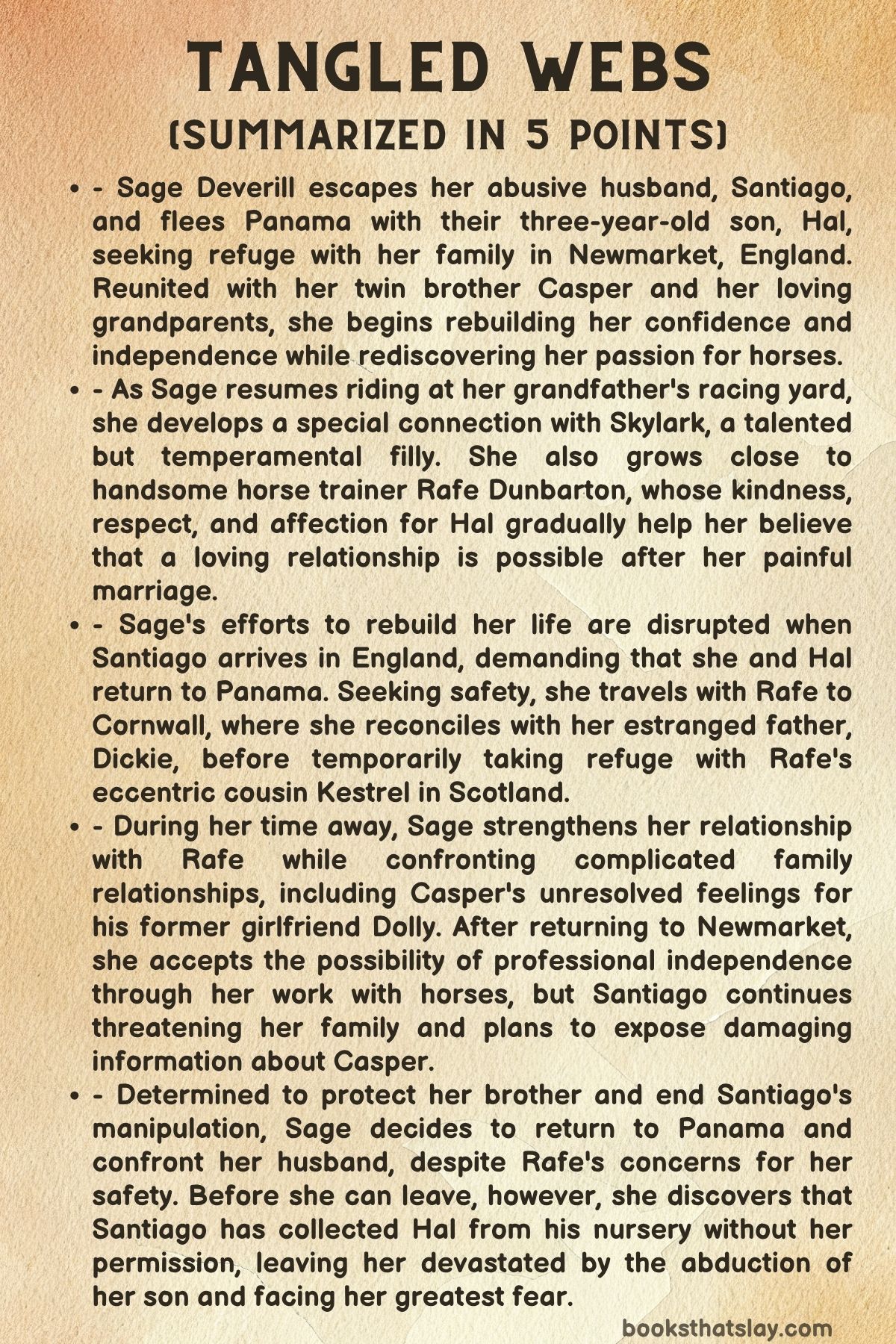
Summary
Sage Deverill awakens on New Year’s Day at Finca Azucar, her husband’s family estate on a secluded Panamanian island. Her swollen eye is a painful reminder of the previous afternoon, when her husband, Santiago, struck her during an argument and sent her crashing into a television.
Their three-year-old son, Hal, witnessed the assault, while Santiago’s mother, Lucilla, deliberately ignored what happened. For Sage, the incident marks the moment when remaining in her marriage becomes impossible.
Santiago, a former racing driver whose career ended after an accident, has become increasingly dependent on alcohol and drugs. His infidelity, cruelty, and unpredictable temper have transformed Sage’s marriage into a life of fear.
Lucilla has reinforced her son’s control by restricting Sage’s access to money and transportation. Determined to protect Hal, Sage announces that she is returning to England and manages to obtain their passports.
Before leaving, she releases Lucilla’s imprisoned parrot, expressing through this small act her determination to recover her own freedom.
After an exhausting journey, Sage and Hal arrive at Heathrow Airport, where her twin brother, Casper Beaumont, welcomes them. Casper immediately recognises the seriousness of Sage’s circumstances, although she remains reluctant to discuss her marriage.
He purchases warm clothing and other necessities for Hal before driving them to North Place, their grandparents’ home near Newmarket.
There, Sage receives an emotional welcome from her grandmother, Betsy Seymour, and the family’s longtime cook, Maggie. Her grandfather, Dennis, also makes it clear that she and Hal can remain for as long as necessary.
The familiar surroundings gradually restore Sage’s sense of belonging. Having grown up around racehorses, she eagerly returns to riding and begins helping Dennis exercise his thoroughbreds.
Her natural ability becomes particularly evident when she handles Skylark, a talented but difficult filly who responds unusually well to her sensitive approach.
Sage also reconnects with Dolly, her former closest friend and Hal’s godmother. Their friendship had suffered because Dolly distrusted Santiago and opposed Sage’s decision to remain with him.
Their reunion allows both women to overcome the distance created by Sage’s unhappy marriage. However, Dolly’s unresolved feelings for Casper complicate their renewed friendship.
Casper is now involved with Isabel Delemaine, a successful radio personality whose cold treatment of Hal and possessive attitude toward Casper make Sage uncomfortable.
Meanwhile, Sage encounters Rafe Dunbarton, an attractive and confident horse trainer. Their shared enthusiasm for horses creates an immediate connection, although Sage remains cautious about becoming romantically involved.
Rafe is equally attracted to her but recognises that her marriage and responsibilities as a mother make the situation complicated.
As Sage settles into life at North Place, Santiago returns her divorce papers with conditions demanding access to Hal in Panama. Sage fears that allowing her son to return there could expose him to further mistreatment.
Despite these worries, her growing friendship with Rafe offers welcome relief.
When Rafe invites her hunting, Sage accepts and wears the carefully preserved hunting clothes of her late mother, Iris.
Riding Rafe’s magnificent grey hunter, Ajax, Sage rediscovers the excitement and confidence she once associated with horses. Rafe is impressed by her abilities, and their attraction becomes increasingly difficult to ignore.
Their connection deepens when Sage questions him about an incident in which she witnessed him angrily dismissing an employee. Rafe explains that the man had been drunk and mistreating a horse, reassuring her that his anger arose from protecting an animal.
Back at North Place, Skylark wins an important race at Chelmsford under apprentice jockey Josie Moore. The victory confirms Dennis’s belief in the filly’s potential and strengthens Sage’s connection to the family racing operation.
During the race meeting, Sage confides in Dolly about her marriage. She explains that she discovered Santiago’s infidelity before their wedding but remained with him after learning she was pregnant.
Believing Hal deserved to grow up with both parents, Sage sacrificed her own happiness. Her decision eventually left her trapped in an increasingly abusive relationship.
Her developing feelings for Rafe become more serious when he offers to drive her home. Their conversation about their families reveals shared experiences of loss and estrangement.
However, Sage’s fragile security is shattered when Santiago unexpectedly arrives at North Place.
He demands that Sage and Hal return to Panama, refusing to acknowledge that their marriage is over. Dennis and Betsy support Sage, but she fears that Santiago may retaliate against her family.
She subsequently seeks refuge at Rafe’s home, Touchstone Lodge. Rafe welcomes both her and Hal, offering them protection without demanding anything in return.
Their relationship becomes more intimate, and Sage experiences a sense of safety that has been absent from her marriage.
Rafe then accompanies Sage and Hal to Cornwall, where she hopes to reconnect with her estranged father, Dickie Beaumont.
During the journey, they visit Rafe’s family home, Crockford. His parents, Constance and Walter Dunbarton, warmly welcome Sage and demonstrate genuine affection for Hal.
Their kindness reassures Sage that her complicated past does not necessarily prevent her from being accepted into another family.
In Cornwall, Sage finally meets Dickie, who abandoned his children following Iris’s fatal riding accident.
Dickie admits that grief and guilt overwhelmed him after his wife’s death. His inability to confront these emotions led him into drinking and isolation.
Sage discovers that he has spent years restoring his farmhouse, partly hoping that his children might eventually visit him.
Their reunion allows them to begin repairing their damaged relationship. Sage assures her father that Iris’s death was not his fault, offering him an opportunity to reconsider the guilt he has carried for years.
Unfortunately, Santiago’s continuing pursuit makes Cornwall unsafe.
Rafe arranges for Sage and Hal to seek temporary refuge with his cousin Kestrel in Scotland.
Kestrel lives at Rasaay, a remote hunting lodge overlooking a loch. An eccentric and generous man, he quickly wins Hal’s affection through his unusual collection of animals.
Sage also meets Mrs M, Kestrel’s longtime nanny and housekeeper, who explains that he is the ninth Duke of Stirling.
Despite his title, Kestrel faces serious financial difficulties following the loss of his ancestral home, Dunbarton Castle. His grief over his father’s death has also contributed to excessive drinking.
Sage finds comfort in the household but remains anxious about Rafe and her family.
Her concerns intensify when Kestrel’s unpleasant sister, Mary, arrives. Mary repeatedly humiliates her brother and reveals that the proposed sale of Dunbarton Castle has collapsed.
Even more disturbingly, Sage discovers that Mary knows Santiago from Panama.
When Mary continues insulting Kestrel, Sage confronts her directly. At that moment, Rafe unexpectedly arrives, having travelled to Scotland because he was worried about Sage.
Their reunion confirms the strength of their relationship.
Sage subsequently returns to Newmarket with Casper and Hal. Dennis offers to employ her properly and proposes helping her purchase a home once her divorce is settled.
Although Sage initially resists financial assistance, she begins accepting that rebuilding her independence does not require rejecting the support of those who love her.
She also becomes increasingly aware that Casper’s relationship with Isabel is troubled and that his feelings for Dolly remain unresolved.
Meanwhile, Sage and Rafe continue spending time together. Rafe’s affection for Hal reassures Sage that he accepts her responsibilities as a mother.
During another visit to Crockford, Sage enjoys hunting with Rafe and becomes increasingly comfortable around his family.
Their relationship reaches an important turning point when Rafe reveals that he has told his mother he loves Sage. She returns his declaration, recognising that she has found a relationship built on affection and respect.
However, the continuing threat from Santiago soon intrudes upon their happiness.
During a family dinner, Rafe’s brother Louis tells Sage that he has seen Mary with Santiago in London. He suspects that their association may be connected to Santiago’s attempts to regain control over Sage.
The following morning, Rafe reveals further information obtained from Louis. Santiago intends to approach the press with damaging information about Casper, timing the disclosure to coincide with public interest in the Grand National.
Sage fears that the threatened revelations could destroy her brother’s racing career.
Determined to prevent further harm, she decides to return to Panama and confront Santiago directly.
Rafe strongly opposes the plan because he fears for her safety. Nevertheless, Sage believes that she must stop allowing Santiago to threaten everyone she loves.
She arranges for Hal to remain with her grandparents and begins preparing for the journey.
Back at North Place, Sage continues exercising Skylark while organising her departure. However, Maggie casually mentions that someone from Rafe’s yard has collected Sage’s and Hal’s passports.
Sage subsequently arrives at Hal’s nursery to collect him.
There, the secretary, Hilary, informs her that Santiago has already taken the child, claiming that the family has a flight to catch.
The discovery devastates Sage. Her worst fear has become reality: Santiago has abducted Hal.
The available portion of the story ends with Sage confronting the terrifying possibility that Santiago may take their son back to Panama, leaving her newfound independence, developing relationship with Rafe, and hopes for a secure family life under immediate threat.
Characters
Sage Deverill
Sage Deverill is the central character of Tangled Webs, and her experiences provide the novel’s emotional foundation. Her development follows a woman attempting to recover her identity after years of psychological manipulation, domestic violence, and isolation.
At the beginning of the story, Sage has become accustomed to suppressing her own desires to avoid provoking her husband. Her decision to leave Panama demonstrates considerable courage, particularly because she must protect her young son while possessing limited financial resources.
Sage’s relationship with horses reveals aspects of her personality that Santiago’s cruelty has suppressed. She is sensitive, patient, observant, and capable of remaining calm while handling difficult animals.
Her ability to understand Skylark illustrates the confidence that gradually returns when she is allowed to exercise her natural talents.
Her determination to earn money also reflects her need to regain control over her circumstances. Although she appreciates her grandparents’ generosity, she wants to establish a future in which she can support herself and Hal.
Sage’s relationship with Rafe demonstrates her gradual recovery from emotional abuse. Initially, she is cautious around his confidence and strong personality, but his consistent kindness helps her distinguish genuine affection from controlling behaviour.
Her greatest vulnerability remains her fear for Hal and the people she loves. Santiago exploits this concern, knowing that threats against her family may influence her decisions more effectively than threats against her alone.
Throughout the novel, Sage’s courage develops alongside her willingness to accept support. She learns that independence does not necessarily mean confronting every danger without assistance.
Rafe Dunbarton
Rafe Dunbarton is Sage’s principal romantic interest and an important figure in her emotional recovery. As a successful horse trainer, he possesses confidence, authority, and considerable professional ambition.
His initial attraction to Sage develops through their shared understanding of horses. He recognises her talent and respects her abilities rather than treating her primarily as someone who needs protection.
Rafe’s behaviour contrasts with Santiago’s possessiveness. Although he becomes deeply concerned about Sage’s safety, he generally attempts to support her decisions rather than control them.
His willingness to welcome Hal is particularly significant. He recognises that loving Sage means accepting her responsibilities as a mother.
Rafe also reveals a compassionate side through his treatment of animals and his concern for his troubled cousin Kestrel. These relationships suggest that his protective instincts extend beyond romantic attachment.
Nevertheless, his determination to keep Sage safe occasionally creates tension. His opposition to her plan to return to Panama illustrates the difficulty of balancing concern for another person with respect for their independence.
In Tangled Webs, Rafe represents the possibility of forming a romantic relationship without surrendering personal freedom. His affection helps Sage reconsider the assumptions about love and marriage that developed during her abusive relationship.
Santiago Deverill
Santiago Deverill is the novel’s principal antagonist and the source of Sage’s most immediate danger. His behaviour establishes the controlling and destructive circumstances from which she attempts to escape.
A former racing driver, Santiago has struggled following the accident that ended his career. His increasing dependence on alcohol and drugs accompanies his infidelity, violent outbursts, and refusal to accept responsibility for his actions.
His abuse extends beyond physical violence. By limiting Sage’s financial independence and isolating her from supportive relationships, he has gradually reduced her ability to make decisions for herself.
Santiago’s relationship with Hal also reveals his possessiveness. Rather than prioritising the child’s emotional security, he uses access to his son as a means of exerting pressure on Sage.
His attempts to threaten Casper’s career demonstrate his willingness to target people who have helped his wife.
The final abduction of Hal represents an escalation of this behaviour. By removing the child without Sage’s consent, Santiago attacks the relationship that matters most to her.
His character illustrates how coercive control can continue after a victim leaves an abusive relationship. Physical separation does not immediately eliminate the danger created by a determined abuser.
Hal Deverill
Hal Deverill is Sage and Santiago’s three-year-old son, whose safety motivates many of Sage’s decisions. Although he is too young to understand the full circumstances of his parents’ marriage, he has already witnessed his father’s violence.
His cheerful personality provides an important contrast to the anxiety experienced by the adults around him. He is particularly enthusiastic about animals, horses, and the opportunities offered by his new life in England.
His relationship with Custard, his pony, reflects the freedom and happiness that Sage hopes to provide. His affection for Rafe also contributes to her growing trust in their relationship.
Hal’s presence reveals the nurturing qualities of other characters, including Betsy, Constance, Kestrel, and Dickie.
At the same time, his vulnerability raises the emotional stakes of the conflict with Santiago. His abduction transforms an already dangerous marital dispute into an immediate crisis.
Through Hal, the novel examines how domestic abuse affects children and how their welfare can become central to a parent’s struggle for independence.
Casper Beaumont
Casper Beaumont is Sage’s twin brother and one of her strongest sources of emotional and practical support. A successful championship-winning jockey, he has established a demanding professional life within the racing industry.
His immediate response to Sage’s return demonstrates his generosity. He collects her from Heathrow, purchases necessities for Hal, and helps her return to their grandparents’ home.
Casper’s affection for Sage is strengthened by their shared childhood experiences, particularly their mother’s death and their father’s subsequent abandonment.
However, his own romantic life is complicated. His relationship with Isabel appears increasingly unsatisfactory, while his unresolved feelings for Dolly continue to influence him.
Casper’s difficulties suggest that professional achievement does not guarantee personal happiness.
His importance to Sage also creates a vulnerability that Santiago attempts to exploit. The possibility of damaging revelations about Casper encourages Sage to consider returning to Panama.
Dolly
Dolly is Sage’s former closest friend, Hal’s godmother, and Casper’s former girlfriend. Her relationship with Sage demonstrates the importance of recovering friendships damaged by an abusive marriage.
Dolly previously distrusted Santiago and disagreed with Sage’s decision to remain with him. Their estrangement reflects the painful distance that can develop when someone becomes isolated within a controlling relationship.
Despite their separation, Dolly welcomes Sage back with genuine affection. She listens to her experiences without allowing their earlier disagreements to prevent reconciliation.
Her continuing feelings for Casper introduce an independent romantic conflict. Although she remains emotionally attached to him, his involvement with Isabel makes their relationship difficult.
Dolly’s loyalty and willingness to forgive make her a significant part of Sage’s recovery.
Dennis Seymour
Dennis Seymour is Sage’s grandfather and the owner of the racing operation at North Place. His character combines professional discipline with considerable affection for his family.
He recognises Sage’s natural riding ability and provides opportunities for her to contribute meaningfully to the stable.
His decision to offer her paid employment demonstrates that he values her work rather than simply regarding her as a dependent relative.
Dennis also provides emotional security by making it clear that Sage and Hal are welcome in his home.
His relationship with Skylark reveals his professional ambitions, while his willingness to acknowledge Sage’s contribution shows his respect for her judgment.
In Tangled Webs, Dennis represents a dependable form of authority that contrasts with Santiago’s abuse of power.
Betsy Seymour
Betsy Seymour is Sage’s grandmother and one of the novel’s most nurturing characters. Her immediate response to Sage’s return provides the reassurance that her granddaughter desperately needs.
Betsy creates an environment in which Sage can recover without being pressured to explain every detail of her marriage.
Her affection for Hal further strengthens the security of the household.
She also possesses considerable confidence and independence. Her involvement in decisions concerning Skylark demonstrates that she is not merely a passive presence within Dennis’s racing operation.
Betsy’s encouragement of Sage’s renewed friendship with Dolly reveals her understanding of the importance of supportive relationships.
Dickie Beaumont
Dickie Beaumont is Sage and Casper’s estranged father. His character explores the lasting consequences of grief, guilt, and parental absence.
Following Iris’s fatal riding accident, Dickie became overwhelmed by his inability to cope with her death. His retreat into drinking and isolation deprived his children of their surviving parent.
When Sage visits him in Cornwall, she discovers that he has spent years restoring a farmhouse and preserving reminders of their family.
These actions suggest that his affection for his children survived even when he lacked the emotional capacity to maintain contact with them.
His reunion with Sage offers an opportunity to confront the damage caused by his disappearance.
Dickie’s character demonstrates that genuine remorse can coexist with serious failures of responsibility. His grief helps explain his behaviour without eliminating the consequences suffered by his children.
Iris Beaumont
Iris Beaumont is Sage and Casper’s deceased mother, whose influence remains important throughout the story.
A talented horsewoman, Iris represents the family’s connection to riding and the racing world. Sage’s decision to wear her mother’s hunting clothes expresses her desire to reconnect with this inheritance.
Iris’s death also explains much of the emotional damage within the Beaumont family.
Dickie’s inability to recover from losing her contributed to his abandonment of the twins.
Although Iris is absent from the present action, her memory influences Sage’s understanding of her childhood, her father, and her own identity.
Lucilla Deverill
Lucilla Deverill is Santiago’s mother and an important contributor to Sage’s isolation.
Rather than intervening when Santiago becomes violent, she deliberately ignores his behaviour.
Her control over Sage’s access to transportation and money reinforces the restrictions imposed by her son.
Lucilla’s treatment of Sage reveals how abusive family environments can be sustained by people who enable the primary aggressor.
Her initial insistence that Hal must remain with his father further demonstrates her disregard for Sage’s concerns about the child’s welfare.
Kestrel Dunbarton
Kestrel Dunbarton is Rafe’s cousin and the ninth Duke of Stirling. Despite his aristocratic title, he faces serious financial difficulties and lives in relative isolation at his Scottish hunting lodge.
His eccentric personality and affection for animals make him an appealing companion for Hal.
However, his cheerful behaviour conceals substantial grief following his father’s death and the loss of Dunbarton Castle.
His excessive drinking suggests that he has developed unhealthy methods of coping with these difficulties.
Kestrel’s relationship with his sister Mary also reveals his vulnerability to emotional mistreatment.
Sage’s defence of him demonstrates that her experiences with Santiago have made her particularly sensitive to cruelty directed at others.
Kestrel contributes to the novel’s examination of grief, family dysfunction, and the importance of compassionate companionship.
Mary Dunbarton
Mary Dunbarton is Kestrel’s sister and a source of conflict within the Dunbarton family.
Her repeated humiliation of Kestrel reveals a domineering personality that appears accustomed to exploiting his emotional vulnerabilities.
She also demonstrates considerable interest in the family’s financial arrangements.
Her association with Santiago raises suspicions about her involvement in his attempts to threaten Sage.
Mary’s character illustrates how cruelty can operate through social pressure, humiliation, and the manipulation of family relationships.
Louis Dunbarton
Louis Dunbarton is Rafe’s brother, whose flirtatious and competitive behaviour initially makes Sage uncomfortable.
He frequently teases those around him and appears interested in provoking reactions from his brother.
However, his later actions reveal a more serious and observant side.
Louis notices Mary’s association with Santiago and warns Sage that the connection may be dangerous.
His willingness to share this information suggests that his apparently frivolous behaviour does not prevent him from recognising genuine threats.
Louis consequently develops from a potentially troublesome presence into an important source of information.
Lady Constance Dunbarton
Lady Constance Dunbarton is Rafe’s mother and an important source of reassurance for Sage.
Her confidence and social standing initially make Sage nervous, particularly because she fears that her marital circumstances may make her an unsuitable partner for Rafe.
Constance’s warm treatment gradually undermines these fears.
Her affection for Hal is especially significant, demonstrating that she accepts Sage’s son as part of the relationship.
Through Constance, the novel presents a version of family privilege that is accompanied by generosity rather than exclusion.
Lord Walter Dunbarton
Lord Walter Dunbarton is Rafe’s father and another welcoming member of the family.
His enthusiasm for horses provides an immediate connection with Sage and Hal.
His willingness to discuss ponies for the child contributes to the relaxed atmosphere Sage experiences at Crockford.
Although less prominent than Constance, Walter helps establish the family home as a place of acceptance.
Maggie
Maggie is the longtime cook at North Place and an important figure in the Beaumont family’s domestic life.
Her practical kindness provides Sage with a sense of continuity after years away from England.
She welcomes Sage and Hal with familiar routines, good food, and genuine concern for their welfare.
Her presence reinforces the emotional security of North Place.
However, her casual revelation that someone has collected Sage’s passports becomes significant as Santiago’s plans develop.
Josie Moore
Josie Moore is the apprentice jockey selected to ride Skylark at Chelmsford.
Her successful handling of the difficult filly demonstrates professional judgment and composure.
Rather than forcing Skylark into an uncomfortable position, Josie allows her sufficient room to build momentum.
Their convincing victory confirms the filly’s racing potential.
Josie’s character contributes to the novel’s portrayal of the racing industry as a world where patience, skill, and intelligent decision-making can determine success.
Isabel Delemaine
Isabel Delemaine is Casper’s girlfriend and a successful radio personality.
Her polished appearance and carefully maintained home initially suggest a woman who values status and control.
Her hostility toward Hal, however, reveals a lack of patience and generosity.
Her possessive behaviour toward Casper also raises questions about the emotional health of their relationship.
Isabel functions as a contrast to Dolly, whose affection for Casper appears more natural and longstanding.
Rosy
Rosy is a groom associated with Rafe’s yard whose hostile manner initially unsettles Sage.
Her behaviour contributes to Sage’s uncertainty about the personalities surrounding Rafe.
However, Rosy’s frustration with Louis’s neglect of his horses also reveals her commitment to their welfare.
She helps establish the demanding practical realities of managing a professional racing yard.
Mrs M
Mrs M is Kestrel’s longtime nanny and housekeeper.
Her return brings order to his neglected Scottish household, demonstrating her practical authority and longstanding affection for him.
She understands the difficulties created by Kestrel’s grief, financial problems, and drinking.
Her concern for his welfare reveals a relationship extending beyond ordinary domestic employment.
Mrs M also provides Sage with valuable information about Kestrel’s family history.
Sir Crowley
Sir Crowley is an elderly expatriate who befriended Sage during her marriage in Panama.
He recognised her mistreatment and offered companionship when Santiago and Lucilla isolated her.
By allowing Sage to ride his horses, he helped her maintain a connection to an important part of her former identity.
His death removed one of the few supportive relationships available to her in Panama.
His character demonstrates the importance of kindness to someone living under coercive control.
Peter
Peter is a member of the stable staff at North Place.
His comments about Dennis’s admiration for Sage’s riding help her recognise that her abilities remain valuable.
Although his role is relatively small, he contributes to the welcoming professional environment that allows Sage to regain confidence.
Hilary
Hilary is the nursery secretary who informs Sage that Santiago has collected Hal.
Her role becomes significant at the conclusion of the available narrative.
By revealing that Santiago claimed the family had a flight to catch, Hilary provides the information that alerts Sage to her son’s abduction.
Her presence illustrates how an apparently ordinary institutional interaction can become central to a dangerous family conflict.
Vanessa
Vanessa is a guest at the Dunbarton family dinner whose interest in Rafe makes Sage uncomfortable.
Her presence exposes Sage’s continuing insecurity about her romantic future.
Although Vanessa does not appear to play a substantial independent role, she helps reveal how Sage’s previous experiences have affected her confidence in intimate relationships.
Themes
Domestic Abuse, Coercive Control, and the Struggle for Freedom
Domestic abuse in Tangled Webs extends beyond the physical violence that finally persuades Sage to leave Santiago. Her marriage has been shaped by financial restrictions, emotional manipulation, isolation, infidelity, and the constant possibility of another violent confrontation.
Lucilla’s participation demonstrates that abusive relationships can be reinforced by other family members. Her refusal to intervene and her restrictions on Sage’s independence help Santiago maintain control.
The opening incident is particularly significant because Hal witnesses his father’s violence. Sage recognises that remaining with Santiago threatens not only her own safety but also her son’s emotional well-being.
Her escape to England represents an important act of resistance, but it does not immediately end Santiago’s influence.
He continues attempting to dictate the terms of their separation, using access to Hal and threats against Casper as instruments of pressure. His behaviour demonstrates that coercive control can persist even when the victim is physically beyond the abuser’s immediate reach.
Sage’s determination to earn her own money reflects the relationship between financial independence and personal freedom.
Her work at North Place allows her to recover practical control over her circumstances while rebuilding her self-confidence.
The final abduction of Hal exposes the continuing danger posed by Santiago’s possessiveness. His actions reveal that he considers the child a means of controlling Sage rather than an individual whose welfare should come first.
The theme ultimately examines freedom as something more complicated than leaving an abusive household. Sage must also confront the emotional, financial, legal, and familial consequences of her marriage.
Emotional Recovery, Trust, and the Possibility of Love
Sage’s relationship with Rafe develops while she is still recovering from the psychological consequences of her marriage.
Her experiences with Santiago have taught her to associate male anger with danger and romantic commitment with the loss of personal freedom.
Consequently, Rafe’s confidence initially produces uncertainty as well as attraction.
Their shared understanding of horses provides a foundation for trust. Rafe recognises Sage’s abilities and encourages her to rediscover activities that once made her happy.
His invitation to go hunting is particularly important because it allows Sage to experience independence and physical confidence within a supportive relationship.
Her questions about his dismissal of a stable employee demonstrate how carefully she evaluates his behaviour. Having lived with Santiago’s unpredictable temper, she needs to understand whether Rafe’s anger represents another potential threat.
Rafe’s explanation reassures her because it reveals a concern for an animal’s welfare rather than a desire to intimidate someone.
The relationship also develops through his acceptance of Hal. Sage cannot separate her romantic future from her responsibilities as a mother, and Rafe’s willingness to include the child makes their growing attachment meaningful.
Nevertheless, emotional recovery remains incomplete.
Sage sometimes fears that Rafe’s family will reject her or that another woman will prove a more suitable partner.
These insecurities reveal the lasting effects of a marriage that undermined her confidence.
In Tangled Webs, romantic love becomes associated with respect, emotional security, and the recognition of individual choice.
Rafe does not erase Sage’s trauma, but his consistent affection helps her imagine a future in which intimacy and independence can coexist.
Family Bonds, Estrangement, and Reconciliation
Family relationships provide both the strongest sources of protection and some of the deepest emotional injuries in the novel.
Sage’s immediate refuge with Casper and her grandparents demonstrates the importance of dependable support during a crisis.
Their willingness to welcome her without demanding explanations allows her to begin recovering at her own pace.
However, the Beaumont family also carries the consequences of an earlier tragedy.
Iris’s death left Dickie overwhelmed by grief, and his subsequent withdrawal deprived Sage and Casper of their father.
Sage’s reunion with Dickie reveals the complicated relationship between forgiveness and accountability.
His suffering helps explain his abandonment, but it does not erase the pain experienced by his children.
Their conversation offers the possibility of reconciliation because Dickie acknowledges his failures rather than denying them.
The Dunbarton family presents another examination of familial responsibility.
Constance and Walter welcome Sage and Hal with generosity, while Rafe’s concern for Kestrel demonstrates his loyalty to a troubled relative.
Mary’s treatment of Kestrel, however, shows that family connections do not automatically guarantee kindness.
Her repeated humiliation of her brother resembles the emotional domination Sage experienced with Santiago.
Sage’s defence of Kestrel consequently becomes an important expression of her developing confidence.
She is increasingly willing to challenge abusive behaviour when she encounters it.
The novel also expands the meaning of family beyond biological relationships.
Dolly, Maggie, Mrs M, and Rafe provide forms of support that are as emotionally significant as those offered by Sage’s relatives.
Together, these relationships suggest that belonging depends upon care, reliability, and mutual respect rather than blood ties alone.
Personal Identity, Independence, and the Restorative Power of Horses
Horses occupy a central position in Sage’s recovery because they connect her present circumstances with the confident person she was before her marriage.
In Panama, Santiago and Lucilla gradually restricted her independence, separating her from many of the activities that had previously defined her.
Her friendship with Sir Crowley offered an important exception.
By allowing Sage to ride his horses, he preserved a connection to the world she had been forced to leave behind.
Returning to North Place allows Sage to recover this neglected part of herself.
Her ability to handle Skylark demonstrates that the talents suppressed during her marriage have not disappeared.
The difficult filly responds to Sage’s patience and sensitivity, creating a relationship that reflects the importance of trust rather than domination.
Their connection also provides Sage with a growing sense of professional value.
Dennis’s decision to offer her employment confirms that she can contribute meaningfully to the family business rather than remaining dependent upon its generosity.
Her experiences hunting with Rafe develop this theme further.
Riding Ajax across demanding countryside allows Sage to confront physical challenges and experience the pleasure of making decisions for herself.
The activity also connects her to Iris, whose abilities as a horsewoman remain an important part of Sage’s childhood memories.
Her mother’s preserved hunting clothes become a symbol of continuity between generations.
The racing world supplies similar opportunities for other characters.
Casper’s professional achievements establish his public identity, while Rafe’s dedication to training reveals his discipline and ambition.
Kestrel’s attachment to animals provides comfort amid grief and financial uncertainty.
For Sage, however, horses represent something particularly personal.
They offer an environment in which her judgment, courage, and sensitivity are recognised.
Her gradual return to riding and professional responsibility demonstrates that recovering from abuse involves more than escaping an unhappy relationship.
It also requires rediscovering interests, abilities, and ambitions that have been neglected or suppressed.
By reclaiming her place among the horses at North Place, Sage begins constructing an identity defined by her own choices rather than Santiago’s demands.