Tempest of Wrath and Vengeance Summary, Characters and Themes
Tempest of Wrath and Vengeance by Melissa K. Roehrich is a dark fantasy novel that explores the consequences of divine manipulation, forbidden love, and the struggle for personal freedom. Set in the realm of Devram, the story follows Tessa as she discovers that her extraordinary abilities connect her to an ancient conflict involving gods, dragons, and the mysterious force known as Chaos.
Meanwhile, Theon and Luka confront their own loyalties as they attempt to protect her from a destiny that threatens their entire world. Through political conspiracies, dangerous magical bonds, and devastating betrayals, the novel examines whether individuals can escape the purposes assigned to them by those who possess power. It’s the 3rd book of the Legacy series.
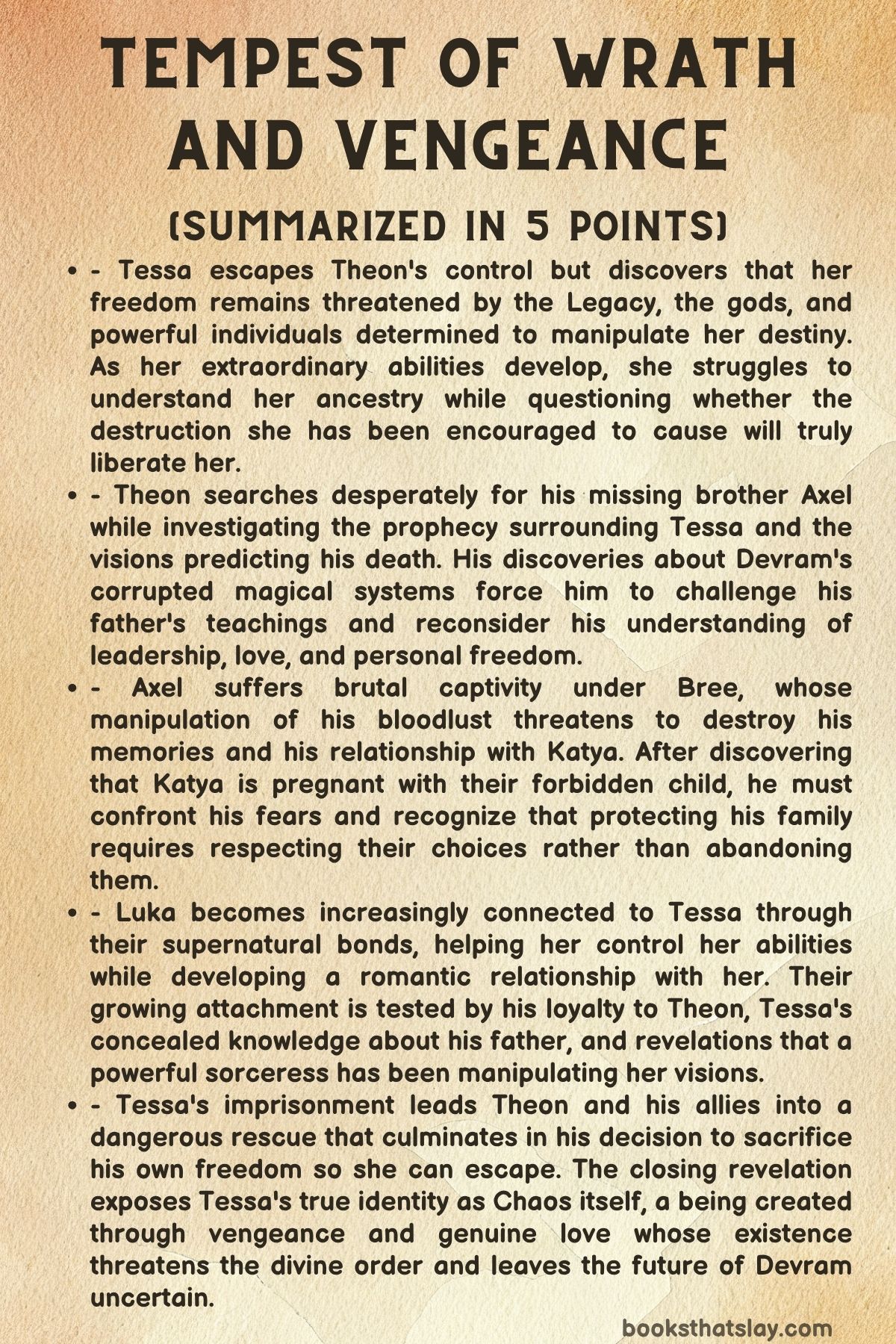
Summary
The story begins with Theon desperately searching for his missing brother, Axel, who disappeared after their father, Valter, discovered that he had helped Katya escape. Theon searches throughout Arius House, the Underground, and his father’s private properties, but every attempt to locate Axel fails.
Although Theon has assumed responsibility as the new Arius Lord, his authority remains uncertain while Valter is alive. His separation from Tessa also causes considerable suffering, as their magical bond continues transmitting emotions neither can escape.
Tristyn Blackheart arrives with an unexpected offer of assistance and introduces Theon to Eliza and Razik Greybane. Their knowledge challenges everything Theon has been taught about the Legacy, the gods, and Tessa’s origins.
Cienna reveals that she knows about Tessa’s visions of Theon’s death. She warns that unless they discover how to prevent the predicted events, killing Tessa may become the only way to stop the approaching catastrophe.
Meanwhile, Tessa attends a Tribunal hearing where Luka appears as the representative of the Arius Kingdom. His questions expose the uncertainty surrounding Tessa’s ancestry and the extraordinary nature of her abilities.
Although she has escaped Theon’s immediate authority, Tessa discovers that the other rulers regard her as something to be controlled. Rordan claims responsibility for her, while Brecken insists that she must fulfill her destiny because his freedom depends upon it.
Tessa resents these expectations but remains determined to accomplish the purpose she believes has been assigned to her. She intends to destroy the oppressive Legacy system, even if doing so requires violence against those who once controlled her.
Her relationship with Luka becomes increasingly complicated. As Theon’s Guardian, Luka remains loyal to his closest friend, yet his own bond with Tessa creates an attachment he cannot dismiss.
When Luka asks her to help locate Axel, Tessa initially refuses because of Axel’s participation in her earlier suffering. Luka reminds her that Axel also offered moments of kindness and companionship when she had little control over her life.
Their disagreement forces Tessa to confront the difference between seeking justice and refusing compassion. Although she insists that she has become a monster, Luka challenges her belief that this identity excuses every destructive decision.
Unknown to them, Axel is imprisoned by Bree, a powerful leader among the Night Children. She exploits his bloodlust through calculated deprivation, offering temporary relief while attempting to make him dependent upon her.
Axel’s memories of Katya gradually deteriorate under the influence of his transformation. His affection becomes entangled with possessive instincts, allowing Bree to manipulate his desire to find the female he loves.
Theon eventually discovers a possible means of reaching Axel through Katya’s magical connection to him. Although he initially opposes the risk, he recognizes that preventing Katya from deciding for herself would repeat the controlling behavior he has begun questioning.
Their efforts eventually lead to Axel’s rescue. However, his reunion with Katya brings another revelation: she is pregnant, and their child will be born from a relationship forbidden by Devram’s laws.
Axel fears that his transformation makes him dangerous to Katya and their unborn child. Convinced that leaving will protect them, he returns to the Underground, where he attempts to infiltrate Bree’s organization and discover its plans.
His investigation exposes the exploitation of children born from Fae and Legacy relationships. He also learns that the Night Children possess information about Valter’s secret dealings and intend to exploit the weakening kingdoms.
Eventually, Axel returns to Katya and acknowledges that abandoning her was wrong. Their reconciliation begins when he accepts that genuine protection requires respecting her choices rather than making every decision on her behalf.
While these events unfold, Tessa searches for information about her ancestry. Her investigation leads her to Valter, whom she tortures for information, and to a mysterious prisoner who knew her mother.
The prisoner reveals that Tessa’s mother once threatened to destroy an entire realm to protect her daughter. For Tessa, who has long believed herself unwanted, the revelation challenges her understanding of her childhood.
Her pursuit of answers also brings her to the Sirana Villas, where Brecken guides her through hidden passages. There she discovers evidence of the exploitation concealed beneath the ruling classes’ privileged existence.
Enraged by the suffering she witnesses, Tessa unleashes her destructive power. The resulting massacre kills numerous Legacy and contributes to a political crisis throughout Devram.
Theon recognizes that the violence may provoke retaliation against innocent Fae. Tessa, however, remains convinced that destroying the existing system is necessary to accomplish her purpose.
As her abilities grow increasingly unstable, she asks Luka to train her. Their sessions teach her that extraordinary magical strength cannot replace discipline, judgment, or emotional control.
Their relationship deepens through shared vulnerability and supernatural experiences. Luka also begins entering Tessa’s visions, discovering that they contain beings and places far beyond his understanding.
During one encounter, they meet Lilura, who reveals that a sorceress has been manipulating Tessa’s visions. This discovery challenges the apparent inevitability of Theon’s death and raises the possibility that someone has deliberately shaped Tessa’s decisions.
Theon responds by investigating historical records with Eliza, Razik, and Luka. Their research reveals that Devram’s Source system differs fundamentally from magical bonds elsewhere and may have been deliberately corrupted.
The group also uncovers evidence that the accepted history of the gods, dragons, and Legacy conceals significant truths. Theon increasingly recognizes that the institutions he was raised to protect were built upon manipulation and exploitation.
Meanwhile, Tessa’s relationships with Rordan and Dexter deteriorate. Both insist that their restrictions exist for her protection, but their behavior increasingly resembles the control she endured under Theon.
Rordan’s attempts to influence her future become especially apparent when he publicly introduces arrangements involving Liam. Tessa recognizes that her extraordinary abilities have made her valuable to yet another powerful ruler.
Her supernatural experiences also bring her into direct contact with Achaz. Although he initially presents himself as a guide, Tessa eventually discovers that her unusual bloodline threatens the balance he intends to preserve.
When she appeals to their family connection, Achaz dismisses its importance. Tessa realizes that the divine being directing her toward her supposed destiny may ultimately intend to destroy her.
Another devastating betrayal follows when the Hunters turn against her. During the confrontation, Auryon is killed, leaving Tessa overwhelmed by grief and guilt.
Although the two frequently disagreed, Auryon had repeatedly attempted to protect her. Tessa retrieves her bow and vows revenge against the beings responsible for her death.
Luka brings Tessa to safety and finally acknowledges that his loyalty belongs to her. Their growing intimacy offers temporary relief from the betrayals surrounding her.
However, their relationship suffers a severe rupture when Luka discovers that Tessa has concealed information about his father’s imprisonment. He is devastated that she allowed him to remain ignorant of something so personally significant.
Following his departure, Tessa returns to Faven and reads the messages Theon has continued sending her. His words reveal that he has remained concerned for her throughout their separation.
She begins questioning whether her determination to reject him has prevented her from recognizing genuine affection. Before she can resolve these feelings, Dexter arrives and takes her into custody.
A black ring suppresses her abilities, and she is imprisoned within the Pantheon. The restrictions leave her increasingly vulnerable as magical energy accumulates inside her.
Theon learns of her imprisonment and immediately seeks Tristyn’s assistance. Refusing to accept a lengthy delay, he organizes a rescue despite the prison’s formidable magical defenses.
Their escape leads to a confrontation involving the Augury and the Hunters. Theon encourages Tessa to trust their connection, briefly allowing their combined abilities to stabilize her dangerous power.
The battle escalates when a Hunter wounds Tessa with a golden weapon. Theon is subsequently struck by a poisoned blade capable of paralyzing Arius blood.
Although Luka and the others help overcome the immediate danger, Theon recognizes that protecting Tessa requires an extraordinary sacrifice. He concludes that preserving Devram’s existing order cannot justify condemning her to a destiny she never chose.
Theon orders Luka to take care of Tessa and ensure that she escapes. When Tessa realizes that he intends to remain behind, she becomes distraught and refuses to accept his decision.
Nevertheless, Luka pulls her away as Theon insists that she must be happy and free. Their separation demonstrates how completely his understanding of love has changed since he first attempted to possess her.
The closing revelation shifts the story toward the divine conflict underlying Tessa’s existence. Akira confronts Achaz and explains that the struggle involving Chaos began long before the present events.
Akira identifies herself as a Fury, created through vengeance and Chaos. Her daughter, however, possesses something even more extraordinary because she was also created through genuine love and acceptance.
Achaz attempts to persuade Akira to surrender her ring, claiming that he can save Tessa. Akira refuses to allow her daughter to become another prisoner of divine ambition.
The final revelation establishes that Tessa is not merely a powerful descendant of the gods. She is Chaos itself, a being whose existence threatens the foundations of the established order and whose future remains uncertain.
Characters
Tessa
Tessa is the central character of Tempest of Wrath and Vengeance, and her development explores the psychological consequences of captivity, manipulation, and extraordinary power. Having escaped Theon’s immediate authority, she initially believes that independence will allow her to determine her own future.
However, her experiences within the Achaz Kingdom reveal that freedom is considerably more complicated than escaping a particular person. Rordan, Dexter, Brecken, and even divine beings repeatedly attempt to direct her actions toward purposes she does not fully understand.
Her response to this continued manipulation is frequently destructive. Rather than simply resisting those who control her, she begins adopting methods resembling those used against her, including intimidation, torture, and the deliberate exploitation of fear.
This contradiction becomes especially apparent in her treatment of Valter. Although her anger toward him is understandable, her willingness to inflict suffering demonstrates how easily the pursuit of justice can become indistinguishable from revenge.
Tessa’s extraordinary abilities intensify these moral difficulties. Because her emotions directly affect her magic, moments of anger and grief can produce consequences far beyond her original intentions.
The massacre at the Sirana Villas demonstrates both her desire to challenge exploitation and her inability to control the scale of her retaliation. Her subsequent request for Luka’s assistance represents an important acknowledgment that power without discipline can threaten the people she wishes to protect.
Her relationships with Theon and Luka reveal competing aspects of her personality. She resents Theon for controlling her, yet their bond preserves an emotional connection she cannot completely reject.
With Luka, she gradually discovers the possibility of companionship founded upon understanding rather than ownership. Nevertheless, her concealment of information about his father demonstrates that she continues struggling with honesty and trust.
Auryon’s death forces Tessa to confront the consequences of treating dangerous supernatural forces as instruments of her will. Her grief exposes the vulnerability she has attempted to conceal beneath her increasingly intimidating identity.
The revelation that Achaz may intend to destroy her further transforms her understanding of destiny. She recognizes that the purpose she has been encouraged to fulfill may serve interests entirely separate from her own survival.
Ultimately, Tessa’s identity as Chaos gives her character a significance extending beyond personal revenge. Her greatest challenge is determining whether she can exercise extraordinary power without allowing violence, manipulation, or divine expectations to determine who she becomes.
Theon
Theon undergoes one of the novel’s most substantial transformations, moving from an authoritarian heir toward a man increasingly willing to question the institutions that shaped him. At the beginning of Tempest of Wrath and Vengeance, he remains deeply influenced by the responsibilities and expectations imposed upon him by Valter.
His upbringing taught him to associate leadership with obedience, authority, and emotional restraint. Consequently, his original treatment of Tessa reflected his belief that possession and protection could coexist without contradiction.
Their separation forces him to confront the consequences of those assumptions. Although their magical bond continues transmitting powerful emotions, he can no longer rely upon authority to maintain their relationship.
His desperate search for Axel provides another opportunity for personal growth. Theon must acknowledge that his brother’s suffering is connected to the family system he previously accepted as necessary.
His conversations with Katya are particularly revealing. When she volunteers to risk herself for Axel, Theon initially attempts to prevent her from doing so, believing that he knows how best to protect her.
Eventually, he recognizes that refusing her choice would reproduce Valter’s controlling behavior. This realization marks a significant development in his understanding of responsibility.
His political transformation follows a similar pattern. As he investigates Devram’s history, Theon discovers that many accepted truths about Sources, dragons, and magical bloodlines have been deliberately concealed.
Rather than defending these institutions simply because he expects to inherit them, he begins challenging the rulers who maintain their authority through exploitation.
His relationship with Luka also develops beyond the traditional expectations of a Legacy heir and his Guardian. Despite jealousy and emotional complications, Theon increasingly accepts that Luka possesses independent desires and responsibilities.
Theon’s most significant decision occurs during Tessa’s rescue. By choosing her freedom over the continued stability of the realm, he rejects the principle that preserving established authority justifies sacrificing individuals.
His willingness to remain behind while Luka takes her away demonstrates a changed understanding of love. He finally recognizes that caring for Tessa may require accepting a future in which she is no longer his to command.
Luka
Luka serves as an essential emotional and moral counterweight to the destructive forces surrounding Tessa. His position as Theon’s Guardian initially defines his identity, but his developing relationship with Tessa forces him to reconsider a lifetime of inherited obligations.
At the beginning of the novel, Luka struggles to distinguish personal loyalty from the expectation that he must always place Theon’s interests before his own. His connection to Tessa challenges that arrangement because protecting her sometimes requires opposing his closest friend.
His relationship with Tessa is characterized by patience, confrontation, and increasing emotional honesty. Unlike individuals who flatter her extraordinary power, Luka regularly challenges her decisions and refuses to excuse her cruelty.
His insistence that Axel deserves consideration despite his past mistakes reveals Luka’s belief that individuals cannot be reduced to their worst actions. He expects Tessa to exercise the same moral judgment she demands from others.
Luka also becomes instrumental in helping her control her magic. Through training, he encourages her to develop discipline and understand that emotional restraint is necessary when her abilities can endanger entire communities.
Their shared visions deepen his involvement in the supernatural conflict. His unexpected participation in these experiences reveals that his dragon ancestry and magical connections are more significant than he previously understood.
The discovery of his father’s imprisonment introduces a deeply personal dimension to his struggles. Tessa’s concealment of this information wounds him precisely because he has invested so much trust in their relationship.
His decision to leave her demonstrates that affection does not require accepting every betrayal. He remains capable of establishing boundaries despite his overwhelming attachment.
Luka’s declaration that his loyalty belongs to Tessa represents a decisive assertion of independence. Nevertheless, his continued concern for Theon demonstrates that choosing one relationship does not automatically erase the importance of another.
Through Luka, the novel explores the difficulty of building an identity beyond inherited roles while preserving compassion for those connected to the past.
Axel
Axel’s storyline in Tempest of Wrath and Vengeance examines the relationship between addiction, manipulation, shame, and the desire to protect loved ones. His imprisonment by Bree exposes him to extreme deprivation that gradually undermines his ability to distinguish affection from possession.
His bloodlust is particularly disturbing because it threatens his relationship with Katya. The person he most wants to protect becomes entangled with the instincts he fears will eventually destroy him.
Bree exploits this vulnerability by controlling his access to blood and presenting herself as someone capable of understanding his transformation. Her manipulation encourages him to imagine a future in which surrendering to his cravings represents freedom.
Nevertheless, fragments of Axel’s affection for Katya survive his deterioration. Their connection eventually helps restore his memories and creates the possibility of rescue.
The discovery of Katya’s pregnancy introduces another conflict. Axel understands that their child will violate Devram’s rigid restrictions surrounding relationships between Fae and Legacy.
His immediate response is to assume responsibility for protecting his family by removing himself from their lives. Although motivated by love, this decision reveals how deeply Valter’s authoritarian example has shaped his behavior.
Katya challenges his belief that protection gives him the right to make unilateral decisions. Their eventual reconciliation requires Axel to acknowledge that partnership depends upon shared responsibility.
His decision to infiltrate the Night Children demonstrates that he remains determined to protect his family, but it also exposes him to further manipulation. He must learn to distinguish courageous action from unnecessary self-sacrifice.
Axel’s development ultimately centers on accepting that his transformation does not eliminate his capacity for love. His future depends upon learning to manage his instincts without allowing fear to dictate every choice.
Katya
Katya represents personal agency within a society that repeatedly denies individuals the right to determine their own futures. Her relationship with Axel places her in direct conflict with Devram’s laws because their child embodies a union the ruling classes consider unacceptable.
Despite the dangers surrounding her pregnancy, Katya refuses to surrender responsibility for her own decisions. She insists upon participating in the effort to locate Axel, even when Theon initially attempts to protect her by excluding her.
Her determination exposes the difference between receiving protection and being controlled. Katya understands that affection becomes restrictive when another person assumes the authority to decide what risks she may accept.
Her relationship with Axel becomes particularly significant after his transformation. Although she recognizes the danger of his bloodlust, she refuses to treat his condition as proof that their future is impossible.
However, her compassion does not mean accepting abandonment. When Axel leaves without consulting her, she confronts him about the emotional damage caused by his decision.
Her insistence upon honesty and partnership forces him to reconsider the example established by his father. Katya wants to face uncertainty alongside him rather than become someone he protects from a distance.
Her pregnancy also exposes the cruelty of Devram’s social divisions. The possibility that their child could be killed or exploited demonstrates how political institutions turn prejudice into threats against innocent lives.
Katya’s strength comes not from overwhelming supernatural power but from her refusal to surrender the ordinary human needs for love, security, and independence.
Valter
Valter embodies the authoritarian foundations of the society portrayed in Tempest of Wrath and Vengeance. His influence extends far beyond his direct appearances because his methods have shaped the behavior, fears, and expectations of several central characters.
His treatment of Theon demonstrates how parental authority can become a mechanism for producing obedience. By imposing relentless expectations upon his eldest son, Valter encouraged him to associate responsibility with control.
His relationship with Axel reveals another dimension of this cruelty. The secrecy surrounding Axel’s condition and the punishment inflicted upon him establish a family environment in which vulnerability becomes dangerous.
Valter’s treatment of Eviana is even more disturbing. He exploits her magical bond, threatens her daughter, and uses fear to guarantee compliance.
These actions demonstrate that his concept of loyalty depends upon coercion rather than mutual obligation. He expects obedience because he possesses the power to punish resistance.
His involvement in hidden arrangements with the Night Children further reveals the hypocrisy of the ruling establishment. Although the Legacy maintain strict public distinctions between bloodlines and social classes, Valter privately benefits from practices that contradict their professed principles.
Even during imprisonment, he remains dangerous because his magical connections allow him to influence individuals beyond his immediate reach.
Valter’s importance lies in the lasting consequences of his authority. Theon, Axel, and Eviana must all confront the ways his behavior has shaped their understanding of relationships.
His character demonstrates that removing an oppressive ruler does not automatically eliminate the beliefs and habits that sustained his power.
Eviana
Eviana is among the novel’s most psychologically complex supporting characters. Her experiences reveal how prolonged captivity can force individuals into morally compromised behavior without eliminating their desire for independence.
Her relationship with Valter has been defined by manipulation, violence, and threats against her daughter. Because their magical bond allows him to communicate with her, even physical separation cannot guarantee her freedom.
Eviana recognizes that she has committed terrible acts under his authority. Rather than presenting herself as innocent, she acknowledges the consequences of her actions while remaining determined to survive.
Her daughter provides the central motivation for her resistance. Nearly every decision she makes is shaped by the possibility that Valter could harm the child if Eviana reveals too much.
Her developing relationship with Tessa is significant because both understand the psychological consequences of being treated as property. Although Eviana remains cautious, their conversations create moments of recognition between individuals whose autonomy has been repeatedly violated.
The revelation that Eviana possesses both Fae and Silas Legacy ancestry further complicates her identity. Her existence demonstrates that the rigid categories maintained by Devram’s rulers do not accurately represent their own history.
Despite receiving assistance from Eliza and Razik, Eviana refuses to surrender control of her future to another group. Her manipulation of Lange and Corbin reveals that she remains capable of morally questionable decisions when pursuing her objectives.
Her storyline illustrates the difficulty of rebuilding personal agency after prolonged coercion. Freedom remains something she must actively pursue rather than something another person can simply grant her.
Bree
Bree represents the calculated exploitation of vulnerability. As a powerful leader among the Night Children, she possesses extensive knowledge of bloodlust and understands how to transform physical dependence into political obedience.
Her treatment of Axel demonstrates this strategy clearly. She alternates deprivation with temporary relief, creating conditions in which accepting her assistance appears increasingly necessary.
Rather than immediately demanding his loyalty, she gradually encourages him to reinterpret his transformation. She presents the instincts he fears as abilities that could liberate him from the restrictions imposed by his father.
This approach makes her particularly dangerous because her promises contain elements of truth. Axel genuinely has been harmed by Valter’s control, but Bree intends to replace that domination with dependence upon herself.
Her ambitions extend beyond manipulating one individual. She expects the established kingdoms to weaken and intends to position the Night Children to benefit from the resulting instability.
Her interest in Katya’s pregnancy reveals how readily she transforms personal relationships into potential resources. The unborn child becomes valuable to her because of its unusual ancestry rather than its individual existence.
Bree functions as a reminder that opposition to an oppressive institution does not necessarily make someone benevolent. Her alternative political order may reproduce the same exploitation she claims to transcend.
Rordan
Rordan represents the established political authority of the Achaz Kingdom. His relationship with Tessa reveals the difficulties she faces when escaping one controlling institution only to encounter another.
Although he claims responsibility for her protection, his actions repeatedly demonstrate that he considers her extraordinary abilities politically valuable. He attempts to regulate her movements, relationships, and access to information.
His insistence that leadership requires sacrifice reveals the worldview through which he justifies his authority. Rordan believes that experienced rulers must sometimes make decisions younger individuals cannot fully understand.
However, this reasoning also allows him to dismiss Tessa’s objections. He treats her resistance as evidence that she requires further supervision rather than considering whether his restrictions are themselves unjustified.
His public announcement involving Liam exposes the political calculations underlying his treatment of her. Tessa recognizes that her future may once again become subject to arrangements designed to benefit powerful families.
Rordan’s character demonstrates how paternalistic authority can conceal self-interest. His apparent concern for stability repeatedly conflicts with Tessa’s desire to determine her own life.
Dexter
Dexter occupies an especially complicated position because he presents himself as someone who understands Tessa’s extraordinary identity. His familiarity with her history gives him an influence that other members of the Achaz household cannot easily reproduce.
However, his relationship with her becomes increasingly strained as she recognizes how much information he has concealed. He repeatedly insists that his decisions were necessary for her protection.
Tessa challenges this explanation because it resembles the justification Theon once used for controlling her. Dexter’s inability to recognize the similarity exposes the contradictions in his behavior.
His encouragement that she concentrate upon her destiny also raises questions about whether he values her independence or the purpose she is expected to fulfill.
The deterioration of their relationship culminates in his participation in her imprisonment. By placing the suppression ring upon her finger, Dexter becomes directly responsible for depriving her of the freedom she has struggled to obtain.
His actions demonstrate how individuals can rationalize betrayal when they believe that protecting someone justifies overriding that person’s autonomy.
Tristyn Blackheart
Tristyn serves as an important connection between Devram’s political conflicts and the wider supernatural history concealed from its inhabitants. His knowledge of the Underground, magical protections, and ancient relationships makes him essential to Theon’s investigation.
Initially, his motives remain difficult to interpret. He offers assistance while withholding information, creating uncertainty about whether his involvement serves personal interests or a larger purpose.
His history with Lilura gradually reveals that his apparently detached behavior conceals enduring emotional commitments. Their separation across centuries gives his actions a personal significance that extends beyond contemporary politics.
Tristyn also demonstrates an unusual willingness to challenge the Legacy’s assumptions. His familiarity with alternative societies allows him to recognize the distortions within Devram’s established order.
During Tessa’s imprisonment, his knowledge becomes instrumental in overcoming the Pantheon’s defenses. His participation illustrates that individuals who once occupied opposing positions may need to cooperate against a common threat.
Cienna
Cienna possesses information that makes her a crucial participant in the effort to understand Tessa’s destiny. Her knowledge of the visions and their possible consequences forces Theon to confront dangers he initially resists acknowledging.
She is also willing to challenge him directly. Rather than allowing his anger or inherited authority to dominate their discussions, she insists that he recognize the seriousness of the supernatural crisis.
Her involvement demonstrates that information can provide influence even to individuals excluded from conventional political power. She becomes valuable because she understands matters the rulers have concealed or misunderstood.
Cienna also provides an important practical perspective during the group’s investigations. Her willingness to prioritize rescue over revenge helps Luka recognize that pursuing Valter would endanger others.
Her character contributes to the novel’s argument that responsible action frequently requires resisting powerful emotional impulses.
Eliza Greybane
Eliza introduces knowledge of magical systems that differ fundamentally from those accepted in Devram. Her expertise becomes important when Theon begins investigating the nature of Source Marks and the manipulation of supernatural bonds.
Her explanations demonstrate that the relationships considered natural by the Legacy may actually represent corrupted versions of older magical practices. This information challenges the ideological foundations of Devram’s hierarchy.
Eliza also provides practical assistance in the effort to protect Eviana. Her knowledge of bloodlines and specialized magic creates the possibility of weakening Valter’s influence without immediately destroying the existing bond.
Her willingness to meet Tessa directly demonstrates a preference for cooperation over distant speculation. Rather than treating Tessa exclusively as a dangerous object of study, Eliza recognizes the necessity of including her in the search for answers.
Razik Greybane
Razik’s arrival introduces an important connection between Luka’s ancestry and the wider world of dragons. His resemblance to Luka immediately raises questions about their family relationship.
As the investigation progresses, Razik contributes knowledge about divine bloodlines, magical bonds, and the historical distortion of Devram’s supernatural institutions.
His connection to Eliza also provides an alternative example of magical relationships. Their bond demonstrates that extraordinary connections need not function through the coercive arrangements familiar to the Legacy.
Razik’s involvement becomes particularly important when Theon is wounded by a golden weapon. His knowledge that dragon fire can remove the poison helps the group respond to a potentially fatal threat.
Through Razik, the novel expands the significance of Luka’s identity and establishes that the mysteries surrounding Devram cannot be understood through its official history alone.
Brecken
Brecken occupies an ambiguous position between guide, manipulator, and reluctant participant in Tessa’s destiny. He repeatedly insists that she must become what she was intended to be because his own freedom depends upon her actions.
This dependence complicates his apparent assistance. Although he provides valuable information, his interests do not necessarily coincide with Tessa’s desire for independence.
His guidance through the Sirana Villas exposes her to hidden exploitation and helps bring about a confrontation that destabilizes the political order.
Brecken also challenges Tessa’s fears, particularly her discomfort with enclosed spaces. However, his insistence that she overcome these limitations often disregards the emotional consequences of her captivity.
His character reveals the moral uncertainty surrounding individuals who assist a powerful figure because they expect to benefit from the fulfillment of a prophecy.
Auryon
Auryon represents a protective presence whose relationship with Tessa is characterized by disagreement rather than unquestioning obedience. She repeatedly challenges Tessa’s willingness to summon Hunters without understanding the responsibility involved.
Her warnings reveal an awareness that supernatural power carries consequences beyond the immediate satisfaction of personal desires.
Although Tessa frequently resents her interference, Auryon’s actions demonstrate genuine concern for her safety. Their relationship develops through conflict, creating an attachment neither fully acknowledges.
Her death becomes especially significant because it exposes Tessa to the consequences of trusting dangerous forces she cannot control. The Hunters’ betrayal proves that possessing the ability to summon powerful beings does not guarantee their loyalty.
Tessa’s decision to retrieve Auryon’s bow transforms the weapon into a reminder of loss and unfinished responsibility.
Auryon’s character demonstrates that meaningful loyalty sometimes requires challenging another person’s decisions rather than simply supporting them.
Achaz
Achaz represents divine authority exercised through manipulation and the preservation of established power. His relationship with Tessa initially suggests that her extraordinary abilities have a sacred purpose.
However, his eventual acknowledgment that her ancestry threatens the balance he intends to maintain exposes the limits of his apparent concern.
Tessa’s appeal to their family relationship reveals how little significance Achaz attaches to ordinary emotional obligations. He evaluates her primarily according to the supernatural forces represented within her blood.
His willingness to sacrifice her demonstrates that divine authority is not necessarily associated with wisdom or compassion.
The conflict between Achaz and Akira further reveals that his ambitions extend beyond Devram’s political institutions. He seeks to control a force whose existence threatens the structure upon which his authority depends.
Akira
Akira’s appearance in the closing section radically expands the significance of Tessa’s origins. As a Fury created through vengeance and Chaos, she embodies powers that existed long before the contemporary political conflicts.
Her relationship with Tessa introduces a distinction between creation through destructive purpose and creation through genuine love.
Although Akira possesses a violent supernatural origin, her refusal to surrender her daughter demonstrates that her identity is not determined exclusively by vengeance.
Her confrontation with Achaz reveals that she understands the danger posed by those who seek to control Chaos. She refuses his assurances that Tessa can be saved through confinement or submission.
Akira’s significance lies in her insistence that her daughter’s existence cannot be reduced to the intentions of the beings who created or manipulated her.
Lilura
Lilura provides crucial information concerning the manipulation of Tessa’s visions. Her revelation that a sorceress has altered what Tessa sees undermines the apparent certainty of the prophecy surrounding Theon’s death.
Her intervention demonstrates that supernatural knowledge is fragmented and that even powerful individuals may be acting upon deliberately distorted information.
Lilura’s connection to Tristyn also introduces a personal dimension to the ancient history of dragons and magical beings.
Her message that she remains waiting for a dance suggests an enduring emotional attachment despite centuries of separation.
Through Lilura, the novel establishes that the past continues shaping present events through relationships, unfinished promises, and concealed truths.
Lange and Corbin
Lange and Corbin illustrate the experiences of Fae whose lives have been shaped by the restrictions imposed by the Legacy. Their involvement with Theon exposes him to perspectives he previously had little reason to consider.
As he assumes greater responsibility for them, Theon begins questioning whether the treatment of Fae can be justified simply because it has become customary.
Their participation in the investigation also demonstrates that individuals considered socially subordinate may possess knowledge and abilities essential to overcoming larger threats.
Eviana’s later manipulation of their identities reveals that they remain vulnerable even when removed from immediate institutional control.
Their characters reinforce the novel’s concern with the dangers of systems that make personal security dependent upon secrecy and obedience.
Liam
Liam’s importance lies primarily in the political arrangements surrounding Tessa’s future. Rordan’s announcement involving him demonstrates that her unusual position makes her valuable within the ruling families’ calculations.
Although Liam is less extensively developed than the central characters, his role exposes the persistence of institutional control within the Achaz Kingdom.
For Tessa, the possibility of another politically determined relationship becomes a reminder that escaping Theon has not guaranteed her independence.
Xan
Xan contributes to the revelation of Luka’s ancestry and the hidden connections between divine and dragon bloodlines. His appearance during the investigation beneath the Achaz Kingdom brings Luka closer to understanding his family history.
The encounter demonstrates that the secrets maintained by Valter and the ruling families have affected individuals across multiple generations.
Xan’s significance also lies in the emotional consequences of his imprisonment. Luka must confront the temptation to pursue revenge while recognizing that rescuing others requires immediate action.
His presence helps transform Luka’s investigation from an abstract search for historical truth into a deeply personal confrontation with his origins.
Roan, Eyal, and Nylah
Roan, Eyal, and Nylah provide assistance during Tessa’s increasingly dangerous supernatural experiences. Their presence demonstrates that she is not entirely isolated, even when powerful beings attempt to control her future.
Roan initially accompanies her during her exploration of the Acropolis, serving as a reminder that her apparent freedom remains entangled with supervision and protection.
Later, the three become important when Tessa escapes an encounter with Achaz. Their assistance allows her to resist the fate he describes.
Although their individual histories receive less attention, their collective role emphasizes that Tessa’s survival depends upon relationships extending beyond her connections to Theon and Luka.
Their presence also creates a contrast with the Hunters, whose betrayal demonstrates that supernatural allegiance cannot be taken for granted.
Themes
Freedom, Control, and Personal Agency
Freedom in Tempest of Wrath and Vengeance is not presented as a simple condition achieved by escaping captivity. Instead, the characters repeatedly discover that physical independence can coexist with psychological manipulation, supernatural obligation, and institutional restrictions.
Tessa’s experiences provide the clearest illustration of this conflict. After leaving Theon, she expects to gain control over her future, only to discover that Rordan, Dexter, Brecken, and Achaz all possess competing expectations about her destiny.
Each claims, directly or indirectly, that their influence serves a necessary purpose. However, their attempts to direct her decisions gradually reveal that protection can become another justification for denying personal autonomy.
The magical bonds governing Devram reinforce this problem because they allow powerful individuals to exercise influence over others even when physical separation has occurred.
Eviana’s relationship with Valter demonstrates the extreme consequences of this arrangement. Although she escapes his immediate presence, their bond continues threatening her independence and the safety of her daughter.
Theon and Axel must confront similar issues from the opposite perspective. Both initially assume that loving someone gives them the responsibility to make decisions on that person’s behalf.
Their relationships with Tessa and Katya challenge this belief. They gradually recognize that genuine affection requires respecting another person’s right to accept risks, make mistakes, and determine their own future.
Theon ultimately expresses this understanding through his willingness to relinquish Tessa rather than preserve his authority over her.
The novel therefore distinguishes freedom from the absence of restraint alone. Meaningful independence requires the ability to make informed choices without coercion, even when those choices conflict with the desires of people who claim to care.
The Corruption of Power and the Cycle of Violence
Power repeatedly becomes dangerous when individuals begin treating their authority as proof that their decisions are justified. The rulers of Devram maintain an oppressive social system by presenting inherited privilege, magical dominance, and historical tradition as sufficient reasons for obedience.
Valter embodies this mentality through his treatment of his sons and Eviana. He regards coercion as a legitimate means of maintaining loyalty, creating relationships in which fear replaces genuine trust.
However, the novel does not restrict this corruption to established villains. Tessa’s development demonstrates that individuals who suffer under oppression can reproduce its methods when they acquire power.
Her confrontation with Valter is particularly revealing. Although she has legitimate reasons to condemn his behavior, her willingness to torture him shows how easily resistance can adopt the practices of the authority it opposes.
The massacre at the Sirana Villas extends this conflict beyond personal revenge. Tessa’s anger arises from genuine exploitation, yet the scale of her retaliation raises questions about responsibility and the consequences of unchecked violence.
Bree represents another variation of the same pattern. Her opposition to the established kingdoms does not prevent her from manipulating Axel through deprivation and dependence.
Her ambitions suggest that replacing one ruling group with another may accomplish little if the underlying methods of domination remain unchanged.
In Tempest of Wrath and Vengeance, this cycle becomes especially significant because supernatural power amplifies the consequences of individual choices.
Theon’s development provides a contrast to these destructive patterns. By questioning his inherited authority and recognizing the suffering caused by the Legacy system, he begins separating leadership from domination.
The novel suggests that breaking cycles of violence requires more than defeating an oppressive ruler. Individuals must also challenge the assumptions that allowed oppression to appear necessary, natural, or justified.
Love, Loyalty, and the Meaning of Sacrifice
Love repeatedly forces characters to reconsider the difference between protecting someone and controlling them. Relationships become destructive when affection is used to justify decisions that deny another person’s independence.
Theon’s relationship with Tessa provides the central example. His original understanding of love is shaped by possession, supernatural obligation, and the authority he expects to exercise as an Arius heir.
Their separation gradually exposes the inadequacy of that understanding. Although his feelings remain powerful, he learns that emotional attachment does not entitle him to determine Tessa’s future.
His eventual willingness to remain behind during her escape demonstrates a changed understanding of sacrifice. Rather than demanding that she remain with him, he prioritizes her freedom even when doing so causes him extraordinary suffering.
Axel’s relationship with Katya explores similar questions through a different set of circumstances. His fear of harming her leads him to abandon her, believing that separation represents the most responsible expression of affection.
Katya challenges this decision because it excludes her from choices that directly affect her life. Their reconciliation becomes possible only when Axel accepts that love requires partnership rather than unilateral protection.
Luka’s development adds another dimension through his divided loyalties. His attachment to Tessa conflicts with his responsibilities toward Theon, forcing him to examine whether loyalty must always involve sacrificing personal desires.
His eventual declaration that his loyalty belongs to Tessa represents an assertion of emotional independence. Nevertheless, his continued concern for Theon demonstrates that genuine relationships need not depend upon the complete rejection of earlier attachments.
Eviana’s determination to protect her daughter further complicates the theme. Her willingness to deceive and manipulate others illustrates how love can motivate morally difficult actions when powerful individuals threaten someone vulnerable.
Together, these relationships suggest that sacrifice becomes meaningful when it respects the needs and independence of others rather than reinforcing the sacrificer’s own authority.
Destiny, Identity, and the Struggle Against Divine Manipulation
The conflict between destiny and self-determination shapes nearly every important development in Tessa’s journey. Her extraordinary ancestry places her at the center of a supernatural struggle that began long before she understood her own identity.
For much of the novel, she believes that fulfilling her assigned purpose will allow her to escape the institutions responsible for her suffering. However, the individuals encouraging her toward that destiny repeatedly conceal information about its consequences.
Brecken insists that she must become what she was intended to be because his freedom depends upon her success. Achaz presents her existence as part of a larger divine arrangement while concealing the danger she poses to his authority.
These conflicting motivations demonstrate that prophecies can become instruments of manipulation when powerful individuals control their interpretation.
Tessa’s visions initially appear to establish the inevitability of Theon’s death. Yet Lilura’s revelation that a sorceress has altered these experiences undermines the assumption that supernatural knowledge provides objective truth.
The uncertainty surrounding the visions forces the characters to consider whether their actions are fulfilling destiny or producing consequences that someone deliberately encouraged them to create.
Theon’s investigations into historical records expose a similar problem within Devram’s political institutions. The accepted histories of dragons, Sources, and divine bloodlines have been shaped by those who benefit from controlling information.
The closing revelation about Tessa’s origins transforms this conflict. As the daughter of Akira, she possesses extraordinary connections to vengeance and Chaos, but her creation also involves genuine love.
This combination challenges the expectation that her nature must produce a predetermined outcome. She contains the potential for both destruction and salvation without belonging entirely to either purpose.
Her identity as Chaos therefore represents more than overwhelming supernatural strength. It symbolizes the possibility that established structures, including divine authority and apparently inevitable prophecies, can be challenged.
Ultimately, Tessa’s struggle concerns whether she will allow her origins to determine her actions or claim responsibility for the person she chooses to become.