That Night by Gillian McAllister Summary, Characters and Themes
That Night by Gillian McAllister is a psychological thriller that examines how far family loyalty can go before it becomes destructive.
Set between Italy and England, the novel follows three siblings whose lives are transformed when a fatal accident forces them to make an impossible decision. What begins as an attempt to protect one another develops into a complicated series of lies, betrayals, and criminal acts. Through shifting perspectives and alternating timelines, McAllister explores guilt, responsibility, and the consequences of protecting loved ones at the expense of others. The novel questions whether family devotion can justify actions that violate an individual’s moral principles.
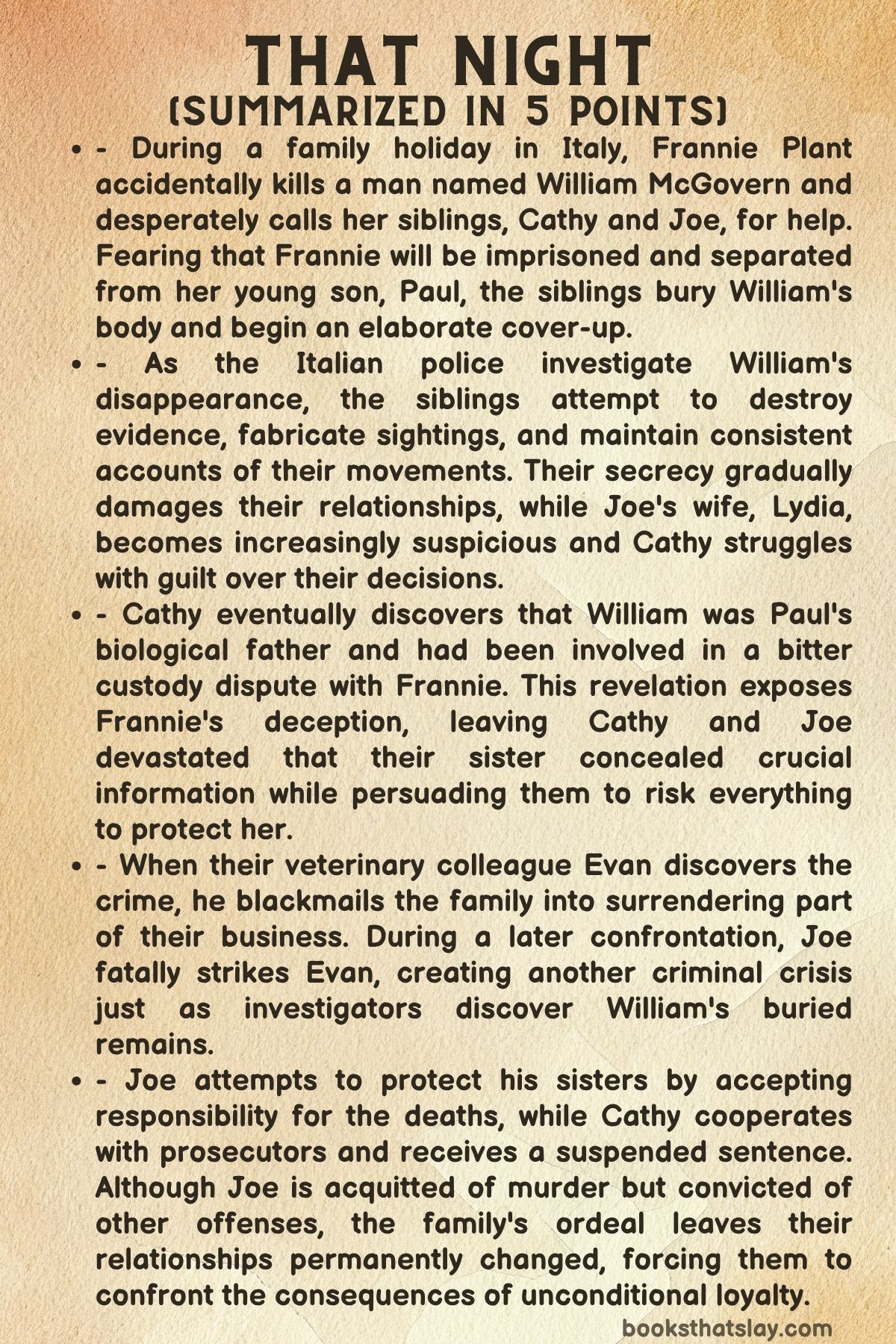
Summary
Cathy, Joe, and Frannie Plant have always shared an unusually close relationship. Living in neighboring cottages in Birmingham and working together at their family veterinary practice, the siblings have built their adult lives around one another.
Their closeness originated partly from the death of their sister Rosie during childhood, a tragedy that left their parents emotionally withdrawn and encouraged the surviving children to depend heavily upon one another.
During a family holiday near Verona, their carefully established world collapses when Cathy receives a desperate telephone call from Frannie in the middle of the night.
Frannie begs her sister to come to a nearby road, where Cathy discovers Joe standing beside their hired Land Rover. Frannie is covered in blood, and a severely injured man lies on the road.
The man is William McGovern, whom the family encountered earlier at a market. Frannie explains that she struck him with the vehicle after accidentally driving on the wrong side of the road.
Cathy and Joe attempt to revive William, but he is already dead.
Frannie becomes terrified of the consequences, particularly because a policeman witnessed an earlier confrontation involving William and the family. She fears that the authorities will suspect deliberate violence rather than an accident.
Her greatest concern is her young son, Paul, whom she cannot bear to leave behind if she is imprisoned.
Cathy initially insists that they must contact the police, while Joe also refuses to participate in concealing the death. However, Frannie reminds them of their lifelong promise to protect one another.
Eventually, their resistance collapses.
The siblings decide to bury William in woodland near their holiday villa. Joe and Cathy carry his body into the trees, dig a grave, and conceal his remains, while Frannie attempts to remove evidence from the vehicle and roadside.
Their actions transform a fatal collision into a criminal conspiracy.
Returning to the villa brings little relief. Bloodstained clothing, the damaged hire car, telephone records, and possible witnesses all threaten to expose them.
Joe begins organizing further measures to conceal their involvement.
He deliberately crashes the rental vehicle into a barrier, hoping to disguise the damage caused by the original collision. Cathy attempts to use William’s financial belongings to create evidence suggesting that he remained alive after the accident.
Although she initially struggles to complete her assignment, a suspicious financial transaction eventually attracts police attention.
Joe also purchases a disposable telephone and sends investigators a fabricated message reporting a supposed sighting of William.
These efforts prove increasingly dangerous. Rather than resolving their difficulties, each deception creates additional evidence that could connect the family to William’s disappearance.
Meanwhile, Lydia, Joe’s wife, remains unaware of the crime.
She notices his anxiety, secret conversations, and increasing emotional distance. Having experienced an unstable childhood, Lydia is especially sensitive to dishonesty and fears that her marriage is beginning to resemble the relationships she once struggled to escape.
The Italian investigation intensifies when the siblings learn that William had connections to the police.
They also discover a damaged official-looking document among his belongings bearing the surname Plant.
Believing that it might be an arrest warrant, they begin wondering whether William’s encounter with their family was accidental.
Police officers question Joe and Cathy separately about their movements. The siblings struggle to maintain consistent explanations, particularly concerning the market confrontation and their activities on the night of William’s disappearance.
Their anxiety increases when investigators bring cadaver dogs into the countryside surrounding the villa.
Nevertheless, the family manages to return to England.
Joe resumes his veterinary work, although ordinary medical procedures now remind him of William’s death. Cathy similarly attempts to recover some normality through her professional responsibilities.
An unexpected development offers Cathy the possibility of a different future.
At the airport, she meets Tom, a friendly stranger whose easy manner challenges her longstanding social insecurity. Their acquaintance gradually becomes a romantic relationship.
For Cathy, who has often felt isolated outside her family, Tom represents the possibility of companionship and independence.
However, the investigation continues threatening the siblings’ lives.
Joe learns that construction work has been approved near their Italian property. He fears that excavation will uncover William’s grave.
At the same time, the family’s colleague Evan discovers their secret.
Cathy eventually tells him about William’s death and the concealment. Evan reacts with horror, but he soon realizes that his knowledge gives him considerable power over the Plants.
He begins blackmailing them.
Joe agrees to transfer twenty percent of the veterinary practice to Evan for a nominal payment of one pound. Because the arrangement requires their mother’s approval, he forges her signature on the partnership documentation.
Cathy is appalled that her brother has committed another offense without consulting her.
The transfer also fails to guarantee Evan’s silence, leaving the family vulnerable to further demands.
Joe eventually confesses the events in Verona to Lydia. She is devastated to discover that her husband has concealed a death and involved himself in increasingly serious criminal conduct.
Their marriage deteriorates further when Joe becomes aggressive during an argument. His behavior reminds Lydia of her violent father, forcing her to reconsider whether their relationship can provide the security she needs.
Meanwhile, Cathy begins suspecting that Frannie has withheld important information about William.
Her suspicions are confirmed when she discovers deleted emails on Frannie’s computer at the veterinary practice.
The correspondence reveals that William was Paul’s biological father.
Frannie had become pregnant during an earlier visit to Verona and eventually informed William that he had a son. Their relationship deteriorated when William demanded greater involvement in Paul’s upbringing.
He threatened legal proceedings concerning custody, making Frannie increasingly frightened that she might lose her child.
The confrontation at the market was therefore not an encounter between strangers but an extension of an existing dispute.
Cathy also realizes that the mysterious document bearing the Plant surname concerned Paul Joseph Plant rather than Joe.
Frannie subsequently admits that she examined William’s telephone after his death and discovered evidence that he had manufactured convincing legal documents.
The apparent legal threat had been fraudulent.
Joe and Cathy are furious that Frannie concealed William’s identity while persuading them to risk everything on her behalf.
The revelation also raises the possibility that William’s death was not the straightforward accident Frannie originally described.
Although Frannie expresses remorse, the siblings struggle to recover their former trust.
Joe eventually reconciles with her, remembering the protective responsibility he assumed during their childhood.
Their fragile reconciliation is soon overshadowed by another catastrophe.
Evan arrives at Joe’s house late at night, intoxicated and demanding additional benefits in exchange for his silence.
Joe refuses, insisting that Evan has already received a substantial ownership interest.
The confrontation becomes increasingly aggressive. Evan threatens to contact the authorities, and Joe attempts to stop him.
Losing control of his anger, Joe punches Evan.
Evan falls backwards, strikes his head against a stile, and dies.
Joe is horrified by the terrible similarity between this incident and William’s death. Once again, a family member is responsible for a fatal incident and faces the temptation to conceal what happened.
He telephones Cathy and begs for help.
At almost the same moment, he receives news that investigators have discovered William’s body near the Italian property.
Everything the siblings sacrificed to conceal the first death has accomplished nothing.
When Cathy responds to Joe’s desperate call, she is forced to confront the same choice she faced in Verona.
This time, however, their circumstances are even more serious.
Joe, Cathy, and Frannie eventually meet in the outhouse behind their cottages.
Recognizing that the family cannot escape the consequences, Joe proposes taking responsibility for the most serious offenses.
He instructs Cathy to tell investigators that he killed both William and Evan, allowing her to acknowledge her involvement in the concealment while identifying him as responsible for the deaths.
His plan is intended to protect his sisters and preserve their ability to care for Paul.
Cathy subsequently cooperates with the authorities and accepts a plea arrangement in exchange for giving evidence against Joe.
The novel’s second timeline gradually reveals these events through Cathy’s meetings with her solicitor, Jason, and her testimony during Joe’s trial.
Initially, her evidence appears to represent a devastating betrayal of her brother.
She has received a suspended sentence for her own offenses, while Joe faces prosecution for crimes connected to William’s burial, financial misconduct, and Evan’s death.
Frannie, meanwhile, has been admitted to a psychiatric hospital for treatment of severe depression. Cathy assumes responsibility for Paul during her sister’s absence.
As the proceedings develop, it becomes clear that Cathy and Joe deliberately maintained the appearance of estrangement to strengthen her credibility as a prosecution witness.
Their apparent betrayal was another expression of the family loyalty that caused the original disaster.
Joe is ultimately acquitted of the murder charges but convicted of several other offenses. His responsibility for Evan’s death is treated as manslaughter following a loss of control.
Cathy leaves the courtroom before hearing his sentence.
In the aftermath, Frannie gradually recovers and resumes caring for Paul. Cathy establishes an independent life with Tom, moves away from her former cottage, and begins working at another veterinary practice.
Lydia also moves forward, eventually having a child with another man.
The siblings’ lives have changed permanently, but their emotional connection survives.
During a visit to Frannie’s cottage, Cathy discovers a calendar recording the days remaining until Joe’s release.
Frannie has been crossing off each passing day.
Moved by her sister’s continuing devotion, Cathy takes the pen and crosses off the current date.
The gesture acknowledges both the consequences of their actions and the enduring attachment that remains between them.
Characters
Cathy Plant
Cathy is the central character of That Night, providing the perspective through which much of the family’s experience is understood. As a veterinarian and the eldest surviving Plant sister, she is accustomed to approaching difficult situations with intelligence, practicality, and emotional restraint.
Her initial reaction to William’s death demonstrates this disposition. She assesses his condition, considers the physical evidence, and recognizes that contacting the authorities would be the appropriate response.
However, her judgment becomes compromised by her attachment to Joe and Frannie.
Cathy’s defining conflict emerges from the difference between her personal moral convictions and the expectations attached to her family role. Although she understands the seriousness of concealing William’s death, she cannot bring herself to abandon her younger sister.
Her childhood experiences help explain this response.
Rosie’s death left Cathy with unresolved guilt, while her parents’ emotional withdrawal encouraged her to assume increasing responsibility for the surviving family members. She consequently developed a belief that protecting others was central to her personal worth.
This belief makes independence particularly difficult.
Throughout the novel, Cathy repeatedly sacrifices her judgment, security, and happiness to preserve her siblings’ interests. Her resentment grows as she recognizes that Joe and Frannie sometimes make decisions without including her.
Her relationship with Tom creates an important counterbalance.
His affection allows Cathy to imagine an identity beyond the veterinary practice and her family obligations. She begins experiencing romantic intimacy and emotional acceptance without having to act as another person’s protector.
Nevertheless, her secrecy threatens this developing relationship.
When Cathy finally confesses her involvement in William’s burial, Tom’s reaction forces her to acknowledge responsibility without immediately defending herself through family loyalty.
Her development in That Night is therefore not simply a movement from wrongdoing towards punishment. It concerns her gradual recognition that love does not require the complete surrender of personal judgment.
By the conclusion, Cathy has established a separate home, professional life, and romantic relationship.
She continues loving her siblings, but she no longer believes that her entire existence must revolve around their needs.
Joe Plant
Joe represents the protective instincts and destructive possibilities of family loyalty. As the Plant brother, he has spent much of his life assuming responsibility for Cathy and Frannie, particularly after Rosie’s death.
His relationship with Frannie is especially important.
He has long considered himself her defender, and her desperate request for help activates a responsibility that feels almost inseparable from his identity.
Although Joe initially refuses to conceal William’s death, his resistance collapses when Frannie appeals to their childhood bond.
His decision illustrates a central contradiction in his character.
Joe possesses genuine compassion, demonstrated through his veterinary work, his affection for Paul, and his commitment to supporting vulnerable family members. However, these qualities coexist with impulsiveness, aggression, and an increasing willingness to rationalize wrongdoing.
His practical intelligence becomes especially dangerous after the burial.
Rather than accepting that the family has committed a serious crime, he repeatedly devises new strategies to prevent discovery. The damaged rental car, fabricated sighting, and fraudulent partnership arrangement all emerge from his determination to control events.
Every solution creates additional consequences.
Joe’s marriage to Lydia exposes another dimension of his personality.
He loves his wife, yet he consistently places his siblings’ interests before their marriage. His secrecy deprives Lydia of the opportunity to make informed decisions about her own future.
When challenged, he sometimes responds with anger rather than understanding.
His confrontation with Evan demonstrates the ultimate danger of this behavior.
Unable to tolerate further threats, Joe strikes Evan and causes his death. The incident reveals how completely his protective instincts have become entangled with fear and aggression.
Yet That Night also presents Joe as capable of extraordinary self-sacrifice.
After Evan’s death and the discovery of William’s body, he proposes accepting responsibility for both deaths to reduce the consequences facing his sisters.
His decision is simultaneously an expression of love and another attempt to control the truth.
Joe’s character therefore exposes the troubling possibility that devotion can remain genuine even when the actions it inspires become destructive.
Frannie Plant
Frannie is the youngest surviving Plant sibling and the person whose actions initiate the central crisis. Her relationship with Joe and Cathy has always involved an expectation that they will protect her when difficulties arise.
As a single mother, she is deeply attached to her son, Paul.
Her fear of losing him becomes the principal explanation she offers when persuading her siblings to conceal William’s death.
Initially, Frannie appears to be a frightened woman responsible for a devastating accident. Her emotional collapse encourages Cathy and Joe to see her primarily as someone who needs rescuing.
However, the discovery of her correspondence with William fundamentally changes this interpretation.
Frannie knew William before the fatal encounter, and their conflict over Paul’s upbringing had become increasingly serious.
Her decision to conceal this information deprived her siblings of the opportunity to understand the circumstances before becoming involved in the cover-up.
This deception reveals a capacity for manipulation that complicates her familiar identity as the vulnerable youngest child.
Her attachment to Paul is nevertheless genuine.
Frannie fears losing control of his future, particularly when William threatens legal proceedings. Her desperation becomes increasingly understandable as the circumstances of their relationship emerge, although it does not excuse her subsequent actions.
Her behavior also demonstrates the consequences of lifelong dependence.
Because Joe and Cathy have repeatedly protected her, Frannie has become accustomed to viewing them as people who will absorb the consequences of her mistakes.
The eventual destruction of their shared life forces her to acknowledge how much she has demanded from them.
Her severe depression and psychiatric hospitalization demonstrate the psychological consequences of the family’s ordeal.
During her recovery, she begins recognizing that her siblings’ treatment of her as a permanently dependent youngest child contributed to her inability to take responsibility independently.
In That Night, Frannie’s eventual progress does not erase her wrongdoing.
Instead, her character illustrates the possibility of remorse and personal change while showing how difficult it can be to confront responsibility when doing so threatens the people one loves.
Lydia Plant
Lydia is Joe’s wife and an important counterpoint to the Plant siblings’ understanding of family loyalty. Unlike Cathy, Joe, and Frannie, she did not grow up within their intensely protective household.
Her childhood included instability, foster care, and exposure to violence.
These experiences shaped her determination to establish a secure adult life built upon honesty, affection, and dependable relationships.
Her marriage to Joe initially appears to provide that security.
She admires his kindness towards animals and values the domestic life they have created together. Their desire to have children reflects her hope of establishing a family different from the one she experienced growing up.
However, the siblings’ secrecy gradually undermines her confidence.
Lydia recognizes that their relationships operate according to rules she does not fully understand. Although she loves Joe, she sometimes feels excluded from decisions that affect their shared future.
After Verona, his secret conversations and emotional withdrawal intensify this insecurity.
She initially suspects an affair, interpreting his behavior through the information available to her.
When Joe eventually confesses, Lydia recognizes that his deception concerns something far more serious.
Her response demonstrates a different understanding of loyalty.
She believes that marriage requires mutual responsibility and that love does not justify exposing another person to serious consequences without their knowledge.
Joe’s increasingly aggressive behavior makes the situation particularly painful.
When he attempts to intimidate her, she recognizes similarities to her father’s conduct and decides that remaining in the marriage would violate the boundaries she has worked to establish.
Lydia’s eventual departure is therefore an act of self-preservation rather than an absence of affection.
Her subsequent relationship and motherhood demonstrate that she can build a secure future without remaining attached to the family she once hoped would provide it.
William McGovern
William McGovern is the first victim whose death sets the central events in motion. Although he appears only through the recollections and discoveries of other characters, his presence influences nearly every important development.
Initially, he is presented as an unpleasant stranger who encountered the Plant family at a market.
His death seems to result from Frannie’s driving mistake, and his identity remains largely unknown to the siblings.
The discovery of his belongings complicates this understanding.
His connections to the police and the document bearing the Plant surname encourage Joe and Cathy to suspect that he had been investigating their family.
Eventually, William’s relationship with Frannie is revealed.
He was Paul’s biological father and wanted greater involvement in his son’s life.
His determination to establish contact created a serious conflict with Frannie, who feared losing custody.
The discovery that William manufactured legal documents complicates his characterization further.
His conduct involved deception and attempts to influence Frannie through apparently official threats. However, the fact that he was Paul’s father also gives his desire for involvement a significance the family initially refuses to recognize.
William’s character is especially important because his death is repeatedly discussed through its consequences for the Plants.
Their fear of prosecution initially overshadows the fact that he was an individual with personal relationships and a life beyond their family.
His identity ultimately becomes essential to understanding Frannie’s motives and the circumstances surrounding the original incident.
Evan
Evan is a veterinarian employed at the Plant family practice whose knowledge of William’s death becomes a source of considerable power.
Initially, he appears as an irritating colleague whom Joe does not particularly respect. His financial difficulties following a divorce also establish his vulnerability.
After learning about the cover-up, Evan recognizes that the siblings are desperate to avoid exposure.
Rather than reporting the crime or refusing involvement, he exploits their fear for personal financial benefit.
His demand for twenty percent of the veterinary practice demonstrates his willingness to use another person’s wrongdoing as an opportunity for advancement.
The arrangement also reveals a particularly calculating aspect of his personality.
Evan understands that the family business represents years of work and emotional investment. By demanding an ownership interest, he threatens something central to the Plants’ shared identity.
However, the transfer does not satisfy him.
He continues considering further demands, eventually confronting Joe while intoxicated and threatening to disclose the crimes.
His behavior contributes directly to the confrontation that causes his death.
Evan’s role in That Night demonstrates how secrecy creates opportunities for exploitation.
Although his blackmail is morally reprehensible, his death remains a consequence of Joe’s violent response.
The novel does not require Evan to be sympathetic for his death to represent another serious human tragedy.
Tom
Tom is Cathy’s romantic partner and one of the few characters who offers her a relationship independent of her family.
Their first meeting at the airport occurs when Cathy is overwhelmed by the consequences of Verona.
His relaxed manner and easy humor provide an unexpected contrast to her anxiety.
Cathy has long struggled with social confidence, particularly in romantic situations. Tom responds to her awkwardness with acceptance rather than criticism.
His willingness to spend time at the veterinary practice and help care for an injured animal demonstrates genuine interest in her daily life.
As their relationship develops, he encourages Cathy to recognize that she deserves companionship outside the responsibilities she has accepted towards her siblings.
However, Tom’s importance extends beyond romantic reassurance.
When Cathy reveals her involvement in William’s death, he does not simply accept her explanation that she acted out of love.
Instead, he acknowledges the seriousness of her decisions.
His response encourages her to confront her own moral responsibility.
Tom eventually continues their relationship, demonstrating that forgiveness need not involve denying wrongdoing.
By the conclusion, their shared life represents Cathy’s growing independence and the possibility of building relationships based upon honesty rather than unquestioning obligation.
Paul Plant
Paul is Frannie’s young son and William McGovern’s biological child.
Although he is too young to understand the family’s crimes, his existence provides the justification repeatedly used by the adults when making their decisions.
Frannie fears imprisonment because it would separate her from Paul.
Joe and Cathy similarly convince themselves that concealing William’s death is necessary to preserve his relationship with his mother.
However, Paul also becomes a victim of the decisions supposedly made for his benefit.
His family is divided, his mother requires psychiatric treatment, and his uncle faces imprisonment.
He eventually lives with Cathy while Frannie recovers.
During this period, he becomes central to his aunt’s emotional life and helps her discover a capacity for caregiving beyond the obligations imposed by her childhood.
Paul’s innocence emphasizes the difference between the siblings’ intentions and the actual consequences of their conduct.
He represents both the family’s motivation for secrecy and the person whose future is most directly affected by its collapse.
Jason
Jason is Cathy’s solicitor and a significant figure in the novel’s later timeline.
He provides professional assistance as she confronts the legal consequences of her involvement in William’s death.
His relaxed manner contrasts with Cathy’s expectations of a conventional lawyer.
Despite his informality, Jason approaches her case with care and considerable attention.
He encourages Cathy to examine the facts of her conduct rather than repeatedly explaining everything through the fear she experienced.
This approach challenges her longstanding habit of presenting family loyalty as a complete justification.
Their conversations also establish a relationship of trust.
Jason recognizes the emotional complexity of her circumstances and eventually understands that her apparent betrayal of Joe is not entirely straightforward.
His decision to preserve her confidence becomes especially important as the trial proceeds.
Jason’s role is to help Cathy navigate the consequences of her actions without allowing her personal explanations to replace legal responsibility.
Rosie Plant
Rosie is the deceased Plant sister whose absence shapes the surviving siblings’ lives.
Although she died before the novel’s central events, her death explains much of the family’s emotional structure.
Cathy and Joe remember Rosie more clearly than Frannie, who was younger when the tragedy occurred.
Their parents responded to the loss by becoming emotionally withdrawn, leaving the surviving children increasingly dependent upon one another.
Cathy also carries unresolved guilt connected to Rosie’s death.
This guilt contributes to her belief that she must continually demonstrate her worth through responsibility and sacrifice.
Joe’s protective relationship with Frannie similarly develops from the family’s experience of losing a child.
Rosie consequently represents more than a remembered family member.
Her death created emotional patterns that remain powerful long after childhood, influencing the siblings’ willingness to protect one another regardless of the consequences.
Owen and Maria Plant
Owen and Maria are the parents of the Plant siblings.
Owen built a successful manufacturing business, establishing a family environment in which determination and practical problem-solving were valued.
Maria remains involved in the veterinary practice and its ownership arrangements.
Their lives were permanently changed by Rosie’s death.
The tragedy left them emotionally distant from their surviving children, unintentionally encouraging Cathy, Joe, and Frannie to depend primarily upon one another.
Although the siblings continue maintaining relationships with their parents, they rarely rely upon them for emotional guidance during the crisis.
Maria becomes particularly important when Joe forges her signature to transfer part of the veterinary practice to Evan.
His willingness to deceive his mother demonstrates how far the family conspiracy has extended beyond the original participants.
The parents also represent the lasting consequences of the siblings’ secrecy.
By the conclusion, their relationship with Cathy remains strained because they believe she betrayed Joe.
Their inability to understand the full circumstances demonstrates how even carefully constructed acts of protection can create enduring divisions within a family.
Themes
Family Loyalty and the Limits of Protection
The relationship between Cathy, Joe, and Frannie demonstrates how family loyalty can become destructive when affection is treated as an obligation to provide unconditional protection.
Their childhood experiences encouraged them to depend upon one another in ways that continued into adulthood. After Rosie’s death, their parents’ emotional withdrawal strengthened the siblings’ belief that they could survive difficult experiences only by remaining united.
This understanding of family becomes particularly dangerous after William’s death.
Frannie appeals to the shared history she has with Joe and Cathy, reminding them that they have always protected her. Her request places them in a situation where refusing to help feels equivalent to abandoning their family.
The siblings consequently interpret their participation in the concealment as evidence of devotion.
However, the novel repeatedly demonstrates that loyalty does not eliminate individual responsibility.
Joe’s determination to protect Frannie leads him to manufacture evidence, forge documents, and surrender part of the family business. Cathy similarly suppresses her moral objections because she fears the emotional consequences of withdrawing her support.
Their actions reveal how loyalty can become a mechanism through which people pressure one another into decisions they would otherwise reject.
Lydia provides an important alternative perspective.
She loves Joe but refuses to accept that his responsibilities towards his siblings automatically outweigh his obligations to their marriage. Her eventual departure demonstrates that preserving personal boundaries can coexist with genuine affection.
The conclusion of That Night complicates this theme further.
Joe accepts responsibility for serious offenses partly to protect his sisters, while Cathy deliberately maintains the appearance of betraying him to support their legal arrangement.
Their devotion survives, but it remains connected to further deception.
The novel therefore distinguishes between the existence of love and the moral value of the actions performed in its name.
Family loyalty can provide comfort, courage, and belonging, but it can also become dangerous when individuals refuse to recognize that protecting someone may require allowing them to face the consequences of their actions.
Guilt, Moral Responsibility, and the Consequences of Secrecy
The concealment of William’s death begins with the siblings attempting to escape the immediate consequences of a frightening event.
However, their decision creates a form of guilt that cannot be resolved through removing physical evidence.
Cathy and Joe are accustomed to caring for living creatures and confronting death responsibly through their veterinary work.
Their decision to conceal a human body therefore contradicts the professional and personal identities they have developed.
This contradiction becomes increasingly difficult to ignore.
Joe experiences severe anxiety, nightmares, and distress during routine veterinary procedures. The sight of blood reminds him of William, making his ordinary work a persistent reminder of his wrongdoing.
Cathy experiences a different form of moral conflict.
She repeatedly questions the family’s decisions and becomes increasingly uncomfortable with the difference between protecting Frannie and participating in deliberate deception.
Her inability to complete certain efforts to fabricate evidence demonstrates that her conscience continues resisting the conspiracy.
Nevertheless, neither sibling immediately accepts responsibility.
Instead, they attempt to manage guilt by preventing the crime from being discovered.
This approach produces a destructive cycle.
The damaged rental car creates further evidence, the false financial transaction attracts suspicion, and the attempt to manufacture a sighting increases the family’s exposure.
Evan’s discovery introduces blackmail, which leads Joe to commit financial misconduct.
Eventually, the attempt to preserve secrecy contributes to a second death.
Each new offense makes the original decision more difficult to confront because acknowledging it would require admitting responsibility for everything that followed.
The courtroom sections establish a different relationship with guilt.
Cathy must describe events precisely, separating the circumstances that influenced her decisions from the actions she actually performed.
Her developing relationship with Tom reinforces this distinction.
He recognizes that fear and loyalty help explain her conduct without removing her responsibility.
The novel suggests that accountability begins when individuals stop treating their motives as sufficient justification.
Although acknowledging wrongdoing cannot restore William or Evan to life, it offers a way to confront reality rather than continue constructing increasingly damaging explanations.
Childhood Trauma and the Formation of Adult Identity
Rosie’s death establishes an emotional pattern that influences nearly every important relationship within the Plant family.
The surviving siblings experienced a tragedy that their parents struggled to address openly.
Rather than developing separate ways of processing their grief, Cathy, Joe, and Frannie formed an intensely protective relationship.
Their closeness initially appears comforting.
They work together, live near one another, and remain involved in each other’s daily lives. However, the same arrangement limits their ability to establish independent identities.
Cathy assumes responsibility for maintaining the family’s emotional stability.
Her unresolved guilt surrounding Rosie contributes to a belief that she must continually prove herself through sacrifice.
Consequently, she finds it difficult to prioritize her own needs.
Joe adopts the position of protector.
He becomes accustomed to resolving Frannie’s difficulties and eventually interprets her dependence as a responsibility he cannot refuse.
Frannie, meanwhile, grows up within a family structure that repeatedly identifies her as the youngest person needing assistance.
This role contributes to her expectation that Joe and Cathy will rescue her from serious difficulties.
The siblings’ responses to William’s death are therefore influenced by emotional habits established long before the accident.
The novel also examines childhood trauma through Lydia.
Her experiences of instability and violence produce a different response.
Rather than believing that family relationships must be preserved regardless of their consequences, she develops firm boundaries intended to protect her from repeating the past.
Her decision to leave Joe demonstrates how childhood experiences can influence adult decisions without determining them completely.
Cathy’s eventual development in That Night offers another example of change.
Her relationship with Tom encourages her to recognize that her identity can extend beyond the responsibilities she assumed during childhood.
Moving away from the adjoining cottages and establishing a separate professional life allows her to challenge patterns she previously considered permanent.
The novel presents recovery not as forgetting traumatic experiences but as learning to recognize how those experiences continue influencing present choices.
Parental Love, Sacrifice, and the Illusion of Control
Frannie’s relationship with Paul provides the emotional foundation for the family’s original decision to conceal William’s death.
Her fear of losing her son becomes more powerful than her fear of the consequences of the accident itself.
When William threatens legal action concerning custody, Frannie begins to believe that her relationship with Paul is endangered.
Her desperation intensifies because she understands motherhood as central to her identity.
The siblings’ subsequent decisions repeatedly rely upon the assumption that protecting Frannie is equivalent to protecting Paul.
Joe and Cathy persuade themselves that concealing William’s death is necessary to preserve the boy’s relationship with his mother.
However, the eventual consequences expose the weakness of this reasoning.
Paul experiences family separation, uncertainty, and the prolonged absence of people who once formed an essential part of his everyday life.
The adults’ efforts to preserve his security ultimately destroy much of the stability they hoped to maintain.
William’s identity as Paul’s biological father adds another dimension to this theme.
Although his use of fraudulent legal documents complicates his conduct, his desire for involvement in his son’s life raises questions about competing parental interests.
Frannie’s determination to retain control prevents her from acknowledging that Paul’s family relationships extend beyond her own wishes.
The novel consequently examines the difference between parental love and the desire to determine every aspect of a child’s future.
Cathy’s temporary responsibility for Paul introduces a different understanding of caregiving.
Rather than attempting to control his circumstances through secrecy, she provides him with practical stability during Frannie’s treatment.
Her experience also changes her understanding of motherhood and family.
By the conclusion, Frannie has recovered sufficiently to resume caring for Paul, while Cathy has established a separate life.
Their circumstances remain imperfect, but the family begins developing a more sustainable arrangement.
The theme extends beyond parenthood to Joe’s relationship with his sisters.
His willingness to accept punishment reflects genuine love, yet it also demonstrates his continued belief that he can control the consequences facing those he protects.
The novel ultimately suggests that meaningful sacrifice requires recognizing the independence and responsibilities of others.
Love becomes destructive when the desire to protect another person develops into an attempt to determine every consequence of that person’s actions.