The Beautiful Ones Summary, Characters and Themes
The Beautiful Ones by by Silvia Moreno-Garcia is a historical fantasy romance that explores love, ambition, social expectations, and the consequences of choices made under pressure.
Set in the elegant society of Loisail, the novel follows Antonina Beaulieu, a young woman whose unusual telekinetic abilities make her an outsider among the fashionable elite. Her attraction to the celebrated performer Hector Auvray draws her into a complicated relationship shaped by his unresolved feelings for her cousin, Valérie. Through these characters, the story examines the conflict between personal happiness and social advancement, the destructive nature of jealousy, and the courage required to embrace love without sacrificing one’s identity.
Summary
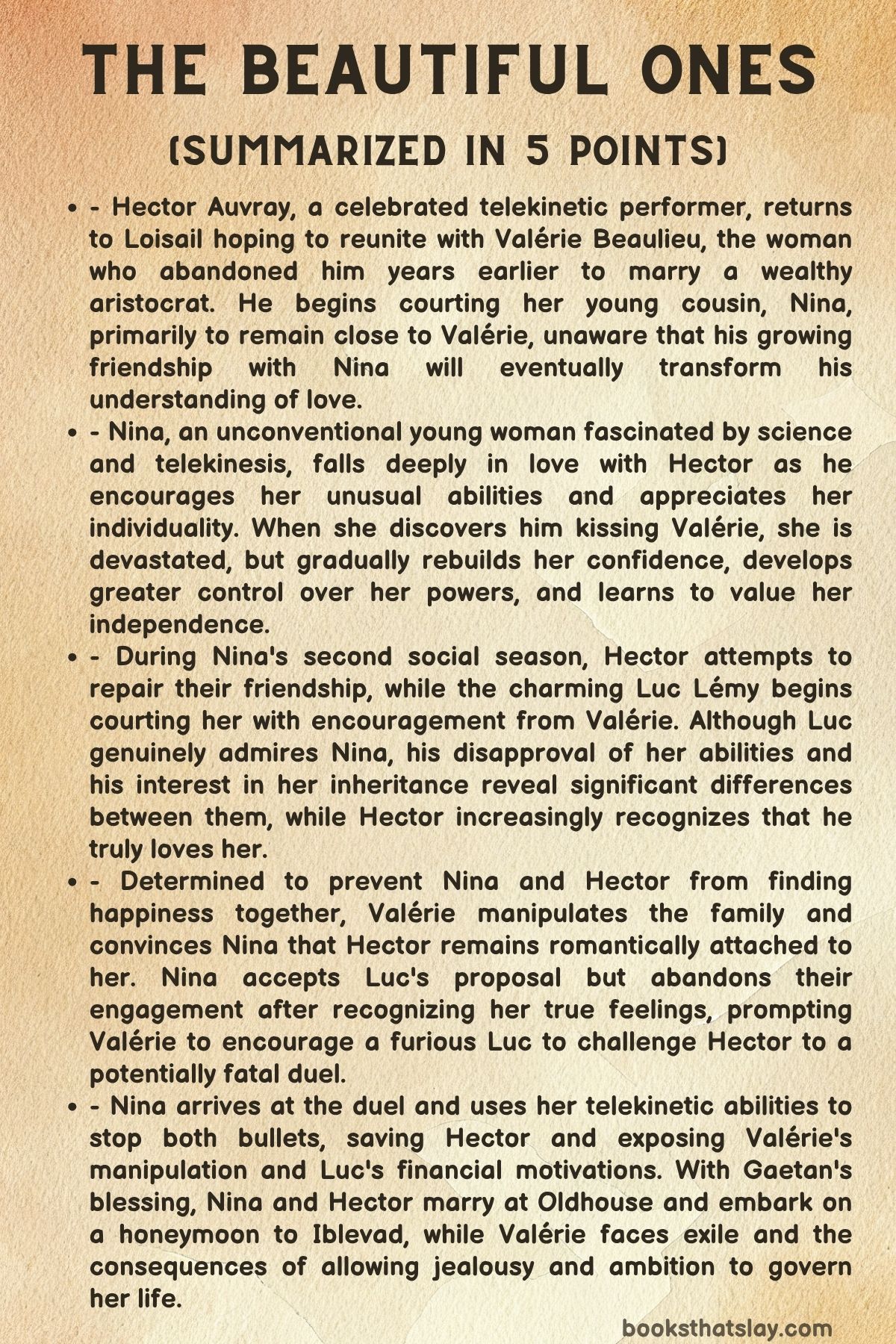
Hector Auvray returns to Loisail after spending years abroad, having established himself as a celebrated performer whose extraordinary telekinetic abilities have earned him fame and wealth. Despite his professional accomplishments, he remains haunted by his youthful romance with Valérie Beaulieu, who abandoned him ten years earlier to marry a wealthy aristocrat.
Hoping to encounter Valérie again, Hector attends a fashionable ball but discovers that she is absent. Instead, he meets Antonina Beaulieu, known as Nina, an unconventional young woman who recognizes him immediately and enthusiastically discusses his remarkable abilities.
Nina has recently arrived in Loisail to participate in the Grand Season and find a suitable husband. Raised in the countryside, she struggles with the elaborate social customs imposed upon respectable young women and feels particularly constrained by her cousin Valérie’s insistence upon flawless behavior.
Unlike the fashionable society surrounding her, Nina possesses a genuine interest in science, natural history, and psychokinetics. She also has telekinetic abilities of her own, although her limited control has caused embarrassing accidents and earned her cruel nicknames.
Hector finds Nina’s sincerity refreshing and dances with her several times. When he discovers that she lives with Valérie and her husband, Gaetan Beaulieu, he realizes that cultivating Nina’s acquaintance could provide an opportunity to see his former lover again.
Their relationship begins developing through apparently accidental meetings and increasingly frequent visits. Nina becomes fascinated by Hector’s accomplishments, while he appreciates her intelligence, curiosity, and willingness to accept his humble origins without prejudice.
Hector eventually visits the Beaulieu residence, where he encounters Valérie for the first time in a decade. Their reunion revives painful memories of a secret engagement that ended when Valérie chose financial security over their relationship.
Years earlier, Valérie belonged to an aristocratic family whose fortune had nearly disappeared. She fell in love with Hector when he was still a struggling performer, but her grandmother persuaded her that marrying Gaetan represented her only practical means of escaping poverty.
Although Valérie promised to wait for Hector while he established his career abroad, she eventually ended their engagement through a brief letter announcing her marriage. Hector never fully recovered from the rejection, and his professional ambitions became inseparable from his desire to prove himself worthy of her.
Now wealthy and admired, Hector hopes that Valérie might reconsider their relationship. However, she refuses to risk her marriage, reputation, or comfortable position, even as their renewed encounters reveal that her feelings remain unresolved.
Hector begins courting Nina partly to maintain access to Valérie. Unaware of his motivations, Nina interprets his kindness as evidence of genuine romantic interest.
Their acquaintance nevertheless develops into a meaningful friendship. Hector accompanies Nina to social events, encourages her scientific interests, and begins teaching her to control her telekinesis through carefully structured exercises.
For Nina, these lessons offer something she has rarely experienced: the opportunity to develop her abilities without embarrassment or condemnation. Hector recognizes her potential, and his encouragement gradually transforms her confidence.
Meanwhile, Valérie becomes increasingly jealous of their growing intimacy. Although she refuses to abandon Gaetan, she resents the possibility that Hector might eventually direct his affection toward someone else.
When the family travels to Oldhouse for the summer, Hector accepts Nina’s invitation to visit. Away from Loisail’s rigid social atmosphere, their friendship deepens as they explore the countryside, collect insects, practice telekinesis, and discuss their childhood experiences.
Hector discovers that Nina possesses qualities he genuinely admires. Her enthusiasm and compassion offer a welcome contrast to the bitterness that has dominated his emotional life, and he begins experiencing an attraction that troubles his loyalty to his memories of Valérie.
During a rainy afternoon in an abandoned tower, Nina initiates a passionate kiss. Hector responds before abruptly withdrawing, frightened by the realization that his feelings for her have become more complicated than he intended.
Nina, believing herself in love, writes Hector a letter confessing her feelings. Valérie discovers and intercepts the letter, then confronts Hector about his relationship with her young cousin.
Their confrontation produces a devastating revelation. Valérie admits that she never stopped loving Hector, and he proposes that they abandon their existing circumstances and begin a new life together.
Valérie refuses because she cannot sacrifice her wealth, family position, and social standing. Nevertheless, they embrace passionately, unaware that Nina is approaching the library.
Nina discovers them kissing, and her romantic expectations collapse. Overwhelmed by betrayal, she loses control of her telekinesis and shatters the corridor’s stained-glass windows.
Valérie immediately begins protecting herself from exposure. She tells the family that Nina mistakenly believed Hector intended to marry her and has become distraught upon discovering that he considers her only a friend.
Privately, Valérie reveals the history of her relationship with Hector and threatens to expose Nina’s passionate letter if she discloses the truth. Nina reluctantly remains silent, partly because she wishes to spare Gaetan the pain of learning about his wife’s infidelity.
Hector leaves Oldhouse recognizing that his obsession with Valérie has caused irreparable damage. He also begins understanding that the companionship he shared with Nina was far more meaningful than he had acknowledged.
Nina withdraws from her family and initially struggles with both emotional distress and uncontrolled telekinetic outbursts. Eventually, she rediscovers the playing cards Hector gave her and begins practicing the techniques he taught her.
Through sustained effort, Nina gradually regains control of her abilities and her life. She returns to her scientific interests, spends time with her sister Madelena, and discovers that heartbreak need not determine her future.
The following spring, Nina returns to Loisail for another Grand Season, choosing to stay with her great-aunts rather than Gaetan and Valérie. Her new living arrangements provide greater independence and allow her to pursue her interests without constant interference.
She soon encounters Luc Lémy, Hector’s charming and sociable friend. Luc begins courting her, entertaining her with motorcar rides, outings, and affectionate attention.
Meanwhile, Hector learns of Nina’s return and attempts to apologize by sending her preserved beetles. Remembering her love of insects, he hopes these unusual gifts will communicate the regret he has been unable to express in letters.
Nina eventually confronts him about the presents. During their conversation, she discovers that Hector never received her love letter and knew nothing about Valérie’s use of it against her.
Although she does not immediately forgive him, she begins recognizing the sincerity of his remorse. Hector admits that his friendship with her was genuine, even though his unresolved attachment to Valérie prevented him from behaving honorably.
Their relationship gradually resumes through meetings at social gatherings, visits to the aquarium, and conversations about their shared interests. Hector explains the full history of his relationship with Valérie and assures Nina that he no longer loves her.
Nina discovers that she can enjoy Hector’s company without surrendering the independence she has regained. However, their renewed closeness also revives romantic feelings that neither initially wishes to acknowledge.
At the same time, Luc becomes increasingly serious about marrying Nina. His attraction is genuine, but his interest in her fortune is connected to an ambitious plan to construct a luxurious hotel on property belonging to Valérie’s impoverished family.
Valérie encourages the proposed marriage because it could improve her family’s finances while keeping Nina away from Hector. She consequently begins manipulating Gaetan, Luc, and Nina to advance the arrangement.
Although Luc is attentive and affectionate, disagreements reveal significant differences between him and Nina. He disapproves of her public telekinetic demonstrations and expects her to conform to conventional standards of feminine respectability.
Nina increasingly questions whether marrying him would require abandoning important aspects of herself. Her uncertainty grows when she realizes that physical attraction and pleasant companionship do not necessarily constitute lasting love.
Hector, meanwhile, becomes jealous of Luc’s courtship but struggles to express his own feelings. Conscious of his earlier betrayal, he believes that he has forfeited the right to interfere with Nina’s decisions.
Valérie eventually visits Hector and offers to resume their romantic relationship secretly if he agrees to stop seeing Nina. His rejection demonstrates that his former attachment has finally lost its power.
Infuriated, Valérie intensifies her efforts to secure Nina’s engagement. She presents Gaetan with Nina’s intercepted letter, describes Hector as a dangerous influence, and persuades him to encourage Luc’s proposal.
Valérie then falsely tells Nina that Hector has renewed his romantic devotion to her. Believing herself deceived again, Nina accepts Luc’s proposal, hoping that marriage to another man will protect her from further heartbreak.
When Hector learns of the engagement, he confronts Nina and exposes Valérie’s deception. Yet the engagement has already been arranged, and Nina feels trapped by the expectations surrounding her decision.
Valérie organizes an elaborate engagement party, making the announcement as public as possible to discourage Nina from reconsidering. Throughout the celebration, Nina becomes increasingly aware that Luc regards her partly as an accessory to his social and business ambitions.
When a luminous beetle lands on her hand outside the party, Nina instinctively wishes to share the discovery with Hector. The moment clarifies her feelings: Hector understands the interests and qualities that make her who she is.
Nina abandons the celebration and rushes to Hector’s apartment. She declares that she cannot marry Luc because she loves Hector and refuses to repeat Valérie’s mistake of choosing security over happiness.
Hector initially fears that their relationship will end in another devastating abandonment. Nina challenges him to stop allowing his past to determine his future, and he finally admits that he loves her.
They spend the night together and become engaged the following morning. However, their happiness is threatened when Luc discovers Nina’s departure and challenges Hector to a duel.
Valérie encourages the confrontation, hoping that Luc will kill Hector. Her jealousy has developed into a determination to destroy the happiness she cannot possess.
Despite Nina’s pleas, Hector accepts the challenge because Luc threatens to shoot him even if he refuses. The conditions forbid telekinesis, leaving Hector at a severe disadvantage against the experienced marksman.
Hector prepares his will and spends the evening with Nina, arranging an indoor picnic that recalls an earlier moment in their courtship. Their intimate conversation emphasizes the happiness they have finally found and the possibility that it may soon be taken away.
The following morning, Nina awakens to discover that Hector has already departed. She rushes to the dueling ground and arrives as the two men prepare to fire.
When the pistols discharge, Nina instinctively unleashes her telekinetic power. She stops both bullets in midair, preventing either man from being injured.
Valérie demands that the duel continue, but Nina appeals directly to Luc. She acknowledges his pain while explaining that marrying him would have made neither of them truly happy.
Luc finally recognizes the truth of her words. He admits that Valérie encouraged him to kill Hector and reveals their financial arrangement concerning Nina’s inheritance.
Gaetan is horrified by the discovery. Hector apologizes for his earlier deception and declares his genuine love for Nina, and Gaetan finally gives the couple his blessing.
Valérie’s schemes collapse when Gaetan confronts her about her manipulation and attempted orchestration of Hector’s death. She admits her former engagement to Hector, hoping the revelation will change her husband’s decision, but Gaetan refuses to interfere with Nina’s happiness.
He orders Valérie to leave Loisail and live elsewhere on an annuity, threatening divorce and the withdrawal of financial support if she attempts to harm Nina’s reputation. During her departure, Valérie discards Hector’s old engagement ring, finally confronting the consequences of a life governed by wealth, pride, and possessiveness.
Nina and Hector marry at Oldhouse in a modest celebration surrounded by family and friends. Their happiness reflects the relationship they have developed through shared interests, mistakes, separation, and renewed trust.
As a wedding present, Hector gives Nina an amber necklace containing a preserved insect. He also reveals that he has arranged a honeymoon in Iblevad, where they can explore the places and wildlife that have fascinated her since their earliest conversations.
The novel concludes with Hector recognizing that his future no longer belongs to the painful memories of his past. Beside Nina, he discovers a form of love founded upon mutual understanding, freedom, and the willingness to grow together.
Characters
Antonina “Nina” Beaulieu
Antonina Beaulieu, affectionately known as Nina, is the central female protagonist of The Beautiful Ones. Her development from an inexperienced young woman seeking romantic fulfillment into an independent individual capable of making her own decisions forms the emotional foundation of the novel.
Raised in the countryside, Nina possesses an unconventional personality that distinguishes her from the fashionable society of Loisail. She enjoys collecting insects, studying natural history, reading scientific literature, and experimenting with her telekinetic abilities.
Her interests frequently conflict with the expectations imposed upon respectable young women. While others encourage her to pursue marriage and social refinement, Nina wants intellectual freedom, meaningful companionship, and the opportunity to explore the world.
Initially, Nina is romantically inexperienced and inclined to interpret Hector’s attentiveness through the expectations established by her favorite novels. She believes that his kindness, shared interests, and willingness to teach her indicate a sincere romantic attachment.
Her innocence makes Hector’s betrayal particularly devastating. Discovering that he has been pursuing her partly to remain close to Valérie destroys her trust and forces her to reconsider her assumptions about love.
Nevertheless, Nina’s response to heartbreak reveals her underlying resilience. Rather than allowing the experience to define her permanently, she gradually restores her independence through scientific study, family relationships, and disciplined telekinetic practice.
Her abilities serve as an important expression of her individuality. Initially associated with embarrassment and social rejection, they become a source of confidence as she learns to control them.
Nina’s relationship with Luc further develops her understanding of personal freedom. Although she appreciates his affection, she recognizes that his disapproval of her abilities would require her to diminish an essential part of herself.
Her eventual return to Hector is therefore not simply a surrender to romantic longing. It represents a conscious decision made after she has learned to recognize manipulation, question social expectations, and distinguish genuine understanding from superficial admiration.
Her decisive intervention during the duel completes this transformation. By stopping the bullets, Nina demonstrates that the qualities once treated as embarrassing have become the very means through which she protects the life she has chosen.
By the novel’s conclusion, Nina retains her intellectual curiosity, independence, and enthusiasm while gaining emotional maturity. Her happiness emerges not from abandoning her unconventional nature but from finding a relationship that allows her to express it freely.
Hector Auvray
Hector Auvray is the principal male protagonist of The Beautiful Ones, a celebrated telekinetic performer whose extraordinary professional achievements contrast with his troubled emotional life.
Orphaned at a young age, Hector begins working as a traveling performer and experiences poverty, hostility, and social exclusion. His childhood teaches him self-reliance, discipline, and the necessity of developing his unusual abilities into a sustainable livelihood.
Despite becoming wealthy and internationally admired, Hector remains deeply conscious of his humble origins. His relationship with Valérie initially represents the possibility of overcoming the social barriers that have shaped his life.
Her decision to marry Gaetan therefore wounds him on several levels. He loses the woman he loves while also confronting the belief that his background makes him fundamentally unsuitable for someone of her social position.
For the following decade, Hector allows this rejection to shape his ambitions and emotional identity. His success becomes partly an attempt to prove that he could have provided Valérie with the life she desired.
When he returns to Loisail, his pursuit of Nina exposes his capacity for selfishness. Although he recognizes her innocence, he initially treats their courtship as a convenient means of approaching Valérie.
His conduct reveals how unresolved suffering can become an excuse for inflicting pain upon another person. Hector does not deliberately set out to destroy Nina, but he repeatedly places his own emotional needs above her welfare.
Nevertheless, his friendship with Nina gradually awakens qualities suppressed by his fixation on the past. Her enthusiasm, honesty, and acceptance of his background allow him to experience companionship without the constant pressure to prove his social worth.
Hector’s ability to teach Nina also reveals his generosity and patience. He understands the difficulties of possessing an unusual talent and refuses to treat her abilities as shameful.
His development becomes particularly evident after their separation. He recognizes his responsibility, attempts to apologize, and eventually accepts that Valérie cannot provide the happiness he has imagined.
When Nina becomes engaged to Luc, Hector struggles with jealousy but initially respects her right to choose another husband. This restraint distinguishes his developing love from the possessive obsession that previously governed him.
His eventual declaration of love represents a willingness to embrace vulnerability again. Rather than demanding that Nina repair his earlier suffering, he begins imagining a future founded upon mutual affection and shared experiences.
Hector remains imperfect, particularly in his determination to proceed with the duel despite Nina’s objections. However, his ability to acknowledge mistakes and change his behavior gives his character a convincing moral development.
By the conclusion, he discovers that love is not a reward for wealth, status, or professional accomplishment. His happiness comes from being understood and accepted by someone who values him as an individual.
Valérie Beaulieu
Valérie Beaulieu is the principal antagonist of The Beautiful Ones, although her motivations emerge from experiences that make her more complex than a conventional villain.
Born into an aristocratic family suffering financial decline, Valérie grows up understanding that marriage may determine her future security. Her grandmother’s pressure convinces her that romantic affection cannot compensate for poverty or the loss of social standing.
Her youthful relationship with Hector offers an alternative to these expectations. She genuinely loves him but fears the uncertainty of joining a struggling performer whose future remains financially insecure.
Her decision to marry Gaetan establishes the central contradiction of her character. She sacrifices personal happiness to obtain wealth and independence, only to discover that her comfortable marriage cannot eliminate her emotional dissatisfaction.
Valérie develops an identity founded upon elegance, reputation, and social authority. Her beautifully maintained household and conservatory reflect her determination to exercise control over every visible aspect of her life.
Nina threatens this carefully constructed identity because she possesses qualities Valérie has suppressed within herself. The younger woman’s sincerity, freedom of expression, and willingness to defy convention expose the limitations of Valérie’s own choices.
Her jealousy becomes especially destructive when Hector begins developing genuine feelings for Nina. Although Valérie refuses to leave Gaetan, she expects Hector to remain emotionally devoted to her.
This possessiveness reveals that her attachment is no longer governed solely by love. She wants to retain the reassurance of Hector’s affection without accepting the sacrifices necessary to share his life.
Valérie’s treatment of Nina exposes her willingness to exploit another person’s vulnerability. She intercepts the young woman’s letter, threatens her reputation, manipulates Gaetan, and deliberately encourages a marriage that would serve her own financial interests.
Her alliance with Luc further demonstrates how she treats relationships as instruments of control. She recognizes his ambition and jealousy and uses both qualities to advance her plans.
Her eventual encouragement of the duel marks the most extreme expression of her possessiveness. Unable to accept Hector’s independence, she becomes willing to destroy him rather than allow him to love someone else.
Yet Valérie is not entirely incapable of self-awareness. Her memories of Hector, her destructive behavior in the conservatory, and her final reaction to discarding his ring reveal the emotional emptiness beneath her cultivated composure.
Her exile represents the collapse of the social identity she spent years protecting. She retains material support but loses the emotional and domestic authority she considered essential to her existence.
Valérie ultimately demonstrates the consequences of allowing fear, resentment, and the desire for control to govern personal relationships. Her tragedy lies partly in her inability to accept that the choices she made cannot entitle her to determine the lives of others.
Gaetan Beaulieu
Gaetan Beaulieu occupies an important position in The Beautiful Ones as Valérie’s husband, Nina’s cousin, and the guardian responsible for overseeing Nina’s marriage prospects.
A wealthy gentleman with conventional social values, Gaetan initially appears more concerned with propriety and financial standing than emotional freedom. However, his actions reveal a fundamentally affectionate and protective nature.
He regards Nina almost as a younger sister and genuinely wishes to secure her happiness. His willingness to welcome Hector despite the performer’s humble origins demonstrates that he is not entirely governed by aristocratic prejudice.
Nevertheless, Gaetan’s judgment is frequently influenced by Valérie. He trusts his wife and assumes that her social knowledge makes her particularly qualified to supervise Nina’s introduction into fashionable society.
His inability to recognize Valérie’s manipulation becomes one of his central weaknesses. By accepting her interpretation of Nina’s relationships, he unintentionally contributes to the pressures that nearly force the young woman into an unsuitable marriage.
His support for Luc also reveals the limitations of his understanding. Although he recognizes the young man’s immaturity, he considers family respectability and apparent good intentions sufficient reasons to encourage the match.
Gaetan’s character develops most clearly when Valérie’s deception is exposed. Confronted with evidence of her financial manipulation and involvement in the duel, he abandons his habitual deference to her wishes.
His decision to support Nina and Hector represents a reassertion of his own moral judgment. He recognizes that protecting his cousin requires respecting her chosen relationship rather than imposing a marriage for the sake of appearances.
His confrontation with Valérie also reveals the emotional disappointment within their marriage. He believed that his affection and generosity had provided the foundation of a genuine partnership, only to discover that she continued to resent him.
Gaetan ultimately emerges as a compassionate but imperfect man whose greatest failing is misplaced trust. His final actions demonstrate his ability to correct that mistake when confronted with its consequences.
Luc Lémy
Luc Lémy is a charming young gentleman whose courtship of Nina creates the central romantic conflict during the latter portion of the novel. His sociable personality, fashionable interests, and flirtatious manner initially distinguish him from the more solemn Hector.
Luc offers Nina an entertaining alternative to the painful relationship she has experienced. His motorcar rides, compliments, and cheerful conversation help her regain confidence in her ability to attract romantic attention.
However, his attraction is complicated by ambition. He hopes to develop a luxurious seaside hotel and recognizes that Nina’s inheritance could provide the financial resources required to accomplish his plans.
His willingness to collaborate with Valérie demonstrates a degree of opportunism. Although he genuinely enjoys Nina’s companionship, he is also attracted to the advantages marriage could bring.
Luc’s conventional attitudes create further difficulties. He disapproves of Nina’s public telekinetic demonstrations because he believes they threaten the respectability expected of his future wife.
Unlike Hector, who recognizes Nina’s talent as an essential part of her identity, Luc treats it as something she should conceal. His attitude reveals that his affection does not necessarily extend to accepting every aspect of her personality.
His jealousy becomes increasingly apparent as Nina renews her friendship with Hector. Rather than trusting her judgment, Luc begins treating their relationship as a contest in which he must defeat another man.
His eventual challenge to Hector demonstrates how easily wounded pride can overwhelm his better instincts. Valérie exploits his humiliation and financial ambition, encouraging him to interpret violence as a legitimate response to romantic rejection.
Nevertheless, Luc is not entirely without conscience. When Nina appeals to him during the duel, he listens and begins recognizing that marriage without her genuine affection would be meaningless.
His decision to end the confrontation and expose Valérie’s involvement demonstrates a capacity for moral reconsideration. He ultimately chooses to acknowledge Nina’s independence rather than continue pursuing a relationship she no longer desires.
Luc’s character illustrates the difference between attraction and genuine compatibility. His feelings for Nina are not wholly insincere, but his inability to accept her individuality prevents their relationship from becoming the partnership she needs.
Étienne Lémy
Étienne Lémy serves as Hector’s closest friend and one of the novel’s most consistently reasonable characters. Having witnessed the emotional consequences of Hector’s separation from Valérie, he understands the dangers of his friend’s renewed involvement with the Beaulieu family.
His advice reflects genuine concern rather than social judgment. He recognizes that Hector’s apparent courtship of Nina is complicated by unresolved feelings and repeatedly encourages him to confront his motivations.
Étienne also provides an important contrast to his younger brother, Luc. Where Luc frequently acts through pride and excitement, Étienne generally favors restraint and careful consideration.
His role becomes especially significant when Luc and Hector begin competing for Nina’s affection. He attempts to prevent their disagreement from escalating and later serves as Hector’s second in the duel.
Although he cannot resolve the conflict himself, his loyalty and willingness to acknowledge uncomfortable truths make him a stabilizing presence. He represents friendship as a relationship founded upon honesty rather than unconditional approval.
Camille Beaulieu
Camille is Nina’s mother and a member of the extended Beaulieu family. Her comparatively modest background contributes to Valérie’s disdain, revealing the social prejudices that operate even within their family.
She represents the domestic environment from which Nina originates. Although Camille accepts many conventional expectations surrounding marriage, her household allows Nina a degree of emotional warmth absent from Valérie’s carefully regulated residence.
Camille hopes that her daughter will establish a respectable future, and she initially supports the possibility of marriage to Luc. Her involvement demonstrates how parental concern can become entangled with social convention.
Although less prominent than Gaetan or Valérie, Camille helps establish the familial pressures Nina must negotiate. Her character illustrates the difference between affectionate intentions and a complete understanding of another person’s emotional needs.
Madelena
Madelena is Nina’s older sister and an important source of emotional reassurance. Her relationship with Nina contrasts with the critical supervision exercised by Valérie.
During Nina’s recovery from Hector’s betrayal, Madelena reminds her of a childhood incident in which she broke her arm while climbing the Devil’s Throne. Nina nevertheless returned to the same dangerous rocks the following summer.
The memory becomes an important lesson about resilience. Madelena encourages Nina to recognize that suffering does not permanently eliminate the possibility of courage or happiness.
Later, when Nina struggles to decide whether she should marry Luc, Madelena’s correspondence helps her examine the difference between affection and love. Her influence reinforces Nina’s developing ability to question expectations rather than accept them automatically.
Madelena represents the value of supportive family relationships that encourage personal growth without demanding complete obedience.
Benedict Beaulieu
Benedict, Nina’s deceased father, remains an influential presence through her memories of childhood. Born with a weak heart, he experienced a degree of freedom from certain family responsibilities because of his fragile health.
His circumstances contribute to Nina’s understanding of the unequal expectations placed upon different family members. She recognizes that social obligations are not distributed according to individual interests or abilities.
Benedict’s memory also connects Nina to the countryside and the earlier life in which her intellectual curiosity developed. Although he does not participate directly in the events, his influence helps explain the independent temperament she brings to Loisail.
Lise and Linette
Lise and Linette are Nina’s great-aunts, whose household provides her with an alternative to Valérie’s restrictive supervision during her second Grand Season.
Their willingness to accommodate Nina’s interests allows her to visit bookstores, develop friendships, and participate in city life with greater independence. The change in household atmosphere contributes significantly to her emotional recovery.
They also welcome Luc when he begins visiting Nina, indicating that they are not opposed to conventional courtship. Their importance lies in allowing her considerably more freedom to experience and evaluate relationships for herself.
Their home provides an environment in which Nina can explore adulthood without constantly fearing criticism.
Agnes Haduier
Agnes Haduier represents the gossip and surveillance that characterize fashionable society in Loisail. Her interest in Nina’s movements reflects a social environment in which apparently innocent actions can become subjects of public speculation.
When she informs Valérie that Nina left a party accompanied by Hector, she provides information that Valérie uses to intensify her interference. Although Agnes presents herself as concerned with propriety, her evident enjoyment of gossip suggests that curiosity and social influence also motivate her.
Her role demonstrates how reputation can be regulated through informal networks of observation and conversation. She becomes a minor but effective instrument of the pressure placed upon Nina.
Mr. Dufren
Mr. Dufren is Hector’s assistant at the Royal and helps manage the practical demands of his performances. His presence emphasizes the professional discipline underlying Hector’s public celebrity.
He also assists Hector in locating preserved insects for Nina. Through these arrangements, he indirectly contributes to Hector’s attempts to repair their relationship.
His courteous reception of Nina backstage reinforces the distinction between Hector’s professional environment and the socially restrictive world she ordinarily inhabits. Although his role is limited, he helps establish the theater as a place where unusual talents are cultivated rather than condemned.
Grandmother Sandrine
Grandmother Sandrine is an older performer whom Hector remembers from his childhood. Her influence is particularly significant because she helped him understand the possibilities of his telekinetic abilities.
By observing her techniques, Hector learned that extraordinary talent required discipline, experimentation, and sustained practice. He later developed his own methods and transformed those early lessons into an international career.
Her influence continues through Hector’s teaching of Nina. The patience and technical understanding he passes to his young student are partly rooted in the guidance he received.
Grandmother Sandrine therefore represents the importance of mentorship and the transmission of knowledge between generations.
Valérie’s Grandmother
Valérie’s grandmother exercises considerable influence over the decisions that shape the novel’s central conflict. Faced with the family’s declining fortune, she insists that Valérie must prioritize financial security when choosing a husband.
Her warnings about poverty and dependency persuade Valérie to abandon Hector and accept Gaetan’s proposal. Although motivated partly by concern for the family’s survival, her advice leaves little room for emotional freedom.
She represents an older generation that regards marriage primarily as an economic and social arrangement. Her influence helps explain why Valérie later imposes similar expectations upon Nina.
The grandmother’s significance lies in demonstrating how restrictive beliefs can pass between generations and continue shaping lives long after the original circumstances have changed.
Other Supporting Characters
Miranda Oclou, Valérie’s friend, provides the setting for the youthful romance that develops between Hector and Valérie in Frotnac. Her importance lies primarily in connecting the lovers’ shared past to the social circumstances surrounding their first engagement.
Lisette, Nina’s maid, accompanies her during her early experiences in Loisail. Her presence reflects the practical dependence of fashionable young women upon attendants and the rules governing their movements.
Lise van Reenen, the naturalist whose lecture Nina attends, represents an alternative model of female accomplishment. Her professional confidence encourages Nina to imagine a future in which women can pursue intellectual interests publicly.
Didier Dompierre, an awkward gentleman whom Nina avoids at the opening ball, helps establish her discomfort with conventional courtship. His presence also creates the circumstances under which she first encounters Hector.
Together, these supporting figures establish the social and intellectual environments that shape the protagonists. Their appearances reinforce the contrast between externally imposed expectations and the more individual forms of happiness the central characters seek.
Themes
Love, Obsession, and Emotional Freedom
In The Beautiful Ones, romantic love is presented as an experience that can either encourage personal growth or become destructive when confused with possession. The contrasting relationships among Hector, Nina, and Valérie demonstrate how affection changes according to the motives and expectations governing it.
Hector initially believes that recovering Valérie’s love will restore the happiness he lost during his youth. His professional success becomes inseparable from this ambition, turning his romantic attachment into a fixed idea that dominates his identity.
However, his desire to reclaim Valérie is increasingly disconnected from the woman she has become. He remains attached to a memory of their relationship rather than confronting the realities of their present circumstances.
Valérie’s attachment is equally problematic. She refuses to leave Gaetan but continues expecting Hector to remain emotionally available to her, revealing that her feelings are entangled with pride and the desire for control.
Neither character initially recognizes the distinction between loving another person and requiring that person to fulfill an emotional need. Their inability to acknowledge this difference leads them to disregard Nina’s feelings.
Nina’s experience provides an alternative understanding of love. Her initial attraction to Hector is shaped by romantic fantasy, but heartbreak forces her to examine whether affection can survive dishonesty and disappointment.
Her developing relationship with Luc further clarifies her understanding. Although she enjoys his attention, she recognizes that marriage without mutual acceptance would undermine her happiness.
The novel ultimately presents mature love as a relationship founded upon honesty, freedom, and the recognition of another person’s individuality. Hector’s transformation becomes meaningful when he stops attempting to recover his past and begins valuing Nina for who she is.
Similarly, Nina’s decision to return to Hector becomes an act of agency rather than dependence. She chooses him after establishing that she can survive without him.
Their eventual union contrasts with Valérie’s emotional isolation. Where she attempts to preserve love through control, Nina and Hector discover that lasting affection requires the freedom to choose one another.
The distinction is especially visible during the duel. Nina refuses to allow the men to determine her future through violence, asserting that her romantic decisions belong to her.
Love consequently becomes most meaningful when it supports personal freedom rather than restricting it. The novel suggests that affection cannot be secured through wealth, obligation, jealousy, or social pressure, but must develop through genuine understanding and voluntary commitment.
Social Class, Marriage, and the Pursuit of Security
The fashionable society of Loisail treats marriage as a means of preserving wealth, improving family standing, and maintaining social influence. Romantic compatibility remains desirable, but it is frequently subordinated to economic considerations and the expectations of respectable families.
Valérie’s youthful circumstances demonstrate the pressures created by this system. Although she possesses an aristocratic name, her family’s declining finances threaten the security and status she has been taught to value.
Her grandmother consequently presents marriage to Gaetan as a practical necessity. Hector’s uncertain prospects make their relationship appear financially dangerous, regardless of the strength of their affection.
Valérie’s decision reveals the limited choices available to women whose social identities depend upon inherited status. She recognizes that refusing a wealthy suitor could mean losing the privileges and independence associated with her upbringing.
Nevertheless, the novel does not portray her circumstances as an unlimited justification for her later actions. Her initial decision may be understandable, but her subsequent attempts to control Hector and Nina arise from her refusal to accept its consequences.
Hector’s experiences expose another dimension of class inequality. Despite his professional achievements and considerable wealth, his childhood poverty continues to influence how aristocratic society evaluates him.
His relationship with Gaetan demonstrates the persistence of distinctions between inherited privilege and earned success. Financial independence does not automatically eliminate prejudice concerning ancestry, occupation, and social behavior.
Nina’s upbringing places her in a different position. Her family connections and expected inheritance make her an attractive prospective bride, but they also expose her to expectations about how her fortune should be used.
Luc’s hotel venture reveals the economic calculations concealed beneath fashionable courtship. His proposed marriage becomes entangled with Valérie’s hopes of improving her own family’s financial circumstances.
The engagement arrangements further demonstrate how public rituals can restrict individual choice. Once Valérie organizes an elaborate announcement, Nina faces the possibility that withdrawing will create embarrassment and social consequences.
Marriage becomes a transaction involving family reputation, property, inheritance, and future financial opportunity. Nina’s personal uncertainty receives comparatively little attention from those eager to finalize the arrangement.
Her eventual decision to abandon Luc challenges this system. She rejects the assumption that material comfort and social approval should outweigh emotional compatibility and personal independence.
Through these contrasting experiences, the novel examines the relationship between economic security and individual freedom. It recognizes the genuine importance of financial stability while questioning a social order that treats marriage primarily as an instrument of status and wealth.
Identity, Difference, and Self-Acceptance
Telekinesis provides one of the clearest expressions of individuality in The Beautiful Ones. Although the ability is extraordinary, the reactions it produces resemble the social rejection experienced by people whose interests, talents, or behavior challenge established expectations.
Nina’s childhood experiences demonstrate how difference can become a source of shame. Her uncontrolled abilities lead to accidents, ridicule, and the belief that she must conceal important aspects of herself to gain social acceptance.
Valérie’s treatment reinforces this insecurity. She regards public telekinetic demonstrations as inappropriate for a respectable young woman and interprets Nina’s enthusiasm as evidence of poor upbringing.
These criticisms reveal a society that values conformity more highly than individual accomplishment. Nina’s talent becomes objectionable not because it lacks merit but because it disrupts conventional ideas about feminine behavior.
Hector’s influence introduces a radically different perspective. Having experienced rejection because of his own abilities, he understands both their practical difficulties and their potential.
His lessons teach Nina that control requires patience, concentration, and repeated practice. Rather than condemning her unusual nature, he provides the knowledge necessary for her to understand and develop it.
The connection between her abilities and emotional life is particularly significant. During her earliest experiences, distress produces involuntary movements that reinforce society’s perception of her as unstable.
Her heartbreak at Oldhouse initially causes another series of uncontrolled manifestations. However, her decision to resume practicing with Hector’s playing cards transforms these abilities into a means of emotional recovery.
The process suggests that self-acceptance does not require denying difficult emotions. Instead, Nina learns to experience them without allowing them to determine her behavior.
Her encounters with Luc expose the difference between superficial admiration and genuine acceptance. Although he finds her attractive, he expects her to reserve her abilities for private settings.
Nina recognizes that complying with this expectation would mean surrendering something essential to her identity. Her refusal demonstrates how much she has changed since arriving in Loisail.
The climactic duel completes the symbolic development of her telekinesis. Nina accomplishes what neither social authority nor masculine codes of honor can achieve: she prevents violence and protects the people involved.
Her power becomes an instrument of independent action rather than an embarrassing defect. The extraordinary quality that once isolated her ultimately enables her to determine the outcome of the central conflict.
Through Nina’s development, the novel presents individuality as something to cultivate rather than suppress. Her eventual happiness depends upon accepting her abilities, interests, and personality without allowing society to define their worth.
Jealousy, Control, and the Consequences of Choice
Valérie’s relationship with Hector demonstrates how jealousy can develop into a destructive desire to control another person’s life. Her conduct becomes increasingly dangerous because she refuses to distinguish between the consequences of her own decisions and the freedoms available to others.
Her marriage to Gaetan begins as a calculated attempt to secure financial stability. Although she sacrifices her relationship with Hector, she expects the privileges of marriage to compensate for that loss.
When Hector returns, however, she discovers that wealth has not eliminated her emotional attachment. His presence reawakens dissatisfaction with the life she has chosen.
Rather than confronting these feelings openly, Valérie attempts to preserve both her social position and Hector’s devotion. She refuses his proposal to escape together but becomes furious when he develops an attachment to Nina.
Her jealousy is intensified by Nina’s ability to make choices Valérie believes were unavailable to her. The younger woman possesses financial security, family affection, and the possibility of marrying for love.
Valérie interprets these advantages as an injustice rather than recognizing them as circumstances that might allow Nina to avoid repeating her mistakes. Her resentment consequently develops into deliberate interference.
The intercepted love letter becomes an instrument of psychological control. By threatening Nina’s reputation, Valérie forces her into silence and prevents the family from learning the truth.
Her later manipulation of Gaetan and Luc extends this behavior. She exploits her husband’s protective instincts and Luc’s ambition to arrange a marriage that serves her own interests.
The hotel scheme illustrates how jealousy and financial calculation reinforce one another. Preventing Nina from marrying Hector would protect Valérie’s emotional pride while potentially providing financial advantages for her impoverished relatives.
Her treatment of Hector also changes as her control diminishes. Initially, she attempts to revive his affection through private encounters and romantic promises.
When he refuses, she moves from persuasion to intimidation and finally encourages Luc to kill him. Her actions reveal the danger of treating another person’s independence as an intolerable personal humiliation.
The destruction of the roses in her conservatory provides an earlier symbolic expression of this impulse. Unable to accept imperfection or disappointment, Valérie destroys the objects she has carefully cultivated.
Her final punishment emerges from the exposure of these patterns. Gaetan discovers that the marriage he considered affectionate has been governed partly by resentment and manipulation.
His decision to send her away deprives her of the influence she considered essential to her identity. Her carefully protected social position becomes something she can no longer control.
The discarded engagement ring completes the emotional consequences of her choices. Although she throws it away, her immediate regret reveals that she remains attached to the past.
Valérie’s fate contrasts sharply with Nina’s development. Nina learns to accept disappointment, recognize her mistakes, and move forward, while Valérie repeatedly attempts to reverse consequences through manipulation.
The novel ultimately presents personal responsibility as inseparable from freedom. Its characters cannot always choose their circumstances, but their responses to those circumstances determine whether suffering produces understanding or becomes a reason to harm others.