Just Playing for Keeps Summary, Characters and Themes
Just Playing for Keeps (Hockey Ever After #2) by Lauren Blakely is a contemporary sports romance about public embarrassment, emotional recovery, and the risks involved in choosing love after disappointment. Remy Hatmaker believes careful planning can protect relationships, while professional hockey player Lake Axelrod has convinced himself that commitment only leads to pain.
Their fake-dating arrangement begins as a way to manage wedding publicity and silence an inconsiderate former boyfriend. It gradually becomes a real partnership built through honesty, ordinary experiences, physical attraction, family connections, and the willingness to accept an uncertain future.
Summary
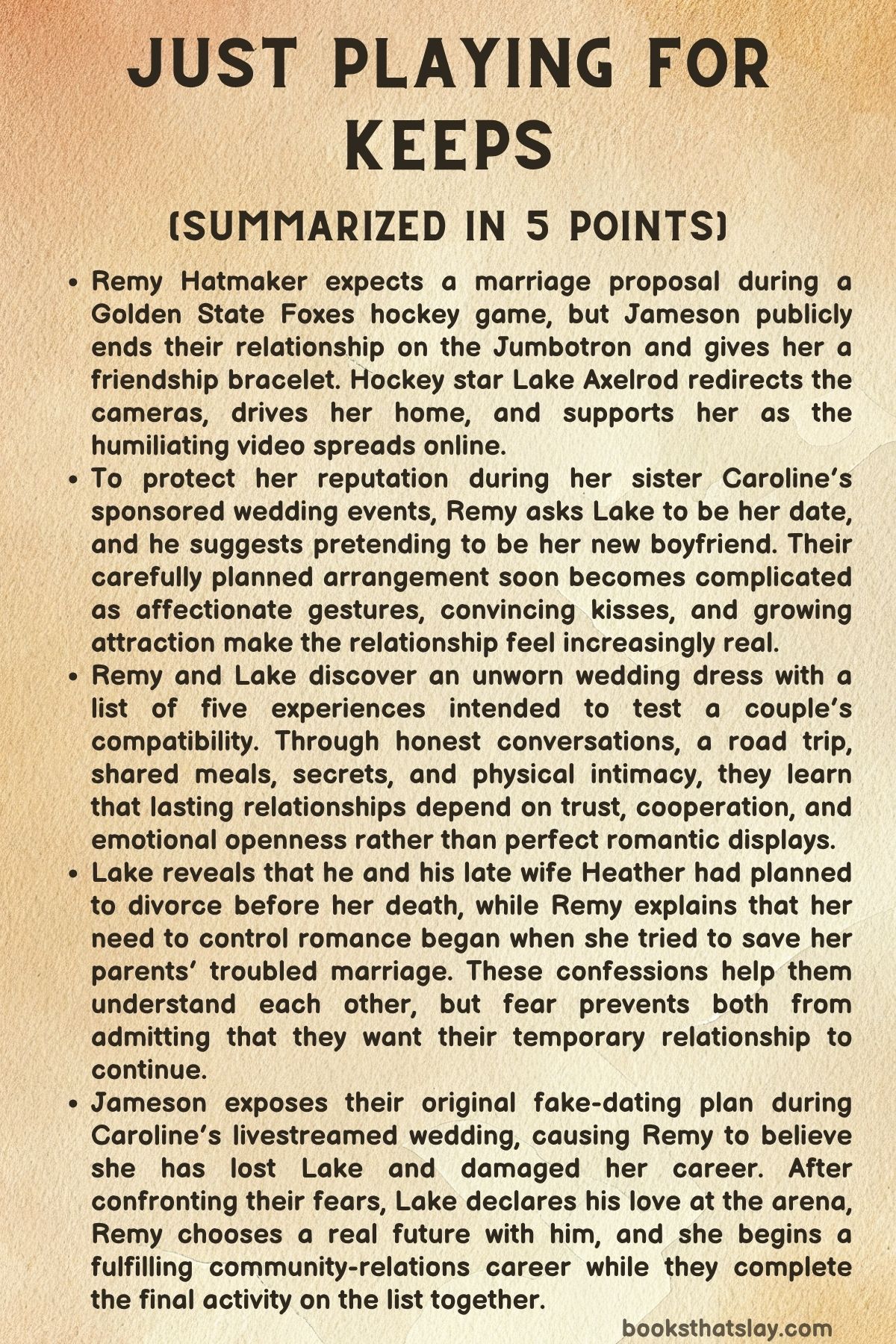
Remy Hatmaker attends a Golden State Foxes hockey game with her boyfriend, Jameson, believing that he intends to propose. After discovering what appears to be a jewelry box in his sweatshirt, she secretly arranges for their conversation to be broadcast on the Jumbotron during a charity event.
Instead of proposing, Jameson praises Remy before asking whether they can remain friends and “consciously uncouple.” The box contains a plastic friendship bracelet, leaving Remy publicly humiliated before thousands of spectators and an online audience that soon turns the incident into a viral video.
Lake Axelrod, a star player for the Foxes, witnesses the breakup from the ice. He recognizes Remy as his sister Clementine’s friend and becomes furious when the control-room staff continue broadcasting her pain.
Lake redirects the cameras by striking stuffed foxes into the crowd with his stick. After the game, he finds Remy still working in an arena corridor, pretending that nothing is wrong while counting donated toys.
Remy initially refuses his offer of a ride because she does not want anyone to see how badly she is hurting. Lake insists that she should not wait outside where reporters or spectators could approach her, and his practical kindness persuades her to accept.
During the drive, Remy admits that she arranged the Jumbotron moment after discovering the jewelry box. She blames herself for assuming Jameson intended to propose, but Lake argues that Jameson knew they were being filmed and could have stopped the public breakup.
Lake walks her to her door, sends her a succulent, and includes a supportive handwritten note. When the breakup video receives millions of views, he continues creating playful distractions during interviews so the media will focus on him instead of Remy.
Two weeks later, Remy has become widely known as the Friendship Bracelet Girl. Her sister Caroline is preparing for a heavily sponsored wedding and worries that Jameson, who remains the groom’s best friend, will attend with another woman.
Caroline believes Remy needs an impressive date to demonstrate that she has moved on and to protect the wedding’s public image. After encouragement from Clementine and Mabel, Remy approaches Lake and asks him to attend the wedding events as her guest.
Lake has already developed feelings for Remy and agrees before she finishes asking. Rather than appearing as a casual companion, he proposes that they pretend to be in a new relationship so Jameson will understand that Remy has moved forward.
Remy accepts and approaches the arrangement as another event-planning assignment. She creates a spreadsheet containing rules, personal facts, a fictional relationship timeline, prepared answers, and guidelines for public affection.
Their first preparation outing takes place at Costco because Remy knows Lake enjoys free samples. They invent a believable dating history, practise holding hands and embracing, and discover that physical closeness feels much more natural than either expected.
Lake purchases a hummingbird feeder for Remy and installs it outside her home. The thoughtful gesture, combined with his attention to small details, makes it increasingly difficult for her to view him as someone merely performing a role.
Remy informs Daniel, her boss and longtime friend, that she is dating Lake. Daniel warns her that Lake’s personal life has received intense media attention since the death of his wife, Heather, who had also been a celebrated hockey player.
The public believes Lake and Heather had a perfect marriage, followed by his complete devastation after her death. Remy assumes she can manage the attention because her relationship with Lake is temporary, though her attraction to him is already challenging that belief.
At the first major wedding event, Lake convincingly tells Remy’s relatives that he wanted her long before they began dating. When Jameson attempts to insert himself into their plans, Lake responds protectively and kisses Remy several times.
The kisses are supposed to support their invented story, but Remy responds with genuine desire. Lake also recognizes that his jealousy, affection, and wish to protect her are not qualities he can dismiss as acting.
He repeatedly creates gestures based on details Remy has shared. He gives her a blanket for their jokingly promised nap lesson and fills a bag with stuffed foxes carrying notes, transforming the objects associated with her humiliation into symbols of care.
Remy cuts Lake’s hair before another sponsored wedding event. The private grooming session becomes intensely intimate, but the arrival of the production team prevents them from acting on their attraction.
At a cake tasting, Lake distracts Jameson from using the cameras to advertise his brewery. His behaviour convinces their friends that the fake relationship is becoming real, but Lake denies that possibility because he believes his failed marriage has left him incapable of offering Remy a healthy future.
A filmed lipstick test requires Remy and Lake to kiss passionately. Before entering the dress shop, they practise inside his car and lose control, though an awkward misunderstanding briefly makes Remy fear that Lake regretted the encounter.
Lake explains that he remained outside because he was too physically affected to enter the shop. During filming, their kiss destroys the lipstick and exposes how little control either possesses when they are together.
Inside the boutique, Remy discovers an unworn wedding dress accompanied by a letter titled “Five Things to Do Before I Say I Do.” The list describes experiences intended to reveal whether two people can build a life together rather than merely create an attractive ceremony.
Lake purchases the gown so the dress and letter will not be separated. He and Remy decide to complete the five activities: playing a truth-telling game, taking a road trip, sleeping beneath the stars, making and cleaning up breakfast, and sharing a secret.
During the truth game, Remy admits that she no longer wants Jameson and has begun therapy to address her need for control. Lake confesses that, given the choice, he would not marry Heather again because their relationship had stopped allowing either of them to grow.
Remy later helps Lake choose a suit in his closet. Their attraction finally overcomes their rules, and they begin a physical relationship that proves their public chemistry was never artificial.
Afterward, Remy panics about the consequences. She works in the same building as Lake, remains friends with his sister, and fears that losing him will make the arena another place filled with painful memories.
Lake accepts her request not to repeat their intimacy, though he is deeply disappointed. They then take a road trip to Evergreen Falls, combining a wedding errand with another activity from the mysterious list.
Remy visits Lake’s family ranch and meets his withdrawn father. She treats him with warmth, discusses birds and animals with him, and encourages him without forcing him to confront his anxiety before he is ready.
A hotel mistake leaves Remy and Lake sharing one room. Lake initially respects her boundary by sleeping separately, but Remy realizes that fear rather than regret caused her to create the rule.
She asks him to come closer, and they deliberately resume their physical relationship. The experience gives both of them a sense of trust and freedom that makes returning to a purely temporary arrangement almost impossible.
The following morning, they agree to enjoy a complete romantic relationship until Caroline’s wedding. Calling it a limited fling allows Remy to believe that she still controls the ending, while Lake quietly begins hoping that she will eventually choose to remain.
Their relationship becomes increasingly domestic and emotionally open. Lake learns how to reassure Remy, listens to her needs, and helps her feel comfortable without demanding perfection.
Remy confesses the truth about the arrangement to Clementine, who warns that emotional and physical intimacy cannot be dismissed as pretending. Remy knows they are now deceiving their families, friends, colleagues, and Lake’s father, but she remains afraid to ask Lake what he wants after the wedding.
During a charitable wedding shower at the ranch, Lake’s protectiveness becomes visible when Jameson again seeks publicity. Lake later criticizes himself for his jealousy and tells Remy that he does not believe he is capable of lasting love.
Remy refuses to accept his negative judgment of himself. She tells him that he deserves good things, while Lake responds by showing her that she deserves to feel valued, capable, and fully desired.
They complete the breakfast activity from the bride’s list by preparing several kinds of toast and cleaning the kitchen together. When Thor knocks food onto the floor, they handle the unexpected mess cooperatively, demonstrating that compatibility appears most clearly in ordinary, imperfect moments.
Lake then shares his greatest secret. He reveals that he and Heather had decided to divorce before her fatal accident and that he was no longer in love with her when she died.
He concealed the separation to protect Heather’s grieving parents, honour her wish for privacy, and avoid adding to his father’s distress. The media created the false image of an ideal marriage, trapping Lake inside a role he felt unable to correct.
Remy listens without judging him and recognizes that his silence came from the same protective instinct he repeatedly shows toward others. She then explains that her own career in romance planning began when she tried to prevent her parents from separating by arranging perfect experiences for them.
Because her parents reconciled, Remy mistakenly concluded that she had saved their marriage. She carried that belief into adulthood and became convinced that relationships succeeded only when she carefully controlled every romantic moment.
Lake tells her that love cannot be created through flowers, music, plans, or performances. People must choose one another and accept responsibility for the difficult emotional work required to remain together.
Remy decides to leave romance design and pursue a full-time community-relations role with the Foxes. Although she and Lake come close to declaring love, they continue using cautious language because neither wants to risk asking directly for a future.
On Caroline’s wedding day, Jameson corners Remy and reveals that he knows the relationship originally began as a scheme. Lake confronts him, insists that his feelings for Remy are real, and condemns Jameson for exploiting both Remy and the wedding for publicity.
Unknown to them, their argument is broadcast on the livestream. Remy sees the camera and believes she has damaged her sister’s wedding, deceived Lake’s father, endangered her career, and destroyed the relationship she has come to value.
Jameson then steps on Caroline’s dress, tears it, and spills beer across the fabric. Parker removes him as best man, while Caroline regrets allowing him to remain involved after the way he treated Remy.
Remy remembers the unused vintage gown and offers it to Caroline. The unexpected dress fits, allowing the wedding to continue while demonstrating that an imperfect situation can still lead to something meaningful.
Remy confesses the fake-dating arrangement to Caroline and their mother. She also reveals the childhood burden she carried, prompting her mother to apologize for allowing Remy to believe that her parents’ marriage depended on her efforts.
After the wedding, Remy tells Daniel the truth and submits a proposal for a community-relations initiative. During therapy, Elena asks whether she ever clearly told Lake that she wanted their relationship to become permanent.
At the same time, Lake’s teammates challenge his assumption that Remy does not want him. His father also tells him that the relationship was never truly fake because Remy’s care and Lake’s happiness were obvious.
Remy returns the vintage gown and list to the boutique. She learns that the dress belonged to Katrina, the owner’s niece, who died before she could complete the activities or marry.
The owner intentionally allowed Remy and Lake to find the dress because she had witnessed the sincerity of their connection. Encouraged by this revelation, Remy decides to visit Lake and express her feelings without preparing a detailed plan.
Lake separately recruits Daniel and his teammates to help arrange a declaration at the arena. He skates onto the empty rink and strikes stuffed foxes toward Remy, each carrying part of a message explaining why he loves her.
The gesture replaces the memory of her public rejection with one of acceptance and choice. Lake tells her that he wants a real relationship, while Remy confirms that he is exactly what she wants.
They later complete the final activity by staying at a treehouse retreat and sleeping beneath the stars. The list that began as a stranger’s unfinished plan becomes part of the beginning of their shared future.
Daniel eventually offers Remy the full-time community-relations position she wanted. She adopts an elderly Chihuahua mix with Lake, names the dog Katrina, and changes her podcast from discussing how couples meet to exploring how they remain connected.
Lake joins the podcast as her genuine boyfriend. Knowing Remy dislikes surprises, he warns her in advance that he intends to marry her someday, showing that their future will be based not on perfect performances but on communication, humour, trust, and deliberate commitment.
Characters
Remy Hatmaker
Remy is the emotional centre of Just Playing for Keeps, and her development is shaped by the collapse of her belief that good planning can guarantee romantic security. Her public breakup is devastating not simply because Jameson rejects her, but because it exposes the limitations of the identity she has created as a romance designer, dating coach, and woman who supposedly understands relationships.
Her need for control began during childhood, when she tried to prevent her parents from separating by arranging special meals and romantic experiences. Their eventual reconciliation convinced her that she was responsible for keeping people together, creating an unhealthy connection between love, performance, and personal responsibility.
Remy initially responds to difficulties by organizing them. She prepares spreadsheets for fake dating, creates fictional histories, manages wedding emergencies, anticipates questions, and attempts to decide in advance when her relationship with Lake will end.
These habits make her highly capable, generous, and dependable, but they also prevent her from accepting that emotional relationships involve uncertainty. Her desire to avoid another humiliation causes her to create boundaries that do not reflect what she genuinely wants.
Her relationship with Lake gradually teaches her to distinguish thoughtful romance from emotional control. The activities on Katrina’s list help her understand that compatibility is shown through travel problems, shared chores, awkward conversations, ordinary meals, and unexpected accidents rather than polished displays.
Remy also becomes more honest about her professional ambitions. Leaving romance planning is not a rejection of love but a refusal to continue carrying responsibility for relationships that only the people involved can maintain.
By the conclusion, Remy is able to speak directly, risk rejection, and trust her own judgment. She no longer requires a perfect plan before acting, and she accepts that courage means choosing what she wants without knowing exactly how events will unfold.
Lake Axelrod
Lake is presented in Just Playing for Keeps as physically powerful, publicly reserved, and privately attentive. His intimidating appearance hides a gentle man whose actions are guided by loyalty, protection, responsibility, and an almost constant awareness of other people’s needs.
His care for Remy begins before their fake relationship. During the Jumbotron breakup, he immediately recognizes her humiliation, redirects the cameras, makes certain she gets home safely, and challenges her belief that she caused Jameson’s cruelty.
Lake communicates affection through action long before he can express it through direct language. The succulent, hummingbird feeder, stuffed foxes, blanket, thoughtful notes, gifts, rides, and carefully remembered preferences all reveal that he listens closely and finds meaning in making another person feel safe.
His central conflict comes from his belief that he is unfit for lasting love. His mother’s departure, his failed marriage, Heather’s death, his father’s struggles, and the public mythology surrounding his widowhood have convinced him that romance produces abandonment, guilt, and disappointment.
Lake’s silence about Heather is morally complicated but understandable. He protects her reputation and grieving family while sacrificing his own ability to explain why he is hesitant to love again.
His relationship with Remy forces him to recognize that protection can become another form of control when he decides what is best for her without asking. By assuming she deserves someone better, he denies her the opportunity to choose him freely.
Lake’s growth requires the same courage he displays during hockey games. He eventually stops waiting for a safer moment, publicly declares what Remy means to him, and accepts that love cannot be experienced without vulnerability.
Jameson
Jameson represents emotional carelessness disguised as friendliness. His decision to end the relationship publicly is especially cruel because he recognizes that the cameras are broadcasting Remy’s reaction and still continues.
He repeatedly describes himself as Remy’s friend, yet his behaviour shows little concern for her dignity. He expects continued access to her life, attempts to involve himself in her new relationship, and uses Caroline’s wedding primarily as an opportunity to promote his brewery.
Jameson does not appear to understand the difference between friendliness and genuine consideration. His cheerful manner allows him to avoid confronting the harm he causes, while his interest in publicity continually takes priority over the feelings of those around him.
His exposure of the fake-dating arrangement is not motivated by concern for Remy or honesty toward the family. It is another attempt to reclaim attention and undermine a relationship that has made his own failures increasingly visible.
The destruction of Caroline’s wedding dress provides a fitting consequence for his self-absorption. His careless movement damages something important at the exact moment when Parker and Caroline finally recognize that maintaining a connection with him is no longer defensible.
Caroline
Caroline is loving, ambitious, image-conscious, and sometimes unintentionally demanding. Her sponsored wedding creates the pressure that leads Remy to seek an impressive date, though Caroline initially fails to understand how strongly her expectations affect her sister.
She genuinely wants Remy to recover from the breakup, but she also views Lake as a useful addition to the wedding’s romantic presentation. Her concern for her sister becomes mixed with her concern for audience reactions, sponsorship agreements, and professional opportunities.
Caroline’s development becomes clear after the livestream disaster. Rather than blaming Remy, she recognizes that she should have removed Jameson from the wedding party when he first humiliated her sister.
She also listens when Remy explains the childhood origins of her controlling behaviour. Caroline’s willingness to apologize allows the sisters to replace performance and guilt with a more honest form of family support.
Clementine Axelrod
Clementine serves as an important link between Remy and Lake. As Remy’s friend and Lake’s sister, she understands both of them well enough to recognize the emotional risks they are avoiding.
She initially supports the fake relationship but warns Remy that Lake is private and emotionally complicated. Her concern is not based on distrust of her brother but on her awareness that he has spent years refusing to discuss his marriage, grief, and romantic future.
When Remy finally admits that the arrangement has become physical and emotionally serious, Clementine responds with humour but refuses to accept the claim that it remains harmless. She helps Remy recognize that intimacy has consequences regardless of the original agreement.
Clementine’s loyalty is balanced rather than possessive. She does not interfere or choose sides, but she insists that both people deserve honesty before either is hurt by assumptions.
Mabel
Mabel is one of Remy’s most encouraging friends and often provides practical support with a light, playful attitude. She helps Remy approach Lake, supplies his favourite cupcake, and repeatedly encourages her to enjoy experiences rather than controlling their outcome.
Her comparison of the temporary relationship to a vacation gives Remy permission to live in the present. Although that advice does not solve the deeper problem of avoiding honest commitment, it helps Remy stop treating desire as something that must always be managed.
Mabel also acts as a source of emotional stability. Her humour reduces Remy’s tendency to turn every complication into a crisis, while her support confirms that Remy has people who value her beyond her public reputation or romantic success.
Daniel
Daniel is Remy’s boss, longtime friend, and eventual professional advocate. His first concern about her relationship with Lake centres on media scrutiny rather than workplace rules, showing that he understands how damaging public attention can become.
He respects Remy’s personal boundaries and later reminds her that she never owed the organization a complete account of her relationship. This response challenges her belief that every mistake or private decision must become a professional failure.
Daniel also recognizes her abilities beyond romance planning. By seriously considering her Hockey Is for Everyone proposal and offering her a full-time community-relations position, he validates the career direction she has chosen for herself.
His participation in Lake’s arena declaration adds humour while also showing his investment in Remy’s happiness. He becomes a temporary romance designer, helping Lake create a gesture that honours her emotional history rather than simply producing a spectacle.
Lake’s Father
Lake’s father is a quiet but significant figure whose withdrawal reflects grief, anxiety, and emotional exhaustion. Lake worries constantly about him and often organizes his own choices around protecting his father from further distress.
Remy connects with him by discussing birds, animals, food, and the ranch without treating him as a problem to be solved. Her patience allows him to respond without feeling pressured or judged.
His gradual return to ordinary life parallels Lake’s emotional recovery. He begins trying plant-based food, spends more time outside, engages with the animals, and takes steps toward managing his anxiety.
His observation that Lake and Remy were never truly fake becomes one of the clearest judgments in the story. He sees authenticity in their happiness and care even when they remain trapped by the language of their original arrangement.
Heather
Heather is absent from the present-day action, but her memory strongly shapes Lake’s identity. The public remembers her as a successful hockey player and one half of an ideal athletic marriage.
Lake’s private account reveals a more complicated relationship. He respects Heather and does not portray her as cruel, yet their shared connection to hockey was not enough to sustain a marriage in which both had changed.
Her death freezes their relationship inside a false public narrative. Lake’s refusal to reveal their planned divorce protects her reputation but forces him to perform permanent grief for a marriage that was already ending.
Heather’s role demonstrates that a relationship can fail without either person becoming a villain. Her history with Lake helps clarify why compatibility requires more than shared interests, public admiration, or an attractive story.
Gavin Axelrod
Gavin functions as a perceptive family observer who quickly recognizes Lake’s happiness. He sees through his brother’s attempts to describe the relationship as casual or artificial.
Although his role is smaller, Gavin helps establish that Lake’s feelings are visible long before he acknowledges them. His teasing provides humour while also challenging Lake’s belief that he can hide emotional change from everyone around him.
Gavin’s presence at the ranch also shows that responsibility for the family does not belong to Lake alone. He represents the broader family structure surrounding Lake’s father and the equine-therapy work.
Parker
Parker is Caroline’s fiancé and Jameson’s longtime friend. His willingness to keep Jameson as best man initially suggests that loyalty and familiarity have prevented him from examining his friend’s behaviour closely.
The livestream confrontation forces Parker to see the extent of Jameson’s selfishness. When Jameson damages Caroline’s dress, Parker immediately removes him from the wedding and accepts responsibility for ignoring earlier warning signs.
His reaction demonstrates growth rather than defensiveness. He supports Caroline, acknowledges his mistake, and refuses to protect a friendship that has become harmful to the people he loves.
Elena
Elena is Remy’s therapist and one of the few people who consistently directs attention away from external events and toward Remy’s internal choices. She helps Remy examine perfectionism, control, shame, professional identity, and the childhood origins of her romantic beliefs.
Her most important question concerns whether Remy ever honestly told Lake what she wanted. Rather than allowing Remy to describe the relationship as something that simply ended, Elena asks her to consider how silence contributed to the separation.
Elena does not offer easy reassurance or tell Remy that Lake will return. She encourages Remy to act according to her own truth, making emotional courage more important than securing a guaranteed result.
Corbin, Riggs, Ivan, and the Foxes Players
Lake’s teammates function collectively as a humorous but perceptive support system. They notice his attraction to Remy, tease him about his behaviour, and refuse to accept his repeated claims that the relationship is temporary.
Corbin often recognizes Lake’s attachment before Lake can admit it. Riggs and Ivan contribute jokes, nicknames, bets, and observations that make the locker room a place where emotional truths are exposed through humour.
The players eventually become active supporters rather than mere observers. They challenge Lake’s belief that he should decide what Remy deserves and help him arrange the arena declaration.
Their loyalty reveals that Lake is less isolated than he imagines. Hockey is not only a hiding place for him but also a community capable of pushing him toward emotional honesty.
Miller and Anna
Miller appears as a goalie whose affection for his longtime friend Anna is obvious to Remy. Their connection activates her old matchmaking instincts, but she deliberately refuses to treat their feelings as another project.
This restraint marks an important stage in Remy’s development. She can recognize romantic possibility without assuming responsibility for arranging or controlling it.
Miller later supports Lake’s declaration with the other players. His presence connects Remy’s changing professional identity with the supportive community she hopes to serve through her new role.
Remy and Caroline’s Mother
Remy’s mother becomes essential when the family finally discusses the childhood experiences that shaped Remy’s need for control. She is devastated to learn that her daughter believed she had to save the marriage.
Her apology allows Remy to surrender a burden she has carried for years. Rather than minimizing the past, she acknowledges that family conflict can affect children even when adults believe they have protected them.
She also encourages Remy to consider that Lake’s feelings may be genuine. Her response during the wedding crisis prioritizes Remy’s emotional wellbeing rather than appearances.
Katrina
Katrina never appears alive in the story, but her unfinished list transforms Remy and Lake’s relationship. The activities she planned encourage them to examine honesty, cooperation, travel, ordinary routines, secrets, and shared wonder.
Her vintage dress also saves Caroline’s wedding after Jameson destroys the original gown. An object connected to loss receives a new purpose without erasing the woman who first owned it.
Remy honours Katrina by naming the adopted rescue dog after her. This choice turns Katrina’s influence into part of the couple’s continuing life rather than allowing the list to remain associated only with an unfinished future.
The Boutique Owner
The boutique owner protects Katrina’s memory while quietly guiding Remy and Lake toward the dress and list. After witnessing the sincerity of their kiss, she senses that they may understand the experiences her niece never completed.
Her decision is based on emotional perception rather than calculation. She does not explain the story immediately, allowing Remy and Lake to interpret the list through their own developing relationship.
When Remy returns with photographs of Caroline wearing the gown, the owner receives proof that Katrina’s dress became part of a joyful event. Her role shows how personal objects can carry grief while still creating new connections.
Thor
Thor, Lake’s cat, provides humour and reveals Lake’s affectionate domestic nature. The special car seat, cat tower, and Lake’s attentive care contradict the intimidating image associated with his public personality.
Thor also interrupts several emotionally significant moments, especially the breakfast scene. By knocking food onto the floor, he turns a simple meal into a test of patience and cooperation.
His presence contributes to the ordinary life Remy and Lake begin building together. He helps transform Lake’s home from a private retreat into a shared space filled with humour, disorder, and companionship.
Themes
Control, Perfection, and Emotional Uncertainty
Remy’s belief in perfect romantic planning originates in childhood fear. When her parents’ marriage appeared unstable, she arranged dinners and special experiences, later interpreting their reconciliation as proof that she had personally prevented the family from separating.
That belief becomes the foundation of her professional identity and romantic behaviour. She manages relationships as if they were events, assuming that enough preparation can prevent rejection, misunderstanding, or loss.
The Jumbotron breakup destroys this illusion in the most public way possible. Remy plans every visual detail of the expected proposal, yet the same preparation magnifies her humiliation when Jameson ends the relationship instead.
Fake dating initially appears to offer another form of control. The spreadsheet, invented timeline, rules, approved physical affection, and predetermined ending allow Remy to believe she can experience romance without becoming vulnerable.
Lake repeatedly disrupts that structure through genuine kindness and spontaneous emotion. His gifts, kisses, family connections, confessions, and attention cannot be reduced to a role because they respond to Remy as a person rather than as part of an arrangement.
The unfinished wedding list further challenges her assumptions. Travel, breakfast, cleaning, secrets, and sleeping beneath the stars reveal that commitment depends on how people handle reality, not how beautifully they arrange ideal moments.
By the end of Just Playing for Keeps, Remy does not abandon competence or thoughtful romance. She learns that planning can support love but cannot create, preserve, or guarantee it without honest choice from both partners.
Public Image and Private Truth
Public perception repeatedly conflicts with personal reality. Remy’s breakup becomes viral entertainment, turning a painful private event into a nickname, online identity, and source of professional embarrassment.
Lake experiences a more enduring version of the same problem. The media present him as the grieving husband of a perfect hockey marriage, though he and Heather had already decided to divorce before her death.
His silence allows the false story to remain because telling the truth might hurt Heather’s parents and damage her reputation. Protection therefore becomes a prison, requiring Lake to perform emotions that match the public narrative while hiding his actual experience.
Caroline’s sponsored wedding creates another environment in which appearance influences decisions. Guests, relatives, and relationships become part of branded content, while Jameson repeatedly searches for opportunities to advertise his brewery.
The fake relationship succeeds publicly because Remy and Lake provide the romantic story everyone expects. The irony is that the performance becomes emotionally authentic even while the couple continues describing it as false.
The livestream confrontation removes their ability to manage the distinction between public and private. Their secret is exposed, but Lake’s defence of Remy also reveals that his feelings are genuine.
Both characters eventually reclaim public spaces associated with false narratives. The arena changes from the location of Remy’s humiliation into the setting of Lake’s honest declaration, proving that visibility is not automatically harmful when it reflects truth rather than performance.
Protection, Sacrifice, and Self-Denial
Lake’s instinct to protect others is one of his most admirable qualities and one of his greatest emotional obstacles. He shields Remy from cameras, media attention, Jameson’s behaviour, and public embarrassment without expecting repayment.
He also protects Heather’s parents, Heather’s reputation, and his own father by concealing the truth about his marriage. These choices come from compassion, but they require Lake to sacrifice his own emotional freedom.
His protectiveness becomes unhealthy when he decides that Remy deserves someone better and assumes that ending the relationship will save her from future pain. In making that decision privately, he denies her the right to evaluate his past and choose for herself.
Remy also expresses love through sacrifice. She manages wedding emergencies, protects Caroline’s sponsored celebration, suppresses her own distress, and accepts responsibility whenever events become difficult.
Her childhood convinced her that caring for people means preventing their relationships from failing. As an adult, she continues measuring her worth through how effectively she can rescue situations.
The story distinguishes genuine care from self-erasure. Protection becomes healthy only when it is combined with communication and respect for another person’s ability to make decisions.
Lake and Remy grow when they stop carrying every burden privately. Their confessions show that being protected does not always mean being spared difficult truths; sometimes it means being trusted enough to hear them.
Love as Choice and Everyday Partnership
Romantic spectacle begins the story as something unreliable. Remy’s carefully designed proposal setting produces rejection, while Lake’s supposedly ideal marriage proves that shared fame and an attractive public story cannot guarantee lasting intimacy.
The experiences on Katrina’s list offer a different definition of partnership. A road trip reveals patience, a truth game tests honesty, breakfast requires cooperation, a shared secret requires trust, and sleeping beneath the stars creates space for wonder.
These activities focus on behaviour rather than display. They ask whether two people can tolerate inconvenience, manage disorder, express uncomfortable truths, and enjoy ordinary time together.
Lake’s affection is shown through small, repeated acts. He remembers Remy’s preferences, gives meaningful gifts, listens to her concerns, respects her boundaries, adapts to her needs, and supports her professional ambitions.
Remy contributes through attentiveness, practical support, emotional acceptance, and her ability to make Lake’s family feel included. She sees his father as a complete person, listens without judging Lake’s marriage, and refuses to accept his belief that he is unworthy of happiness.
Their eventual declaration succeeds because it follows private emotional work. The stuffed foxes and arena setting are romantic, but the gesture has meaning because Lake has already chosen honesty and Remy has chosen to risk an unplanned answer.
Love is therefore presented as a continuing decision rather than a perfect moment. Attraction brings Remy and Lake together, but shared routines, direct communication, forgiveness, humour, and mutual responsibility allow them to imagine remaining together.