Keep Them Close Summary, Characters and Themes
Keep Them Close by David Ellis is a psychological legal thriller centred on Allison Brice, a brilliant former federal prosecutor whose ability to shape facts into convincing courtroom narratives becomes dangerously useful in her private life.
After betrayal, family conflict and a failed act of revenge create several overlapping crises, Allison begins treating real events as cases that can be controlled through evidence and strategy. The book examines how loyalty can become possessiveness, how intelligence can support self-deception and how a person may cross one moral boundary after another while believing every choice is necessary.
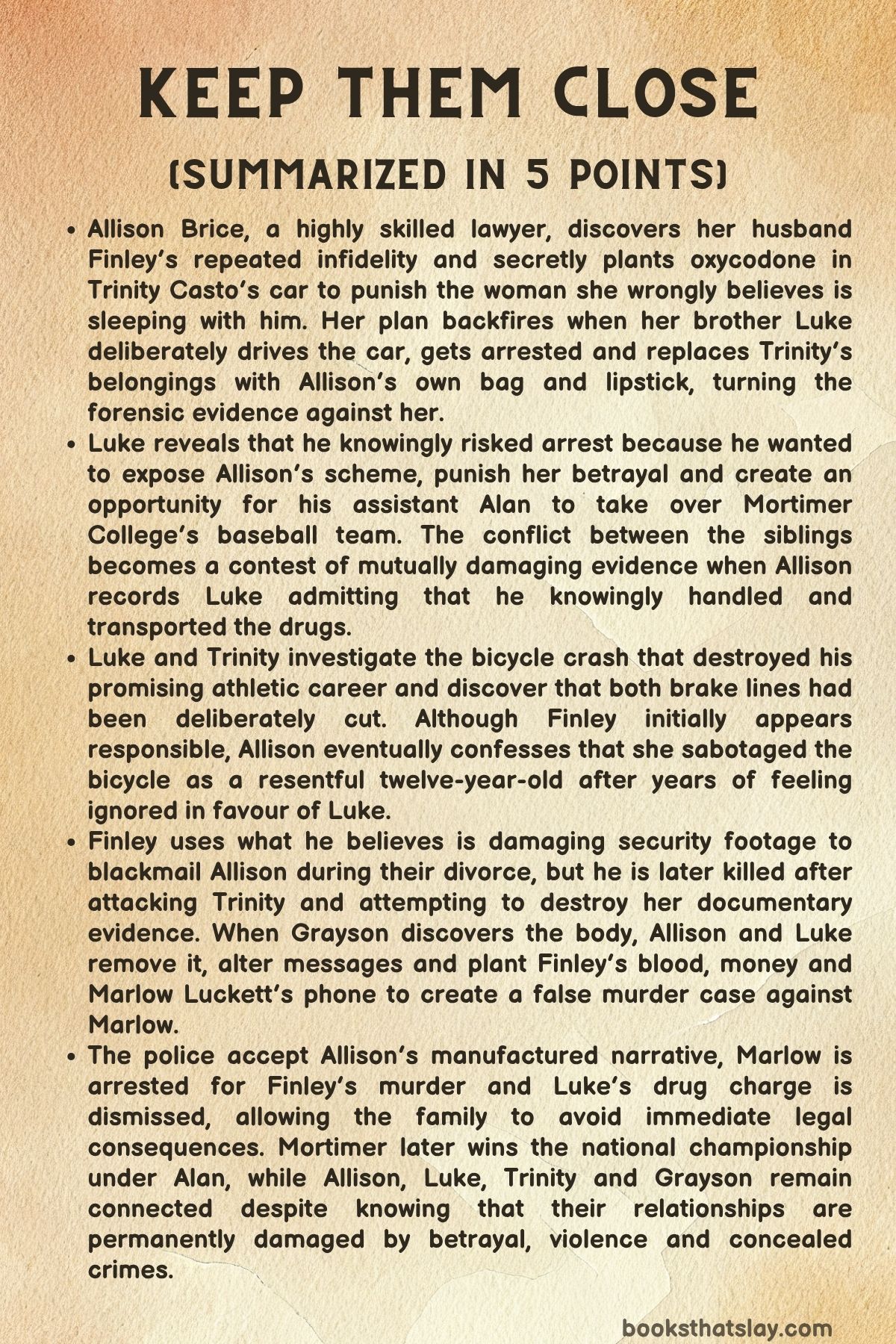
Summary
Allison Brice is a successful Chicago attorney, wife to Finley Brice and mother to their eighteen-year-old son, Grayson. Her disciplined professional life hides a marriage damaged by Finley’s repeated failures, insecurity and affair with Anna Cortese.
After discovering Finley at Anna’s home, Allison briefly considers killing them or burning the house. She arrives dressed in dark clothing with an untraceable gun and gasoline, but she cannot act because she still loves Finley and wants to protect Grayson from the destruction of his family.
While driving away, Allison is pursued by Marlow Luckett, a violent and intoxicated man in a yellow truck. He follows her into the parking lot of Mortimer College, corners her and approaches with a crowbar.
Allison points her gun at Marlow and tries to escape, but she strikes him with her SUV. Instead of calling for help, she takes his phone and flees, then asks her brother, Luke Rankin, whether he can reach the parking-lot security recordings.
Luke removes the recordings because he believes he is protecting Finley from another scandal. Allison destroys them and allows Luke to continue believing that Finley was involved.
Ten months later, Finley’s body is discovered wrapped in construction materials inside a waste facility. Sergeant Louise Pratt and her partner, George “Cutty” Sarkisian, begin investigating the murder.
The story then returns to the weeks before Finley’s death. Allison has temporarily reconciled with him after caring for him through knee surgeries, but her optimism ends when he asks to resume the poker nights he once used as cover for his affair.
Allison hires private investigator Jennifer “Harp” Harper to follow him. Harp’s surveillance leads Allison to the Brices’ downtown condominium, where she sees Finley entering with Trinity Casto.
Trinity is Luke’s close friend and the filmmaker creating a documentary about his life. Allison assumes Trinity is sleeping with Finley while pretending to care about Luke, and the perceived betrayal becomes more painful because Allison believes Luke is romantically devoted to her.
At the same time, Allison is preparing to defend Congressman Lawton Childress against corruption charges. Her professional confidence contrasts with her private anger, where she repeatedly creates explanations before possessing all the facts.
Luke soon drives Trinity’s Toyota toward Olivet Nazarene University to deliver clothes to her brother, Max. Police stop him after receiving a precise tip and discover one hundred oxycodone tablets beneath the trunk floor.
Allison immediately represents Luke and suspects that either Trinity or Max placed the pills in the vehicle. Max has a history of selling oxycodone, while Trinity regularly travels to visit him and owns a fitness studio that Allison imagines could conceal criminal activity.
Luke refuses to accuse Trinity and even considers pleading guilty. Allison interprets his behaviour as blind loyalty, but his unusual calm suggests that he knows more than he admits.
The traffic stop was not accidental. Allison herself created the situation after seeing Trinity with Finley.
Seeking revenge, Allison used Finley’s unused oxycodone prescriptions and stole a tube of Trinity’s lipstick and a branded bag carrying Trinity’s biological traces. She duplicated Trinity’s car key, entered the Toyota and hid the drugs with the items that would appear to implicate Trinity.
Allison then instructed Harp to tip the police that Trinity’s vehicle would be carrying oxycodone on a Monday. She expected Trinity to drive the car, but Luke volunteered for the journey instead.
Allison feels guilty that Luke was arrested, yet she convinces herself that forensic testing will clear him. She still views herself as his protector, refusing to recognise that her desire to control his life created the danger.
Luke’s arrest also serves a secret purpose of his own. He wants to leave Mortimer College and begin another rebuilding project, but he wants his assistant, Alan McIntyre, to inherit the team and receive a genuine chance to lead it.
Luke and Trinity had discovered a hidden camera recording of Allison planting the bag in the Toyota. Instead of reporting her immediately, they removed Trinity’s items and replaced them with one of Allison’s grocery bags and Allison’s lipstick.
Luke deliberately cancelled a baseball scrimmage, placed the pills back in the vehicle with Allison’s belongings and drove along the route Allison had told police to watch. He knew he would be arrested, but he expected the physical evidence and surveillance video eventually to reveal that Allison had tried to frame Trinity.
The arrest causes Mortimer to suspend Luke, allowing Alan to become interim coach. Luke accepts the damage to his reputation because the scandal creates the only opportunity for Alan to prove himself over a full season.
When forensic results arrive, Allison expects Trinity’s fingerprints and DNA to appear. Instead, the bag and lipstick match Allison.
She instantly understands that someone discovered her plan and reversed it. Believing Trinity could not have entered her house alone, Allison wrongly concludes that Finley assisted her.
The discovery deepens Allison’s hostility toward Finley. She has already confronted him about his affairs and expelled him from their home, but she now believes he has also conspired to expose her to prosecution.
Luke eventually admits that he and Trinity replaced the evidence. He tells Allison that he intentionally drove the car and regards his actions as punishment for her attempt to ruin Trinity.
Allison refuses to accept defeat. After formally ending her attorney-client relationship with Luke, she secretly records him admitting that he handled the oxycodone, placed it in the vehicle and knowingly drove with it.
She explains that the surveillance footage shows only Allison placing an unidentified bag in a car, while Luke’s recorded confession directly proves possession. She offers mutual silence: Luke will hide the video, and she will hide his confession.
Their relationship collapses. Luke tells Allison that he no longer wants her in his life, while Allison treats his rejection as another problem she must solve rather than a boundary she must respect.
Trinity’s documentary also concerns the bicycle collision that ended Luke’s future as an elite pitcher. When Luke was fourteen, he raced downhill during a reckless neighbourhood game, entered the street and collided with a car driven by Carmela Muller.
Carmela was slightly over the legal alcohol limit and went to prison, while Luke lost his athletic career. The public treated Carmela as the person solely responsible for destroying a promising young athlete.
A bicycle expert later confirms that both of Luke’s brake cables had been deliberately cut before the collision. Since Finley had collected Luke’s bicycle before the race, Luke and Trinity begin to suspect that Finley sabotaged it.
Trinity has a personal reason for investigating the accident. She and Max are Carmela’s children, and their family was destroyed after their mother’s conviction.
Luke knew Trinity’s identity from the beginning, but he concealed it from Allison. Trinity intends to use her documentary to correct the public account of the crash and restore some dignity to her mother.
Another danger enters Allison’s life when Marlow recognises her from newspaper coverage of Luke’s case. He attacks her in her garage and forces her to transfer twenty-five thousand dollars into his account.
The payment creates a financial connection between them. Allison fears that Finley will discover it and use the road-rage incident against her during their increasingly hostile divorce.
Meanwhile, Luke directs Allison’s attention toward a thumb drive recovered from Trinity’s Toyota. It is labelled as a school-security video, and Allison assumes it contains the Mortimer footage of her striking Marlow.
In reality, the drive contains footage from Luke’s childhood school. Because Luke never copied the Mortimer recording, the road-rage video Allison fears does not exist.
Finley sees the school footage and also misunderstands it. He believes it contains evidence capable of destroying Allison, so he demands two million dollars and ownership of the condominium in exchange for his silence.
Allison meets him at the condominium and argues that exposing her would destroy the income on which he depends. She also tells him that Trinity is Carmela’s daughter and that the documentary may accuse him of cutting Luke’s brakes.
Finley is shocked to learn that Trinity may have been interviewing him to investigate the accident rather than to celebrate him. Allison leaves believing she has persuaded him to abandon the blackmail.
That evening, Grayson secretly visits the condominium. He has recently seen Finley with another woman and arranged a confrontation after sending an angry message accusing his father of destroying their family.
When Grayson arrives, Finley is already dead. Terrified by the blood and conscious that his messages make him look guilty, he calls Allison before contacting the authorities.
Allison immediately begins planning a cover-up. She leaves her phone behind, removes her SUV’s front licence plate, packs cleaning supplies and instructs Luke to come to her house by bicycle so electronic records will appear to place him there.
At the condominium, Allison finds Finley stabbed with a vintage letter opener. She notices Trinity’s damaged laptop in the fireplace, Trinity’s lipstick on a glass and signs of a struggle.
Allison concludes that Trinity killed Finley in self-defence after he attempted to destroy her documentary materials. She could report the truth and clear Grayson, but she feels responsible for provoking Finley and believes Trinity should not lose her life because of a confrontation Allison helped create.
Allison instead constructs a false timeline. She sends messages from Finley’s phone making it appear that he was alive after Trinity left and was planning to meet Marlow.
Using her own phone through Luke, she creates an exchange suggesting that Finley was at Ohio Street Beach, ashamed of disappointing Grayson and preparing to confront the man who had been blackmailing the family. She also sends an apologetic message from Finley to Trinity, supporting her future claim that he was alive when she departed.
Allison removes the murder weapon and finds approximately twenty thousand dollars hidden in the condominium. She puts the money into Finley’s red leather duffel bag and deliberately contaminates both the cash and the bag with his blood.
She wraps Finley’s body in paint coverings and duct tape, places it on a wardrobe cart and transports it through the service area. Luke later helps her place the body in a dumpster at a construction site where Marlow had worked.
Allison drives Finley’s vehicle to Marlow’s neighbourhood and plants the bloodstained duffel beneath his woodpile. She also leaves Marlow’s stolen phone inside Finley’s vehicle, creating another connection between them.
The manufactured evidence tells a persuasive story. Investigators believe Marlow blackmailed Finley over the road-rage collision, accepted a cash payment, killed him during an argument, disposed of his body at a familiar construction site and abandoned his vehicle nearby.
Marlow’s violent history, his assault on Allison, the money transfer and his refusal to cooperate make the accusation believable. Allison has not merely removed evidence; she has created a complete alternative account for investigators to discover independently.
After the cover-up, Allison meets Luke and Trinity. Trinity confirms that Finley tried to destroy her laptop, pushed her into a window and advanced on her again before she stabbed him in self-defence.
Allison tells them how to support the fabricated timeline. Trinity must admit visiting the condominium but insist Finley was alive when she left, while Luke will remain silent because of his related drug case.
Allison then reveals the truth about Luke’s childhood accident. Finley did not cut the brake lines; Allison did.
When Allison was twelve, her mother constantly criticised her appearance and treated Luke’s athletic success as more important than Allison’s achievements. On the day of Allison’s Scholastic Bowl competition, her parents chose Luke’s baseball event instead.
Enraged by years of feeling invisible, Allison used the razor blade she carried to cut the brake cables on Luke’s bicycle. She intended to disrupt the family’s celebration and punish her mother, not to cause Luke’s catastrophic injuries.
The childhood security video shows Allison crouching beside Luke’s bicycle, although her body blocks the exact act. Carmela’s lawyers obtained the footage, and Carmela saw it before deciding not to expose a twelve-year-old girl.
Carmela accepted punishment for her own intoxicated driving rather than destroy Allison’s future. Allison is overwhelmed by the knowledge that the woman whose life was ruined had protected her.
Trinity has spent years blaming Allison, but Allison’s decision to save her after Finley’s death changes their relationship. Forgiveness is incomplete, yet the two women recognise the moral debt connecting them.
During her police interview, Allison supports the false case against Marlow. She claims Finley was the person who struck him at Mortimer and says Marlow later attacked her while demanding money.
She also blames Finley for the oxycodone scheme. According to her account, he used Allison’s belongings and his own pills to frame Luke out of jealousy and resentment.
With Finley dead, Trinity’s surveillance video deleted and the others supporting Allison’s version, the police cannot disprove the story. Luke’s drug charge is dropped, while Marlow remains accused of a murder he did not commit.
Several weeks later, Mortimer wins the Division III College World Series under Alan. The victory confirms that Luke’s sacrifice gave his assistant the opportunity he wanted.
Luke accepts a coaching position at Olivet Nazarene, where he can begin rebuilding another program. His relationship with Allison remains deeply damaged by her attempt to frame Trinity and by the truth about his bicycle.
Grayson completes his first year at NYU but continues carrying the trauma of finding his father. Allison prepares to return to the Childress trial while living with grief, guilt and the knowledge that her new life was secured through deception.
The family remains together in a fragile form. Allison has protected Luke, Trinity and Grayson, but her protection has also required manipulation, obstruction and the punishment of another guilty man for a crime he did not commit.
Characters
Allison Brice
Allison Brice is the central character of Keep Them Close, and nearly every conflict develops from the difference between her professional brilliance and her distorted personal judgment. As a former federal prosecutor and accomplished defence attorney, she understands evidence, motive, narrative and the weaknesses of investigators better than almost anyone around her.
Her greatest strength is her ability to remain composed when events become chaotic. Even after learning that Finley is dead and finding Grayson beside the body, she does not freeze but immediately assesses timelines, physical evidence, electronic records and possible explanations.
That control is also her greatest danger. Allison rarely allows events to remain outside her influence, and she treats people’s choices as problems that can be managed through pressure, secrecy or manipulation.
Her love for her family is genuine, particularly her devotion to Grayson and Luke. However, she often confuses love with the right to decide what is best for them, even when they have clearly rejected her interference.
Allison’s childhood explains much of her behaviour. Her mother taught her that appearance determined her value and that Luke’s achievements deserved greater attention, leaving Allison with deep insecurity beneath her confidence.
Cutting Luke’s brake lines is the first major example of her anger producing consequences far beyond what she intended. The same pattern returns when she tries to frame Trinity, only to cause Luke’s arrest and trigger a chain of retaliation.
Allison is highly skilled at creating moral justifications for herself. She believes Trinity deserves punishment for betraying Luke, Marlow deserves prison because he is violent and Finley’s death must be concealed because exposing Trinity would be unjust.
These explanations contain partial truths, which makes her self-deception convincing. Nevertheless, she repeatedly replaces legal and moral truth with the story that best protects the people she has chosen.
Her decision to protect Trinity shows that she is capable of accepting responsibility, at least indirectly. She cannot undo the harm done to Carmela, Luke or Trinity, but saving Trinity from prosecution becomes a form of repayment.
By the end, Allison has preserved her family but not restored it. Her intelligence wins the immediate battle, while the emotional consequences remain unresolved.
Luke Rankin
Luke Rankin is Allison’s brother, a former pitching prodigy and a respected baseball coach whose identity has been shaped by both extraordinary promise and devastating loss. His childhood collision ended his expected professional career, but he rebuilt himself by teaching others how to recover from failure.
In Keep Them Close, Luke acts as both Allison’s closest emotional connection and her strongest opponent. He understands her habits, shares her strategic intelligence and knows that ordinary confrontation will not force her to admit wrongdoing.
His decision to drive Trinity’s car with the oxycodone is reckless but carefully planned. He turns Allison’s attempted frame-up into a way to punish her, expose her behaviour, secure Alan’s coaching opportunity and create a path toward his own departure from Mortimer.
Luke’s coaching principles reveal how he approaches life. Preparation, execution and trust in the plan allow him to remain calm even when his reputation, freedom and career appear to be collapsing.
His loyalty to Trinity is not simply romantic devotion. He respects her intelligence, understands her family’s suffering and supports her effort to correct the false story surrounding Carmela.
Luke’s anger toward Allison is justified, but he also inherits some of her willingness to manipulate events. He knowingly commits a drug offence and risks public scandal because he believes the final outcome will justify the temporary harm.
Despite declaring that he wants no further relationship with Allison, Luke helps her after Finley’s death. His decision reflects the strength of their family bond and his inability to abandon Grayson during a crisis.
Learning that Allison cut his brakes forces Luke to reconsider the central tragedy of his life. He understands that she acted from childhood rage rather than a desire to destroy him, but understanding does not remove the consequences.
By the end, Luke has gained a new coaching position and helped Alan succeed. His professional future is hopeful, while his relationship with Allison remains uncertain and dependent on whether trust can ever be rebuilt.
Finley Brice
Finley Brice is Allison’s husband, Luke’s childhood friend and the murder victim whose weaknesses intensify nearly every conflict. He was once charming and central to Allison’s emotional world, but years of professional disappointment gradually turn him insecure, resentful and unfaithful.
Finley struggles with the success of both Allison and Luke. Allison becomes a powerful attorney, while Luke transforms personal tragedy into professional achievement, leaving Finley feeling increasingly ordinary beside them.
His affairs are partly an attempt to recover the admiration he believes he has lost at home. Instead of confronting his insecurity or accepting practical responsibility, he seeks attention from women who make him feel important.
Finley’s participation in Trinity’s documentary shows his hunger for recognition. He imagines himself as a significant figure in Luke’s story and fails to understand that Trinity is interviewing him because she suspects his involvement in the bicycle sabotage.
His financial demands during the divorce reveal both entitlement and fear. He resents dependence on Allison’s income, yet he wants a large share of the wealth her career created without accepting the limitations of their actual assets.
Finley’s decision to blackmail Allison marks the final collapse of their relationship. He believes the school-security video can force her to surrender money and fails to understand that permanent blackmail can never create a stable agreement.
His confrontation with Trinity is driven by humiliation after Allison reveals the documentary’s true purpose. When he tries to destroy Trinity’s work and physically attacks her, he creates the conditions of his own death.
Finley is neither a simple villain nor an innocent victim. His adultery, jealousy, violence and extortion are serious wrongs, but his death remains tragic because it ends a life already weakened by resentment and wasted potential.
Trinity Casto
Trinity Casto is a filmmaker, fitness-studio owner, Luke’s close companion and Carmela Muller’s daughter. Her calm behaviour hides a long personal mission to investigate the event that destroyed her mother’s life and separated her family.
Trinity approaches Luke initially with knowledge she does not immediately disclose. However, her relationship with him develops into genuine trust, and she tells him her identity early enough for their partnership to become honest.
Her documentary is an act of historical correction. She wants to show that Carmela’s intoxication was not the only cause of the collision and that someone deliberately disabled Luke’s bicycle.
Trinity’s hidden camera captures Allison planting the drugs, giving her the power to expose Allison immediately. She instead works with Luke, allowing him to decide how the evidence should be used.
Although Allison repeatedly views Trinity as manipulative, Trinity often acts with greater restraint than either sibling. She discourages Luke from risking arrest, warns him not to underestimate Allison and later offers to delete the damaging surveillance footage.
Her confrontation with Finley is the result of years of research and unresolved family pain. When he attacks her and attempts to destroy the documentary, she stabs him in a moment of self-defence rather than planned violence.
Trinity’s willingness to cooperate with Allison’s cover-up is morally complicated. She accepts protection from a woman she once blamed for her family’s suffering, while also recognising that Allison has finally taken responsibility through action.
Her relationship with Allison ends in neither friendship nor complete forgiveness. Instead, it reaches a cautious understanding based on shared knowledge, mutual protection and the possibility that future truth may be handled differently.
Grayson Brice
Grayson Brice is Allison and Finley’s son, an NYU student whose departure for college influences many of Allison’s decisions. Allison postpones confronting Finley because she wants Grayson to leave home believing his family is stable.
Grayson is more observant than Allison realises. He has noticed Finley’s emotional absence for years and understands that his mother carried most of the practical and emotional responsibilities of parenthood.
His discovery of Finley with another woman confirms his suspicions and creates intense anger. His message arranging a confrontation makes him appear capable of violence even though he does not kill his father.
Finding Finley’s body places Grayson at the centre of the murder investigation. His instinct to call Allison before the police shows his complete dependence on her judgment during crisis.
Allison protects him by altering the crime scene, changing the digital timeline and moving Finley’s body. This protection keeps Grayson from becoming the primary suspect but also prevents him from processing the event through truth.
Grayson represents the person Allison most readily sacrifices herself for. Her willingness to make herself appear guilty demonstrates the depth of her maternal devotion, while her immediate choice of concealment shows how quickly protection can become control.
Louise Pratt
Sergeant Louise Pratt leads the investigation into Finley’s death and serves as the strongest representative of lawful evidence gathering. She is patient, observant and willing to challenge witnesses who attempt to control the direction of the inquiry.
Louise quickly recognises that Allison’s composure is unusual for a recently separated spouse identifying a murdered husband. Rather than treating calmness as proof of guilt, she studies it as one element within a larger pattern.
Her pressure on Harp reveals her ability to use legal procedure effectively. By securing immunity and threatening contempt consequences, she forces Harp to admit that Allison arranged the tip concerning Trinity’s vehicle.
Louise correctly senses that Allison’s refusal to cooperate may be deliberate. She considers whether Allison is drawing suspicion toward herself to protect someone else, which becomes partly true when investigators discover Grayson’s visit.
Her eventual error is not incompetence but confirmation bias. Allison gives the police a narrative that fits evidence they have already discovered, making the false Marlow theory appear to be the result of their own independent reasoning.
George “Cutty” Sarkisian
Cutty is Louise’s investigative partner and an important balancing presence within the police inquiry. He pays close attention to behaviour, especially moments that appear staged or strategically unusual.
He recognises that Luke’s anger during his interview may have been performed. Luke’s willingness to surrender his phone while avoiding substantive answers suggests to Cutty that he wants investigators to discover selected information.
Cutty is less dominant than Louise but frequently raises questions that widen the investigation. His observations help the team consider whether apparent guilt is being displayed deliberately rather than accidentally.
Like Louise, Cutty ultimately accepts the evidence against Marlow because its separate pieces appear to support one another. His failure demonstrates how manufactured evidence becomes especially persuasive when each planted fact seems to confirm the others.
Jennifer “Harp” Harper
Harp is a private investigator with former connections to federal law enforcement. She is highly capable, discreet and accustomed to handling sensitive assignments for attorneys.
Allison exploits Harp’s trust by presenting personal schemes as privileged legal work. Harp follows Finley, investigates Trinity and contacts the police without knowing Allison has planted drugs in the Toyota.
Harp’s secrecy initially protects Allison, but Louise uses legal pressure to force her cooperation. Once granted immunity, Harp admits that she delivered the confidential tip at Allison’s direction.
Her role shows how professionals can become participants in wrongdoing when they accept a client’s description without demanding enough independent verification. Harp is not innocent of every questionable choice, but Allison carefully prevents her from seeing the complete plan.
Bruce Ghadiali
Bruce Ghadiali is a senior prosecutor who handles Luke’s drug case and later joins the homicide investigation. He knows Allison professionally and understands that her legal intelligence makes ordinary questioning unlikely to succeed.
Bruce behaves fairly when forensic evidence changes the nature of Luke’s case. Once Allison’s biological traces appear on the items, he informs her that she must withdraw because she has become a witness and potential target.
His cooperation with Louise connects the drug investigation to Finley’s murder. He recognises that the conflicts surrounding Luke, Trinity, Allison and Finley may arise from the same hidden struggle.
Bruce notices the convenience of Allison’s final accusation against Finley but lacks evidence capable of disproving it. His acceptance reflects the central problem of the investigation: a persuasive explanation can defeat suspicion when the person who could contradict it is dead.
Marlow Luckett
Marlow Luckett is violent, predatory and accustomed to intimidating vulnerable people. His attack on Allison after the road-rage encounter confirms that her fear of him is justified.
He corners Allison at Mortimer, later attacks her inside her garage and forces her to transfer money. These acts make him morally dangerous even though he did not murder Finley.
Allison chooses him as the false killer because his real behaviour makes the manufactured story believable. His criminal record, financial connection to Allison, missing phone and construction work all become parts of the case she creates.
Marlow’s framing raises one of the book’s hardest moral questions. He deserves punishment for serious crimes, but Allison denies him justice by ensuring that he is prosecuted for an offence he did not commit.
Carmela Muller
Carmela Muller is Trinity and Max’s mother and the driver involved in Luke’s childhood collision. She becomes the public villain because she was slightly intoxicated, while the sabotage of Luke’s bicycle remains hidden.
Her conviction destroys her marriage, separates her from her children and permanently damages her reputation. Although she made the dangerous choice to drive after drinking, she did not create the entire chain of events.
Carmela’s decision to protect twelve-year-old Allison reveals remarkable compassion. After seeing the school footage, she chooses not to expose a child even though doing so might have changed public understanding of her own case.
This sacrifice gives Allison’s later protection of Trinity deeper meaning. Allison cannot repair Carmela’s lost years, but she can prevent Carmela’s daughter from suffering another life-destroying prosecution.
Aaron Starks
Aaron Starks is a talented associate on Allison’s Childress defence team. He admires Allison’s courtroom skill and views working with her as the fulfilment of a professional ambition.
His near-romantic moment with Allison gives her a rare experience of being desired outside her failing marriage. She stops the encounter before it becomes physical, demonstrating that she still maintains certain personal boundaries despite Finley’s betrayals.
Aaron also represents the healthier professional future available to Allison. His admiration is based on her intelligence and accomplishments rather than her appearance or ability to support someone financially.
Vivian D’Agostino
Vivian D’Agostino is a former prosecutor, junior partner and member of Allison’s trial team. She provides practical legal support during both the Childress case and the early stages of Luke’s defence.
Vivian approaches problems with greater emotional distance than Allison. She recognises that the state’s possession case against Luke may be weak because he does not own the vehicle and may not know the pills are present.
Her presence reinforces Allison’s professional authority. Vivian sees Allison as a mentor and strategist without understanding the extent to which Allison is privately manipulating the legal situations surrounding her family.
Alan McIntyre
Alan McIntyre is Luke’s assistant coach and chosen successor at Mortimer. Luke considers him capable of leading the team but believes the college will never give him a real opportunity without extraordinary circumstances.
Luke’s arrest and suspension allow Alan to become interim coach. Although Alan initially resists replacing Luke, he eventually accepts the responsibility and guides the team to a national championship.
Alan represents the constructive purpose hidden inside Luke’s destructive plan. Luke risks his own career partly to ensure that another deserving coach receives recognition that institutional politics might otherwise deny him.
Denise Schwartz
Denise Schwartz is Mortimer’s athletic director and one of Luke’s strongest professional supporters. She recruited him because she recognised his talent for rebuilding unsuccessful teams.
When Luke is arrested, Denise argues that the school should honour the presumption of innocence. She is willing to defend him even though doing so could threaten her own position.
Luke responds by protecting her from unnecessary risk. Their relationship is based on mutual professional respect rather than manipulation, making it one of the healthier connections in the story.
Elias Crisham
Elias Crisham is the chancellor of Mortimer College and a figure Luke distrusts. Luke believes Crisham would prefer to replace him with a personally favoured candidate if an opportunity arose.
Crisham’s decision to suspend Luke is institutionally understandable but also politically useful. The situation allows him to remove a controversial employee without immediately deciding guilt.
Luke defeats Crisham’s expected strategy by bargaining for Alan’s appointment. The threat of litigation from Allison gives Luke enough leverage to determine who temporarily controls the team.
Allison and Luke’s Mother
Allison’s mother is one of the most important influences on Allison’s personality even though she remains outside the present-day action. She spends Allison’s childhood criticising her weight, appearance, clothing and ambition.
She teaches Allison that intelligent women frighten men and that physical attractiveness determines whether a woman deserves love. These messages create the insecurity Allison continues to hear internally as an adult.
Her preference for Luke’s athletic achievements produces resentment between the siblings. Allison’s decision to damage Luke’s bicycle begins as an attempt to punish her mother for making Allison feel invisible.
The mother’s influence survives through Allison’s need to control how others see her. Allison’s courtroom discipline, resistance to humiliation and fear of abandonment all grow partly from the childhood belief that acceptance must be earned and protected.
Max Casto
Max Casto is Trinity’s brother and Carmela’s son. His previous convictions for selling oxycodone make him an easy suspect when drugs are discovered in Trinity’s vehicle.
Allison uses Max’s history to strengthen her mistaken belief that Trinity is involved in trafficking. His past allows her to transform innocent details, such as Trinity’s weekly visits, into supposed evidence of a criminal operation.
Max mainly functions as an example of how existing suspicion shapes interpretation. Once Allison decides Trinity is dangerous, Max’s record becomes confirmation rather than one fact requiring careful context.
Anna Cortese
Anna Cortese is Finley’s earlier mistress and the first person Allison associates with the destruction of her marriage. Seeing Finley embrace Anna pushes Allison close to committing murder or arson.
Anna’s role is limited, but the discovery of the affair begins Allison’s movement from silent suffering toward secret retaliation. Allison’s inability to confront Finley directly allows anger to remain active long after Anna’s relationship with him appears to end.
Lawton Childress
Lawton Childress is the congressman Allison defends against corruption charges. His case provides a professional parallel to the private conflicts consuming her family.
Allison teaches her team that jurors need a coherent narrative and often require a villain. She plans to shift blame toward Childress’s ambitious chief of staff, demonstrating the same method she later uses to direct police attention toward Marlow.
The Childress defence shows that Allison’s manipulation is not an unexpected skill created by crisis. It is an established professional ability that becomes dangerous when separated from courtroom rules and applied to real lives.
Themes
Control, Narrative and the Manipulation of Truth
Allison understands that facts rarely speak for themselves. In Keep Them Close, she repeatedly demonstrates that people interpret evidence through the explanations attached to it, allowing a skilled storyteller to shape what investigators, jurors and family members believe.
Her professional method begins with collecting favourable and unfavourable facts before selecting a narrative. During the murder cover-up, she applies the same method to a crime scene, arranging evidence so that every later discovery appears to support Marlow’s guilt.
The false account succeeds because Allison does not invent an entirely fictional suspect. She builds around genuine facts: Marlow attacked her, demanded money, worked at the construction site and had previously lost his phone.
Each true element gives credibility to the false conclusion. The investigators become confident because they believe the story emerged from their own work rather than from Allison’s design.
Narrative control also damages Allison’s personal relationships. She decides Trinity is sleeping with Finley, Luke is being manipulated and Finley helped reverse the drug frame-up, even though she lacks proof for these conclusions.
Once she selects an explanation, she interprets new information as confirmation. Her legal talent therefore becomes a form of blindness, because the ability to create a convincing story prevents her from admitting that another story may be true.
The theme questions whether truth can survive when evidence is controlled by the person best equipped to interpret it. Allison protects several people, but she does so by replacing reality with a version that serves her chosen outcome.
Family Loyalty and Possessive Love
Family loyalty motivates many of the characters, but loyalty repeatedly becomes dangerous when it removes respect for personal choice. Allison, Luke, Grayson and Trinity all act to protect people they love, yet their protection often requires secrecy, manipulation or personal sacrifice.
Allison’s devotion to Grayson drives the murder cover-up. She is willing to risk her career, freedom and reputation before she even knows whether he killed Finley, because the possibility of losing her son outweighs every other concern.
Her attachment to Luke is equally powerful but more controlling. She assumes that she knows what is best for him, frames Trinity because she believes Luke is being betrayed and refuses to accept his request for permanent distance.
Luke’s loyalty operates in a similar way. He protects Trinity, supports her documentary and risks arrest to expose Allison, but he also conceals important information from his sister and knowingly creates a crisis that affects the entire family.
The cover-up reunites Allison and Luke because both believe family members must close ranks during catastrophe. Their cooperation is moving but troubling, since restoring their bond requires them to move a body, destroy evidence and frame another person.
The book presents love as neither automatically moral nor automatically healing. Love can inspire courage and sacrifice, but when it becomes possessive, it allows people to treat others as extensions of themselves rather than independent individuals.
Guilt, Responsibility and Moral Debt
The characters carry different forms of guilt, and the story distinguishes legal responsibility from moral responsibility. Carmela is legally punished for driving while intoxicated, but Allison’s sabotage is a hidden cause of the collision and Luke’s injuries.
Allison avoids responsibility for decades, allowing Carmela to bear public blame. When she learns that Carmela saw the security footage and still protected her, Allison can no longer view the past as a secret without continuing consequences.
Her decision to protect Trinity becomes repayment of a moral debt. Allison believes that since Carmela sacrificed her own chance at public vindication to save a child, she must now prevent Carmela’s daughter from losing her future.
This repayment does not erase Allison’s original act. Luke still lost his career, Carmela still went to prison and Trinity and Max still grew up without their mother.
The theme becomes more complex through Finley’s death. Trinity is responsible for stabbing him but acts in self-defence, while Allison feels responsible for provoking the confrontation by exposing Trinity’s purpose.
Marlow is guilty of violence and extortion but innocent of murder. Allison treats his actual crimes as moral permission to frame him, replacing the principle that people should answer for what they did with the belief that punishment is acceptable if the target deserves suffering.
Responsibility therefore becomes unstable when individuals appoint themselves judges. The book suggests that guilt may create obligations, but private repayment cannot substitute for honest accountability.
Childhood Damage and the Repetition of Harm
The major adult conflicts originate in childhood wounds that were never addressed honestly. Allison’s mother reduces her daughter’s value to beauty, treats intelligence as socially dangerous and directs family attention toward Luke’s athletic promise.
Allison responds by creating small forms of control, including the paper razor she uses to straighten notebook pages. The razor later becomes the instrument through which private resentment creates permanent public harm.
Luke’s identity is also fixed by the collision. He rebuilds his life as a coach and teaches resilience, yet the unanswered question of who cut his brakes continues shaping his relationships and decisions.
Trinity and Max inherit the consequences from the other side of the event. Carmela’s imprisonment, the collapse of their family and the public belief that their mother destroyed Luke create the purpose behind Trinity’s documentary.
Finley remains trapped by childhood comparison as well. Once Luke’s friend and Allison’s adored companion, he becomes increasingly resentful as both siblings achieve the success he cannot sustain.
None of these characters fully escapes the original family dynamics. Allison still competes for recognition, Luke still plans life like a coach managing a crisis and Finley still needs admiration to protect himself from feelings of inferiority.
The eventual revelation does not repair the damage, but it interrupts the false history that allowed the damage to continue. By naming Allison’s responsibility and Carmela’s sacrifice, the characters gain the possibility of making future choices without relying entirely on the stories created during childhood.