Kingdom of Waves Summary, Characters and Themes
Kingdom of Waves by Melissa de la Cruz is a fantasy adventure about oppression, stolen history, ancestral magic, and the difficult work of rebuilding a shattered nation.
The story follows Gineth and Eban, two young Ophir thieves who discover relics connected to the lost Floating City and its gods. Their discovery places them between Lacon’s ruling houses, the criminal underworld, and a resistance movement whose leader hides dangerous secrets. Through Gin and Eban’s struggles, the book examines how conquerors control people by rewriting their past, dividing their communities, and teaching them to accept survival in place of freedom.
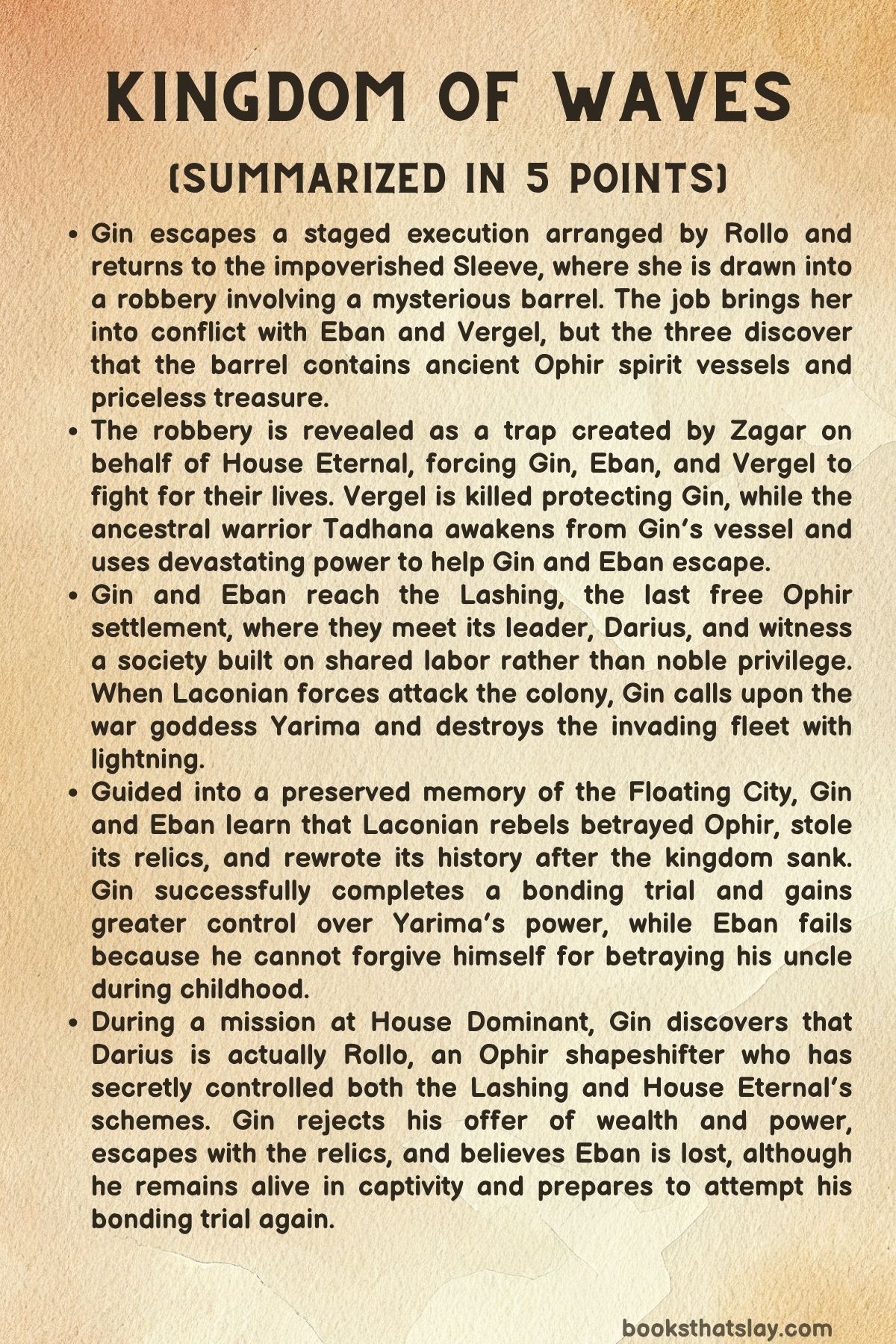
Summary
Gineth, usually called Gin, awaits execution at House Eternal after her forbidden relationship with Rollo, the noble family’s heir, is discovered. From hiding, she watches a young woman dressed like her apparently hanged, only to learn that Rollo arranged a false execution using a Guild thief and a safety harness.
Rollo guides Gin through secret passages beneath the palace but cannot accompany her without exposing the deception. He gives her money, directs her to a boatman named Bahram, and tells her to seek refuge at the Lashing, the last free Ophir settlement.
Returning to the impoverished Sleeve forces Gin back into the world she hoped to escape. She finds Bahram and arranges passage, but she still needs shelter until the boat departs.
Gin visits her former friend Charlie at Madame Verona’s pleasure house. Charlie has been beaten for helping Gin escape a predatory customer and cannot risk protecting her again, so Gin leaves rather than cause her more suffering.
Her last option is Aris, the aging thief who raised her after her mother died. Aris is ill and poor, but he agrees to shelter Gin if she helps him complete one final robbery involving treasure hidden inside a sewage barrel.
Elsewhere in the Sleeve, Eban Sadreal and his fifteen-year-old companion Vergel are recovering from a failed gambling-hall robbery. Their friend Angel was killed, their debts remain unpaid, and Eban believes one last successful job could finance their escape to the Lashing.
An informant named Zagar tells them that Guild thieves stole valuable objects from House Dominant and concealed them inside a barrel. The thieves plan to move the treasure while disguised as gong farmers, giving Eban and Vergel an opportunity to intercept them.
Gin and Aris pursue the same targets from another direction. When both groups attack, the robbery turns into a violent struggle among the original thieves, Gin’s crew, and Eban’s crew.
Aris and one of the Guild thieves stab each other and die. Gin, shocked by her mentor’s death, finds herself facing Eban and Vergel over the unopened barrel while Blackcoats approach.
Eban refuses to kill another Ophir merely for profit and proposes dividing the treasure. When they open the barrel, they discover jeweled vessels containing glowing spirits, along with gold, gems, and other riches.
Eban recognizes the objects from Ophir legends. The vessels once connected chosen descendants to ancestral spirits and the gods of the Floating City, giving their people powers capable of maintaining an entire kingdom.
The dead thieves bear official Guild markings. By killing licensed criminals protected by Lacon’s ruling houses, Gin, Eban, and Vergel have made themselves targets of both the Guild and the Blackcoats.
They take as many valuables and vessels as they can carry before fleeing. Gin can touch one spirit bottle without injury, while a different vessel burns Eban and rejects Vergel, suggesting that each relic responds to a particular descendant.
Eban leads the group to an isolated safe house. There they discover that Zagar gave identical information to both crews, intentionally placing them in conflict so that they would kill the Guild thieves and then destroy one another.
Gin describes the scarred informant and his silver ring, confirming Eban’s suspicions. Eban also shows Gin a double-diamond mark on his arm identical to the mark she has always considered a birthmark.
The symbol, the relics, and their shared desire to reach the Lashing persuade the three fugitives to make a temporary oath. They agree to protect one another and act for the future of the Ophir rather than for personal wealth alone.
Tension remains between Gin and Eban, especially when she speaks about Rollo. Eban believes the nobleman treated her as a secret possession or a charitable project, while Gin insists that Rollo cared for her and risked his life to save her.
The fugitives confront Zagar in a tavern and learn that House Eternal hired him. The estate wanted the stolen objects taken from House Dominant without beginning an open conflict between the two houses, so disposable Ophir criminals were manipulated into doing the dangerous work.
House Eternal guards surround the tavern. During the fight, Eban is wounded, and Vergel sacrifices himself to protect Gin from a fatal attack.
Desperate, Gin calls upon the spirit inside her vessel. The spirit manifests as Tadhana, an Ophir shieldmaiden, and releases a blast that destroys the tavern, kills their attackers, and allows Gin and Eban to escape.
Gin and Eban flee Lacon aboard Bahram’s boat. Eban mourns Vergel and resents how every attempt at freedom seems to demand another death, while Gin struggles with the guilt of surviving Aris, Charlie’s punishment, and the destruction around her.
When Gin asks Tadhana for guidance, the spirit vessel begins acting like a compass. Its light leads them across the water until they reach the Lashing, a floating settlement constructed from boats, rafts, platforms, and salvaged materials.
Darius, the Lashing’s polished and confident leader, permits them to enter. Although the settlement is poor, Gin and Eban see a community where resources are shared and Ophir people live without openly serving the Great Houses.
Darius immediately takes an interest in Gin and the stolen relics. He knows her full cultural name without being told and serves her from a goblet bearing House Eternal’s insignia, causing her to question his claimed loyalty.
The Lashing is attacked during Liberation Day, the Laconian celebration of Ophir’s defeat. The raiders arrive to capture new servants and prisoners for the estates, while Darius is conveniently absent on an intelligence mission.
Gin and Eban organize the settlement’s defense. When the Blackcoats and their ships overwhelm the poorly equipped residents, Gin calls upon Tadhana and the war goddess Yarima.
Lightning strikes the attacking fleet, destroying ships and throwing armored soldiers into the sea. The Lashing survives, although Gin is frightened by the scale of the power that moved through her.
Darius returns with information that the remaining vessels are stored beneath House Dominant. He proposes a mission to recover them and insists that Gin should remain behind, but she refuses to let him decide what dangers she may face.
Gin, Eban, and Darius sail toward Lacon. During the journey, Tadhana explains that the Laconians were rebels rather than foreign conquerors and that they destroyed or rewrote Ophir records after seizing power.
Gin begins reconsidering Rollo’s protection. She recognizes that he hid her from danger but never helped her build a life in which she could stand openly as his equal.
In Lacon, Gin and Eban obtain information from Silva, a former servant whose brother was beaten to death for stealing an orange. Silva directs them toward a sea cave that may connect to House Dominant’s underground passages.
Gin later sees Rollo distributing sweets and coins to impoverished Ophir children. His charity now appears less generous because it does nothing to challenge the system that keeps the children hungry.
When Rollo notices Gin alive, he turns away rather than approaching her. The moment destroys her remaining hope that she might return to House Eternal or recover the life she once imagined there.
Gin and Eban travel toward the sea cave, but an unnatural current overturns their boat. Instead of drowning, they discover that they can breathe underwater and enter a preserved ancestral memory of the Floating City.
Luwalhati, Ophir’s last archivist, welcomes them into the memory. She explains that the spirit vessels once allowed chosen descendants to bond with ancestors and communicate with the gods.
The bonded people maintained the magic that kept Ophir above the sea. During a celebration, Laconian rebels slaughtered them, stole the vessels, and attempted to command the gods for themselves.
Because the rebels lacked the proper ancestry and spiritual connection, the magic failed. Ophir sank, its survivors scattered, and the conquerors rewrote history to portray the fallen civilization as weak and backward.
Luwalhati identifies Gin as a descendant of the Matabagka Warrior Clan. Eban descends from the Duke of Chryse and carries royal blood linked to King Mangsana.
Both must complete bonding trials before they can fully use the relics. The trials force each candidate to confront guilt, fear, and concealed truths, and failure may bring rejection or death.
Eban’s trial reveals the secret he has carried since childhood. While fleeing Blackcoats, he deliberately injured his uncle so that the man would be captured while Eban escaped.
He later adopted his uncle’s name as both punishment and tribute. Unable to forgive himself or separate his identity from the betrayal, Eban begs for the trial to stop and fails to complete the bond with King Mangsana.
Gin’s trial forces her to witness Ophir’s destruction and confront the people she harmed during her criminal years. She also faces her dependence on Rollo and the shame that made her believe Laconian acceptance determined her worth.
Gin accepts that she cannot erase her capacity for violence, but she can decide whom and what she fights for. She endures Yarima’s power and successfully bonds with Tadhana, emerging with greater control over lightning.
Luwalhati commands them to recover the stolen vessels and restore the Drowned City. Their mission is no longer simply about escaping Lacon or becoming wealthy; it concerns the possible return of Ophir’s history, power, and national identity.
Back at the Lashing, Darius creates a new plan during House Dominant’s Liberation Day celebration. Gin and Eban will enter among Ophir seeking temporary work, while Darius disguises himself as a nobleman and approaches the vault separately.
The estate guards select only strong applicants. Gin and Eban soon discover that the supposed workers have been chosen as victims for an arena reenactment of Ophir’s defeat.
A mechanical killing machine called the Octoblade is released before an audience of cheering nobles. Gin sees Rollo watching from the stands and understands that he will not intervene.
Eban encourages Gin to save herself and the other prisoners. His faith in her strength contrasts with Rollo’s need to keep her hidden and dependent.
Gin destroys the Octoblade with lightning and directs the prisoners toward freedom. The resulting fire spreads through the arena and the machinery beneath House Dominant.
Gin and Eban enter the underground passages in search of the vault. They discover cages filled with Ophir prisoners, including Silva, who explains that House Dominant planned to use them in future spectacles.
Eban refuses to leave the captives, partly because abandoning them would repeat what he did to his uncle. He orders Gin to continue toward the relics alone while he remains behind to open every cage.
Before separating, Gin and Eban admit their feelings through a kiss. They promise to meet at the eastern garden by sundown.
Eban frees the prisoners but is captured by Rollo and the Blackcoats. Rollo reveals knowledge of the relic mission and suggests that even Eban’s earlier failed robbery may have been manipulated as part of a larger plan.
Gin reaches the vault and finds Darius already carrying the relics. He admits that he possessed the vault key and deliberately used Gin and Eban as distractions.
Darius then transforms into Rollo. Gin learns that the Lashing’s leader and the heir of House Eternal are the same person, using power received through a bond with Dokpilan, the trickster god.
Rollo was born Ophir and carried the royal double-diamond mark. Lady Ariadne adopted him because she hoped his blood could unlock a spirit vessel, and his shapeshifting later allowed him to replace her dead son.
Rollo claims his double life helps the Ophir survive, but he secretly gives the Lashing’s location to Laconian raiders and supplies the estates with captives. He protects the community only enough to preserve his authority over it.
He plans to force selected descendants to bond with the stolen vessels so that he can control their powers. He offers Gin wealth, safety, political influence, and a place beside him.
Gin recognizes that Rollo never treated her as an equal. His protection, charity, and affection depended on her remaining vulnerable, grateful, and easy to control.
When direct magical force fails against Dokpilan’s power, Gin pretends to accept Rollo’s offer. As he embraces her, she stabs him, takes the chest of relics, and escapes.
Gin reaches the eastern garden, but Eban does not appear. Perlah arrives with a boat, and Gin is forced to leave as House Dominant burns and the Blackcoats close in.
Months later, Eban remains imprisoned deep beneath House Eternal. Rollo survived Gin’s attack, although the wound refuses to heal properly.
Despite torture and isolation, Eban has not abandoned hope. He calls upon King Mangsana and announces that he is ready to face the bonding trial again, suggesting that captivity may become the beginning of his return rather than the end of his story.
Characters
Gineth “Gin”
Gin is the central force of Kingdom of Waves, beginning as a survivor whose ambitions are shaped by hunger, danger, and the desire for personal security. She has spent much of her life believing that safety belongs to powerful people and that the best she can hope for is protection from someone like Rollo.
Her criminal upbringing makes her alert, resourceful, and willing to use violence when necessary. Aris trained her to act quickly and distrust others, yet her experiences with Charlie, Vergel, and the residents of the Lashing show that she has never lost her concern for people who suffer because of her choices.
Gin’s attachment to Rollo reveals her deepest emotional vulnerability. She mistakes secrecy for devotion because she has rarely experienced comfort without conditions, and House Eternal offers her a life that seems removed from the cruelty of the Sleeve.
Her growth begins when she recognizes that Rollo’s protection depends on inequality. He can rescue her privately, but he will not challenge the society that makes her rescue necessary.
The bonding trial forces Gin to accept her history without pretending that survival left her innocent. She acknowledges the harm she caused but chooses to direct her strength toward liberation rather than personal escape.
Her final rejection of Rollo completes this transformation. She turns away from luxury and dependence, chooses responsibility for the relics, and accepts that restoring Ophir will demand courage without any guarantee of comfort.
Eban Sadreal
Eban is a skilled thief, strategist, and idealist whose confidence hides severe guilt. He speaks boldly about rebuilding Ophir, but privately believes that one act of childhood cowardice has made him unworthy of love, leadership, or survival.
His loyalty to other Ophir people shapes nearly every major decision he makes. Even when he considers killing Gin for the treasure, he refuses because he has promised never to harm one of his own people merely for profit.
Eban’s relationship with Vergel reveals his protective nature. He treats the younger boy as family, carries responsibility for their debts, and imagines the Lashing as a place where they might finally live without fear.
Vergel’s death deepens Eban’s anger and reinforces his belief that everyone close to him suffers because of his choices. This grief contributes to his difficult behavior toward Gin, especially when jealousy and distrust make him judge her relationship with Rollo harshly.
His failed bonding trial is the clearest expression of his inner conflict. Eban cannot accept that the frightened child who betrayed his uncle and the man who repeatedly risks himself for others are the same person.
By remaining behind to free House Dominant’s prisoners, he begins acting against the pattern that has defined his shame. His capture is tragic, but it also proves that he no longer values his own escape above the lives of other Ophir.
In the final scene, Eban’s decision to attempt the trial again suggests that he is beginning to understand redemption as continued action rather than the erasure of guilt. His future role in Kingdom of Waves depends on whether he can reclaim his identity without denying the person he once was.
Rollo / Darius
Rollo is the book’s most deceptive character because nearly every generous act he performs conceals a desire for control. As Rollo, he appears to be a sympathetic nobleman troubled by the suffering of the Ophir, while as Darius, he presents himself as the capable leader of their last free settlement.
His history complicates his betrayal. He was born Ophir, adopted by Lady Ariadne, and used because his blood could activate a spirit vessel.
After bonding with Dokpilan, he gains shapeshifting abilities and replaces Ariadne’s dead son. This transformation gives him access to Laconian wealth, but it also teaches him to value power within the existing system more than freedom from it.
Rollo believes that managing oppression is more realistic than ending it. He allows the Lashing to survive, yet repeatedly exposes it to raids and supplies captives to the estates.
His treatment of Gin follows the same pattern. He rescues and comforts her, but only while she remains hidden, dependent, and grateful for whatever protection he chooses to provide.
Rollo’s offer in the vault reveals that he cannot imagine Gin wanting anything beyond the privileges he values. He assumes that wealth and authority will persuade her to abandon Eban, the relics, and the broader Ophir cause.
His magical bond with Dokpilan reflects his personality. He relies on disguise, manipulation, divided loyalties, and the ability to make exploitation appear like compassion.
Vergel
Vergel is Eban’s younger companion and the moral caution within their partnership. He repeatedly questions reckless plans, recognizes traps earlier than Eban, and understands that desperation can make a large reward appear safer than it truly is.
Although Vergel lacks Eban’s confidence, he possesses deep loyalty. He remains beside Eban after the gambling-hall disaster, even though Angel has died and their debts have increased.
His willingness to cooperate with Gin shows that he does not automatically treat every stranger as an enemy. He prefers negotiation to unnecessary killing and supports the group’s attempt to pay Zagar rather than execute him.
Vergel’s death is an act of instinctive courage. He places himself between Gin and a fatal attack, sacrificing his life for someone he has known only briefly.
His loss becomes one of the emotional foundations of Gin and Eban’s relationship. Gin carries guilt because he died protecting her, while Eban must learn not to convert his grief into resentment against the person Vergel chose to save.
Tadhana
Tadhana is an ancestral shieldmaiden who served Queen Bulakna before Ophir’s destruction. Her spirit survives inside Gin’s vessel and becomes the bridge between Gin’s personal struggle and the lost history of her people.
She is sharp, demanding, and unwilling to offer comforting lies. Rather than teaching Gin to reject violence completely, Tadhana helps her understand that power carries responsibility and must be directed by conscious choice.
Tadhana’s bond with Gin is based on shared ancestry, but it becomes meaningful through trust. She responds when Gin asks for help, guides her through the bonding trial, and reminds her of her chosen identity when Rollo’s magic weakens her resolve.
Through Tadhana, Gin gains access to Yarima’s power without becoming merely a weapon. The spirit provides memory, discipline, and moral guidance, helping Gin connect magical strength with service to her community.
King Mangsana
King Mangsana is the ancestral spirit connected to Eban’s vessel. As Ophir’s first ruler, he represents the history, authority, and responsibility associated with Eban’s royal blood.
His trial does not reject Eban because the thief lacks courage or intelligence. It fails because Eban remains unable to acknowledge his past without allowing it to define his entire identity.
Mangsana’s continued presence after the failed trial is important. The king does not abandon Eban permanently, suggesting that worthiness is not determined by a single moment of fear.
The spirit’s call follows Eban into captivity. This connection offers Eban a path toward freedom, but only after he learns that leadership requires honest acceptance of weakness as well as strength.
Luwalhati
Luwalhati is the last archivist of Ophir and the guardian of its preserved ancestral memory. She protects the history that Lacon attempted to destroy and explains how the Floating City truly fell.
Her role is not simply to provide information. She restores cultural continuity by showing Gin and Eban that their people once possessed knowledge, art, political institutions, magic, and a complex spiritual tradition.
Luwalhati also refuses to treat ancestry as automatic proof of virtue. She explains that blood may awaken a vessel, but only a successful confrontation with fear and guilt can create a stable bond.
Her command to recover the relics transforms Gin and Eban from fugitives into agents of restoration. She gives their survival a historical purpose while warning them that inherited power does not remove personal responsibility.
Aris
Aris is the thief who raises and trains Gin after her mother’s death. He gives her the skills that keep her alive, but he also introduces her to violence and teaches her to view exploitation as an unavoidable part of survival.
By the time Gin returns to him, Aris is old, ill, and nearly abandoned. His condition shows the likely future awaiting criminals in the Sleeve once they can no longer protect themselves or earn money.
His final robbery is motivated by desperation and the hope of retiring with dignity. Instead, the job leads to his death and pulls Gin into the larger struggle surrounding the relics.
Gin’s feelings toward Aris remain complicated. She mourns him as a parent and mentor while recognizing that the life he taught her caused lasting harm.
Lady Ariadne
Lady Ariadne represents the calculated cruelty of Lacon’s ruling houses. She appears to defend noble order, yet she privately uses deception, criminal networks, and disposable Ophir lives to advance House Eternal’s interests.
Her adoption of Rollo is not an act of compassion. She selects him because his royal Ophir blood may allow her to control a spirit vessel.
Ariadne’s actions help create the person Rollo becomes. By teaching him that identity, affection, and status are tools, she encourages him to understand power as the ability to manipulate everyone around him.
Even when she is not physically present, her influence shapes the plot. The false execution, Zagar’s operation, Rollo’s position, and House Eternal’s pursuit of the relics all connect to the system she helps maintain.
Zagar Aguirre
Zagar is an informant who profits by selling useful truths without loyalty to anyone affected by them. His beggar disguise and silver ring reflect his ability to move between poverty, criminal activity, and noble employment.
He gives the same robbery information to Aris and Eban, ensuring that multiple Ophir crews will attack one another. His plan depends on the ruling houses’ assumption that poor Ophir lives can be spent without political consequence.
Zagar’s confidence in the tavern comes from believing the victims of his scheme have no legal or social protection. He does not expect Gin, Eban, or Vergel to survive long enough to challenge him.
His death ends one part of the conspiracy but reveals a more troubling truth. He is not the mastermind; he is a paid instrument within a system that repeatedly turns the oppressed against one another.
Perlah
Perlah is one of the Lashing’s defenders and initially approaches Gin and Eban with suspicion. Her caution is reasonable because the settlement survives only by hiding its location and reacting quickly to possible threats.
She participates directly in protecting the community and survives the Liberation Day raid. Unlike Darius, whose leadership depends on secrets, Perlah’s loyalty is demonstrated through visible service.
At the end, she arrives at House Dominant with the escape boat and helps Gin carry the relics away. Her actions make her an important link between Gin’s success and the future of the Lashing.
Silva
Silva is a former servant who understands the brutality of both House Eternal and House Dominant. Her brother was killed for stealing an orange, showing how Laconian law treats minor resistance by the Ophir as an offense deserving extreme punishment.
Her grief becomes a source of action rather than passive despair. She gives Gin and Eban information about the sea cave and later helps Eban free prisoners from House Dominant’s underground cages.
Silva also becomes a practical leader during the escape. She directs the released captives through hidden passages and helps turn Eban’s individual decision into a successful rescue.
Her character demonstrates how ordinary people preserve resistance through knowledge of buildings, work routines, service passages, and the private crimes of the powerful.
Bahram
Bahram is the boatman who agrees to help Gin reach the Lashing. His mismatched eyes confirm his identity and give him an unusual presence during Gin’s return to the Sleeve.
He is cautious about romantic ideas of Ophir’s restoration. Having seen repeated attacks on the Lashing, he understands that hope without preparation can lead people into danger.
Even so, Bahram keeps his agreement and provides Panglaban. His assistance gives Gin and Eban their first genuine route out of Lacon and makes the later discovery of the Lashing possible.
Charlie
Charlie is Gin’s friend from Madame Verona’s pleasure house. Her bruises and scars show the personal cost of helping someone resist the demands of violent customers and controlling employers.
She wants to protect Gin but understands that sheltering her again may bring further punishment. Her refusal is not a rejection of friendship; it is the response of someone whose choices have been restricted by fear and abuse.
Gin’s decision to leave rather than endanger Charlie shows that she is already capable of placing another person’s safety above her own immediate need. Charlie’s brief appearance therefore contributes to Gin’s moral development.
Madame Verona
Madame Verona controls the pleasure house where Gin once worked in the kitchen. Although she provides employment, she also participates in a system that exposes vulnerable workers to exploitation and punishes resistance.
Her order that Gin must be reported prevents Charlie from offering meaningful help. Verona represents people who survive within oppressive systems by enforcing their rules against those with even less power.
She is not presented as equal to the Great Houses, but her behavior shows how domination reproduces itself at every social level. Those who lack freedom may still gain limited authority by policing others.
Angel
Angel is Eban and Vergel’s friend who dies during the failed gambling-hall robbery. Although he appears only through memory, his death establishes the emotional and financial desperation behind Eban’s decision to accept Zagar’s offer.
Angel’s loss also shows that Eban’s adventures have consequences before Gin enters his life. Vergel’s later death continues a pattern in which young Ophir are sacrificed while pursuing the smallest chance of independence.
Yarima
Yarima is the Ophir war goddess whose power becomes available through Gin’s bond with Tadhana. Her lightning can destroy fleets, machines, buildings, and soldiers, making her one of the strongest forces in the story.
The goddess is not a neutral source of energy. Her history, emotions, and former love for Dokpilan affect how Gin can use her power against Rollo.
Yarima’s connection to Gin reflects the difficult union of anger and responsibility. The power becomes destructive when released without control, but it can also defend communities and break instruments of oppression.
Dokpilan
Dokpilan is the trickster god linked to Rollo. His abilities allow Rollo to alter his appearance, maintain separate identities, and manipulate people across both Laconian and Ophir society.
The god’s connection with Yarima creates a weakness in Gin’s magic. Rollo attempts to use an ancient divine relationship to persuade the goddess that resistance is futile.
Dokpilan’s influence matches Rollo’s approach to power. Both depend on appearances, emotional pressure, uncertainty, and the destruction of trust.
Queen Bulakna
Queen Bulakna is the ruler Tadhana served before the fall of Ophir. Although she is not active in the present-day plot, her position gives historical context to the shieldmaiden’s identity and loyalty.
She represents the political order that existed before Laconian rebels destroyed the bonded descendants. Her remembered reign challenges Lacon’s claim that Ophir lacked civilization or legitimate leadership.
King Alred
King Alred is associated with the water-dragon symbol found on uniforms used during House Dominant’s arena spectacle. The symbol supports Tadhana’s claim that Lacon began through rebellion within Ophir rather than conquest by a completely separate people.
His historical significance lies in the uncertainty surrounding him. The official story treats Laconian power as legitimate, while surviving Ophir evidence suggests that Alred’s rise depended on betrayal and the destruction of historical records.
Themes
The Erasure and Recovery of History
Lacon maintains power not only through soldiers, laws, and poverty but also through control of the past. In Kingdom of Waves, the official account portrays the Ophir as defeated, backward, and naturally suited to servitude, allowing later generations of Laconians to treat oppression as the result of history rather than an ongoing political choice.
The preserved Floating City exposes this account as a deliberate construction. Ophir possessed scholarship, architecture, religious traditions, magical knowledge, royal institutions, and archives extensive enough to challenge every assumption Gin and Eban were taught.
The destruction of the bonded descendants was therefore more than a military attack. By killing the people capable of maintaining the city’s magic and stealing the vessels that connected them to their ancestors, the rebels severed the survivors from the institutions that preserved collective memory.
Fragments of Ophir culture continue to survive in marks, clothing patterns, stories, names, and repeated designs whose meanings have been forgotten. Gin’s recognition of these fragments demonstrates that cultural destruction is rarely complete, even after centuries of suppression.
Recovering history gives the characters more than pride. It provides evidence that their present condition was created by human decisions and can therefore be changed through new decisions.
The relics become politically dangerous because they restore both power and memory. A people who understand what was taken from them may no longer accept limited charity, hidden settlements, or survival under terms established by their conquerors.
Survival, Guilt, and Redemption
Gin and Eban survive by making choices that leave lasting moral injuries. Gin has harmed people during her years as a thief, while Eban escaped capture by deliberately disabling his uncle and allowing the Blackcoats to take him.
Neither character can build a meaningful future by pretending these acts did not occur. Their bonding trials demand recognition rather than denial, forcing them to confront the difference between explaining a choice and excusing it.
Gin succeeds because she accepts that survival changed her without deciding that it destroyed all possibility of goodness. She acknowledges her capacity for violence and chooses to use it in defense of others.
Eban fails because he continues to treat guilt as his complete identity. Adopting his uncle’s name keeps the memory alive, but it also prevents him from believing that later courage can have genuine meaning.
His decision to remain behind and free the prisoners becomes an act of redemption because it directly opposes the choice that has haunted him. As a child, he sacrificed another person for his freedom; as an adult, he sacrifices his freedom so that many others can escape.
Redemption in the story is therefore not presented as forgiveness granted after one heroic deed. It is the continuing decision to act differently while accepting that the past cannot be undone.
Protection, Control, and Genuine Love
Rollo and Eban offer Gin two sharply different forms of care. Rollo protects her by hiding her, providing comfort, and controlling the circumstances in which she is permitted to exist.
His affection depends on unequal power. Gin must remain secret, grateful, and vulnerable so that Rollo can continue viewing himself as her rescuer.
Eban is often difficult, jealous, and unfair, but he gradually learns to respect Gin’s independence. During the arena attack, he does not tell her to wait for rescue; he tells her that she has the power to save herself and the prisoners around her.
This difference helps Gin understand that protection can become another form of possession. Rollo’s generosity toward Ophir children works in the same way as his treatment of Gin because it relieves visible suffering without challenging the conditions that produce it.
His leadership of the Lashing extends this false protection to an entire community. He permits the settlement to survive while secretly exposing it to raids, ensuring that its residents remain dependent on his information and authority.
Genuine love requires recognizing another person’s right to make dangerous choices. Gin and Eban’s relationship develops only after both stop attempting to decide what the other is capable of facing.
Collective Freedom Versus Personal Security
Gin initially imagines the stolen treasure as a route toward private safety. After a life shaped by hunger and fear, an estate, money, and freedom from criminal work appear more realistic than rebuilding a lost kingdom.
Eban interprets the relics differently. He believes they belong to all Ophir descendants and may restore something no individual fortune can provide: a homeland, a shared history, and freedom from inherited servitude.
Rollo offers Gin the most attractive form of personal security. He promises luxury, authority, protection, and a place beside him within the system that once condemned her.
Accepting his offer would protect Gin while leaving the larger structure unchanged. Other Ophir would remain servants, prisoners, entertainment for arena crowds, and tools through which Rollo could obtain additional magical power.
Gin’s final choice does not reject comfort because suffering is noble. She rejects a form of comfort purchased through cooperation with the oppression of others.
The Lashing provides an imperfect alternative. It is unstable, poor, and vulnerable to attack, but its people share labor and resources without organizing society around inherited Laconian privilege.
By taking the vessels back to the Ophir, Gin chooses collective uncertainty over private certainty. Her decision suggests that real freedom cannot exist when one person’s safety depends on accepting the continued subordination of everyone like her.