The Best I Never Had Summary, Characters and Themes
The Best I Never Had by Amy Buchanan is a contemporary romance about second chances, family obligations, and the courage to pursue personal happiness.
Set against the picturesque Blue Ridge Mountains, the novel follows Thea Pappas and Owen Hayes, two people whose fabricated relationship unexpectedly becomes the foundation for genuine love. Both have spent much of their lives protecting younger siblings and meeting the expectations of others, leaving little room for their own desires. When their siblings announce their engagement, Thea and Owen must confront an old deception, complicated family relationships, and their growing attraction. Their story explores how love can flourish when people finally allow themselves to be vulnerable.
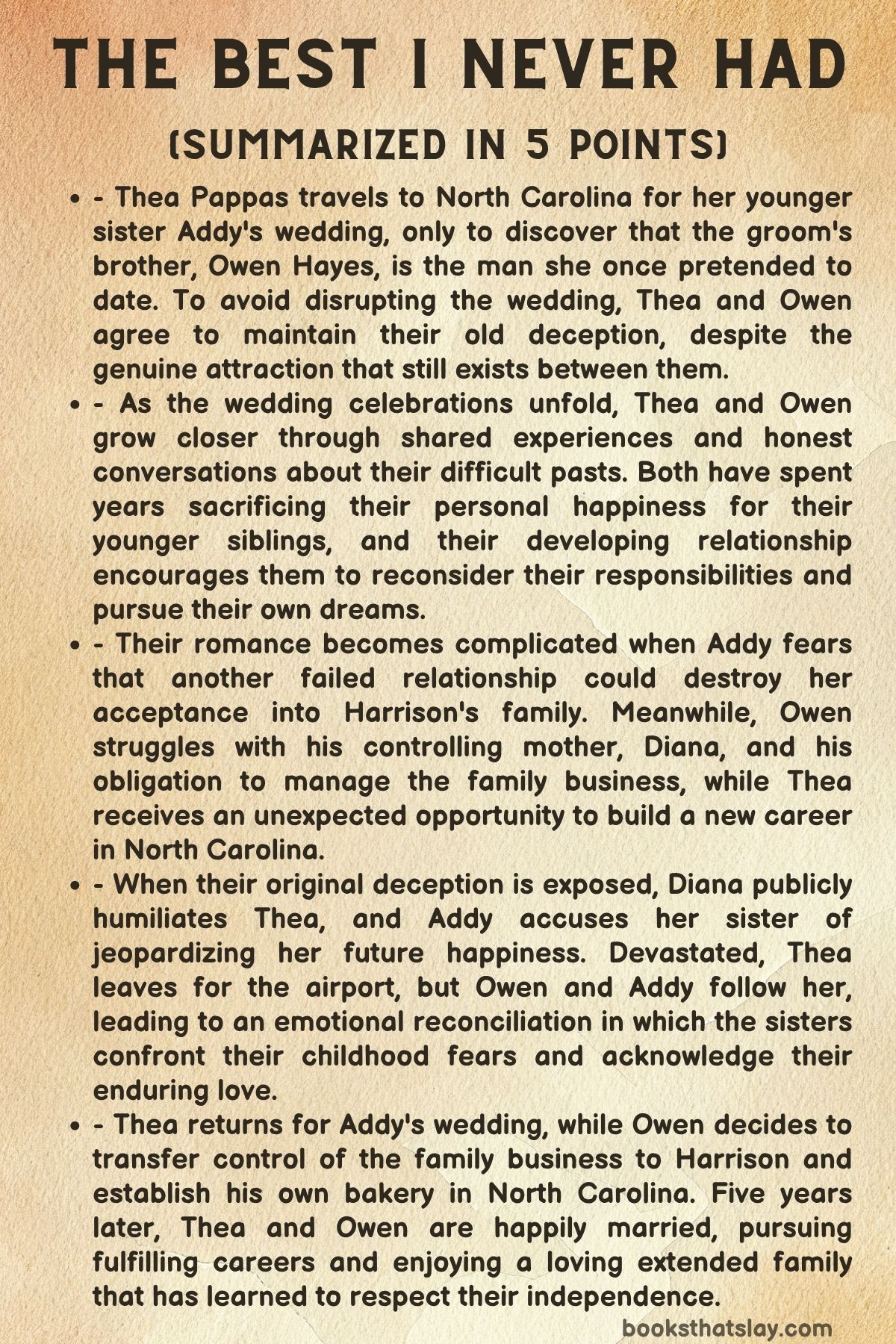
Summary
Thea Pappas has spent most of her adult life protecting her younger sister, Adelaide, whom she affectionately calls Addy. Having grown up together in foster care after their mother’s death, Thea considers her sister’s happiness the most important responsibility in her life.
When Addy announces that she is marrying Harrison Hayes after only three months of dating, Thea is astonished by the speed of their relationship. Nevertheless, she agrees to serve as maid of honor and accompany her sister to Harrison’s family vineyard in North Carolina.
Thea’s circumstances become more difficult when Gordon, her manager at the Italian restaurant where she has worked for years, unexpectedly fires her. With limited savings and an uncertain future, she travels to the Blue Ridge Mountains determined to make Addy’s wedding unforgettable.
What Thea does not realize is that Harrison’s older brother is Owen Hayes, a man she met three years earlier under extraordinary circumstances. At that time, Owen paid her to pretend to be his girlfriend during a family wedding, hoping to escape his mother’s relentless matchmaking.
Their arrangement lasted only a weekend, but the connection between them remained memorable. Although they never pursued a genuine relationship, neither entirely forgot the other.
Owen has continued thinking about Thea while struggling with the responsibilities he inherited after his father’s death. He manages Hayes Electric, supports his mother, Diana, and has spent years ensuring that Harrison enjoys opportunities he himself surrendered.
When Thea arrives at the vineyard and recognizes Owen, her shock causes her to stumble into the enormous welcome cake. Their awkward reunion becomes even more complicated when Owen reveals that his family still believes they once dated.
Rather than expose their original deception, they agree to maintain the fiction until after Addy’s wedding. Thea worries that confessing could damage her sister’s relationship with her future in-laws, while Owen fears upsetting his emotionally demanding mother.
As the wedding festivities begin, Thea finds herself welcomed by Owen’s extended family. His grandmother, Cece, his cousins, and several other relatives remember her fondly, while Diana enthusiastically imagines reuniting the supposedly heartbroken couple.
However, the family’s affection for Thea creates unexpected difficulties for Addy. Having always longed for a permanent family, Addy feels overshadowed by her older sister’s effortless popularity and worries that Harrison’s relatives will never accept her as fully.
Thea becomes increasingly protective whenever Diana makes insensitive remarks about Addy’s place in the family. Her determination to defend her sister occasionally creates uncomfortable situations, but Owen begins appreciating her willingness to confront problems others prefer to ignore.
During a family outing to Sliding Rock, Thea and Owen experience the easy companionship they enjoyed three years earlier. Their shared laughter and playful challenges remind them that their connection was never entirely artificial.
Yet Addy privately asks Thea not to rekindle her romance with Owen. She fears that another breakup could produce lasting tensions between the families, leaving her marriage and future security vulnerable.
Thea promises to keep her distance, although doing so becomes increasingly difficult.
At a family baseball game, Owen helps Thea learn to swing a bat, and their physical closeness intensifies their attraction. When she injures her elbow, he tends to her with a gentleness that makes their supposedly ended relationship feel increasingly genuine.
Meanwhile, Cece discovers that their original romance was fabricated. Rather than immediately exposing them, she challenges both to reconsider the lives they have constructed around other people’s expectations.
Thea initially resents Owen for appearing ungrateful toward his loving family. Having experienced childhood instability, she struggles to understand why he would want freedom from relatives whose affection she has always desired.
Owen eventually explains that his father’s illness and death forced him into adulthood before he was ready. He inherited the family business, assumed responsibility for Harrison, and became the person everyone depended upon, leaving his own ambitions unexplored.
Thea responds by sharing painful details of her childhood, including her mother’s death from an overdose and the sisters’ repeated foster placements. Their conversation allows them to recognize that different experiences of family responsibility can produce remarkably similar emotional burdens.
Their growing understanding leads to greater intimacy, particularly during the wedding party’s celebrations. At a local bar, Harrison surprises Addy by arranging for the sisters to sing together, allowing Thea to rediscover her remarkable musical talent.
Owen watches her performance with admiration and realizes that his feelings extend far beyond physical attraction. He appreciates her humor, loyalty, determination, and willingness to defend people she loves.
Later, they share their first kiss after Owen admits that he has dreamed about her since their original encounter. He explains that he never kissed her while paying her to pretend to be his girlfriend because he feared exploiting the arrangement.
Their happiness is interrupted when his cousin Camila discovers them together. Although she agrees to preserve their secret, the encounter increases Thea’s anxiety about jeopardizing Addy’s wedding.
A crisis involving the wedding cake subsequently forces Thea and Owen to spend several days baking together. Thea discovers that Owen developed his passion for baking after his father’s death, when he wanted to make a birthday cake for Harrison.
Working alongside him reveals how much satisfaction he derives from creating something entirely through his own efforts. She encourages him to consider building a career around this passion rather than remaining indefinitely at Hayes Electric.
Their attraction becomes increasingly difficult to resist, but Thea repeatedly withdraws because she believes her happiness must remain secondary to Addy’s security.
The sisters’ relationship becomes strained when Thea offers Addy a necklace that belonged to their mother. Addy refuses to wear it, explaining that she associates their mother with abandonment and suffering rather than affection.
Thea interprets her sister’s rejection of the necklace as a rejection of their shared childhood. Deeply upset, she seeks comfort from Owen, and their emotional closeness develops into physical intimacy.
Afterward, Owen makes it clear that he wants something more substantial than a temporary romance. They agree to explore their feelings privately and reveal the truth to their families after the wedding.
Thea also begins reconsidering her tendency to suppress her emotions around Addy. Encouraged by her best friend, Vaughn, she realizes that their relationship cannot remain healthy if she continually avoids conflict out of fear of abandonment.
The sisters reconcile, acknowledging that they remember their mother differently without allowing those differences to destroy their bond.
Meanwhile, Thea helps Camila manage the family’s restaurant during an unexpected staffing difficulty. Her professional confidence, experience, and creative ideas impress Camila, who recognizes that she would make an excellent manager.
The possibility of working in North Carolina offers Thea an exciting opportunity to rebuild her career.
Owen also begins questioning his professional future when Harrison expresses interest in assuming greater responsibility at Hayes Electric. He gradually realizes that protecting his younger brother has sometimes prevented Harrison from exercising his own independence.
During an afternoon together, Thea and Owen collect the wedding rings and explore a nearby town. Their return journey is interrupted by a violent thunderstorm, forcing them to shelter overnight in a barn.
Away from their families, they discuss their ambitions and discover how naturally their individual hopes could fit together. Their relationship begins to feel like a genuine future rather than a temporary escape.
Unfortunately, the following morning brings new complications when a fallen branch damages Thea’s car. Their relatives eventually locate them, and Owen returns to finish the wedding cake with Diana.
During their conversation, he tentatively mentions his desire to establish a bakery. Diana dismisses the idea, insisting that his obligations to the family business must come first.
She also reveals that Camila has offered Thea a restaurant-management position in North Carolina. Believing Thea has already accepted without consulting him, Owen assumes that she never intended to pursue their relationship seriously.
His hurt makes him distant throughout the rehearsal celebrations. Thea, unaware of the misunderstanding, cannot understand why he suddenly refuses her affection.
When she finally confronts him, Owen admits that he assumed she had chosen another future. Thea explains that she had intended to discuss the offer with him and reassures him that she wants them to make decisions together.
They reconcile, acknowledging that their fears of rejection have prevented them from communicating honestly.
Their happiness collapses when Addy discovers their renewed relationship. Terrified that Diana will uncover their original deception, Addy begs Thea to abandon Owen before the situation damages her marriage.
Thea confesses that she and Owen never actually dated three years earlier, but the revelation only intensifies Addy’s fears. Haunted by memories of their unstable childhood, Thea begins believing that pursuing Owen would constitute another failure to protect her sister.
She reluctantly ends the relationship, devastating them both.
Their private farewell is interrupted when Diana discovers them kissing in a storage closet. The situation escalates when Vaughn arrives and Diana mistakenly assumes that Thea has been romantically involved with another man.
During the resulting confrontation, Camila exposes the original fake relationship. Diana becomes furious, accusing Thea of manipulating Owen and making cruel remarks about the sisters’ childhood.
Harrison defends Addy, but the confrontation leaves her overwhelmed. She accuses Thea of repeatedly choosing Owen despite knowing how frightened she feels about losing her newly discovered family.
When Addy demands that Thea leave, Thea accepts the rejection as confirmation of her worst fears.
She writes Diana a letter falsely accepting responsibility for the original deception, hoping to protect Owen and Addy from further accusations. Then, with Vaughn’s help, she departs for the airport before the wedding.
Owen discovers her disappearance the following morning and finally refuses to continue sacrificing his happiness to manage Diana’s emotions. He admits that he never wanted to run Hayes Electric and insists that his mother must accept his right to pursue another life.
Harrison reveals that his years of changing departments were intended to prepare him to lead the company. He offers to buy Owen’s share, creating an opportunity for his brother to pursue baking professionally.
Meanwhile, Addy realizes that her desperation for acceptance has caused her to hurt the person who has always protected her. She accompanies Owen and several relatives to the airport to bring Thea home.
There, the sisters finally discuss the guilt and resentment that have shaped their relationship. Addy assures Thea that their repeated foster placements were never her fault and that her sacrifices made their childhood survivable.
She also acknowledges her jealousy of Thea’s confidence and popularity. Thea realizes that loving her sister does not require surrendering every possibility of personal happiness.
When they emerge from the airport, Owen and the extended family are waiting with signs welcoming Thea back. Owen tells her that he loves every part of her, including the qualities she has always considered flaws.
They return to the vineyard together, determined to build a future based on honesty rather than fear.
Owen formally asks Thea to be his girlfriend and reveals that he plans to open a bakery in North Carolina after training Harrison for six months. Thea can therefore accept Camila’s restaurant-management offer without sacrificing their relationship.
Diana eventually apologizes for her behavior, although Owen makes it clear that their reconciliation requires genuine change. She begins acknowledging the grief and need for control that have damaged her relationships with her sons.
On the wedding day, Addy honors Thea by incorporating a bead from a childhood bracelet into her necklace and asking her to walk her down the aisle. The gesture confirms that their sisterhood will remain secure even as Addy creates a new family with Harrison.
The wedding becomes a celebration of both romantic love and renewed family relationships.
Five years later, Thea and Owen are happily married in North Carolina. Owen’s successful bakery is expanding, while Thea continues managing the family restaurant and developing its connection with the local community.
Addy and Harrison have five children, and their extended family remains closely connected. Diana has made progress through therapy, while Owen has worked through the resentment he carried for years.
Having devoted much of their youth to caring for their siblings, Thea and Owen choose not to have children themselves. Their marriage gives them the freedom, companionship, and unconditional acceptance they once believed were beyond their reach.
Characters
Thea Pappas
Thea Pappas is the central female protagonist of The Best I Never Had, a fiercely independent woman whose outward confidence conceals profound insecurities about love, belonging, and personal worth. Her experiences in foster care have convinced her that relationships are fragile and that keeping her younger sister safe requires constant vigilance.
Thea’s defining characteristic is her protective devotion to Addy. Having assumed responsibility for her sister during childhood, she has carried that obligation into adulthood, frequently placing Addy’s happiness above her own ambitions.
This devotion becomes both her greatest strength and her most significant emotional limitation. She is willing to sacrifice opportunities, relationships, and professional advancement whenever she believes her sister’s security is threatened.
Her outspoken personality creates an interesting contradiction. Although she readily confronts strangers and challenges unfair behavior, she struggles to express anger toward people whose affection she fears losing.
This contradiction emerges most clearly in her relationship with Addy. Thea believes that disagreement might lead to abandonment, so she often conceals her feelings until resentment becomes overwhelming.
Her relationship with Owen challenges these established patterns. His patience and acceptance gradually help her recognize that expressing anger, making mistakes, and pursuing personal happiness do not make her undeserving of love.
Thea’s professional development is equally significant. Losing her restaurant job initially reinforces her insecurity, but Camila’s recognition of her abilities helps her discover that she has valuable skills and ambitions beyond caring for her sister.
Her eventual decision to accept a position in North Carolina represents a new understanding of independence. She learns that building a fulfilling life does not require abandoning her family.
By the novel’s conclusion, Thea has stopped defining herself exclusively through sacrifice. Her marriage to Owen demonstrates her ability to accept affection without continually fearing that it will disappear.
Owen Hayes
Owen Hayes is the male protagonist of The Best I Never Had, a responsible and emotionally restrained man who has spent years fulfilling obligations he never consciously chose. His father’s death forced him to assume responsibility for both his younger brother and the family business, leaving little opportunity to consider his own desires.
Owen’s dependability initially appears admirable, but the novel gradually exposes its emotional cost. He has become so accustomed to meeting other people’s needs that he struggles to recognize when those expectations are unreasonable.
His relationship with Diana illustrates this difficulty. Although he loves his mother, he feels responsible for maintaining her emotional stability and preserving his father’s professional legacy.
Thea’s arrival disrupts his carefully controlled existence. Unlike his relatives, she questions why he continually accepts responsibilities that make him unhappy.
Owen initially responds defensively because he has spent years convincing himself that duty and personal happiness cannot coexist. Her challenges nevertheless encourage him to reconsider the assumptions governing his life.
His passion for baking reveals a different aspect of his personality. What began as an attempt to comfort Harrison after their father’s death becomes an independent source of creative satisfaction.
His romantic relationship with Thea also exposes emotional insecurities that his competence usually conceals. When he mistakenly believes she intends to move away, he withdraws rather than admitting that he fears rejection.
His eventual willingness to communicate openly marks an important change. He learns that protecting himself from disappointment can cause the very emotional distance he fears.
By transferring responsibility for Hayes Electric to Harrison, Owen finally distinguishes love from obligation. His decision to establish a bakery represents his acceptance that his own ambitions deserve consideration.
His marriage to Thea ultimately becomes a partnership in which both people can pursue happiness without surrendering their individuality.
Adelaide “Addy” Pappas
Adelaide Pappas is Thea’s younger sister and one of the most emotionally significant characters in The Best I Never Had. Her experiences in foster care have produced an intense longing for permanence, security, and unconditional acceptance.
Although Thea responds to their childhood instability by becoming confrontational and protective, Addy develops a quieter strategy. She attempts to avoid conflict, meet expectations, and make herself indispensable to people who might otherwise reject her.
Her relationship with Harrison promises the stable family life she has always wanted. However, the speed of their engagement reveals how urgently she desires that security.
Addy’s insecurity becomes particularly apparent when Harrison’s relatives embrace Thea. Rather than recognizing their affection as evidence of the family’s generosity, she interprets it as confirmation that her sister is more lovable.
Her jealousy does not diminish her affection for Thea. Instead, it reflects the painful belief that acceptance is limited and that one person’s popularity might reduce another person’s chances of belonging.
Her response to Thea’s relationship with Owen is shaped by this fear. She becomes convinced that any romantic disappointment could jeopardize her marriage and therefore pressures her sister to surrender something personally meaningful.
Addy’s most damaging moment occurs when she compares Thea’s behavior to their mother’s selfishness. The accusation exposes how deeply she has misunderstood her sister’s sacrifices.
Her eventual apology demonstrates considerable growth. She recognizes that Thea was never responsible for their childhood instability and that demanding constant sacrifice has placed an unfair burden on their relationship.
The necklace she wears at her wedding symbolizes this recognition. By incorporating a bead from Thea’s childhood bracelet, Addy acknowledges her sister as the person who provided the love and continuity missing from their early lives.
Her eventual comfort within the extended family confirms that she no longer needs to compete with Thea for affection.
Harrison Hayes
Harrison Hayes is Owen’s younger brother and Addy’s devoted fiancé in The Best I Never Had. Initially characterized by his youthful enthusiasm and tendency to change professional positions, Harrison gradually emerges as a thoughtful man capable of assuming substantial responsibility.
His relationship with Addy reveals his emotional intelligence. He recognizes her longing for security and consistently attempts to make her feel valued.
His elaborate musical surprise demonstrates how carefully he listens to her. Rather than simply arranging conventional wedding entertainment, he creates an experience connected to the sisters’ childhood dreams.
Harrison’s devotion becomes particularly important when Diana publicly attacks Addy. He refuses to excuse his mother’s cruelty and makes it clear that protecting his future wife takes precedence over preserving family appearances.
His professional development parallels Owen’s struggle for independence. Although Owen believes he must continue managing Hayes Electric to protect Harrison, his brother has quietly been preparing to assume greater responsibility.
The revelation that Harrison’s departmental transfers were part of a deliberate learning process challenges Owen’s assumptions. Harrison does not need perpetual protection; he needs the opportunity to establish himself.
His offer to buy Owen’s share of the company becomes essential to both brothers’ futures. It allows Harrison to pursue the career he wants while releasing Owen from a position he never freely chose.
By the conclusion, Harrison represents a form of adulthood defined by commitment rather than dependence. His marriage and professional ambitions demonstrate that he is capable of creating the stable future he promises Addy.
Diana Hayes
Diana Hayes is Owen and Harrison’s mother and one of the principal sources of conflict in The Best I Never Had. Her husband’s death has left her emotionally dependent on Owen, whose reliability allows her to avoid confronting the full consequences of her grief.
Diana’s behavior frequently appears affectionate on the surface. She welcomes Thea, enthusiastically participates in wedding preparations, and expresses genuine pride in her family’s achievements.
However, her affection is often accompanied by controlling expectations. She assumes that Owen should preserve his father’s business, remain geographically close, and pursue romantic relationships that satisfy her preferences.
Her treatment of Addy reveals another troubling aspect of her personality. She repeatedly overlooks the future bride’s insecurities while lavishing attention on Thea, failing to understand how her comments reinforce Addy’s fear of exclusion.
Her longstanding grudge against Patricia also illustrates her difficulty forgiving perceived betrayals. This characteristic makes the concealed relationship particularly dangerous once the truth emerges.
When Diana discovers the deception, she responds with public accusations and cruel remarks about the sisters’ upbringing. Her actions expose how quickly her desire for control can override her responsibility to treat others compassionately.
Nevertheless, Diana is not presented as incapable of change. Her eventual apology marks the beginning of a more honest relationship with her sons and daughters-in-law.
Owen’s insistence that she seek professional help establishes an important boundary. He recognizes that loving his mother does not require accepting behavior that damages his happiness.
The epilogue shows Diana making gradual progress through therapy. Her development suggests that meaningful reconciliation requires accountability, sustained effort, and a willingness to reconsider established patterns.
Cece
Cece is Owen’s grandmother and one of the novel’s most perceptive and encouraging characters. Her independent outlook contrasts sharply with Diana’s insistence that family members must preserve established traditions.
Having rejected the life her wealthy family expected her to lead, Cece understands the importance of making decisions based on personal convictions. She recognizes that financial comfort and family affection do not necessarily guarantee happiness.
Her conversations with Thea reveal this wisdom. Rather than treating Thea’s sacrifices as an unquestionable obligation, she encourages her to consider whether she has ever given herself permission to dream.
Cece also recognizes that Owen and Thea’s supposed former relationship was fabricated. Her discovery demonstrates her ability to observe emotional truths beneath the family’s accepted explanations.
Although she could expose them, she is primarily interested in understanding why they felt deception was necessary. Her response reflects a preference for honest relationships rather than unquestioning conformity.
Cece’s invitation for Owen to move to North Carolina represents a practical alternative to the life he feels compelled to maintain. She provides both emotional encouragement and the possibility of a different future.
Her role is ultimately that of a compassionate mentor who understands that family love should create opportunities rather than restrict them.
Camila
Camila is Owen’s cousin and a capable businesswoman whose independence provides an important contrast to his sense of obligation. She manages the family’s restaurant and plans to take over the inn after her maternity leave.
Her discovery of Owen and Thea’s renewed intimacy initially creates anxiety because she enjoys teasing her relatives. However, her subsequent conversations with Owen reveal genuine concern for his happiness.
Camila remembers their childhood closeness and recognizes that he has become emotionally distant since assuming responsibility for Hayes Electric. She encourages him to admit that his career no longer satisfies him.
Her relationship with Thea develops through professional respect. After observing Thea confidently manage the restaurant and suggest improvements, Camila recognizes her potential as a hospitality manager.
The job offer is especially meaningful because it validates Thea’s abilities independently of her relationship with Owen. Camila encourages her to evaluate the opportunity according to her own ambitions.
Camila also becomes aware that the family’s enthusiasm for Thea has unintentionally marginalized Addy. Her willingness to acknowledge this problem reveals a capacity for self-examination.
Although she contributes to the public revelation of the fake relationship, she remains a supportive presence throughout the family’s eventual reconciliation.
Vaughn
Vaughn is Thea’s best friend and one of the few people who understands the emotional defenses she has developed since childhood. His friendship offers stability without the complicated obligations that characterize her relationship with Addy.
He recognizes Thea’s growing feelings for Owen before she is prepared to acknowledge them. Although he warns her about the potential consequences, his concern is rooted in understanding rather than judgment.
His observations about Thea’s fear of conflict are particularly important. He notices that she freely challenges strangers but conceals anger toward people whose affection matters to her.
By identifying this pattern, Vaughn helps Thea understand why she repeatedly sacrifices her own needs. His advice encourages her to speak honestly with Addy instead of preserving superficial harmony.
When the wedding confrontation becomes disastrous, Vaughn immediately supports Thea. He helps her prepare to leave while remaining available to the family during the aftermath.
His role demonstrates the significance of friendships that provide both acceptance and constructive criticism. He loves Thea without demanding that she remain unchanged.
Gabriel
Gabriel is one of Owen’s cousins and a musician whose playful, sometimes inappropriate behavior frequently creates romantic complications. His teasing personality contributes much of the story’s humor, particularly during the family celebrations.
He recognizes Thea’s musical talent and encourages her to perform with his band. His enthusiasm allows her to reconnect with an ability she has neglected while concentrating on survival and responsibility.
However, Gabriel sometimes overlooks the emotional consequences of his jokes. His insensitive comparison between Thea and Addy, along with his playful threat to reveal Thea and Owen’s intimacy, demonstrates his tendency to prioritize entertainment over discretion.
His willingness to apologize distinguishes him from characters who refuse to acknowledge their mistakes. When Owen explains why the couple needs privacy, Gabriel accepts the seriousness of their situation.
He also helps create opportunities for romantic developments through the wedding festivities. His presence shows how family teasing can produce both companionship and discomfort, depending on whether personal boundaries are respected.
Dawn
Dawn is Diana’s twin sister and a member of the extended family gathered for the wedding. Her presence contributes to the lively family atmosphere that initially overwhelms Thea and Addy.
Unlike Diana, Dawn is not characterized by the same degree of emotional dependence or controlling behavior. Her participation in wedding preparations reflects the family’s cooperative traditions.
She also helps create the circumstances that bring Thea and Owen together in the kitchen by suggesting that they prepare the wedding cake. This practical solution becomes unexpectedly significant for their relationship.
Although Dawn remains a supporting character, she represents the extended family’s willingness to share responsibilities and preserve the celebratory atmosphere.
Johnny
Johnny is one of Owen’s mischievous cousins, whose teasing behavior contributes to the family’s affectionate and energetic dynamic. His most memorable intervention occurs when he notices Owen’s jealousy over another man flirting with Thea.
By deliberately spilling a drink on the stranger, Johnny creates an opportunity for Owen to approach her. His actions demonstrate how closely the cousins observe one another’s romantic interests.
Johnny’s playful interference also illustrates the difficulty of maintaining privacy within such a closely connected family. His humor generally expresses affection, but it can leave Owen uncomfortable when he becomes the subject of everyone’s attention.
Tommy
Tommy is another of Owen’s cousins and frequently participates in the family’s playful interference. Together with Johnny, he recognizes Owen’s attraction to Thea and encourages situations that bring them closer.
His presence reinforces the family’s tradition of affectionate teasing and shared entertainment. These interactions contrast with Owen’s serious personality and highlight how disconnected he has become from the carefree relationships of his youth.
Although Tommy has a limited individual storyline, he contributes to the atmosphere of belonging that gradually draws Thea into the family.
Dennis
Dennis is Owen’s uncle and a knowledgeable member of the vineyard-owning family. He introduces the wedding guests to the cultivation of wine grapes during a tour of the property.
His response to Thea’s instinctive reaction to tasting a bitter grape reveals his approachable personality. Rather than criticizing her, he explains that her response resembles the way a wine producer might evaluate the fruit.
This small interaction is meaningful because Thea expects embarrassment to invite rejection. Dennis instead transforms the incident into a moment of shared amusement.
His presence contributes to the vineyard’s welcoming atmosphere and emphasizes the family’s connection to its land and traditions.
Mira
Mira is Camila’s wife and a member of the extended family whose presence contributes to the novel’s portrayal of varied family relationships. Although she receives relatively little individual attention, her partnership with Camila forms part of the stable domestic environment surrounding the wedding.
Camila’s willingness to share Owen’s secret with Mira suggests the trust and emotional closeness of their marriage. Their relationship provides another example of companionship built on openness.
In the epilogue, their daughter Riya’s affection for Thea demonstrates how the family’s relationships have continued developing over the following five years.
Maria Fischer
Maria Fischer is one of the former foster parents who provided Thea and Addy with care during their childhood. Her presence at the wedding connects the sisters’ difficult past with the more secure lives they are beginning to establish.
Although she is not extensively developed, Maria represents an important distinction between biological relationships and the people who actively fulfill parental responsibilities.
Addy’s decision to address Maria as her mother demonstrates that she has developed a meaningful understanding of family beyond biological inheritance. It also shows that her desire for belonging does not depend exclusively on acceptance by Harrison’s relatives.
Maria’s inclusion in the wedding emphasizes the continuing value of supportive relationships formed during difficult circumstances.
Gary Fischer
Gary Fischer is Maria’s husband and another of the sisters’ former foster parents. Like Maria, he represents the possibility of finding dependable parental figures outside one’s birth family.
His presence at the wedding is especially significant because Thea initially associates his arrival with guilt about their childhood placements. She continues to believe that her own behavior repeatedly endangered Addy’s chances of finding a permanent home.
However, the sisters’ eventual reconciliation challenges this interpretation. Gary’s continuing place in their lives helps demonstrate that their childhood was not defined exclusively by abandonment.
Although his individual personality receives limited attention, his role contributes to the novel’s broader understanding of family as something maintained through care and commitment.
Soledad
Soledad is a compassionate foster mother from Thea’s childhood who organized a memorable beach outing for the children in her care. Her kindness stands out against Thea’s recollections of instability and repeated displacement.
The memory becomes significant during Thea’s conversation with Owen about childhood vacations. While Owen remembers summers filled with relatives and recreational activities, Thea remembers how exceptional even a simple family outing could feel.
Soledad’s generosity demonstrates that Thea’s childhood contained moments of genuine affection despite its difficulties. Her character also illustrates how seemingly ordinary acts of care can become lasting emotional memories.
Thea and Addy’s Mother
The sisters’ birth mother remains an important influence despite having died before the main events of the novel. Her addiction and eventual death contributed to the instability that shaped both daughters’ childhoods.
Thea and Addy remember her differently, creating one of the story’s central emotional disagreements. Thea preserves affectionate memories and sentimental objects, while Addy associates their mother with abandonment and suffering.
Neither sister’s recollections completely invalidate the other’s experience. Their disagreement illustrates how children from the same household can develop sharply different understandings of a shared past.
The blue topaz necklace becomes the principal symbol of this conflict. For Thea, it represents an enduring emotional connection, while for Addy, wearing it would feel like honoring someone who failed to protect her.
Their eventual acceptance of these differences demonstrates that reconciliation does not require identical memories.
Owen and Harrison’s Father
The late father of Owen and Harrison exercises considerable influence over the family’s decisions, even though he does not appear directly in the present-day storyline. His illness and death fundamentally altered Owen’s adolescence, forcing him to assume responsibilities that shaped his adult identity.
His ownership of Hayes Electric creates the professional legacy that Diana expects Owen to preserve. Owen initially interprets leaving the company as a betrayal of both his father and his family.
However, his father’s own interests complicate that interpretation. When Owen learns that his father enjoyed baking and pursued various activities, he begins questioning whether preserving the business was ever meant to require abandoning personal fulfillment.
The father’s legacy therefore acquires a different meaning. Rather than representing an obligation to reproduce his life, it becomes a reminder that happiness can involve interests beyond professional responsibility.
Gordon
Gordon is Thea’s manager at Cibare and represents the precarious professional circumstances she faces before arriving in North Carolina. His decision to fire her for sitting with Addy during her shift removes the stability she has maintained for more than a decade.
His unpleasant behavior also highlights how little authority Thea possesses over her working environment. Despite her experience and loyalty, she remains vulnerable to someone else’s arbitrary decision.
Although Gordon disappears from the story early, his actions initiate an important period of change. Losing her job eventually allows Thea to recognize opportunities she might otherwise have ignored.
His character provides a contrast to Camila, who values Thea’s professional judgment and recognizes her potential.
Patricia
Patricia is Diana’s former best friend, whose appearance during the bridal shower reveals Diana’s longstanding difficulty forgiving perceived betrayals. Their friendship deteriorated after Patricia lied about bringing her family to Orlando.
The incident is relatively minor compared with the deception surrounding Owen and Thea, but Diana has preserved her resentment for years. Patricia’s appearance therefore becomes an alarming warning to Thea.
Through this supporting character, the novel establishes that Diana’s reaction to dishonesty is not necessarily proportionate to the harm involved. Thea consequently fears that the discovery of her fabricated relationship could permanently damage Addy’s future within the family.
Patricia’s role is primarily illustrative, exposing a pattern of behavior that later becomes central to the wedding confrontation.
Riya
Riya is the young daughter of Camila and Mira, introduced in the epilogue. Her affectionate relationship with Thea reflects the lasting sense of belonging Thea has developed within the extended family.
Her habit of calling Thea “tía Tia” demonstrates the warmth and familiarity of their relationship. What once seemed like an inaccessible family environment has become an ordinary part of Thea’s daily life.
Although Riya is a minor character, her presence provides evidence of the family’s continuity across generations.
Themes
Family Responsibility and Personal Freedom
Family responsibility shapes nearly every important decision in The Best I Never Had, particularly through Thea and Owen’s relationships with their younger siblings. Both characters have spent years believing that love requires them to sacrifice personal freedom for the security of others.
Thea’s responsibilities originate in childhood, when the instability of foster care forced her to become Addy’s protector. She gradually develops the conviction that her sister’s happiness depends entirely on her own behavior.
Owen experiences a similar transformation following his father’s death. His responsibility for Harrison and Hayes Electric becomes inseparable from his identity, leaving him unable to imagine a life beyond meeting his family’s expectations.
Their situations differ considerably, yet both characters mistake responsibility for an obligation that can never be renegotiated. Neither initially recognizes that the people they protect have the right to develop their own independence.
Harrison’s desire to lead the family business exposes the limitations of Owen’s assumptions. By continually shielding his younger brother from responsibility, Owen has unintentionally prevented him from demonstrating his abilities.
Similarly, Thea’s determination to protect Addy becomes restrictive when she assumes that her sister’s emotional security must always take precedence over her own romantic happiness.
The novel challenges the belief that family devotion must involve permanent self-denial. It suggests that healthy relationships require individuals to acknowledge both their responsibilities and their personal aspirations.
Cece’s encouragement reinforces this idea by presenting independence as compatible with affection. Her own rejection of inherited expectations demonstrates that choosing a different life does not necessarily mean rejecting one’s family.
The conclusion brings these ideas together through practical changes. Harrison assumes leadership of Hayes Electric, Addy establishes her marriage, Owen opens a bakery, and Thea develops a fulfilling professional career.
Their relationships survive these developments because responsibility becomes more equally distributed. Love is no longer measured exclusively through sacrifice, but through the willingness to support each person’s growth.
The Fear of Abandonment and the Search for Belonging
Thea and Addy’s childhood experiences establish abandonment as one of the most influential emotional forces in the novel. Their repeated foster placements teach both sisters that affection can disappear without warning and that security may depend on satisfying other people’s expectations.
Although they share the same experiences, their responses develop differently. Thea attempts to protect herself through confidence and confrontation, while Addy seeks acceptance by avoiding conflict and minimizing anything that might make others uncomfortable.
These opposing strategies conceal a common fear. Both sisters believe that making mistakes or expressing difficult emotions could cause people to withdraw their affection.
Thea’s fear becomes particularly apparent in her relationship with Owen. She repeatedly distances herself whenever their growing intimacy threatens to expose her vulnerability.
Her harsh humor after their first kiss illustrates how she attempts to regain emotional control. By making a hurtful remark, she creates distance before Owen can reject her.
Addy’s insecurity emerges through her response to Harrison’s extended family. Although his relatives are generally welcoming, she interprets their affection for Thea as evidence that she herself is less desirable.
Her jealousy reflects a belief that love is a limited resource. She fears that every expression of affection toward Thea leaves less available for her.
Diana’s insensitive comments intensify this insecurity because they seem to confirm Addy’s expectations. Her desire for acceptance consequently becomes so powerful that she attempts to control Thea’s romantic choices.
The novel gradually demonstrates that belonging cannot be secured through constant obedience or self-sacrifice. Both sisters must learn that enduring relationships can accommodate disappointment, disagreement, and emotional complexity.
Their reconciliation at the airport becomes a crucial demonstration of this principle. Addy admits that she was wrong, while Thea finally reveals the guilt she has carried since childhood.
Neither sister needs to conceal her fears to preserve their relationship. Instead, honest communication allows them to understand each other more completely.
Addy’s wedding necklace provides a lasting symbol of their renewed security. By honoring Thea’s childhood bracelet, she acknowledges that their bond has endured circumstances far more difficult than a disagreement about romantic relationships.
Their eventual happiness establishes belonging as something created through mutual commitment rather than flawless behavior.
Love, Vulnerability, and Emotional Honesty
Romantic love in The Best I Never Had develops through the gradual dismantling of emotional defenses. Thea and Owen begin their relationship through a deliberately fabricated romance, but their genuine connection grows as they become increasingly willing to reveal uncomfortable truths.
Their original arrangement offers both characters emotional protection. Thea can enjoy Owen’s companionship without risking rejection, while Owen can temporarily escape his family’s expectations without committing to a real relationship.
The deception therefore functions as a substitute for vulnerability. Neither character must admit what they want because the arrangement provides an explanation for their closeness.
Their unexpected reunion removes the safety of that original agreement. As their attraction returns, they must confront the possibility that their feelings are genuine and that pursuing them could result in disappointment.
Owen’s revelation that he never kissed Thea during their paid arrangement is especially significant. His restraint demonstrates that his attraction has always been accompanied by concern for her ability to make an independent choice.
Thea’s decision to initiate their first kiss changes the nature of their relationship. For the first time, their intimacy develops through mutual desire rather than an arrangement designed to satisfy other people.
However, physical closeness does not immediately resolve their emotional difficulties. Thea continues to fear that revealing her anger or insecurity will make Owen reject her.
Owen faces a related struggle when he mistakenly believes she has accepted Camila’s job offer. Instead of asking her about the decision, he withdraws because he assumes that she has already chosen a future without him.
Their reconciliation demonstrates that vulnerability requires more than admitting affection. It also involves expressing fear, asking difficult questions, and allowing another person to respond honestly.
The novel places particular emphasis on Owen’s acceptance of Thea’s imperfections. He does not demand that she become consistently cheerful or suppress the emotions associated with her childhood.
Instead, he recognizes that anger, fear, and difficult behavior are experiences to understand rather than reasons to withdraw affection.
Thea gradually learns to extend the same acceptance toward Owen. She recognizes the insecurities beneath his dependable exterior and encourages him to pursue ambitions that make him feel fulfilled.
Their eventual marriage represents the development of a relationship in which both individuals can be fully known. Love becomes a source of security because neither must maintain a flawless appearance to preserve the other’s affection.
Healing from the Past and Redefining Family
The past remains an active influence on the characters’ present relationships, particularly through the sisters’ childhood experiences and Owen’s unresolved obligations following his father’s death. Their emotional difficulties cannot be understood without recognizing how earlier losses shaped their expectations of themselves and others.
For Thea, healing begins with reconsidering the guilt she associates with their repeated foster placements. She has spent years believing that her confrontational behavior prevented Addy from finding a permanent home.
This belief gives her a sense of responsibility for circumstances that were largely beyond her control. By imagining that she caused their instability, she also convinces herself that she must continually compensate for her supposed failures.
Addy’s admission that Thea helped her survive their childhood challenges this interpretation. It allows Thea to begin separating her actual responsibilities from the guilt she has imposed upon herself.
The sisters’ disagreement about their mother also demonstrates that healing does not require a single accepted interpretation of the past. Thea preserves affectionate memories, while Addy understands their mother’s behavior primarily through the suffering it caused.
Their eventual reconciliation respects both experiences. Addy does not have to wear the inherited necklace, and Thea does not have to surrender her own memories.
Owen’s emotional recovery follows a parallel course. He must reconsider the belief that honoring his father requires preserving the exact professional life his father left behind.
His decision to open a bakery allows him to acknowledge his father’s influence without allowing that influence to determine his future.
Diana’s development introduces the importance of accountability within the healing process. Her grief helps explain her controlling behavior, but it does not excuse the harm she causes.
Owen’s insistence on meaningful change establishes that reconciliation cannot depend exclusively on forgiveness. Diana must recognize the consequences of her actions and actively work toward healthier relationships.
The epilogue reinforces this understanding by showing that emotional recovery continues beyond the central romantic resolution. Diana attends therapy, Owen addresses his resentment, and the family gradually establishes more constructive ways of relating to one another.
The novel also presents family as something broader than biological inheritance. Maria and Gary remain meaningful parental figures, Camila and Mira provide a supportive household, and the extended relatives create connections that Thea once believed she would never experience.
Addy’s decision to honor Thea through her wedding necklace brings this understanding into focus. The person who provided the greatest continuity in her childhood was not necessarily the person who gave birth to her, but the sister who remained beside her.
Ultimately, healing allows the characters to understand family as a relationship sustained through care, accountability, and freely chosen commitment. Their pasts remain part of their identities, but those experiences no longer dictate every decision they make about their futures.