The Blue Moon Café & 24-Hour Occult Emporium Summary, Characters and Themes
The Blue Moon Café & 24-Hour Occult Emporium by Lexie Sharabianlou is a cozy fantasy novel combining magical adventure, romance, family relationships, and personal discovery.
Set in the seemingly ordinary town of Pine Hollow, the story follows Talula, a young sorceress struggling to fulfill her inherited responsibilities while pursuing her passion for cooking. Her life changes when she develops feelings for a human writer, discovers an unusual magical cookbook, and becomes involved in protecting supernatural creatures from dangerous hunters. Through its imaginative magical setting, the novel explores belonging, self-acceptance, love, and the freedom to choose one’s future. Its central message celebrates the importance of finding happiness without abandoning responsibility.
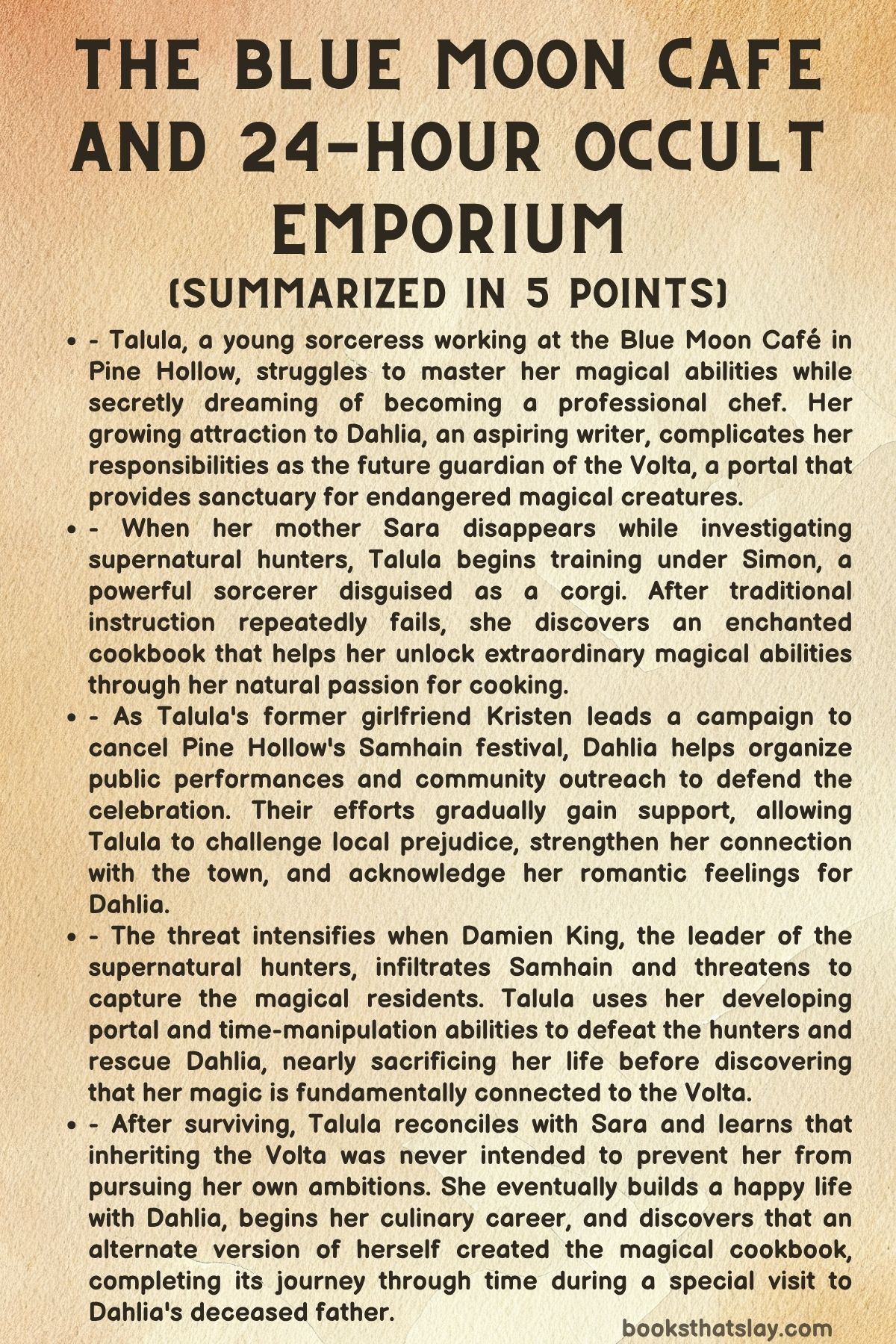
Summary
In the small town of Pine Hollow, the Blue Moon Café has an unusual reputation for serving terrible coffee. Its deliberately unappealing menu conceals its true purpose: providing sanctuary for magical creatures traveling through the Volta, a powerful portal connecting distant places and supernatural communities.
Twenty-four-year-old Talula works alongside her mother, Sara, who manages the portal and protects its travelers. Although Talula is expected to inherit these responsibilities, her magical abilities remain frustratingly unreliable, and she secretly dreams of transforming the establishment into a successful café.
Her life becomes more complicated through her attraction to Dahlia Jones, a human writer who regularly visits for Talula’s exceptional hot chocolate. Talula enjoys their conversations but fears that becoming romantically involved with someone outside the magical community could interfere with her responsibilities.
One day, a vampire named Mina visits the café seeking sanctuary. Talula attempts to summon protective witchfire when Dahlia is nearby, but her magic fails, reinforcing her belief that she cannot meet her mother’s expectations.
Talula’s difficulties continue during a lesson involving the Volta, when an accidental diversion transports dozens of jackalopes into the café basement. She struggles to return the creatures before Dahlia discovers them, resulting in an embarrassing encounter that nevertheless strengthens their growing attraction.
Meanwhile, Sara learns that wealthy trophy hunters have begun capturing supernatural beings. She leaves to investigate the disappearances, promising to return before Samhain, Pine Hollow’s annual Halloween celebration and an important occasion for magical families to reunite.
The magical Council sends Talula a replacement instructor who unexpectedly arrives in the form of a corgi. Before his identity is revealed, another unusual visitor appears: Kiki, a powerful jinn escaping an abusive relationship.
Talula offers Kiki sanctuary and introduces them to Dahlia, whose encouragement helps the jinn imagine an independent future. Talula also successfully summons witchfire for the first time, suggesting that her abilities are beginning to develop.
Kiki gives Dahlia a necklace containing a ring capable of summoning jinn. When Kiki departs through the Volta, Talula discovers that the corgi, whom she has named Simon, is actually her new magical instructor.
Simon introduces a demanding training schedule based on traditional sorcery. His methods emphasize concentration and control, but Talula struggles with elemental magic, conjuring, and illusions, particularly when her thoughts turn toward cooking or Dahlia.
Simultaneously, opposition to Samhain develops throughout Pine Hollow. A petition seeks to cancel the festival, threatening an event that sustains connections between magical beings and their loved ones.
Dahlia offers to help defend the celebration, but Simon believes her presence distracts Talula from mastering her powers. His concerns intensify when Talula nearly sends a sanctuary seeker into an active volcano before correcting the portal’s destination.
Simon reveals that Mhairi, a selkie Talula knew during childhood, has disappeared while investigating the hunters. Terrified that her inadequate abilities might endanger more people, Talula decides to distance herself from Dahlia.
She cruelly rejects Dahlia’s offer of assistance and questions her commitment to writing. The confrontation leaves both women devastated, while Talula discovers that sacrificing her happiness makes her magical difficulties worse rather than improving them.
During a subsequent encounter at the farmers’ market, Talula learns that her former girlfriend, Kristen Richards, initiated the anti-Samhain campaign. Kristen’s resentment toward Talula and hostility toward the magical community give the conflict an intensely personal dimension.
Recognizing the harm caused by his teaching, Simon apologizes and encourages Talula to repair her relationship with Dahlia. Talula approaches Dahlia, admits that she unfairly transferred her anxiety onto her, and proposes a reconciliation brunch.
While visiting Dahlia’s house, Talula discovers an ancient book among the archaeological objects left by Dahlia’s deceased father. She recognizes its writing as a language associated with the jinn and borrows it for translation.
The mysterious text turns out to be a magical cookbook intended for young sorceresses. Its recipes require ingredients to be prepared through elemental magic, allowing Talula to approach sorcery through her natural understanding of food.
Preparing an elemental quiche produces an extraordinary breakthrough. Instead of forcing herself to imitate conventional magical techniques, Talula learns to recognize the elements within her surroundings and herself, unlocking abilities that previously seemed inaccessible.
Her growing confidence is accompanied by renewed affection for Dahlia, who helps develop a campaign to save Samhain. They decide to present the festival as an exciting cultural celebration, demonstrating its importance to Pine Hollow rather than relying on magical manipulation.
Their plans become increasingly necessary when Kristen seeks to close the Blue Moon itself. A health inspection and a forthcoming town council meeting threaten Talula’s home, business, and position within the magical community.
Talula and Dahlia transform the town’s public spaces with decorations and establish the Magic Box, an elaborate performance venue. Its nightly entertainment attracts increasingly enthusiastic audiences, while local supporters help distribute information about Samhain.
Despite opposition from protesters, their campaign begins changing public opinion. Talula’s culinary talents also contribute as she distributes sandwiches prepared through another magical recipe, discovering that her abilities can summon ingredients from distant locations.
Meanwhile, her relationship with Dahlia becomes more intimate. During a nighttime adventure originally intended as revenge against Kristen, they abandon the idea of vandalism and discuss their past relationships and hopes for the future.
A later evening at Dahlia’s house ends with Talula staying overnight. Although they do not immediately begin a romantic relationship, the experience offers Talula a sense of comfort and belonging that challenges her belief that personal happiness must be sacrificed.
Their first kiss eventually follows a dinner during which Dahlia questions Talula’s habit of rejecting opportunities before anyone can deny them to her. Talula reveals that she once declined an extraordinary culinary apprenticeship because she assumed Sara would expect her to remain at the Volta.
Dahlia’s observations force Talula to recognize how completely she has organized her life around imagined obligations. Nevertheless, when romance becomes a real possibility, she retreats again, frightened by the consequences of pursuing what she wants.
Elsewhere, the danger facing magical creatures grows. A stranger named Damien King visits the Blue Moon, searching for Kiki, and Talula discovers that he is the jinn’s abusive former partner.
Damien’s threatening behavior makes Talula deeply uncomfortable, but he escapes after accidentally eating a sandwich containing mango, to which he is severely allergic. The encounter leaves Talula shaken and increasingly suspicious of connections between Kiki’s past and the hunters.
Sara subsequently reveals that the hunters possess an artifact capable of detecting magical activity. Because magical communication could expose her location, she must stop contacting Talula while continuing her investigation.
Shortly before the town council meeting, the magical Council member Elegba arrives to reinforce Pine Hollow’s protective enchantments. He reveals that Sara has disappeared, prompting Talula to search for her through the Volta.
By connecting directly with its immense power, Talula discovers Sara and the missing magical creatures imprisoned in mirrored cages. She also recognizes Damien among their captors, identifying him as the leader of the hunting operation.
Talula unleashes an extraordinary magical surge that destroys the prisons and allows the captives to escape. However, channeling so much power nearly kills her, and Sara remains unable to return home.
Consequently, Talula must defend Samhain without her mother’s assistance. Dahlia prepares extensive research demonstrating the festival’s economic and cultural benefits, but encourages Talula to speak personally about what it means to her.
At the town council meeting, hostile interruptions initially undermine Talula’s confidence. Eventually, she abandons her prepared remarks and explains how Samhain has always allowed her to feel accepted by both the human and magical communities.
Her speech earns enthusiastic support. Mrs. Bochart, a baker who has long treated Talula with hostility, unexpectedly opposes the proposed ban, arguing that the government should not determine which celebrations people are permitted to observe.
The council votes against canceling Samhain. Although Talula celebrates this victory with Dahlia, her fear of romantic commitment remains unresolved, and she once again hesitates when Dahlia asks about their future.
Returning to the café, Talula discovers that Simon has arranged for magical craftsmen to install a professional kitchen. Mrs. Bochart subsequently reveals that she has known the Blue Moon’s secret for decades and deliberately discouraged ordinary customers at Sara’s request.
The baker also admits that she once had a romantic relationship with Sara. Her revelations help Talula understand that her mother’s choices need not determine her own, encouraging her to pursue the life she genuinely desires.
Talula finally visits Dahlia, kisses her, and openly commits to their relationship. The two women become girlfriends, and Talula’s happiness strengthens her confidence in both her magical abilities and her culinary future.
As Samhain approaches, Talula discovers that her connection with the Volta is far more extraordinary than anyone realized. The portal responds to her memories, establishes transportation arrangements, and creates protective enchantments for its travelers.
Her growing abilities become essential when Damien infiltrates the festival. He reveals that his hunters possess protective magical cuffs and threatens to destroy Pine Hollow unless Talula surrenders its supernatural residents.
Desperate to protect both communities, Talula summons Kiki using the ring previously given to Dahlia. Dahlia is accidentally transported into the café during the attempt, forcing Talula to explain the supernatural world and apologize for earlier suspicions about her intentions.
Kiki reveals that Damien coerced them into creating the hunters’ detection equipment and protective cuffs. During their discussion, Dahlia notices that the mysterious cookbook’s handwriting matches Talula’s, suggesting that Talula herself will eventually write it.
The discovery introduces an extraordinary possibility: Talula possesses the ability to manipulate time. Combining this power with her portal magic, she devises a plan to capture the hunters by targeting their protective cuffs.
When Damien arrives, Talula transports the hunters into the Volta’s magical wellspring. Inside, she accelerates the aging of their cuffs until the devices become fragile enough to destroy.
Her plan becomes more dangerous when she discovers that Dahlia has also been transported into the portal and captured. Talula rescues her and uses witchfire and dangerous historical destinations to force the hunters into surrendering their weapons.
Damien nevertheless manages to seize Dahlia at gunpoint. With the Volta’s immense energy already destroying her body, Talula uses her remaining strength to imprison him beyond ordinary reality and send Dahlia to safety.
Believing that she has sacrificed her life, Talula surrenders to the portal. Instead of dying, however, she awakens in a mysterious blue space and encounters a shimmering version of herself.
This counterpart helps Talula understand that the Volta’s magic is not separate from her own existence. By accepting their connection rather than resisting it, Talula allows its power to reconstruct her physical body.
Several days later, she awakens surrounded by her loved ones. Although the Blue Moon has been destroyed, everyone at Samhain survived, the Council has dismantled Orion Hunts, and the captive magical creatures are safe.
Sara returns, and Talula finally explains how the expectations surrounding her upbringing made her believe that inheriting the Volta was compulsory. Sara apologizes, explaining that she intended to offer her daughter a gift rather than impose an obligation.
Their conversation transforms their relationship. Talula recognizes that she can love her mother and protect the magical community while also pursuing cooking, friendship, and romance.
Weeks later, Talula returns to the Volta and meets her mysterious counterpart again. The figure identifies herself as Volta Talula, a version of Talula who survived a catastrophic alternative timeline by becoming part of the portal’s power.
Volta Talula explains that she has spent millennia searching for a way to prevent Damien from causing devastating consequences throughout history. The magical cookbook was central to her solution, providing the living Talula with precisely the knowledge she needed.
Although the book exists through a temporal paradox, Talula must eventually write it herself. She also understands that her survival depended not only on magic but on the relationships she developed with Dahlia, Simon, Kiki, Sara, and Pine Hollow’s residents.
By the following summer, Talula and Dahlia are living together in a cottage. The Blue Moon has been rebuilt as a successful café, magical beings have become more openly accepted in Pine Hollow, and Simon remains their loyal corgi companion.
Talula pursues culinary training around the world through magical doorways while developing plans to improve transportation for supernatural communities. Dahlia continues writing, and their relationship flourishes.
For Dahlia’s birthday, Talula arranges a carefully controlled journey into the past, allowing her to spend two precious hours with her deceased father. During the visit, Talula secretly buries the magical cookbook that he will eventually discover, completing its journey through time.
Returning to the present, Dahlia remembers a mysterious telephone call in which her father expressed his love and pride on the day of their visit. The experience reinforces the couple’s determination to appreciate their shared life, leaving Talula free to embrace a future shaped by her own choices.
Characters
Talula
Talula is the central protagonist of The Blue Moon Café & 24-Hour Occult Emporium, a twenty-four-year-old sorceress whose struggle to reconcile personal ambition with inherited responsibility drives the novel’s central conflict. Raised to become the guardian of the Volta, she believes her worth depends upon mastering magic and meeting the expectations associated with her mother’s extraordinary abilities.
Despite her insecurities, Talula possesses considerable kindness, courage, and compassion. She welcomes endangered magical creatures, protects vulnerable visitors, and genuinely cares about the people of Pine Hollow, even when some residents treat her with hostility.
Her passion for cooking represents an important aspect of her identity that she initially considers incompatible with her magical responsibilities. She dreams of becoming a professional chef but has become so accustomed to prioritizing the Volta that she dismisses opportunities without allowing herself to consider them seriously.
Her relationship with Dahlia exposes the emotional consequences of this self-denial. Although she develops powerful romantic feelings, she repeatedly withdraws because she believes that happiness must come after fulfilling her obligations.
Talula’s magical development parallels her emotional transformation. When she discovers the enchanted cookbook, she learns that her powers respond naturally to her culinary creativity rather than the rigid techniques she has been taught to imitate.
Her eventual mastery of the Volta demonstrates that she possesses an extraordinary magical identity of her own. However, her defining achievement is recognizing that her responsibilities, ambitions, and relationships do not have to exclude one another.
By the novel’s conclusion, Talula becomes a confident young woman who can protect her community without sacrificing her individuality. Her decision to pursue cooking, develop new magical transportation systems, and build a life with Dahlia establishes her independence from the expectations that once controlled her.
Dahlia Jones
Dahlia is Talula’s romantic interest and one of the most influential characters in The Blue Moon Café & 24-Hour Occult Emporium. An aspiring writer who has abandoned a stable marketing career following her father’s death, she represents the possibility of pursuing personal fulfillment despite uncertainty.
Her personality is energetic, affectionate, curious, and occasionally impulsive. She approaches new experiences enthusiastically, although previous relationships have made her sensitive to the possibility that other people might find her intensity overwhelming.
Dahlia’s relationship with Talula develops through their conversations at the café, where their shared humor and growing trust gradually deepen into romance. She consistently encourages Talula’s cooking ambitions and recognizes abilities that Talula herself struggles to appreciate.
Her professional marketing knowledge becomes essential when the anti-Samhain campaign threatens the Blue Moon. Rather than responding to hostility with withdrawal, Dahlia develops a strategy that celebrates the festival’s importance and encourages meaningful community participation.
Dahlia also demonstrates emotional maturity in her response to Talula’s repeated hesitation. Although Talula’s rejection hurts her, she insists upon honest communication without demanding that Talula immediately resolve every uncertainty.
Her grief over her father’s death adds considerable depth to her characterization. Instead of attempting to erase her loss, she carries his memory into her new life and draws strength from the belief that he would support her decisions.
The discovery of the magical world presents Dahlia with another opportunity to demonstrate her loyalty. When Talula mistakenly suspects her of investigating the supernatural community for personal gain, Dahlia explains her curiosity without abandoning their relationship.
By the ending, Dahlia has become Talula’s partner in both everyday life and extraordinary magical adventures. Her continuing writing ambitions establish that their relationship allows both women to pursue independent aspirations while supporting one another.
Sara
Sara is Talula’s mother and the established guardian of the Volta, whose extraordinary abilities and long history shape much of the conflict in The Blue Moon Café & 24-Hour Occult Emporium. She is powerful, courageous, and deeply committed to protecting supernatural beings from persecution.
Her dedication to the magical community has influenced her decisions about work, friendship, and romance. Having repeatedly placed her responsibilities before personal relationships, she unintentionally teaches Talula that love and individual ambition must remain secondary to duty.
Nevertheless, Sara’s intentions are fundamentally protective rather than controlling. She wants Talula to inherit the opportunities associated with the Volta, but she fails to recognize that her daughter has interpreted those opportunities as unavoidable obligations.
Her investigation into the trophy hunters reveals the dangerous responsibilities she carries. Even after being captured, she remains an important figure in the effort to protect endangered magical creatures.
Sara’s history with Mrs. Bochart and Kiki also reveals aspects of her life that Talula does not initially understand. These relationships suggest that her existence has involved complicated personal choices and connections beyond her role as a mother.
Her emotional development becomes clear when Talula finally explains the pressure she has experienced throughout her upbringing. Sara acknowledges her mistakes and reassures Talula that she has never needed to earn maternal love through magical achievement.
Their reconciliation transforms Sara from an imposing figure associated with duty into a mother capable of respecting her daughter’s independence. Her willingness to listen allows their relationship to develop on more equal and honest terms.
Simon
Simon is the magical instructor assigned to Talula after Sara’s departure, appearing as a talking corgi despite ordinarily existing without a physical body. His presence introduces humor, discipline, and conflict into The Blue Moon Café & 24-Hour Occult Emporium.
Initially, Simon is strict, impatient, and convinced that traditional magical instruction provides the only reliable path toward mastery. He believes Talula’s emotional attachments and culinary interests distract her from the urgent responsibilities facing the magical community.
His teaching methods become increasingly damaging when he pressures Talula to distance herself from Dahlia. Although motivated by concern for magical travelers, his criticism reinforces her existing insecurities and temporarily undermines her progress.
Simon’s character changes when he recognizes that his methods have caused harm. His apology demonstrates an emerging willingness to reconsider his assumptions, and he gradually accepts that Talula needs an educational approach suited to her individual abilities.
The revelation that a former student killed his physical form exposes the personal history behind his rigidity. His assignment to Talula becomes an opportunity to confront an earlier failure and develop a more compassionate understanding of mentorship.
As Talula gains confidence, Simon becomes increasingly supportive of her culinary ambitions and romantic relationship. His decision to arrange a professional kitchen demonstrates that he has learned to value the activities he previously dismissed.
By the conclusion, Simon has developed a genuine family-like attachment to Talula and Dahlia. His decision to remain a corgi and live with them transforms him from an intimidating instructor into an affectionate and loyal companion.
Kiki
Kiki is a powerful jinn whose arrival at the Blue Moon introduces questions about freedom, abusive relationships, and the dangers of granting wishes. Having escaped a harmful partnership, they initially distrust romantic love and seek a new beginning beyond their former partner’s influence.
Their mischievous personality becomes apparent through their interactions with Talula and Dahlia. They enjoy teasing Talula, particularly when her anxiety about revealing magic to Dahlia creates opportunities for playful interference.
Nevertheless, Kiki possesses considerable compassion beneath this humor. Their promise never to lie to Talula or those she considers her own establishes a meaningful bond of trust.
Kiki’s relationship with Dahlia is especially significant because Dahlia encourages them to pursue happiness on their own terms. Her words help Kiki imagine an identity independent of the relationship they have escaped.
The revelation that Damien coerced Kiki into creating magical detection equipment and protective cuffs demonstrates the continuing consequences of their abuse. Their decision to assist Talula in confronting him represents an important assertion of personal agency.
Kiki ultimately helps protect Pine Hollow and becomes part of its expanding magical community. Their later life with Sara suggests that freedom is not simply the absence of an abusive partner but the opportunity to build relationships based on mutual respect.
Damien King
Damien King is the principal antagonist, combining an abusive personal history with a dangerous campaign against supernatural beings. As the leader associated with Orion Hunts Incorporated, he uses specialized magical technology to locate, imprison, and exploit vulnerable creatures.
His initial appearance at the café establishes his threatening personality. He ignores Talula’s boundaries, invades her personal space, and attempts to locate Kiki despite knowing that they have fled their relationship.
Damien’s treatment of Kiki reflects his broader approach to power. He relies on coercion, intimidation, and control, treating other beings as resources whose independence threatens his authority.
His hunting organization extends this attitude to the supernatural community. The capture of magical creatures, including the mutilated griffin, demonstrates the cruelty underlying his pursuit of wealth and power.
His confrontation with Talula during Samhain forces her to choose between surrendering vulnerable residents and risking the destruction of Pine Hollow. His willingness to threaten an entire town establishes the scale of the danger he represents.
Although Damien possesses formidable resources, his control depends heavily upon the artifacts and protective equipment created for him. Talula’s ability to manipulate time eventually undermines these advantages, allowing her to imprison him beyond ordinary reality.
Kristen Richards
Kristen is Talula’s former girlfriend and the principal organizer of the campaign against Samhain. Their previous relationship ended painfully, leaving Talula with memories of rejection and the experience of being treated as someone whose existence needed to remain concealed.
Kristen’s hostility is expressed through public petitions, personal insults, and attempts to threaten the Blue Moon’s continued operation. Her resentment becomes especially apparent when she sees Dahlia developing a close relationship with Talula.
Although her campaign uses language about community values, her behavior reveals deeply personal antagonism toward Talula. Her actions transform an old romantic wound into a conflict affecting the wider magical community.
Kristen functions as a contrast to Dahlia, who openly celebrates Talula rather than asking her to become less visible. Through this contrast, the novel shows how acceptance and rejection can shape a person’s understanding of their own worth.
Kristen’s failure to prevent Samhain also demonstrates the limits of intimidation when a community chooses to defend an established celebration.
Mrs. Bochart
Mrs. Bochart is a local baker whose apparently hostile relationship with Talula conceals a complicated history. Throughout much of the novel, Talula believes that the older woman genuinely dislikes her and the Blue Moon.
The revelation that Mrs. Bochart deliberately discouraged ordinary customers at Sara’s request changes the meaning of their previous encounters. What Talula interpreted as personal hostility was partly an arrangement intended to protect the café’s supernatural purpose.
Mrs. Bochart’s earlier romantic relationship with Sara provides another important revelation. She understands the personal consequences of Sara’s dedication to magical responsibility and recognizes that Talula risks repeating similar sacrifices.
Although Mrs. Bochart does not entirely abandon her opinions, she publicly opposes the proposed ban on Samhain. Her decision demonstrates that people can defend another person’s freedom without sharing every belief.
Her assistance with Talula’s magical cake also strengthens the connection between cooking and personal discovery. By encouraging Talula to approach magical transformation through baking, she helps the younger woman recognize another dimension of her abilities.
Ultimately, Mrs. Bochart represents the possibility of revising long-standing assumptions. Her developing relationship with Talula reveals how incomplete knowledge can create unnecessary conflict between people who might otherwise become allies.
Volta Talula
Volta Talula is the extraordinary alternate version of the protagonist introduced near the conclusion of The Blue Moon Café & 24-Hour Occult Emporium. Originating in another version of events, she survived a catastrophic magical experience by allowing her consciousness to become part of the Volta.
Her existence reveals the full complexity of Talula’s relationship with time and portal magic. Unlike the living Talula, she can perceive different possibilities across history and has spent millennia seeking a way to prevent Damien’s actions from producing devastating consequences.
Her creation and preservation of the magical cookbook form the basis of the novel’s central temporal paradox. She ensures that the living Talula receives the lessons necessary to develop her abilities, even though Talula must eventually write the book herself.
Despite her immense knowledge, Volta Talula cannot simply impose a successful outcome. Her efforts depend upon the living Talula making meaningful decisions, developing relationships, and discovering her own capabilities.
Her inability to return to an ordinary human existence makes her sacrifice substantial. Nevertheless, she has found purpose within her transformed existence and expresses satisfaction that another version of herself can experience the future she could not.
Volta Talula represents both the extraordinary possibilities of magical identity and the consequences of choices made under extreme circumstances.
Anna Navarro
Anna Navarro is a welcoming farmers’ market vendor and one of Talula’s most reliable supporters within Pine Hollow. Her friendliness provides an important contrast to the hostility Talula experiences from other residents.
When the anti-Samhain campaign begins, Anna offers encouragement rather than withdrawing from the controversy. She understands that the festival benefits local businesses and recognizes Talula as a valued member of the community.
Her support becomes particularly meaningful when protesters confront Talula during the Magic Box performances. Anna helps protect her and demonstrates that solidarity requires action as well as sympathetic words.
Through her consistent loyalty, Anna represents the ordinary human relationships that help sustain the magical community.
Emilio Navarro
Emilio, Anna’s partner, shares her commitment to supporting Talula and preserving Samhain. His participation in the festival demonstrates how ordinary residents contribute practical skills and resources to the town’s cultural life.
He helps organize security for the Magic Box performances, working with costumed friends to maintain order during the increasingly contentious public celebrations. His involvement becomes especially important when protesters attempt to intimidate Talula.
Emilio’s willingness to defend the festival demonstrates that protecting a community does not always require supernatural abilities. His character reinforces the importance of dependable local relationships and collective responsibility.
Mina
Mina is a vampire who visits the Blue Moon seeking assistance through the Volta. Her friendly personality and vegan lifestyle challenge Talula’s initial expectation that a vampire might threaten Dahlia.
The encounter establishes the distinction between a supernatural being’s identity and the assumptions others make about them. Mina is not dangerous simply because she belongs to a traditionally frightening magical species.
Her appreciation of Talula’s specially prepared cocoa also demonstrates the protagonist’s ability to create meaningful connections through food. Although Mina has a relatively brief appearance, she helps establish the café’s role as a sanctuary for beings who may be misunderstood or endangered.
Michail
Michail is a horned magical being who arrives at the Blue Moon hoping to reunite with his beloved Linh in Pompeii. His journey illustrates the importance of the Volta as a means of maintaining personal relationships across great distances.
Talula’s difficulty transporting him becomes a turning point in her training. When thoughts of Pompeii’s destruction redirect the portal toward an active volcano, his safety is placed in immediate danger.
However, Talula successfully corrects the destination by concentrating on Linh. Michail’s safe arrival demonstrates that emotional connections can help Talula navigate the Volta more effectively than rigid technical concentration alone.
His experience also explains why Simon becomes increasingly concerned about the consequences of Talula’s unreliable abilities.
Linh
Linh is Michail’s beloved and the person he hopes to reach through the Volta. Although Linh does not receive extensive individual development, the relationship provides an important emotional anchor for one of Talula’s early magical challenges.
Talula’s concentration on Linh allows her to redirect the portal away from a dangerous destination and complete Michail’s journey safely. Linh consequently represents the personal relationships that make the Volta’s sanctuary work meaningful.
The reunion reinforces the idea that magical transportation serves human and supernatural needs extending beyond physical movement.
Mhairi
Mhairi is a selkie whom Talula loved during childhood and who later disappears while investigating the supernatural hunters. Her disappearance makes the growing danger intensely personal for Talula.
Because Mhairi represents an emotional connection from Talula’s past, the news of her disappearance reinforces the younger woman’s fear that she cannot adequately protect those she loves. Simon uses the incident to emphasize the urgency of her training, although his approach contributes to her increasing distress.
Mhairi’s experience demonstrates that the hunters’ activities threaten established relationships and entire supernatural communities rather than isolated individuals.
Elegba
Elegba is a powerful orisha and member of the magical Council whose appearance at the Magic Box initially seems like an unpredictable interruption. His spectacular magical performance entertains Pine Hollow’s residents while forcing Talula to improvise in order to prevent the exposure of genuine magic.
Behind his playful behavior, Elegba carries serious responsibilities. Sara has asked him to reinforce the magical barriers surrounding the town, indicating that the hunters’ activities have become increasingly dangerous.
His revelation that Sara has disappeared prompts Talula’s desperate attempt to locate her mother through the Volta. Elegba subsequently helps Simon understand the consequences of Talula’s extraordinary magical surge.
His character combines unpredictable humor with considerable supernatural authority.
Nathan Green
Nathan Green is Pine Hollow’s health inspector, who visits the Blue Moon after receiving complaints concerning its hygiene. His inspection initially threatens to expose the Volta because the café’s basement contains magical facilities that cannot safely be revealed.
Nathan nevertheless approaches his responsibilities with professional fairness. He recognizes that many complaints appear connected to the campaign against Samhain and refuses to treat hostile accusations as established facts.
His appreciation of Talula’s quiche also provides outside confirmation of her culinary abilities. By suggesting that the café could become commercially successful with a better menu, he validates an ambition she has long considered secondary to magic.
Nathan represents the possibility of ordinary institutional authority functioning fairly even during a period of community conflict.
Muriel
Muriel is a Pine Hollow resident who becomes involved in defending and organizing Samhain. Her contribution is especially visible when local volunteers arrive at the Blue Moon to help prepare the festival.
She enthusiastically assigns responsibilities, helping transform an overwhelming organizational challenge into a coordinated community effort. Her practical energy demonstrates how residents can contribute to an event’s success through cooperation and initiative.
Muriel also supports the festival during the town council proceedings. Her participation reinforces the importance of ordinary citizens in protecting community traditions.
Dimitra
Dimitra is a wood nymph forced to seek sanctuary after her former grove is converted into farmland. She arrives at the Blue Moon carrying her tree, emphasizing the intimate connection between her supernatural existence and the natural environment.
Her situation demonstrates that magical creatures face displacement not only from deliberate persecution but also from changes to the landscapes on which their lives depend.
Talula successfully transports Dimitra to a protected nature reserve, revealing her improving connection with the Volta. Dimitra’s journey therefore provides both an example of environmental vulnerability and evidence of Talula’s developing confidence.
Dr. Jones
Dr. Jones is Dahlia’s deceased father, an archaeology professor whose influence continues throughout the novel despite his death from an aneurysm. His loss motivates Dahlia to reconsider her career and pursue writing, making his absence central to her personal transformation.
Talula remembers him as a kind and humorous visitor to the café. These memories comfort Dahlia and contribute to the emotional connection between the two women.
His collection of archaeological objects includes the mysterious cookbook, which he discovered buried in his backyard. This discovery eventually becomes essential to Talula’s magical education and the events surrounding the Volta.
The novel’s final journey into the past allows Dahlia to spend time with him again. His affectionate acceptance of Talula and encouragement of Dahlia’s happiness provide an emotional resolution to the grief that influenced Dahlia’s earlier choices.
Although his memory of their visit is erased, the happiness associated with it remains. His mysterious telephone call in the present demonstrates how love can continue shaping relationships even when its immediate circumstances are forgotten.
Larry
Larry is Talula’s human father, whose earlier involvement in occult practices brought him into contact with Sara. When he encountered the realities of Sara’s magical existence and Talula’s unusual origins, he became uncomfortable with their supernatural lives.
His relationship with Talula remained distant despite occasional childhood visits. This emotional separation helps explain why Sara became the dominant influence in Talula’s upbringing.
Larry’s limited participation in her life also contrasts with the family Talula eventually develops through friendship, romance, and magical community relationships. His characterization demonstrates that biological connections do not automatically create emotional intimacy.
The Craftsmen Elves
The four craftsmen elves are skilled magical builders who contribute to the Magic Box and later help transform the Blue Moon into a more suitable establishment for Talula’s culinary ambitions. Their abilities demonstrate that magic can be expressed through practical craftsmanship rather than traditional sorcery alone.
Their work supports the campaign to preserve Samhain and provides the infrastructure necessary for Talula to pursue cooking more seriously. By the epilogue, their establishment of an architectural business reflects the opportunities created by Pine Hollow’s increasing acceptance of magical residents.
Their presence reinforces the idea that different talents can contribute meaningfully to a community.
The Magical Council
The Council is the governing institution responsible for protecting the magical community and coordinating the operation of supernatural sanctuaries. Its decisions influence Talula’s life through the appointment of Simon, the investigation of the hunters, and the protection of Pine Hollow.
Although its members possess considerable magical authority, the Council cannot resolve every danger immediately. Its limitations become apparent when hunters disappear with sanctuary seekers and when Talula must confront Damien without sufficient time to request additional help.
The Council eventually dismantles Orion Hunts and continues working with Talula as she develops plans for improved magical transportation. It represents the larger institutional framework within which her individual abilities operate.
The Supernatural Hunters
The hunters working for Orion Hunts Incorporated serve as the organized threat facing the magical community. Their activities involve locating, capturing, and exploiting supernatural beings, including creatures whose existence depends upon the safety provided by sanctuaries.
Their use of magical detection equipment and protective cuffs demonstrates that advanced supernatural knowledge can be turned against the beings it was intended to serve. Their willingness to infiltrate Samhain places both magical travelers and ordinary residents in danger.
The confrontation inside the Volta strips the hunters of their technological advantages and exposes their vulnerability. Their defeat emphasizes that equipment, weapons, and intimidation cannot guarantee control over forces they do not fully understand.
The Deathdog
The injured deathdog encountered by Talula initially appears to be a vulnerable supernatural creature requiring immediate assistance. Because deathdogs are associated with approaching death, its appearance also carries an ominous significance.
Talula responds compassionately and arranges veterinary care through the Volta. She later discovers that the creature was deliberately released to help Damien identify the sanctuary.
Its appearance demonstrates how the hunters exploit Talula’s protective instincts. Nevertheless, her decision to help the animal remains consistent with the compassion that defines her character throughout the novel.
Themes
Personal Freedom and Inherited Responsibility
Talula’s struggle to distinguish between responsibility and obligation provides the foundation for The Blue Moon Café & 24-Hour Occult Emporium. From childhood, she has understood the Volta as her inevitable destiny, and this assumption shapes her education, relationships, and sense of personal worth.
Her mother never explicitly intends to deny her independence, but Sara’s extraordinary dedication establishes an example that Talula believes she must reproduce. Consequently, Talula interprets her own desires as potential failures rather than legitimate aspects of her identity.
Her culinary ambitions demonstrate the cost of this misunderstanding. When an accomplished chef offers her an opportunity to travel and study, Talula refuses without consulting Sara because she assumes that accepting would constitute an abandonment of her responsibilities.
The same pattern emerges in her romantic relationship with Dahlia. Talula repeatedly withdraws from intimacy because she believes that becoming a capable guardian requires sacrificing emotional fulfillment.
Simon’s initial teaching reinforces this conflict by presenting discipline as the exclusion of personal interests. His eventual recognition that Talula learns best through cooking demonstrates that individuality and responsibility can strengthen rather than undermine one another.
The magical cookbook becomes a practical expression of this discovery. By approaching sorcery through food, Talula learns that her natural talents provide access to abilities that conventional instruction could not unlock.
Her final conversation with Sara resolves the emotional misunderstanding at the center of her upbringing. Sara explains that the Volta was intended as an opportunity, allowing Talula to recognize that an inherited gift does not create an unconditional obligation.
The ending does not require Talula to abandon the magical community in order to become independent. Instead, she develops new transportation systems while pursuing professional cooking, demonstrating that genuine freedom involves choosing how to honor the responsibilities one accepts.
Her transformation suggests that personal fulfillment becomes possible when individuals stop treating inherited expectations as the only legitimate foundation for their future.
Belonging, Prejudice, and Community Solidarity
Pine Hollow initially appears to be a welcoming small town, but the campaign against Samhain reveals significant divisions beneath its familiar routines. Talula has lived there throughout her life, yet she discovers that some residents consider her traditions incompatible with their understanding of community identity.
The petition threatens much more than a public celebration. Because Samhain provides magical beings with opportunities to reunite with distant loved ones, its cancellation would damage relationships that many supernatural residents depend upon.
The proposed closure of the Blue Moon creates an even more serious danger. Without the café’s protective cover, the Volta’s operations could become impossible to maintain, leaving vulnerable travelers without an essential sanctuary.
Kristen’s campaign demonstrates how personal resentment can contribute to wider social hostility. By presenting her opposition through appeals to community values, she encourages others to view Talula and the festival as outsiders rather than established parts of Pine Hollow.
Talula initially expects Sara to solve the problem through magical manipulation. However, she becomes increasingly uncomfortable with the possibility of changing people’s opinions without their consent.
Dahlia offers an alternative grounded in public communication and genuine participation. Her marketing strategy encourages residents to experience the festival’s value directly rather than accepting hostile descriptions of it.
The Magic Box performances transform this approach into a series of shared cultural experiences. Music, dance, magical entertainment, and community participation gradually reveal the joy that Samhain brings to the town.
Anna, Emilio, Muriel, and the other volunteers demonstrate that solidarity involves practical action. Their willingness to organize events, provide security, and speak publicly gives Talula protection that magical secrecy alone cannot provide.
Mrs. Bochart’s intervention adds an important dimension to this conflict. Although she does not necessarily share every belief associated with the festival, she recognizes the danger of allowing public authorities to determine which traditions deserve protection.
By the conclusion, the rebuilt Blue Moon and the increasing presence of magical residents show how Pine Hollow has begun moving toward a more inclusive identity. The novel suggests that belonging develops when communities recognize the contributions of different members and accept that shared life need not require identical beliefs or backgrounds.
Love, Trust, and Emotional Vulnerability
Talula’s relationship with Dahlia demonstrates how love can challenge assumptions that have become central to a person’s identity. Although Talula desires companionship, she initially believes that emotional attachment threatens the discipline necessary to fulfill her magical responsibilities.
Her attraction consequently produces both happiness and anxiety. Every affectionate conversation encourages her to imagine a different future, while her fear of disappointing Sara makes that possibility seem dangerous.
Dahlia experiences a related insecurity through her memories of previous relationships. Having been told that her enthusiasm can become overwhelming, she worries that expressing affection too openly might drive Talula away.
Their developing romance requires both women to confront these fears. Dahlia learns that Talula values her energetic personality, while Talula gradually discovers that being loved does not require abandoning her responsibilities.
Trust becomes especially significant when Talula begins concealing information about the magical world. Her secrecy is partly necessary to protect vulnerable beings, but it also reflects her reluctance to risk emotional exposure.
The consequences become visible when Talula discovers Dahlia’s investigative board. Rather than considering the possibility that Dahlia is simply curious, she assumes that the woman she loves intends to exploit the supernatural community.
Simon’s intervention helps Talula recognize that her fear has again led her to expect rejection. The resulting reconciliation requires Talula to explain her behavior and acknowledge that suspicion cannot replace honest communication.
The relationship between Sara and Talula develops through a similar process. Sara’s love has always been present, but her failure to communicate her intentions allows Talula to misunderstand the meaning of her expectations.
Their eventual conversation demonstrates that affection alone cannot resolve every emotional conflict. Both must express their experiences honestly and accept that their assumptions about one another have been incomplete.
Kiki’s escape from Damien provides a contrasting example of a relationship built upon control rather than mutual respect. Their gradual recovery emphasizes the importance of independence, safety, and the freedom to choose one’s connections.
The novel ultimately presents love as a relationship between individuals who remain entitled to their own ambitions and identities. Talula and Dahlia’s shared future becomes possible because neither woman requires the other to abandon the qualities that make her distinctive.
Creativity, Magical Identity, and the Possibilities of Time
Magic in The Blue Moon Café & 24-Hour Occult Emporium becomes an expression of personal identity rather than simply a measure of inherited power. Talula initially evaluates herself according to techniques developed by other sorcerers, making every unsuccessful lesson appear to confirm her inadequacy.
Simon’s traditional instruction demonstrates the limitations of this approach. His methods assume that magical mastery depends upon controlling elemental forces through established mental disciplines, but they fail to account for Talula’s individual understanding of the world.
The enchanted cookbook provides an alternative by connecting magical principles with activities Talula already understands. Preparing ingredients allows her to experience fire, water, earth, and air as familiar components of a creative process.
Her discovery that conjuring can involve opening miniature portals reveals another dimension of her unusual abilities. Having grown up beside the Volta, she has developed an instinctive relationship with space and movement that differs from conventional sorcery.
Time magic extends this relationship beyond ordinary physical boundaries. The cookbook’s recipes gradually prepare Talula to manipulate temporal processes, culminating in her ability to alter the age of the hunters’ protective equipment.
The revelation of Volta Talula introduces a more complex understanding of magical possibility. Her existence demonstrates that identity can persist across alternative histories, even when the physical circumstances sustaining an ordinary life disappear.
The cookbook’s temporal paradox transforms the apparent relationship between teacher and student. Talula’s future existence helps educate her younger self, suggesting that personal development can involve forms of influence that extend beyond conventional chronology.
Nevertheless, knowledge of the future does not eliminate the importance of individual decisions. Volta Talula provides guidance, but the living Talula must still develop friendships, confront her fears, and decide how to respond to danger.
The final journey into Dahlia’s past gives time magic a deeply personal purpose. Rather than using her abilities solely for extraordinary feats, Talula creates an opportunity for Dahlia to experience a final moment of connection with her father.
The conclusion therefore connects magical creativity with emotional generosity. Talula’s greatest discoveries become meaningful because they allow her to protect others, pursue her talents, and create experiences that enrich the lives of the people she loves.