Done and Dusted Summary, Characters and Themes
Done and Dusted by Lyla Sage is a contemporary romance set in the small town of Meadowlark, Wyoming, where past heartbreaks and second chances collide. The novel follows Clementine “Emmy” Ryder, a talented barrel racer who returns home after a devastating accident and a failed relationship in Denver.
Back at her family’s ranch, Rebel Blue, Emmy is forced to confront her old life, her lingering fears, and Luke Brooks—her brother’s best friend and the boy she once considered off-limits. What begins as antagonistic banter soon turns into something undeniable, as Emmy learns to rebuild both her confidence in riding and her trust in love.
Summary
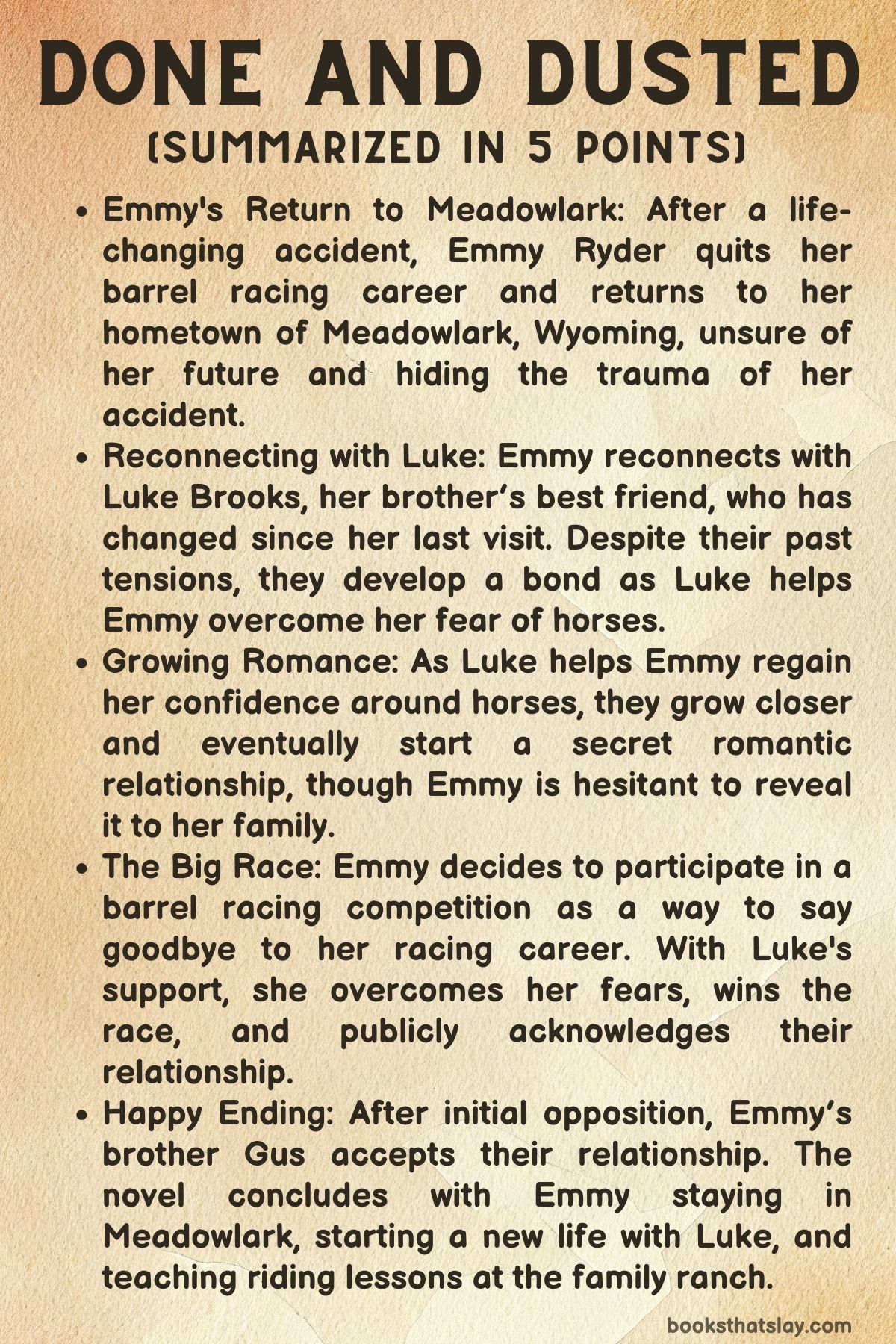
Clementine “Emmy” Ryder returns to her hometown of Meadowlark after abruptly ending her life in Denver. She leaves behind her apartment, her boyfriend, and her career as a barrel racer.
Feeling out of place but comforted by the familiarity of home, she reconnects with her best friend Teddy Andersen, who insists they visit The Devil’s Boot, the town’s rowdy bar. There, Emmy runs into her old high school flame, Kenny Wyatt, but the night takes an unexpected turn when the band starts playing “Oh My Darlin’ Clementine.” She knows immediately that Luke Brooks, her brothers’ best friend and the new owner of the bar, is behind it.
Their reunion is sharp and heated, filled with old resentment and new tension. Luke pretends to be indifferent, but he can’t shake the impact of seeing Emmy again.
The next morning, Luke inadvertently reveals Emmy’s return to her brother Gus. Furious she didn’t come to him first, Gus demands answers.
Emmy admits she needs a break from racing and the city, so Gus ropes her into helping with his daughter Riley. Back at Rebel Blue Ranch, Emmy settles into a cabin on the property.
She discovers Luke teaching children’s riding lessons, including Riley, and though their banter remains sharp, she begins to see a softer, capable side of him. That night, when Luke helps her unpack, they share a moment that nearly turns into a kiss before being interrupted.
Both are unsettled by how close they came to crossing a line.
Determined to restart her life, Emmy focuses on ranch life while struggling with the trauma of her accident. She can’t bring herself to ride, suffering panic attacks whenever she tries.
Luke witnesses her fear and offers to help her start over with small steps. Reluctantly, she agrees on the condition that her brothers don’t find out.
Their lessons begin simply with grooming and walking horses. Slowly, Emmy starts to rebuild her trust in herself, supported by Luke’s steady presence.
She begins to discover layers beneath his reputation as a ladies’ man—his rough upbringing, the loss of his father, and his dedication to the ranch. Their connection deepens, though neither is willing to voice it openly.
Emmy eventually mounts a horse again, finding courage with Luke’s guidance. The breakthrough moment brings relief and joy, but also sparks undeniable chemistry between them.
Both fight to resist their attraction, yet their bond continues to grow. Luke tries to keep his distance, aware of the risk to his friendship with Gus, but fails to stay away.
Teddy confronts him directly, warning him not to hurt Emmy, but she also sees the truth—that he cares for her more than he admits.
As Emmy’s confidence in riding grows, so does her confusion about what she wants for her future. The rodeo circuit reaches out, pressuring her to compete again, but she’s uncertain if she’s ready.
At the same time, she joins her brother Wes in exploring new possibilities for the ranch. In the midst of it, Luke continues to surprise her with thoughtful gestures, showing her a tenderness no one else sees.
Their relationship teeters on the edge of something real.
Their restraint finally breaks one night after a family dinner, where Luke nervously joins the Ryder household. Walking Emmy back to her cabin, he admits he has genuine feelings for her.
She confesses the same, and they fall into each other’s arms. Their intimacy is passionate, new, and overwhelming, but Emmy insists on secrecy, not ready to face Gus’s inevitable reaction.
Luke reluctantly agrees, though he makes it clear he doesn’t want to be hidden forever.
Their romance deepens in secret, filled with stolen moments and small acts of care. Luke builds her a barrel racing course at Rebel Blue, determined to help her finish her career on her own terms.
Emmy is terrified but realizes she still loves racing. With Luke’s encouragement, she pushes herself toward competition again.
Their bond strengthens further when she accompanies him to visit his estranged family, standing up for him against his brother’s insults. For Luke, Emmy’s support becomes something he has never experienced before, cementing his feelings for her.
The climax arrives at the divisional race. Emmy faces her fears head-on and delivers her best performance, breaking her own record and proving to herself she is still a champion.
Overcome with emotion, she kisses Luke in front of the cheering crowd, exposing their relationship. The public kiss sparks immediate fallout—Gus punches Luke and accuses him of betrayal.
Their father, Amos, steps in, acknowledging Luke’s loyalty and support for Emmy, but the rift between Luke and Gus threatens to tear everything apart.
In the aftermath, Emmy refuses to abandon Luke despite her brother’s anger. Eventually, Gus confronts Luke privately, and though still wary, he begins to see how much Luke genuinely loves Emmy.
He reluctantly gives his blessing with a stern warning never to hurt her. Determined to make things right, Luke rides across the ranch to Emmy, breathless with urgency, and declares his love.
Emmy finally says the words back, choosing him openly.
The epilogue shows their love fully embraced. Luke gives Emmy a key to his house, symbolizing their shared future.
She has returned to teaching riding lessons, rediscovering her joy without fear. Their relationship with Gus is healing, and life in Meadowlark has settled into a rhythm where Emmy and Luke are no longer defined by secrecy but by the strength they’ve built together.
After everything, Emmy has found both her place and her partner, finally at home in the life she was meant to live.
Characters
Clementine “Emmy” Ryder
Clementine “Emmy” Ryder is at the heart of Done and Dusted, a woman caught between the weight of her past and the promise of her future. Returning to Meadowlark after a devastating riding accident and a failed relationship, she embodies resilience, though she often doubts herself.
Her struggle with panic attacks around horses highlights her vulnerability, but also her determination to reclaim her identity. Emmy is deeply loyal to her family and friends, yet her independent streak makes her chafe at her brother Gus’s protective instincts.
What makes Emmy compelling is her transformation—from a woman haunted by fear and uncertainty into someone who chooses to face those fears head-on. Her love for Luke Brooks becomes a catalyst for healing, not just romantically but also in rediscovering her passion for riding and her place at Rebel Blue Ranch.
Through her journey, Emmy reflects themes of second chances, growth, and the quiet strength found in coming home.
Luke Brooks
Luke Brooks is presented as both the classic “bad boy” and a man burdened by the shadows of his upbringing. As the owner of The Devil’s Boot and Gus Ryder’s best friend, he projects confidence and charm, often hiding behind his reputation as Meadowlark’s notorious ladies’ man.
Yet beneath that exterior lies a deeply complex character shaped by loss, strained family ties, and a longing for belonging. Luke’s interactions with Emmy reveal a softer, protective side—his patience in helping her regain confidence with horses contrasts beautifully with his impulsive jealousy and fierce loyalty.
He is torn between respecting his bond with Gus and pursuing his feelings for Emmy, and this conflict makes his character layered and human. Ultimately, Luke evolves from someone who fears emotional vulnerability into a man unafraid to declare his love openly, making him one of the most dynamic figures in the novel.
Gus Ryder
Gus Ryder is Emmy’s older brother, a figure who embodies both the role of caretaker and enforcer within the Ryder family. His “dad voice” underscores the parental role he has adopted since the family’s losses, and his protectiveness over Emmy often manifests as frustration or control.
While his reaction to her relationship with Luke is explosive—fueled by both betrayal and worry—it also stems from love and fear of seeing his sister hurt again. Gus represents tradition, duty, and the weight of family expectations, yet over time, he softens enough to accept that Emmy’s happiness cannot be dictated by him.
His gradual acceptance of Luke as a partner for Emmy highlights his growth from a rigid protector to a brother who learns to trust her choices.
Wes Ryder
Wes, the other Ryder brother, serves as a stabilizing and supportive presence. Unlike Gus, Wes is more open and gentle, offering Emmy both encouragement and space as she adjusts to life back at Meadowlark.
His dream of turning the old house on the property into a guest ranch showcases his vision and optimism, in contrast to the more practical concerns of his siblings. Wes’s easy acceptance of Emmy’s struggles and his ability to bring levity to family dynamics make him a grounding character, reminding readers of the importance of quiet, steady love in family relationships.
Teddy Andersen
Teddy Andersen, Emmy’s best friend, provides both comic relief and emotional support throughout the story. She is sharp-tongued, unfiltered, and fiercely loyal, often pushing Emmy to confront truths she’d rather avoid.
Teddy’s teasing about Luke and her blunt assessments of Emmy’s feelings bring lightness to the narrative, while her unwavering presence shows the depth of female friendship. She acts as a mirror, reflecting Emmy’s growth and helping her recognize her own desires.
Teddy’s role, while secondary to the romance, is vital in anchoring Emmy to her roots and reminding her that love—platonic and romantic—can coexist as sources of strength.
Amos Ryder
Amos, the Ryder patriarch, represents wisdom and quiet resilience. Though not as dominant as Gus in terms of protective instincts, Amos provides steady guidance and subtle influence.
His decision to welcome Luke at family gatherings and his acknowledgment of Luke’s support for Emmy show his ability to see beyond appearances and reputation. Amos serves as a bridge between the old ways of the family and the new paths his children are forging, embodying acceptance, tradition, and the enduring bond of kinship.
Riley Ryder
Riley, Gus’s daughter and Emmy’s niece, adds innocence and warmth to the story. Her relationship with Emmy highlights Emmy’s nurturing side, while her bond with Luke showcases his patience and capacity for care.
Riley is not just a background character but a symbolic reminder of why family ties matter so deeply in Meadowlark. Her presence softens the adults’ conflicts, grounding them in love and responsibility that extends beyond themselves.
Kenny Wyatt
Kenny Wyatt functions as both a reminder of Emmy’s past and a contrast to her future with Luke. His flirtations initially unsettle Emmy and bring out Luke’s jealousy, but his role quickly diminishes as the story progresses.
Kenny represents nostalgia and the paths not taken, highlighting how far Emmy has come since her high school days. His presence underscores the difference between fleeting attraction and lasting, transformative love.
JJ Brooks
JJ Brooks, Luke’s brother, serves as an antagonist figure, embodying the dysfunctional side of Luke’s family. His hostility toward both Luke and Emmy not only highlights the scars of Luke’s upbringing but also provides Emmy with a moment to step up and defend the man she loves.
JJ’s presence accentuates Luke’s struggles with belonging and self-worth, while also giving Emmy the opportunity to demonstrate her loyalty and courage.
Themes
Homecoming and Belonging
In Done and Dusted, the motif of homecoming serves as both a literal and emotional journey for Emmy Ryder. Returning to Meadowlark after abandoning her city life and barrel racing career, Emmy finds herself both comforted and unsettled by the familiarity of her hometown.
Her re-immersion into Meadowlark life is not just about geographical relocation but also about rediscovering her roots and redefining what “home” means. The ranch, her family, and the small-town community become spaces where she must confront her past while forging a new sense of belonging.
Home is not portrayed as an idyllic refuge but rather as a complicated setting layered with family expectations, unresolved tensions, and unspoken desires. The Devil’s Boot, Luke’s bar, functions as a second symbol of rootedness—both for him, as an inheritance that ties him to his father’s memory, and for Emmy, as a reminder of the life she once rejected.
Through these spaces, the narrative suggests that belonging is not about returning unchanged but about facing the fractures of the past and deciding whether one can carve out a life within them. Emmy’s slow acceptance of Meadowlark as not just a fallback but a place where she might rebuild her confidence demonstrates that home is both grounding and transformative.
Healing from Trauma
Emmy’s riding accident casts a long shadow over her story, shaping her choices, her confidence, and her sense of identity. Barrel racing was not only her passion but also her primary marker of self-worth, and losing it meant a loss of self.
Her panic attacks around horses dramatize the way trauma lodges itself physically as much as emotionally. Luke’s steady presence becomes pivotal here—not as a savior figure but as someone who encourages her to rebuild at her own pace, starting with small steps.
This theme of healing does not glorify quick recovery but emphasizes resilience, patience, and trust. Emmy’s journey is as much about acknowledging her fear as it is about overcoming it.
Her eventual return to competition is framed not as a triumphant return to former glory but as a reclamation of agency. By breaking her own record in the divisionals, she proves to herself that the accident does not define her.
Importantly, the novel positions healing as intertwined with love, friendship, and community, but ultimately it insists that Emmy’s strength lies in reclaiming her voice and power on her own terms.
Forbidden Love and Family Loyalty
The romance between Emmy and Luke is charged not only with desire but also with the tension of secrecy. As her brother’s best friend, Luke represents a boundary Emmy is not supposed to cross, and their growing intimacy forces them to weigh personal happiness against family loyalty.
The secrecy of their early encounters highlights the stakes—sneaking around cabins, hiding in bathrooms, and sharing stolen moments intensifies the thrill but also underscores the risk of betrayal. When their relationship is revealed during Emmy’s public victory kiss, Gus’s fury dramatizes the consequences of crossing familial lines.
Yet the novel complicates this theme by showing that Luke’s care and love for Emmy ultimately earn him a place within the family, albeit after resistance. This tension between desire and duty reflects a broader conflict many face when personal happiness collides with familial expectations.
The resolution, where Gus reluctantly accepts Luke, highlights that true loyalty does not mean blind obedience but mutual respect and recognition of each other’s choices.
Identity and Self-Discovery
At its heart, Done and Dusted is as much about Emmy’s self-discovery as it is about her romance. Her return to Meadowlark coincides with a crisis of identity—she no longer fits neatly into the mold of a city dweller, nor does she feel secure in her old identity as a barrel racer.
She struggles with questions of what she wants for her future, whether it is racing, running a guest ranch, or simply reclaiming joy in riding without the pressure of competition. This process of rediscovering herself is paralleled by Luke’s own journey.
Known in town as a ladies’ man with a bad-boy reputation, he struggles to show Emmy and her family that he is more than the rumors suggest. His inheritance of The Devil’s Boot and his dedication to working with children at Rebel Blue Ranch show his desire to create a stable, meaningful life.
Together, Emmy and Luke’s romance becomes a lens through which identity is tested and redefined, but neither character’s growth is wholly dependent on the other. Instead, their relationship highlights how self-discovery can be supported by love but must ultimately be chosen and embraced individually.
Love as Transformation
Romance in the novel is not portrayed as an escape but as a force that transforms both Emmy and Luke. Their relationship is characterized by moments of tenderness—Luke building her a barrel racing course, Emmy defending him against his brother—that reveal love as both an act of care and a catalyst for change.
For Emmy, Luke’s love helps her rediscover confidence and self-worth, reminding her that she is not defined by her accident or fears. For Luke, Emmy’s love allows him to shed the hardened persona he has carried, rooted in abandonment and family estrangement, and step into a more vulnerable, authentic self.
The secrecy, jealousy, and conflict surrounding their romance only amplify its transformative power, as they are forced to confront external pressures and internal fears. Ultimately, their love is validated not by secrecy or rebellion but by its endurance—surviving family resistance, personal fears, and the weight of the past.
By the epilogue, their relationship represents stability and mutual growth, a love that is not only passionate but sustaining, proving that transformation in love is less about losing oneself and more about becoming more fully who one already is.