Gliff by Ali Smith Summary, Characters and Themes
Gliff by Ali Smith is a speculative novel about childhood, identity and resistance within a society that classifies people according to their usefulness to the state. Through siblings Bri and Rose, the story examines what happens when official systems gain the power to decide who belongs, who deserves protection and whose existence can be erased.
At once a family story, a political warning and an exploration of language, the novel contrasts institutional cruelty with imagination, loyalty and communal care. A vulnerable grey horse becomes both a real companion and a sign of freedom that cannot be fully measured, named or controlled.
Summary
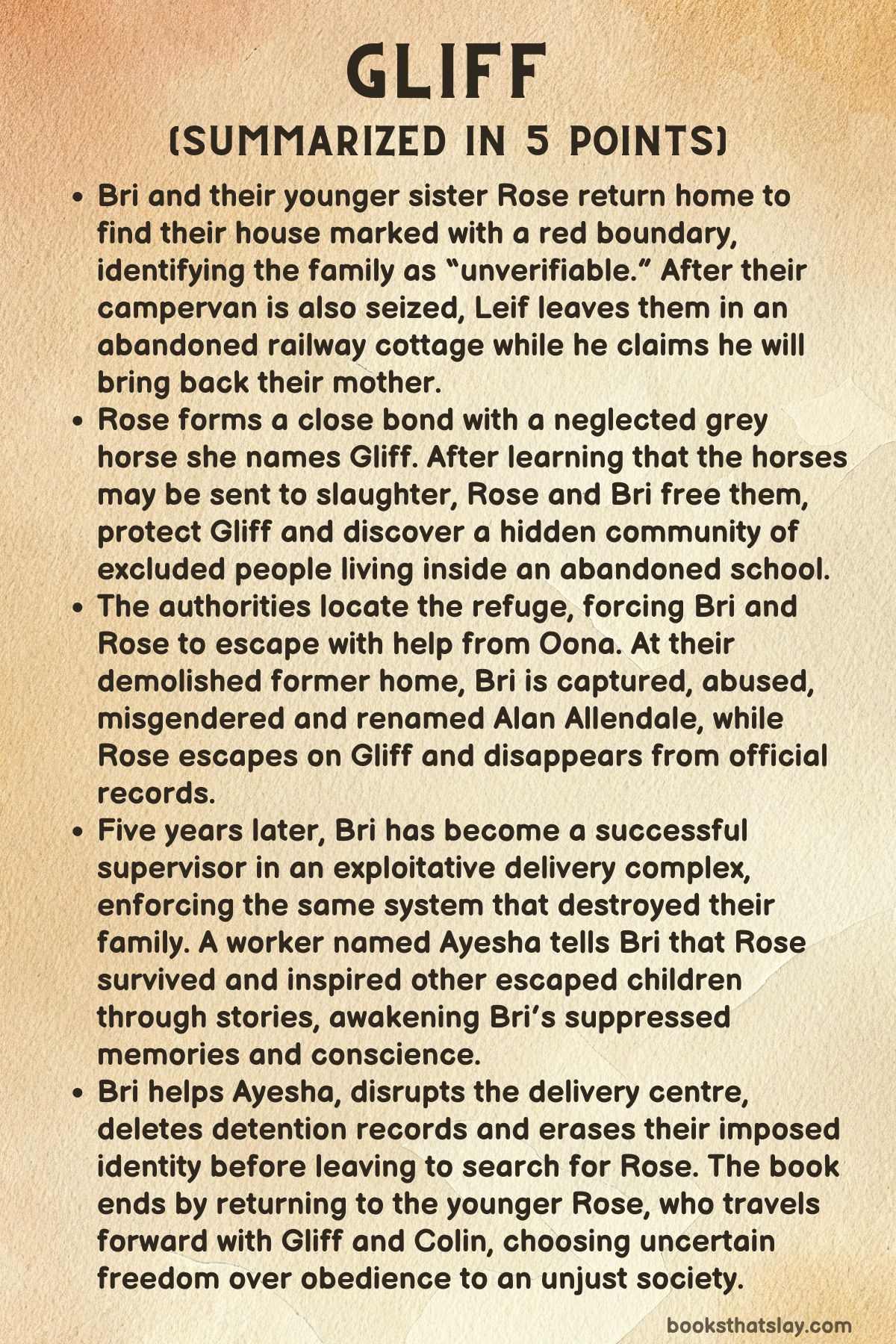
Briar, usually called Bri, and their younger sister Rose return home with Leif, their mother’s partner. Their mother has remained abroad to cover the work shifts of her sick sister, Alana, leaving Leif temporarily responsible for the children.
When they reach the house, they discover that a red line has been placed around it. The marking identifies the property and its residents as undesirable, suspicious or “unverifiable,” showing that the authorities have already passed judgment on the family without offering any meaningful explanation or opportunity to defend themselves.
Leif understands the danger immediately and drives the children away in the family’s campervan. The vehicle is soon marked in the same way and taken from them, demonstrating that the official system can extend its boundaries wherever its targets attempt to move.
With their home inaccessible and their transport gone, Leif leaves Bri and Rose in an empty railway cottage. He provides them with tins of food and claims that he will find their mother and bring her back, but the children are left without reliable information about where he is going or when he will return.
Bri attempts to become the responsible adult in Leif’s absence. They ration supplies, consider the dangers around them and try to protect Rose, even though Bri is also frightened and uncertain about what has happened to their family.
Rose responds differently to their isolation. While exploring the area, she discovers a nearby field containing several horses and becomes especially attached to a thin grey gelding, whom she names Gliff.
The horse appears neglected and vulnerable, yet Rose immediately recognizes him as an individual rather than as property. Their connection gives her a sense of purpose at a time when nearly every familiar part of her life has been removed.
Bri soon meets Oona, an elderly woman who understands the workings of the state and openly opposes them. Oona explains that the red lines are not merely physical markings but instruments of psychological control, designed to make targeted people accept exclusion as something permanent and inescapable.
The children also become acquainted with Colin, a boy whose family owns the horses. Colin collects information and has absorbed many assumptions from the society around him, but his interactions with Bri and Rose gradually expose him to realities that his previous way of life allowed him to ignore.
Bri and Rose learn that the horses may be sent to an abattoir. Their discovery leads them to broader knowledge about a society that treats animals, workers and children according to their economic value, with those considered unproductive facing slaughter, forced labour, detention or retraining.
Rose becomes determined to save Gliff, while Bri recognizes that rescuing only one horse would leave the others to their fate. Together, the siblings release the horses and temporarily hide Gliff inside the abandoned house where they have been staying.
Their attempt to protect him leads them toward a concealed community living within the deserted St Saccobanda school. The residents are people whom the authorities have classified as unverifiable, yet inside the refuge they have created a form of social life based on mutual assistance rather than official approval.
The community’s name is connected to a fable about Saccobanda, a girl born with a horse’s head. She possesses the unusual ability to understand everything that people, animals and even objects are unable to express openly.
Because the authorities cannot place Saccobanda within their accepted categories, they declare her unverifiable and take her away. Her mother’s grief becomes a call to resistance, awakening mistreated creatures, silenced people and discarded matter against the forces that have abused and controlled them.
The fable reflects the danger facing Bri and Rose, but it also offers another way of understanding power. The state may command institutions, records and machines, yet the things it rejects can form relationships and meanings beyond its authority.
At the school, the children encounter books, art, music and different languages. These experiences reveal how much knowledge has been restricted in the world outside, where education appears designed to produce obedience and usefulness rather than curiosity, independence or understanding.
The refuge also shows Bri and Rose what communal care can look like. People share resources, protect one another and make room for identities that the official system refuses to recognize.
Bri repeatedly tries to contact Leif, their mother and Alana, but receives no dependable response. The lack of communication leaves the siblings suspended between hope that their family will return and the growing realization that they may have been abandoned by circumstance, fear or state interference.
During this period, Bri discovers that the word “gliff” has many possible meanings. It can refer to a glimpse, a trace, a sudden light, a shock, a narrow escape or a momentary sign of something that cannot be fully seen.
The word’s flexibility makes the horse’s name especially significant. Because it cannot be confined to a single definition, it resists the same kind of classification that the authorities impose on people, places and identities.
Life in the school cannot remain secure. Daisy, one of the community’s residents, is abducted, and the machines used to draw the red boundaries arrive near the refuge.
The community recognizes that discovery may lead to detention, violence or forced reclassification. Oona helps Bri and Rose escape on Gliff, placing the children’s survival above her own safety.
The siblings travel to their former home in the hope that it might offer answers or some connection to their previous life. Instead, they find that the house has been demolished and the ground covered with artificial grass, as though their family’s existence can be removed and replaced by a clean, controlled surface.
Officers arrive before they can escape together. Bri is seized, while Rose apparently manages to flee with Gliff.
In custody, Bri is stripped, physically assaulted and deliberately misgendered. The officials disregard Bri’s own understanding of their identity and replace it with an administrative identity that can be entered, tracked and used within the state’s records.
Bri is renamed Alan Allendale. The new name is not simply a disguise but an attempt to erase Bri’s past, separate them from Rose and turn them into a person who serves the system that harmed them.
The authorities regard Bri as a valuable test case. Their youth, vulnerability and disputed identity allow the state to study how completely a person can be reconstructed through isolation, punishment, repetition and institutional reward.
As a storm breaks outside, Bri protects their remaining sense of self by imagining Rose and Gliff escaping beyond the reach of surveillance. In Bri’s mind, the girl and horse become like a modern version of Pegasus, moving with a freedom that machines and official records cannot contain.
Later fragments suggest that Bri searches for Rose and Gliff but cannot find any dependable record of them. Their mother repeatedly attempts to return to the country, yet she is denied entry, keeping the family divided through border controls and administrative decisions.
Five years pass, and Bri has been thoroughly reshaped into Alan Allendale. They now work as an award-winning supervisor in a vast delivery complex, occupying an office above the Packing Belt where injured and exhausted employees process goods under constant pressure.
Bri has gained safety and authority by accepting the identity created for them. They discipline workers, protect productivity targets and benefit from the hierarchy that once declared their own family unacceptable.
The complex depends on the same logic that controls the wider society. Everything is measured according to output, while pain, exhaustion and individual circumstances matter only when they affect efficiency.
Beneath the official working areas are spaces called voids. These places are not properly monitored, allowing the institution to hide abuse and exploitation while publicly claiming that its systems provide complete order and accountability.
A worker named Ayesha Falcon notices Bri’s resemblance to Rose. She remembers meeting Rose years earlier, when Rose had taken shelter with a group of escaped children in a cave.
Ayesha describes how Rose offered the children hope through stories. Rose spoke about Gliff and preserved the possibility of another life by helping the group imagine freedom even when their immediate conditions offered little reason for confidence.
These memories disturb the identity Bri has been trained to accept. The recognition that Rose survived, influenced others and continued speaking about the horse breaks through Bri’s cultivated emotional distance.
Ayesha retells a story called “The Tyrant and the Ash.” In it, a ruler attempts to destroy a dissident so completely that no trace of resistance will remain, but the murdered person’s influence spreads through ash, air, water and the universe.
The story teaches that power cannot guarantee erasure. A person may be removed physically or deleted from official records, yet their words, choices and influence can continue through other people.
Bri begins to recognize that Rose has remained present in precisely this way. Although the state has prevented them from finding her directly, her courage has travelled through the memories of people such as Ayesha.
This realization allows Bri to reject Alan Allendale as the complete definition of who they are. They understand that their years of obedience do not have to determine the rest of their life, even though they cannot simply undo the harm they have participated in.
Bri uses their authority to help Ayesha. They provide her with drugs and shelter, improve her employment record and reduce the immediate danger created by the institution’s treatment of vulnerable workers.
They then take wider action against the delivery complex. Bri reassigns the Packing Belt workforce, disrupts the existing structure and deletes operational files that allow the institution to classify and punish employees.
Bri also removes records connected to detention centres. By deleting these files, they attack the state’s ability to preserve its version of reality through databases, names and administrative histories.
Finally, Bri erases their own official data. The act destroys the state-created identity of Alan Allendale and makes Bri unverifiable once again, but this time unverifiability becomes a chosen condition rather than a sentence imposed from outside.
Bri leaves their uniform and electronic devices behind. Without the objects that linked them to institutional authority, they travel north in search of Rose.
The story then returns to Rose at the age of eleven, riding Gliff through the storm after escaping the raid. Her future remains uncertain, but she is still free and continues to move beyond the boundaries created for her.
Colin follows Rose and admits that the system he once accepted is wrong. He asks to accompany her and help, showing that his exposure to the siblings has changed his understanding of responsibility.
Rose accepts him without pretending to possess a complete plan. Rose, Colin and Gliff continue forward by making decisions as circumstances arise, choosing uncertain freedom over the security promised by an unjust order.
Characters
Briar “Bri” / Alan Allendale
At the centre of Gliff, Bri is a young person forced to carry adult responsibility before they have the security or experience needed for it. Their instinct is to protect Rose, manage limited supplies and understand the dangers around them, but their careful behaviour cannot shield the family from a system that has already decided they are unacceptable.
Bri’s gender identity is essential to their characterization because the state treats self-definition as a challenge to administrative authority. When officers misgender Bri and rename them Alan Allendale, the violence is both physical and linguistic, since the imposed name attempts to replace a living person with a manageable record.
The adult Bri is morally complicated rather than simply heroic or defeated. As a supervisor, they enforce productivity rules, discipline injured workers and enjoy privileges created by the same hierarchy that separated them from Rose.
Their conformity shows how oppression can reproduce itself through survivors who are offered safety in exchange for obedience. Bri has not forgotten everything, but they have learned to bury memory beneath professional success, routine and the official story of who they are.
Ayesha’s testimony restores the connection between Bri’s present and their lost past. Once Bri learns that Rose survived long enough to protect other children, they can no longer pretend that resistance is childish, useless or impossible.
Bri’s final rebellion does not erase their complicity, but it marks a return to moral agency. By helping Ayesha, disrupting the complex, deleting detention records and removing their own data, Bri chooses uncertainty over a secure identity built on the suffering of others.
Rose
Rose’s youth does not make her passive or dependent. Her emotional openness allows her to recognize the suffering of Gliff before the adults around her acknowledge the danger facing either the horse or the children.
Her bond with the grey gelding is based on attention rather than possession. She gives him a name, but she does not treat naming as ownership; instead, the name expresses a relationship in which each vulnerable being offers the other trust.
Rose often acts before Bri has completed a practical assessment of the risks. This impulsiveness can place them in danger, yet it also prevents fear from becoming an excuse for accepting cruelty.
Her desire to rescue Gliff expands into concern for the other horses. That development reveals a strong moral imagination, since Rose recognizes that saving the individual she loves would be incomplete if the others were knowingly abandoned.
After escaping Bri’s capture, Rose becomes a source of courage for other displaced children. Her stories in the cave do not deny danger but create a shared mental space in which the children can imagine themselves as more than victims.
Rose represents continuity across separation. Even when Bri cannot locate her, her influence reaches them through Ayesha, proving that relationships can survive beyond official records and direct contact.
Her decision to accept Colin also shows her capacity for practical forgiveness. She does not require him to have understood everything from the beginning, but she expects him to recognize the wrongness of the system and participate in creating another way forward.
Gliff
Gliff is an animal with his own physical vulnerability, yet he also carries several symbolic meanings. His thin body and uncertain fate reveal how a society ruled by usefulness treats living creatures as disposable once they no longer promise sufficient economic value.
As the horse whose name gives Gliff its title, he is associated with a word that refuses a single stable definition. The name can suggest light, fear, escape, evidence or a momentary perception, making him difficult to reduce to the status of property or data.
Gliff’s connection with Rose is founded on mutual recognition. Rose sees him as a being with fear, needs and preferences, while his presence helps her preserve confidence and direction after the loss of her home.
For Bri, the image of Rose riding Gliff becomes a means of mental survival. Their imagined flight beyond surveillance preserves the possibility that freedom still exists, even while Bri is being physically controlled and administratively renamed.
The horse also links everyday suffering with myth. Bri’s vision of Rose and Gliff as a new Pegasus raises their escape beyond a simple chase, presenting free movement and imagination as forces that authority cannot completely contain.
Leif
Leif occupies an uncertain moral position because his actions combine urgent protection with abandonment. He recognizes the meaning of the red boundary quickly and removes the children from immediate danger, suggesting that he understands more about the state’s practices than Bri and Rose do.
His decision to leave them in the railway cottage is harder to judge. He supplies food and claims that he will retrieve their mother, but he leaves two children alone in a threatening environment without dependable communication or a clear plan.
The novel does not provide enough evidence to determine whether Leif is captured, prevented from returning, frightened into withdrawal or deliberately deserting them. That uncertainty reflects the larger world of the story, where surveillance and disrupted communication make it difficult to separate personal betrayal from institutional interference.
For Bri and Rose, however, the emotional result is the same. Leif becomes another adult whose promises cannot provide security, forcing the siblings to depend on each other and on strangers outside their family.
Bri and Rose’s Mother
The children’s mother is largely absent from their immediate experience, yet her absence is created by work, family responsibility and border control rather than simple indifference. She remains abroad to cover the shifts of her ill sister Alana, showing how economic obligations can separate people even before direct political persecution begins.
Her inability to return later demonstrates how states can transform geography into an instrument of punishment. A parent may remain emotionally committed to her children while being made powerless by administrative rules that deny movement and recognition.
Because the children receive little reliable information, their mother becomes both a real person and an object of hope. Bri repeatedly tries to reach her, preserving the belief that family restoration might still be possible despite growing evidence of permanent separation.
Her repeated attempts to re-enter the country complicate any assumption that she willingly abandoned Bri and Rose. The story instead presents her as another family member trapped by systems that can divide people without needing to declare them guilty of a recognizable crime.
Alana
Alana never becomes an active presence in the children’s journey, but her illness contributes to the circumstances that leave them exposed. Bri and Rose’s mother remains abroad to cover Alana’s work, linking personal illness with financial pressure and unstable employment.
Her situation suggests a society in which sickness affects an entire family network because adequate support is unavailable. Rather than allowing Alana to recover without consequence, the economic system transfers her responsibilities to her sister and indirectly removes the children’s mother from them.
Alana also represents the unseen people whose needs shape major events without being recognized by official narratives. Her vulnerability is not the cause of the family’s persecution, but it reveals how existing pressures make ordinary people easier for authoritarian systems to isolate.
Oona
Oona is one of the clearest figures of informed resistance in the book. Unlike the children, she already understands that the red lines function through both material enforcement and fear, teaching targeted people to imagine that no route beyond the boundary exists.
Her age gives her knowledge without making her cautious to the point of inaction. She speaks honestly to Bri, connects the children with a hidden community and later helps them escape when the authorities approach.
Oona’s importance lies partly in her ability to explain the system without granting it total power. She knows how surveillance works, yet her continued resistance shows that understanding oppression does not have to lead to despair or surrender.
Her assistance to Bri and Rose is an act of chosen kinship. In a society that has broken their legal and biological family connections, Oona offers protection based on shared vulnerability and moral responsibility.
When she prioritizes the children’s escape, she accepts personal danger without turning herself into a grand heroic figure. Her courage is practical, immediate and rooted in the belief that another person’s survival is worth the risk.
Colin / Colon
Colin begins as a boy shaped by a family and society that treat information, animals and people according to established systems of value. His habit of collecting data suggests that he has learned to observe the world through categories rather than relationships.
Because his family owns the horses, he is initially connected to the threat against Gliff. Ownership gives his household the legal power to decide the animals’ fate, even though that decision ignores the animals’ fear and desire to live.
His encounters with Bri and Rose create a moral conflict. Their actions force him to see that legality, normality and family custom do not automatically make a practice right.
Colin’s eventual pursuit of Rose is therefore more than an offer of companionship. By admitting that the system is wrong, he rejects the assumptions that previously protected him from recognizing his own position within it.
Rose’s acceptance allows Colin to become an example of change rather than inherited guilt. He cannot alter where he came from, but he can choose what he does after gaining a clearer understanding of the harm around him.
Ayesha Falcon
Ayesha is the character who breaks through Bri’s constructed identity by connecting them to Rose. Her recognition is based not on official data but on physical resemblance, memory and the persistence of personal experience.
As a worker in the delivery complex, Ayesha is vulnerable to the authority Bri exercises. Her position reveals the conditions beneath the institution’s claims of order, including exhaustion, injury, exploitation and the hidden dangers associated with the unmonitored voids.
Ayesha’s account of Rose gives Bri evidence that cannot be easily absorbed into the identity of Alan Allendale. Rose did not merely survive; she cared for other children and became part of their understanding of hope.
By retelling “The Tyrant and the Ash,” Ayesha also becomes a carrier of resistant knowledge. The story she shares teaches Bri that influence survives attempted erasure because it can pass into new voices, memories and actions.
Ayesha does not rescue Bri through force. She makes change possible by speaking, remembering and trusting Bri with a connection to the past that the state had tried to remove.
Daisy
Daisy’s abduction demonstrates the constant danger faced by the community at St Saccobanda’s. Even collective protection cannot guarantee safety when the authorities possess greater technological, institutional and physical power.
Although little personal information about Daisy is provided, her disappearance has an important effect on the group. It confirms that their refuge has become vulnerable and turns the threat of discovery into an immediate reality.
Daisy also represents the many people whose stories vanish when they are taken by authoritarian systems. The absence of later information about her reflects the terror of a society in which detention can remove not only a person’s freedom but also public knowledge of what happened to them.
Saccobanda
Saccobanda is a figure from a fable, but her story closely reflects the experiences of Bri, Rose and the unverifiable community. Born with a horse’s head, she exists outside the physical and social categories that authority considers acceptable.
Her ability to understand what people, animals and objects cannot say makes her especially dangerous to those in power. She hears the suffering that official language excludes and recognizes connections between living beings and discarded things.
The authorities remove her because they cannot verify her according to their standards. Their response shows that unverifiability is not proof of wrongdoing but a label applied to whatever challenges the limits of institutional understanding.
Saccobanda’s removal does not end her significance. Her story becomes part of the culture of resistance, giving the hidden school both its name and an account of why those rejected by power may possess forms of knowledge that power lacks.
Saccobanda’s Mother
Saccobanda’s mother transforms private grief into a force with universal consequences. Her sorrow begins with the loss of her child, but it expands into recognition of every being and object that has been mistreated, silenced or discarded.
She challenges the isolation on which oppressive authority depends. Instead of accepting Saccobanda’s removal as an individual misfortune, she connects it to a larger pattern of exploitation.
Her response inspires animals, people and matter itself to rise against those who control them. This development presents care as a source of political power, since her love for one child teaches her to recognize the suffering of countless others.
She also offers a model for understanding the absent mother of Bri and Rose. Both mothers are separated from their children by authority, yet maternal attachment continues to resist the state’s attempt to make separation feel complete or final.
The Authorities and Administrators
The officers, officials and managers function collectively as the human face of the state’s classification system. Their power depends less on individual personality than on their willingness to treat rules, records and institutional goals as more important than living people.
They use red boundaries, databases, border controls, renaming and physical violence to create the appearance that their judgments are objective. By converting prejudice into procedure, they avoid acknowledging the moral choices involved in declaring someone undesirable or unverifiable.
Their treatment of Bri reveals the personal cruelty hidden within administrative language. Misgendering, assault and renaming are presented as necessary stages in processing a test case, allowing abuse to be described as correction or management.
The delivery complex shows how this mentality spreads beyond police action. Supervisors and workers are placed within a hierarchy that rewards discipline, speed and compliance while concealing the injuries and exploitation required to maintain productivity.
The authorities are powerful, but they are not all-knowing. Their dependence on records becomes a weakness when Bri deletes information, while Rose’s movement and the spread of stories demonstrate that life continues beyond what their systems can document.
Themes
Identity, Naming and the Right to Self-Definition
In Gliff, naming becomes a struggle over who has the authority to define a person. Bri understands their own identity, but the state refuses to recognize that knowledge because it does not fit the categories through which officials organize the population.
The name Alan Allendale is imposed as an administrative replacement for Bri rather than offered as a genuine expression of self. Once the new identity is supported by records, employment and institutional rewards, it begins to influence how Bri behaves and what they are willing to ignore.
The word “gliff” offers a direct contrast to this method of control. Its many possible meanings prevent it from being confined to one stable definition, allowing language to remain open, mobile and responsive to experience.
That flexibility suggests that identity does not have to be reduced to the categories used by governments, employers or databases. A person may contain memories, relationships and possibilities that no official description can fully represent.
Bri’s deletion of their own data is therefore an act of self-recovery. Becoming unverifiable again carries serious danger, but it also removes the identity that was built through coercion and permits Bri to act according to a moral understanding that the system had suppressed.
Surveillance, Boundaries and Administrative Power
The red line turns an ordinary mark into a tool of exclusion. It identifies homes, vehicles and communities as contaminated spaces, encouraging both targeted people and observers to believe that crossing the boundary is dangerous, illegal or impossible.
Its effectiveness depends partly on machinery and enforcement, but it also relies on imagination. As Oona explains, people can become controlled by what they believe the line means even before an officer physically prevents them from crossing it.
Records extend these boundaries beyond visible places. Bri can be detained, renamed and reconstructed because the state’s databases determine which version of their identity will be treated as real.
The same logic governs borders, workplaces and detention centres. Bri’s mother is kept outside the country through administrative decisions, while employees in the delivery complex are measured through productivity records that conceal pain and reduce human lives to performance.
The voids beneath the complex expose the dishonesty within claims of total oversight. Surveillance does not eliminate abuse; it determines what will be recorded, what will remain hidden and whose testimony will be believed.
Bri’s destruction of institutional files attacks the system at this vulnerable point. When records disappear, the state loses part of its ability to enforce its categories, preserve its preferred history and present its judgments as permanent truth.
Stories, Language and Imagination as Resistance
Stories allow characters to preserve knowledge that official institutions attempt to erase. The fable of Saccobanda explains exclusion through the experience of a child whose unusual body and understanding make her unacceptable to authority.
Because the fable connects people, animals and objects, it challenges the divisions that justify exploitation. Its meaning survives through retelling rather than through an approved archive, making it difficult for the state to control.
Rose uses stories similarly when she shelters with escaped children. She cannot promise them safety, yet she can help them imagine lives that are not completely defined by fear, capture or abandonment.
Ayesha later carries Rose’s influence back to Bri. Her memories demonstrate that a story may travel far beyond its original speaker and eventually reach someone whom the speaker cannot contact directly.
“The Tyrant and the Ash” develops this idea further by showing that murdered resistance cannot be perfectly contained. Influence spreads through the physical world, entering air, water, memory and future action.
Bri’s vision of Rose and Gliff as figures capable of outrunning surveillance performs the same protective function. Imagination does not remove the violence happening to Bri, but it preserves a mental connection to freedom until they are able to act upon it.
Care, Kinship and Freedom Beyond Ownership
Care repeatedly appears outside the structures that claim to provide security. Legal ownership allows Colin’s family to send the horses to slaughter, while official guardianship and state protection fail to keep Bri and Rose safe.
Rose’s relationship with Gliff offers another model. She names and protects him without treating him as an object whose value depends on usefulness, recognizing that responsibility toward another being does not require possession.
The community at St Saccobanda’s extends this principle to human relationships. Its residents share knowledge, shelter and resources because they understand one another’s vulnerability, not because an authority has verified their right to belong.
Oona’s protection of the children and Ayesha’s decision to speak to Bri show how chosen relationships can repair some of the damage caused by broken families and institutions. These acts do not replace the siblings’ mother or erase their losses, but they prevent isolation from becoming absolute.
Bri’s later assistance to Ayesha marks a return to this ethic. Rather than using power to protect only themselves, they use their access to reduce another person’s danger and then disrupt the system harming the wider workforce.
The final movement of Rose, Colin and Gliff leaves their destination uncertain, yet their freedom rests on shared responsibility rather than fixed authority. They proceed without ownership, guarantees or official approval, creating trust through the choices they make together.