Don’t Let Her Stay Summary, Characters and Themes
Don’t Let Her Stay by Nicola Sanders is a psychological thriller that explores family tensions, hidden pasts, and the fragile balance between trust and suspicion. The story follows Joanne, a new mother adjusting to life with her baby daughter Evie, as she navigates isolation, insecurity, and her complex relationship with her husband Richard.
Her world shifts dramatically when Chloe, Richard’s estranged daughter, moves into their home. What begins as a chance for reconciliation soon transforms into a chilling struggle for control and survival. The novel builds suspense through manipulation, paranoia, and shocking revelations, forcing Joanne to question everyone around her—including herself.
Summary
The book opens with Joanne making a desperate late-night escape from her home with her infant daughter, Evie. As she drives away, she glimpses Chloe, Richard’s daughter, standing at the nursery window, her figure backlit by smoke.
This haunting image sets the tone for the events leading up to this moment.
Three weeks earlier, Joanne’s life seems ordinary but strained. Living in a large country house with her husband Richard and baby Evie, she feels isolated and weary.
Adjusting to motherhood has been more challenging than she imagined, leaving her drained and insecure. When she discovers a mysterious letter addressed to Richard, she assumes it is from Isabella, his glamorous ex-fiancée, but soon learns the truth: the letter is from Chloe, Richard’s estranged daughter, asking to reconnect.
Richard is overjoyed and quickly arranges for her to visit, despite Joanne’s unease.
Chloe’s arrival brings uneasiness into the household. Joanne hopes to bond with her, but Chloe’s behavior is inconsistent.
At times she appears sweet and affectionate, but she also exhibits hostility and dismissiveness, particularly toward Joanne. Joanne notices troubling interactions with Evie, such as Chloe handling the baby roughly, though Richard dismisses her concerns.
During a family dinner, Chloe undermines Joanne while charming Richard. When Joanne announces she has arranged for a nanny, Chloe abruptly offers to care for Evie herself, having dropped out of college.
Richard eagerly accepts, leaving Joanne feeling sidelined.
As Chloe settles in, her manipulative behavior intensifies. She gaslights Joanne by contradicting her memory of events, makes veiled threats, and presents herself as the perfect daughter to Richard while portraying Joanne as paranoid and unstable.
Joanne notices Chloe flirting with Simon, the gardener, and later finds Chloe using doctored photos to frame her in compromising situations. Fearing Richard’s jealous streak, Joanne keeps Chloe’s threats secret.
The mounting tension isolates her further, as Richard grows increasingly critical, even suggesting she seek medical help for imagined paranoia.
One night, Joanne discovers Chloe in the nursery bathroom with a broken medicine bottle, fueling her fear that Chloe is dangerous to Evie. But Richard takes Chloe’s side, accusing Joanne of overreacting.
Determined to protect her child, Joanne installs hidden cameras. When Richard discovers them, he reacts with rage, forcing her to remove them and accusing her of spying.
He reveals more of Chloe’s tragic past—her mother Diane’s death and the earlier loss of baby Sophie. While Richard paints Diane’s death as suicide, Joanne uncovers troubling details that suggest Chloe may have been involved.
Journalist Jim Preston reveals that Chloe once fabricated a story about an intruder, and that she had been admitted to a psychiatric hospital afterward. He warns Joanne to stay vigilant.
Despite these warnings, Richard refuses to believe anything against Chloe. Joanne’s attempts to confront him only deepen his doubts about her sanity, echoing concerns from her own family history of postpartum psychosis.
Chloe continues to destabilize Joanne, eroding Richard’s trust and making her appear irrational. Eventually, Joanne reviews footage from her hidden cameras and sees Chloe watching Evie silently in the dark.
But before she can show Richard, the evidence disappears, reinforcing her fear that Chloe has infiltrated her phone.
As Richard leaves for a trip, Joanne finds herself alone with Chloe, who grows increasingly unstable. Chloe claims Richard murdered both Diane and Sophie, insisting he will kill Joanne and Evie next.
Joanne struggles to know whom to trust. When Richard suddenly returns, the house erupts into chaos.
Chloe locks herself in the bathroom with Evie, the smell of petrol lingers, and both Richard and Chloe accuse each other of deception and violence. Joanne, caught between conflicting stories, grows terrified for her safety and her baby’s life.
Richard arms himself with a shotgun, while Chloe insists he is setting a trap. Joanne and Chloe eventually flee through the basement, narrowly escaping as the house fills with smoke and flames.
In the climactic confrontation, Richard corners them outside, but Chloe seizes the gun and kills him, claiming it is payback for her mother and sister.
After Richard’s death, Joanne and Chloe tell the police it was an accident. Their relationship softens; Chloe moves in permanently, resuming her studies and appearing devoted to Evie.
Joanne begins to relax, believing the danger has passed. But a series of conversations with Diane’s mother and solicitor Solomon shatters her fragile peace.
She learns that Chloe lied about her inheritance, manipulated Joanne with false stories, and may have poisoned her baby sister Sophie years earlier. Joanne realizes the photograph Chloe carried—a supposed picture of Sophie—was actually of Chloe herself, used as a tool to deceive.
Gradually, Joanne pieces together that Chloe orchestrated Richard’s downfall, manipulating events to frame him and secure her place in Joanne’s home.
In the final realization, Joanne understands that Chloe is the true threat. Though outwardly protective and supportive, Chloe’s history of lies, manipulation, and possible violence suggest she engineered Richard’s death and deceived Joanne into trusting her.
Now living under the same roof, Joanne is left in a state of dread, recognizing that Chloe may not have saved her and Evie at all, but instead maneuvered events to ensure Richard’s death while securing her own position. The novel closes on this chilling ambiguity, leaving Joanne trapped in uncertainty about the dangerous young woman who now controls her life.
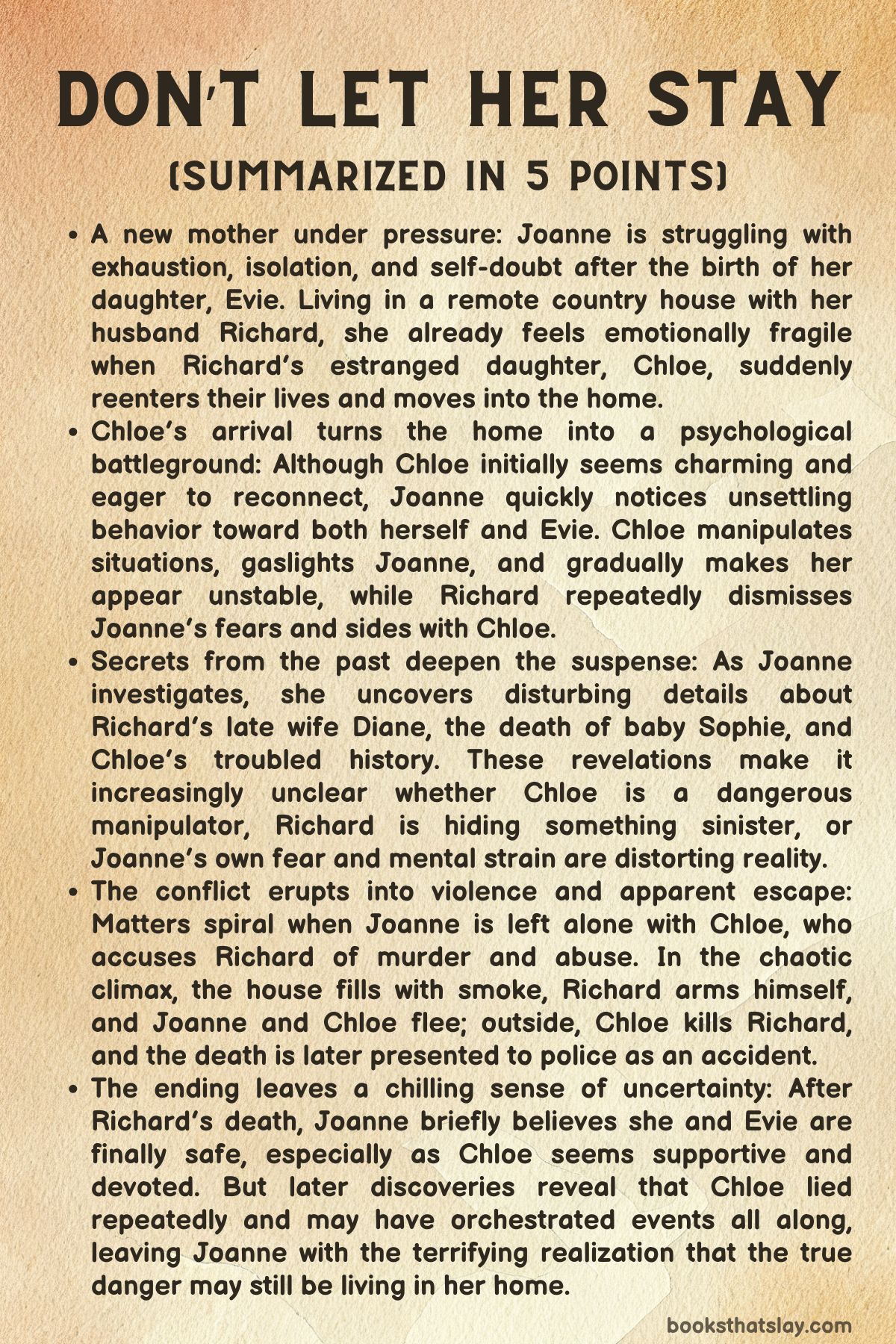
Characters
Joanne
Joanne is the emotional center of Don’t Let Her Stay, a woman caught between love, fear, and self-doubt. At the start, she appears fragile, weighed down by the exhaustion of new motherhood and the isolation of country life.
Yet beneath this vulnerability lies an instinctive strength: her fierce protectiveness toward baby Evie drives many of her choices, even when she risks appearing paranoid to her husband. Joanne struggles with insecurity, both in her marriage and in her role as a mother, and her awareness of her mother’s history of postpartum psychosis makes her doubt her own sanity whenever Richard or Chloe gaslight her.
Despite this inner turmoil, she grows increasingly resolute, secretly gathering evidence, installing cameras, and confiding in friends to safeguard her child. Joanne’s journey is one of gradual awakening: she moves from self-doubt and dependence to a chilling recognition that she has been manipulated at every turn.
By the end, though outwardly a survivor, she remains trapped in uncertainty, forced to live alongside Chloe—the very person she suspects engineered everything.
Richard
Richard emerges as a deeply complex figure, embodying both charm and menace. At first, he appears as the successful, doting husband who offers Joanne stability, but as the story unfolds, his blindness—or willful refusal—to acknowledge Chloe’s manipulations exposes cracks in his character.
His constant comparisons to Joanne’s mother’s illness undermine Joanne’s confidence, and his readiness to side with Chloe paints him as an enabler of her destructive behavior. Yet his own past reveals hidden darkness: his former wife’s suicide, the cot death of Sophie, and the suggestion that he himself may have been controlling or even violent.
Richard’s charm and authority mask an undercurrent of intimidation—whether by smashing glasses, dismissing Joanne’s fears, or brandishing weapons, he exerts dominance that makes him both protector and threat. In the climax, his behavior blurs the line between guilt and innocence, leaving readers uncertain whether he was a manipulative abuser or a victim of Chloe’s long-standing deceit.
Chloe
Chloe is the novel’s most enigmatic and unsettling character, embodying both victimhood and villainy. Introduced as Richard’s estranged daughter, she swiftly unsettles Joanne with her shifting demeanor—alternating between sweetness and cruelty, affection and hostility.
Her manipulative nature is revealed through subtle gaslighting, fabricated evidence, and strategic lies that erode Joanne’s credibility. Chloe’s traumatic past, particularly the deaths of her mother Diane and baby sister Sophie, casts her as a damaged young woman craving stability, yet her actions—sabotaging phones, manipulating Richard, deceiving Joanne with doctored photos—suggest calculated malice.
In the climactic scenes, Chloe positions herself as savior, yet later revelations hint that she may have orchestrated Richard’s downfall all along. Her duplicity is chilling: she is both the frightened girl locked in trauma and the architect of chaos who skillfully bends reality to her advantage.
By the end, her ambiguous morality leaves Joanne—and the reader—questioning whether Chloe is a survivor of abuse, a master manipulator, or both.
Diane
Though absent from the narrative, Diane, Richard’s late wife and Chloe’s mother, haunts the story as a ghostly presence. Her death—officially a suicide—frames Chloe’s and Richard’s shared trauma, but details gradually reveal deeper complexities.
Diane’s struggles with depression and grief after Sophie’s cot death mirror Joanne’s fears of inherited mental illness, creating a haunting parallel across generations. To Richard, Diane remains a source of guilt and sorrow, while to Chloe, she is both a lost parent and a weaponized memory.
Different perspectives paint Diane as either a victim crushed by despair or as a woman driven to desperation by family dysfunction. Though she never appears in the present action, her absence looms large, shaping Chloe’s manipulations and Richard’s defensiveness, and reminding Joanne of the fragility of maternal identity.
Evie
Evie, though only an infant, is the emotional anchor around which the story turns. She represents innocence, vulnerability, and the future that Joanne is desperate to protect.
While Evie has no active voice, her presence magnifies every conflict: Joanne’s paranoia about Chloe centers on keeping Evie safe, Chloe uses her as a pawn to assert dominance, and Richard dismisses concerns under the guise of protecting Evie’s well-being. Symbolically, Evie embodies both the continuity of family and the stakes of betrayal—her safety is the line Joanne will not allow to be crossed.
In this way, Evie becomes more than a passive character; she is the embodiment of the novel’s central tension between trust, fear, and survival.
Roxanne
Roxanne, the cleaner and occasional confidante, serves as a subtle but important supporting character. She provides Joanne with fleeting companionship in an otherwise isolated life, yet her shifting loyalties complicate matters.
At times she seems trustworthy, offering Joanne comfort, while at other times she appears complicit in Chloe’s manipulations, such as when seen with her in the village. Roxanne highlights Joanne’s precarious position: even those who could be allies are unreliable, deepening her sense of isolation.
She embodies the everyday outsider who moves through the drama, never fully trustworthy but never fully villainous either, reinforcing Joanne’s paranoia that she cannot depend on anyone.
Themes
Motherhood and Isolation
In Don’t Let Her Stay, motherhood is presented as both a transformative and suffocating experience. Joanne’s early reflections reveal how her world has narrowed since Evie’s birth, leaving her exhausted, lonely, and caught between the expectations of being a “good mother” and the reality of her emotional vulnerability.
Her struggle to regain identity—through attempts at rekindling intimacy with Richard or considering remote work—shows how motherhood can erase a woman’s previous sense of self. The isolation of the countryside home magnifies this burden, cutting her off from meaningful connections and increasing her dependency on Richard’s approval.
This solitude makes her more susceptible to Chloe’s manipulations, as her support network is minimal and her own judgment is repeatedly dismissed. The novel examines how society often downplays the psychological toll of early motherhood, treating symptoms of distress as overreactions rather than valid warnings.
Joanne’s fear of inheriting her mother’s history of psychosis deepens her insecurity, illustrating how generational trauma compounds the pressures of caregiving. Her desperate efforts to protect Evie, even while being undermined at every turn, reflect the consuming nature of maternal love and the fragile boundary between protectiveness and paranoia.
Through Joanne’s inner conflict, the narrative exposes how easily motherhood can become a prison of doubt, mistrust, and self-erasure when combined with neglect and manipulation from those closest to her.
Manipulation and Gaslighting
The dynamic between Joanne and Chloe is built on a constant pattern of gaslighting, with Chloe undermining Joanne’s perception of reality at every opportunity. From small acts, like denying conversations about errands, to larger fabrications, such as doctoring photographs or sabotaging childcare arrangements, Chloe’s calculated behavior erodes Joanne’s confidence in her own memory and instincts.
This manipulation is intensified by Richard’s continual siding with Chloe, positioning Joanne as irrational or unstable whenever conflicts arise. The more Joanne resists, the more she appears paranoid, feeding into Chloe’s strategy.
This theme reveals the insidious nature of gaslighting—not only as a personal tactic of control but as a systemic silencing of women whose anxieties are too quickly attributed to hysteria or mental instability. The novel forces readers to consider how truth becomes malleable in environments where trust is weaponized.
By the climax, even the reader is drawn into Joanne’s disorientation, unsure of who is truly dangerous, illustrating how gaslighting corrodes certainty itself. Chloe’s success at bending perceptions showcases the frightening power of psychological warfare, where reality is not about facts but about which version is most convincingly performed.
Family Secrets and Deception
Beneath the domestic surface of Don’t Let Her Stay runs a labyrinth of hidden histories and suppressed truths. The gradual revelations about Richard’s first wife Diane, their deceased child Sophie, and Chloe’s past in a psychiatric facility destabilize Joanne’s trust not just in Chloe but in Richard himself.
Each secret emerges at a critical point, reshaping Joanne’s perception of her family and suggesting that deception is the glue holding the household together. Richard’s concealment of Diane’s death and Chloe’s past signals his fear of confronting uncomfortable realities, while Chloe’s manipulations thrive in this climate of secrecy.
Even Joanne, who initially presents as transparent and desperate for clarity, adopts secrecy herself—sending away evidence for testing, hiding cameras, and withholding her suspicions from Richard. This atmosphere of lies and omissions makes the home an unsafe space, where every relationship is shadowed by doubt.
The theme underscores how deception corrodes intimacy, turning partners and family members into strangers whose motives are suspect. The final twist—that Chloe may have orchestrated everything—cements the idea that deception is not an aberration in this family but its defining mode of survival.
Trust and Betrayal
The novel hinges on the precariousness of trust within intimate relationships. Joanne wants to believe in Richard as a partner who values and protects her, yet his constant dismissal of her fears represents a betrayal as damaging as Chloe’s manipulations.
His trust is disproportionately given to Chloe, even when her behavior raises alarms, creating a triangular dynamic where Joanne is always the outsider. This betrayal is not only emotional but existential, as Joanne’s pleas for safety are rejected, leaving her and her child vulnerable.
At the same time, Joanne herself struggles with whether to trust Chloe, who oscillates between moments of apparent vulnerability and cruelty. The shifting alliances make trust both a weapon and a vulnerability—who one believes determines survival.
By the end, when Joanne is left questioning whether Chloe or Richard was the true threat, the novel demonstrates that betrayal is inevitable when trust is extended without evidence. The theme suggests that in toxic family dynamics, trust becomes less about faith and more about calculated risk, a choice between competing dangers rather than a foundation for love.
The Fragility of Sanity
Sanity itself is a contested terrain in Don’t Let Her Stay, as Joanne constantly fears she is losing her grip on reality. Richard’s repeated comparisons to her mother’s psychosis, along with Chloe’s manipulative staging of events, feed her paranoia that she is unraveling.
This fear of inherited madness blurs the line between legitimate intuition and irrational anxiety. Joanne embodies the precariousness of mental stability, where self-doubt becomes as dangerous as external threats.
The novel situates her within a psychological limbo: when she resists Chloe, she seems unstable; when she accommodates her, she feels complicit in her own erasure. The climax, where competing narratives between Chloe and Richard leave her unsure whom to believe, crystallizes the terror of losing not only one’s safety but one’s ability to trust one’s mind.
The final revelation that Chloe may have engineered everything leaves Joanne with the chilling recognition that her doubts were justified, yet the damage to her confidence remains irreversible. The theme highlights how mental fragility can be exploited by others, turning sanity into both a personal and social battleground where control over the narrative determines survival.