The Killing Rules Summary, Characters and Themes
The Killing Rules by Bree Despain is a supernatural young-adult thriller centered on Harper Westbrook, a teenager whose ordinary school life conceals a dangerous inherited condition.
Harper is Blood Bound, gifted with extraordinary strength, heightened senses, and a violent need to kill, but she has been raised to direct that need only toward men who have committed terrible crimes. Her carefully regulated existence begins collapsing when another Blood Bound appears in her territory, old family secrets surface, and her former best friend Grayson starts investigating the supernatural truth behind his father’s death. The book combines murder mystery, romance, family conflict, and questions about justice, identity, and moral choice.
Summary
Harper Westbrook has spent years following rules created by her grandmother, Nana, to control the supernatural bloodlust she inherited from her mother. She periodically kills men whose serious crimes have been carefully verified, allowing herself to satisfy the Blood Bound need for violence without attacking innocent people.
Her latest target is Emmit, a man accused of harming girls at a summer camp. Harper lures him into attacking her, kills him with her axe Lizzie, disposes of his body, and believes the act has bought her several months before the bloodlust returns, but she senses an unexplained presence near the corpse and notices strange claw marks that suggest someone may have been watching.
Meanwhile, Grayson Jones remains obsessed with the unsolved death of his father, District Attorney Marcus Jones. Authorities now claim Marcus was killed by an animal, but Grayson remembers that his mother once described a person at the scene and refuses to accept the official explanation.
Grayson and Harper were once extremely close and were on the verge of becoming a couple before Marcus died. Harper abruptly withdrew afterward because Marcus’s death was actually connected to the first uncontrolled manifestation of her Blood Bound powers, a truth Grayson knows nothing about.
Harper’s carefully managed life becomes unstable when she notices suspicious behavior between her best friend Alia and Christian Donner, a teacher at their school. Alia secretly meets Donner, receives an expensive crystal-heart bracelet from him, and later emerges from his office distressed and bruised, while Donner dismisses the incident as a misunderstanding.
Harper also begins experiencing painful ringing and whisper-like sensations whenever Donner is nearby. Believing the sensations are connected to her supernatural instincts and convinced Donner has harmed Alia, Harper attacks him near the school after a football game and tears out his throat.
The killing violates almost every rule Nana has imposed. Donner is connected to Harper personally, the attack occurs in Harper’s own town, and Harper loses roughly twenty minutes of memory afterward.
When Harper later sees Donner’s body, she discovers it has been mutilated far beyond what she remembers doing. The injuries resemble those inflicted on Marcus years earlier, raising the frightening possibility that Harper either transformed during her blackout or that another supernatural creature reached the scene after she left.
Grayson discovers Donner’s corpse and also encounters a large upright creature in the darkness. His camera flash drives it away, and because Donner’s injuries resemble Marcus’s, Grayson becomes convinced the two deaths are connected.
Grayson secretly obtains photographs from his father’s sealed case and begins communicating with an online figure called NightHunter. At the same time, Harper joins the school newspaper, The Lighthouse, partly because she wants to remain close enough to Grayson to learn what evidence he possesses.
Their former affection quickly returns. Harper still loves Grayson but knows that revealing her identity could expose not only her supernatural nature but also her responsibility for Marcus’s death, while Grayson views Harper as both a possible witness and the person he never fully stopped caring about.
Harper’s investigation into Nana’s hidden files produces a second crisis. She discovers writings from her mother, Abigail, explaining that Blood Bound women are capable of hearing the voices of victims associated with exceptionally cruel men and that these whispers help identify people who deserve punishment.
Abigail’s writings also reveal that Nana concealed significant information about the Blood Bound community. Elaine Boucher, an elderly Blood Bound woman, later explains that their condition is regarded by some not as a curse but as a gift originating from a divine protector of women and children.
Elaine tells Harper that Blood Bound women can form sisterhoods, become stronger around one another, and sense hostile members of their own kind. The painful ringing Harper has been hearing is therefore a warning that another Blood Bound intends to harm or challenge her.
Evidence soon proves another creature really is following Harper. Grayson’s photograph shows a scaled hand taking Harper’s missing cheer scrunchie from Donner’s corpse after Harper had already left the area, and Harper later discovers that Emmit’s body has also been mutilated by someone else.
The mysterious Blood Bound appears connected to several attacks around Cliffside, including the disappearance of two boys who threatened Harper and an attack on Elaine. When Elaine begins revealing that Nana was never cured of the Blood Bound condition as Harper had always believed, the call ends violently.
Harper reaches Elaine’s shop too late to save her. A powerful Rogue Blood Bound kills Elaine and attacks Harper before escaping, and Harper begins wondering whether Nana herself could be the creature.
Her fears appear confirmed when she discovers Donner’s bloodstained scrunchie hidden beneath Nana’s floorboards. However, Nana eventually reveals that the truth is very different: she was never Blood Bound at all.
The condition skipped Nana and passed to Abigail and then Harper. Nana invented the story that she had once been Blood Bound and later cured because she wanted Harper to believe that one day she could become completely normal.
Nana also reveals that the Rogue may be Harper’s unknown sister. Abigail became pregnant again after Harper went to live with Nana and Papa, and Hunters killed Abigail while she was pregnant, removing the premature child from her body and secretly raising the baby themselves.
At the same time, Grayson learns increasingly disturbing truths about his father. Marcus had connections to Bear River Youth Farm, an institution accused of abusing and trafficking vulnerable teenagers, and evidence suggests he transported children there for an organization called the Hunters.
Grayson initially refuses to believe Marcus knowingly participated. His emotional image of his father has shaped his entire life, but testimony from former Bear River resident Pete Sivaldi and statements from Grayson’s mother gradually make denial impossible.
Harper finally prepares to confess her true nature to Grayson, but events collapse before she can do so. Grayson’s mother Alice recognizes Harper as the creature she saw on the night Marcus died, while Grayson discovers the photographic negatives Harper secretly took from the darkroom.
Believing Harper is responsible for nearly every unexplained attack, Grayson concludes she is the dangerous Blood Beast he has been hunting. He contacts the Hunters, not realizing he is inviting Harper’s enemies directly into Cliffside.
The Rogue is eventually revealed as Kylie Walsh, Harper’s cheerleading teammate. Kylie’s real name is Sloane, and she is Harper’s younger sister, the child removed from Abigail after the Hunters murdered her.
Kylie was raised inside the Hunter organization, subjected to abuse and experimentation, and trained to transform into a Blood Beast and kill other Blood Bound women. She came to Cliffside intending to identify Harper but became obsessed with the stable family life, friendships, popularity, and romantic connection Harper possessed.
Kylie kidnaps Grayson and holds him inside the sea cave at Skadi’s Cay. Harper comes to rescue him, forcing the two former friends to finally confront the truth about Marcus.
Harper explains that Marcus encountered her when she was fourteen and recognized her as Blood Bound. She overheard him discussing the delivery of children, and when he attempted to seize her for the Hunters, fear triggered Harper’s first transformation.
Harper lost control and killed him. Grayson, having independently discovered Marcus’s role in trafficking children, realizes Harper did not murder an innocent father without cause.
Kylie then arrives with Nana and Alia as hostages. She explains how the Hunters shaped her entire childhood and how deeply she resents Harper for receiving the family and normal life that were denied to her.
When Harper and Kylie fight, Nana ultimately throws herself in front of a bullet meant for Kylie. Nana dies protecting the granddaughter she had never known, and Hunter agents seize both sisters.
Inside a private-airfield hangar, Harper learns more about the horrific experimentation that conditioned Kylie. Instead of seeing her sister simply as a murderer, Harper recognizes someone who was brutalized from infancy and taught that survival depended on obedience.
Kylie eventually turns against her handlers and frees Harper. Fighting together strengthens both sisters, but they are nearly killed by Micheal, the real NightHunter.
Grayson, Morgan, and Alia race to the airfield and prevent the Hunters’ plane from departing. Grayson saves Harper by driving a patrol vehicle into Micheal, while Kylie kills the man who spent years controlling her.
Grayson tells Harper that he now understands the truth about Marcus and does not blame her for his death. Harper warns him that there is no cure and that her need to kill will remain part of her life, but Grayson accepts the reality of who she is rather than demanding that she become someone else.
Several weeks later, Harper prepares for a different future. Nana is gone, but the rules she created remain a source of guidance rather than absolute law, and Harper rejects the rule that once demanded she stay away from Grayson.
Kylie leaves Cliffside because the surviving Hunters may continue pursuing her. Harper gives her Nana’s rules, while Kylie gives Harper Elaine’s burner phone so Harper can connect with other Blood Bound women and learn the history Nana concealed.
Grayson also begins releasing himself from the past. Alice moves into assisted living, he plans to help expose Bear River and the Hunter network, and he accepts a journalism scholarship at Cal Poly.
Harper considers attending the same university. Grayson gives her a jar filled with blue sea glass he collected during their years apart, showing that their connection survived separation, grief, and deception, while Harper finally accepts that hope does not require curing or denying the supernatural part of herself.
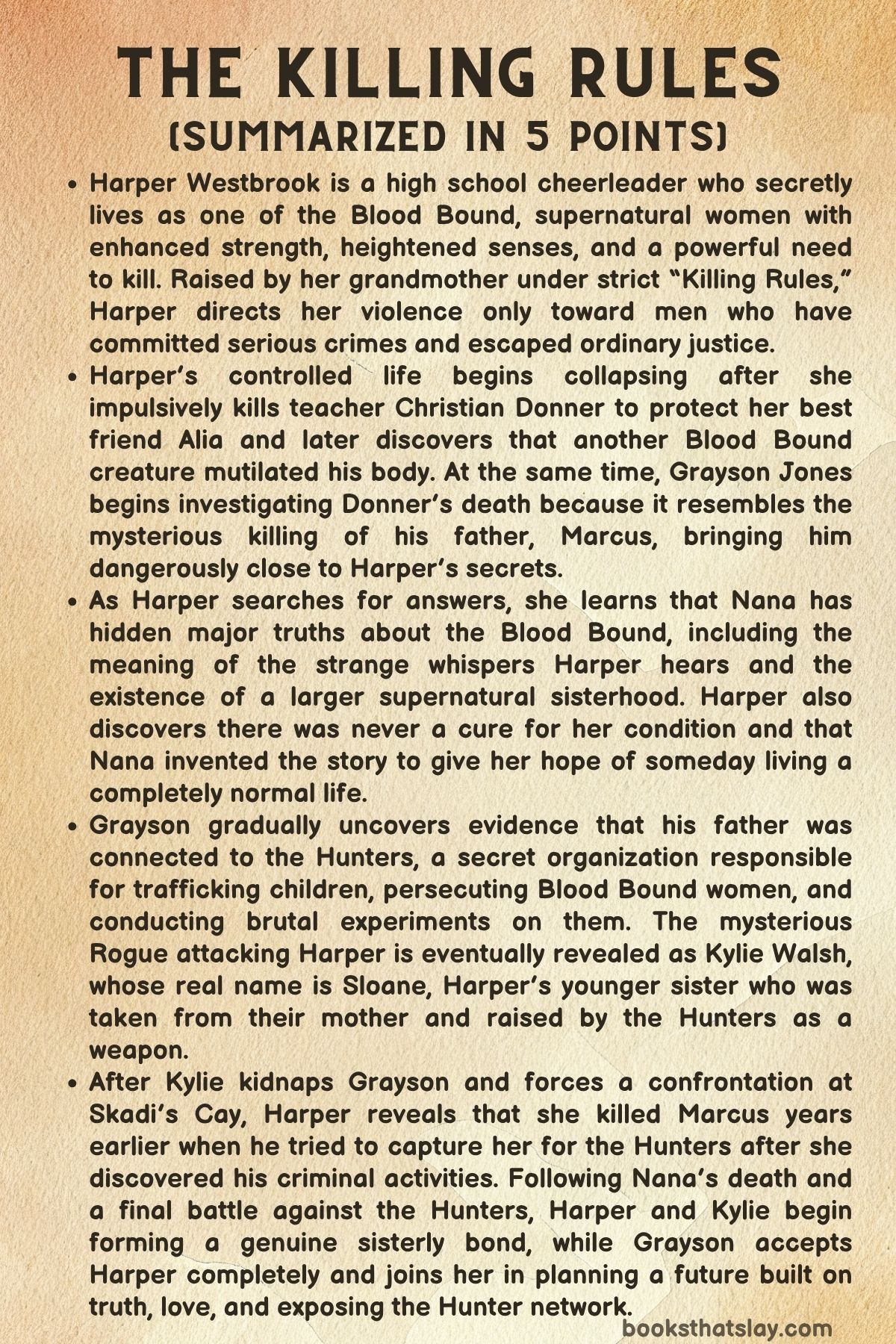
Characters
Harper Westbrook
Harper is the central character of The Killing Rules, and nearly every major conflict develops from the divide between the person she wants to be and the supernatural identity she has been taught to fear. She is intelligent, disciplined, protective, and capable of extraordinary violence, but her moral character is defined less by whether she kills than by the constant effort she makes to control whom she kills and why.
Nana’s rules give Harper a system through which she can live with the Blood Bound need for violence. She researches targets, avoids innocent victims, limits unnecessary harm, and even practices “Cosmic Balancing” by performing good deeds after kills, showing how strongly she needs to believe that morality can survive inside a life that contains killing.
Her deepest weakness is secrecy. Harper lies to Alia, Grayson, Nana, her teammates, and eventually herself because she believes exposure will lead to rejection or death, yet those lies gradually isolate her from precisely the people who might help her.
Her relationship with Grayson reveals Harper’s longing for an ordinary emotional life. She avoids him for years not because she stops loving him but because guilt over Marcus’s death and Nana’s rules convince her that intimacy is dangerous.
Harper’s development ultimately depends on rejecting the false goal of becoming “cured.” She ends the novel understanding that her supernatural nature is permanent but that permanence does not determine her morality; her choices, loyalties, restraint, and willingness to protect others remain her own.
Grayson Jones
Grayson is both Harper’s romantic counterpart and the novel’s primary investigator, giving The Killing Rules a second perspective through which the supernatural mystery can be examined. His identity has been shaped by Marcus’s death, his mother’s decline, and his determination to preserve a heroic image of the father he lost.
Journalism becomes Grayson’s method for imposing order on uncertainty. He searches documents, interviews witnesses, pursues NightHunter, obtains forbidden crime-scene photographs, and repeatedly risks himself because discovering facts feels like the only way to protect his family and repair the damage left by Marcus’s death.
His major emotional flaw is his attachment to an idealized version of his father. Even when evidence begins connecting Marcus to Bear River and the Hunters, Grayson initially searches for explanations that preserve Marcus’s innocence.
The eventual acceptance of Marcus’s crimes represents a painful maturation. Grayson must recognize that loving someone does not require denying what that person did, just as loving Harper eventually requires him to distinguish her supernatural nature from the moral choices she makes.
His relationship with Harper also forces him to reconsider trust. He is genuinely manipulated through some of her lies, but he eventually understands that fear, trauma, and survival motivated much of her secrecy rather than a desire to exploit him.
Nana
Nana is one of the most morally complicated figures in The Killing Rules because her love for Harper is genuine even while much of Harper’s worldview rests on Nana’s deceptions. She raises Harper after Abigail’s death, creates strict safeguards around her killings, researches targets, and devotes her life to keeping her granddaughter hidden from the Hunters.
Her greatest deception is the invented cure. Nana claims that she herself was once Blood Bound and eventually overcame the condition, giving Harper a future toward which she can work, but Nana was never Blood Bound at all.
The lie comes from love mixed with fear and control. Nana watched Abigail resist restrictions and eventually become vulnerable to the Hunters, so she responds by giving Harper rigid structure and carefully limiting what she can learn about her own community.
That strategy protects Harper physically but damages their trust. By hiding Elaine, the wider Blood Bound sisterhood, the meaning of the whispers, and the truth about Abigail, Nana unintentionally repeats the isolation that helped alienate her own daughter.
Her death completes her attempt at reconciliation with the family history she mishandled. By taking the bullet meant for Kylie, she protects the granddaughter she never knew and symbolically accepts both of Abigail’s daughters as family.
Kylie Walsh / Sloane
Kylie, whose real name is Sloane, is the tragic antagonist of The Killing Rules and Harper’s distorted mirror. Both sisters inherit the same supernatural nature, but Harper grows up with rules, affection, protection, and some degree of moral agency, whereas Kylie is raised by people who treat her as a weapon.
Her hostility toward Harper is therefore deeply personal. She does not merely want Harper dead; she wants Harper’s home, friendships, cheerleading identity, grandmother, and relationship with Grayson because those things represent the childhood and belonging stolen from her.
Kylie’s violence is extensive and frightening, especially because she has learned to transform far more completely than Harper. Yet that mastery is the product of torture, experimentation, conditioning, and forced killing rather than freedom.
Her role as both Blood Bound and Hunter demonstrates how thoroughly abuse can distort identity. The Hunters convince Kylie that the people most like her are enemies while simultaneously exploiting the very abilities they claim make Blood Bound women monstrous.
Kylie’s eventual decision to free Harper and fight the Hunters does not erase what she has done. It does, however, prove that her conditioning has not completely destroyed her capacity to choose, trust, and form a bond with her sister.
Alia
Alia is Harper’s longtime best friend and represents the ordinary teenage relationship Harper repeatedly neglects while managing her supernatural life. Her involvement with Christian Donner becomes one of the central catalysts of the story because Harper interprets the signs of manipulation as evidence that Alia needs protection.
Alia initially cannot accept that Donner exploited her. Her grief after his death and her defense of him show the confusion created when an older authority figure manipulates a younger person while making that attention feel special.
Her friendship with Harper nearly collapses when she learns that Harper killed Donner. Fear initially sends Alia running, but further reflection and contact with another former student help her recognize Donner’s pattern of behavior.
Alia’s decision to return is especially important because it challenges Harper’s assumption that knowing the truth will inevitably make people abandon her. She eventually accompanies Harper toward Skadi’s Cay and even attacks Kylie with Lizzie to save Harper, proving that her loyalty survives the discovery of Harper’s supernatural nature.
Marcus Jones
Marcus is physically absent for the main events, yet he exerts enormous influence over the story and over both Harper and Grayson. In The Killing Rules, his death begins as an apparent family tragedy and gradually becomes the key to exposing the Hunters’ corruption.
Grayson remembers Marcus as a respected district attorney and loving father, making the later revelations especially destructive. Evidence eventually shows that Marcus participated in transporting vulnerable young people to Bear River and profited from his relationship with the Hunters.
His encounter with fourteen-year-old Harper exposes the gap between his public identity and private behavior. After recognizing Harper as Blood Bound, he sees her as someone the Hunters might value rather than as a frightened child.
Marcus’s importance therefore lies partly in the collapse of idealization. His son must learn that a beloved parent can also have committed terrible acts, and Harper must understand that killing him in terror does not make her responsible for everything that happened to his family afterward.
Alice Jones
Alice is Grayson’s mother and one of the clearest examples of the long-term damage caused by Marcus’s death. Her stroke and dementia have altered her memory, independence, and ability to communicate, leaving Grayson convinced that he must organize his entire future around caring for her.
Despite her impaired condition, Alice carries fragments of crucial truth. Her terrified reaction to Harper proves that she remembers enough of Marcus’s death to identify Harper, while her later statements reveal that she knew Marcus was involved in harming vulnerable children.
Alice therefore functions as both a witness and a source of emotional pressure. Grayson spends much of the book interpreting her confusion as something he must manage, only to learn that some of her apparently disordered statements contain genuine memories.
Her eventual move into assisted living also contributes to Grayson’s development. He begins accepting that loving his mother does not mean assuming sole responsibility for every aspect of her care.
Elaine Boucher
Elaine Boucher becomes Harper’s alternative guide to Blood Bound history. Where Nana presents the condition primarily through fear, control, and secrecy, Elaine introduces Harper to a tradition in which Blood Bound women are considered Blessed protectors rather than cursed monsters.
Elaine explains the whispers, territorial warning signals, sisterhoods, and the possibility that proximity between Blood Bound women can increase their strength. Her knowledge immediately gives Harper explanations for experiences Nana had either misunderstood or concealed.
She also remembers Harper from infancy and serves as a living connection to Abigail. Through Elaine, Harper begins realizing that she belongs to a larger community and history that Nana’s protective isolation prevented her from knowing.
Elaine’s murder by Kylie is consequently more than the death of an ally. It cuts off a source of knowledge just as Harper begins constructing an identity beyond Nana’s version of the truth.
Christian Donner
Christian Donner initially appears to many students as a generous and inspiring teacher, making the suspicions surrounding him difficult for others to reconcile with his public reputation. His private interactions with Alia, however, contain secrecy, expensive gifts, emotional manipulation, physical evidence of distress, and behavior suggesting a pattern involving multiple girls.
Harper’s decision to kill him is impulsive compared with her usual carefully researched targets. She acts largely because she believes Alia has been harmed, making Donner’s death an important example of both Harper’s protective instincts and the danger of allowing those instincts to outrun certainty.
Later discoveries support Harper’s suspicions, including the second crystal-heart bracelet and reports concerning a student at Donner’s former school. Alia also eventually acknowledges that his behavior toward her was manipulative.
Donner’s death additionally becomes the event that brings Harper and Grayson back into sustained contact. His corpse links Grayson’s investigation of Marcus to the supernatural world while exposing the presence of another Blood Bound in Cliffside.
Morgan
Morgan is one of Grayson’s closest friends and an important counterweight to his obsession with Harper. She remembers how deeply Harper hurt him by withdrawing after Marcus’s death and therefore views their renewed closeness with suspicion.
Her anger is not simple jealousy. Morgan has supported Grayson through trauma and feels reasonably betrayed when he excludes her from an investigation that has become increasingly dangerous.
Morgan also provides crucial evidence when she reveals that a creature resembling the Blood Beast caused the accident near Skadi’s Cay. Her testimony helps Grayson finally accept that the supernatural explanations he previously dismissed may be real.
Although conflict temporarily separates them, Morgan ultimately joins the effort to rescue Harper. Her actions confirm that friendship can survive anger when both people acknowledge the ways they have failed one another.
Mateo Tucker
Deputy Mateo Tucker occupies an older-brother role in Grayson’s life because Marcus once helped him and because Tucker continues watching over the Jones family. He repeatedly attempts to protect Grayson while also discouraging him from becoming consumed by the investigation.
Tucker is limited by his position within institutions that may themselves be compromised. Official explanations surrounding Marcus and Donner repeatedly conflict with what Grayson discovers independently, placing Tucker in the uncomfortable position of representing law enforcement while caring deeply about someone who distrusts its conclusions.
The revelations about Bear River ultimately affect Tucker personally as well. He remembers that Marcus once nearly took him to the same facility, suggesting how narrowly Tucker may have escaped becoming another victim of the system he later entered as an officer.
His involvement near the conclusion positions him as someone capable of helping expose the corruption rather than simply defending established authority.
Micheal / NightHunter
Micheal represents the Hunters in their most personal and abusive form. As the real NightHunter, he belongs to the network connected to Bear River, Marcus, the persecution of Blood Bound women, and the experimentation performed on Kylie.
His relationship with Kylie is built on manipulation. He frames his control as rescue and insists that she owes him loyalty because the Hunters supposedly spared her, even though they tortured, conditioned, and weaponized her from childhood.
Micheal’s treatment of Kylie demonstrates how abusers can redefine dependence as gratitude. By convincing her that survival itself is a gift granted by him, he attempts to make resistance feel like betrayal.
His death at the airfield represents Kylie’s final rejection of that control. Killing him is not simply another act of violence for her; it marks a break with the identity the Hunters imposed upon her.
Pete Sivaldi
Pete Sivaldi is essential to uncovering the truth about Bear River and Marcus. As a former resident, he can describe the facility not as an abstract rumor but as a place of forced labor, violence, starvation, trafficking, and fear.
He initially withholds some information about Marcus, demonstrating how trauma and mistrust complicate testimony. Eventually, however, he admits Marcus personally transported other young people to Bear River and knew what occurred there.
Pete’s evidence forces Grayson to confront information he would prefer to reject. By the conclusion, Grayson intends to work with Pete and Tucker to expose what happened, allowing Pete’s experience to become part of a larger effort toward accountability.
Aunt Jenny
Aunt Jenny provides practical stability inside the Jones household. She helps care for Alice, worries about Grayson, and carries responsibilities that Grayson often treats as his alone.
Her presence exposes how unnecessarily Grayson has burdened himself with the belief that he must sacrifice his future for his mother. Jenny repeatedly demonstrates that Alice’s care is a shared family responsibility rather than a test Grayson must pass by himself.
Her developing relationship with Tucker also connects two parts of Grayson’s support network. By the end, the adults around Grayson are beginning to create a more sustainable structure that allows him to imagine leaving Cliffside for college.
Sheriff Barnes
Sheriff Barnes represents institutional compromise and the danger of official explanations that protect powerful people. He supports the animal-attack conclusion surrounding Marcus’s death and remains associated with earlier investigations that dismissed allegations involving Bear River.
His exact degree of knowledge is not fully resolved, but Grayson comes to suspect that Barnes and District Attorney Fuller helped protect the Hunter network. Those suspicions gain weight because official decisions repeatedly prevent genuine examination of crimes linked to Bear River.
Barnes’s terror when he encounters Kylie in beast form also contrasts with the confidence of the professional Hunters. He knows enough to exist near the conspiracy but is clearly unprepared for the full supernatural reality behind it.
Papa
Papa is already dead before the central events, but his absence remains important in Harper and Nana’s household. Harper associates him with family stability, while Nana’s grief after losing him contributes to the fear and desperation that shape her treatment of Harper.
Nana cruelly tells Harper during one argument that the stress of protecting her contributed to Papa’s death. The statement wounds Harper because it turns a family loss into apparent evidence that her very existence harms the people she loves.
Harper later begins moving beyond that belief. The story gradually separates responsibility from guilt, allowing her to recognize that tragedy around her does not automatically mean she caused it.
Jabari
Jabari is a secondary figure whose injury helps establish the early consequences of Kylie’s presence near Skadi’s Cay. His shoulder injury ends his football season after the vehicle accident that Morgan initially attributes to an ordinary animal.
Once Morgan admits that a supernatural creature actually caused the crash, the accident becomes an important piece of evidence in the larger mystery. Jabari therefore represents one of the ordinary people harmed indirectly by the hidden conflict between Blood Bound women and Hunters.
Themes
Identity, Self-Acceptance, and the Meaning of Being a Monster
Harper begins The Killing Rules believing that her Blood Bound nature is essentially a disease she must manage until she can eventually be cured. Nana’s invented story gives her hope, but it also teaches her to divide herself into two categories: the normal girl she wishes to become and the monster she fears already exists inside her.
This division shapes nearly every decision Harper makes. She carefully performs ordinary teenage roles as cheerleader, friend, student, and baker while treating killing as a secret contamination that must never enter those relationships.
Kylie offers the darkest possible version of the identity Harper fears. She has been trained to transform almost completely, conditioned to kill Blood Bound women, and taught that her supernatural abilities make her useful only as a weapon.
Yet Kylie’s existence ultimately shows that supernatural nature and moral identity are not identical. Her cruelty is influenced by years of abuse and conditioning, while her eventual decision to protect Harper proves that even someone shaped by extreme violence retains some capacity for moral choice.
Elaine provides another possibility by calling Blood Bound women Blessed rather than cursed. Harper does not need to accept every part of Elaine’s spiritual interpretation for the idea to change her thinking; she only needs to recognize that power itself is not proof of evil.
The conclusion therefore rejects the idea that Harper must become ordinary before she deserves love or a future. Her growth comes from accepting permanence without accepting moral surrender: she may always experience bloodlust, but she can still decide what kind of person lives with it.
Justice, Violence, and Moral Responsibility
The novel repeatedly asks what justice means when legal systems fail vulnerable people. Harper’s targets are generally men accused of severe harm who have escaped meaningful punishment, making her killings morally different from random predation even though they remain acts of violence.
Emmit, Donner, Marcus, and the man at the Fall Festival each force the issue into a different context. Harper does not always possess the same degree of certainty, which prevents her personal code from functioning as a simple guarantee that everything she does is unquestionably right.
Her killing of Donner demonstrates the risk especially clearly. Harper acts before fully understanding Alia’s experience, and although later evidence supports her belief that Donner was manipulating girls, Harper herself recognizes that this killing violated the safeguards designed to prevent emotion from determining guilt.
Marcus complicates the moral issue further because Grayson initially experiences him only as an innocent murder victim. Once evidence reveals his participation in child trafficking, the ethical frame changes, but the discovery does not erase Grayson’s grief or make his father’s death emotionally simple.
The Hunters provide the opposite model of violence disguised as righteousness. They claim to protect society from dangerous supernatural women, yet their methods include kidnapping, torture, trafficking, experimentation, coercion, and murder.
The contrast shows why claimed moral purpose cannot excuse conduct by itself. Harper’s rules matter because they require restraint, evidence, and self-questioning, while the Hunters become monstrous precisely because they stop recognizing the humanity of the people they target.
Secrecy, Lies, and the Cost of Protection
Nearly every central relationship is damaged by secrets intended to protect someone. Nana lies to Harper about the cure and the history of the Blood Bound because she believes hope and ignorance will keep Harper safer than the truth.
Harper copies this pattern in her own relationships. She hides her nature from Alia and Grayson, steals evidence, sabotages photographs, invents explanations, and repeatedly decides that other people will be safer if she chooses what they are allowed to know.
Grayson also withholds information. He excludes Morgan from his investigation, minimizes dangers around his family, and often pursues leads alone because he regards the search for Marcus’s killer as a responsibility uniquely belonging to him.
These characters rarely lie because they do not care about others. More often, their lies grow from love, guilt, fear, and the conviction that secrecy is a form of protection.
The consequences challenge that belief. Nana’s secrecy leaves Harper ignorant about abilities that could have helped her, Harper’s deception makes Grayson interpret real affection as manipulation, and Grayson’s decision to contact the Hunters without understanding them nearly gets Harper killed.
Truth does not immediately repair every relationship either. Alia is frightened when Harper confesses, Grayson is devastated when he learns about Marcus, and Harper feels betrayed when Nana admits the cure was fabricated.
Yet honest knowledge eventually makes genuine choice possible. Alia can choose whether to remain Harper’s friend, Grayson can decide whether he loves Harper as she actually is, and Harper can build an identity based on reality rather than a future Nana invented for her.
Family, Inheritance, and Breaking Cycles of Harm
Family in The Killing Rules carries both love and damage across generations. Harper inherits the Blood Bound condition from Abigail, but she also inherits Nana’s fear of Abigail’s fate, the Hunters’ hostility toward women like her, and years of unresolved grief surrounding her mother’s death.
Nana responds to losing Abigail by trying to control Harper more successfully than she controlled her daughter. Her rules contain genuine wisdom, but her secrecy recreates the same problem Abigail once identified: a young Blood Bound woman is isolated and prevented from understanding her own community.
Kylie shows an even more brutal form of inherited harm. She shares Harper’s mother and supernatural abilities but is taken from her family before she can know them, allowing the Hunters to replace family identity with institutional conditioning.
The sisters therefore demonstrate how dramatically environment can alter two people with the same inheritance. Harper receives love mixed with excessive control, while Kylie receives cruelty presented as discipline and exploitation presented as belonging.
Nana’s death becomes a final attempt to interrupt that history. By protecting Kylie from Barnes’s bullet, she acts for the granddaughter she once failed to know and accepts responsibility through action rather than explanation.
Harper then continues that change by refusing to abandon Kylie at the airfield. Instead of treating her sister solely as an enemy, she acknowledges the abuse that shaped her while still recognizing the seriousness of her actions.
The ending does not erase generations of damage. It offers something more realistic: Harper and Kylie begin constructing a sisterhood that neither Nana, Abigail, nor the Hunters were able to give them, creating the possibility that inheritance will no longer dictate what the next relationship must become.