The Ladies Hall Summary, Characters and Themes
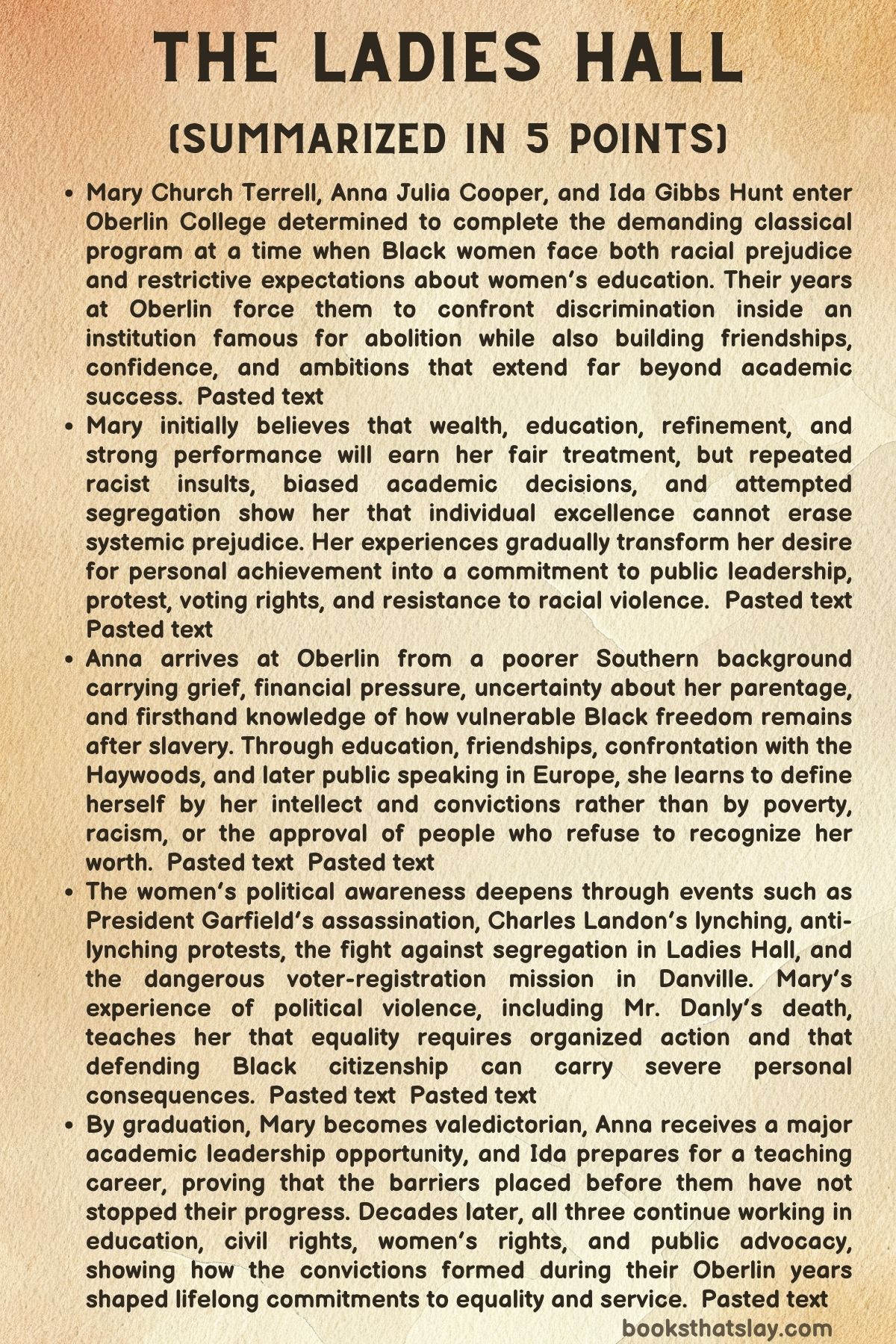
The Ladies Hall by Vanessa Miller is a historical novel centered on Mary Church Terrell, Anna Julia Cooper, and Ida Gibbs Hunt during their years at Oberlin College in the 1880s.
Drawing on the lives of women who would become influential educators, intellectuals, and civil-rights advocates, the book follows their struggle to claim academic opportunity in a society shaped by racism, sexism, class divisions, and the unfinished consequences of slavery. Their experiences inside and beyond Oberlin gradually transform education from a personal goal into a means of public service, while friendship gives them the strength to challenge institutions that often fail to honor their own ideals.
Summary
Mary Church’s understanding of race changes when she is still a child in Yellow Springs, Ohio. After learning at school that her father and grandparents had been enslaved, she initially feels humiliated, but the Vaughans, with whom she lives, teach her that the shame belongs to those who created slavery rather than those who survived it.
Their encouragement becomes foundational to Mary’s identity. She decides that intelligence, education, conduct, and achievement will become her answer to anyone who considers her inferior because she is Black.
Years later, Mary enters Oberlin College, where her wealthy father, Robert Church, insists that she live in Ladies Hall so that she can develop useful relationships with other educated students. She rooms with her close friend Ida Gibbs, and both young women enroll in the difficult four-year classical course rather than the shorter program normally expected of women.
Mary quickly discovers that Oberlin’s progressive reputation does not protect her from racism. Suzie McFarland repeatedly insults her, questions her right to belong, and treats her achievements as though they result from money or favoritism instead of ability.
At the same time, Anna Julia Cooper travels north from Raleigh, carrying very different experiences. She has grown up poor, lost her husband George after a brief marriage, remains uncertain about the identity of her White father, and has seen how fragile freedom remains for Black people in the postwar South.
Anna reaches Oberlin determined to receive the best education available. When administrators place her in the easier Ladies’ Course, she protests, takes a demanding entrance examination, passes, and earns admission to the same classical program pursued by Mary and Ida.
Mary and Anna initially respect each other, but their backgrounds create tension. Mary believes interracial contact is necessary because equality must be built by entering institutions dominated by White Americans, while Anna questions why Black people should constantly seek acceptance from spaces controlled by those who have historically excluded them.
Their economic differences also cause conflict. Mary gives Anna clothing and other assistance with good intentions, but Anna interprets the gestures as pity and becomes frustrated when Mary seems unaware of the labor expected from poorer students.
Meanwhile, Mary begins establishing herself within Oberlin. Disturbed by the deteriorating condition of Ladies Hall, she helps organize a petition and fundraising campaign for repairs, proving that she can mobilize students, gain support from administrators, and produce visible change.
She also becomes involved with the Aeolian Literary Society and develops a friendship with its president, Janet McKelvey. Mary sees relationships with White students like Janet as evidence that racial boundaries can be crossed, even though Suzie’s hostility continually reminds her that personal acceptance does not equal social equality.
Mary’s confidence is shaken repeatedly. She loses debates despite evidence that her arguments are stronger, and later she is denied the position of poet for the Sophomore Exhibition even though her friends consider her clearly more qualified than the young White man chosen instead.
Ida gives Mary a difficult lesson: prejudice may mean that being equal or even slightly better will never be enough. Mary may have to perform so convincingly that those inclined to dismiss her are given almost no opportunity to justify doing so.
Mary also develops a romantic attraction to Mason, a Black student whose political and religious views encourage her to think more seriously about social responsibility. Yet restrictions governing young women’s reputations make the relationship difficult, and Mary gradually becomes less interested in allowing romance to determine the direction of her future.
Anna experiences her own forms of isolation. She tutors students and works to meet expenses while grieving George, worrying about her mother, and feeling that wealthier students cannot understand what it means to survive through constant labor.
Her friendship with Katherine Smalls begins changing some of her assumptions about interracial relationships. Katherine’s willingness to acknowledge injustice and the example of Wilson Evans, who helped resist slave catchers during the Oberlin-Wellington Rescue, persuade Anna that White allies can participate meaningfully in racial justice when sympathy is accompanied by courage and action.
Mary and Anna eventually repair their damaged friendship. When Mary finally admits that wealth and social status have not protected her from racial humiliation, Anna recognizes that their circumstances may be different without making Mary’s pain less real.
During the summer, both women face crises at home. Mary returns to Memphis and watches her parents’ marriage collapse, while Anna returns to Raleigh and finds her mother Hannah dangerously ill.
Anna temporarily assumes much of Hannah’s work, including service in the Haywood household. Being treated as socially insignificant by men she suspects may be connected to her by blood forces Anna to confront the question of whether she needs their acknowledgment at all.
She eventually rejects that need. After confronting Dr. Fabius Haywood about the racial and gender privilege that allows his family to consider itself superior, Anna decides that her identity will be determined by education, character, and those who truly value her rather than by White men unwilling to recognize her.
Mary’s summer brings an even more brutal lesson when Charles Landon, a young man she had known socially, is killed in a racist lynching. His death makes racial violence immediate and personal, convincing Mary that education without action will not satisfy her.
President James Garfield’s assassination and eventual death also devastate her. Mary and her father had viewed Garfield as an important supporter of Black education and citizenship, so his loss makes national progress appear dangerously vulnerable.
Returning to Oberlin, Mary becomes more openly political. She begins distributing material against lynching, and Anna and Ida join her in staging a visible protest that attracts the attention of other students.
Their growing activism is tested when White residents of Ladies Hall attempt to force Black students to sit at a separate dining table. Mary, Anna, and Ida refuse, bringing the matter before administrators, who reaffirm Oberlin’s official commitment to equality.
The victory convinces Mary that institutions cannot be trusted to preserve their principles automatically. Equality survives only when individuals insist that laws, rules, and stated ideals be applied fairly.
Mary consequently becomes more confident about leadership. She wins the vice presidency of the Aeolian Literary Society and later its presidency, gradually accepting that ambition is not something for which she should apologize.
Anna’s world also expands when she receives an opportunity to travel to Europe. Mary voluntarily gives up her own place so Anna can participate, while Mary and Ida instead join a voter-registration mission in Virginia.
Both journeys expose the dangers surrounding racial advancement. Anna is denied first-class accommodation on the voyage because she is Black, while Mary enters a politically explosive Southern community where efforts to register Black voters face violent White resistance.
In Danville, the voter-registration mission turns deadly. When violence erupts, Mary risks her own safety to rescue Suzie, and Mr. Danly is killed because of his involvement in the struggle for Black voting rights.
Mary leaves Virginia understanding that political equality is not an abstract debate. People may die simply for insisting that Black citizens possess the political rights supposedly guaranteed to them.
Anna reaches London expecting greater freedom but encounters racial insults even while performing charitable work. Rather than deliver a cautious speech about unity, she speaks openly about racism, human dignity, and the particular burden carried by Black women who must confront both racial and gender discrimination.
The experience helps Anna discover the public voice that will shape her future. Paris later gives her moments of greater freedom, but she realizes how thoroughly repeated rejection has conditioned her expectations.
Back at Oberlin for their final year, Mary, Anna, and Ida recognize how extraordinary their position has become. Three Black women are approaching graduation from one of the institution’s most rigorous programs despite years of pressure suggesting that they do not belong.
Mary nevertheless continues encountering prejudice. After helping establish a young women’s missionary organization, she receives little recognition for her labor while Suzie gains an important office.
Instead of withdrawing, Mary decides to confront Suzie in another public debate. Anna advises her to stop merely constructing arguments that seem academically safe and instead speak from the convictions created by her own experience.
Suzie unexpectedly transforms the debate before Mary can deliver the confrontation she anticipated. She admits that her father taught her racist beliefs, confesses that Mary’s achievements threatened everything she had been taught about Black inferiority, and apologizes for years of hostility.
Mary accepts the apology, and their public reconciliation becomes more meaningful to her than simply defeating Suzie. The eventual victory confirms Mary’s intellectual ability, while Suzie’s change suggests that persistent confrontation with truth can sometimes alter individual prejudice.
Anna receives her own remarkable recognition when Wilberforce University offers her a position heading the Department of Modern Languages and Science. After a lifetime of feeling socially invisible, she encounters an institution willing to acknowledge her intellect and leadership.
Graduation finally brings the three friends together in triumph. Anna has secured an important academic career, Ida intends to teach, and Mary is unexpectedly chosen as valedictorian, becoming the first Black woman to receive that distinction at an American college educating both Black and White students.
Twenty-five years later, Mary, Anna, and Ida return to Oberlin with established careers behind them. Anna has become an educator and intellectual, Ida has worked as a teacher and international advocate, and Mary has become Mary Church Terrell, a national leader in Black women’s organizations and civil rights.
Their return is affectionate but not uncritical. They recognize that Oberlin itself later tolerated discriminatory practices that contradicted the principles they had once fought to defend.
Mary’s activism continues into old age. She challenges organizations excluding Black women and later participates in efforts to force Washington restaurants to obey laws requiring equal service, carrying into her eighties the same determination that first emerged during her Oberlin years.
The lives of Mary, Anna, and Ida therefore extend far beyond college success. Their education becomes preparation for decades of teaching, organizing, scholarship, political advocacy, and challenges to institutions that proclaim equality while practicing exclusion.
Characters
Mary Church Terrell
Mary is the central figure in The Ladies Hall, and her development is defined by the gradual transformation of privilege into responsibility. She enters Oberlin confident that wealth, education, social refinement, and excellent conduct can prove her equality to White society, but repeated discrimination forces her to recognize that racism does not disappear simply because an individual Black person becomes exceptional.
Her greatest strength is her refusal to remain permanently defeated by humiliation. Losing debates unfairly, being denied recognition as a poet, facing segregation inside her own residence, witnessing political violence, and losing Charles Landon to lynching each widen her understanding of injustice.
Mary initially wants achievement partly because she values recognition, but she gradually begins asking whom her achievements serve. That question changes her ambitions from largely personal advancement into public leadership.
Her friendship with Anna is especially important because Anna challenges Mary’s assumptions about money, labor, integration, and respectability. By listening to someone whose life has been far less protected, Mary becomes more capable of understanding that equality cannot depend on Black people constantly proving themselves acceptable to White institutions.
Mary also becomes increasingly independent from the expectations of her family. Her father wants her to succeed and believes she can change the world, but his influence sometimes conflicts with her desire to choose her own residence, career, relationships, and public commitments.
By the end of the book, Mary no longer believes that excellence alone will force society to become fair. She understands that laws, organizations, schools, and customs must be actively challenged when they fail to practice the equality they claim to support.
Anna Julia Cooper
Anna provides The Ladies Hall with a perspective shaped by poverty, bereavement, labor, Southern racism, and uncertainty about her parentage. Unlike Mary, she does not begin with faith that participation in elite institutions will naturally bring acceptance because she has spent much of her life watching social status protect White people while Black people remain vulnerable.
Education is therefore intensely personal for Anna. She refuses placement in the lesser academic program because she recognizes that accepting reduced expectations would allow other people to decide what her mind is capable of accomplishing.
Her pride can sometimes make assistance difficult for her to accept. Because she has repeatedly encountered environments where charity carries assumptions of inferiority, even Mary’s well-intended generosity initially feels like another reminder of class difference.
Anna develops by learning to distinguish pity from genuine support. Her relationships with Katherine, Sarah Evans, Wilson Evans, Mary, and Ida gradually show her that accepting fellowship does not necessarily require surrendering dignity.
Her confrontation with the Haywoods marks an especially important stage in her growth. Rather than continue defining herself through the unanswered question of which White man might be her father, she refuses to seek worth from people who have never treated her as worthy.
Europe further strengthens her public identity. Experiencing racism outside America destroys any easy belief that distance alone can create freedom, but speaking openly before a White audience helps her recognize that scholarship can become a weapon against both racial and gender oppression.
Ida Gibbs Hunt
Ida is one of the stabilizing forces in The Ladies Hall, particularly within Mary’s life. Coming from a prosperous Black family, she shares some of Mary’s social advantages, but she is often more cautious, practical, and attentive to consequences.
She repeatedly reminds Mary that academic preparation matters and warns her when romance, social activities, or wounded pride threaten to distract her. Her advice after Mary loses a debate is particularly revealing because Ida understands that Black women often face a standard in which ordinary competence is insufficient.
Ida is not simply Mary’s companion. She demonstrates courage in the protests against lynching, refuses the attempt to segregate the dining room, and participates in the dangerous voter-registration mission.
Her commitment to teaching also gives her an identity separate from marriage. She wants professional experience rather than immediately accepting the conventional assumption that a woman’s education should become secondary once she finds a husband.
Although Ida receives less individual attention than Mary or Anna, she represents the importance of dependable companionship within reform movements. Her friendship helps transform Mary and Anna from isolated individuals into members of a small community capable of resisting pressure together.
Suzie McFarland
Suzie serves as the principal interpersonal antagonist through much of The Ladies Hall. She expresses racist assumptions directly, resents Mary’s success, interprets Black achievement as illegitimate, and repeatedly attempts to remind Mary and Anna that she considers them socially inferior.
Her hostility is especially damaging because it exists inside Oberlin, an institution associated with abolition and interracial education. Suzie therefore demonstrates how an institution can possess progressive principles without eliminating prejudice from the individuals who inhabit it.
Her rivalry with Mary is fueled by insecurity as much as ideology. Mary’s intelligence, popularity, academic strength, and leadership threaten the racial hierarchy Suzie has inherited because Mary’s success contradicts the claim that White superiority is natural.
The Danville violence complicates Suzie’s worldview. Mary saves her despite years of cruelty, while Mr. Danly dies during a struggle for Black voting rights, forcing Suzie to encounter consequences that cannot easily be reduced to the assumptions she learned at home.
Her final apology does not erase the harm she caused. Instead, it shows that prejudiced beliefs can be learned and therefore can sometimes be confronted, questioned, and abandoned when a person becomes willing to acknowledge evidence that contradicts them.
Robert Church
Robert Church strongly shapes Mary’s ambitions in The Ladies Hall, even when he is physically distant from Oberlin. Having risen from enslavement to extraordinary financial success, he believes social influence, education, and strategic connections can help Black Americans secure greater power.
His decision to place Mary in predominantly White environments is deliberate. He wants her to build relationships with families and institutions that may eventually matter in wider struggles over racial equality.
Robert’s confidence in his daughter gives Mary a powerful sense that she is capable of more than conventional domestic expectations. Yet his protective and strategic instincts sometimes become restrictive when Mary wants greater control over where she lives and how she uses her education.
His political involvement also provides Mary with an early model of activism. Over time, she stops merely admiring his public commitments and begins developing causes, methods, and convictions of her own.
Hannah
Hannah is Anna’s mother and one of the strongest sources of sacrifice in the novel. Her life as a working Black woman has been defined by physical labor, economic insecurity, and the social consequences of slavery, yet she does everything possible to give Anna opportunities she never possessed.
Her decision to provide the small amount of money she has saved for Anna’s journey to Oberlin demonstrates how much Anna’s education depends on sacrifices made by women whose names rarely receive public recognition. Hannah cannot give her daughter wealth or influence, but she gives her permission to imagine a different life.
Her serious illness later creates an emotional conflict for Anna. Anna wants to remain and care for her, but Hannah insists that her daughter must return to Oberlin and complete the education for which they have both sacrificed.
Hannah therefore represents an older generation whose endurance creates possibilities for the next one. Anna’s later accomplishments cannot be separated from her mother’s refusal to allow poverty to become the final limit of her daughter’s future.
Louisa Church
Louisa is Mary’s mother and initially appears associated with elegance, social tradition, domestic expectations, and the privileged world Mary has known since childhood. As Mary matures, however, she begins recognizing that her mother’s comfortable surroundings have not necessarily given her freedom.
The failure of Louisa’s marriage changes Mary’s understanding of womanhood. She begins questioning the assumption that marriage automatically provides security or fulfillment, especially when a woman lacks equal authority within the relationship.
Louisa therefore contributes indirectly to Mary’s growing independence. Watching her mother’s circumstances encourages Mary to imagine a future in which education, work, and public purpose are essential parts of a woman’s identity rather than temporary activities before marriage.
Mason
Mason is Mary’s romantic interest at Oberlin, but his importance extends beyond courtship. He introduces conversations about religion, political responsibility, Black leadership, and the obligation of churches to oppose oppression.
His presence reveals Mary’s conflict between personal affection and public ambition. She enjoys being admired and considers the possibility of romance, but she becomes increasingly unwilling to allow courtship or social expectations to determine her future.
Mason also encourages greater visibility when Mary begins protesting lynching. His suggestion that quiet leafleting will not attract enough attention helps move the students toward a more public demonstration.
Katherine Smalls
Katherine becomes one of Anna’s most important White friends. Her significance lies less in dramatic action than in her ability to challenge Anna’s understandable suspicion that White people will inevitably protect racial privilege when doing otherwise becomes uncomfortable.
Katherine listens, questions inherited assumptions, and treats Anna as an intellectual equal. Her friendship does not cause Anna to overlook racism, but it helps her separate oppressive systems from individuals who consciously choose to oppose them.
Her presence reinforces the idea that solidarity has value when it includes action and self-examination. Anna can maintain racial pride while still building meaningful relationships across racial lines.
Wilson Evans
Wilson Evans gives Anna a living connection to Oberlin’s abolitionist past. His participation in the rescue of fugitive John Price proves that opposition to slavery was not merely a collection of moral statements but could require personal danger and defiance of unjust authority.
Anna respects him because his principles have been tested through action. His example strengthens her belief that genuine allyship requires people to risk comfort, reputation, or safety when justice demands it.
His home also gives Anna a place where Black history is treated with dignity. Living there contributes to the intellectual and moral environment that helps her imagine the larger purpose of her education.
Sarah Evans
Sarah offers Anna a form of care that gradually helps her reconsider her suspicion of receiving help. She encourages Anna to devote more attention to her studies instead of behaving as though every kindness must immediately be repaid through labor.
Her support is important because Anna associates dependence with vulnerability. Sarah demonstrates that assistance offered with respect can strengthen a person without diminishing her dignity.
Through Sarah, Anna learns an emotional lesson that complements her academic education. Independence does not have to mean complete isolation, and accepting care from trustworthy people can coexist with self-respect.
Mrs. Johnston
Mrs. Johnston supervises Ladies Hall and frequently occupies the difficult position between institutional rules and student conflicts. She recognizes Mary’s potential, supports the effort to improve the residence, and often encourages her to continue pursuing leadership despite hostility.
She is also concerned with the restrictive standards governing women’s reputations. Her intervention in Mary’s meetings with Mason illustrates how female students are expected to protect themselves from gossip in ways their male counterparts are not.
Mrs. Johnston becomes an important adult supporter of Mary’s development. Her encouragement to avoid making herself smaller because of prejudice reinforces Mary’s growing belief that exclusion should be confronted rather than quietly endured.
Janet Huntington McKelvey
Janet helps Mary gain access to the Aeolian Literary Society and becomes one of her earliest meaningful White friendships at Oberlin. Her willingness to recognize Mary’s intelligence and social confidence provides a contrast to Suzie’s racial hostility.
Their friendship matters because Mary strongly believes interracial relationships can help challenge inherited prejudice. Janet demonstrates that such relationships are possible, although the book never suggests that individual friendship alone can solve institutional racism.
Mr. Danly
Mr. Danly connects Mary’s education to direct political activism. He initially invites her to participate in voter-registration work when she is still more interested in school, social activities, and personal advancement.
When Mary later joins his mission in Virginia, she has changed enough to understand the importance of the work. His death during the violence in Danville becomes one of the clearest demonstrations of the danger faced by people attempting to defend Black political rights.
Danly’s sacrifice permanently changes Mary’s understanding of activism. Political participation is no longer something admirable people do elsewhere; it becomes a responsibility she feels personally compelled to continue.
Charles Landon
Charles appears briefly in Mary’s social life, bringing charm and romantic possibility during a period already filled with family uncertainty. His murder in a racist lynching radically changes the meaning of his presence in the story.
His death turns racial violence from an issue Mary understands intellectually into a personal loss. It becomes one of the events that ends her willingness to treat activism as something she can postpone until after education, romance, or social advancement have been settled.
George Cooper
George, Anna’s late husband, remains psychologically present long after his death. Anna’s grief for him shapes her loneliness and reminds readers that her educational ambitions develop alongside personal sorrow rather than replacing it.
She often imagines what he might think about her accomplishments. His memory therefore represents both what Anna has lost and the emotional history she carries as she constructs a new identity beyond widowhood.
Rufus
Rufus is Anna’s brother and another figure confronting the narrow opportunities available to Black Americans in the postwar South. His dream of becoming a musician reflects his desire for a life defined by talent rather than racial restrictions.
The threatening encounter during the journey north demonstrates how quickly Black freedom can be challenged through accusations, coercion, and laws designed to criminalize ordinary life. Anna’s concern for Rufus strengthens her determination that neither sibling should accept the limits society attempts to impose upon them.
Themes
Education as Freedom and Responsibility
Education functions as far more than academic achievement in The Ladies Hall. For Mary, Anna, and Ida, entering Oberlin’s classical program is itself a rejection of the restricted intellectual expectations applied to Black women, because success requires them to claim subjects, institutions, and leadership opportunities from which people like them have historically been excluded.
Anna’s insistence on taking the entrance examination illustrates the connection between education and self-definition. Accepting the easier program would mean accepting another person’s judgment about the proper limits of her ambition, so passing the examination becomes an assertion that her abilities must be evaluated rather than assumed.
Mary initially treats academic success partly as proof. She believes achievement will demonstrate Black equality so convincingly that prejudice will become impossible to justify, yet experience teaches her that excellence alone cannot force unfair institutions or individuals to behave fairly.
This realization changes the meaning of education for her. Knowledge becomes valuable not simply because it brings distinction but because it provides language, authority, organization, and confidence that can be used in public struggles.
Anna undergoes a similar transition. Her studies begin as a path away from poverty and confinement, but her European speech reveals that intellectual development has given her a public voice capable of naming racial and gender injustice.
The three women eventually understand that education carries an obligation beyond the self. Their achievements gain their fullest significance when scholarship becomes connected to teaching, organizing, writing, political participation, and efforts to expand opportunity for those who follow them.
Racism Beyond Legal Emancipation
Freedom after slavery is repeatedly shown as incomplete. The formal end of enslavement has not eliminated racial violence, voter suppression, economic exploitation, social segregation, prejudice, or the assumption that Black people must constantly justify their presence in institutions dominated by White Americans.
Anna learns this during the journey north when Rufus is nearly subjected to arrest and forced labor based on suspicion rather than wrongdoing. The incident demonstrates how easily legal structures can reproduce coercion even when slavery itself has been abolished.
Oberlin provides another example of incomplete freedom. The college possesses a celebrated abolitionist history, yet Black women still encounter racist insults, biased judgments, social exclusion, and attempts at segregation.
Mary’s experiences are especially important because wealth cannot protect her from these conditions. Her family’s money provides education, clothing, travel, and social access, but none of those advantages prevent White classmates from viewing her through racial assumptions.
The Danville violence exposes the political stakes most brutally. Black men technically possess voting rights, yet attempting to exercise those rights can invite intimidation and death.
Charles Landon’s lynching provides the same lesson through racial terror. Laws may proclaim citizenship, but citizenship has little meaning when Black people can be murdered without adequate protection.
The novel therefore separates emancipation from genuine equality. Freedom requires more than removing one legal institution; it demands continuous resistance to the systems, customs, fears, and prejudices that survive after that institution is gone.
Black Womanhood, Gender, and Independence
Mary and Anna must confront sexism at the same time that they confront racism. Their ambitions are frequently judged not only by whether Black people are considered capable of intellectual leadership but also by whether women are expected to pursue such leadership at all.
The academic structure at Oberlin illustrates this distinction immediately. Women are offered a less demanding course, while the rigorous classical curriculum is associated with men, making Mary, Anna, and Ida’s choice of program a challenge to gender expectations as well as racial ones.
Anna’s career ambitions repeatedly raise questions about what an educated woman is supposed to do with her knowledge. Her eventual appointment to lead a department matters because an institution recognizes her as an intellectual authority rather than treating education as preparation for domestic respectability.
Mary faces similar pressures through romance and family expectations. Her relationship with Mason occurs under strict supervision, while observing her parents’ failed marriage leads her to question whether a woman’s security should depend primarily on becoming a wife.
Louisa’s experience strengthens these doubts. Mary gradually understands that social comfort can hide unequal power within marriage, encouraging her to seek an identity supported by education, work, and public purpose.
The women therefore resist the idea that racial advancement should focus primarily on Black men while women remain in secondary roles. Their activism insists that justice cannot be complete if Black citizenship expands while Black women continue to be denied intellectual, professional, and political authority.
Friendship, Allyship, and Collective Action
Individual courage matters throughout The Ladies Hall, but the novel repeatedly shows that sustained change becomes possible through relationships. Mary, Anna, and Ida become much more effective once they stop treating one another merely as fellow students and begin acting as a community.
Mary and Anna’s friendship is especially significant because it survives serious disagreement. Their differences in wealth, regional background, attitudes toward integration, and experiences of labor initially divide them, yet those same differences eventually allow each woman to understand realities she might otherwise have overlooked.
Ida strengthens that relationship through consistency. She offers practical advice, participates in protests, refuses segregation, and joins political work, demonstrating that friendship can become a form of shared resistance.
Interracial friendships are treated with more caution. Janet and Katherine show that genuine relationships across racial lines are possible, but the story does not present friendship as a substitute for structural change.
Instead, meaningful allyship requires action. Wilson Evans earns Anna’s respect because he once risked punishment while opposing slave catchers, while Katherine becomes important because she is willing to question racial assumptions rather than merely claim goodwill.
Suzie’s transformation offers the most difficult example. Her apology cannot undo years of cruelty, but acknowledging how racism was taught to her and publicly rejecting those beliefs demonstrates the possibility of change when a person accepts responsibility instead of defending inherited prejudice.
The larger lesson is that movements depend on people acting together without pretending that everyone enters the struggle from the same position. Mary, Anna, and Ida retain distinct personalities and experiences, yet their willingness to stand beside one another allows education to become activism and personal conviction to become collective power.