For the Love of the Quest Summary, Characters and Themes
For the Love of the Quest by Alexandra Ammon Parthun is an Arthurian adventure romance about two women who begin a treasure hunt for very different reasons and gradually discover that the journey is changing what they believe about themselves.
Edith Darling leaves a sheltered upper-class existence to pursue the dream she once shared with her grandmother, while Thomasin Shaw, a feared criminal leader, initially sees Edith as a possible source of profit. Their search for Excalibur becomes a test of courage, trust, sacrifice, identity, and love as legendary Arthurian sites prove far more real than either woman expects.
Summary
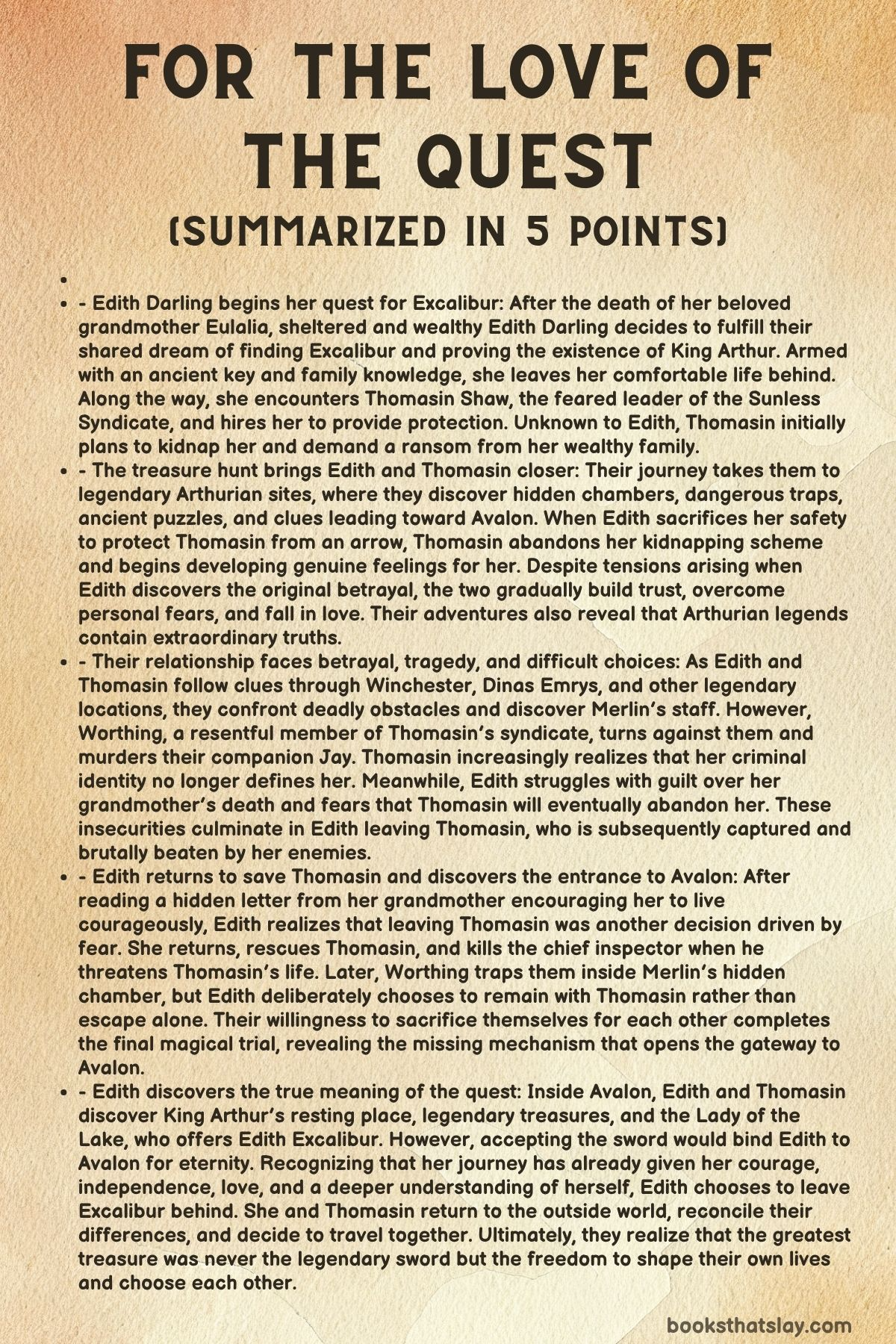
Edith Darling has spent much of her life protected by wealth, family expectations, and her own fears. After the death of her beloved grandmother Eulalia, however, Edith finally chooses to pursue the adventure they once planned together: searching for Excalibur, Camelot’s lost treasures, and evidence that King Arthur was a genuine historical figure.
Her grandmother had left her an ancient iron key and knowledge passed through the Camborne family concerning Arthur’s Stone at Slaughterbridge. Edith believes that these clues form the beginning of a hidden route to Avalon, and she sets out alone despite having almost no practical experience of independent travel.
On her way to London, Edith encounters Thomasin Shaw, a female highway robber who points a gun at her. Instead of reacting with terror, Edith finds Thomasin fascinating and treats the encounter almost as though she has finally stepped into one of the adventure stories she has spent years reading.
Edith later seeks out the dangerous Sunless Syndicate at the Oleander Inn because she wants professional protection for her quest. She is delighted to discover that its feared leader is Thomasin herself.
Thomasin considers Edith’s theory about Camelot absurd, but Edith offers her all the treasure they might find in exchange for keeping Excalibur. The offer comes at a useful moment because Thomasin’s criminal organization is under increasing pressure from the Metropolitan Police.
Yet Thomasin secretly develops another plan. Believing Edith’s wealthy father will pay an enormous ransom, she intends to accompany Edith to Slaughterbridge and then exchange her for gold.
The expedition begins with Thomasin, Edith, Worthing, and Jay. Worthing is an older member of the syndicate who resents Thomasin’s leadership, while Jay is considerably more accepting of her authority.
Their departure becomes violent when the chief inspector and his constables confront them. Edith initially assumes that the officers can be reasoned with, but the chief fires at her, forcing Thomasin to intervene and kill several policemen.
Instead of recoiling from Thomasin afterward, Edith embraces her and thanks her for saving her life. Her uncomplicated trust begins troubling Thomasin, who knows that she is secretly planning to betray the woman who now considers her a protector.
During the journey to Slaughterbridge, Edith discovers that the discomforts of adventure make her happier than the protected life she left behind. She becomes close to Jay and increasingly attracted to Thomasin, while Thomasin finds herself caring about Edith’s comfort, safety, and happiness in ways that conflict with everything she has been taught.
At Arthur’s Stone, Edith uses the inherited key to reveal a concealed underground chamber. A puzzle based on the legend of Sir Bedivere requires them to surrender wealth, so Edith pours her gold into a carved basin.
The mechanism opens and reveals an ancient parchment, but Thomasin is furious when she learns that this is merely another clue rather than the location of Camelot’s treasure. When Thomasin attempts to recover one coin, she activates a trap, and Edith throws herself into the path of an arrow meant for Thomasin.
Edith’s willingness to risk her life changes Thomasin decisively. Horrified by the contrast between Edith’s selfless action and her own ransom plan, Thomasin cancels the kidnapping and commits herself to continuing the quest.
She still cannot bring herself to confess what she intended, however. That dishonesty later becomes one of the first serious threats to their growing relationship.
Edith’s wound becomes infected because she hides her worsening condition rather than admit weakness. She fears Thomasin will regard her as a burden and abandon her, but when Edith collapses, Thomasin reacts with fear and anger because Edith endangered herself unnecessarily.
The infection must be cauterized, and Thomasin remains beside Edith throughout her recovery. She makes it clear that they are friends and that Edith does not need to prove her worth by silently suffering.
Their companionship becomes increasingly intimate. Edith offers to teach Thomasin cosmetics and other feminine skills Thomasin never had the opportunity to learn, while Thomasin promises to teach Edith self-defense.
Their exchange reveals an important similarity between them. Edith has spent her life believing that caution and obedience make her acceptable, whereas Thomasin has been taught that violence and ruthlessness are the only qualities that make her valuable.
Their relationship nearly collapses when Edith overhears Jay confronting Thomasin about the ransom scheme. Thomasin finally admits that she had intended to kidnap Edith and threaten her family for money.
Edith ultimately forgives the original plan because Thomasin abandoned it once their relationship became real. More painful to Edith is learning that Thomasin never believed the quest itself, but Thomasin insists that even if she remains uncertain about Arthurian magic, she believes in Edith.
The map leads them to Winchester and the famous Round Table displayed in the Great Hall. Edith, once terrified of breaking rules, impulsively smashes a window so they can enter after dark.
A secret mechanism in the table reveals another underground passage. Inside, Edith and Thomasin encounter an enormous chamber filled with spiders, forcing them to confront their fears rather than solve a conventional puzzle.
Beyond the spiders lies the genuine Round Table of Camelot. A further trial involving blood and sacrifice produces a clue represented by red and white dragons.
For Thomasin, the discovery destroys her remaining disbelief. She finally accepts that Edith has been right, calls the search “our quest,” and kisses her.
Their romance grows alongside the adventure. Thomasin reveals painful details of her childhood, including losing her parents young and being raised by Marshall, the former syndicate leader who trained her primarily as a weapon.
Edith tells Thomasin about her own fear that no one has ever truly chosen her first. The two promise to prioritize one another, and Thomasin later gives Edith a tattoo of Excalibur that becomes a symbol of Edith’s growing ability to make choices without letting fear control every decision.
The dragon clue takes them to Dinas Emrys, where legends concerning Merlin lead them through an underwater passage and into another concealed cavern. There they must cross a deadly floor by following the sequence of animals in Merlin’s prophecy.
Edith nearly falls into an abyss but saves herself, drawing strength from the heroines whose stories shaped her imagination. The experience strips away her hesitation, and she tells Thomasin that she loves her.
Thomasin immediately returns the declaration. Soon afterward they find Merlin’s staff, seemingly proving once again that the myths Edith treasured contain historical truth.
Their success is followed by tragedy. Worthing, increasingly furious that Thomasin has placed Edith above the syndicate, turns against them and takes Edith hostage.
Jay attacks Worthing to protect her and is killed when Worthing cuts his throat. Thomasin wants to execute Worthing, but Edith begs her to stop the cycle of killing.
Thomasin lets him escape and recognizes that she no longer wants the Sunless Syndicate badly enough to become the person Worthing demands. Her relationship with Edith has shown her that she can build an identity beyond leadership, intimidation, and violence.
Merlin’s staff provides the next clue, directing Edith and Thomasin toward Bardsey Island. Before reaching it, their boat collapses, forcing them into freezing water.
Thomasin helps Edith reach shore and saves the urn containing Eulalia’s ashes. Sheltering in an abandoned church afterward, Edith and Thomasin become physically intimate, with Thomasin repeatedly checking Edith’s comfort and allowing her to control the pace.
On Bardsey, marked trees lead them to Merlin’s hidden tomb. Thomasin must confront her fear of heights while descending a dangerous staircase, and Edith supports her using the same lessons about courage Thomasin once gave her.
Merlin’s staff activates a concealed passage leading to an amethyst chamber and an elaborate door that appears to guard Avalon. A central component is missing, however, and nothing Edith attempts will open it.
The failure overwhelms her. Edith finally admits that Eulalia postponed their original expedition because Edith had been too afraid to leave home, and she has blamed herself ever since her grandmother died before they could undertake it together.
Edith also becomes convinced that Thomasin will eventually resent everything she sacrificed for the relationship. Terrified that abandonment is inevitable, Edith chooses to leave first.
She encounters her father and agrees to return with him, devastating Thomasin. Soon afterward Worthing and the chief inspector seize Thomasin, intending to hand her over to the authorities while preserving the syndicate.
Aboard her father’s boat, Edith discovers a final letter from her grandmother that her father had hidden. Eulalia tells her that she never blamed Edith for delaying the quest and that finding Excalibur matters less than living courageously, making mistakes, and following her good heart.
Edith understands that returning home is not a mature sacrifice but another decision controlled by fear. She declares Thomasin her true home and races back to rescue her.
Thomasin has been brutally beaten by the time Edith finds her. Although Thomasin is angry and refuses to forgive her immediately for leaving, Edith accepts responsibility rather than demanding instant reconciliation.
When the chief inspector later prepares to shoot the injured Thomasin, Edith kills him with a knife. She is horrified by taking a life but does not regret choosing Thomasin when there was no other way to save her.
Before leaving Bardsey, Edith insists on returning to Merlin’s tomb to scatter her grandmother’s ashes. Worthing follows them, takes Edith hostage, destroys Merlin’s staff, and attempts to trap Thomasin permanently inside the amethyst chamber.
Edith escapes Worthing but makes an extraordinary choice. Rather than flee through the narrowing doorway, she slides beneath it at the final moment and traps herself inside with Thomasin.
She refuses to let Thomasin die believing she has been abandoned again. Their willingness to face death together completes the trial they had previously failed.
A white gear suddenly appears, revealing that the missing requirement was not blood or wealth but genuine sacrifice motivated by love. Edith and Thomasin place it into the door and finally open the entrance to Avalon.
Inside they discover a magical sanctuary containing legendary treasures, Arthur’s resting place, and the Lady of the Lake. The Lady offers Edith Excalibur but warns that taking it into the outside world would bind Edith to return upon death and spend eternity protecting Avalon.
Edith finally has the opportunity to possess everything she once thought she wanted: proof of Arthur, fame, historical recognition, and the legendary sword itself. Yet she realizes that the quest has taught her that her life does not require public validation to have meaning.
She leaves Excalibur behind. She also discovers records from previous successful seekers, including members of her own family, who likewise chose to protect Avalon rather than expose it.
Edith and Thomasin return to the ordinary world through Glastonbury Tor. With the quest completed, they finally confront the emotional wounds that nearly separated them.
Edith explains that she left because fear convinced her Thomasin would eventually regret loving her. Thomasin explains that the criminal life she abandoned had already become empty and that Edith did not ruin her future but offered her the possibility of becoming someone she actually wanted to be.
Their reconciliation completes the changes begun on the road to Camelot. Edith no longer believes safety should determine her life, while Thomasin no longer believes violence should determine hers.
With neither woman eager to return to her former home, Thomasin proposes continuing to travel around the world. Edith joyfully agrees, accepting that Excalibur was never the final reward of the adventure.
The real treasure is the freedom they have gained to choose their identities, their future, and each other.
Characters
Edith Darling
Edith Darling is the emotional center of For the Love of the Quest, beginning as a wealthy twenty-seven-year-old woman whose imagination is far more adventurous than her actual experience. Her sheltered upbringing has given her knowledge, curiosity, and romantic ideals, but it has also encouraged a powerful habit of treating safety as the most responsible possible choice.
Her grandmother’s death forces Edith to confront the cost of that habit. She leaves home partly because she wants Excalibur and partly because completing the journey seems like the only way to repair the guilt she feels over delaying the adventure until Eulalia could no longer join her.
Edith initially approaches danger through the logic of books and legends. She treats Thomasin’s attempted robbery with fascination, believes policemen should behave reasonably because they represent law, and regards wounds almost proudly because they prove she has finally become an adventurer.
Experience gradually complicates that romantic outlook. Edith learns that adventure contains infection, terror, grief, betrayal, moral compromise, and death alongside discovery and excitement.
Her greatest weakness is not simple cowardice but her belief that fear should be obeyed whenever obedience can be disguised as practicality. She repeatedly worries that she is inconvenient, unworthy, or easy to abandon, causing her to hide her infected wound and later leave Thomasin before Thomasin has the chance to leave her.
Thomasin helps Edith discover courage as action rather than fearlessness. By the later stages of For the Love of the Quest, Edith can fight, pick locks, make impulsive choices, confront physical terror, and even kill when Thomasin’s life is immediately threatened.
Her development never requires her to become Thomasin. Edith remains scholarly, compassionate, romantic, and deeply interested in stories, but she stops assuming those traits make her weak.
Her final decision concerning Excalibur completes this development. Early Edith wants the sword because possessing it would validate her beliefs before the world, whereas the mature Edith no longer needs strangers to confirm that her experiences, choices, and relationships matter.
Thomasin Shaw
Thomasin Shaw initially appears to be Edith’s opposite: physically capable, fearless in combat, sexually confident, socially intimidating, and accustomed to surviving through violence. Beneath that presentation, however, she is controlled by expectations almost as strongly as Edith is.
Marshall taught Thomasin that her value came from being useful, dangerous, and emotionally hardened. Becoming leader of the Sunless Syndicate therefore gave her authority without genuine freedom, because she continued performing the identity another person designed for her.
Thomasin’s decision to ransom Edith demonstrates how fully criminal logic initially governs her thinking. She can appreciate Edith’s personality while simultaneously planning to sell her back to her family because she has learned to treat attachment and exploitation as compatible.
Edith taking an arrow for her breaks through that emotional structure. Thomasin cannot reconcile Edith’s unquestioning concern for her life with her own planned betrayal, so canceling the ransom becomes one of her first major decisions based on who she wants to be rather than what the syndicate requires.
Her relationship with Edith reveals vulnerabilities Thomasin normally hides. In For the Love of the Quest, her affection for romance novels, interest in cosmetics, memories of her mother, fear of heights, desire for tenderness, and longing to be trusted gradually emerge from beneath her criminal persona.
Thomasin is particularly affected by being chosen without conditions. She has spent years being obeyed because of power and feared because of reputation, but Edith treats her as someone worth loving even when there is no immediate benefit to doing so.
Her protectiveness can nevertheless become controlling or secretive. Concealing the ransom plot demonstrates that Thomasin sometimes prefers managing another person’s reaction to risking honest vulnerability.
By the conclusion, she accepts that leaving the syndicate does not mean losing herself. She can retain her confidence, fighting ability, independence, humor, and appetite for adventure while rejecting Marshall’s belief that brutality is the foundation of her identity.
Eulalia Camborne Darling
Eulalia is dead before the central journey begins, yet she remains one of the strongest influences on Edith. She is the family member who encouraged Edith’s fascination with Arthurian history rather than treating it as childish or impractical.
Her relationship with Edith gave the planned quest emotional significance long before it became real. Edith carries Eulalia’s ashes partly because she cannot separate the search for Avalon from the grandmother who taught her to dream about it.
After Eulalia’s death, however, Edith turns love into guilt. She convinces herself that her hesitation robbed her grandmother of one last great adventure, and this belief becomes a hidden source of pressure throughout For the Love of the Quest.
Eulalia’s final letter corrects Edith’s interpretation of their relationship. She explains that planning and dreaming together were themselves valuable experiences and that Edith does not owe her a successful discovery.
Her final advice also defines the emotional lesson Edith needs most: living courageously matters more than behaving perfectly. Eulalia therefore influences the adventure not by directing every step but by eventually freeing Edith from the guilt that has distorted the meaning of their bond.
Worthing
Worthing represents the criminal world Thomasin is gradually outgrowing. He believes the Sunless Syndicate must come before personal relationships and interprets Thomasin’s changing priorities as weakness, irresponsibility, and betrayal.
His resentment is also personal. Marshall selected Thomasin rather than the older Worthing to lead the organization, creating an unresolved struggle over legitimacy and authority.
Worthing correctly recognizes that Edith is changing Thomasin, but he interprets every change negatively. Thomasin’s compassion, willingness to abandon the ransom, reduced interest in the syndicate, and emotional attachment all look to Worthing like evidence that she has become incapable of leadership.
His escalating violence makes him more than a critic. He kills Jay, repeatedly threatens Edith, collaborates with the chief inspector, helps capture Thomasin, and eventually tries to seal Thomasin inside Merlin’s tomb.
Worthing consequently represents Thomasin’s old life refusing to release her. Defeating him is not simply about surviving an enemy but about rejecting a system that demands Thomasin sacrifice love, individuality, and moral choice to preserve power.
Jay
Jay is a comparatively gentle presence within the Sunless Syndicate and becomes an important companion during the quest. His knowledge of plants interests Edith, and unlike Worthing, he does not continually challenge Thomasin’s authority.
His strongest quality is moral independence. When he realizes Thomasin has concealed the ransom scheme from Edith, he argues that Edith deserves the truth even though confronting the leader of the syndicate could place him in danger.
That confrontation helps force Thomasin toward honesty. Jay therefore contributes to the development of the central relationship by refusing to treat loyalty as unquestioning obedience.
His death demonstrates the growing stakes surrounding Worthing’s rebellion. When Worthing takes Edith hostage, Jay intervenes immediately and is killed protecting her.
Edith’s grief afterward shows how far she has moved beyond treating the expedition as an exciting story. Jay becomes one of the clearest reminders that real adventure creates genuine relationships and genuine losses.
Marshall
Marshall appears largely through Thomasin’s memories, but his influence explains many of her emotional defenses. After Thomasin lost her parents, he became the person responsible for shaping her into a survivor and criminal.
He taught her to endure pain, use violence, suppress softness, and regard usefulness as the foundation of personal worth. Even after his death or absence, Thomasin continues measuring herself against the version of strength he imposed on her.
Marshall’s influence is especially visible when Thomasin worries that tenderness, romance, cosmetics, emotional dependence, or domestic happiness somehow make her less authentic. The development of For the Love of the Quest steadily challenges that belief by allowing Thomasin to discover that these desires were always genuine parts of her personality.
Edith does not erase Marshall’s training; much of what he taught Thomasin helps keep them alive. The change is that Thomasin learns practical strength does not need to control her entire identity.
Edith’s Father
Edith’s father represents the respectable version of the restrictive world Edith leaves behind. Unlike Thomasin or Worthing, he does not need open criminal violence to limit Edith because paternal authority, wealth, social convention, and claims about safety already provide him with substantial control.
His determination to retrieve Edith can be understood partly as parental fear, especially after receiving a brutal ransom demand. Yet his behavior also demonstrates a refusal to acknowledge Edith as an autonomous adult capable of deciding what kind of life she wants.
His most damaging action is withholding Eulalia’s final letter. By keeping Edith from reading her grandmother’s words, he unknowingly allows Edith’s guilt and distorted beliefs to survive much longer than they should.
When Edith finally confronts him, she does more than reject a journey home. She rejects the idea that belonging must be determined by family expectations and declares that the life she has chosen with Thomasin is more authentic than the security she once accepted.
The Chief Inspector
The chief inspector embodies institutional authority stripped of the moral superiority Edith initially associates with the law. Her first encounter with him destroys her assumption that official status necessarily means reasonableness or justice.
His willingness to fire at Edith, pursue Thomasin with personal cruelty, collaborate with Worthing, and participate in Thomasin’s beating places him morally close to the criminals he claims to oppose. The difference between lawful and unlawful behavior becomes increasingly unstable around him.
His death also marks one of Edith’s most difficult transformations. Faced with the immediate possibility that he will execute Thomasin, Edith kills him herself.
The act does not turn Edith into someone who enjoys violence. Instead, it forces her to accept that moral choices in real danger may be far less clean than the chivalric ideals she once admired in books.
Jonathan Darling
Jonathan is one of Edith’s siblings and belongs primarily to the family background that shaped her loneliness. As Jonathan grows older and builds a separate life, Edith experiences his independence partly as abandonment.
He does not need to mistreat Edith directly to affect her. His movement into adulthood contributes to her fear that people eventually find new priorities and leave her behind.
That emotional pattern later influences her romance with Thomasin. Edith repeatedly expects that being loved is temporary because earlier changes within her family taught her to associate closeness with eventual separation.
Marigold Darling
Marigold serves a similar structural role to Jonathan as another sibling whose growing independence contributes to Edith’s feeling of being left behind. Edith remains emotionally attached to her family but struggles with the realization that her siblings have developed lives that no longer revolve around their shared childhood.
Marigold therefore contributes indirectly to Edith’s insecurity. Edith’s fear that Thomasin will eventually discover something more interesting and move on reflects a pattern she has already experienced within her family relationships.
Edith’s Mother
Edith’s mother appears only indirectly through the clothes she sends when Edith returns to her father. Those familiar garments become unexpectedly symbolic because Edith realizes they belong to a version of herself she no longer recognizes.
The contrast shows that Edith’s transformation is not merely internal. By the time she briefly attempts to resume her former life, even the physical appearance associated with home feels less authentic than the dirty adventuring clothes she wore beside Thomasin.
The Lady of the Lake
The Lady of the Lake appears near the end of For the Love of the Quest as the guardian who confirms that Avalon and its magic are real. Her importance lies less in personal development than in the final choice she places before Edith.
She offers Edith Excalibur, apparently fulfilling the purpose of the entire journey. Yet possessing the sword carries a permanent obligation: Edith must eventually return and spend eternity guarding Avalon.
The Lady therefore transforms Excalibur from a reward into a test of values. Edith must decide whether public proof and personal glory still matter more than the relationships and life she has discovered outside Avalon.
By respecting Edith’s decision to leave the sword behind, the Lady validates a form of success based on wisdom rather than possession.
Themes
Fear, Courage, and the Freedom to Choose
Fear shapes nearly every important decision in For the Love of the Quest, but the story repeatedly separates being afraid from being controlled by fear. Edith begins with a long history of avoiding uncertainty because she believes cautious choices are sensible, responsible, and morally superior to reckless ones.
Her journey gradually teaches her that fear can disguise itself as reason. Hiding an infected wound seems to Edith like a way to avoid burdening Thomasin, while leaving Thomasin on Bardsey seems like a selfless attempt to prevent future resentment, yet both choices actually come from terror of rejection.
Thomasin experiences the same conflict differently. She can confront guns, violence, criminals, and physical danger with confidence but struggles with emotional dependence, heights, tenderness, and the possibility that someone might see her vulnerable self and decide she is unworthy.
Their relationship allows each woman to learn from the other. Thomasin teaches Edith that courage means acting while frightened, and Edith later repeats that lesson when helping Thomasin descend into Merlin’s tomb.
The final trial at Avalon makes this idea literal. The door opens only when Edith knowingly enters what appears to be a fatal situation because love matters more to her than allowing fear to dictate another abandonment.
Courage therefore becomes less about heroic fearlessness and more about preserving the ability to choose. Both women become freer when they stop asking how to eliminate fear and start asking whether fear deserves authority over their lives.
Love, Trust, and Choosing Another Person
The romance develops through repeated choices that gradually make trust possible. Edith trusts Thomasin almost immediately, but her early confidence is partly naive because she does not understand that Thomasin has secretly arranged to ransom her.
Thomasin’s emotional development begins when Edith takes the arrow meant for her. The act confronts Thomasin with a kind of loyalty she has rarely experienced, and she becomes unable to continue treating Edith as a profitable target.
Trust remains difficult because affection alone cannot erase dishonesty. When Edith discovers the ransom scheme, Thomasin must admit that keeping the secret was motivated not only by shame but by fear that telling the truth would cause Edith to leave.
Their relationship repeatedly asks whether love means protecting someone from uncomfortable truths or trusting them enough to make their own decisions. Thomasin eventually learns that secrecy cannot create security, while Edith learns that anticipating abandonment can itself become a form of betrayal.
Physical intimacy also reinforces this theme through consent. Thomasin repeatedly pauses when Edith appears uncertain, making trust dependent on choice rather than pressure.
The final sacrifice gives the theme its strongest expression. Edith enters the closing chamber not because she wants to die but because she refuses to let Thomasin face death believing herself unloved and abandoned.
In For the Love of the Quest, love becomes meaningful because it is repeatedly chosen after betrayal, fear, grief, and conflict rather than existing only when circumstances are easy.
Identity, Expectations, and Becoming Oneself
Edith and Thomasin appear to come from opposite worlds, yet both have been shaped by identities other people created for them. Edith is expected to be a respectable wealthy woman who values comfort, caution, marriage, and family approval, while Thomasin is expected to be a ruthless criminal whose authority depends on emotional hardness.
Neither woman is entirely false at the beginning, but each has been forced to suppress important parts of herself. Edith truly loves scholarship and Arthurian legend, yet she has treated her adventurous instincts as impractical fantasies.
Thomasin genuinely enjoys danger and is exceptionally skilled at violence, but those qualities have been allowed to consume everything else about her. She hides romance novels, feminine interests, emotional needs, and tenderness because she assumes they contradict the identity Marshall created.
Their relationship does not simply reverse these roles. Edith does not become a hardened criminal, and Thomasin does not abandon every violent or unconventional part of herself.
Instead, each woman gains the freedom to become more complete. Edith can be scholarly and physically brave, cautious and impulsive, compassionate and capable of lethal action when absolutely necessary.
Thomasin can remain formidable while enjoying makeup, romance, domestic quiet, affection, and vulnerability. Their growth comes from realizing that strength is not a narrow category imposed by family, society, or criminal hierarchy.
By the end, neither returns to the place where her old identity was formed. Choosing to travel together gives them the opportunity to build lives based on continued discovery rather than returning to predetermined roles.
Adventure, Treasure, and the Meaning of Fulfillment
The search for Excalibur begins as a conventional treasure hunt but gradually changes the characters’ understanding of what treasure actually means. Edith initially wants the sword as historical proof, believing that discovering it will validate both her research and the passion she shared with her grandmother.
Thomasin begins from an even more material position. She joins because Camelot’s wealth could rescue the Sunless Syndicate, and when that prospect seems uncertain, Edith herself temporarily becomes the treasure Thomasin hopes to convert into ransom money.
The trials repeatedly challenge possession as the measure of success. The first major puzzle requires surrendering gold, while later challenges demand blood, bravery, honesty, trust, and sacrifice.
Even the discoveries themselves matter most because of what they change. Finding the Round Table gives Thomasin enough evidence to believe in Edith; Merlin’s staff leads them toward deeper emotional commitments; and the failed door forces Edith to confront grief and insecurity she has avoided for years.
Excalibur becomes the final expression of this pattern. After risking everything to reach Avalon, Edith is offered the exact object she once believed would complete her life.
She refuses it because the journey has already provided something more valuable. She has discovered independence, courage, love, a new understanding of her grandmother, and a future she actively desires.
The treasure hunt therefore ends without its heroine possessing the treasure. Its deeper victory lies in Edith and Thomasin becoming people who understand that a meaningful life cannot always be measured by what they can prove, own, display, or take home.