All That Is Solid Melts Into Air Summary, Characters and Themes
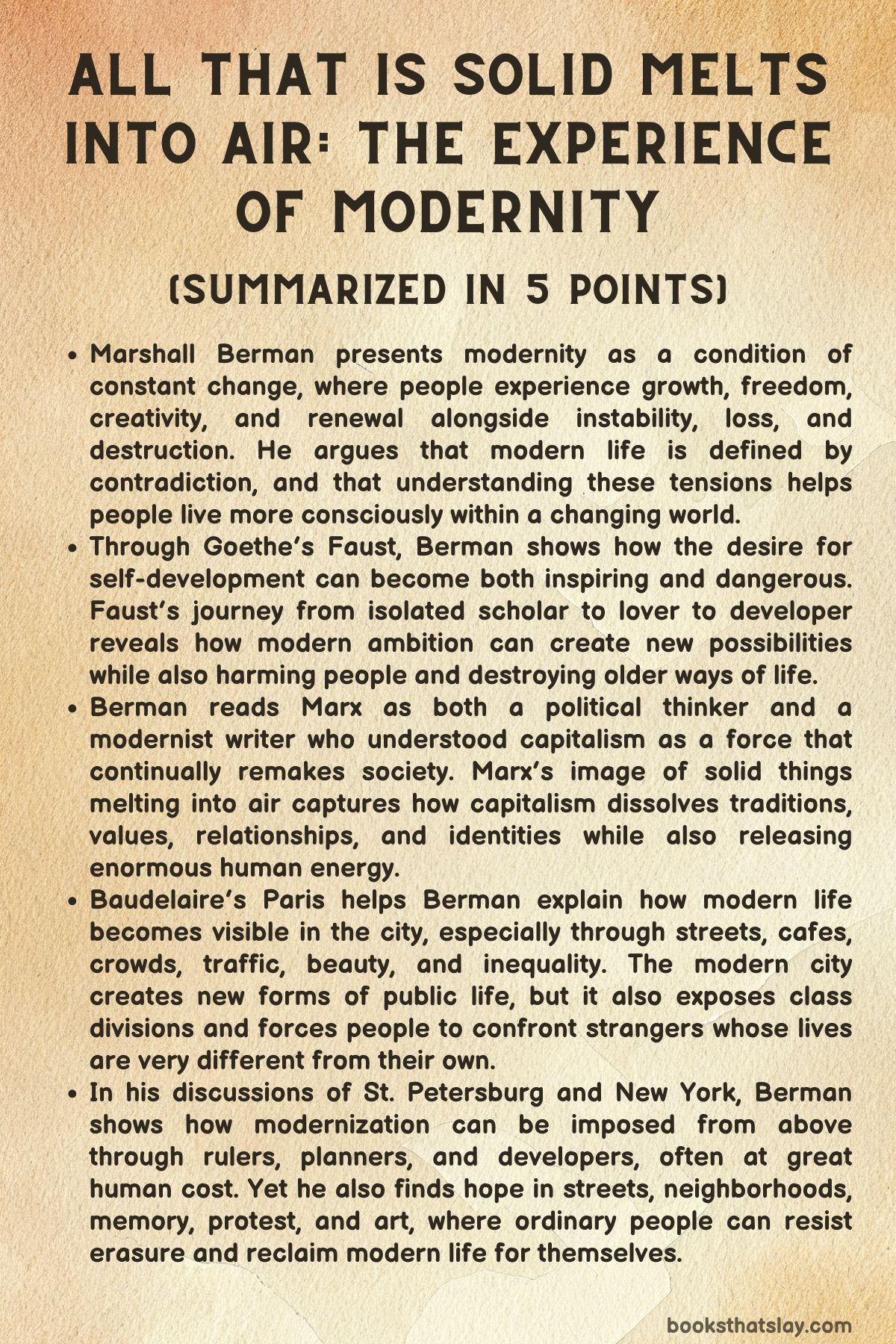
All That Is Solid Melts Into Air by Marshall Berman is a major study of modernity: the experience of living in a world that is always changing, expanding, destroying, and remaking itself. Berman reads literature, philosophy, politics, and city life together, showing how modern people face both freedom and loss.
Through Goethe, Marx, Baudelaire, Russian literature, and New York urban history, he argues that modernization is not only an economic or technological process but also a human drama. The book asks how people can stay alive, creative, and morally aware when the ground beneath them never feels stable.
Summary
All That Is Solid Melts Into Air begins with Marshall Berman’s personal sense of what it means to be modern. He recalls growing up in the Bronx in a “modern” building and a “modern” family, yet feeling that modern life was never simple or secure.
For him, modernity is defined by contradiction. It promises growth, self-discovery, new cities, new technologies, political freedom, and cultural energy.
At the same time, it brings destruction, displacement, loneliness, and fear. Modern people want transformation, but they also fear being transformed beyond recognition.
Berman presents modernity as a shared condition across nations, classes, and cultures. Scientific discovery, industrial production, expanding capitalism, population movement, urban growth, and political revolution all push people into a state of constant change.
Modernism, in his view, is the cultural attempt to understand this condition and help people become active subjects within it rather than passive victims of modernization. The book traces modernity through several historical moments, beginning with early modern Europe, moving through the revolutionary age, and reaching the global modern world of the twentieth century.
Berman’s first major example is Goethe’s Faust. He treats Faust not only as a literary character but as a symbol of modern development.
Faust begins as an isolated scholar, full of knowledge but cut off from life. He feels that his intellectual achievements are empty because they do not connect him to the world, to other people, or to real action.
His despair shows the modern split between inner life and social reality. When he turns away from suicide and chooses engagement with life, he begins the path of modern self-development.
Faust’s relationship with Gretchen becomes the next stage in this process. Through love and desire, Faust enters emotional and bodily life, but his awakening causes terrible damage.
Gretchen is not merely an innocent victim; Berman presents her as a young woman trapped by the rigid moral order of her small community. Her tragedy grows from the collision between modern desire and traditional social control.
Faust opens new possibilities for her, but neither he nor her society can protect her from the consequences. Her destruction reveals the human cost of modernization when old communities are too narrow to contain new forms of selfhood.
In Faust’s final stage, he becomes a developer. He seeks to reshape nature itself through massive projects: reclaiming land, controlling the sea, and building new communities.
His vision seems generous because it aims at a better future for humanity. Yet it also requires violence and erasure.
The deaths of Philemon and Baucis, an old couple who stand in the way of his plans, show how development destroys the very worlds it replaces. Faust creates, but he also blinds himself to what his creation costs.
For Berman, this is the central tragedy of modern development: progress builds new worlds while burying older ones.
Berman then turns to Marx, especially The Communist Manifesto. He argues that Marx should be read not only as a political economist but also as a modernist writer.
Marx understands capitalism as a force that breaks down inherited values, institutions, professions, communities, and beliefs. Under capitalism, nothing remains fixed.
The bourgeoisie constantly revolutionizes production, expands markets, and remakes social life. This gives capitalism immense creative power, but it also produces crisis, instability, and alienation.
Marx’s famous image of solid things melting into air captures this experience. Capitalism strips away sacred appearances and reveals social relations as relations of money, labor, and power.
Professions once surrounded by honor, such as doctors, priests, poets, and scientists, become forms of wage labor. Family bonds, social rank, religious authority, and moral ideals are all exposed to the market.
This unmasking can be liberating because it reveals reality without illusion. Yet it is also disturbing because it can reduce human value to price.
Berman admires Marx’s vision of human development beyond capitalism, where the free growth of each person supports the freedom of all. But he also questions whether Marx underestimates the dangers of endless change.
If capitalism releases energies of innovation and destruction, can any future society control them? Could a communist society also face new forms of instability and nihilism?
Berman does not reject Marx. Instead, he presents Marx as a thinker who helps us understand both the promise and danger of modern freedom.
The book next moves to Baudelaire and Paris. For Berman, Baudelaire is one of the first writers to capture modern life in the streets.
His Paris is not just a setting but a space where new forms of beauty, danger, class conflict, and self-awareness appear. Haussmann’s renovation of Paris creates broad boulevards, cafes, and public spaces that make the city more open and spectacular.
But this new openness also exposes social inequality.
In Baudelaire’s scene of a poor family looking into a bright cafe, Berman sees the shock of modern urban life. The city brings rich and poor into visual contact, making inequality harder to ignore.
The boulevard creates public life, but it also reveals exclusion. Modern people are forced to see one another across class lines, and this vision can create sympathy, discomfort, shame, or resentment.
Baudelaire’s image of the poet losing his halo in the street becomes another key symbol. The modern artist is no longer sacred or separate from ordinary life.
He must move through traffic, mud, commerce, and danger like everyone else. For Berman, this loss is not only humiliation; it is also freedom.
Art can no longer pretend to stand above modern life. It must enter the street and find meaning there.
Berman contrasts this street-based modernism with twentieth-century urban planning, especially the world of highways, towers, and separated spaces. Planners such as Le Corbusier sought order, efficiency, and control, but Berman argues that this often weakened the human richness of cities.
The boulevard allowed encounter; the highway isolates movement. Jane Jacobs becomes important because she defends dense, mixed, active streets as places where modern people learn to live together.
Berman then studies St. Petersburg as a city of underdeveloped modernity. Built by Peter the Great as Russia’s “window to Europe,” Petersburg represents forced modernization from above.
It is grand and artificial, powerful and unreal. Its beauty rests on suffering, labor, and autocratic will.
Russian writers turned this city into a symbol of alienation, fantasy, and modern longing without full modernization.
In nineteenth-century Russia, new intellectuals, students, and ordinary urban figures began to claim public space. The “little man” of Russian literature becomes a modern figure: weak, marginal, often humiliated, yet capable of moral insight and public courage.
For Berman, Petersburg shows how even societies that are economically behind can produce intense modernist awareness, especially when people feel the gap between dreams of progress and harsh social limits.
Finally, Berman returns to his own New York, especially the Bronx. Robert Moses represents the destructive power of modern development in the twentieth century.
His expressways, parks, and infrastructure projects reshaped New York, but they also tore apart neighborhoods. The Cross-Bronx Expressway becomes, for Berman, a personal and historical wound: a sign of progress that destroyed living communities.
Against Moses, Berman places Jane Jacobs, street culture, public protest, art, music, and neighborhood memory. The 1960s rediscovered the street as a place of creativity and democratic energy.
The 1970s brought a stronger need to remember the past and reclaim damaged places. Berman imagines art along the expressway as a way to honor what was lost and create a shared future.
All That Is Solid Melts Into Air ends as a defense of modern life despite its pain. Berman does not ask readers to reject modernity or worship it.
He asks them to face it clearly: to see its violence, its beauty, its promise, and its losses. To be modern is to live amid change, but also to search for connection, memory, freedom, and human meaning inside that change.
Characters
Marshall Berman
Marshall Berman functions as the guiding mind and central presence of All That Is Solid Melts Into Air. Although the book is not a novel, Berman’s personal voice gives it a human center.
He is not only an academic critic explaining modernity from a distance; he is also someone shaped by the same forces he studies. His memories of the Bronx, his reflections on urban destruction, and his dedication to his son give the work an intimate emotional base.
Berman sees modern life as a condition filled with contradiction: people long for freedom, growth, and transformation, yet these same desires often produce loss, instability, and pain. His role is to connect literature, politics, architecture, philosophy, and ordinary city life into one broad meditation on what it means to live in a changing world.
He is sympathetic to modern dreams but never blind to their costs. His character as thinker and witness is marked by generosity, grief, intellectual energy, and a strong belief that modern people can still create meaning amid disruption.
Faust
Faust is Berman’s most important literary figure for understanding modern development. He begins as a scholar who has mastered learning but feels empty because his knowledge has not given him a full life.
His dissatisfaction represents the modern hunger for experience, action, and transformation. Faust does not want comfort or simple pleasure; he wants expansion of the self.
He wants to feel, act, build, love, and reshape the world. This ambition makes him heroic in one sense, because he refuses to accept a narrow or stagnant life.
Yet it also makes him dangerous. His desire for development becomes destructive when he fails to see the people harmed by his progress.
In his relationship with Gretchen, he opens emotional and sexual possibilities but leaves devastation behind. Later, as a builder and developer, he imagines grand projects for humanity while destroying lives that stand in his path.
Faust embodies the creative and violent energy of modernity: he builds new worlds, but he cannot fully account for what he ruins.
Mephistopheles
Mephistopheles is not simply a devilish tempter in Berman’s reading; he is the force that releases Faust from paralysis and pushes him into the modern world. He understands desire, irony, motion, and disruption.
Where Faust is full of longing and abstraction, Mephistopheles brings action, contact, and worldly experience. His role is to break down barriers, mock sacred limits, and expose hidden appetites.
He makes Faust’s transformations possible, but he also reveals the moral danger inside them. Mephistopheles represents the negative energy that often drives modern change: destruction, cynicism, manipulation, and impatience with inherited forms.
Yet Berman’s analysis suggests that this negative force cannot be separated completely from creativity. Modern development often depends on breaking old structures, and Mephistopheles personifies that break.
His presence shows that the pursuit of growth is rarely innocent. He gives Faust access to life, but the price is moral blindness and human damage.
Gretchen
Gretchen is one of the most tragic figures in Berman’s analysis because she stands at the meeting point between traditional community and modern desire. She is not treated merely as a passive innocent.
Instead, she becomes a young woman whose emotional and sexual awakening exposes the cruelty of the social world around her. Her small-town environment claims to protect morality, but it offers little mercy, freedom, or understanding.
Faust introduces her to new feelings and possibilities, but he is unable to remain responsible for the consequences of that awakening. Gretchen’s downfall is therefore not only personal; it is social.
She is crushed by a community that cannot tolerate deviation and by a modern lover who does not fully understand the world he has disturbed. Her character reveals the human cost of transformation when individuals, especially women, are denied the space to grow freely.
Through Gretchen, Berman shows that modernity’s promise of self-development is unevenly distributed and often paid for by the vulnerable.
Philemon and Baucis
Philemon and Baucis represent the old world that Faust’s development project cannot tolerate. They are humble, rooted, and attached to a way of life that seems small beside Faust’s vast schemes.
Their home stands in the path of modernization, and this makes them obstacles in the eyes of the developer. Berman treats them as morally significant because their destruction exposes the violence hidden inside grand visions of progress.
Faust wants to create land, communities, and a future for humanity, but he cannot bear the presence of a modest past that resists absorption into his plan. Philemon and Baucis are not powerful characters in a political sense, yet their fate gives the development narrative its deepest moral wound.
They show that modernization often names certain lives as expendable. Their deaths reveal that progress can become brutal not only when it is selfish, but also when it is idealistic and convinced of its own historical necessity.
Karl Marx
Karl Marx appears as both a political thinker and a modernist imagination. Berman presents him as someone who understood capitalism not as a fixed system but as a revolutionary force that constantly remakes the world.
Marx sees the bourgeoisie as historically dynamic because it destroys feudal limits, expands production, and forces people to confront reality without old illusions. At the same time, he condemns capitalism for reducing human beings, relationships, professions, and values to market exchange.
Marx’s character in Berman’s analysis is therefore dialectical: he is both fascinated and horrified by the energies of capitalism. He recognizes that modern society creates the possibility of fuller human development, but he also sees that the same society alienates people from themselves and each other.
Berman admires Marx’s boldness while also questioning whether Marx is too confident that a post-capitalist world could control the very forces of change capitalism has released.
The Bourgeoisie
The bourgeoisie functions almost like a collective character: restless, productive, revolutionary, and destructive. In Berman’s reading of Marx, this class does not merely preserve order; it overturns every inherited order in pursuit of growth, profit, and expansion.
Its historical power lies in its ability to innovate constantly. It builds factories, cities, markets, technologies, and global networks.
Yet its creativity is inseparable from crisis. The bourgeoisie cannot stop transforming the world because its survival depends on constant change.
This makes it both modernity’s great engine and one of its most destabilizing forces. Berman stresses the irony that the bourgeoisie often imagines itself as respectable and orderly, even though it dissolves traditions, communities, and values wherever it goes.
As a character, it is marked by denial. It creates a world in which nothing is secure, while pretending to defend security.
Its tragedy is that it cannot recognize the full meaning of its own revolutionary power.
The Proletariat
The proletariat appears as the class produced by capitalist modernization and also as the possible agent of a new society. In Marx’s vision, workers are gathered, disciplined, exploited, and connected by the very system that oppresses them.
Their suffering gives them a shared interest in transforming society. Berman, however, treats this figure with both hope and caution.
The proletariat carries the promise of collective liberation, but it is not magically outside modern contradictions. Workers, too, live in a world of instability, competition, desire, and change.
Berman questions whether any class can fully master the energies unleashed by modernization. The proletariat matters because it brings the social cost of modern development into view.
It reminds readers that progress is not an abstract process; it is built through labor, exhaustion, displacement, and struggle. At the same time, it keeps alive the possibility that modern people might organize change for human freedom rather than private accumulation.
Charles Baudelaire
Charles Baudelaire is the poet of the modern street. Berman presents him as one of the first writers to understand that modern life must be grasped in motion, in public, among crowds, traffic, commerce, spectacle, and inequality.
Baudelaire’s importance lies in his refusal to separate beauty from the disorder of the city. He sees modernity in fleeting encounters, fashionable surfaces, dirty streets, cafes, strangers, and shocks of recognition.
His attitude toward modern life is unstable: at moments he celebrates it, at other moments he recoils from it. This instability is precisely what makes him valuable to Berman.
Baudelaire does not offer a clean judgment on modernity; he captures its contradictions. He understands that the artist can no longer stand above ordinary life with a sacred aura.
The artist must enter the crowd and accept exposure to the same dangers and confusions as everyone else. Through Baudelaire, All That Is Solid Melts Into Air locates modernism in the everyday drama of urban existence.
The Poor Family
The poor family in Baudelaire’s urban scene becomes a powerful collective figure of exclusion and visibility. Standing outside the glittering cafe, they look in at a world that is physically near but socially unreachable.
Their importance lies in their gaze. They do not speak, but their presence forces the comfortable urban couple to confront the inequality that modern public space reveals.
The renovated city brings different classes into contact, yet it does not make them equal. The poor family represents those who are included visually in modern life but excluded materially from its pleasures.
Berman uses them to show how modernization creates spaces of display where beauty and suffering appear side by side. They also expose the moral pressure of the modern city: once people see each other, they cannot claim innocence in the same way.
The family’s silence becomes an accusation against a society that turns progress into spectacle while leaving many outside the glass.
The Modern Artist
The modern artist, especially through Baudelaire’s image of the poet who loses his halo, is a figure stripped of sacred distance. In older traditions, the artist might imagine himself as elevated above ordinary people, protected by genius or spiritual authority.
Berman argues that modern life destroys this illusion. The artist must cross dangerous streets, face traffic, sell work, compete in markets, and live among the crowd.
Losing the halo is humiliating because it ends the fantasy of artistic purity. Yet it is also liberating because it allows the artist to discover new subjects, new languages, and new solidarities.
The modern artist becomes valuable not by escaping the city but by learning to move through it. This figure shows that creativity in the modern age depends on contact with ordinary life.
Art becomes stronger when it accepts mud, noise, commerce, danger, and shared vulnerability as part of its material.
Peter the Great
Peter the Great appears as the ruler who tries to force modernity into existence through sheer political will. His construction of St. Petersburg represents a state-led project of modernization designed to turn Russia toward Europe and away from its older traditions.
He is ambitious, visionary, and ruthless. In Berman’s analysis, Peter’s city is both a triumph of planning and a monument to suffering.
Built on difficult terrain through coercive labor, St. Petersburg shows how modernization from above can create impressive forms while intensifying alienation. Peter’s character is defined by command.
He does not wait for society to develop organically; he imposes a modern image upon it. This gives his project grandeur but also unreality.
The city becomes a symbol of Russia’s desire to become modern before its social foundations are ready. Peter therefore represents the authoritarian side of modernization, where progress is treated as a command and human beings become material for state ambition.
The Little Man
The Little Man is one of the most important symbolic figures in Berman’s discussion of Russian modernism. He represents ordinary urban people who are weak in social rank but intense in consciousness.
Often humiliated, unstable, and marginal, the Little Man experiences the modern city as both home and threat. He is not a heroic revolutionary in the traditional sense, yet he carries a deep moral and political importance.
His presence shows how modernization is felt from below, by people who do not control institutions or grand projects. In St. Petersburg, the Little Man moves through streets and public spaces that both expose his insignificance and awaken his sense of dignity.
Berman values this figure because he can turn suffering into symbolic action. Even small gestures of defiance can claim a right to the city.
The Little Man reveals that modernity is not only made by rulers, planners, and developers; it is also lived and contested by the vulnerable.
The New Men
The New Men of nineteenth-century Russian culture represent a generation that wants to reject inherited authority and rebuild society through reason, science, and radical social arrangements. They emerge from outside the old aristocratic elite and bring a sharper, more aggressive voice into public life.
Berman treats them as signs of a society beginning to modernize from below. They are impatient with tradition, hostile to empty manners, and drawn to visions of collective transformation.
Yet their rational confidence can also seem rigid. Their dream of a scientifically organized society risks flattening the complexity of human life.
As characters in Berman’s broader argument, the New Men embody the restless desire for an alternative to autocracy, hierarchy, and stagnation. They mark a moment when Russian public space becomes politically charged and when intellectual life begins to imagine new forms of social existence.
Their strength is their refusal of passivity; their danger is their temptation to replace one narrow certainty with another.
Robert Moses
Robert Moses is Berman’s major figure of twentieth-century urban power. He represents the developer as administrator, planner, and builder on a massive scale.
His parks, highways, bridges, and public works changed New York, and for a time he was celebrated as a master modernizer. Yet Berman focuses on the destructive underside of that achievement, especially the damage done to neighborhoods like the Bronx.
Moses’s expressways cut through living communities, displacing residents and weakening social bonds that had taken generations to form. His character is defined by confidence in large systems and impatience with local life.
He sees the city from above, as a map of circulation and infrastructure, rather than from the street, as a web of human relationships. Moses is not presented as a simple villain; he is powerful because his works answer real modern needs for movement and access.
But his failure is moral and imaginative: he cannot see the people his progress sacrifices.
Jane Jacobs
Jane Jacobs stands as a counterforce to the expressway vision of modern urban planning. She defends the street, the neighborhood, and the small-scale interactions that make city life meaningful.
In Berman’s account, Jacobs understands what planners like Moses miss: cities are not machines to be simplified but living social environments full of informal knowledge, routine contact, diversity, and shared observation. Her defense of sidewalks and mixed-use neighborhoods is not nostalgic rejection of modernity.
It is a different modern vision, one rooted in participation rather than command. Jacobs values density, surprise, and local attachment because they allow people to become active citizens of their own surroundings.
Her character is practical, democratic, and attentive. She shows that modernization does not have to mean erasure.
It can also mean protecting the conditions under which ordinary people create public life. In Berman’s argument, Jacobs helps recover the street as a place of modern freedom and human connection.
Themes
Modernity as Contradiction
Modern life in All That Is Solid Melts Into Air is never presented as purely liberating or purely destructive. It is a condition in which opposing forces exist together.
People gain new freedoms, new forms of knowledge, new cities, new political possibilities, and new chances for self-development. At the same time, they lose stable communities, inherited values, familiar landscapes, and secure identities.
Berman’s central insight is that modernity does not ask people to choose between progress and destruction, because both often arrive through the same process. Faust’s development projects create a future while destroying older lives.
Marx’s capitalism releases human productive power while reducing people to market values. Baudelaire’s Paris opens dazzling public spaces while exposing painful class divisions.
New York’s highways promise movement while cutting through neighborhoods. This contradiction is not a temporary flaw in modern life; it is its basic structure.
Berman wants readers to face this condition honestly. He resists both nostalgia for a lost past and blind celebration of progress.
His modern person is someone who learns to live inside tension, aware that growth can wound and that loss can sometimes produce new forms of consciousness, art, and solidarity.
Development and Destruction
Development in Berman’s argument is charged with moral danger because it often presents itself as benevolent while hiding its violence. Faust wants to reclaim land and create a better world, but his project requires the removal of those who do not fit his plan.
Robert Moses builds infrastructure that seems to serve the public, yet his expressways devastate neighborhoods and uproot communities. Peter the Great creates a city meant to bring Russia into the modern age, but the project rests on coercion and human suffering.
These examples show that development is never only technical. It is also ethical and political.
Every project of modernization makes decisions about whose lives matter, whose homes can be destroyed, whose memories can be erased, and whose future is being built. Berman does not argue that development should stop.
He understands the human desire to build, improve, and transform. But he insists that development becomes tragic when it loses contact with the people and places it affects.
The problem is not only destruction itself but the blindness that often accompanies power. Developers imagine large futures and may become unable to see small human realities.
Berman’s critique asks for a form of progress that remains answerable to memory, community, and moral responsibility.
The City as a Stage of Modern Life
The city is the place where modernity becomes visible, physical, and emotionally immediate. Paris, St. Petersburg, and New York are not just backgrounds in Berman’s analysis; they are active spaces that shape consciousness and social relations.
The boulevard in Paris creates new forms of public life by bringing strangers, lovers, workers, artists, and poor families into shared view. St. Petersburg turns modernization into a strange and unstable urban experience, where imperial ambition and social underdevelopment exist side by side.
New York becomes a battlefield between expressways and streets, between large-scale planning and neighborhood life. Berman treats streets, cafes, bridges, highways, and public squares as symbolic environments where modern people discover who they are.
The city intensifies contradiction because it gathers wealth and poverty, beauty and decay, freedom and danger into close contact. It can isolate people, but it can also create unexpected recognition.
It can be planned from above, but it can also be reclaimed from below through protest, art, movement, and daily interaction. For Berman, the modern city matters because it teaches people how to see one another.
Its spaces can either deaden human contact or make democratic life possible.
Self-Development and Moral Responsibility
Berman is deeply interested in the modern desire to become more fully alive. Faust wants experience beyond scholarship.
Marx imagines a society where each person’s free development supports the freedom of all. Baudelaire’s artist enters the street and discovers new forms of perception.
The Little Man claims dignity in an urban world that tries to reduce him to insignificance. Across these examples, self-development is treated as one of modernity’s great promises.
Human beings do not have to remain fixed in inherited roles; they can grow, act, speak, desire, and create. Yet Berman repeatedly shows that self-development becomes dangerous when it ignores responsibility to others.
Faust’s growth damages Gretchen. His later public vision destroys Philemon and Baucis.
Capitalist development expands human powers while commodifying human beings. The artist’s freedom can become empty if it loses connection to shared life.
Berman’s ideal is not self-denial, but a fuller form of growth that recognizes interdependence. To become modern in the best sense is not merely to transform oneself, but to understand how one’s transformation affects other people.
Freedom must be joined to awareness. Otherwise, the pursuit of self-expansion becomes another form of domination.