All’s Well That Ends Well Summary, Characters and Themes
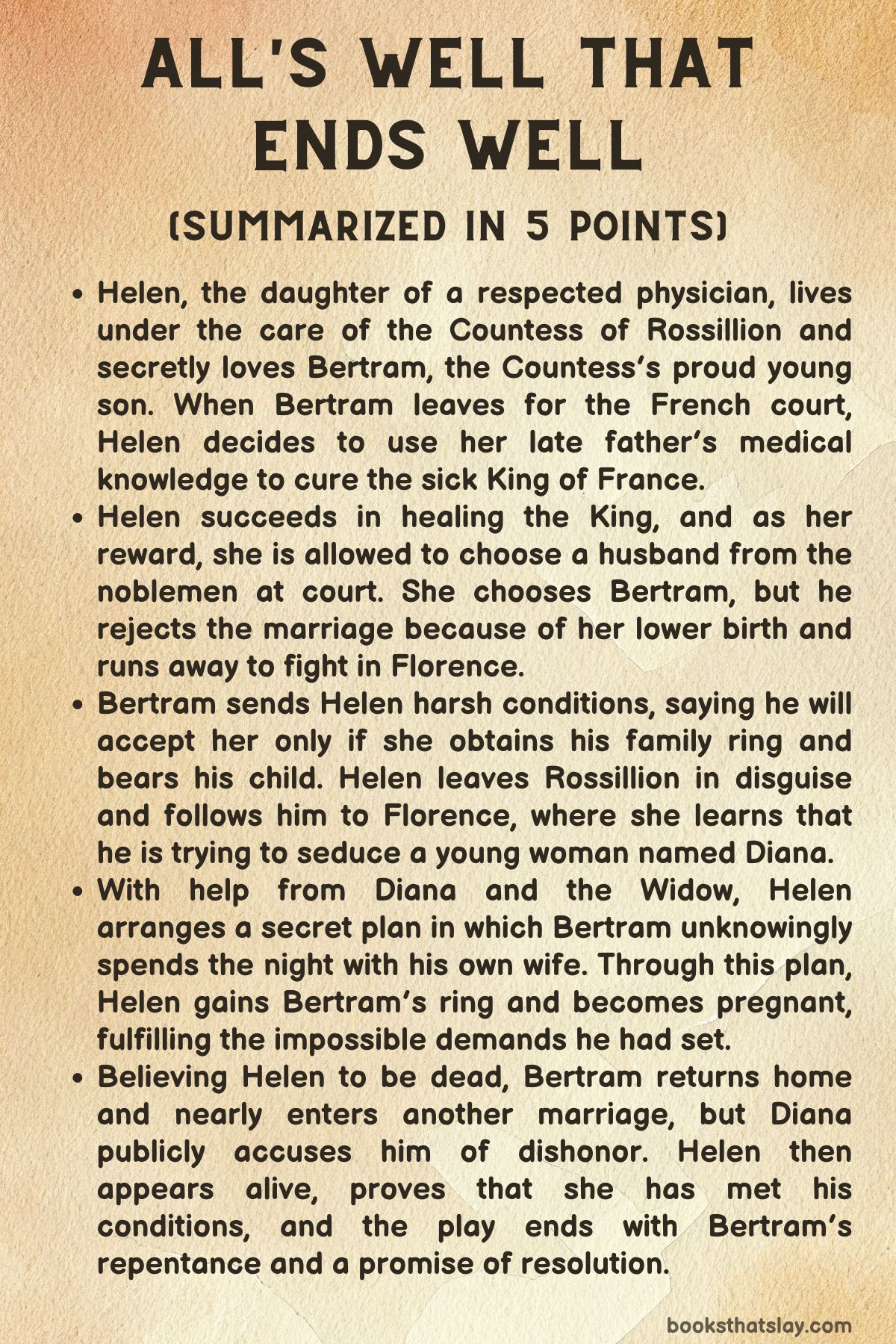
All’s Well That Ends Well is a comedy by William Shakespeare about love, class, pride, deception, and the strange bargains people make to gain what they want. At its center is Helen, a gifted young woman of modest birth who loves Bertram, a nobleman who thinks her beneath him.
When she cures the King of France, she earns the right to choose a husband and selects Bertram, but his rejection sets off a chain of tests, disguises, and moral reversals. The play questions whether love can survive humiliation, whether social rank defines worth, and whether a happy ending can truly repair dishonor.
Summary
All’s Well That Ends Well begins in Rossillion, where Bertram, the young Count, is preparing to leave for the court of the King of France. His father has recently died, and his mother, the Countess, mourns both the loss of her husband and the coming absence of her son.
Bertram is too young to take full control of his estate, so he must serve at court. Also living in the Countess’s household is Helen, the daughter of the late physician Gerard de Narbon.
The Countess cares deeply for Helen and treats her almost as a daughter.
Helen is grieving, but her sadness is not only for her father. She is secretly in love with Bertram.
Her love feels impossible because Bertram is a nobleman and she is not. To Helen, the difference in rank stands between desire and marriage.
Bertram leaves for court with Lafew, while Helen remains behind, troubled by the thought that he will meet other women. Parolles, Bertram’s boastful companion, mocks ideas of chastity and speaks cynically about sex.
Helen sees through his false courage and shallow talk. After he leaves, she begins to form a plan.
Her father left behind medical knowledge and remedies, and she believes she may be able to cure the King of France, who is suffering from a dangerous illness.
At the French court, the King welcomes Bertram and remembers Bertram’s father with admiration. He praises the older Count as honorable, gracious, and respectful toward people of all ranks.
The King also mourns the death of Gerard de Narbon, believing that the famous physician might have cured him. Meanwhile, back in Rossillion, the Countess learns that Helen loves Bertram.
Rather than scold her, she speaks to Helen with sympathy. Helen admits her love and reveals her plan to go to Paris with her father’s remedies.
The Countess doubts that the King’s physicians will listen to a young woman, but she supports Helen and gives her permission and financial help.
Helen arrives at court and offers to heal the King. At first, he refuses.
His own doctors have failed, and he does not want to trust false hope. Helen insists that her father’s remedy can work and presents her mission as guided by heaven.
To prove her confidence, she offers her life as the penalty if she fails. In return, if she succeeds, she asks the King to let her choose a husband from among the noblemen of the court.
The King agrees.
Helen’s cure works. Restored to health, the King keeps his promise and allows her to choose a husband.
The noblemen are uneasy because Helen is of lower birth, and she knows they do not want her. She chooses Bertram.
Bertram is horrified and protests, saying he should not be forced to marry beneath his class. The King rebukes him, arguing that Helen’s virtue and service make her worthy.
Under royal pressure, Bertram accepts the marriage legally, but in his heart he rejects it. He plans to avoid the church ceremony, send Helen back to Rossillion, and flee to the war in Florence.
Parolles encourages him, claiming that military honor is better than married life.
Bertram lies to Helen, saying he must leave because of business that existed before their sudden marriage. He orders her to return to Rossillion and obey his wishes.
Helen accepts his command. After she leaves, Bertram admits that he does not intend to live with her as her husband.
He writes to his mother and to Helen, declaring that he will not accept the marriage unless Helen can meet two impossible conditions: she must wear his ring and bear his child. He believes this will never happen.
The Countess receives Bertram’s letter and is ashamed of him. She considers Helen her true child and condemns Bertram’s cruelty.
Helen, feeling guilty that her marriage has driven Bertram into danger, decides to leave Rossillion. She believes that if she disappears, Bertram may return safely.
She sets out disguised as a pilgrim and allows people to think she has gone on a holy journey.
In Florence, Bertram joins the war and gains military honor. He is given command of cavalry and proves brave in battle.
Yet his personal conduct remains dishonorable. He becomes attracted to Diana, a young woman of Florence who lives with her widowed mother.
Parolles helps Bertram pursue Diana, though the local women distrust Parolles and recognize his empty boasting. Helen, still disguised as a pilgrim, meets the Widow and Diana.
She learns that Bertram is trying to seduce Diana and reveals her true identity to the Widow. Helen proposes a plan: Diana will pretend to accept Bertram’s advances, demand his ancestral ring as a pledge, and arrange a midnight meeting.
Helen will take Diana’s place in the dark. In this way, Helen can fulfill Bertram’s conditions without his knowledge.
The Widow agrees after Helen promises money and a dowry for Diana.
At the same time, two French lords decide to expose Parolles as a coward. Parolles has bragged that he can recover a lost military drum, so they set a trap.
They capture him while pretending to be enemy soldiers and speak nonsense to confuse him. Blindfolded and terrified, Parolles immediately agrees to betray his own side.
He gives away military information and insults Bertram and the French captains, not knowing they are present. When his blindfold is removed, his disgrace is complete.
Parolles loses his false reputation, but he accepts survival and decides he can live without honor.
Diana carries out Helen’s plan. Bertram swears love to her, but she refuses to yield without a promise of marriage.
She demands his ring, comparing it to her own chastity as a precious family inheritance. Bertram hesitates because the ring is an important sign of his house, but desire overcomes caution.
He gives it to Diana and agrees to meet her at night. Helen takes Diana’s place, and Bertram unknowingly sleeps with his lawful wife.
Helen receives his ring and becomes pregnant, meeting both conditions he had set.
News spreads that Helen has died during her pilgrimage. Bertram hears this and returns to Rossillion.
The King, now healthy, also comes there. The Countess and Lafew mourn Helen, and arrangements are made for Bertram to marry Lafew’s daughter.
The King forgives Bertram enough to allow this new marriage, but then he notices a ring on Bertram’s finger. It is the ring he had given Helen after she cured him.
Bertram claims it came from another woman, but the King suspects that he has wronged Helen and orders him detained.
Diana then appears with her mother and accuses Bertram of promising marriage, taking her chastity, and abandoning her. Bertram admits he pursued her but tries to deny any binding promise.
When pressed, he attacks Diana’s character. Parolles is brought in and confirms that Bertram promised marriage and intended to sleep with her.
Diana speaks in riddles, saying she is still a virgin and that Bertram is both guilty and mistaken. The King grows frustrated, unsure whom to believe.
Finally, Helen enters alive. Everyone is astonished.
She reveals that she has fulfilled Bertram’s impossible demands: she has his ring and is carrying his child. Bertram, confronted by the truth, asks her forgiveness and says that if she can prove everything, he will love her as his wife.
The King promises that all will be explained and rewards Diana by offering to provide a dowry for a husband of her choice. The play closes with the suggestion that suffering, deception, pride, and error may still lead to repair, though the happiness at the end remains complicated.
Characters
Helen
Helen is the emotional and intellectual center of All’s Well That Ends Well. She begins as a young woman of lower social rank, dependent on the Countess’s household after her father’s death, but she quickly proves herself more capable than almost anyone around her.
Her love for Bertram is intense, patient, and difficult to judge simply. On one hand, she is brave, loyal, intelligent, and resourceful; she cures the King when trained physicians have failed, crosses social barriers, and refuses to accept the limits placed on her birth.
On the other hand, her pursuit of Bertram raises uncomfortable questions because he clearly rejects the marriage. Helen’s strength lies in her ability to act where others only complain.
She understands systems of power and uses them: her father’s medical reputation, the King’s gratitude, Diana’s cooperation, and Bertram’s own written conditions. Her virtue is not passive goodness but strategic endurance.
She suffers humiliation, yet she does not surrender her claim. By the end, she has fulfilled the impossible terms Bertram set, but the audience is left to decide whether her victory is romantic, unsettling, or both.
Bertram
Bertram is young, proud, privileged, and morally immature. He inherits noble status but lacks the wisdom that should come with it.
Much of his conduct is shaped by class prejudice: he cannot accept Helen as his wife because he thinks her birth makes her unworthy, even though she has saved the King’s life and shown far more courage than he has in personal matters. Bertram’s desire for war also exposes his need to prove himself publicly while avoiding private responsibility.
In battle, he wins praise and seems capable of bravery, but his treatment of Helen and Diana shows cowardice of another kind. He runs from marriage, lies, manipulates, and tries to seduce Diana without intending to honor her.
His final repentance is brief, which makes him one of Shakespeare’s more troubling comic heroes. He changes only after evidence traps him.
Bertram’s role is important because he represents inherited honor without inner honor. His noble name means little until he learns, or is forced to learn, accountability.
The Countess of Rossillion
The Countess is one of the play’s strongest moral figures. Though Bertram is her biological son, she does not excuse his cruelty.
Her affection for Helen is sincere, and she recognizes Helen’s worth beyond class boundaries. This makes the Countess wiser and more generous than many characters of higher public authority.
She grieves deeply, first for her dead husband and then for the damage Bertram causes, but her grief does not make her passive. She judges clearly.
Her shame over Bertram’s behavior shows that she values virtue more than family pride. In many ways, she becomes the parent Helen needs and the moral guide Bertram ignores.
Her language often carries warmth, dignity, and emotional intelligence. She also reflects the play’s concern with inheritance: Bertram inherits title and land, but Helen inherits skill, discipline, and moral seriousness from her father.
The Countess understands that true worth is not always carried through bloodline or rank.
The King of France
The King of France represents political authority, aging power, and the unstable connection between justice and command. At first, he is physically weak and resigned to death, but Helen’s cure restores him to health and action.
His gratitude gives Helen social power, allowing her to choose a husband from the nobility. The King’s defense of Helen against Bertram’s class prejudice is one of his finest moments.
He argues that virtue can raise a person’s worth and that noble birth without goodness is hollow. Yet his authority is also imperfect.
By forcing Bertram to marry Helen, he creates a legal union without emotional consent, setting much of the conflict in motion. Later, he is quick to suspect, judge, and threaten punishment when the matter of the rings becomes confusing.
He wants order restored, but he often relies on command rather than understanding. His character shows both the usefulness and danger of power: he can reward merit, but he can also impose solutions that do not heal the deeper problem.
Parolles
Parolles is a comic fraud whose name suggests empty words, and that is exactly what defines him. He talks constantly of courage, honor, war, and masculine confidence, but he has little substance beneath the performance.
He encourages Bertram’s worst instincts, especially his contempt for domestic responsibility and his desire to prove himself through military adventure. Parolles is not simply a clown; he is dangerous because his false values influence a young nobleman who already lacks judgment.
His exposure in the military trick is one of the play’s clearest comic punishments. Blindfolded and frightened, he betrays secrets, insults his companions, and reveals his cowardice.
Yet his response after humiliation is strangely practical. Once stripped of reputation, he decides to survive as he is.
Parolles may be shameful, but he has a sharp instinct for self-preservation. He represents a society in which reputation can be built from noise, costume, and confidence, even when there is no real honor underneath.
Lafew
Lafew is an older lord whose judgment is often blunt but reliable. He recognizes Helen’s value and is one of the first men at court to treat her achievement with proper seriousness.
He also sees through Parolles much earlier than Bertram does, identifying him as a coward and a pretender. Lafew’s age gives him perspective, and his direct manner often cuts through the vanity of younger men.
He is socially conservative in some ways, but he is not foolishly bound to rank. He respects virtue when he sees it.
His willingness to arrange a marriage between Bertram and his daughter after Helen’s reported death shows his commitment to social order, though that plan collapses when Bertram’s conduct becomes suspect again. Lafew functions as a voice of worldly experience.
He does not transform the action, but he helps reveal the truth about others, especially Parolles and Bertram.
Lavache
Lavache, the Fool, provides comic relief, but his jokes often expose the crude realities beneath polite society. His humor circles around sex, marriage, cuckoldry, social ambition, and human weakness.
He speaks in riddles, songs, and verbal games, frustrating the Countess and others, yet his foolishness often reflects uncomfortable truths. Lavache’s comments reduce noble romance to bodily appetite and practical survival.
This makes him an earthy counterpoint to Helen’s idealized love and Bertram’s obsession with honor. He reminds the audience that marriage is not only a social contract or emotional bond but also a physical and economic arrangement.
Though he is not central to the main plot, his presence broadens the play’s view of human behavior. He makes high-born characters seem less grand by placing their concerns beside common jokes about desire, money, and domestic disorder.
Diana
Diana is one of the most important figures in the second half of All’s Well That Ends Well. She is young, intelligent, self-controlled, and alert to male deception.
Bertram approaches her as though she can be won by flattery and promises, but Diana understands the danger of trusting a man who wants pleasure without commitment. Her exchange with Bertram shows her verbal strength.
She turns his arguments back on him and insists that her chastity has value equal to his family ring. Diana’s role in Helen’s plan requires courage because her reputation is placed at risk.
For much of the final confrontation, others believe she may have slept with Bertram, and she must endure suspicion while helping reveal the truth. She is not merely a tool for Helen’s success; she is a moral witness against Bertram’s dishonesty.
By the end, the King promises her a dowry, which publicly restores her honor and acknowledges her service.
The Widow
The Widow is practical, protective, and socially aware. As Diana’s mother, she understands the danger Bertram poses and the vulnerability of young women in a world where male reputation often outweighs female testimony.
She is cautious when Helen first explains the plan, partly because her family’s honor could be damaged. Her agreement is not careless; it comes after Helen reveals her identity and offers financial security for Diana.
The Widow’s cooperation makes the bed trick possible, but her deeper importance lies in her realism. She knows how men like Bertram operate, and she prepares Diana to resist seduction.
Her household becomes a place where women organize a response to male irresponsibility. In a play where public institutions often fail to protect women, the Widow represents female caution, community, and strategy.
Mariana
Mariana is a smaller character, but she helps shape the audience’s view of Florence and of Bertram’s behavior there. She speaks critically of Parolles and supports the judgment that he is untrustworthy.
Her presence also strengthens the sense that Diana is not isolated; she belongs to a female community that observes, evaluates, and discusses male conduct. Mariana’s skepticism helps prepare the ground for Helen’s plan.
She may not direct the action, but she contributes to the play’s pattern of women seeing through men more clearly than men see through one another.
The French Lords
The French lords, especially the two captains associated with the exposure of Parolles, serve as observers and testers of masculine honor. They understand that Parolles is a fraud and design the trick that reveals his cowardice.
Their plot against him is comic, but it also has moral purpose: they want Bertram to see the truth about the man he trusts. These lords also comment on Bertram’s conduct, recognizing that his military success will not erase his mistreatment of Helen.
They separate battlefield bravery from ethical character, which is one of the play’s central judgments. Their role shows that male society can expose false honor, but it is less effective at correcting deeper injustice until Helen and Diana force the truth into public view.
The Duke of Florence
The Duke of Florence represents the world of war and public achievement that attracts Bertram. He welcomes the French volunteers and gives Bertram military responsibility.
Through him, Bertram receives the kind of recognition he desires: command, praise, and martial status. The Duke is not deeply developed as a psychological character, but he is important as a symbol of the alternative life Bertram chooses over marriage.
Florence allows Bertram to appear honorable while avoiding the private dishonor he has created. The Duke’s trust in Bertram also shows how public reputation can be incomplete.
A man may seem brave and capable in war while behaving selfishly and cruelly in love.
Gerard de Narbon
Gerard de Narbon never appears alive, yet his influence is central. He is Helen’s dead father, a respected physician whose knowledge gives her the means to change her life.
His reputation opens the door to the King’s court, and his medicine allows Helen to cure the King. Gerard’s legacy is not wealth or rank but skill, learning, and trust.
Through him, the play contrasts inherited title with inherited knowledge. Bertram receives a noble name from his father, while Helen receives practical wisdom from hers.
The results show that Helen’s inheritance is more powerful. Gerard’s unseen presence also gives Helen moral authority: she does not act from fantasy alone but from training, memory, and filial devotion.
Isbel
Isbel is mentioned in connection with Lavache and his comic discussion of marriage. Though she does not become an active figure in the main plot, she helps establish the play’s frank treatment of sexuality.
Through the Fool’s remarks about her, marriage is presented in a coarse, practical light rather than an idealized one. Isbel’s presence in the margins also reflects how women’s reputations can be casually discussed and judged by men.
Even as a minor offstage figure, she contributes to the play’s broader concern with sex, social standing, and the unequal ways men and women are viewed.
The Austringer
The austringer appears briefly near the end, but his role is useful because he helps carry Helen’s petition to the King. As a messenger figure, he assists the movement from hidden truth to public revelation.
His small part reminds us that the final resolution depends not only on bold plans but also on timing, travel, and communication. In Shakespeare’s comedies, minor messengers often help bring private schemes into official spaces, and the austringer performs that function here.
Themes
Class, Merit, and Social Rank
Social rank controls much of the conflict, but the play repeatedly questions whether birth should determine human value. Helen’s love for Bertram seems impossible because she is not noble, and Bertram’s rejection of her is rooted less in personal dislike than in class pride.
He sees marriage to her as a punishment, even though she has cured the King and proved herself more capable than the aristocrats around her. The King challenges this prejudice by arguing that virtue can create honor where birth has not supplied it.
His argument is powerful because it attacks the emptiness of inherited status without moral worth. Bertram has a title, but his behavior is selfish and evasive.
Helen lacks rank, but she has intelligence, courage, discipline, and loyalty. The Countess also supports this moral vision by loving Helen as a daughter and condemning her own son.
Yet the play does not pretend that class barriers disappear easily. Helen must perform an extraordinary service before she can claim a place among the nobility, and even then Bertram resists her.
Social mobility is possible in All’s Well That Ends Well, but it requires proof, pressure, and suffering.
Marriage, Consent, and Obligation
Marriage in the play is treated as a legal bond, a social arrangement, a sexual union, and a moral duty, but these meanings do not always agree with one another. Helen wins the right to choose a husband, and the King’s authority makes Bertram accept her.
Legally, the marriage is valid, but emotionally it is broken from the start because Bertram refuses to give himself to it. This creates one of the play’s central discomforts: Helen’s claim is lawful and sincere, yet Bertram’s lack of consent makes the union troubling.
Bertram then tries to escape obligation by setting impossible conditions, believing that he can turn marriage into an empty technicality. Helen responds by fulfilling those conditions through disguise and substitution.
The result forces Bertram to acknowledge the marriage he tried to deny. Diana’s subplot sharpens the same issue from another angle.
Bertram wants sexual access without responsibility, while Diana demands a promise, a ring, and public accountability. The play presents marriage not as simple romance but as a structure filled with power, negotiation, pressure, and risk.
It asks whether a bond made by law can become meaningful if the heart resists it.
Honor, Reputation, and False Masculinity
The men in the play often speak of honor, but their actions reveal how unstable that word can be. Bertram seeks honor in war while behaving dishonorably toward Helen and Diana.
His military success gives him public praise, yet it cannot erase his private failures. This contrast suggests that courage in battle is incomplete if a man lacks honesty in intimate life.
Parolles offers an even clearer example of false masculinity. He performs the language of bravery, boasting about war and courage, but when tested, he betrays his companions to save himself.
His disgrace exposes the gap between reputation and reality. The French lords understand this gap and stage the trick that strips Parolles of his false image.
Bertram’s exposure is more serious because his wrongdoing harms women directly. He lies, seduces, denies, and attacks Diana’s character when cornered.
The play shows a male world fascinated by rank, combat, and reputation, yet often blind to moral responsibility. True honor appears less in heroic speeches than in keeping promises, respecting others, and accepting consequences.
By that measure, Helen, Diana, and the Countess often possess more honor than the men who claim it most loudly.
Female Intelligence and Strategic Power
Women in the play survive and succeed through intelligence, patience, and cooperation. Helen cannot rely on birth, wealth, or male protection, so she uses knowledge and planning.
Her medical skill saves the King, and her later plan with Diana and the Widow allows her to meet Bertram’s impossible conditions. Diana protects herself from seduction by demanding proof and turning Bertram’s desire against him.
The Widow understands the social danger involved and negotiates carefully before agreeing to help. The Countess, meanwhile, provides emotional and moral support, recognizing Helen’s worth even when Bertram does not.
Together, these women create a network of judgment and action that corrects male irresponsibility. Their power is not loud or official in the way the King’s power is, but it is often more effective.
They read situations accurately, understand weakness, and use available rules to their advantage. Still, their intelligence operates within harsh limits.
Helen must risk humiliation, Diana must risk her reputation, and the Countess must suffer shame because of her son. The play respects female strategy while showing why such strategy is necessary: open justice is not always available to women, so they must create indirect routes to truth.