The Magic We Made Summary, Characters and Themes
The Magic We Made by Meg Cabot is a romantic paranormal mystery centered on skepticism, belief, manipulation, recovery, and unexpected love.
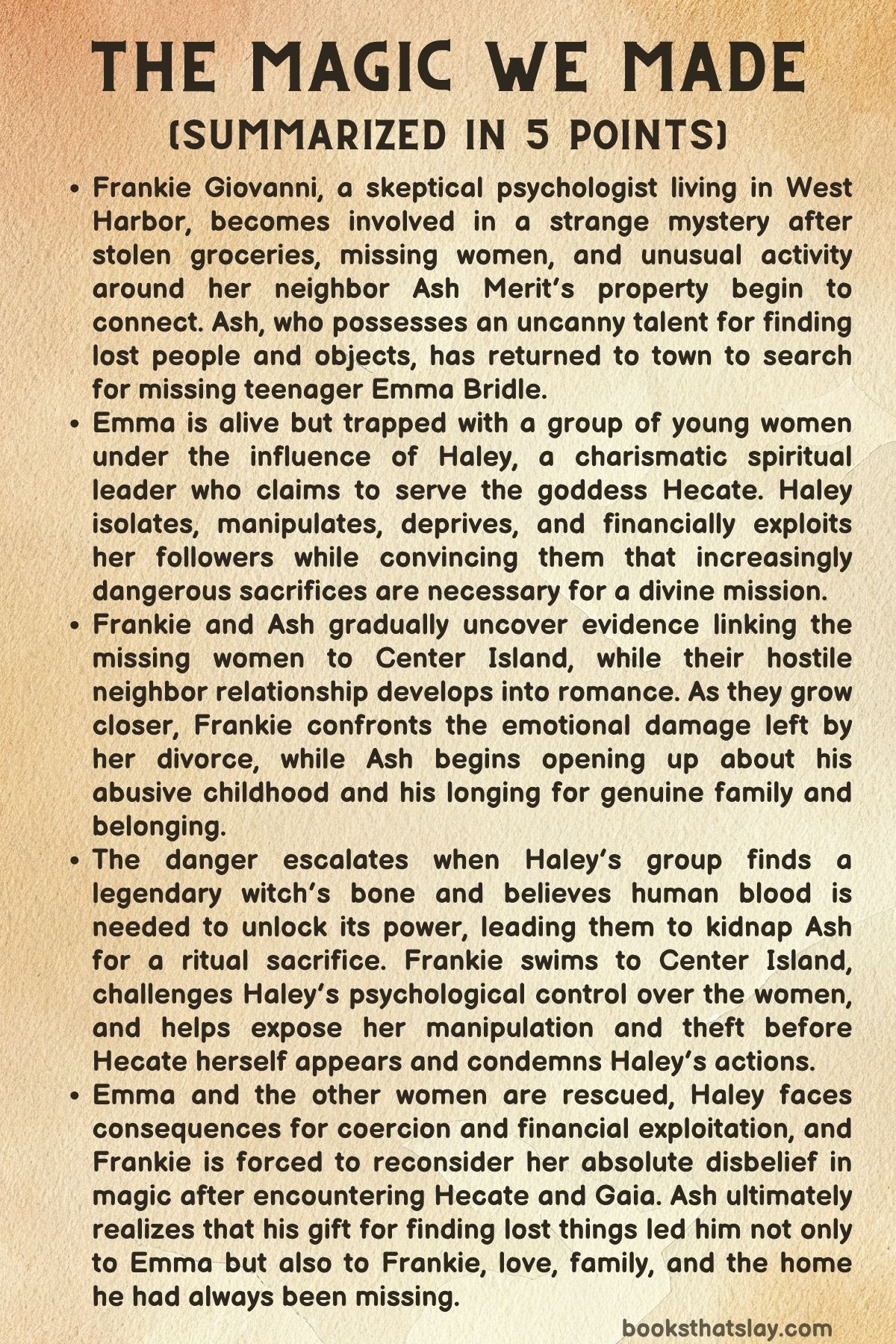
Psychologist Francesca “Frankie” Giovanni has built her life around logic, but a series of disappearances in West Harbor forces her into an investigation alongside Ash Merit, her irritating yet increasingly appealing neighbor. What begins with stolen groceries and rumors of ghosts develops into a dangerous search for missing women influenced by a charismatic spiritual leader. Along the way, Frankie must confront the limits of rational explanation, while Ash discovers that finding what is lost can mean far more than locating a missing person.
Summary
Dr. Francesca “Frankie” Giovanni lives in West Harbor, where she works as a psychologist specializing in financial therapy and is attempting to rebuild her life after a painful divorce. Her ordinary routine is interrupted when Ruth Baumgarten, a temporary tenant in the house next door, reports that hundreds of dollars’ worth of groceries and alcohol have vanished from the locked rental without any valuable electronics or jewelry being taken.
Frankie’s brother Mark has jokingly told Ruth that Frankie is a parapsychologist, causing Ruth to approach her about possible ghosts. Frankie immediately rejects the supernatural theory and suspects teenagers or someone with access to the property, but the strange circumstances leave her curious.
West Harbor itself has developed a reputation for supernatural activity. After a violent storm disrupted a courthouse event the previous year, online videos transformed the town into a destination for people interested in witches and paranormal experiences.
The town is also connected to something darker. Several young women have disappeared after visiting the area, including eighteen-year-old Emma Bridle, whose abandoned car was discovered near West Harbor Beach.
The neighboring house belongs to Ash Merit, a Manhattan financial adviser whom Frankie has long regarded as an irresponsible absentee owner. Ash, however, has a secret talent: throughout his life, he has displayed an uncanny ability to locate lost people and objects.
His employer asks him to find Emma, who is distantly connected to the employer’s family. Ash therefore returns to West Harbor, partly to investigate Emma’s disappearance and partly because he has been attracted to Frankie for some time.
Emma is actually alive. She is living in the wilderness with several young women led by Haley, a charismatic witch who claims a special relationship with the goddess Hecate.
What once seemed to Emma like an empowering spiritual community has become increasingly controlling. Haley demands obedience, isolates her followers, deprives them of ordinary comforts, and interprets nearly everything as evidence of divine purpose.
Emma and another follower, Meg, begin privately questioning the group. Haley conducts rituals requiring sacrifices and cuts Emma’s hair, claiming it is necessary to hide her from someone seeking the group.
Back in West Harbor, Frankie and Ash begin investigating together. Their personalities clash immediately because Frankie insists on rational explanations while Ash remains open to supernatural possibilities.
Evidence around Ash’s house suggests someone has been hiding beneath his deck. Their exchanges are argumentative but increasingly playful, revealing a growing attraction neither initially wishes to acknowledge.
Ash unexpectedly helps Frankie capture a stray cat she has been trying to rescue for weeks. He discovers the animal is pregnant, and Frankie names her Daisy.
Soon afterward, a violent storm arrives with remarkable suddenness. The strange timing adds another unexplained event to Frankie’s growing collection of coincidences, although she continues insisting that ordinary explanations must exist.
The mystery becomes far more serious when Frankie discovers a young woman hiding beneath Ash’s deck. The frightened stranger collapses, and Frankie and Ash bring her inside.
She identifies herself as Meg Boucher, one of the missing women. Meg confirms that Emma is with the same isolated group but is terrified of revealing where they are because she believes the others will suffer if she betrays Haley.
Frankie’s therapeutic training helps calm Meg, while Ash realizes they have finally found direct evidence connecting Emma to a dangerous community. Once Meg is taken to the hospital, Frankie demands that Ash explain why he has been investigating the missing women.
Ash reveals his assignment and shows Frankie videos of Haley. Frankie recognizes classic methods of psychological control beneath Haley’s language about empowerment and spirituality.
Isolation, exhaustion, deprivation, fear, and unquestioning loyalty have made Haley’s followers increasingly dependent on her. Ash fears Haley may now see herself as Hecate’s earthly embodiment and may believe divine authority excuses violence.
Frankie’s personal life becomes complicated at the same time. Her former husband Richard is returning after abandoning her following the previous year’s courthouse storm.
Frankie attends an engagement party despite initially wanting to remain at home. There she discovers that Ash is related to Derrick, the groom, and that he has connections to people she has known for years.
Seeing Ash outside their investigation changes the way Frankie views him. Their teasing develops into open flirtation, and after weeks of resisting her attraction, Frankie kisses him.
They return to her house and spend the night together. Their physical relationship soon develops into deeper emotional intimacy as both reveal painful details about their pasts.
Ash tells Frankie about the abuse he experienced during childhood, which he habitually minimizes. Frankie challenges him to acknowledge that suffering does not become insignificant simply because someone else may have endured worse.
Frankie also admits how deeply her divorce and earlier losses affected her. Their conversations allow each of them to see vulnerabilities beneath the other’s defensive personality.
The following morning, Daisy gives birth to kittens inside Frankie’s laundry basket. The scene makes Frankie unexpectedly aware of how happy she feels with Ash in her home.
Their developing relationship is interrupted by new information about Emma. Local boys who have been watching suspicious activity around the lake report seeing unusual movement near Center Island.
At a Giovanni family gathering, Frankie’s sister Angie reveals that she visited Meg in the hospital and learned more about Haley’s activities. Meg mentioned that the group had been searching around Center Island for a mysterious bone.
Dina, Frankie’s sister-in-law and a practicing witch, recognizes the legend. According to occult stories, the bone of a powerful witch may retain magical energy and allow another person to claim the witch’s power through a ritual involving blood.
Frankie still doubts the literal truth of such legends, but Ash points out that Haley’s belief is enough to create real danger. If Haley thinks murder or blood sacrifice can give her supernatural power, the consequences will be deadly whether magic exists or not.
Meanwhile, Emma watches Haley’s authority become even more extreme after the group discovers the bone. Haley believes it proves that Hecate supports her mission and that she can now defeat Gaia, whom she considers her divine enemy.
Emma understands that Haley’s idea of sacrifice is escalating. After hair, money, freedom, comfort, and independence have already been surrendered, human life appears to be the next offering.
As Frankie and Ash prepare to intervene, Richard unexpectedly arrives at Frankie’s house. He explains that his bizarre behavior after the previous year’s courthouse storm began because he genuinely believed he saw a witch.
Frankie refuses to reconcile with him and makes clear that their marriage is finished. More urgently, she discovers that Ash has disappeared and that the available boats have been sabotaged.
Ash has been captured by Haley and her followers. They overpower and drug him before carrying him toward their ritual site because Haley believes his connection to Gaia makes his blood valuable.
Unable to reach the island by boat, Frankie calls for emergency assistance and then decides she cannot wait. She swims through the freezing lake toward Center Island, carrying supplies in a waterproof bag.
Once on the island, Frankie secretly approaches the ritual site and sees Ash bound to an altar. Haley intends to use his blood in a ceremony involving the witch’s bone.
Frankie realizes that she cannot physically overpower the entire group. Instead, she relies on her psychological expertise and begins attacking the foundation of Haley’s authority.
She challenges Haley’s claims about Hecate, arguing that a protective goddess would not require followers to starve, steal, suffer abuse, and participate in murder. Emma and several others begin listening.
Ash strengthens Frankie’s argument by revealing that Haley stole thirty-five thousand dollars from Emma’s college account and transferred the money offshore. The discovery gives the followers concrete evidence that Haley has exploited them financially while pretending to act for a divine cause.
Haley’s control begins collapsing as the women question her. Then something happens that permanently changes Frankie’s understanding of reality.
A supernatural presence appears at the ritual site. Ash identifies the figure as Hecate herself.
Rather than supporting Haley, Hecate is enraged by her. Haley has invoked the goddess’s name to justify cruelty, theft, deprivation, and personal ambition.
Supernatural forces restrain Haley as she attempts to defend her actions. Emma, however, approaches Hecate with genuine reverence and is treated gently.
The contrast demonstrates that Emma’s faith was never the real danger. Haley’s exploitation of faith and her desire for power created the abusive system.
Ash survives, Haley’s control is destroyed, and the missing women are rescued. Frankie can no longer easily explain everything she witnessed through psychology or science, although accepting the existence of magic remains difficult for her.
Authorities focus publicly on the crimes that can be documented: financial exploitation, coercive control, abuse, and the manipulation of vulnerable women. Haley faces serious consequences while Emma is reunited with her mother.
Emma learns how starvation, exhaustion, and isolation weakened her judgment. She does not reject her spirituality but decides that faith should coexist with education, independence, and critical thought.
Frankie’s understanding of magic changes further when an older woman named Gaia visits her. Gaia suggests that supernatural power is often subtle and that emotional need can activate abilities people do not realize they possess.
She also explains that Ash’s lifelong gift for finding lost things may have accomplished something more important than locating Emma. By coming to West Harbor, Ash found the love, belonging, family, and home that had been missing from his own life.
Ash fears Frankie may want him to leave once the crisis is over, but she makes clear that she does not. Their connection has grown through investigation, vulnerability, danger, trust, and genuine affection.
Frankie no longer wants the isolated life she created after Richard abandoned her. Ash, meanwhile, finally understands that his search led him toward something he did not know he needed.
The novel closes with Frankie accepting both a future with Ash and the possibility that her rational worldview may have room for mysteries she cannot scientifically explain. Their search for Emma ultimately rescued several women while also helping two guarded people discover that they had found a home in one another.
Characters
Francesca “Frankie” Giovanni
Frankie is the central protagonist of The Magic We Made, and her strongest defining quality is her commitment to rational thought. As a psychologist specializing in financial therapy, she is trained to examine behavior through evidence, motivation, patterns, and emotional history rather than supernatural explanations.
Her skepticism also functions as emotional protection. The collapse of her marriage left her humiliated, angry, and wary of trusting experiences she cannot control, so certainty becomes one of the ways she maintains stability.
Frankie is caring even when she appears prickly. Her treatment of Ruth, Meg, Daisy, her patients, and her family reveals that her instinct is repeatedly to protect vulnerable people, even when she complains about being dragged into their problems.
Her professional skill becomes particularly important during the confrontation with Haley. Frankie cannot defeat Haley through force, so she recognizes that the real battleground is psychological authority and begins exposing the contradictions that keep the followers obedient.
Her development in The Magic We Made is therefore not about abandoning intelligence for superstition. Instead, she learns that intellectual confidence must leave room for experiences that exceed her current understanding.
Her relationship with Ash is equally important to this transformation. Loving him requires Frankie to accept uncertainty because intimacy cannot be reduced to a system she can completely predict, diagnose, or control.
By the end, she remains recognizably skeptical, but she is less rigid. She has reopened herself to love, community, wonder, and the possibility that not everything meaningful can be explained immediately.
Ash Merit
Ash initially appears to Frankie as an annoying wealthy neighbor who rents out his property without considering the consequences for those living nearby. Beneath that impression, however, he is observant, protective, emotionally perceptive, and much more vulnerable than his relaxed confidence suggests.
His defining ability is his unusual talent for locating lost people and objects. In The Magic We Made, that ability operates both literally and symbolically because Ash spends much of his life helping others find what they have lost while remaining unaware of what is absent from his own existence.
His difficult childhood shaped his independence. Because he lacked the security represented by the Giovanni family, he learned to minimize his own pain and to expect very little emotional protection from others.
Frankie recognizes that habit when Ash discusses childhood abuse as though it should not matter because other people experienced worse suffering. Her refusal to accept his self-dismissal creates a significant moment of emotional intimacy between them.
Ash is also ethically thoughtful about his gift. He understands that a missing adult may not necessarily want to be found, which demonstrates his respect for personal autonomy even when his ability could potentially invade it.
His concern for Emma eventually overrides his caution because the available evidence suggests she is genuinely endangered. His willingness to risk himself culminates in his capture by Haley’s followers.
Romantically, Ash offers Frankie patience rather than demanding emotional access. He respects her boundaries, responds to her skepticism with humor, and gradually becomes comfortable enough to reveal parts of himself that he normally hides.
The conclusion reframes his entire journey. He believes he came to West Harbor to find Emma, yet Gaia suggests that his gift ultimately brought him toward Frankie, family, belonging, and a place where he could finally feel at home.
Emma Bridle
Emma begins The Magic We Made as a missing young woman whom other characters know primarily through photographs, videos, and reports. Her own perspective reveals something more complicated: she voluntarily joined Haley because she genuinely wanted spiritual community, meaning, and a way of contributing to something larger than herself.
That distinction is important because Emma is not portrayed as foolish simply for having spiritual beliefs. Her vulnerability comes from Haley’s deliberate manipulation of those beliefs through isolation, deprivation, fear, hierarchy, and demands for progressively larger sacrifices.
Emma gradually recognizes inconsistencies between the values Haley teaches and the reality of the group. Hunger, exhaustion, secrecy, financial exploitation, and punishment begin contradicting the promised ideas of empowerment and divine purpose.
Meg’s escape becomes crucial because it proves that leaving is possible. Emma’s growing conversations with other doubtful followers similarly show that Haley’s control becomes weaker whenever the women communicate honestly instead of receiving every interpretation through their leader.
Her moral independence becomes strongest during the final confrontation. Once Frankie and Ash expose Haley’s lies, Emma becomes capable of separating her faith in Hecate from her obedience to Haley.
Hecate’s response confirms that distinction within the supernatural logic of the novel. Emma’s spirituality is treated with compassion because her faith is sincere, whereas Haley is condemned for weaponizing divine authority for personal control.
After the rescue, Emma does not simply reject everything she once believed. She chooses education, healthier relationships, independent thought, and a form of spirituality that does not require surrendering her judgment.
Haley
Haley is the principal antagonist of The Magic We Made, but the danger she represents comes less from supernatural power than from her ability to persuade people that she alone understands supernatural truth. Her public persona is built around empowerment, spiritual discovery, and devotion to Hecate.
Behind that image, Haley gradually creates a coercive system. She isolates followers from family, normal routines, outside information, financial independence, and alternative perspectives.
Her demands increase slowly enough to become normalized. Haircuts, hunger, exhausting physical labor, secrecy, money, obedience, and fear prepare the women to accept increasingly severe actions that they might have immediately rejected under normal conditions.
Haley’s most dangerous quality is her capacity to transform personal ambition into supposedly sacred necessity. By claiming that Hecate requires her decisions, she protects herself from criticism because disagreeing with Haley becomes equivalent to opposing a goddess.
The discovery of the witch’s bone intensifies her grandiosity. She interprets possession of the object as confirmation that she has divine approval and begins contemplating human blood as another step toward ultimate power.
Her financial theft reveals that the spiritual rhetoric is also materially useful to her. Taking Emma’s money and hiding it offshore demonstrates that Haley has benefited personally while demanding sacrifice from everyone else.
Her downfall occurs when those two forms of control collapse simultaneously. Frankie challenges her spiritual legitimacy, while Ash provides concrete evidence of financial exploitation.
Hecate’s appearance delivers the final rejection. Haley discovers that invoking sacred authority does not make her morally justified, and the goddess she claimed to represent becomes the force that exposes her fraud.
Meg Boucher
Meg serves as one of the first members of the isolated group to transform doubt into action. She has experienced the same deprivation and manipulation as Emma but eventually reaches the point where remaining with Haley feels more dangerous than attempting escape.
Her disappearance from the camp gives Emma hope. Until that moment, questioning Haley remains largely private, but Meg proves physically that the group’s boundaries can be crossed.
When she reaches Ash’s property, Meg is severely dehydrated, frightened, and unable to immediately describe everything she has experienced. Her condition demonstrates the physical consequences of Haley’s supposedly empowering spiritual community.
Meg’s fear of revealing the group’s location also shows how coercive control continues operating even after physical escape. She genuinely believes the other women may be harmed if she speaks.
Frankie’s careful treatment of her is therefore significant. Rather than interrogating Meg, Frankie creates enough psychological safety for her to begin reconnecting with ordinary human trust.
Meg later supplies information about the bone and Center Island, allowing others to understand Haley’s intentions more clearly. Her escape therefore becomes one of the decisive events leading to the rescue.
Richard
Richard is Frankie’s former husband and represents a painful connection between her emotional past and West Harbor’s supernatural history. After witnessing the strange courthouse event, he abruptly changed his life, drained financial resources, bought a sailboat, and left with a younger yoga instructor.
From Frankie’s perspective, his behavior initially seems selfish, irrational, and humiliating. His abandonment contributes directly to her determination to trust evidence rather than mysteries.
When Richard eventually returns, he explains that he believed he genuinely witnessed a witch during the storm. The experience destabilized his understanding of reality and apparently contributed to his desperate attempt to escape his old life.
The explanation adds context without undoing his responsibility for hurting Frankie. She does not interpret his fear as a reason to restart their marriage.
Richard therefore becomes important to Frankie’s growth because she can finally understand part of what happened without confusing understanding with forgiveness or reconciliation. Her ability to send him away demonstrates that she has emotionally moved beyond the relationship.
Dina
Dina, Frankie’s sister-in-law, provides a counterpoint to Frankie’s strict skepticism. She openly practices witchcraft and is willing to consider folklore, spiritual traditions, magical locations, and supernatural explanations that Frankie repeatedly dismisses.
Despite their different beliefs, Dina is not presented as irrational. Her knowledge becomes practically useful when Meg mentions the mysterious bone discovered around Center Island.
Dina researches the local legend and explains why the relic matters to Haley. More importantly, she recognizes that the danger does not depend entirely on whether the magical claims are true.
If Haley believes human blood can activate supernatural power, then her beliefs can motivate real violence. Dina thus helps connect the supernatural mythology with the immediate practical need to rescue the missing women.
Angie Giovanni
Angie is one of the family members pushing Frankie back toward ordinary life after her divorce. Her insistence that Frankie attend the engagement party may initially seem superficial, especially when she focuses on clothing, hair, and presentation.
Yet Angie’s deeper intention is to remind Frankie that self-expression and enjoyment do not have to revolve around Richard. Dressing up can be something Frankie does for herself rather than an attempt to win back or impress her former husband.
Angie also becomes unexpectedly useful to the investigation through her visit to Meg. By helping repair the haircut inflicted within Haley’s group, Angie creates an ordinary, caring interaction that helps restore part of Meg’s sense of self.
The information Meg shares during that encounter contributes directly to the discovery of Haley’s plan involving the witch’s bone.
Mark Giovanni
Mark is Frankie’s mischievous brother and the person responsible for convincing Ruth that Frankie is a paranormal investigator. His prank accidentally helps initiate the central investigation because it causes Ruth to approach Frankie about the unexplained theft.
Mark’s teasing relationship with Frankie reflects the Giovanni family’s broader emotional culture. They irritate one another freely, but their teasing exists within genuine affection and loyalty.
He also participates in bringing Ash into the family environment. Like the other Giovannis, Mark helps create the sense of communal belonging that Ash has been missing throughout his life.
Troy
Troy, Frankie’s brother-in-law and a Fish and Wildlife ranger, provides practical knowledge about Center Island. His reports concerning trash and unexplained digging around Satan’s Seat become early indications that people are living or operating secretly there.
Because his information comes from ordinary observation rather than supernatural speculation, Troy unintentionally provides evidence that even Frankie can accept. His role helps connect the strange folklore surrounding the island with physical activity occurring in the real world.
Gaia
Gaia appears late in The Magic We Made, but she significantly changes the meaning of Ash and Frankie’s experiences. Haley has treated Gaia as an enemy within her private spiritual conflict, yet the reality proves far more complicated than the mythology Haley has constructed.
Gaia’s conversation with Frankie presents magic as something subtle rather than simply theatrical. She suggests that extraordinary abilities may emerge through powerful emotions, desires, and circumstances.
She also offers the final interpretation of Ash’s gift. His talent for finding lost things may have been guiding him toward something missing from his own emotional life.
Through Gaia, the story transforms the idea of being “lost” from a physical condition into an emotional one. Ash has spent years locating other people while remaining disconnected from home, stable love, and family.
Hecate
Hecate functions as both a supernatural figure and the ultimate challenge to Haley’s false authority. Throughout the novel, Haley uses Hecate’s name to justify deprivation, obedience, punishment, and the pursuit of power.
When Hecate actually appears, she rejects everything Haley has done in her name. Her anger demonstrates that claiming divine approval does not automatically make an action righteous.
Her different treatment of Emma is equally important. Emma approaches her with sincere faith rather than self-aggrandizement, and Hecate responds with kindness.
Through this contrast, Hecate separates spirituality from exploitation. The problem was never belief itself but the use of belief to dominate vulnerable people.
Themes
Rationality, Faith, and the Limits of Certainty
Frankie’s confidence in rational explanation gives The Magic We Made one of its central tensions. Her skepticism is not presented merely as stubbornness because it comes from education, professional training, and a reasonable expectation that extraordinary claims require evidence.
At the same time, Frankie sometimes turns skepticism into certainty of another kind. Rather than saying she has not seen convincing evidence of magic, she repeatedly behaves as though supernatural explanations must be impossible before the evidence has even been examined.
The investigation steadily challenges that certainty. Missing groceries, sudden storms, Ash’s unusual talent, the hidden coven, the witch’s bone, Richard’s account of the courthouse incident, and finally the appearances of Hecate and Gaia force Frankie to confront phenomena that resist her preferred explanations.
The story does not require her to become unquestioningly mystical. Her psychological expertise remains essential, especially when she recognizes Haley’s manipulation and breaks her influence over the followers.
Faith and reason therefore become most valuable when neither demands total intellectual submission. Emma can remain spiritual while becoming more critical, and Frankie can remain rational while admitting that her knowledge may be incomplete.
The novel ultimately treats certainty itself as potentially dangerous when it becomes rigid. Haley’s absolute spiritual certainty leads toward violence, while Frankie’s absolute disbelief occasionally prevents her from recognizing genuine possibilities.
Healthy thought instead requires curiosity, evidence, humility, and willingness to revise previous assumptions. Frankie’s growth comes from accepting that saying “I cannot explain this yet” can sometimes be more rational than forcing every experience into an explanation that no longer fits.
Coercive Control and the Corruption of Spiritual Community
Haley’s group demonstrates how a community built around belonging can be transformed into a mechanism of domination. The young women do not initially join because they want to surrender autonomy; they are attracted by promises of spirituality, empowerment, friendship, purpose, and connection.
Haley gradually changes the conditions surrounding them. Isolation from families and ordinary society makes alternative viewpoints harder to access, while hunger, exhaustion, fear, and constant work reduce the followers’ ability to evaluate her claims independently.
Small sacrifices prepare them for larger ones. Cutting hair may appear symbolically meaningful at first, but it trains members to associate personal suffering with spiritual worthiness.
Once that association is established, greater deprivation can be framed as proof of commitment. Financial exploitation, secrecy, physical danger, and eventually the possibility of human sacrifice become extensions of the same logic.
The Magic We Made makes an important distinction between spirituality and spiritual abuse. Emma’s encounter with Hecate confirms that her personal faith was not inherently foolish or corrupt.
Haley’s wrongdoing comes from positioning herself as the exclusive interpreter of that faith. She persuades others that challenging her decisions means challenging Hecate herself, thereby turning ordinary disagreement into sacrilege.
Frankie breaks that system by returning critical thought to the followers. She asks whether starvation, theft, abuse, and murder are genuinely consistent with the protective divine figure Haley claims to serve.
Ash then provides financial evidence that exposes material self-interest behind the sacred language. Once followers are allowed to compare Haley’s claims against her actions, her authority begins collapsing.
The theme therefore shows that manipulative leadership thrives when people surrender their right to question. Community becomes healthier when belief can survive disagreement, independent judgment, outside relationships, and accountability.
Finding Home, Love, and Belonging
Ash’s ability to locate lost people and objects gives the idea of “finding” meaning far beyond the missing-person investigation. He enters the story believing that his task is to locate Emma, yet he gradually discovers that something important has been missing from his own life.
His childhood lacked the emotional security he sees in Frankie’s family. The Giovannis are intrusive, noisy, teasing, and occasionally overwhelming, but they are also dependable and openly affectionate.
Ash is fascinated by ordinary family rituals because they represent a kind of stability he has never fully possessed. Meals, conversations, celebrations, arguments, and casual acceptance begin to matter as much as his romantic feelings for Frankie.
Frankie has a different form of emotional homelessness. She physically possesses a home and has a loving family nearby, yet her divorce has caused her to withdraw from much of the life surrounding her.
Her growing connection with Ash begins reversing that withdrawal. The relationship develops not only through attraction but through shared investigation, domestic moments with Daisy, difficult conversations, family gatherings, danger, and mutual emotional disclosure.
Gaia eventually gives this theme its clearest expression when she suggests that Ash’s gift did not fail. Perhaps it brought him toward the thing he most needed to find.
That idea also applies to Frankie. She begins the novel attempting to preserve safety through emotional distance but eventually realizes that isolation cannot protect her without also limiting her happiness.
Love in the story is therefore closely connected to belonging. The romantic conclusion matters because both characters choose participation in one another’s lives rather than continuing to protect themselves through separation.
Recovery, Autonomy, and the Rebuilding of the Self
Many characters are recovering from experiences that disrupted their sense of identity. Frankie is healing from betrayal and divorce, Ash from childhood abuse, Emma and Meg from coercive control, and even Richard is trying to make sense of an experience that shattered his previous worldview.
Recovery in the story does not mean returning unchanged to an earlier version of oneself. Frankie does not restore her marriage or become the woman she was before Richard left.
Instead, she builds a life in which her past informs her boundaries without completely determining her future. Her refusal to reconcile with Richard is important because understanding why he acted strangely does not require accepting the damage he caused.
Emma’s recovery follows a similar principle. She does not conclude that every spiritual idea she embraced was false simply because Haley exploited her beliefs.
She learns to separate faith from obedience and spirituality from the surrender of judgment. Her decision to continue her education reflects a renewed commitment to autonomy rather than a rejection of the person she was before the rescue.
Meg’s physical escape shows that recovery can begin before fear disappears. Even after reaching safety, she remains psychologically affected by Haley’s control and worries that speaking will harm the others.
Ash’s recovery is quieter but equally significant. Frankie helps him recognize that minimizing childhood abuse does not make its consequences disappear.
By acknowledging his own pain and allowing himself to become attached to Frankie’s family, Ash stops defining strength entirely through self-sufficiency. Each of these arcs suggests that autonomy is not the absence of relationships but the ability to enter relationships without surrendering one’s capacity to choose, question, and define oneself.