After You Summary, Characters and Themes
After You by Jojo Moyes is a contemporary novel about grief, recovery, and the difficult work of rebuilding a life after loss. It follows Louisa Clark after the death of Will Traynor, the man who changed the direction of her life and then left her with a promise to keep living boldly.
Instead, Louisa is stuck in loneliness, guilt, and a dead-end routine. When a sudden accident, a troubled teenager, and a new relationship force her back into the world, she begins to understand that moving forward does not mean forgetting the person she loved.
Summary
Louisa Clark is living in London, working at an airport bar called the Shamrock and Clover. Her life looks independent from the outside: she has her own flat, a job, and the money Will Traynor left her after his death.
Inside, though, she is barely coping. Eighteen months have passed since Will chose medically assisted death, and Louisa has not found the full, adventurous life she promised him she would pursue.
She spends her days in an uninspiring job and her nights alone, drinking too much and drifting through grief.
One night after work, Louisa climbs onto the roof of her apartment building. She has been pushing herself into risky situations, almost as if trying to feel close to Will’s daring spirit.
While walking near the edge, she hears a voice behind her, startles, loses her balance, and falls. She survives only because an awning breaks her fall and she lands on a neighbor’s balcony furniture.
Her family rushes back into her life, believing she may have tried to die. Louisa insists the fall was accidental, but she cannot fully explain the numbness and anger that have been ruling her.
After surgery and recovery, Louisa returns to her family home in Stortfold. Her parents, sister Treena, nephew Thomas, and grandfather are all there, and the house is noisy, crowded, and familiar.
Louisa is comforted by them, but she also feels trapped. People in town still know her through Will’s death, and some judge her for it.
She remembers how she first tried to honor Will’s wishes by moving to Paris, taking a job, and exploring the city, but loneliness followed her there too. Eventually, she returned to England and settled into a smaller, safer life.
Before Louisa goes back to London, her father makes her promise to attend a grief support group. She joins the Moving On Circle, led by Marc.
At first, she feels like an outsider among people who seem to know how to name their sorrow. She even gives Will a false name when she speaks about him.
Still, she returns. Through the group, she meets Jake, a teenage boy mourning his mother, and Sam Fielding, a paramedic who helped rescue her after her fall.
Louisa assumes Sam is Jake’s father and is cautious around him, but she is drawn to his steady kindness.
Louisa’s life changes again when sixteen-year-old Lily Houghton-Miller appears at her door, claiming to be Will’s daughter. Lily says her mother, Tanya, had a relationship with Will when they were young, and that she only recently learned the truth.
Louisa is shocked and hurt, wondering why Will never told her. Yet she is also curious and concerned.
Lily is angry, restless, and clearly neglected in her wealthy home. Louisa visits Tanya, who confirms that Will is Lily’s father but says she never told him because their relationship ended badly.
Lily overhears the conversation and feels rejected by everyone. Louisa lets her stay at her flat.
Lily’s arrival gives Louisa a purpose she did not know she needed. She takes Lily to Stortfold to meet her family and later contacts Will’s father, Steven Traynor.
Steven is stunned but interested, and Lily visits Granta House. The meeting begins well, but when Lily asks to stay with Steven and his new wife, Della, they refuse because Della is pregnant.
Lily sees this as another rejection and storms out. Louisa then writes to Will’s mother, Camilla, but receives no immediate reply.
Meanwhile, Louisa and Sam grow closer. He visits her, takes her to the railway carriage on the land where he is building a home, and listens without trying to fix her.
Louisa wants to trust him, but she is afraid of betraying Will’s memory. Their relationship becomes physically intimate, yet misunderstanding soon follows.
At the grief group, Louisa hears Jake talk about his father dating someone new and assumes Sam has been sleeping with other women. Hurt and embarrassed, she lashes out at Sam.
Later, she learns that Sam is not Jake’s father but his uncle; Jake’s mother was Sam’s sister, and Sam has also been living with grief.
Lily’s behavior becomes harder for Louisa to manage. She smokes, drinks, disappears for long stretches, and brings careless friends to Louisa’s flat.
When Louisa discovers that her jewelry, including her grandmother’s ring, has been stolen by Lily’s friends, she sends Lily back to Tanya. Louisa is crushed afterward.
She feels she has failed Lily, just as she believes she failed Will. Around this time, Nathan, Will’s former physiotherapist, calls from New York with a job opportunity.
A wealthy family, the Gopniks, needs a companion and helper, and Nathan thinks Louisa would be right for the position. Louisa interviews and is offered hope for a different future.
Then Lily vanishes. Louisa searches for her, calls Tanya, contacts Camilla, and drives through London looking for clues.
Tanya dismisses the panic, saying Lily has run off before. Louisa refuses to accept that.
Sam eventually finds Lily sleeping at the hospital. When Louisa brings her home, Lily finally reveals what has been happening.
A boy named Peter took an explicit photo of her during a humiliating sexual encounter and has been blackmailing her for money. Lily stole jewelry to pay him.
Later, a man named Garside pretended to help her, then threatened to use the same photo against her. Louisa and Sam help Lily confront Garside and recover the phone.
Louisa’s fierce protection helps Lily feel less alone.
As Lily begins to heal, Camilla sends her a letter and photo album of Will. Louisa and Lily look through the pictures together, connecting Lily to the father she never knew.
Louisa declines the New York job because she thinks Lily still needs her. Yet Lily surprises her by forming a bond with Camilla.
After a tense first meeting, Camilla apologizes and invites Lily to live with her and return to school nearby. Louisa is sad to let Lily go, but she understands this is what Lily needs.
Louisa also begins to see her own family differently. Her mother, Josie, starts questioning the limits placed on her marriage and life, while her father struggles to adjust.
Louisa and Treena encourage Josie’s independence, and Louisa realizes that everyone around her is changing, not just her. At work, after being fired for absences, Louisa stands up to her manager, Richard.
He unexpectedly offers her job back, and she is later promoted. Still, the New York opportunity remains in her thoughts.
Sam challenges Louisa to admit that part of her is still holding herself back because of Will. He tells her she is in love with a ghost, and though the words hurt, they are true enough to unsettle her.
Louisa wants Sam, but she fears loving someone new means losing Will again. When she tries to explain herself during a ride in Sam’s ambulance, a call interrupts them.
At the scene, Sam is shot while helping a victim. Louisa rides with him to the hospital, pressing on his wounds and begging him to live.
In that terrifying moment, she understands that she loves him and wants a future with him.
Sam survives. As he recovers, Louisa is offered the New York job again.
This time, Sam urges her to take it. They confess their love and agree to try a long-distance relationship.
Louisa also leaves the Moving On Circle, recognizing that she no longer needs grief to define her days. She hosts a rooftop ceremony for the group, where friends and family gather to remember those they have lost.
Lily speaks to Will, and everyone releases balloons. Louisa releases hers too, symbolically loosening her hold on the past.
At the airport, Louisa says goodbye to her family and to Sam. The farewell is painful, but it is no longer a retreat from life.
She is leaving for New York because she has chosen a future, not because she is running from grief. As she boards the plane, she knows Sam will be there when she comes home, and she carries Will’s memory with her in a healthier way.
After You ends with Louisa finally beginning to live beyond loss, with love, courage, and possibility ahead.
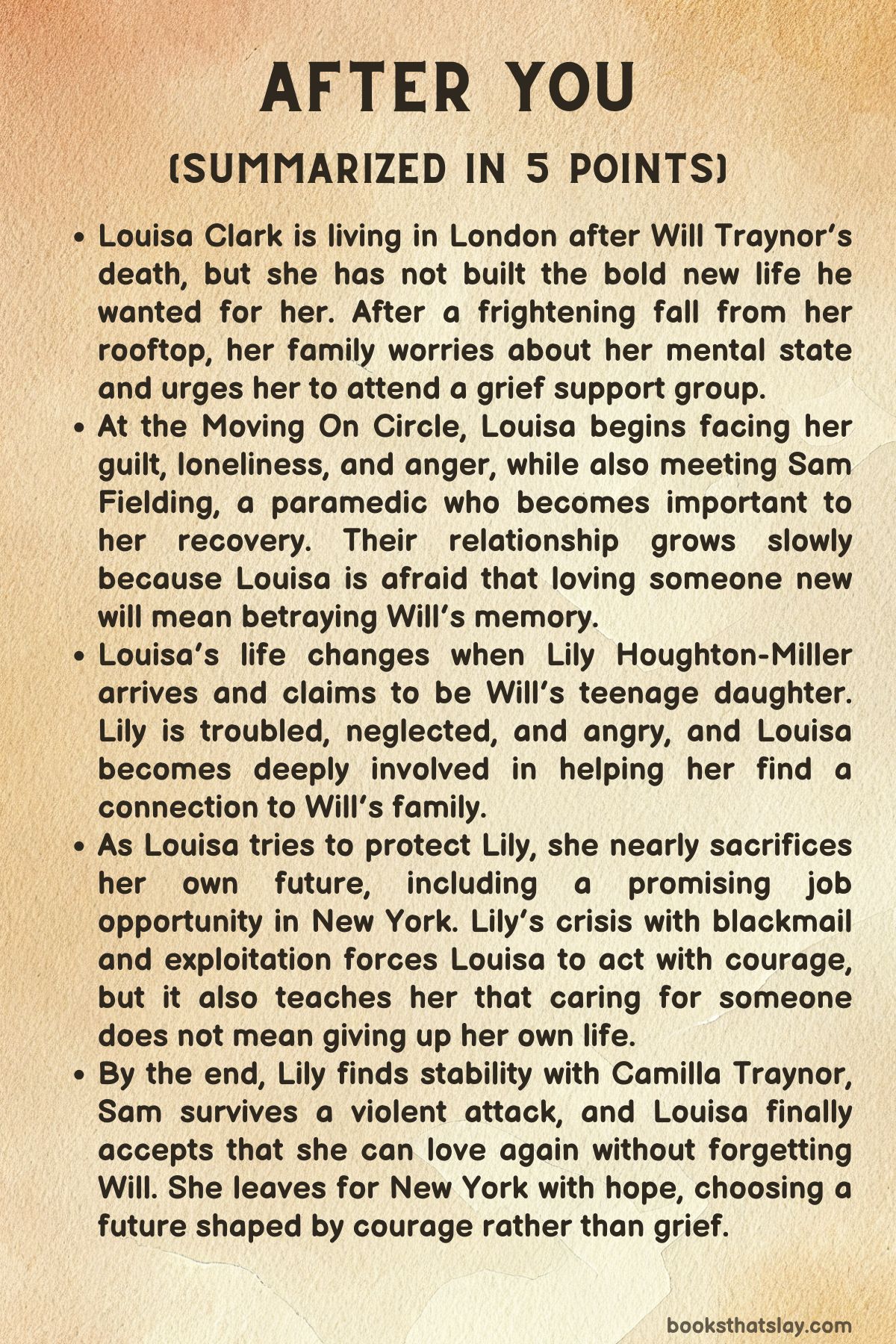
Characters
Louisa Clark
Louisa Clark is the emotional center of the novel, a woman caught between the person she used to be and the person she has not yet become. After Will Traynor’s death, she is outwardly independent but inwardly stalled.
Her job at the airport bar, her empty apartment, her drinking, and her reckless night on the roof all show a life that has lost direction. Louisa is not simply sad; she is angry, guilty, lonely, and ashamed that she has failed to live the way Will encouraged her to live.
Her grief has made her smaller, quieter, and more withdrawn than before. She has money, freedom, and possibility, but none of these things matter because she does not know how to want a future for herself.
Her character develops through responsibility, love, and painful confrontation. Lily’s arrival forces Louisa out of self-absorption, not because Louisa is selfish, but because grief has narrowed her world.
Lily needs help, and Louisa’s instinct to care gives her a reason to move again. At the same time, Louisa’s relationship with Lily exposes her habit of defining herself through other people’s needs.
She becomes protective of Lily, but she also risks using Lily as an excuse to avoid her own future. The New York job represents the life Louisa has been afraid to claim, while Sam represents the possibility of loving again without betraying Will.
By the end of After You, Louisa has not forgotten Will, nor has she fully escaped grief. What changes is her relationship to grief.
She learns that remembering someone does not require staying frozen in pain. Her decision to go to New York shows that she has finally begun to act from hope rather than fear.
Louisa’s growth is not dramatic in a simple way; it is uneven, messy, and believable. She becomes stronger not because she stops hurting, but because she accepts that life can still ask something of her.
Lily Houghton-Miller
Lily Houghton-Miller is one of the most disruptive and important figures in Louisa’s recovery. As Will’s daughter, she arrives like a living reminder of everything Louisa did not know about him.
Her existence unsettles Louisa’s memory of Will, complicating the idea that love gives complete knowledge of another person. Lily is angry, defensive, impulsive, and often rude, but her behavior comes from deep emotional neglect.
She has grown up in a wealthy home without feeling wanted or understood. Her mother is distant, her stepfamily treats her as a problem, and the adults around her repeatedly fail to protect her.
Lily’s rebellion is a form of communication. Her smoking, drinking, disappearing, and sharp comments are ways of testing whether anyone will stay.
She expects rejection, so she often creates situations that seem to invite it. When she asks to stay with Steven and is refused, her hurt confirms what she already believes: that families do not truly want her.
Her bond with Louisa matters because Louisa treats her not as an inconvenience, but as a person with pain that deserves attention. Even when Louisa makes mistakes, she tries to listen and protect her.
Lily also becomes a mirror for Louisa. Both women are connected to Will but cannot reach him.
Both feel abandoned in different ways. Both are trying to understand who they are after a rupture.
Lily’s crisis with Peter and Garside reveals how vulnerable she has been beneath her hard exterior. When Louisa helps her face that threat, Lily begins to trust again.
Her eventual move to Camilla’s home suggests the possibility of stability, education, and belonging. Lily does not become perfectly healed, but she begins to believe that she may have a place in the world.
Sam Fielding
Sam Fielding serves as both a romantic interest and a symbol of life after loss. As a paramedic, he is practical, calm, and used to meeting people at moments of crisis.
He first enters Louisa’s life after her fall, so his presence is immediately associated with survival. Unlike many people around Louisa, Sam does not treat her as fragile or as a scandal.
He asks questions, listens, and gives her space to speak honestly. His steadiness contrasts with Louisa’s emotional confusion.
Sam is also grieving. His loss of his sister Ellen and his complicated role in Jake’s life show that he understands mourning from the inside.
He is not a simple rescuer figure. He has his own history, his own loneliness, and his own attempts to keep living.
His home in the railway carriage reflects this transitional state. He is building something, but it is unfinished.
This makes him a fitting partner for Louisa, who is also unfinished and uncertain.
His relationship with Louisa challenges her loyalty to Will’s memory. Sam does not demand that she erase Will, but he does ask her to be honest about whether she is using the past to avoid the present.
When he says she is in love with a ghost, the statement hurts because it names something she has not wanted to face. Sam’s shooting becomes a turning point because Louisa nearly loses him before she has fully admitted that she loves him.
Through Sam, Louisa learns that loving again is not a replacement of the past. It is proof that she is still alive.
Will Traynor
Will Traynor is physically absent but emotionally central. His death shapes nearly every major choice in the novel.
For Louisa, Will is memory, guilt, love, anger, and unfinished instruction. She still hears him in her mind and measures her life against the promise she made to him.
Because he wanted her to live boldly, her failure to do so becomes a source of shame. Yet Will’s influence is complicated.
His memory inspires Louisa, but it also traps her. She treats him as a standard she cannot meet and as a bond she must not loosen.
The discovery that Will had a daughter changes the way the characters understand him. Lily’s existence does not destroy his memory, but it makes him more human.
He had a past before Louisa, and that past included selfishness, immaturity, and consequences he never knew about. This matters because Louisa’s grief has partly turned Will into an idealized figure.
Lily forces her to see that loving someone does not mean possessing the whole truth about them.
Will’s role in After You is therefore not only as the lost beloved. He is also the measure against which Louisa must stop judging herself.
His memory becomes healthier when Louisa stops treating it as a command and begins carrying it as part of her life. By the ending, Will remains important, but he no longer controls the direction of Louisa’s future.
Camilla Traynor
Camilla Traynor is a woman marked by restraint, grief, and emotional difficulty. Her first meeting with Lily is cold and awkward, not because she feels nothing, but because she feels too much and has little ability to express it warmly.
Camilla has lost her son, her marriage has collapsed, and her sense of identity has been damaged by events she could not control. Lily’s arrival is not simply a surprise; it is another upheaval in a life already reshaped by loss.
At first, Camilla’s disbelief wounds Lily, who is desperate to be accepted. Yet Camilla’s later actions reveal growth.
She sends Lily a letter and photo album, offering her a connection to Will that no one else can provide in the same way. When she invites Lily to live with her and return to school, Camilla becomes one of the few adults willing to offer real structure and care.
This decision is important because it allows Lily to have family without making Louisa responsible for everything.
Camilla’s character shows that grief can make people appear harsh when they are actually overwhelmed. She is not naturally expressive, but she is capable of loyalty and repair.
Her relationship with Lily offers her a new form of connection to Will, while also giving Lily the stability she badly needs.
Steven Traynor
Steven Traynor represents the limits of charm when it is not matched by responsibility. He is initially warm toward Lily and seems pleased by the discovery that he has a granddaughter.
His interaction with her gives Louisa hope that Lily may find a place with Will’s family. However, Steven’s refusal to let Lily stay at Granta House reveals his weakness.
He is interested in the idea of Lily, but not ready to take on the reality of her pain, needs, and disruption.
His new marriage to Della and the coming baby make clear that Steven has moved into another life. That does not make him cruel, but it does show his emotional convenience.
He is willing to engage when the situation is pleasant, but he withdraws when Lily asks for more. For a girl already wounded by rejection, this failure is devastating.
Steven’s character also reflects the brokenness of the Traynor family after Will’s death. He and Camilla stayed together partly because of Will, and after Will died, the marriage collapsed.
Steven’s new life may be his way of escaping grief, but it leaves others to deal with the emotional consequences.
Tanya Houghton-Miller
Tanya Houghton-Miller is Lily’s mother, and her portrayal is defined by emotional distance, defensiveness, and failure of care. She confirms that Will was Lily’s father but explains that she never told him because of the way their relationship ended.
Her decision may have begun in hurt and resentment, but it leaves Lily with a fractured identity and a deep sense of abandonment. Tanya’s home is wealthy and comfortable, yet Lily feels unloved within it.
Tanya treats Lily largely as a problem to be managed. She lists Lily’s bad behavior, school trouble, drinking, and rebellion, but she seems unable or unwilling to ask what pain might be causing these actions.
When Lily disappears, Tanya’s response is disturbingly dismissive. Because Lily has run away before, Tanya assumes the situation is routine rather than dangerous.
This failure allows Louisa to become the adult who takes Lily seriously.
Tanya is not presented as a villain in a simple sense. She has her own history with Will and may feel that she was wronged by him.
Still, the novel makes clear that her bitterness and emotional absence have damaged Lily. Her character shows how unresolved pain can be passed down when adults refuse to face it directly.
Treena Clark
Treena Clark is Louisa’s sister and one of the most honest voices in her life. Practical, sharp, and sometimes impatient, Treena refuses to romanticize Louisa’s situation.
She sees when Louisa is using Lily, Will, or fear as a reason to avoid making choices for herself. Her advice can sound blunt, but it often comes from love.
She understands Louisa well enough to challenge her directly.
Treena’s role is important because she balances Louisa’s emotional intensity with realism. She reminds Louisa that she is not Lily’s parent and cannot solve every problem by sacrificing herself.
She also pushes Louisa toward the New York job, recognizing that it may be exactly the kind of opportunity Louisa needs. Treena’s own life is not easy, and her housing and work concerns show that she is also trying to build something stable for herself and her son.
As a sister, Treena is not always gentle, but she is loyal. Her presence keeps Louisa connected to family and to common sense.
She represents the kind of love that does not always comfort softly but tells the truth when truth is needed.
Josie Clark
Josie Clark, Louisa’s mother, undergoes a quieter but meaningful transformation. At first, she seems rooted in the domestic role she has long occupied: wife, mother, caregiver, and household manager.
Over time, however, she begins questioning the expectations placed upon her. Her reading, her interest in feminism, and her refusal to continue serving Bernard without complaint all show a woman awakening to her own needs.
Josie’s development parallels Louisa’s. Both women are learning that love should not require self-erasure.
Josie’s marriage has trained her to serve and accommodate, while Louisa’s grief has trained her to put her own future aside. Their conversations help Louisa see her mother as a full person rather than only as a parent.
This shift deepens Louisa’s understanding of womanhood, independence, and family.
Josie’s changes also create tension with Bernard, who struggles to adapt. Yet her growth is not treated as selfish.
She is not abandoning her family; she is asking to exist within it as more than a provider of meals and emotional labor. Her character adds warmth, humor, and social observation to the novel.
Bernard Clark
Bernard Clark is Louisa’s father, and his character often reflects traditional ideas about marriage, family, and gender roles. He loves his family, but he is slow to recognize how much he expects from Josie without appreciating her.
His frustration over small domestic changes, such as Josie not making lunch or not baking a cake, reveals how dependent he has become on routines that benefit him.
Yet Bernard is not unfeeling. He worries about Louisa after her fall and wants her to attend the grief group because he fears losing her.
His problem is not a lack of love, but a limited way of expressing it. He is used to a world where roles are fixed, and when Josie begins to change, he feels threatened and confused.
His apology to Josie near the end shows that he is capable of humility. Bernard’s growth is modest but important.
He begins to understand that loving someone means allowing that person room to change. His character adds a family-based version of the novel’s larger concern with moving forward.
Nathan
Nathan is a steady link between Louisa’s past with Will and her possible future beyond him. As Will’s former physiotherapist, he understands what Louisa lost without needing long explanations.
His calls from New York are warm, practical, and encouraging. He does not pressure Louisa harshly, but he does remind her not to close herself off from life.
Nathan’s most important role is offering Louisa the job opportunity with the Gopnik family. This offer becomes a test of whether Louisa is ready to choose a life beyond grief and obligation.
Nathan sees qualities in her that she struggles to see in herself: adaptability, kindness, humor, and the ability to care for others in a meaningful way. Because he knew Will, his encouragement carries extra emotional weight.
Nathan represents friendship that is both compassionate and forward-looking. He honors Louisa’s grief but does not let her disappear inside it.
His presence helps open the door to New York, independence, and renewal.
Jake
Jake is a young member of the Moving On Circle who is grieving the death of his mother. His presence shows that grief is not limited by age and that teenagers can carry sorrow in confusing, indirect ways.
Louisa initially misunderstands his relationship to Sam, assuming Sam is his father. This misunderstanding leads to one of the major emotional conflicts between Louisa and Sam.
Jake’s comments about his father’s behavior after his mother’s death reveal how adults’ coping mechanisms affect children. He feels uncomfortable and hurt by his father’s romantic life, and his grief is mixed with judgment, confusion, and loneliness.
Through Jake, the novel shows that mourning within a family can become uneven, with each person trying to survive in ways that may wound someone else.
Although Jake is not central to the plot in the same way as Lily, his role matters because he helps Louisa understand that grief has many forms. His presence in the support group also adds realism to the circle, showing people at different ages and stages trying to speak about loss.
Marc
Marc leads the Moving On Circle and provides a calm, structured space for grief to be spoken aloud. He is not a dramatic figure, but his importance lies in consistency.
He gently encourages Louisa to share, even when she resists. He also helps her see that guilt, anger, and confusion are common parts of mourning rather than private failures.
Marc does not solve Louisa’s problems. Instead, he gives her a setting where she can hear other people’s losses and slowly understand her own.
The group becomes a mirror, reflecting both where she is stuck and how far she has come. When Louisa eventually feels she has nothing urgent to say, that silence itself becomes evidence of healing.
Marc’s character represents patient support. He shows that recovery is not always caused by grand advice; sometimes it comes from being given a place to return to until one no longer needs it in the same way.
Richard
Richard, Louisa’s manager at the airport bar, begins as an irritating authority figure. He imposes rules, uniforms, and rigid expectations, making Louisa’s already dull job feel even more restrictive.
His management style seems cold and insensitive, especially when Louisa’s life becomes chaotic because of Lily and her own emotional struggles.
However, Richard becomes more human when Louisa finally stands up to him. Her confrontation reveals that he too has reasons for his behavior, even if they do not excuse all of it.
His decision to offer Louisa her job back, and later promote her, suggests that he can recognize competence and respond to honesty. Through Richard, Louisa also learns that she is capable of asserting herself in a workplace she had treated as merely temporary.
Richard’s role is minor but useful. He helps show Louisa’s changing confidence.
By speaking up to him, she proves to herself that she is not only someone things happen to; she can defend her own worth.
Peter
Peter is one of the clearest antagonistic figures in the novel. His blackmail of Lily exposes the danger behind her erratic behavior.
He exploits her vulnerability, humiliation, and fear of social shame. By threatening to release an explicit image, he traps her in silence and forces her to steal money and jewelry.
His actions are cruel because they depend on Lily believing that no adult will protect her.
Peter’s role is important because he reveals the real danger beneath what others dismiss as teenage rebellion. Lily is not merely acting out; she is being manipulated and threatened.
His abuse also shows how shame can isolate victims, especially young people who fear judgment more than they trust help.
Although Peter does not occupy much space in the story, his impact is severe. He becomes a symbol of the predatory world Lily has been navigating without adequate support.
Mr. Garside
Mr. Garside is disturbing because he first appears to offer help. When he notices Lily with Peter, he seems like a responsible adult stepping in.
This makes his later betrayal especially harmful. Instead of protecting Lily, he takes control of the same threatening material and uses it to exploit her himself.
His behavior shows how vulnerable people can be harmed not only by obvious predators, but also by those who disguise control as assistance.
Garside’s character deepens Lily’s crisis. After Peter, she might have believed that an adult could finally help her.
Garside destroys that possibility, leaving her more frightened and alone. When Louisa and Sam confront him, the scene is not only about retrieving a phone; it is about proving to Lily that some adults will stand between her and harm.
Garside represents corruption of trust. His role sharpens the novel’s concern with protection, responsibility, and the need to believe young people when they are in danger.
Themes
Grief and the Difficulty of Moving Forward
Grief in After You is not shown as a single emotional state but as a force that changes behavior, identity, memory, and relationships. Louisa’s sorrow after Will’s death is complicated by guilt and anger.
She does not only miss him; she feels she has failed him by not living the larger life he wanted for her. This makes her grief active rather than passive.
It shapes where she works, how she lives, how she dresses, how much she drinks, and how afraid she is to imagine happiness without him. The Moving On Circle gives the novel a way to show grief in many forms.
Jake, Sam, Marc’s group members, Camilla, and Louisa all carry loss differently, which prevents mourning from being treated as a neat process. Sam’s grief over Ellen is quieter than Louisa’s, while Camilla’s appears controlled and cold until her actions reveal the pain beneath it.
The novel suggests that moving forward does not mean replacing the dead or pretending the loss has ended. Louisa’s final growth comes when she understands that memory can remain without controlling every choice.
Her rooftop ceremony and departure for New York show a shift from being ruled by grief to carrying it as one part of a wider life.
Love After Loss
Love after loss is treated as both a possibility and a source of fear. Louisa’s connection with Sam develops slowly because she is not emotionally free in any simple sense.
Will remains present in her thoughts, and loving Sam feels, at first, like a betrayal. This fear is realistic because Louisa’s love for Will did not end through rejection or fading feeling; it was interrupted by death.
As a result, Sam is not competing with an ordinary former lover but with an idealized memory. The novel is careful to show that Sam also understands grief.
He has lost his sister and knows how the dead can remain part of everyday life. This makes him patient, but not passive.
He eventually challenges Louisa to face the fact that she may be using Will’s memory to avoid risk. Their relationship becomes meaningful because it asks Louisa to accept uncertainty again.
To love Sam is to accept the possibility of another loss, and his shooting makes that fear immediate. In the hospital, Louisa recognizes that protecting herself from pain has also kept her from joy.
The novel’s view of love is mature: new love does not erase old love, but it does require permission to live in the present.
Responsibility, Care, and Self-Sacrifice
Louisa’s care for Lily gives her life purpose, but it also raises difficult questions about responsibility. Lily needs help badly.
She is neglected, angry, unsafe, and desperate for someone to choose her. Louisa responds with compassion, offering shelter, attention, and protection when Lily’s own family fails to provide it.
This care is one of Louisa’s strengths, but the novel also shows the danger of losing oneself in another person’s crisis. Louisa begins to use Lily’s need as a reason to refuse the New York job, even after the opportunity clearly matters to her.
This does not make her selfish or foolish; it shows how easily care can become avoidance when someone is already unsure of their own worth. Treena’s reminders are important because they challenge Louisa to separate kindness from self-erasure.
Lily’s eventual move to Camilla’s home confirms that Louisa was never meant to become the sole answer to Lily’s problems. True care sometimes means helping someone reach a better support system, not making oneself permanently necessary.
The novel argues for a balanced form of responsibility: people should help one another, but not at the cost of abandoning their own future.
Identity and Rebuilding a Life
Louisa’s journey is fundamentally about rebuilding identity after the collapse of an old self. Before Will’s death, and even during her time with him, she had begun to see herself as someone capable of more than the narrow life she had known.
After his death, that emerging identity breaks down. She owns a London flat and has financial freedom, but she does not feel like a person with direction.
Her clothes, work, apartment, and routines all reflect uncertainty about who she is now. Lily’s arrival, the grief group, Sam, her family’s changes, and the New York job each force Louisa to reconsider the story she is telling about herself.
She is not only Will’s former caregiver or the woman who loved him. She is also a daughter, sister, friend, worker, protector, lover, and person with ambitions of her own.
This theme also appears through Josie, who begins questioning her domestic role, and Lily, who is trying to understand herself after learning the truth about her father. Rebuilding a life is shown as practical as well as emotional: it involves work, housing, family conversations, difficult choices, and the courage to leave.
Louisa’s departure for New York marks the beginning of a self chosen by her, not merely shaped by loss.