Against the Loveless World Summary, Characters and Themes
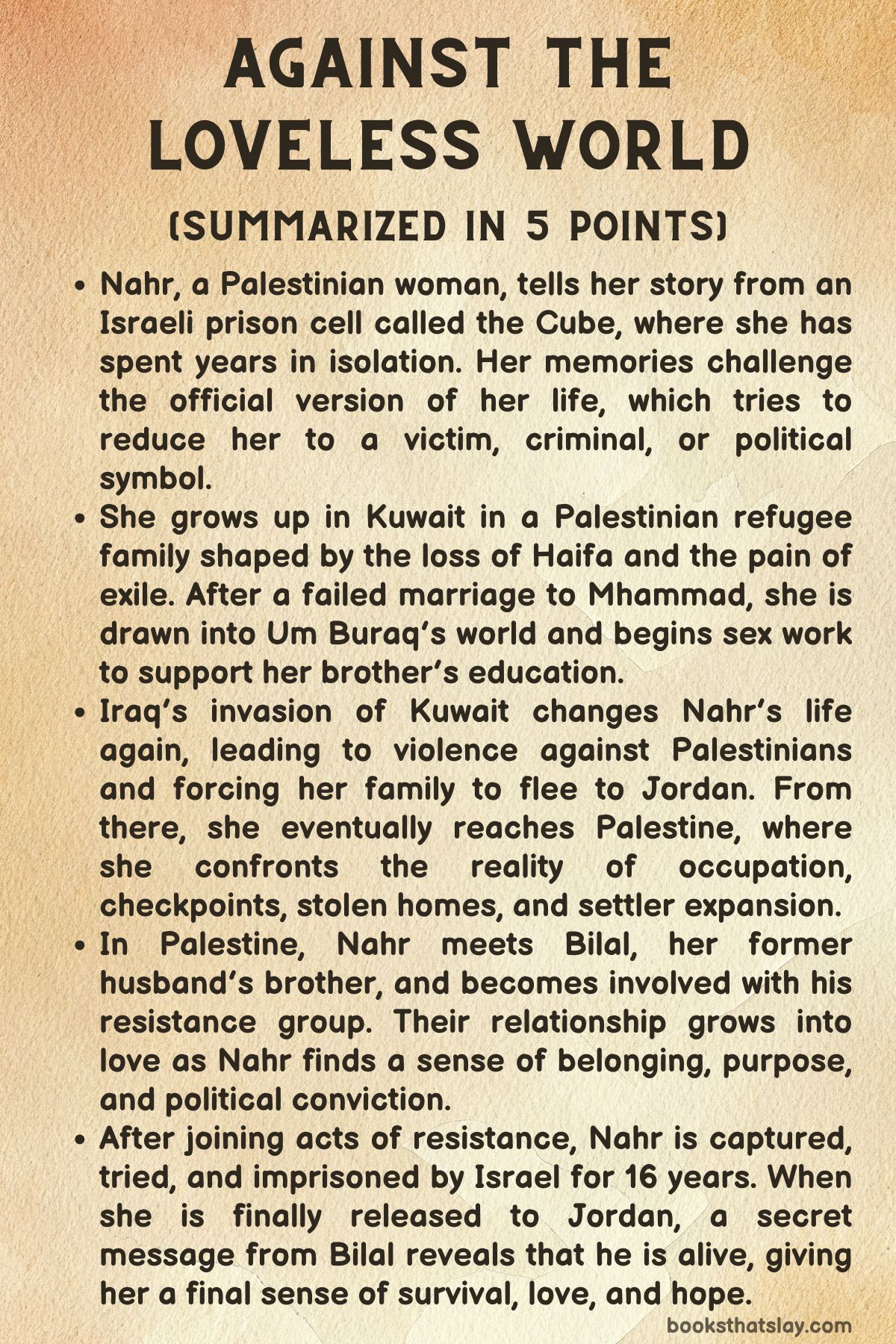
Against the Loveless World by Susan Abulhawa is a political and personal novel about Nahr, a Palestinian woman whose life is shaped by exile, poverty, gendered violence, occupation, and resistance. Told through her memories while she is held in an Israeli prison cell called the Cube, the book moves between Kuwait, Jordan, and Palestine.
It follows her from a troubled young marriage and exploitation in Kuwait to political awakening in Palestine, where love and belonging become inseparable from struggle. The novel presents Nahr not as a victim defined by others, but as a woman who claims her own story, anger, desire, and freedom.
Summary
Against the Loveless World centers on Nahr, a Palestinian woman imprisoned for many years in a high-security Israeli cell known as the Cube. The cell is small, controlled, and cruelly efficient, fitted with automated systems that regulate her access to water, the toilet, movement, and even restraint.
Her isolation is meant to break her, but it also becomes the place where she decides to tell her story. Israeli officials and foreign journalists try to reduce her life to a clean political narrative: a damaged woman supposedly pushed into violence by abuse and manipulation.
Nahr rejects that story. Her memories reveal a much larger life shaped by displacement, survival, love, shame, resistance, and a fierce refusal to be owned by anyone’s version of her.
Nahr grows up in Kuwait in a Palestinian refugee family. Her mother’s family fled Haifa after the Nakba, losing their home and property when Israel was created in 1948.
Though Nahr is born outside Palestine, the loss of Palestine fills her family’s life. Her mother longs for Haifa, while her grandmother lives emotionally in the village she was forced to leave.
Nahr is restless, difficult, and resistant to the expectations placed on Palestinian girls. She loves music and dance, especially the traditional forms that connect women to culture, memory, and joy.
Her father dies when she is young, after years of betraying her mother, leaving behind grief, resentment, and social shame.
As a young woman, Nahr marries Mhammad, a respected Palestinian activist. The marriage is awkward and brief.
On their wedding night, there is no real intimacy between them, and Mhammad cries out another person’s name. Soon after, he leaves for Palestine, abandoning Nahr and leaving her confused, humiliated, and socially vulnerable.
After the marriage collapses, Nahr is drawn into the orbit of Um Buraq, an older Iraqi woman with a scandalous reputation. At first, Nahr does not understand the world Um Buraq inhabits.
She is taken to parties where women entertain powerful men, and she is gradually pulled into sex work.
Nahr initially recoils from this life, but poverty and family duty trap her. Her brother Jehad has the chance to study medicine, and Nahr cannot afford his tuition through ordinary work.
She returns to Um Buraq’s world because it gives her access to money. What begins as shame becomes a hard lesson in survival.
Nahr learns that men who judge, buy, and use women are often the same men who are protected by society. Um Buraq teaches her that women with few choices must take what they can from a world built to exploit them.
Nahr is hurt, abandoned, and forced through a dangerous abortion after a man promises marriage and then betrays her. Still, she continues to support her family.
Her life changes again on the night Iraq invades Kuwait in 1990. Nahr is at a party with Saudi officials who assault her.
The invasion interrupts the attack and saves her life. For this reason, Nahr cannot view the political event in simple terms.
The war disrupts Kuwait, and Palestinians become targets because of Yasser Arafat’s support for Saddam Hussein. Jehad, who opposes Saddam and follows politics closely, is arrested by Kuwaiti authorities despite having little connection to the occupation.
He is beaten and falsely accused of collaboration. The family is evicted and threatened, and Nahr is forced to seek money from one of her former clients, who assaults her before giving her access to her bank account.
Nahr steals his bank card information and, with Um Buraq’s help, drains his account. Eventually, the family flees to Jordan.
In Amman, Nahr feels rootless. Her mother and grandmother adjust more easily because they have already known displacement, but Nahr has lost the only country she has ever lived in.
Jehad works to secure permission for himself and Nahr to enter Palestine. Their mother and grandmother are denied the same right except as visitors.
Nahr eventually travels to Palestine, where she stays with her mother-in-law and Bilal, the brother of her absent husband, Mhammad.
Palestine changes Nahr’s understanding of herself. She sees military checkpoints, unequal laws, settlements, and the daily humiliation of Palestinians on their own land.
Bilal explains how the Oslo Accords have divided territory and left Palestinians trapped under a growing structure of control. Nahr visits her mother’s childhood home in Haifa, now occupied by a Jewish woman who reacts with anger rather than sympathy.
The visit makes the theft of Palestinian homes painfully concrete. Nahr is no longer hearing inherited grief; she is standing inside it.
Nahr also begins to understand Bilal. He is a shepherd, former prisoner, and active member of the resistance.
At first, he is unsure whether he can trust her, but he later brings her closer to the underground network. Jumana, a salon owner, hosts secret meetings in rooms and tunnels beneath her business.
The group asks Nahr to help move weapons because her tourist visa allows her to travel where local Palestinians cannot. Nahr refuses at first, and when Jumana insults her past as a sex worker, Nahr explodes.
She rejects the idea that privileged women can judge poorer women for doing what survival requires. Her anger marks a turning point: she begins to see that her life, with all its pain and compromise, has also made her strong.
Bilal reveals the truth about Mhammad. Mhammad is gay and had been involved with an Israeli soldier named Itamar.
A violent incident involving Israeli soldiers destroyed Bilal’s family and changed the course of his life. Nahr realizes that the failure of her marriage was never truly about her.
This knowledge frees her from years of confusion and shame.
After returning briefly to Jordan, Nahr chooses to go back to Palestine. There, she finds belonging with Bilal, Jumana, and the wider community.
She learns about women who organize prison visits and families who keep resisting in small and large ways. She joins operations with the resistance, helps create diversions, and participates in plans meant to unsettle Israeli control.
The group’s weapons are often old or useless, so they turn to unconventional tactics. Nahr suggests creating chaos among soldiers who are used to Palestinian obedience.
Her bond with Bilal deepens into love. They work together to restore water to his almond trees after settlers steal Palestinian water through irrigation systems supported by Israeli authorities.
Bilal is arrested and held without charge, then released. Later, during the olive harvest, Israeli settlers attack Palestinians in the groves.
Soldiers defend the settlers, a Palestinian child is killed, trees are burned, and Bilal is arrested again. His mother dies while he is imprisoned.
Bilal goes on a hunger strike, gains public attention, and is eventually freed.
Nahr and Bilal marry in a ceremony rich with Palestinian memory and symbolism. Her mother makes a dress that honors different regions of Palestine.
Their marriage is tender but shadowed by trauma. Bilal has been physically damaged by torture, and Nahr carries wounds from exploitation and assault.
They choose to define intimacy on their own terms, beginning with tenderness, trust, and the comfort of holding each other.
As the Second Intifada intensifies, Israeli violence grows more severe. Curfews, raids, killings, and bombings shape daily life.
Bilal, trained as a chemist, creates a compound and uses the settlers’ stolen water system against them, causing infertility and other symptoms among the settlers near his land. When authorities investigate, he and Nahr remove the evidence, then resume the sabotage after suspicion fades.
Some settlers leave, believing they have been cursed.
Nahr discovers she is pregnant around the same time she learns her grandmother has died. Bilal, unable to leave Palestine, arranges for her to return to Jordan.
On the way, Nahr realizes he has sent her away because a resistance action is about to happen. A letter confirms that he and others have carried out the hornet-spray plan at a checkpoint, leading to a major military response.
Nahr’s taxi is struck by helicopter fire, and Israeli soldiers capture her.
She is beaten, interrogated, and imprisoned. She confesses to sabotaging the water pipes but is glad that Bilal remains free.
At her trial, Israeli media displays old images of her dancing in Kuwait and uses them to shame her. Nahr refuses shame.
She sings Palestinian songs in chains and feels a form of freedom that prison cannot fully erase.
After 16 years in the Cube, Nahr is released to Jordan. Freedom is difficult.
She is reunited with her mother, but she struggles with visitors, noise, and ordinary life. She has survived, but she has changed.
Her reunion with Um Buraq brings unexpected peace. The two women, both aged and marked by prison, still share love, humor, and loyalty.
They spend time together, remembering the past without letting it destroy them.
The novel ends with a secret message. At a bathhouse, Nahr receives a coded letter from Bilal.
He is alive and has been in hiding. He still loves her and wants to meet.
Nahr knows they cannot live openly or safely, but the letter gives her joy. After exile, violence, imprisonment, and loss, she and Bilal have endured.
The ending does not offer simple peace, but it gives Nahr something stronger: proof that love, memory, and resistance have survived with her.
Characters
Nahr
Nahr is the central character and narrator of Against the Loveless World, and her life is defined by a constant struggle to keep ownership of her own story. Others repeatedly try to explain her: journalists call her a terrorist, prison officials frame her as a damaged woman rescued by Israel, men reduce her to a body, and society judges her for the choices she makes under economic pressure.
Nahr rejects all of these versions. She is angry, sensual, wounded, funny, defiant, and deeply intelligent, though her intelligence is not always recognized in formal ways.
Her love of dance connects her to Palestinian womanhood and cultural memory, while her time in Kuwait exposes her to exploitation and betrayal. Her work under Um Buraq is not presented simply as moral failure, but as survival in a world where women’s choices are shaped by money, shame, and family duty.
In Palestine, Nahr changes from someone trying to endure history into someone actively resisting it. Her love for Bilal gives her tenderness without weakening her anger.
By the end, imprisonment has altered her, but it has not erased her. She survives as a woman who refuses shame, refuses silence, and refuses to let power define what freedom means.
Bilal
Bilal is one of the novel’s most important figures because he represents both personal tenderness and political resistance. When Nahr first meets him in Palestine, he is cautious, watchful, and shaped by years of imprisonment and struggle.
He has learned that trust can be dangerous, especially under occupation, where betrayal, surveillance, and state violence are constant threats. Yet Bilal is not emotionally cold.
He treats Nahr with a patience and respect she has rarely received from men. Unlike those who judge her past, he sees her courage and recognizes the strength it took for her to survive.
His bond with the land is also central to his character. His sheep, almond trees, and family home are not just property; they are proof of Palestinian continuity.
When settlers steal water and the state supports them, Bilal’s resistance becomes both political and intimate. His love for Nahr is quiet but powerful, and their marriage is built on honesty rather than fantasy.
His torture has damaged him physically and emotionally, but he does not hide behind pride. Bilal’s character shows how occupation attacks the body, the home, and the future, while love offers a way to remain human inside that violence.
Um Buraq
Um Buraq is one of the most complex characters in the story. She first appears as a dangerous influence on Nahr, introducing her to parties, sex work, and a world of men who pay for women while pretending to stand above them morally.
Yet Um Buraq is not written as a simple villain. She is a survivor who understands the brutality of men, money, and social hypocrisy.
Her worldview is harsh because her life has taught her that women without protection must find power wherever they can. She exploits Nahr in certain ways, but she also cares for her, rescues her after illness, helps her earn money for Jehad’s education, and later becomes one of the few people who can comfort Nahr after prison.
Their relationship is full of contradiction: manipulation, loyalty, affection, damage, and shared understanding. Um Buraq sees through the false respectability of society.
She knows that many men who condemn women like her are the same men who use them in private. By the end, her reunion with Nahr becomes one of the gentlest moments in the novel.
She represents a form of love that is imperfect but enduring, born from survival rather than innocence.
Jehad
Jehad, Nahr’s brother, carries the hopes of his family. Nahr works and sacrifices so that he can study medicine, making him a symbol of possible upward movement for a displaced Palestinian family.
He is thoughtful, politically aware, and more idealistic than Nahr at several points in the story. During the Iraqi invasion of Kuwait, he refuses to view Saddam Hussein as a liberator and pays attention to the wider human rights consequences of the war.
His political clarity contrasts with Nahr’s more personal response, since she associates the invasion with being saved from immediate violence. Jehad’s arrest in Kuwait reveals how quickly Palestinians become scapegoats when political circumstances shift.
Though he has done little to deserve suspicion, he is beaten and humiliated because of his identity. His suffering also forces the family into another exile.
Jehad later helps Nahr gain access to Palestine, making him an important link between their refugee life and their ancestral homeland. He is not as central as Nahr or Bilal, but his character shows how Palestinian men are also trapped by statelessness, suspicion, and political forces larger than themselves.
Nahr’s Mother
Nahr’s mother is shaped by loss, endurance, and a quiet hunger for dignity. She carries the memory of Haifa as a wound that never fully closes.
Having lost her home and status after displacement, she spends much of her life trying to keep her family respectable in communities that judge women harshly. Her marriage leaves her with humiliation because of her husband’s infidelity and death in another woman’s arms.
This personal betrayal deepens the social shame she already bears as a refugee woman. As a mother, she can be strict, fearful, and bound by convention, especially in her expectations of Nahr.
Yet she is not merely oppressive. She works hard, sews wedding dresses, and later gains pride through office work, which gives her a sense of worth beyond survival.
Her visit to her childhood home in Haifa is especially important because it shows how exile lives inside the body. She does not simply remember the house; she is emotionally pulled back to a life that was stolen.
Through her, the novel shows how displacement passes from one generation to the next, even when the younger generation has never seen the lost homeland.
Nahr’s Grandmother
Nahr’s grandmother represents the oldest layer of Palestinian memory in the family. She has physically left Palestine, but emotionally she remains there.
Her memories of village life shape the atmosphere of Nahr’s childhood, creating a household where the past is not past. She can be traditional and judgmental, especially about women’s behavior, marriage, and reputation.
Her disapproval of Um Buraq reflects an older moral order that values respectability as a form of protection. At the same time, her life has been defined by dispossession, and this makes her more than a figure of conservatism.
She is living evidence of what was taken from Palestinians during the Nakba. Her later inheritance connected to her village briefly restores a material link to what had been lost, but it cannot undo exile.
Her death is devastating for Nahr, especially because Nahr learns of it while trapped in solitary confinement. The loss is not only personal; it is historical.
With her grandmother’s death, one living bridge to the pre-exile world disappears. Her character gives the novel a sense of generational depth, showing how homeland survives through memory, speech, grief, and family ritual.
Jumana
Jumana begins as a difficult presence in Nahr’s life but becomes one of her closest companions in Palestine. She runs a beauty salon that secretly shelters resistance activity beneath it, making her public and private identities sharply different.
On the surface, she participates in feminine community and everyday labor; beneath that surface, she is part of an organized effort against occupation. Her early insult toward Nahr’s sex work exposes a weakness in her politics.
Though she is committed to national liberation, she initially fails to extend that liberation to women whose survival has taken forms she does not respect. Nahr’s anger forces Jumana to confront her own prejudice.
This conflict becomes the basis for a stronger relationship, because Jumana apologizes and grows. She is brave, practical, and emotionally open, especially in her love for Ghassan and her loyalty to the resistance group.
Her friendship with Nahr offers a model of female solidarity that is not automatic or sentimental. It must be earned through honesty, accountability, and mutual recognition.
Jumana’s character shows that revolutionary politics must include the dignity of women, not just the freedom of a nation.
Mhammad
Mhammad is central to Nahr’s early pain, even though he is absent for much of the story. He marries her without being able to love her honestly, then leaves her with confusion and shame.
His abandonment helps push Nahr into social and economic vulnerability. At first, he seems like another man who uses a woman to satisfy family or social expectations and then escapes the consequences.
Later, the truth about his sexuality complicates him. He is a gay Palestinian man living in a world where his identity is dangerous and unacceptable, and this explains some of his fear and emotional distance.
Still, the novel does not use his suffering to excuse the harm he causes. His relationship with Itamar and his possible betrayal of Palestinians create a more troubling portrait.
Mhammad is a man trapped by secrecy, but he also makes choices that damage others. For Nahr, learning the truth about him is freeing because it allows her to stop blaming herself for the failure of their marriage.
His character shows how repression, shame, and political violence can produce private wreckage that spreads through many lives.
Klara
Klara, the Russian prison guard, is a minor but memorable character because she complicates the prison world around Nahr. She is part of the system that confines Nahr, yet she does not fully belong to it.
Having been forced to move to Israel with her family, she carries her own form of displacement, though it is not the same as Nahr’s. Her interactions with Nahr are limited, controlled, and shaped by the prison’s rules, but she offers small signs of humanity in an environment designed to deny it.
Nahr’s almost-friendly relationship with Klara shows how even inside systems of oppression, individual people may reveal discomfort, sadness, or reluctant sympathy. Still, Klara’s kindness has limits.
She cannot free Nahr, and she remains attached to the machinery of Nahr’s captivity. This makes her important not because she redeems the prison, but because she shows how oppressive structures often include people who feel uneasy yet continue to function within them.
Her disappearance also deepens Nahr’s isolation, reminding the reader that even small human contacts can become lifelines in solitary confinement.
Itamar
Itamar represents betrayal, occupation, and the intimate corruption created by unequal power. As an Israeli soldier and Mhammad’s lover, he is connected to both personal secrecy and military violence.
His relationship with Mhammad is dangerous not only because it crosses social and political boundaries, but because it becomes tied to deception and bloodshed. The plan that makes Itamar appear heroic after the deaths of other soldiers reveals a willingness to use Palestinian suffering and Israeli military mythology for personal advancement.
For Bilal, Itamar is not an abstract enemy but someone whose actions helped destroy his family’s life. His later raid on Bilal’s home shows that he continues to embody state power, entering Palestinian space with authority and threat.
Itamar’s character is not developed through tenderness or inner conflict in the same way as Nahr or Bilal; instead, he functions as a figure of moral decay within systems that reward domination. His presence shows how private desire, ambition, militarism, and betrayal can combine in destructive ways.
Themes
Exile, Homeland, and the Inheritance of Loss
Homeland in Against the Loveless World is not simply a place on a map; it is a wound carried through generations. Nahr is born in Kuwait, yet Palestine shapes her life before she ever sees it.
Her mother’s longing for Haifa and her grandmother’s memories of village life create a household where displacement is ordinary and permanent. This inherited loss affects how Nahr understands identity.
She is Palestinian in Kuwait, unwanted after the war, displaced again in Jordan, and treated as a temporary visitor when she finally reaches Palestine. The novel shows that exile is not only physical removal from land.
It is also the denial of legal status, the inability to return home freely, the humiliation of checkpoints, and the experience of seeing another person occupy a family house. When Nahr visits Haifa, the past becomes painfully visible.
The stolen home is not an idea but a real garden, a real wall, and a real confrontation. Through Nahr’s family, the novel presents Palestinian displacement as both historical and intimate.
Loss is inherited through stories, habits, grief, food, clothing, dance, and silence. Yet homeland also survives through those same things.
The characters are repeatedly forced away, but memory keeps returning them to Palestine.
Gender, Shame, and Survival
Nahr’s life exposes how women are judged by standards that ignore the conditions under which they are forced to live. After her failed marriage, she becomes vulnerable in a society where a woman’s respectability can determine her safety, work, and future.
Her involvement in sex work is treated by outsiders as proof of moral failure, but the novel presents it as part of a larger system of poverty, male entitlement, and family responsibility. Nahr needs money to support Jehad’s education, and ordinary labor does not provide enough.
The men who use her body often have social status, money, and protection, while she bears the shame. This imbalance reveals the hypocrisy of patriarchal morality.
Um Buraq understands this world clearly, even if her lessons are harsh. She teaches Nahr that men often create the conditions of women’s exploitation and then punish women for surviving those conditions.
Jumana’s early judgment of Nahr shows that even politically active women can reproduce the same moral policing they claim to resist. Nahr’s refusal to be ashamed becomes one of her strongest acts of self-defense.
When Israeli media later uses images of her dancing to humiliate her, she rejects the insult. Her body has been used, judged, and displayed, but she refuses to let shame become her prison.
Resistance and the Meaning of Freedom
Freedom in the novel is not presented as a simple condition of being outside prison. Nahr is physically confined in the Cube, yet she often understands power more clearly than those who claim to judge her.
Her captors control her body, her visitors, her movement, and her environment, but they cannot fully control her memory or her interpretation of her life. This makes storytelling a form of resistance.
Political resistance also takes many forms throughout the novel. Bilal tends land, repairs water access, shelters underground networks, and joins armed operations.
Jumana uses her salon as a cover for organizing. Elderly women coordinate prison visits.
Nahr transports messages, helps with plans, and later accepts responsibility for sabotage. The novel does not romanticize resistance as clean or easy.
It emerges from military occupation, stolen land, imprisonment without charge, settler violence, and the daily denial of dignity. It also carries risk, fear, and moral difficulty.
Nahr’s transformation is important because she does not begin as someone seeking political action. Her resistance grows from lived experience: exile, assault, poverty, humiliation, and finally the reality of Palestine under occupation.
Freedom, for her, becomes less about safety and more about refusing obedience to a system built to erase her.
Love, Intimacy, and Human Dignity Under Violence
Love in the novel survives under conditions that constantly threaten to distort or destroy it. Nahr’s early experiences teach her to distrust intimacy.
Her marriage to Mhammad is emotionally empty, her encounters with men in Kuwait are shaped by money and power, and sexual violence leaves deep wounds. Because of this history, her relationship with Bilal is significant not because it magically heals her, but because it allows tenderness without demand.
Bilal does not treat Nahr as ruined, impure, or lesser. He sees her clearly and respects her anger.
Their marriage is built on truth: he speaks about torture and his damaged body, while she acknowledges her own emotional scars. They choose closeness without forcing themselves into ordinary expectations of sex, children, or marital performance.
This makes their love an act of dignity. It gives both characters a space where they are not reduced to what violence has done to them.
Friendship also carries this theme. Nahr’s bond with Um Buraq, and later with Jumana, shows that love can be flawed, difficult, and still real.
In a world marked by prison, exile, occupation, and betrayal, human connection becomes a way of saying that the characters are more than victims, more than symbols, and more than wounds.