The Matchmaker’s Cottage Summary, Characters and Themes
The Matchmaker’s Cottage by Kat Sloane is a second-chance romance centered on Julia Schaeffer and Ethan Duchamp, former childhood best friends whose bond was destroyed by resentment, misunderstanding, and feelings neither was willing to confront.
Years after their separation, Ethan returns to Julia’s struggling bed-and-breakfast seeking help with a celebrity publicity campaign. His arrival forces both of them to confront the emotional history they have spent years avoiding. Combining romance, family grief, anxiety, career dissatisfaction, and the complicated meaning of home, the book shows how reconciliation requires more than attraction: Julia and Ethan must learn to communicate honestly, accept help, and stop treating vulnerability as weakness.
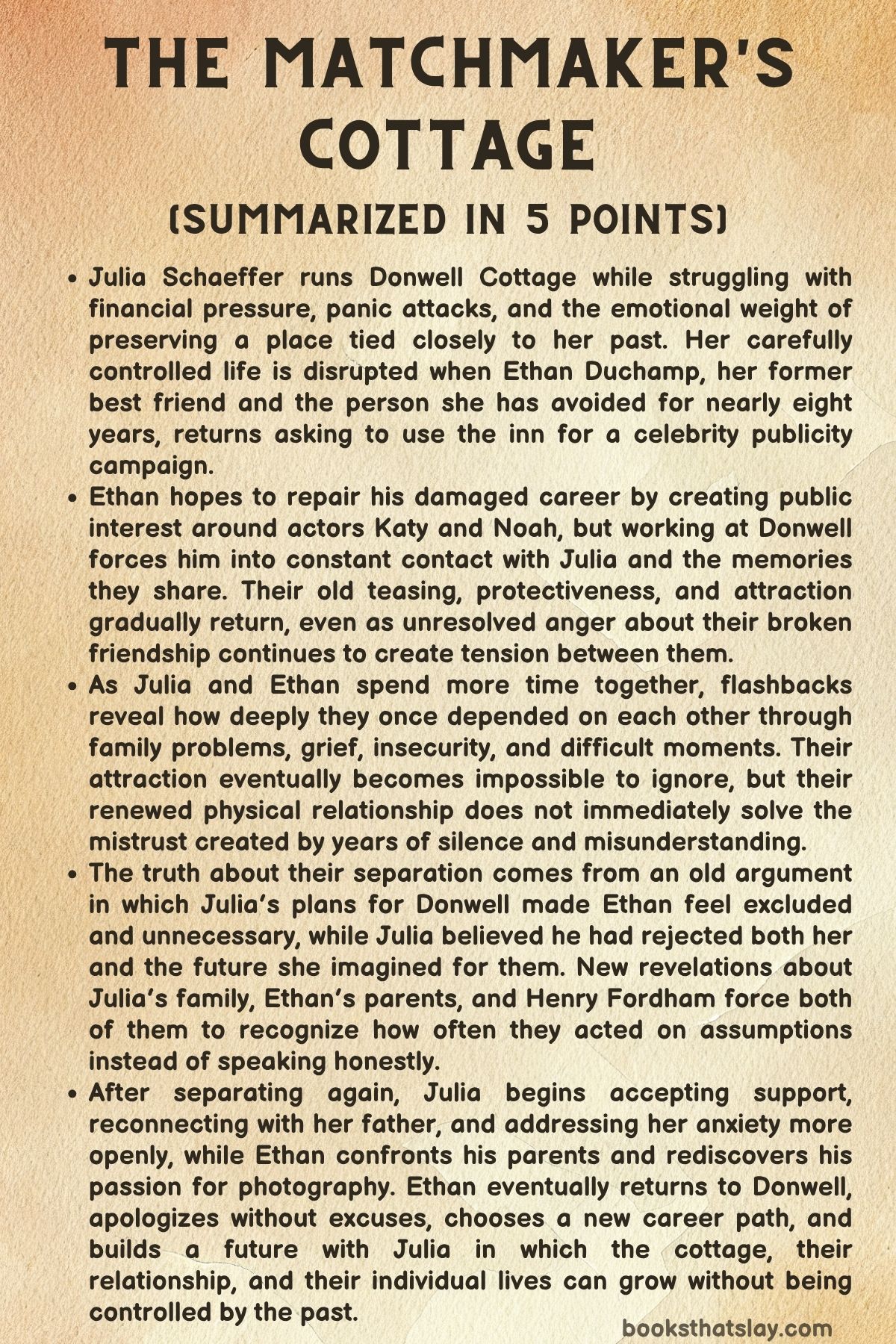
Summary
Julia Schaeffer has built her adult life around Donwell Cottage, a bed-and-breakfast connected to the summers of her childhood. She runs almost everything herself, relying mainly on Maggie for cooking and housekeeping and Norman for the grounds. Although Julia projects competence and independence, the business is struggling financially, and the pressure of keeping it alive has contributed to increasingly severe panic attacks. Baking gives her comfort because it offers structure and predictability when the rest of her life feels uncertain.
Her controlled existence is disrupted when Ethan Duchamp sends her a message after nearly eight years of silence. Ethan was once Julia’s closest friend, the person who knew her better than almost anyone, but their relationship ended so badly that neither has contacted the other since. Because Ethan rarely admits needing help, Julia suspects his situation must be serious and eventually agrees to hear him out.
Ethan works for Fordham PR as a celebrity matchmaking specialist, arranging relationships that generate favorable publicity. His career is suddenly threatened when actress Emily Sattler publicly exposes one of his manufactured romances and associates Ethan’s company with deception. His boss, Henry Fordham, offers him a chance to repair the damage by producing another celebrity pairing—this time involving people who willingly understand the arrangement.
Ethan chooses actors Katy and Noah, former costars with obvious natural chemistry. He needs a secluded, attractive location where their apparent romance can develop away from aggressive media attention, and Donwell immediately comes to mind.
Julia agrees to host the project, partly because celebrity attention could help her financially troubled inn. Yet Ethan’s arrival immediately shows how difficult their reunion will be. He looks older and more polished, but he remains painfully familiar. Julia insists on treating him like an ordinary guest and refuses him the informal privileges he once enjoyed.
The cottage itself reflects the distance between them. Ethan remembers it as part of their shared childhood, while Julia has transformed it into a business and home that belongs to her. Every room carries some connection to their earlier lives, making professional distance almost impossible.
Their uneasy cooperation is interrupted when Julia injures her ankle while she and Ethan are returning through a storm. Ethan reacts instinctively, checking her injury and carrying her back despite her protests. Later, when Julia becomes trapped in the bathtub because she cannot safely stand, Ethan helps her again. The unwanted physical closeness makes them increasingly aware that their bond contains an attraction that never disappeared.
Memories from their childhood and adolescence gradually reveal why the present feels so emotionally charged. As teenagers, Julia and Ethan depended heavily on one another. When Julia experienced embarrassing or frightening situations, Ethan often became the person she trusted most.
Both came from complicated families. Julia lived with the instability caused by her mother’s serious emotional struggles, while Ethan dealt with his mother’s drinking and unhappiness. These experiences helped make their friendship a source of safety for both of them.
Ethan’s feelings began changing during adolescence, when he first became physically attracted to Julia but refused to exploit her vulnerability. Later, at college, he protected an intoxicated Julia from a man attempting to take advantage of her. Afterward, Julia confided painful details about her childhood, and Ethan promised that she would never have to face everything alone.
Those promises make their adult estrangement especially painful.
In the present, Katy and Noah arrive at Donwell and settle easily into the cottage. Their natural affection makes Ethan confident that the publicity campaign will work, but watching them also reminds him of the effortless closeness he once shared with Julia. Maggie and Norman add warmth and unpredictability to the retreat, frustrating Ethan’s professional desire to manage everything while making Donwell feel authentic.
A trip into Highbury Hollow allows Ethan to create photographs and social-media moments suggesting that Katy and Noah are romantically involved. The plan succeeds, yet Ethan increasingly questions his own career. He once dreamed of becoming a traveling photographer, but instead built a profession around controlling public narratives.
Julia has also abandoned earlier possibilities. Her talent for baking never became the career she might once have imagined, and Donwell consumes nearly all of her energy.
As Julia and Ethan spend more time together, their old habits begin returning. Their teasing resurfaces, but so do their resentments. Julia does not want Ethan touching her casually or calling her by his old nickname for her because those gestures belong to a relationship she believes no longer exists.
When Ethan tries to discuss the past, Julia refuses. The emotional pressure triggers a panic attack, and she hides from him rather than allow him to see her in distress.
Later, Ethan discovers her during another severe episode. Their concern for each other quickly becomes an argument about the years they have spent apart. Julia insists that Ethan lost the right to know her when their friendship ended, while Ethan resents being treated as though their entire history means nothing.
Their anger turns into physical awareness when Julia collapses into his lap. Ethan kisses her, and she initially responds before pulling away.
The next morning, Julia tries to regain emotional control through excessive baking. During an outing at the lake with Katy, Noah, Maggie, and Ethan, she and Ethan struggle to behave normally while both remain preoccupied with the kiss.
The situation becomes more complicated with the unexpected arrival of Emily Sattler. Emily acts possessively toward Ethan and implies that something romantic has occurred between them. Julia becomes jealous despite trying to deny that she has any claim on Ethan.
Emily’s dismissive behavior toward Maggie and Norman also angers Julia, who fiercely protects the people who have become part of Donwell.
Noah eventually kisses Julia. Although he is attractive and kind, Julia immediately realizes the experience lacks the emotional force she feels with Ethan. Meanwhile, Ethan sees the kiss and becomes intensely jealous.
Emily then kisses Ethan without his consent. Julia witnesses the moment and walks away before hearing his explanation.
Ethan follows her into the rain, and their confrontation carries them to a shed on the property. He explains that he did not want Emily’s kiss, forcing Julia to confront why seeing it affected her so strongly. Their attraction finally overwhelms their attempts to remain emotionally distant, and Julia deliberately chooses to act on it.
They have sex in the shed, but the encounter cannot resolve the deeper conflict between them. Julia soon insists that nothing fundamental has changed. Ethan will eventually return to New York, while she will remain at Donwell.
Ethan tells her that he does not want to let her go, but before they can determine what their relationship means, professional complications surrounding the celebrities demand his attention.
Their history is finally clarified through what happened years earlier in New York. Julia and Ethan had been working at the Greek restaurant Kouzina while struggling to establish themselves professionally. Ethan was attempting freelance photography without achieving the success he wanted.
Julia then told him that his parents intended to sell her their cottage cheaply so she could create a bed-and-breakfast. Julia imagined that Ethan might become part of the project, but Ethan heard something very different. He felt excluded because his parents had made plans involving a place tied to his childhood without consulting him.
His insecurity turned Julia’s offer into evidence, in his mind, that nobody truly needed him.
Their argument escalated brutally. Julia revealed that she had inherited money from her mother, while Ethan attacked her attachment to the cottage and the past. They kissed amid the argument, only for Ethan to pull away. Both then said deliberately cruel things.
Julia ordered him to leave, and Ethan assumed they would eventually repair their relationship. Neither contacted the other, allowing one terrible argument to become nearly eight years of separation.
The present conflict intensifies when Ethan’s boss arrives at Donwell and Julia reveals that Henry Fordham is actually her grandfather, Hank. Neither Julia nor Ethan realized that the same man connected them professionally and personally.
The revelation exposes just how separate their lives have become.
Hank discusses Julia’s family history and her mother’s emotional instability, helping Julia better understand some of the trauma that continues to influence her own anxiety. Ethan, meanwhile, becomes overwhelmed when he realizes that Henry knew about Donwell and Julia while Ethan himself remained distant.
His old fear of being unnecessary returns. Rather than staying and confronting the feeling, he emotionally shuts down and leaves.
Several weeks pass.
The publicity generated by Katy and Noah dramatically improves Donwell’s business. Bookings increase, although Julia worries that people are interested only because celebrities stayed there. Maggie and Katy also grow closer, developing a relationship independent of Ethan’s original scheme.
Julia begins making changes internally as well. She finally tells her father about Donwell’s financial problems, Ethan’s return, and her emotional struggles. Their conversation exposes the way both of them have used distance to cope with grief.
Julia starts accepting that preserving Donwell cannot mean preserving every part of the past exactly as it once existed. She begins valuing the relationships she currently has rather than measuring her life entirely against what has been lost.
Ethan, instead of returning directly to New York, spends several weeks with his parents. He finally confronts them about selling the cottage to Julia. They explain that they assumed his long absence and different ambitions meant he did not want it.
The conversation forces Ethan to recognize how often he has interpreted other people’s decisions through his own belief that he has little to offer.
Looking through old photographs becomes another turning point. Ethan rediscovers the importance photography once held for him and notices how often Julia appears in the images that mattered most. He understands that he did not merely abandon a career dream; he also abandoned an essential part of himself.
Ethan returns to Donwell with a different attitude. Instead of demanding forgiveness or trying to restore their old relationship exactly as it was, he admits how deeply his insecurity shaped their separation. He apologizes for assuming that Julia’s independence meant she did not want him.
He shows her photographs taken during his recent stay. Rather than promotional images alone, they capture Donwell and Julia with an intimacy that demonstrates how closely Ethan understands what the place means to her.
Julia sees that he has not returned simply because he misses their childhood. He is finally prepared to create an adult life based on choice rather than nostalgia.
Their reconciliation becomes both emotional and physical. Ethan then tells Julia that he has quit Fordham PR and intends to give photography another genuine chance.
He wants to remain at Donwell and use his photography and publicity experience to support the inn without trying to take control of it. He makes clear that Julia does not need rescuing. He simply wants to build something with her.
Months later, Donwell is thriving. Ethan’s photography strengthens its public identity, Julia has hired more staff, and bookings provide the stability she once lacked.
Julia has also started therapy and received treatment for her anxiety. She understands that her relationship with Ethan did not cure her panic attacks and that professional help remains important.
The cottage becomes a gathering place again, with family and friends returning without pretending that the painful years never happened. Julia and Ethan recover something that resembles the security of their childhood bond, but their relationship is now founded on honesty, mutual choice, and the understanding that staying together requires more than promises made when they were young.
Characters
Julia Schaeffer
Julia is the emotional center of The Matchmaker’s Cottage, a woman whose outward competence conceals intense anxiety, unresolved grief, and a deep fear of depending on others. Running Donwell Cottage allows her to create order around herself, but it also becomes another way of proving that she can survive without asking for help.
Her determination is admirable, yet it often becomes self-punishing. She overworks herself, hides financial problems, conceals her panic attacks, and avoids difficult conversations because vulnerability feels dangerous. Her instinct is to protect herself by becoming indispensable to everyone while refusing to admit when she needs support.
Julia’s relationship with the past is equally complicated. Donwell represents childhood safety, her connection with Ethan, family history, and the possibility of preserving something that survived years of emotional instability.
That attachment gives her purpose, but it also encourages her to treat preservation as an obligation. She spends years believing that keeping the cottage alive is something she must accomplish almost alone.
Her anger toward Ethan is rooted in more than their final argument. He was once the person she trusted to stay, and his disappearance therefore confirmed one of her deepest fears: that even the people who promise permanence can leave.
Julia’s development in The Matchmaker’s Cottage depends on separating independence from emotional isolation. She does not end the story by surrendering control of her life to Ethan. Instead, she learns that accepting help does not erase her strength.
Her decision to reconnect with her father, pursue therapy, seek appropriate treatment for her anxiety, and allow Ethan to participate in Donwell reflects genuine growth. She retains her ambition and independence while becoming more willing to live in relationships rather than simply protect herself from their possible loss.
Ethan Duchamp
Ethan initially appears confident, charismatic, socially skilled, and professionally successful, but much of that persona operates as a defense against insecurity. His work in public relations suits his ability to read people and manage appearances, yet it also reflects his tendency to control situations rather than confront what he genuinely feels.
His central emotional wound is the belief that he is unnecessary. When Julia reveals years earlier that his parents intend to sell her the cottage, Ethan does not hear her invitation to join her. Instead, he hears proof that decisions about the people and places he loves can happen perfectly well without him.
That same insecurity shapes his departure from Julia and his years of avoidance afterward.
Ethan’s bond with Julia has always been deeper than friendship in a conventional sense. He cared for her during frightening moments, protected her when she was vulnerable, knew her family history, and repeatedly promised that she would not face her difficulties alone.
Yet he ultimately broke the permanence that both of them associated with their bond. His guilt over that failure remains beneath his polished adulthood.
In The Matchmaker’s Cottage, Ethan gradually recognizes that his professional life has also been built around avoidance. He once wanted to be a photographer, but when that path became uncertain, he moved toward a career that rewarded strategic thinking and emotional distance.
His return to photography therefore represents more than a career change. It signals his willingness to stop designing narratives for other people and begin paying attention to what actually matters to him.
His eventual apology succeeds because he stops asking Julia to interpret his behavior generously and takes responsibility for his assumptions. By choosing Donwell, photography, and a relationship with Julia, Ethan finally begins constructing a life around genuine desire rather than fear of failure or rejection.
Maggie
Maggie provides warmth, humor, loyalty, and emotional spontaneity within Donwell. As the inn’s cook and housekeeper, she is technically Julia’s employee, but their relationship clearly extends beyond a professional arrangement.
Julia treats Maggie as someone worth protecting, and Maggie responds with practical care whenever Julia is injured, exhausted, or emotionally strained.
Her presence also challenges the controlled atmosphere Julia tries to maintain. Maggie’s cooking, her unexpected chicken disaster, and her immediate sociability bring unpredictability into a household where Julia often seeks order as a defense against anxiety.
That unpredictability is not destructive. Instead, it reminds Julia that meaningful life cannot be completely managed.
Maggie’s developing relationship with Katy adds another layer to The Matchmaker’s Cottage. Ethan arrives intending to manufacture a romantic narrative between two celebrities, yet an authentic romantic connection begins elsewhere without his planning.
Their relationship contrasts naturally with his publicity strategy. It develops through genuine affection rather than calculated appearances.
Maggie also represents the family Julia has created for herself. Her importance demonstrates that Donwell is not simply a building tied to childhood memories; it has become the center of new relationships that Julia has built independently.
Norman
Norman, Donwell’s groundskeeper, is understated but important. His slow pace and plain manner initially frustrate Ethan, whose professional life has conditioned him to value efficiency and control.
Julia’s immediate protectiveness toward Norman reveals how seriously she takes loyalty. She will tolerate many things directed at herself, but disrespect toward the people she considers part of Donwell quickly provokes her.
Norman often functions as a quietly perceptive observer. He has a tendency to recognize truths that Julia would rather avoid, and she knows that his comments can be uncomfortable precisely because they are often accurate.
He is therefore more than comic background. His steadiness contrasts with the emotional volatility surrounding Julia and Ethan.
Norman also helps establish Donwell as a community rather than a commercial property. His presence, along with Maggie’s, makes the cottage feel inhabited by people whose relationships matter independently of Julia and Ethan’s romance.
Katy
Katy arrives as one half of Ethan’s intended celebrity pairing, but she quickly becomes more than an instrument in his professional rescue plan. She is warm, socially adaptable, and willing to participate in the publicity arrangement, yet her interactions at Donwell reveal a person capable of genuine attachment.
Her natural chemistry with Noah makes Ethan’s plan believable, but her growing closeness with Maggie becomes more significant because it develops without calculation.
Katy’s presence also highlights Julia’s insecurities. Julia compares herself to Katy’s beauty and style, exposing the self-doubt she normally hides behind practical competence.
Yet Katy never acts as Julia’s romantic rival. Her friendliness instead helps expose how much of Julia’s insecurity comes from within.
By the end of The Matchmaker’s Cottage, Katy has developed a meaningful place within Donwell’s extended circle. Her connection with Maggie transforms her from temporary celebrity guest into someone who may remain part of the community.
Noah
Noah is relaxed, observant, and socially confident. His existing chemistry with Katy gives Ethan the raw material needed for his campaign, but Noah often seems more interested in genuine human behavior than in the constructed narrative surrounding him.
He quickly notices the unresolved attraction between Julia and Ethan. His suggestion that they resemble former friends with benefits is inaccurate in detail but remarkably close to the emotional truth of their relationship.
Noah’s brief kiss with Julia serves an important narrative purpose. Julia has been attempting to treat her attraction to Ethan as something produced by loneliness, memory, or proximity.
When a desirable man kisses her and she feels little in comparison, she can no longer maintain that explanation.
Noah does not become a serious rival for Ethan. Instead, he acts as a catalyst who helps both Julia and Ethan recognize their jealousy and emotional investment.
Emily Sattler
Emily functions as both a professional threat to Ethan and a catalyst in his relationship with Julia. Her decision to expose the earlier publicity arrangement damages Ethan’s reputation and creates the crisis that brings him back to Donwell.
Her later arrival at the cottage destabilizes the temporary balance he and Julia have created.
Emily repeatedly interprets or presents her connection with Ethan as romantic despite his insistence that it is professional. Her behavior becomes especially problematic when she kisses him without his consent.
The incident reveals the difference between appearance and reality, one of the story’s central concerns. Julia sees the kiss but initially lacks the context necessary to understand it.
Emily’s dismissive treatment of Maggie and Norman also brings out Julia’s fierce loyalty. Julia may struggle to defend her own emotional needs, but she has little hesitation defending the dignity of people she cares about.
Emily therefore creates conflict on several fronts: professional, romantic, ethical, and social.
Henry “Hank” Fordham
Henry Fordham occupies two seemingly separate roles until the revelation that he is also Julia’s grandfather, Hank. To Ethan, Henry is the demanding head of Fordham PR, the man with authority over his career.
To Julia, he belongs to a complicated family history tied to her mother.
The revelation forces both central characters to recognize how incomplete their knowledge of each other has become. Ethan has worked closely with Julia’s grandfather without knowing the connection, while Julia has remained unaware that Ethan’s professional life is linked so closely to her family.
Hank also provides important information about Julia’s mother and the emotional instability that affected Julia’s childhood. His explanation cannot erase Julia’s pain, but it helps place experiences that once felt chaotic into a clearer context.
At the same time, his presence unintentionally triggers Ethan’s old fear of exclusion. Discovering that Henry knew about Donwell while Ethan remained disconnected reinforces Ethan’s belief that important parts of his life continued perfectly well without him.
Julia’s Mother
Although Julia’s mother is not present in the main timeline, her influence shapes Julia’s emotional life throughout the novel. Julia remembers a childhood defined partly by dramatic changes in her mother’s moods and ability to function.
At some times her mother could be energetic and affectionate; at others she became withdrawn, unstable, or emotionally unavailable. Julia learned to monitor her environment closely and control whatever she could because she could not control her mother’s emotional state.
The inheritance Julia receives after her mother’s death also becomes connected to Donwell. Money originating in grief helps Julia preserve a place associated with safety, making the cottage both a refuge and a memorial.
Julia’s eventual progress requires acknowledging that she cannot heal by simply protecting everything connected to the past.
Julia’s Father
Julia’s father represents another relationship damaged by grief and emotional distance. Julia keeps the seriousness of Donwell’s financial problems and her mental-health struggles from him, partly because withholding difficult information has become one of her standard methods of maintaining control.
Their later conversation becomes important because Julia finally allows a family member to know how much she has been carrying.
Her father’s response reveals that their distance is not evidence of indifference. Both have been protecting themselves in ways that prevent real communication.
His suggestion that they spend Christmas together represents a modest but meaningful rebuilding of family connection.
Ethan’s Parents
Ethan’s parents play a crucial role in the misunderstanding that destroys his friendship with Julia. Their decision to offer Julia the cottage comes from assumptions about Ethan’s ambitions and distance rather than a desire to reject him.
Because Ethan has pursued a different life and rarely expressed interest in returning, they believe the property matters more to Julia.
Ethan interprets their decision through his insecurity. To him, it proves that even his parents have imagined the future of an important family place without considering him.
When he finally confronts them, their explanation forces him to see how much damage can come from people assuming they understand one another without communicating directly.
His mother’s grief and drinking also provide important context for Ethan’s childhood. Like Julia, he grew up learning to navigate adult sadness before he was emotionally equipped to understand it.
Themes
Home, Memory, and the Meaning of Belonging
Donwell Cottage is both a physical home and a container for memory. For Julia, it represents childhood summers, her bond with Ethan, family history, grief, and the possibility of creating something stable after growing up around emotional unpredictability.
Her attachment to the property therefore exceeds ordinary financial or professional ambition. Preserving Donwell becomes a way of proving that something from the past can survive.
That motivation gives Julia purpose, but it can also trap her. When she treats the cottage as something that must remain financially viable through her effort alone, home becomes another burden she has to defend rather than a place where she can receive support.
Ethan experiences Donwell differently. He associates it with childhood safety and Julia, yet he also connects it to exclusion after learning that his parents intended to sell it without consulting him.
The conflict demonstrates that people can attach radically different meanings to the same place.
By the end of The Matchmaker’s Cottage, Donwell stops functioning merely as a preserved relic. Maggie, Norman, Katy, Julia’s returning family members, and Ethan all contribute to giving it new life.
The cottage remains connected to memory, but its future is no longer dependent on recreating the past. Julia and Ethan learn that belonging does not come from possessing a place exactly as it once existed. It comes from choosing to participate in the relationships being built there now.
Vulnerability, Anxiety, and Accepting Help
Julia’s need for control develops from years of uncertainty. Growing up with a mother whose emotional condition could change dramatically taught her that stability cannot be taken for granted.
As an adult, she responds by becoming highly organized, self-reliant, and resistant to dependence. Donwell, baking, work, and routine all become methods of imposing order.
Her panic attacks expose the limits of that strategy. Julia cannot simply work harder or become more disciplined until anxiety disappears.
Her instinct is nevertheless to hide the attacks, especially from Ethan. Allowing him to witness her distress would mean acknowledging that she is not fully in control, and she equates that loss of control with danger.
Ethan has his own form of emotional avoidance. His charisma and professional confidence allow him to appear secure even when he feels unnecessary or replaceable.
He manages other people’s public images because controlling perception is easier than admitting how strongly rejection affects him.
The story gradually separates vulnerability from helplessness. Julia remains capable and independent while seeking therapy and medical treatment.
Ethan remains ambitious while admitting that his PR career is no longer fulfilling him.
In The Matchmaker’s Cottage, emotional progress occurs when both characters accept that needing other people does not make them weak. Julia’s relationship with Ethan supports her, but it does not cure her anxiety.
That distinction matters because the novel does not present romantic love as a substitute for mental-health care. Healing requires communication, professional support, and a willingness to stop hiding pain from the people who have earned the right to see it.
Miscommunication, Assumptions, and Emotional Avoidance
Julia and Ethan lose nearly eight years not because they stop caring about each other, but because both interpret painful events through private fears they never properly explain. Their final New York argument shows how quickly assumptions can transform affection into resentment.
Julia tells Ethan about the cottage because she imagines a future in which he could participate. Ethan interprets the same information as proof that everyone has already planned a future without him.
Neither stops the argument long enough to explain the fear underneath the anger.
The pattern continues afterward. Ethan assumes they will eventually repair the friendship, while Julia treats his silence as abandonment.
Both wait for the other person to act, allowing weeks to become years.
Their reunion demonstrates the same problem repeatedly. Julia assumes Ethan’s departure is inevitable, so she tries to define their renewed intimacy as temporary before he can disappoint her.
Ethan assumes Julia’s independence means she does not need him, rather than asking whether she wants him.
Even smaller conflicts follow the same structure. Julia sees Emily kiss Ethan and initially reacts to what she sees rather than what actually happened.
The novel repeatedly distinguishes visible events from accurate understanding. Real communication begins only when Julia and Ethan stop trying to interpret each other through old wounds.
Their eventual reconciliation succeeds because Ethan explains his insecurity directly and Julia allows herself to respond honestly. They do not repair their relationship by discovering that the past was harmless. They repair it by finally giving each other the information, accountability, and emotional clarity that were missing when the original damage occurred.
Authenticity Versus Manufactured Appearances
Ethan’s profession depends on creating believable romantic narratives for public consumption. He arranges settings, photographs, outings, and social-media activity so strangers will draw the conclusion he wants.
His work therefore provides a direct contrast with the emotional story developing at Donwell.
Katy and Noah are selected because their existing chemistry can make a staged romance seem natural. Yet the most significant relationships at the cottage develop outside Ethan’s strategy.
Maggie and Katy form a genuine connection that he never planned. Julia and Ethan revive feelings he has spent years avoiding. Donwell itself attracts people not because it is flawless but because its eccentricities and relationships give it personality.
The publicity campaign succeeds professionally, but Ethan becomes increasingly dissatisfied with a career centered on manufacturing perception. His return to photography offers a different relationship with appearances.
Photography can still shape what other people see, but Ethan uses it at Donwell to reveal his perspective rather than fabricate one. The photographs he gives Julia matter because they show the cottage as he genuinely experiences it.
Julia faces a similar conflict over Donwell’s sudden popularity. She worries that celebrity attention will transform a meaningful place into a temporary social-media attraction.
Her eventual solution is not to reject publicity entirely. Instead, she and Ethan use his skills more honestly, presenting the cottage through photographs rooted in genuine attachment.
The theme ultimately suggests that presentation itself is not inherently false. What matters is whether appearance is being used to conceal reality or communicate something authentic about it.