The Plight Before Christmas Summary, Characters and Themes
The Plight Before Christmas by Kate Stewart is a contemporary second-chance romance centered on Whitney Collins, a successful but dissatisfied advertising professional whose Christmas holiday unexpectedly reunites her with Eli Welch, the man who broke her heart seventeen years earlier.
Set largely within a crowded family cabin in North Carolina, the novel combines romance, family comedy, old wounds, and questions about the choices people make after disappointment. Whitney enters the holiday believing she has accepted her independent life, but Eli’s arrival forces her to reconsider the story she has told herself about their breakup, her career, and the future she actually wants. It’s the 1st book in the Holiday Hijinx series.
Summary
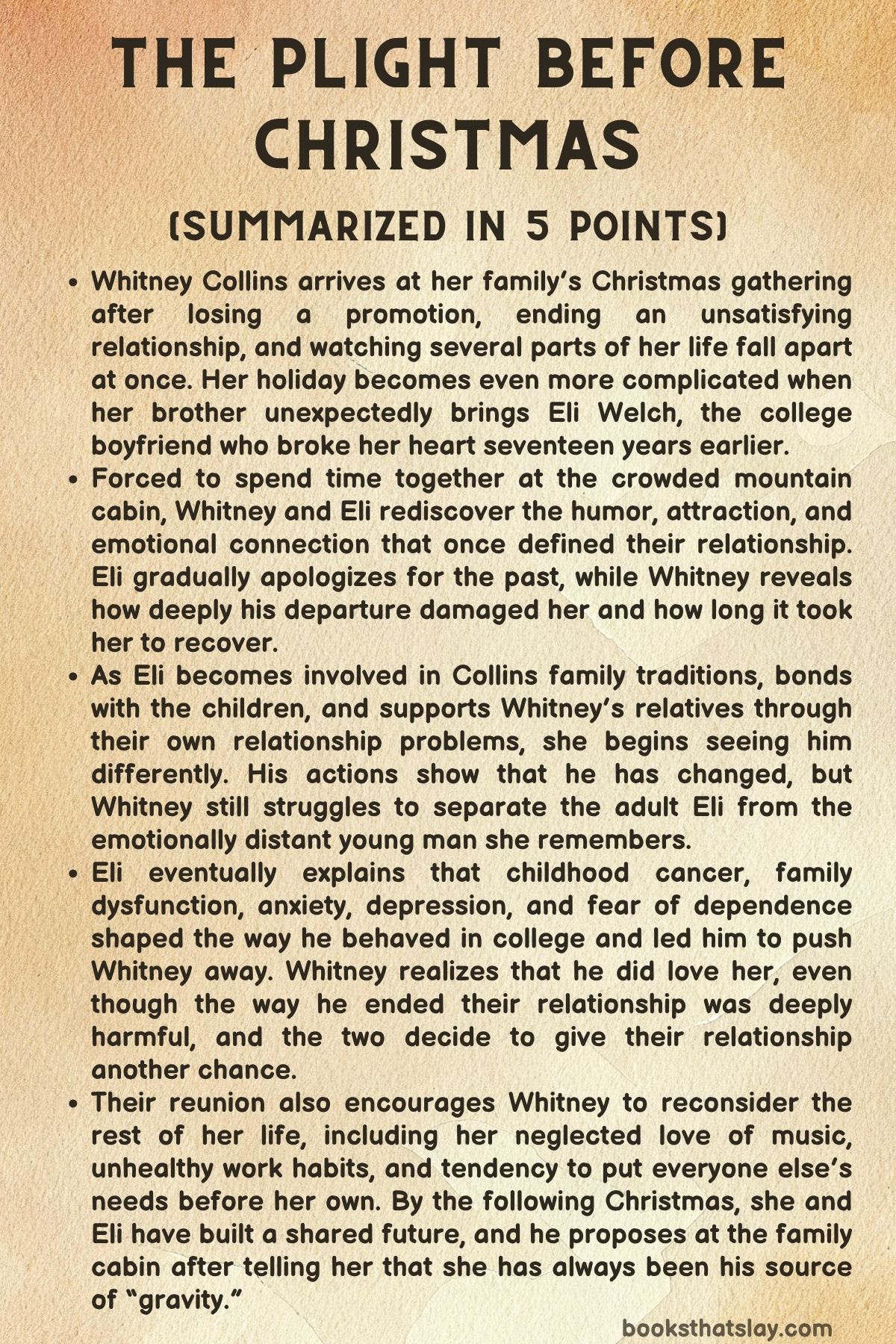
Whitney Collins reaches the Christmas season feeling as though nearly every part of her life has gone wrong at once. She has broken her toe, ended an unsatisfying casual relationship, watched her aging car deteriorate, and lost a promotion she was convinced she deserved.
The professional disappointment hurts most because Whitney has invested enormous energy in her advertising career. She has worked long hours, landed valuable accounts, and postponed other parts of her life while pursuing advancement, only to see Stuart receive the Senior VP position instead.
Already exhausted and discouraged, Whitney leaves for the Collins family Christmas at her late grandparents’ cabin in Triple Falls, North Carolina. Her father, Allen, has organized the gathering with obsessive enthusiasm, while her mother, Ruby, tries to preserve the warmth and traditions associated with Whitney’s grandparents, Joe and Penelope.
The cabin immediately reminds Whitney of childhood Christmases and of Joe’s belief in “gravity,” his way of describing the need to place personal problems within the larger mystery and importance of life. Although Whitney arrives carrying considerable frustration, the noise and affection of her family begin helping her recover from the loneliness of her work-centered routine.
Her older sister Serena is struggling with her daughter Gracie’s approaching adolescence, while Serena’s marriage to Thatch has become strained by routine and parenting responsibilities. Whitney’s brother Brenden arrives with his wife Erin and their children, creating the crowded, chaotic atmosphere that defines the Collins family holidays.
Brenden also brings a colleague who supposedly has nowhere else to spend Christmas. Whitney expects a stranger and is stunned when the guest turns out to be Eli Welch, her college boyfriend and first great love.
Whitney has not seen Eli for seventeen years. Their relationship ended so painfully that she spent months emotionally devastated, yet she has convinced herself that enough time has passed for the experience to be irrelevant.
Eli’s arrival proves otherwise almost immediately. Whitney remains intensely aware of him, and the attraction between them has survived despite nearly two decades apart.
Brenden insists that inviting Eli was innocent because he did not understand the seriousness of their history. Eli has recently become both a colleague and friend, and Brenden believed he was simply offering companionship to someone who otherwise would have spent Christmas alone.
From Eli’s perspective, however, the reunion carries enormous emotional weight. He knows he hurt Whitney, recognizes that her hostility is justified, and gradually admits that the possibility of seeing her influenced his decision to accept Brenden’s invitation.
The Collins family becomes fascinated by the history between them. Serena is openly suspicious of Eli, while Ruby and Allen attempt to learn what happened without fully understanding why their daughter suffered so badly after the breakup.
Whitney tries to minimize the relationship, but Eli remembers too much for that strategy to work. He knows old family stories, Whitney’s habits, her ambitions, and the details of a younger woman who once imagined an entire future with him.
Forced into frequent proximity, Whitney and Eli begin rediscovering the rhythm they once shared. Their conversations alternate between sarcasm, teasing, anger, tenderness, and sexual tension.
Eli wants to apologize properly, but Whitney initially refuses to reopen the past. She believes forgiveness may be useful, yet she has no intention of allowing an apology to become an invitation back into her life.
Watching Eli interact with the younger Collins children complicates her position. Peyton becomes particularly attached to him, and Whitney sees a gentle, nurturing side of Eli that resembles the private man she once loved rather than the emotionally inaccessible person she remembers from the end of their relationship.
Eli eventually apologizes directly during a shopping trip in Triple Falls. He tells Whitney that he understands she remembers their relationship and that she had every reason to leave him.
Whitney is shaken because those are the words she wanted from him for years. She decides to accept his apology and proposes that they release the resentment, enjoy Christmas, and regard their old relationship as something belonging to their youth.
Eli accepts her answer but is clearly disappointed. Whitney realizes that absolution is not all he wants.
As Christmas continues, small moments repeatedly undermine Whitney’s attempt to maintain emotional distance. Eli remembers her old birthday bucket list, including adventures she never completed, and reveals that he accomplished several of them while thinking about her.
Physical memories return just as strongly. An absent-minded touch while they talk at the kitchen sink reminds both of them how instinctive their attraction remains.
The family itself becomes important to Eli. He participates in traditions he never experienced growing up, bonds with the children, helps with activities, and becomes part of the teasing and disorder that characterize the Collins household.
A snowstorm traps everyone at the cabin and cancels their planned tubing trip. Eli improvises by turning roasting pans into sleds and converting the driveway into a family snow course.
The fun ends abruptly when Whitney crashes while sledding with Peyton. Eli’s immediate panic exposes how deeply he cares about her, and he insists on checking her injuries himself.
Later, Whitney finally explains the true cost of their breakup. She tells Eli that she cried for months, frightened her parents, struggled to get out of bed, and broke down when she later attempted intimacy with another man.
Her family had watched helplessly as she tried to recover. Whitney tells Eli that his apology is therefore owed not only to her but also to the people who had to rebuild her after he disappeared.
Eli is devastated. He had convinced himself that ending the relationship was ultimately better for Whitney, but her account destroys his belief that he spared her by leaving.
Ruby later speaks with him about marriage and forgiveness. She explains that lasting relationships are not based on never causing pain; they survive because people choose repeatedly to repair damage, return to one another, and remain committed when life becomes difficult.
Whitney, meanwhile, begins revisiting the good parts of her relationship with Eli. She remembers his attentiveness, the way he learned her preferences, his ability to care for her physically and emotionally through actions, and the intensity of their private connection.
Eli continues demonstrating the same qualities in the present. When Whitney is sore after the sledding accident, he massages her without exploiting the intimacy of the situation and quietly looks after her until she falls asleep.
He also defends the Collins family against Aunt Gretchen’s constant criticism. Rather than creating an argument, he cleverly exposes the insecurity behind Gretchen’s behavior while still allowing her enough dignity to recover.
Whitney notices how naturally Eli understands people. She also watches him participate in decorating the family Christmas tree, an experience that means far more to him because he never had similar traditions growing up.
At the same time, Eli overhears Serena and Ruby worrying that Whitney has gradually surrendered her old hopes for love, family, travel, and creativity. He remembers a younger Whitney who wanted those things passionately and wonders whether repeated disappointment caused her to stop believing she deserved them.
Whitney receives another reminder of Eli’s feelings when an attractive tow-truck driver named Sean jokingly pretends to have a romantic history with her. Eli becomes visibly jealous, and Whitney secretly enjoys seeing an emotion he once hid so effectively.
After consuming too much of Ruby’s strong eggnog, Eli becomes drunk enough to lose his normal restraint. He admits how much he still wants Whitney and speaks openly about memories he normally keeps controlled.
Although his behavior is comic, the emotional truth beneath it is unmistakable. Whitney admits to the sleeping Eli that she remembers everything and that he was her first love.
The next morning Eli becomes embarrassed and withdrawn, convinced he has pushed too hard. Whitney interprets his retreat differently.
To her, his sudden emotional distance resembles the pattern that destroyed them in college. She begins believing that the old Eli has returned: a man capable of intense desire who disappears emotionally once intimacy becomes frightening.
Their misunderstanding erupts during a Christmas shopping trip. Whitney accuses him of repeating his old behavior, while Eli argues that he has been honest since arriving and that Whitney repeatedly draws him close before rejecting him.
The argument reveals that neither is indifferent. Both are frightened and are interpreting the other’s defenses as rejection.
Meanwhile, the romantic problems surrounding Whitney reveal something about her own personality. Serena admits that she feels invisible in her marriage because parenting and routine have replaced intimacy with Thatch.
Whitney immediately tries to repair Serena’s problems, just as she attempts to protect everyone else in the family. Eli challenges this habit and asks when she decided that everybody’s happiness became her personal responsibility.
His question strikes at the central problem in Whitney’s life. She has become skilled at caring for other people while ignoring her own dissatisfaction.
Eli eventually stops avoiding the truth and kisses Whitney under the mistletoe. When she argues that desire cannot repair seventeen years of hurt, he agrees.
He tells her he wants something larger than sex or nostalgia. He wants the chance to know the woman she has become and openly admits that Whitney, not Brenden, was the real reason he came to Christmas.
Eli then promises not to kiss or pressure her again unless she chooses to move toward him. By surrendering control of the next step, he gives Whitney something the younger version of him could not provide: a clear statement of intention combined with respect for her decision.
Further conversations change Whitney’s understanding of their college romance. Eli reveals that Whitney was actually his first sexual partner.
His supposedly experienced “Campus Casanova” identity was largely based on assumptions and rumors. His slow approach to intimacy had not been a game but an expression of nervousness, attachment, and his desire not to damage something important.
Whitney begins recognizing how frequently they misunderstood one another. She had interpreted silence as indifference, restraint as manipulation, and emotional difficulty as evidence that he did not love her.
Eli had assumed that actions were enough and failed to understand how desperately Whitney needed direct reassurance. Their love had been real, but their inability to communicate turned uncertainty into increasingly destructive assumptions.
Other relationships within the family begin reflecting similar lessons. Whitney confronts Brenden over the sacrifices Erin has made for his career, forcing him to recognize that professional success does not erase his wife’s isolation.
Eli encourages Brenden to reconsider how his company operates so Erin can live closer to her family and community. He also helps Thatch understand Serena’s need for intentional romantic attention, while Thatch prepares a plan to renew their wedding vows.
Christmas Eve brings another turning point. During family karaoke, Whitney sings with the confidence and creativity Eli remembers from college.
Watching her perform reminds him of the musical ambitions she abandoned while building her advertising career. For Whitney, the evening becomes another reminder that significant pieces of her earlier identity have disappeared beneath professional obligation and emotional caution.
Finally left alone while the family attends Christmas Eve church, Whitney and Eli have the conversation that has been missing for seventeen years. Eli explains that he had cancer as a child and spent long periods isolated in hospitals.
After the death of a close friend, his parents became excessively protective, and their troubled family dynamics contributed to Eli’s anxiety and depression. During college, those problems intensified until he felt psychologically overwhelmed.
Whitney had become the brightest and most stabilizing part of his life, but Eli began fearing that he was depending on her instead of confronting his mental health. When a pregnancy scare made him imagine binding her permanently to his instability, he panicked.
Believing Whitney would remain and try to save him if given a choice, Eli deliberately became cruel enough to force her away. He thought losing her was necessary to make him seek help and prevent her from being trapped by his problems.
Whitney finally understands that his rejection was not evidence that he never loved her. Eli does not excuse what he did, and Whitney does not pretend the pain disappears simply because she understands its source.
Instead, they recognize that they are no longer the frightened young people who failed each other. Their kiss becomes a decision to explore what can exist between the adults they are now.
Their physical reunion follows naturally, but the greater change is emotional. Eli repeatedly communicates what Whitney means to him, while Whitney allows herself to trust what he says rather than relying only on memory.
Christmas morning confirms Eli’s understanding of Whitney in another way. He secretly restores the tradition of placing oranges and Brach’s candy in the stockings, remembering that Whitney once told him her grandparents always did so.
The gesture moves Whitney because Eli has remembered a small detail for seventeen years and used it not simply to impress her but to honor the people and traditions that created her sense of home. She openly kisses him in front of her family, making their renewed relationship unmistakable.
Ruby later welcomes Eli into the family. When he tells her about the loneliness of his childhood and how the moon became a symbol of constancy during his hospital years, Ruby connects the idea to the Collins concept of “gravity.”
For Eli, her acceptance gives him a sense of belonging that reaches beyond romance. Whitney is not simply the woman he wants back; her family represents the home and connection he has spent much of his life missing.
After Christmas, Whitney returns to work with a changed understanding of what she is willing to sacrifice. She refuses to continue doing Senior VP-level work without recognition and establishes boundaries with her boss.
She buys the new vehicle she had postponed purchasing, allows herself pleasures she previously treated as unnecessary, and begins making space for a life beyond professional achievement. Most importantly, she reconnects with music, an abandoned part of herself that Eli’s return helped her remember.
Changes also spread through the Collins family. Brenden restructures his business so Erin can return closer to Nashville, while Eli eventually moves into Whitney’s Nashville condominium.
Whitney and Eli initially manage distance and practical complications, but their renewed relationship becomes increasingly permanent. They create a new birthday bucket list, building new experiences instead of allowing their shared history to remain defined by regret.
At the following Christmas, they return to the mountain cabin where their second chance began. Eli tells Whitney that she has been his source of “gravity” since the day they met and asks her to marry him.
Whitney accepts. Their private moment is almost immediately interrupted by the loud Collins family, perfectly fitting the life they have chosen.
The ending of The Plight Before Christmas therefore brings Whitney back not to the person she was seventeen years earlier but to the parts of herself she had gradually abandoned. Through forgiveness, communication, family, and renewed ambition, she and Eli transform an unfinished first love into a relationship built on greater honesty and choice.
Characters
Whitney Collins
Whitney is the emotional center of The Plight Before Christmas, and much of her development comes from the contrast between the capable woman she appears to be and the dissatisfaction she has learned to ignore. Professionally successful, independent, funny, and highly responsible, she enters the novel convinced that she has constructed a reasonable adult life even if it lacks much of the excitement she once imagined.
Her failed promotion exposes the weakness in that arrangement. Whitney has devoted enormous energy to work partly because achievement gives her a measurable form of security, yet the promotion demonstrates that loyalty and sacrifice do not necessarily produce the rewards she expects.
Whitney is also a natural caretaker. She helps Serena with Gracie, entertains the children, manages family problems, supports friends, and repeatedly tries to repair the relationships around her.
This generosity becomes unhealthy when it allows Whitney to avoid examining herself. Eli recognizes that she spends so much time making life easier for others that she rarely asks whether her own needs are being met.
Her cynicism about marriage and romantic commitment is largely defensive. Whitney once loved intensely and believed strongly in a shared future, but Eli’s departure taught her that emotional investment could lead to catastrophic disappointment.
Instead of completely abandoning romantic hopes, she gradually lowers her expectations and tells herself she no longer wants what once mattered to her. The return of Eli exposes how incomplete that transformation actually was.
Whitney’s greatest challenge is learning to distinguish the past from the present. She understandably judges Eli through the emotional consequences of their breakup, yet doing so sometimes prevents her from recognizing evidence that he has changed.
Her eventual decision to consider the man standing before her rather than continually punishing him for the frightened young man he once was marks a major shift. Forgiveness does not require her to deny the damage he caused; it allows her to stop organizing her future around it.
Her growth also extends beyond romance. By the end of the book, Whitney begins setting professional boundaries, reconnecting with music, spending money on herself without guilt, and recovering ambitions unrelated to corporate advancement.
Her reconciliation with Eli therefore becomes part of a broader recovery of identity. Whitney learns that independence does not require emotional isolation and that caring for others should not mean disappearing from her own life.
Eli Welch
Eli is presented initially through Whitney’s memories as the brilliant, attractive, emotionally mysterious man who caused the worst heartbreak of her life. The Plight Before Christmas gradually complicates that image by revealing how much of his younger behavior arose from psychological distress, poor communication, fear, and a deeply isolated childhood.
His history with childhood cancer is essential to understanding him. Long hospital stays, the death of a young friend, and his parents’ extreme protectiveness shaped him into someone accustomed to isolation and wary of emotional dependence.
By college, Eli could appear socially confident while still carrying serious anxiety and depression. Whitney’s energy drew him into experiences he would otherwise have avoided, but his growing dependence on her frightened him because he did not possess the emotional tools to distinguish loving someone from using that person as his only source of stability.
Eli’s central failure was believing that actions could replace communication. He remembered Whitney’s preferences, cared for her carefully, learned her physical and emotional habits, and loved her with extraordinary attention, but he rarely gave her the verbal reassurance she needed.
When his mental health deteriorated, he repeated the same mistake on a more destructive scale. Rather than explaining what he was experiencing and allowing Whitney to make her own decision, he decided for both of them that she would be better without him.
His deliberate cruelty during the breakup was therefore both self-sacrificing in intention and deeply unfair in practice. Eli believed he was preventing Whitney from becoming trapped by his instability, yet he denied her agency and left her to interpret his rejection as proof that their love had meant little to him.
The older Eli understands this distinction. He repeatedly accepts responsibility without demanding that Whitney forgive him simply because his motives were complicated.
His growth is especially visible in the way he communicates. He tells Whitney directly that he wants her, explains why he came to Christmas, acknowledges his mistakes, and eventually gives her the full truth about his past.
Eli also promises not to pursue physical intimacy unless Whitney chooses it, showing that he now understands the importance of allowing her control over her own decisions. His willingness to remain emotionally present when conversations become difficult sharply contrasts with the withdrawal that defined his youth.
His interactions with Peyton, Conner, Ruby, Allen, Serena, Thatch, Brenden, and Erin show another side of him. He is observant, patient, funny, generous, and surprisingly comfortable caring for others once he feels safe.
By the end, Eli’s desire is not merely to reclaim an old romance. He wants partnership, family, belonging, and a future built through communication rather than assumption.
Serena
Serena acts as Whitney’s older sister, emotional challenger, and one of the clearest witnesses to the consequences of Whitney and Eli’s original breakup. Her suspicion of Eli is therefore not simple interference.
She remembers Whitney’s collapse after the relationship ended and knows how much work it took for her sister to function again. Serena’s resistance reflects protective loyalty, especially because Eli initially appears to have reentered Whitney’s life without understanding the scale of the damage he caused.
At the same time, Serena knows Whitney well enough to recognize the difference between genuine indifference and defensive denial. She repeatedly challenges Whitney’s claim that Eli no longer matters because she remembers how completely Whitney once loved him.
Serena is also dealing with her own crisis. Her marriage to Thatch has become dominated by parenting, routine, and shared responsibility, leaving her feeling unseen as a romantic partner.
This difficulty makes Serena more than a commentator on Whitney’s relationship. Her story shows what happens after people achieve the marriage and family Whitney once imagined.
Love does not automatically preserve intimacy. Serena needs Thatch to recognize that being a reliable husband and father is not identical to actively choosing her as a woman and romantic partner.
Her willingness to admit dissatisfaction is important because she could easily continue pretending everything is fine. Instead, she risks confrontation in order to improve the marriage.
Serena eventually becomes more accepting of Eli because she observes his present behavior rather than relying entirely on the past. His affection for Peyton, respect for Whitney, willingness to participate in the family, and growing honesty gradually weaken her resistance.
Within The Plight Before Christmas, Serena therefore functions both as Whitney’s protector and as a parallel example of romantic vulnerability. She reminds Whitney that love can cause pain but also demonstrates that avoiding difficult conversations creates its own form of damage.
Thatch
Thatch initially appears as the humorous and reasonably easygoing member of the Collins family, but his marriage to Serena reveals the danger of mistaking stability for emotional health. He loves his wife and family and does not consciously neglect them, yet he has become comfortable enough to stop noticing how much Serena needs deliberate romantic attention.
His shock when Serena admits her unhappiness shows that he has underestimated the seriousness of their disconnection. Thatch knows they have become less intimate, but he assumes this is an ordinary consequence of marriage and parenting rather than a warning that Serena feels increasingly invisible.
Importantly, Thatch does not respond by dismissing her concerns. Once he understands the problem, he begins considering how to address it.
His plan to renew their wedding vows shows that he wants to make Serena feel intentionally chosen again. Although a romantic gesture alone cannot solve every marital difficulty, the proposal represents his willingness to recognize that their relationship requires active maintenance.
Thatch also serves as an important ally to both Whitney and Eli. After Eli’s drunken confession, he encourages Whitney to consider the possibility that people genuinely change rather than assuming someone must remain forever defined by earlier failures.
He is similarly willing to listen when Eli explains what Serena needs from him. Their conversations create an unusual friendship grounded in imperfect men trying to understand how their choices affect the women they love.
Brenden Collins
Brenden is Whitney’s brother, a successful businessman whose teasing relationship with his sister initially provides much of the family comedy. He and Whitney argue easily, criticize each other, and compete in the familiar manner of siblings who are deeply attached despite their constant insults.
His decision to invite Eli sets the central reunion in motion. Brenden genuinely does not know the full seriousness of Whitney and Eli’s history, and his horror after understanding it shows how protective he is of Whitney beneath the joking surface.
Brenden’s own marriage becomes an important parallel to Whitney’s concerns about love and sacrifice. His professional ambitions have required Erin to move away from Nashville and the network of family, friends, church, and community that supported her.
Because Brenden views the move through the lens of financial success and opportunity, he fails to recognize the emotional cost Erin is paying. Whitney’s confrontation forces him to understand that a decision benefiting the household economically may still be deeply harmful to his partner.
His response matters. Rather than simply defending himself, Brenden eventually begins considering structural changes to his business.
With Eli’s help, he sees that modern work arrangements and trusted employees could allow the company to succeed without demanding that Erin remain isolated. His arc reinforces the novel’s insistence that love requires listening to what another person actually needs rather than assuming one already knows.
Erin Collins
Erin is quieter than several other members of the Collins family, but her circumstances provide an important example of sacrifice inside a marriage. She has moved away from the community that gave her a strong sense of belonging in order to support Brenden’s professional ambitions.
Her unhappiness is not caused by a lack of love for Brenden. Instead, it develops because the marriage has gradually treated her sacrifices as background conditions rather than choices with continuing emotional consequences.
Erin’s silence also shows the limits of endurance. By tolerating the situation without making Brenden fully confront her unhappiness, she protects the marriage from immediate conflict but allows resentment and loneliness to grow.
Whitney’s blunt intervention is uncomfortable precisely because it says openly what Erin has struggled to express. Once Brenden recognizes the truth, their relationship has an opportunity to change.
Erin therefore contributes to the broader argument that commitment cannot depend upon one partner continually adapting while the other assumes everything is acceptable. Partnership requires awareness of unequal sacrifice and a willingness to reorganize shared life when those sacrifices become damaging.
Ruby Collins
Ruby is the emotional foundation of The Plight Before Christmas and represents a mature understanding of family, marriage, forgiveness, and belonging. She maintains the traditions associated with Joe and Penelope while creating a home in which disorder and affection comfortably coexist.
Her kindness toward Eli is particularly significant. Ruby witnessed the consequences of Whitney’s heartbreak and would have every reason to treat him coldly, yet she allows the adult Eli to demonstrate who he has become.
This does not mean Ruby dismisses the past. Her conversation with Eli about marriage makes clear that she understands how deeply people can hurt one another.
Her own story about shooting Allen with a pellet gun during an argument is comic, but the lesson beneath it is serious. Long-term relationships are not sustained because partners never fail; they survive because commitment includes repair, forgiveness, and the decision to return after conflict.
Ruby also becomes a maternal presence for Eli. When he tells her about his childhood illness, loneliness, and relationship with his parents, she understands why being absorbed into the Collins family affects him so strongly.
Her eventual declaration that he is welcome in the family offers something Eli has lacked for much of his life. Ruby recognizes that his relationship with Whitney cannot be separated from his longing for connection, stability, and home.
Allen Collins
Allen is enthusiastic, controlling in harmless ways, deeply sentimental, and responsible for much of the novel’s holiday comedy. His obsessive scheduling, Google documents, Alexa announcements, elaborate karaoke arrangements, and determination to preserve Christmas traditions initially make him seem like an exaggerated holiday organizer.
Behind the humor is a man who values family rituals because he understands their emotional importance. The gathering at the cabin connects his children and grandchildren to Joe and Penelope, preserving a shared history that might otherwise fade.
Allen also has a close relationship with Whitney. When she tells him about her terrible month, he returns to the family idea of keeping problems in perspective.
His philosophy does not erase Whitney’s disappointment but reminds her that work failures and temporary setbacks are only portions of a much larger life. Allen’s marriage to Ruby similarly provides a model of imperfect endurance.
They irritate each other, argue, and have accumulated decades of shared stories, yet their attachment remains obvious. Their relationship contrasts with Whitney’s fear that love must either remain perfect or eventually become unbearable.
Gracie
Gracie is Serena and Thatch’s nine-year-old daughter, positioned at the uncomfortable edge between childhood and adolescence. Her battles with Serena over phone privileges, makeup, and independence create comic family conflict while also exposing Serena’s anxiety about parenting a daughter whose needs are changing quickly.
Whitney relates to Gracie more effectively because she does not approach every disagreement as a parental battle. By negotiating over makeup and treating Gracie’s desires with some respect, Whitney becomes a useful intermediary between mother and daughter.
Gracie also demonstrates notable emotional awareness. During the family’s questioning of Eli and Whitney, she notices her aunt’s discomfort and tells the adults to stop.
That moment suggests that beneath her dramatic behavior, Gracie is capable of observing emotions more accurately than some of the adults around her. She contributes to the family atmosphere not simply as a difficult child but as someone beginning to understand the complicated behavior of the people around her.
Peyton
Peyton is a toddler, yet he plays an unexpectedly important role in Whitney and Eli’s reunion. He attaches himself to Eli almost immediately, repeatedly seeking him out and calling him “Lie.”
Because toddlers respond without concern for adult history, Peyton judges Eli entirely through present behavior. His affection therefore becomes a simple but powerful challenge to the Collins family’s suspicion.
For Whitney, watching Eli with Peyton reveals qualities she had partly forgotten. Eli is patient, protective, playful, and comfortable providing care without needing recognition.
Peyton repeatedly creates situations in which Whitney and Eli must interact, making him a small but effective bridge between them. His innocent observations also occasionally carry surprising emotional force, particularly when his simple understanding of past pain helps Whitney reconsider how much authority she continues giving old wounds.
Conner
Conner is one of the quieter children in the Collins family and provides Eli with another opportunity to show his patience. Rather than expecting the child to become louder or more socially confident, he meets Conner where she is.
Their gingerbread-house activity and later Christmas-tree decorating reveal Eli’s ability to make shy people comfortable, a quality that reflects his own childhood experience. Because he remembers what it feels like to remain on the edge of social situations, he knows how to invite participation without making it feel like pressure.
Whitney notices these interactions. Each one challenges the image she has preserved of Eli as emotionally detached.
Conner therefore has a small but meaningful role in revealing the adult Eli through behavior rather than confession.
Aunt Gretchen
Aunt Gretchen represents a harsher form of family interference. Unlike the teasing of the Collins siblings, her criticism tends to diminish people rather than create affectionate humor.
She questions careers, choices, relationships, and lifestyles, often positioning herself as intellectually or socially superior. Her arrival makes other family members tense because they expect to become targets.
Eli’s response exposes an important part of his social intelligence. He does not defeat Gretchen by becoming crueler than she is.
Instead, he uses questions and calm humor to reveal that much of her criticism appears connected to loneliness and dissatisfaction. After establishing boundaries, he allows her to recover without humiliation.
The encounter shows that Eli has learned how to manage interpersonal conflict without either withdrawing or attacking. It also allows Whitney’s family to see why she once found him so compelling.
Joe and Penelope
Although Whitney’s grandparents are already dead when the novel begins, their influence remains present throughout The Plight Before Christmas. The cabin, ornaments, stocking traditions, photographs, family stories, and the idea of “gravity” all preserve their presence.
Joe’s concept of gravity becomes especially important. He encouraged Whitney to remember that personal disappointments exist within a much larger existence and that the forces connecting people are often more important than temporary problems.
Penelope is similarly preserved through family rituals, particularly the Christmas stocking tradition involving oranges and candy. When Eli secretly restores that tradition, he shows that he understands Whitney’s love not simply as romantic attachment but as something rooted in family history.
The grandparents therefore represent continuity. Their marriage and traditions offer the younger generation a reminder that lasting connection is created through accumulated acts of attention and commitment.
Sophie
Sophie is Whitney’s close friend and provides perspective from outside the Collins family. Her own developing relationship with Jonathan creates humorous complications, but she also serves as someone Whitney can speak to without the emotional intensity of a sibling conversation.
Sophie encourages Whitney to recognize her own value. When Eli’s motives become uncertain, she suggests that if he knowingly entered a family Christmas where Whitney would be present, he probably has strong reasons for doing so.
Her reassurance that Whitney is not easily replaceable matters because Whitney’s heartbreak caused her to internalize the belief that Eli had discarded her. Sophie helps challenge that interpretation before Eli is capable of fully explaining himself.
Evie
Evie appears primarily through Eli’s conversations and memories, yet her role is important because Whitney initially interprets her as potential romantic competition. Eli explains that Evie became his closest female friend and that their relationship never became the permanent romance Whitney fears.
She later married someone else, with Eli serving as best man. Evie represents the life Eli lived after Whitney while also demonstrating that he learned how to sustain meaningful emotional relationships.
She encourages him to tell Whitney the complete truth and not abandon the effort simply because reconciliation is difficult. Her influence suggests that Eli’s emotional growth did not happen in isolation.
He has spent years developing friendships, learning communication, and confronting the weaknesses that once damaged his relationship with Whitney.
Sean
Sean, the tow-truck driver, appears briefly but plays a useful role in forcing Eli’s jealousy into the open. After realizing that Eli is Whitney’s former boyfriend, Sean deliberately exaggerates his familiarity with Whitney for amusement.
Whitney quickly understands the joke and participates because she enjoys seeing Eli react. His visible jealousy gives her something she rarely received from younger Eli: unmistakable proof of emotional investment.
Sean therefore functions less as a serious romantic alternative than as a catalyst. By provoking Eli, he forces both Eli and Whitney to acknowledge that their feelings are far from neutral.
Rich and Stuart
Rich and Stuart represent Whitney’s professional frustrations. Rich is the boss who gives the Senior VP promotion to Stuart despite Whitney’s belief that her work and accomplishments made her the stronger candidate.
Whitney does not view Stuart as evil and even acknowledges that he is fundamentally decent. Her anger arises because his advancement exposes how little control she actually has over a career she allowed to consume enormous portions of her life.
Rich becomes more important symbolically at the end. Whitney refuses to continue performing higher-level responsibilities without recognition and establishes stronger limits on what work is allowed to demand from her.
Through Rich and Stuart, the novel connects Whitney’s romantic development to professional self-respect. She begins recognizing that loyalty without reciprocity is unhealthy in both work and personal relationships.
Jonathan
Jonathan appears mainly through Sophie’s developing romance and contributes to the comic complications surrounding Whitney’s holiday. His messages to Sophie accidentally appear on the Collins family television, creating one of the more embarrassing episodes of the gathering.
Although Jonathan is not central to Whitney and Eli’s relationship, his romance with Sophie reinforces the larger atmosphere of people taking emotional risks. Whitney enters Christmas surrounded by relationships at different stages: new attraction, strained marriage, established partnership, unresolved first love, and family commitment.
Jonathan therefore contributes to the broader romantic environment against which Whitney must decide what kind of life she wants.
Themes
Forgiveness, Responsibility, and the Meaning of a Second Chance
Forgiveness in The Plight Before Christmas is never presented as simply forgetting what happened. Whitney’s pain was real, prolonged, and serious enough to affect her family as well as her later relationships, so understanding Eli’s motives cannot retroactively erase the consequences of his choices.
The story instead separates explanation from excuse. Eli eventually explains that childhood illness, family dysfunction, anxiety, depression, and fear of dependency contributed to his decision to destroy the relationship, but he does not claim those circumstances made his behavior harmless.
That distinction is essential to the second-chance romance. Eli becomes worthy of Whitney’s renewed consideration not because the revelation about his past magically cancels his wrongdoing, but because he now accepts responsibility for it.
Whitney similarly learns that forgiveness does not require surrendering judgment or ignoring self-protection. Initially, she imagines forgiveness as a way of closing the door: Eli can apologize, she can accept, and both can continue separately.
Her understanding changes when she realizes that releasing resentment also gives her freedom to evaluate Eli according to who he is now. She can forgive the younger man without automatically trusting the older one, and she can gradually rebuild trust without pretending the original betrayal never happened.
Ruby’s reflections on marriage reinforce this idea. Lasting relationships contain disappointment, mistakes, anger, and repair because loving imperfect people guarantees moments of failure.
What matters is whether someone repeatedly chooses accountability and reconnection. The second chance between Whitney and Eli becomes meaningful precisely because neither person can return to the innocence of their college relationship.
They must create something different from it. Their renewed love is possible only after responsibility replaces misunderstanding and choice replaces assumption.
Communication, Assumptions, and Emotional Honesty
Whitney and Eli’s original relationship collapses largely because each person interprets behavior instead of receiving clear explanations. Eli believes his actions should prove his love, while Whitney needs verbal reassurance and interprets his silence as uncertainty.
Whitney assumes Eli’s confidence and sexual attentiveness indicate experience, creating the false image of the “Campus Casanova.” Eli assumes Whitney will sacrifice herself to save him if she understands his psychological struggles, so he denies her the opportunity to decide for herself.
Their misunderstandings demonstrate how dangerous even loving assumptions can become. Eli’s belief that he knows what is best for Whitney leads him to manipulate her into leaving, while Whitney’s belief that his departure proves he never loved her shapes seventeen years of resentment.
The same pattern reappears when Eli becomes withdrawn after his drunken confession. Whitney immediately interprets his behavior as evidence that he has reverted to his old emotional habits, while Eli assumes her mixed signals mean she has rejected him.
Neither assumption is entirely irrational, but both are incomplete because fear fills the gaps created by missing communication. Their argument in the store shows what happens when people allow interpretation to replace inquiry.
Other relationships repeat the theme. Serena assumes Thatch should recognize her loneliness, while Thatch assumes their reduced intimacy is manageable because the household continues functioning.
Brenden believes providing professional and financial stability should be enough for Erin, while Erin’s quiet endurance allows him to underestimate her unhappiness. In each case, communication becomes necessary not because love is absent but because love alone does not grant perfect understanding.
The adult Whitney and Eli finally change their pattern when they begin saying precisely what they mean. Eli explains his history, names his desire for another chance, apologizes without qualification, and allows Whitney to choose.
Whitney tells him the severity of the damage he caused and eventually admits what she still wants. Emotional honesty becomes the foundation that their younger relationship lacked.
Family, Belonging, and Gravity
The Collins family is loud, intrusive, argumentative, embarrassing, and deeply connected. The mountain cabin becomes a physical expression of that connection because it holds memories of grandparents, childhood traditions, family rituals, and relationships that existed long before the current Christmas.
Whitney initially returns to the cabin after a month in which work, dating, and material problems have made her feel increasingly defeated. Being surrounded by family does not solve those difficulties, but it places them within a larger emotional context.
Joe’s idea of “gravity” gives the theme its clearest language. Gravity represents the forces that keep people connected and remind them that individual frustrations are not the whole of existence.
For Whitney, family is one source of that gravity. She may complain about her father’s obsessive schedules, Serena’s questions, Brenden’s teasing, or the chaos created by the children, yet these same people provide continuity when other parts of her life become unstable.
For Eli, belonging has a different meaning. His childhood was shaped by hospitals, fear, overprotective parents, loss, and isolation, so the Collins family’s overwhelming closeness is initially unfamiliar.
Gradually, he begins participating rather than observing. Peyton searches for him, Conner accepts him, Ruby advises him, Allen includes him in traditions, Brenden works beside him, and even Serena’s suspicion eventually softens.
His restoration of the stocking tradition proves that he understands family membership as attention to shared memory. He remembers something Whitney told him seventeen years earlier and uses that memory to honor people he never met.
When Ruby welcomes him into the family, The Plight Before Christmas expands the meaning of Eli and Whitney’s reconciliation. Eli is not simply recovering a lost romance; he is gaining a home.
The proposal built around the language of gravity completes that idea. Whitney becomes one of the enduring forces that gives his life direction, while the Collins family becomes evidence that belonging can be chosen as well as inherited.
Recovering Identity After Disappointment
Whitney’s romantic life is only one area in which disappointment has altered her. Over time, she has also abandoned music, postponed travel and adventure, accepted an unsatisfying dating pattern, centered her identity on work, and convinced herself that several dreams she once valued are no longer important.
The novel treats this gradual narrowing of life as more significant than any single bad event. Whitney does not wake one morning and consciously decide to become cynical.
Instead, disappointments accumulate. Eli breaks her heart, adulthood creates obligations, work rewards constant availability, unsuccessful relationships lower her expectations, and years pass while older ambitions become easier to describe as unrealistic.
Her lost promotion becomes important because it exposes the poor bargain she has made. She sacrificed time, personal interests, and emotional energy for professional advancement, yet the company does not reward that loyalty in the way she expected.
Eli’s return forces her to remember the younger Whitney, but the novel does not argue that she should simply become twenty years old again. The goal is recovery rather than regression.
She must decide which parts of adulthood represent genuine growth and which are defenses created by disappointment. Her independence, professional competence, and practical judgment are valuable.
Her emotional isolation, neglected creativity, and belief that desire is dangerous are not. The birthday bucket list symbolizes this distinction because the adventures themselves matter less than Whitney’s former willingness to imagine a large life.
By the end, she begins writing music again, places boundaries around work, spends money on things she enjoys, makes room for love, and creates new adventures with Eli. Her renewed relationship is therefore only one part of a larger reclamation.
Whitney does not find happiness because a man returns and fixes her life. She becomes happier because the reunion forces her to admit how many choices she has been making from fear, habit, and disappointment, and she begins choosing again from genuine desire.