The Project by Annie Lord Summary, Characters and Themes
The Project by Annie Lord is a contemporary novel about dating, friendship, gender expectations, insecurity, and the uncomfortable work involved in changing the ways people relate to one another.
At its center is Daisy, a young woman whose long attachment to the emotionally unavailable Fin has left her questioning her desirability and judgment. When she and her best friend Maya decide to conduct an experiment designed to help their immature friend James become a more thoughtful partner, their project quickly becomes far more personal than expected. The story examines not only male behavior but also the fears, habits, and assumptions Daisy herself must confront.
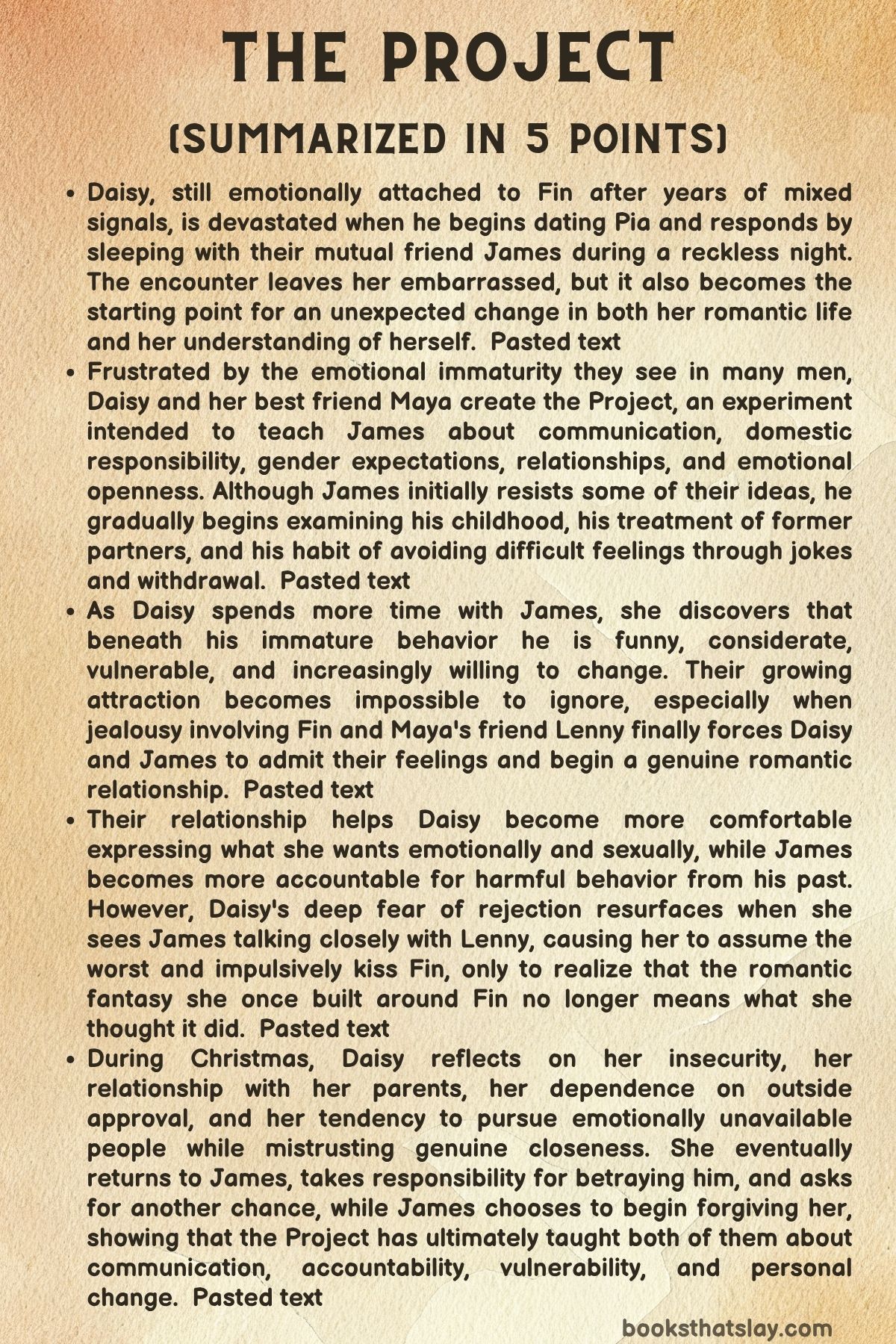
Summary
The Project begins with Daisy waking in James Stanley’s bed after a drunken night together. She is immediately embarrassed because James is not someone she has ever seriously imagined dating, and their encounter happened largely because she was hurt by Fin, the man she has wanted for years.
Fin has long occupied an uncertain position in Daisy’s life. They share emotional intimacy, private jokes, and a history that has repeatedly made Daisy believe a relationship might finally develop, yet Fin never actually commits to her.
When Daisy attends a party with her best friend Maya, she secretly hopes Fin will be there and that the uncertainty between them might finally be resolved. Instead, James tells her that Fin has a new girlfriend, Pia, and Daisy soon sees them together.
Pia’s kindness only makes the situation worse because Daisy cannot dismiss her as someone undeserving of Fin. She realizes that Fin had asked Daisy for space shortly before beginning a relationship with Pia, leaving Daisy feeling humiliated by how completely she misread his intentions.
Maya points out that Fin has repeatedly encouraged Daisy’s feelings while avoiding responsibility for them. Daisy understands this intellectually but remains attached to him, and after Maya leaves the party, Daisy drinks heavily, takes drugs, and allows herself to become increasingly reckless.
James begins flirting with her, and Daisy responds partly because she wants to feel desirable and partly because she hopes Fin might notice. Eventually Daisy and James sleep together, but the encounter provides none of the emotional relief Daisy wanted.
At work several days later, Daisy and Maya discuss the hookup and eventually broaden the conversation into their frustrations with heterosexual dating. They talk about how much work women are expected to perform on their appearance, emotional intelligence, homes, and relationships while many men appear to reach adulthood without developing equivalent skills.
What begins as a joke about creating a programme to improve men gradually becomes a real plan. Daisy and Maya imagine teaching a man about communication, domestic responsibility, emotions, respectful dating, gender expectations, and the unpaid labor women often perform in relationships.
James becomes the obvious candidate. He can be charming and kind, but he is also immature, emotionally evasive, careless with women, and deeply accustomed to turning discomfort into jokes.
Meanwhile, Daisy is struggling with frustrations that extend beyond romance. She feels trapped in an uninspiring public-relations job and uncertain about what career would actually satisfy her. Her mother Sandra frequently encourages her toward something more ambitious, but Daisy experiences those suggestions as criticism because she already fears that she has failed to construct an interesting adult life.
Daisy eventually proposes the experiment to James, who surprises her by agreeing. Maya names their experiment the Project and begins planning exercises intended to challenge the assumptions James has developed about masculinity and relationships.
Their first formal outing is an art exhibition focused on women’s bodies, sexuality, and cultural representations of women. Daisy tries to make James engage seriously with the ideas, but James continually redirects the conversation toward Daisy herself.
The outing reveals that Daisy has her own difficulty discussing sex and desire. She often adapts herself to what she thinks men want instead of clearly expressing her own preferences, and her interactions with James begin forcing her to notice that behavior.
They also admit more personal vulnerabilities. Daisy confesses that she often feels lonely within their university friendship group, and James is hurt because he never realized that she felt excluded.
A later discussion about masculinity goes badly. James challenges the speakers, makes provocative remarks, and treats ideas Daisy considers important as material for jokes. Furious, Daisy concludes that attempting to change him is pointless.
Maya persuades her not to quit. She argues that genuine change usually involves defensiveness and resistance because people rarely abandon familiar beliefs the moment somebody explains why they are harmful.
The Project continues, and James gradually begins spending more time in Maya’s social circle. Around Maya’s expressive and unconventional friends, he becomes less performative and more relaxed. Daisy starts seeing qualities in him that were hidden by the exaggeratedly careless personality he shows around their university friends.
Her attraction also becomes increasingly difficult to deny. James fits naturally into Maya’s world, makes Daisy laugh, and repeatedly gravitates toward her physically.
Daisy nevertheless insists that James is not someone she could genuinely want. She continues comparing him with Fin, whom she regards as more sophisticated and intellectually impressive.
Maya increasingly challenges Daisy’s idealization of Fin. She notices that Daisy is relaxed around James in a way she rarely is around Fin and begins suggesting that their chemistry is obvious.
The Project soon becomes more serious. Conversations about masculinity lead James to discuss his childhood, his father’s anger, and the emotional restraint within his family.
Daisy and Maya help him recognize that he often avoids confrontation because he never learned how to tolerate emotional discomfort. Rather than discussing problems, he jokes, withdraws, or apologizes simply to end an argument.
These patterns become clearer when they discuss his former relationships. James admits that he has sometimes disappeared from women’s lives or become cold when emotional intimacy frightened him.
One example involves May, a woman he had casually dated. When she became more present in his social world, James distanced himself without honestly explaining his discomfort.
Daisy forces him to consider May’s perspective and the humiliation caused by his behavior. Instead of excusing himself, James eventually accepts that a casual relationship did not give him permission to treat another person without consideration.
Together they draft an apology. The moment represents genuine progress because James moves from discussing respectful behavior theoretically to acknowledging specific harm he has caused.
At the same time, Daisy grows jealous when James shows interest in Maya’s friend Lenny. She tries to convince herself that his dating someone else would simply prove that the Project succeeded, but her emotional reaction reveals otherwise.
Maya finally tells Daisy that she cannot keep relying on hints and assumptions. James cannot know what Daisy wants unless she communicates openly, but Daisy remains frightened because her experience with Fin taught her that apparent romantic signals can be misleading.
That fear becomes especially important during a group weekend at Fin’s family cottage. Traveling with Fin briefly recreates the intimacy Daisy once believed would eventually turn romantic, yet James’s presence makes her increasingly conscious that her feelings have changed.
James becomes jealous when Daisy repeatedly gravitates toward Fin, while Fin behaves possessively despite having a girlfriend. Rather than communicating, both men become competitive and resentful.
Daisy eventually becomes overwhelmed and walks away from the group. Alone by the sea, she begins questioning why she has spent so much of her life seeking validation from people who make her feel uncertain.
James follows her and finally admits that he is jealous of Fin. He feels intellectually inferior to him and believes Daisy values qualities in Fin that James cannot provide.
Daisy admits that James’s attention toward Lenny has made her equally jealous. Their mutual honesty finally breaks the cycle of indirect signals, and they kiss.
They later sleep together, but the experience is completely different from their first encounter. Daisy communicates her desires more clearly, while James listens and responds without defensiveness.
Their relationship becomes increasingly comfortable after the weekend. James easily fits into Daisy’s flat and domestic life, and their sexual connection gives Daisy a new sense of safety and confidence.
They also discuss families, childhood, and the possibility of children. James says he would want his own children to feel safe telling him about mistakes, revealing how consciously he wants to behave differently from his father.
A protest concerning violence against women pushes James’s self-examination further. He begins remembering moments when he humiliated former partners, crossed sexual boundaries, or behaved in ways that he once dismissed as ordinary.
Rather than separating himself from obviously abusive men, James recognizes that harmful behavior can exist within ordinary relationships. Daisy also reflects on times when she hid discomfort because managing a man’s ego seemed easier than speaking honestly.
Their growing relationship appears promising until Fin’s Christmas party. Daisy arrives excited to see James but discovers him talking closely with Lenny.
Her old fears immediately return. Instead of asking James what is happening, Daisy assumes that he has rejected her and falls back into the defensive habits she has spent the entire Project criticizing.
Fin chooses that moment to admit that being around Daisy is difficult, renewing the emotional uncertainty that controlled her for years. Daisy kisses him, expecting some version of the romantic fulfillment she once wanted.
Instead, the kiss reveals how thoroughly her feelings have changed. Fin no longer feels like the answer to years of longing, and Daisy realizes that much of her attachment involved an imagined version of him rather than the man himself.
Yet she knows that kissing him may have destroyed her relationship with James. She leaves for Christmas devastated and eventually confesses everything to Maya.
Daisy initially wants to explain her actions through insecurity and fear, but she gradually recognizes that those feelings do not remove her responsibility. She sends James an apology and asks to speak, but he does not immediately respond.
At home, Daisy’s pain brings longstanding tensions with Sandra to the surface. Their Christmas argument eventually becomes an unusually honest discussion about dating, Daisy’s father, and the ways emotional distance in her childhood may have shaped her adult relationships.
Sandra finally tells Daisy directly that she considers her intelligent, attractive, warm, and wonderful. Hearing those words helps Daisy understand how much she has depended on external approval because she never felt sufficiently secure in her own worth.
During the days after Christmas, Daisy also recognizes her reliance on alcohol whenever anxiety becomes overwhelming. She decides that she wants to stop using drinking as an automatic way of escaping difficult emotions.
More importantly, she identifies a pattern in her relationships: she pursues unavailable people while distrusting those who offer genuine closeness. Fin felt safe precisely because he could remain an unresolved fantasy, whereas James became frightening once a real relationship was possible.
Daisy decides that regardless of whether James forgives her, she must finally communicate directly. Sandra unexpectedly supports her by driving her back toward London despite bad weather before New Year’s Eve.
When Daisy reaches James, she takes responsibility for kissing Fin and explains the jealousy and fear behind her actions without presenting those emotions as excuses. She also reminds him that the Project was based on the belief that people should be allowed to recognize harmful behavior, accept responsibility, and change.
James does not treat the betrayal as insignificant, but he chooses to begin forgiving her. Their reconciliation confirms that the experiment was never truly about fixing one defective man.
James has learned to communicate more honestly, accept vulnerability, reconsider his treatment of women, and acknowledge harm without immediately defending himself. Daisy has learned that her own fears can become destructive when she replaces communication with assumptions.
By the end of The Project, both understand that healthier relationships require more than attraction or compatible personalities. They require accountability, direct communication, emotional courage, and the willingness to recognize that personal growth does not belong to only one gender.
Characters
Daisy
Daisy is the emotional center of The Project, and much of her development comes from recognizing that the frustrations she identifies in other people are connected to insecurities she has never fully confronted in herself. She begins the book deeply attached to Fin and conditioned to interpret fragments of affection as evidence that a relationship may eventually materialize.
Her feelings for Fin have become part of the way she understands her own desirability. Because he repeatedly approaches her emotionally and then withdraws, Daisy remains trapped in a cycle where uncertainty makes her want his approval even more.
This insecurity extends into Daisy’s relationship with her body. She constantly thinks about beauty routines, dieting, exercise, clothes, and comparison, revealing how thoroughly she has learned to evaluate herself from an imagined external perspective.
Her early sexual encounter with James reflects this lack of stability. She does not sleep with him because she has consciously recognized a desire for him; she does it while hurt, intoxicated, and desperate to feel desirable after seeing Fin with Pia.
Daisy is also professionally uncertain. Her public-relations job provides stability but little purpose, while the ambitions of people around her make her wonder whether she has settled for a life she never actively chose.
Her frustration with her mother intensifies this insecurity because Sandra’s encouragement often sounds to Daisy like disappointment. She believes other people possess clear ambitions while she has somehow failed to identify what kind of person she wants to become.
The Project initially gives Daisy something external to fix. By making James the subject of an experiment, she can focus on his emotional limitations without immediately confronting her own communication problems.
That arrangement gradually collapses as James begins turning the lessons back toward her. Conversations about sex expose Daisy’s tendency to hide her own preferences, while discussions about emotional honesty reveal that she often expects other people to interpret signals she refuses to state directly.
Her developing attraction to James demonstrates the conflict between what Daisy thinks she should want and what actually makes her feel secure. Fin represents sophistication, intellectual status, and years of romantic fantasy, whereas James gives her laughter, physical comfort, attention, and increasing emotional openness.
Daisy struggles to value the latter because genuine intimacy frightens her. When she sees James with Lenny, she does not ask what the interaction means because asking would expose her directly to rejection.
Kissing Fin becomes Daisy’s greatest mistake because it shows how self-protection can become self-sabotage. She acts before James can supposedly reject her, preferring to cause the ending herself rather than wait helplessly for someone else to do it.
What makes Daisy’s development convincing is that the story does not excuse this decision simply because it comes from insecurity. She ultimately accepts that fear explains her behavior without erasing its consequences.
Her conversations with Sandra allow Daisy to understand the deeper origins of her need for approval. Emotional distance from her father and a complicated relationship with her mother have contributed to her habit of pursuing unavailable people while mistrusting secure affection.
By the conclusion, Daisy has not become completely confident or emotionally fearless. Instead, she becomes more willing to speak directly, tolerate uncertainty, examine her own mistakes, and understand that intimacy requires her participation rather than passive waiting.
James Stanley
James begins The Project as the apparent subject of Daisy and Maya’s experiment, but his development eventually proves much more complicated than a simple transformation from bad boyfriend to good boyfriend. He is sociable, funny, physically confident, and capable of kindness, yet he relies heavily on humor to avoid vulnerability.
His early behavior toward women demonstrates how emotional immaturity can cause harm without requiring deliberate cruelty. James avoids difficult conversations, assumes sexual familiarity where it has not been clearly established, and withdraws when relationships begin demanding emotional responsibility.
The Project initially irritates him because its lessons challenge assumptions he has rarely examined. During the public discussion about masculinity, he responds with provocation and jokes because intellectual disagreement is easier for him than admitting that the conversation may apply personally.
Over time, however, James becomes more willing to examine the emotional structure underneath his behavior. Conversations about his father reveal a childhood in which affection was limited and anger carried significant power.
He has learned that emotional discomfort should be escaped rather than discussed. Consequently, he apologizes to stop arguments, jokes to hide embarrassment, and becomes distant when romantic relationships demand more vulnerability than he knows how to provide.
His treatment of May demonstrates this pattern clearly. Instead of telling her that increasing closeness frightened him, he became cold and excluded her, leaving her to interpret the rejection alone.
Drafting an apology becomes a turning point because James acknowledges that his discomfort did not justify humiliating another person. He begins understanding that avoiding a difficult conversation can itself become a form of selfishness.
His growth also appears in ordinary domestic behavior. Cooking breakfast, clearing dishes, listening during conversations, and thinking about unequal expectations are small actions, but they indicate a change from treating consideration as women’s responsibility toward recognizing shared responsibility.
James’s romantic feelings for Daisy create a more difficult test. When he becomes jealous of Fin, he initially abandons the communication principles he has supposedly learned and falls back into hostility, competition, and sarcasm.
His eventual decision to follow Daisy and admit jealousy shows meaningful progress precisely because it occurs after failure. He is not transformed into an idealized man; he learns to recognize old patterns quickly enough to choose a different response.
The protest against violence toward women produces another important stage in his development. James begins examining incidents from his past that he previously categorized as jokes, awkward sex, or ordinary relationship conflict.
He recognizes that being an ordinary man who does not consider himself dangerous does not automatically mean all his behavior has been harmless. This capacity to remember his own actions without immediately defending himself becomes one of his most significant changes.
His relationship with Daisy also demonstrates improved sexual communication. When she tells him what she likes, he listens rather than interpreting guidance as criticism, allowing physical intimacy to become collaborative rather than performative.
By the end, James’s decision to begin forgiving Daisy also reflects what the Project taught him about accountability. He does not pretend that her betrayal caused no pain, but he recognizes that accepting responsibility for a mistake can create the possibility of repair.
Maya
Maya serves as Daisy’s closest friend, intellectual challenger, and one of the driving forces behind The Project. Her confidence and political awareness initially make her seem more emotionally settled than Daisy, yet the story gradually reveals that Maya also hides vulnerabilities beneath a strong social identity.
She helps transform Daisy’s frustration with dating into the experiment with James. Where Daisy often doubts whether people can change, Maya remains interested in the difficult process by which beliefs are challenged and new habits are formed.
Her response after James behaves badly at the masculinity discussion captures this aspect of her character. Daisy wants to abandon the Project because James’s defensiveness appears to prove that he is unwilling to change, but Maya argues that resistance may be part of change rather than evidence that change is impossible.
Maya is also highly creative and ambitious. She initially imagines turning their experiment into a documentary, podcast, book, or other public project, partly because she sees artistic possibilities where Daisy sees another exhausting responsibility.
This ambition creates occasional tension between them because Daisy fears becoming trapped in another obligation. Maya eventually agrees to scale down the experiment, demonstrating that despite her enthusiasm she values the friendship more than the potential career opportunity.
Maya’s relationship with Daisy provides one of the story’s strongest forms of intimacy. Their friendship includes humor, drugs, nights out, emotional arguments, physical affection, professional frustration, dating conversations, and the ordinary companionship that often receives less cultural attention than romantic love.
She also functions as the person most willing to challenge Daisy’s distorted self-image. When Daisy insists that James could not seriously want her, Maya does not merely offer reassurance; she points out the evidence that Daisy repeatedly dismisses because she has become accustomed to expecting rejection.
Maya’s own romantic disappointment complicates her role as adviser. When a man she genuinely likes becomes inconsistent while traveling, she attempts to rationalize his silence in many of the same ways Daisy has rationalized men’s behavior.
James’s blunt observation that genuine interest would probably involve clearer communication hurts Maya, but the moment shows that the Project is no longer moving in only one direction. James has begun using the ideas they taught him to help them examine their own situations.
Maya also reveals pain connected to her absent father. Although she often presents herself as independent and emotionally informed, she admits that his absence affected her far more deeply than she allowed others to see.
That disclosure makes her more than a confident feminist voice positioned beside Daisy. She becomes another example of how people can possess strong intellectual understanding while still carrying unresolved emotional wounds.
Fin
Fin is one of the most important forces in The Project because he represents the difference between emotional possibility and emotional responsibility. Daisy has spent years interpreting their closeness as evidence of a future relationship, while Fin repeatedly enjoys intimacy with her without making the commitment she hopes for.
His behavior is damaging largely because of ambiguity. He tells Daisy suggestive things, behaves with emotional intimacy, and creates moments that encourage her expectations, yet he preserves enough distance to avoid formally promising anything.
When he begins dating Pia shortly after asking Daisy for space, Daisy is forced to confront how differently they understood the same period. What she interpreted as a meaningful pause before possible romance was, for Fin, apparently compatible with moving toward somebody else.
Fin remains significant because Daisy has idealized him. She associates him with intelligence, sophistication, taste, and emotional depth, turning him into a standard against which James initially seems inadequate.
The seaside weekend gradually undermines this idealization. Once Daisy’s attention is no longer entirely focused on winning Fin, she notices his competitiveness, self-importance, and possessiveness more clearly.
His behavior becomes especially contradictory because he has a girlfriend yet still reacts to Daisy’s growing closeness with James. This suggests that Fin is comfortable with Daisy’s emotional availability even when he does not intend to offer her the relationship she wants.
The Christmas-party kiss finally destroys the fantasy. Daisy has imagined physical intimacy with Fin for so long that the moment should represent the fulfillment of years of longing, yet it feels emotionally empty.
Fin therefore functions less as a conventional romantic rival than as the embodiment of Daisy’s old emotional pattern. She wants him most intensely when he remains just beyond reach, allowing longing itself to become more powerful than the reality of the person she desires.
Sandra
Sandra, Daisy’s mother, initially appears as a source of irritation and pressure. She sells handmade candles, encourages Daisy toward a more exciting career, praises Maya’s creative ambitions, and frequently behaves as though Daisy should be doing something more interesting with her life.
Daisy interprets much of this behavior as disappointment. Because she already feels uncertain about work and identity, Sandra’s suggestions reinforce the fear that even her mother views her current life as inadequate.
Their relationship becomes especially important after Daisy returns home following the Christmas-party disaster. Romantic heartbreak makes Daisy emotionally vulnerable, and the familiar tensions between mother and daughter quickly surface.
The Christmas argument exposes how easily Sandra’s involvement can feel invasive. When she discusses Daisy’s romantic life with relatives, Daisy feels that her private failures have been transformed into family conversation.
Yet their conflict eventually produces one of Daisy’s most important emotional breakthroughs. They discuss her father, childhood, dating patterns, and Daisy’s fear that people will eventually lose interest in her.
Sandra’s direct reassurance is powerful because Daisy has spent years wanting approval without fully acknowledging the need. When Sandra tells her that she sees her as intelligent, attractive, warm, and wonderful, Daisy receives affirmation from a relationship that has often felt more critical than comforting.
Sandra also demonstrates growth of her own when she helps Daisy return to London before New Year’s Eve. Rather than simply giving advice, she actively supports Daisy’s decision to face the consequences of her mistake and speak honestly to James.
Pia
Pia plays a relatively small role in the plot, but her presence is psychologically important for Daisy. When Daisy first learns that Fin has a new girlfriend, she would find it easier if Pia were unpleasant, superficial, or obviously mismatched with him.
Instead, Pia is warm, attractive, funny, and likable. Daisy therefore cannot protect herself by turning Fin’s new relationship into evidence of his poor judgment.
Pia’s existence forces Daisy to confront a painful reality: another woman’s desirability does not explain why Fin did not choose her. This intensifies Daisy’s insecurity but also gradually pushes her toward understanding that romantic rejection cannot be reduced to a competition between women.
The fact that Pia herself has done nothing wrong is important. Daisy’s conflict is with Fin’s ambiguity and her own expectations, not with the woman he chooses to date.
Lenny
Lenny initially appears as one of Maya’s friends and later becomes crucial because she exposes Daisy’s jealousy toward James. Daisy is theoretically comfortable with the idea that the Project will make James a better partner for someone else, but that position becomes much harder to maintain when Lenny actually shows interest in him.
Because Lenny belongs to Maya’s creative and socially aware circle, she appears like precisely the kind of person the improved James might date. Daisy therefore sees her not only as romantic competition but also as confirmation that the Project may succeed in ways Daisy did not emotionally anticipate.
James’s messages with Lenny force Daisy to recognize her own feelings. More importantly, seeing them together at Fin’s Christmas party becomes the trigger for Daisy’s most destructive decision.
Lenny does not betray Daisy or deliberately interfere with her relationship. The crisis occurs because Daisy projects her fear onto an ambiguous scene rather than asking James directly what is happening.
Gabby
Gabby is part of the university friendship group that connects Daisy, Fin, and James. Her parties provide several important social settings in which Daisy’s relationships and insecurities become visible.
Although Gabby receives less individual development than the central characters, her presence helps establish the social world Daisy has spent years trying to remain part of. Daisy frequently feels peripheral within this group even while continuing to attend its gatherings and measure herself against its dynamics.
Gabby’s house is also where Daisy’s initial disappointment over Fin leads to her first sexual encounter with James. Later, social events involving the same group repeatedly expose the contrast between Daisy’s established identity and the new emotional possibilities emerging through the Project.
May
May never occupies the center of the narrative, but her history with James becomes essential to demonstrating whether his growth is genuine. She previously had a casual relationship with him, and when she became more integrated into his social life, he responded by withdrawing and treating her coldly.
James initially understands his behavior through his own discomfort. Daisy forces him to consider the experience from May’s perspective, where his avoidance would have appeared sudden, humiliating, and confusing.
The apology he writes to May marks one of the earliest occasions when he accepts responsibility for specific harm rather than discussing emotional maturity as an abstract concept. Her role therefore represents the people affected by behavior long before the person responsible becomes willing to examine it.
Themes
Emotional Communication and the Fear of Vulnerability
Emotional communication drives nearly every important relationship in The Project. Characters repeatedly suffer not because feelings are absent but because those feelings remain hidden behind jokes, assumptions, silence, avoidance, jealousy, or deliberately ambiguous behavior.
James embodies one version of this problem through his habit of using humor whenever a situation becomes emotionally exposing. His childhood taught him to associate vulnerability with discomfort, while anger and emotional restraint shaped the model of masculinity available to him.
Daisy experiences the same problem differently. She desperately wants clarity from other people but struggles to provide clarity herself, expecting men to recognize her desires while she protects herself from the danger of stating them directly.
Fin and Daisy’s long relationship demonstrates what can happen when ambiguity becomes emotionally sustainable. Fin offers enough intimacy to maintain Daisy’s hope, while Daisy avoids demanding a direct answer because uncertainty allows the fantasy to continue.
The relationship between Daisy and James only develops after both begin naming feelings they previously tried to disguise. Their seaside argument becomes productive when jealousy is finally stated openly instead of expressed through competition or sarcasm.
The later crisis at the Christmas party shows how quickly communication can collapse under fear. Daisy interprets James’s conversation with Lenny as rejection, acts on that interpretation, and creates the very loss she was trying to prevent.
The novel therefore treats communication as more than the exchange of information. Speaking honestly requires a willingness to risk embarrassment, conflict, rejection, and responsibility.
Growth occurs when characters learn that avoiding those risks does not prevent emotional pain. It merely transfers that pain into confusion, resentment, and behavior that harms people who were never given the chance to understand what was happening.
Gender Expectations and Learned Behavior
Gender expectations shape the experiment at the center of the story, but The Project gradually complicates the idea that men simply need to be taught a fixed collection of correct behaviors. Daisy and Maya begin with the assumption that James needs lessons in communication, domestic labor, emotional awareness, dating, sex, and respect, yet the process reveals that gendered expectations influence all three of them.
James has learned to equate masculinity with confidence, emotional control, sexual casualness, and resistance to vulnerability. His jokes and provocative arguments protect him from appearing uncertain, while withdrawing from relationships allows him to avoid situations where he might feel emotionally powerless.
Domestic competence also becomes significant because seemingly ordinary behaviors reflect assumptions about who notices and performs everyday labor. Making breakfast or clearing dishes is not presented as heroic transformation; its importance lies in James learning that consideration should not automatically be managed by women.
Daisy faces a different set of expectations. She has absorbed relentless pressure concerning beauty, weight, grooming, sexual desirability, and emotional performance.
She frequently evaluates her body from an imagined male perspective and has learned during sex to protect men’s confidence even when doing so means concealing her own preferences. Her experience demonstrates how gender expectations shape not only what people demand from others but also what they believe they are permitted to ask for themselves.
The story’s treatment of masculinity becomes especially serious when James considers past sexual behavior. He recognizes that harmful conduct does not belong exclusively to a separate category of obviously dangerous men.
This recognition shifts the theme away from simplistic divisions between good men and bad men. Social behavior is learned, repeated, normalized, and therefore capable of being questioned, but change requires personal accountability rather than merely understanding the correct vocabulary.
Self-Worth, Validation, and Romantic Idealization
Daisy’s romantic life is closely tied to her unstable sense of self-worth. For years, Fin’s attention functions as proof that she might eventually become the kind of woman she wants to believe she is, making his approval emotionally valuable far beyond the actual quality of their relationship.
Because Fin remains unavailable, Daisy can preserve an idealized version of both him and herself. If he finally chooses her, she imagines that the choice will validate years of waiting and confirm that she correctly interpreted their connection.
James disrupts this pattern because he offers something far more immediate. He enjoys Daisy’s company, desires her physically, listens to her, jokes with her, and increasingly allows her to see his insecurities.
Paradoxically, this availability frightens Daisy more than Fin’s distance. Real affection can be lost, whereas an unresolved fantasy can survive indefinitely because it never has to face ordinary reality.
Daisy’s insecurity also affects how she interprets other women. Pia initially feels threatening because she represents Fin’s decision not to choose Daisy, while Lenny becomes threatening because Daisy assumes James will prefer someone she considers more suitable.
Maya repeatedly challenges this competitive framework by reminding Daisy that attraction cannot be understood through a simple ranking of women’s qualities. Daisy’s fear comes from believing that she must prove herself sufficiently desirable rather than believing that she can be loved while remaining imperfect.
Sandra’s affirmation near the end helps Daisy see how deeply this need for outside validation has shaped her. The emotional distance in her family has encouraged her to pursue approval without recognizing how dependent she has become on receiving it.
Her growth does not consist of suddenly becoming completely self-confident. Instead, she begins separating rejection from personal worth and recognizing that another person’s decision cannot serve as a final judgment on her value.
Accountability, Change, and the Possibility of Repair
The story repeatedly asks what meaningful change looks like after someone has behaved badly. Rather than presenting growth as a sudden realization, it shows characters resisting criticism, repeating old habits, causing harm, apologizing, and then attempting to behave differently.
James provides the clearest example. He initially reacts defensively when confronted about masculinity and relationships, but later begins examining specific moments in which his avoidance or entitlement hurt women.
His apology to May matters because he does not simply announce that he is now more emotionally intelligent. He identifies what he did, considers its effect from her perspective, and accepts that his fear of intimacy did not justify the way he treated her.
The same standard eventually applies to Daisy. Her kiss with Fin could easily be explained through jealousy, insecurity, intoxication, and years of emotional confusion, but the novel refuses to treat explanation as absolution.
Daisy gradually recognizes that she caused harm while trying to prevent herself from being hurt. She apologizes to James without demanding immediate forgiveness and accepts that his response belongs to him.
This parallel is essential because it prevents the Project from becoming a story in which women possess all the insight and men require correction. James may begin as the official subject of the experiment, but Daisy eventually discovers that she also needs to confront destructive patterns.
Repair becomes possible when both characters reject the idea that a mistake must either be excused completely or define someone forever. James’s willingness to forgive Daisy does not make the betrayal meaningless, just as his own improvements do not erase his previous behavior.
Change instead depends on recognizing harm clearly, accepting consequences, and making different choices when similar fears return. The relationship at the end remains hopeful because both characters understand that becoming better is an ongoing practice rather than a completed achievement.