The Roman Holiday Rule Summary, Characters and Themes
The Roman Holiday Rule by Andra Loy is a contemporary romance about grief, travel, family, and the danger of allowing old fears to determine new possibilities.
Lexington “Lexi” Walker arrives in Rome believing careful preparation can protect her from disappointment, while architect Mark Russo believes temporary romances are almost guaranteed to end painfully. Their competitive argument about discovering the “heart of Italy” gradually becomes a personal challenge to both of their assumptions. Through Reena Brooke’s final letters, an architectural mystery, family conflicts, and an increasingly serious romance, the novel asks whether love can survive uncertainty when two people are willing to change their plans.
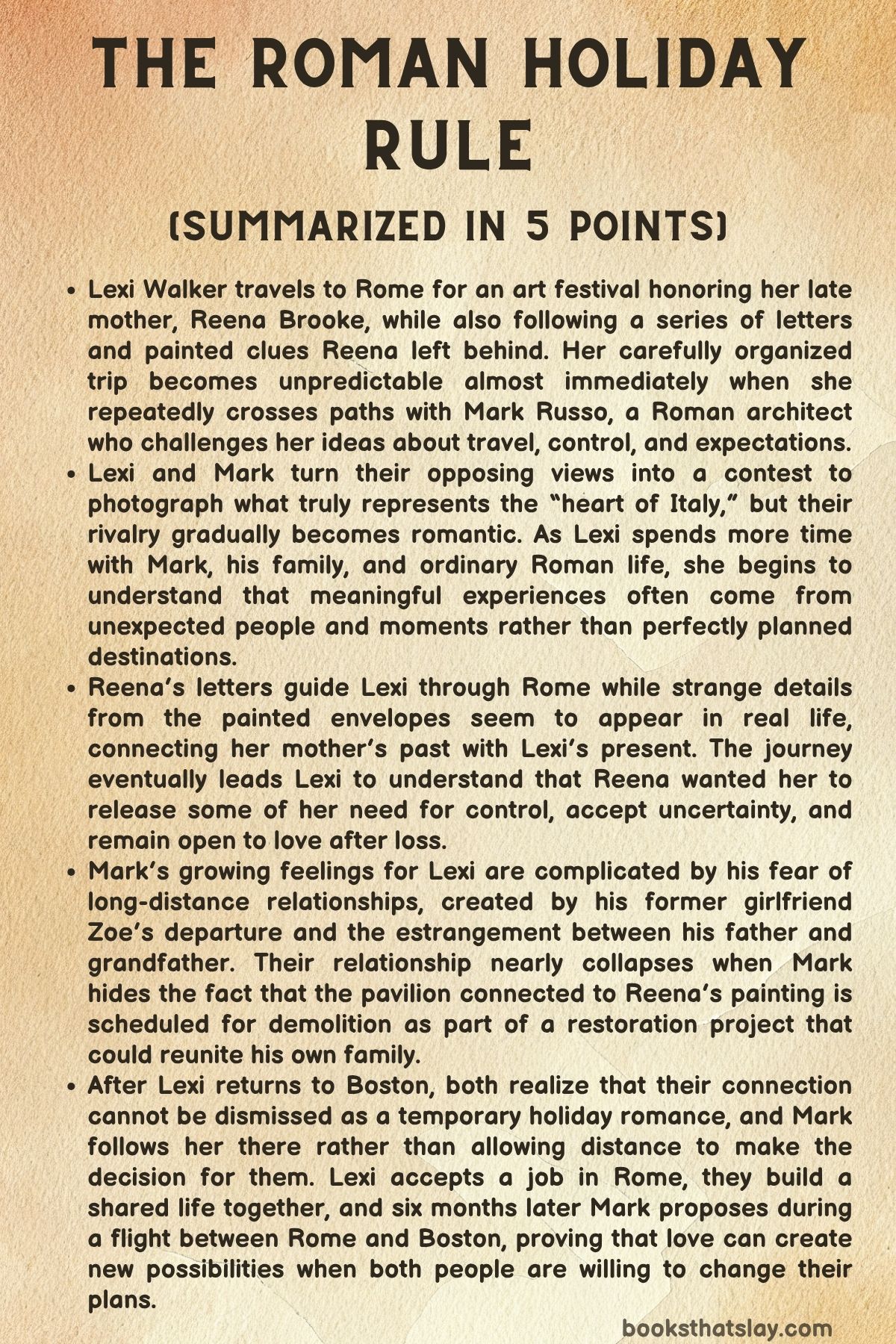
Summary
Lexington “Lexi” Walker has spent nearly a year preparing for a trip to Rome that carries both professional and deeply personal importance. Her event-planning company is helping organize a major Roman art festival centered partly on the donation of an unrevealed painting by her late mother, celebrated artist Reena Brooke, while Lexi has also brought four letters Reena instructed her to open at specific Italian locations.
Before leaving Boston, Lexi nearly loses her passport, only for an attractive stranger to retrieve it and return it to her. The stranger is Mark Russo, a Roman architect visiting his family in Boston, and their immediate chemistry is complicated by the fact that both have strong opinions about travel, expectations, and romance.
They discover they are seated beside each other on the flight. Mark criticizes tourists who arrive with carefully manufactured expectations, while Lexi defends the emotional value of preparation and travel, eventually challenging him over his belief that visitors rarely understand the real character of Italy.
Their argument becomes a formal bet. Each must photograph what represents the “heart of Italy,” and the anonymous Ninth King of Rome photography account will eventually host a public vote deciding whose interpretation is better.
Mark’s skepticism about temporary relationships comes from personal experience. His former girlfriend Zoe left Rome after he had committed himself to building a future there, while his father Riccardo’s departure from Italy created an older family wound that separated Riccardo from Mark’s grandfather, Santino.
Travel complications immediately test Lexi’s belief in careful planning. Their connecting flight is canceled, both their suitcases disappear, and Lexi repeatedly encounters Mark despite trying to treat him as a temporary inconvenience.
Once in Rome, they unexpectedly meet again at the festival’s opening reception. Mark initially believes Lexi is merely a tourist, only to discover that she helped organize the event and is professionally responsible for much of its success.
Lexi, meanwhile, overhears Mark talking with a woman named Katie and mistakenly assumes Katie is his fiancée. The misunderstanding makes her increasingly uncomfortable with their obvious attraction because she believes Mark has been flirting with her despite being committed to someone else.
The reception also introduces a stranger mystery. An image of a striped balloon on the event program exactly matches a watercolor Reena painted on one of Lexi’s sealed envelopes, even though neither Lexi nor her colleague Julie placed the image there.
At Trevi Fountain, Lexi opens Reena’s first letter and meets an elderly man named Santino without knowing he is Mark’s grandfather. Reena’s message encourages her daughter to take risks and let go, prompting Lexi to throw a precious old lira connected with her mother into the fountain.
More strange correspondences follow. A flower seller carries flowers matching Reena’s artwork, and other details from the painted envelopes later appear in Rome with such precision that Lexi begins wondering whether coincidence can explain what she is experiencing.
Mark sees how painful losing the lira has been for her and secretly arranges to retrieve it. His attempt becomes a humiliating family prank involving a staged confrontation at the fountain, but he successfully recovers the coin and eventually returns it to Lexi.
The gesture changes how Lexi sees him. Beneath his sarcasm and arguments about tourists, Mark consistently notices people’s needs, quietly helps strangers, cares intensely about his family, and understands the emotional significance of details that other people overlook.
Lexi’s exploration of Rome also begins changing her relationship with planning. After getting lost, she accidentally discovers the Aventine Keyhole and meets Mariella, a local woman who invites her to lunch without Lexi realizing she is Mark’s cousin.
The spontaneous decision introduces Lexi to Mark’s wider social circle. She meets Luca and gradually learns that experiencing Italy through conversations, food, family, humor, and ordinary moments may teach her more than a perfectly organized list of landmarks.
Meanwhile, Mark is competing professionally for the restoration of an old palazzo owned by Mr. and Mrs. Gallo. Winning has become intensely personal because his father, Riccardo, has promised to return to Italy and contribute his specialist restoration skills if the Russo family secures the contract.
Mark hopes the project could finally reconcile Riccardo with Santino. Santino’s worsening Ménière’s disease makes the possibility more urgent because Mark fears his father and grandfather may lose their opportunity to repair decades of estrangement.
Lexi continues following Reena’s letters through Rome. Each message challenges her assumptions about control, misunderstandings, love, and risk, while apparently impossible visual echoes of Reena’s envelope paintings keep appearing around her.
At the Colosseum, Lexi follows an elderly couple who resemble figures Reena painted and accidentally arrives at the restaurant where Mark is interviewing the Gallos. Her presence relaxes Mark, allowing his humor and genuine personality to emerge during an otherwise formal professional meeting.
Their attraction nearly results in a kiss afterward. Remembering Reena’s advice about misunderstandings, Lexi finally asks directly about Katie and discovers that Katie is Mark’s younger sister rather than his fiancée.
The revelation removes the imaginary moral barrier Lexi has placed between them. Mark also admits that he has not seriously dated for years and that communicating with Lexi has felt unusually natural from the beginning.
Their photography competition continues, but the original stakes matter less as they spend an unscheduled day wandering Rome together. Lexi deliberately abandons parts of her itinerary and discovers that simply talking, eating, walking, and experiencing the city beside Mark can be more meaningful than completing planned activities.
Mark likewise stops seeing Lexi as the stereotypical tourist he once used her to represent. He watches her interact naturally with children, strangers, artists, and local residents and realizes that her interest in Italy is connected to people rather than appearances.
Their relationship becomes still more intimate when Mark accompanies Lexi by Vespa outside central Rome. Following another clue from Reena’s letters, they arrive at a flower-filled orange villa identical to the image painted on Reena’s final envelope.
The villa belongs to Mark’s extended family. Surrounded by relatives cooking, arguing, laughing, feeding one another, and welcoming her without hesitation, Lexi finally understands the answer to their challenge.
The heart of Italy is not a famous building, artwork, meal, or geographical point. For Lexi, it is the love expressed through family and the ordinary acts through which people care for one another, an understanding that connects Mark’s family with her own relationship with Reena.
Lexi and Mark finally kiss after the gathering. Their attraction has now become emotional commitment, although neither wants to address what will happen when Lexi returns to Boston.
The following day, Mark receives his prize from the festival reception: a private viewing of Reena Brooke’s unrevealed painting. The image shows the mysterious pavilion Lexi has been trying to identify, and Mark immediately recognizes it as a structure on the Gallo palazzo property.
Unfortunately, the pavilion is structurally unsafe and is scheduled for demolition as part of the restoration. Mark hides this information because he does not want to upset Lexi before her major festival responsibilities, creating the secret that eventually damages their growing trust.
Mark’s former girlfriend Zoe also reappears during the festival. Seeing her reactivates his fear of abandonment, and when Zoe assumes that Lexi is his girlfriend, Mark hesitates before describing Lexi merely as his festival date.
Lexi recognizes that Zoe’s departure explains much of Mark’s cynicism about relationships separated by distance. His refusal to define what exists between them nevertheless wounds her, especially after the closeness they have developed.
The deeper conflict erupts when Lexi studies the Russo restoration plans and discovers that the pavilion will be demolished. She realizes Mark already knew and confronts him for hiding something so personally important.
Mark explains that he tried to save the pavilion but that structural engineers and the Gallos consider it unsafe. When Lexi asks him to abandon the project rather than participate in its destruction, Mark refuses because the restoration may finally bring his father home and repair his fractured family.
Their positions are emotionally understandable but incompatible. Lexi sees the pavilion as one of the last physical connections to her parents’ love story, while Mark sees the project as perhaps his last opportunity to reconnect Riccardo and Santino.
Soon afterward, Mark attends the unveiling of Reena’s painting and hears Lexi publicly reveal that Reena was her mother. He suddenly understands the true purpose of Lexi’s Roman journey and recognizes how unfairly he judged her from the beginning.
Lexi explains that Reena met Lexi’s father in Rome and that the pavilion depicted in the painting was the site of their first kiss. Mark realizes that Lexi was never simply collecting tourist experiences but attempting to understand her dead mother’s history while learning how to live with her grief.
The festival succeeds, and Gia unexpectedly offers Lexi a professional position in Rome. The job would allow her to maintain a partnership with Julie’s Boston company while creating an entirely new life in Italy.
Lexi nevertheless returns to Boston believing her relationship with Mark has ended. On the flight home, she finally sees Mark’s photograph for their competition and recognizes that his interpretation of Italy, like hers, is rooted in human connection rather than monuments.
She admits that she loves him. Back in Boston, however, she buries herself in work and prepares to reject Gia’s offer rather than reorganize her life around a relationship that appears to have failed.
In Rome, the Russo company wins the Gallo restoration bid. Santino also reveals that something Lexi said has made him reconsider his estrangement from Riccardo, meaning Lexi has already begun helping Mark’s family heal even though she has left Italy.
The separation ends when one of Lexi’s Boston clients, Kathryn, turns out to be Mark’s sister Katie. Santino accompanies her, and then Mark himself appears, having crossed the Atlantic rather than allowing geographical distance to decide their future.
Mark admits that fear made him abandon their relationship before Lexi could make her own choice. He finally rejects the idea that previous abandonment guarantees future abandonment and accepts that protecting himself from possible loss was also preventing him from experiencing genuine love.
Lexi reveals Gia’s offer and explains that Rome can become her home if she chooses it. The supposedly impossible long-distance problem therefore has a practical solution, but their reunion matters because both are finally willing to communicate rather than allow fear, assumptions, or rigid rules to make their decisions.
Six months later, Lexi is living successfully in Rome, working with Gia while maintaining her partnership with Julie and becoming part of Mark’s family. She and Mark remain playful, competitive, and deeply attached.
While flying to Boston for Katie and Noah’s wedding, Mark returns Lexi’s lira necklace after pretending it has gone missing. Attached beside Reena’s coin is a diamond ring, and Mark proposes on the airplane between the two cities that once represented the impossibility of their relationship.
Mark ultimately accepts that his Roman Holiday rule contained some practical truth: distance does create real difficulties. What changes is his belief that those difficulties automatically determine the ending, because people willing to choose one another can change jobs, cross oceans, repair family relationships, reconsider plans, and create the life that rigid rules once told them was impossible.
Characters
Lexington “Lexi” Walker
Lexi is the emotional center of The Roman Holiday Rule, beginning as a woman who associates planning with security. Her detailed itineraries, research, schedules, backup clothing, and professional organization are not merely personality quirks; they reflect her attempt to create predictability after experiencing losses she could not control.
Her mother’s death particularly shapes this behavior. The Italian journey was originally imagined as something Lexi and Reena would share, so completing it alone becomes both an act of remembrance and an attempt to preserve a relationship that death has interrupted.
Lexi initially believes that proper research can allow her to experience Italy exactly as she has imagined it. Mark’s criticism therefore feels personal because he is unknowingly questioning not only her approach to tourism but also the structure she has created around her grief.
Her development involves learning that preparation and control are useful but limited. Lost luggage, canceled flights, accidental discoveries, new friendships, Reena’s mysterious clues, and her relationship with Mark all force her to respond to experiences that cannot be scheduled.
Lexi’s compassion remains consistent throughout the story. Mark first notices her because she helps a stressed airport employee and comforts a child, and these small interactions later undermine his assumption that she views Italy only through romanticized tourist expectations.
Her relationship with Mark also teaches her to confront assumptions directly. The misunderstanding about Katie lasts because Lexi accepts incomplete information, but Reena’s letters eventually encourage her to ask the question she has avoided, immediately transforming the situation.
Grief remains important even as romance grows. Lexi worries that enjoying Italy with Mark means replacing the mother-daughter journey she was supposed to have, revealing how easily bereavement can make new happiness feel like disloyalty to the dead.
By the end, Lexi understands that loving Reena does not require preserving the exact future they once planned. Accepting Gia’s position in Rome represents her willingness to create something new rather than treating her mother’s memory as an obligation to remain emotionally unchanged.
Mark Russo
Mark functions as both romantic partner and ideological counterpoint to Lexi in The Roman Holiday Rule. He begins with an apparently cynical philosophy about tourism and long-distance romance, but those beliefs are rooted less in superiority than in fear created by abandonment.
His relationship with Zoe is central to his defensiveness. Mark committed himself to living in Rome and imagined a shared future, only for Zoe to leave, reinforcing his belief that people who treat Italy as temporary will eventually leave the people who consider it home.
That fear is older than Zoe. Riccardo’s departure from Italy and estrangement from Santino taught Mark that physical distance can become emotional separation, which explains why geographical compatibility matters so intensely to him.
Mark’s quieter personality contrasts with Lexi’s ease around strangers. Crowds and formal social situations make him uncomfortable, yet photography allows him to observe people closely, and his photographs demonstrate that he is deeply attentive to small human moments.
His behavior toward Lexi repeatedly contradicts his stated desire for emotional distance. He watches over her during travel problems, recovers her lira, photographs her, introduces her to his family, accompanies her on personal journeys, and continually creates reasons to extend their time together.
The recovered lira is particularly revealing because Mark understands its significance before fully knowing the story behind it. He recognizes Lexi’s grief through observation and willingly endures embarrassment simply to return something that gives her comfort.
His greatest weakness is allowing past experience to become a rule for future relationships. Zoe’s reappearance causes him to retreat precisely when his connection with Lexi requires honesty, showing how unresolved fear can reproduce the very loss someone is trying to avoid.
Mark’s eventual trip to Boston becomes the decisive rejection of that pattern. Instead of assuming Lexi will leave him, he crosses the ocean and allows her to participate in deciding their future, transforming love from something he fears losing into something he actively chooses.
Reena Brooke
Although Reena has died before the events of The Roman Holiday Rule, she remains one of the novel’s most influential characters. Her paintings, letters, memories, artistic reputation, and earlier experiences in Rome continually shape Lexi’s decisions.
Reena’s letters initially appear to be carefully structured instructions from a mother who knew she would not survive long enough to accompany her daughter to Italy. Yet their deeper purpose is not to dictate Lexi’s trip but to encourage her to abandon the need for total control.
Her relationship with Rome becomes a hidden family history that Lexi gradually uncovers. Reena met Lexi’s father there, and the mysterious pavilion becomes significant because it marks the beginning of their romance.
The repeated visual echoes between the painted envelopes and Lexi’s experiences create an almost magical quality around Reena’s continued presence. Whether understood as coincidence, careful design, fate, or something less explainable, they allow Lexi to experience maternal guidance after death.
Reena’s importance ultimately lies in directing Lexi toward life rather than permanent mourning. Her final gift does not ask her daughter to endlessly recreate the past; it teaches her to recognize new people, unexpected opportunities, and forms of love that Reena could never have planned for her.
Julie
Julie is Lexi’s closest professional and personal ally. She provides humor, emotional support, and practical stability, particularly when Lexi becomes overwhelmed by the coincidences surrounding Reena’s letters and by her growing feelings for Mark.
Her decision to fly spontaneously to Rome demonstrates a form of friendship that contrasts with Lexi’s preference for advance preparation. Julie acts because she senses her friend needs support, making her arrival another example of an unplanned event producing something valuable.
Julie also functions as the person who repeatedly recognizes Lexi’s feelings before Lexi is prepared to acknowledge them. Her exaggerated enthusiasm about Mark is comic, but it reflects an accurate understanding that Lexi’s attachment has moved beyond ordinary travel flirtation.
Professionally, Julie matters because Lexi’s eventual move to Rome does not require abandoning everything she built in Boston. Their continued collaboration shows that choosing a new life does not always mean destroying the old one.
Santino Russo
Santino is one of the strongest links between romance, family, and fate in The Roman Holiday Rule. He first appears to Lexi as an elderly stranger at Trevi Fountain, advising her about the proper way to make a wish before she knows he is Mark’s grandfather.
His importance grows as Lexi enters Mark’s family. Santino is affectionate, humorous, observant, and willing to participate in the family’s elaborate teasing, yet his long estrangement from Riccardo reveals that pride and hurt have also shaped his life.
His Ménière’s disease adds urgency to the conflict. Declining health reminds Mark that reconciliation cannot remain an abstract future possibility forever.
Lexi influences Santino by speaking from the perspective of someone who can no longer repair relationships with dead parents. Her belief that she would pursue surviving family rather than waste available time encourages him to reconsider his expectations of Riccardo.
Santino therefore mirrors the younger characters. Just as Mark must stop allowing abandonment to determine his choices, Santino must stop allowing old resentment and pride to decide whether reconciliation remains possible.
Riccardo Russo
Riccardo is physically absent for much of the novel, but the consequences of his choices strongly influence Mark. His departure from Italy created a fracture between father and son and provided Mark with one of his earliest examples of geographical separation becoming emotional division.
Professionally, Riccardo possesses specialist knowledge crucial to the Gallo palazzo restoration. His agreement to return if the Russo family wins the project transforms the bid from ordinary business competition into Mark’s opportunity to reunite his family.
Riccardo also complicates simple ideas about abandonment because Mark gradually recognizes that estrangement is maintained by more than one person. Santino eventually questions whether Riccardo has spent years waiting for his father to reach out first.
His planned return suggests that family relationships can survive long periods of damage if the people involved eventually become willing to reconsider the stories they have told themselves about one another.
Mariella Russo
Mariella becomes one of the unexpected bridges between Lexi’s carefully planned Roman experience and the more personal Italy she eventually discovers. Their meeting occurs only because Lexi becomes lost, making their friendship an early example of the value hidden within disrupted plans.
She welcomes Lexi into a local social environment without knowing the full significance of her relationship with Mark. Through Mariella, Lexi encounters ordinary meals, family conversations, and perspectives that cannot be obtained from research.
Mariella also provides insight into Mark’s family and professional life. Her presence allows Lexi to see that his attachment to Italy is connected not merely to architectural pride but to an entire network of relationships and responsibilities.
Her easy acceptance of Lexi anticipates the wider Russo family’s response. Long before Lexi consciously imagines belonging in Rome, Mariella helps make that belonging possible.
Luca Russo
Luca is Mark’s cousin and one of the people most capable of recognizing how dramatically Lexi affects him. Mark repeatedly attempts to describe Lexi as a rival or temporary acquaintance, but Luca notices that his normally reserved cousin becomes impulsive, defensive, and unusually expressive around her.
His restaurant provides an important setting where Lexi begins experiencing Italy through people instead of famous destinations. The meal also shows her ability to interact naturally with locals rather than treating them as accessories to a vacation.
Luca’s teasing contributes to the novel’s comic family atmosphere, but it also serves a narrative purpose. By observing Mark from outside, he exposes the gap between what Mark claims to believe and how he actually behaves.
Zoe Richards
Zoe represents the unresolved memory that Mark mistakenly treats as a universal rule. Her earlier departure from Rome damaged him because he had built his future around a relationship he believed was permanent.
Her return during the restoration competition forces Mark to confront what remains from that relationship. He discovers that he does not still love Zoe, but he has continued organizing his emotional life around the fear her departure produced.
Zoe’s presence becomes most damaging when Mark hesitates to identify Lexi as his girlfriend. The moment demonstrates that a past relationship can continue influencing someone even when romantic attachment to the former partner has completely disappeared.
Her role is therefore less about creating a conventional romantic triangle and more about exposing Mark’s internal obstacle. Lexi is not competing with Zoe for his affection; she is competing with the defensive beliefs his experience with Zoe created.
Gia
Gia plays a significant role in linking Lexi’s professional abilities with the possibility of a new future. Through the Rome art festival, she sees Lexi not simply as Reena Brooke’s daughter but as a highly capable organizer whose talents can operate internationally.
Her later job offer changes the practical meaning of Rome. Until that moment, the city has been a temporary destination tied to grief, Reena, and Mark, but Gia gives Lexi an independent professional reason to imagine remaining there.
This distinction matters because Lexi does not move to Rome solely for a relationship. She chooses a life that includes meaningful work, professional independence, continued collaboration with Julie, and Mark.
Gia therefore helps ensure that Lexi’s romantic resolution does not require sacrificing her own ambitions. Instead, love and career become compatible parts of a broader personal transformation.
Katie “Kathryn” Russo
Katie initially exists in Lexi’s imagination as a romantic obstacle because Lexi misunderstands Mark’s phone conversation and assumes Katie is his fiancée. The misunderstanding reveals how easily incomplete information can become a convincing private narrative.
Once the truth emerges, Katie becomes another member of Mark’s family who indirectly pushes him toward emotional honesty. Her own engagement to Noah also provides a contrast to Mark’s fear of commitment across uncertain circumstances.
Her appearance in Boston under the more formal name Kathryn creates the story’s final major surprise. Lexi unknowingly becomes involved in planning Katie’s wedding, allowing the supposedly separate worlds of Boston and Rome to intersect before Mark arrives.
Katie’s presence ultimately helps create the setting in which Mark rejects passive separation. The sister Lexi once mistakenly viewed as evidence that romance with him was impossible instead becomes part of the reunion that makes their future possible.
Themes
Control, Uncertainty, and the Freedom of Changing Plans
Lexi’s devotion to planning begins as an understandable response to experiences she could not control. In The Roman Holiday Rule, schedules, research, reservations, and backup strategies give her the impression that preparation can protect her from the kind of helplessness she experienced during Reena’s illness and death.
Rome systematically challenges that belief through canceled flights, lost luggage, accidental meetings, navigation failures, spontaneous invitations, unexplained coincidences, and emotions that refuse to fit into a timetable. Importantly, the novel does not argue that planning is useless, because Lexi’s competence repeatedly helps her succeed professionally and solve practical problems.
The deeper distinction is between preparation and control. Lexi can prepare for possibilities, but she cannot demand that life reproduce the future she imagined.
Many of her most meaningful experiences occur because something goes wrong or because she chooses to abandon a plan voluntarily. Getting lost leads her to the Aventine Keyhole and Mariella, skipping scheduled activities gives her an intimate day with Mark, and following apparently irrational clues brings her into Mark’s family.
By the conclusion, Lexi has not become careless or unorganized. She has learned to leave space for uncertainty, recognizing that a worthwhile future may require changing even deeply cherished plans rather than measuring happiness by whether life follows the original schedule.
Grief, Memory, and Continuing to Live
Lexi’s Italian journey demonstrates the complicated relationship between remembering someone who has died and allowing one’s own life to continue. Reena’s letters initially give Lexi a structured way to remain connected to her mother, but opening them also creates anxiety because every opened envelope means one fewer message remains.
Physical objects carry similar emotional weight. The lira necklace, Reena’s painting, the envelopes, and the pavilion all become containers for memory, which explains why losing or surrendering them feels like another version of losing Reena herself.
The pavilion conflict makes this tension especially visible. Lexi’s desire to protect it is understandable because it represents her parents’ love story, yet the structure’s physical instability illustrates the impossibility of preserving every material connection to the past forever.
Reena’s guidance gradually leads Lexi toward a different understanding of remembrance. Honoring her mother does not require recreating the journey they were supposed to share or refusing experiences Reena never anticipated.
Lexi’s guilt about enjoying Rome with Mark reveals how grief can make happiness feel disloyal. Her development allows her to recognize that new love does not replace old love, and building a future does not erase the person whose memory helped make that future possible.
By living fully in Rome, Lexi ultimately turns remembrance into continuation. Reena remains part of her life without becoming the boundary that prevents anything new from entering it.
Family, Reconciliation, and Everyday Love
The search for the “heart of Italy” gradually changes from a photography competition into a broader examination of how people express love. Famous landmarks initially appear like obvious candidates, yet Lexi eventually realizes that what moves her most is the domestic environment of Mark’s extended family.
Cooking, teasing, sharing food, remembering preferences, arguing, helping, welcoming strangers, and gathering around a table become more meaningful than monuments. These ordinary gestures reveal family affection as something repeatedly practiced rather than merely declared.
The Russo family’s warmth is complicated by the unresolved separation between Santino and Riccardo. Their estrangement demonstrates that love can survive alongside pride, anger, misunderstanding, and years of silence.
Mark believes winning the palazzo project is the mechanism that can reunite them, but Lexi provides the emotional insight that finally changes Santino’s thinking. Having lost both parents, she recognizes the tragedy of wasting time with family members who are still available for reconciliation.
The Roman Holiday Rule therefore presents family not as an automatically harmonious institution but as a relationship requiring active choices. People can care deeply for one another and still cause long-lasting damage when they refuse to communicate or become trapped in old grievances.
The theme also expands beyond biological family. Julie’s loyalty, Gia’s support, Lexi’s integration into the Russo household, and her continued partnership across two countries show that belonging can be created through friendship, work, partnership, and intentional commitment as well as blood.
Fear, Assumptions, and Choosing Love
Both Lexi and Mark repeatedly confuse self-protection with certainty. Lexi assumes Katie is Mark’s fiancée and alters her behavior around that belief, while Mark assumes Lexi’s temporary presence in Rome means any relationship with her must eventually reproduce the loss he experienced with Zoe.
Their mistakes come from different sources but operate similarly. Instead of asking what is possible now, they allow incomplete information or previous experience to dictate conclusions before reality has been tested.
Mark’s Roman Holiday rule becomes the clearest expression of this tendency. His belief contains practical truth because relationships across countries require difficult decisions, but he transforms that difficulty into inevitability, treating possible failure as justification for never attempting the relationship.
Lexi challenges the same pattern when she asks directly about Katie. One honest conversation eliminates an obstacle that existed almost entirely because she had trusted an assumption.
Their later conflict is more complicated because the pavilion, the restoration contract, family reconciliation, jobs, and geographical distance are genuine problems. Love cannot simply make those realities disappear.
The resolution therefore depends on choice rather than fantasy. Mark crosses the Atlantic instead of waiting for abandonment, Lexi considers a professional future in Rome instead of treating Boston as permanent by default, and both finally allow the other person to participate in decisions affecting their relationship.
The story ultimately presents courage in love not as certainty that nothing will go wrong, but as willingness to act without demanding that the future be guaranteed first.