The Salt King Summary, Characters and Themes
The Salt King by Natasha Pulley is a speculative fantasy novel that combines theology, science, folklore, romance, and apocalypse through the idea that belief can influence physical reality.
At its center is Avelyn Brocken, a Jesuit priest who returns to the isolated salt-mining community of Hreodwater after twelve years away and discovers that the supernatural power he once rejected is becoming active again. As impossible events spread across the world, distinctions between religion and mythology, hallucination and matter, angels and monsters, begin to collapse. The book ultimately asks whether goodness can be determined by religious labels, or whether morality depends on choices and actions instead.
Summary
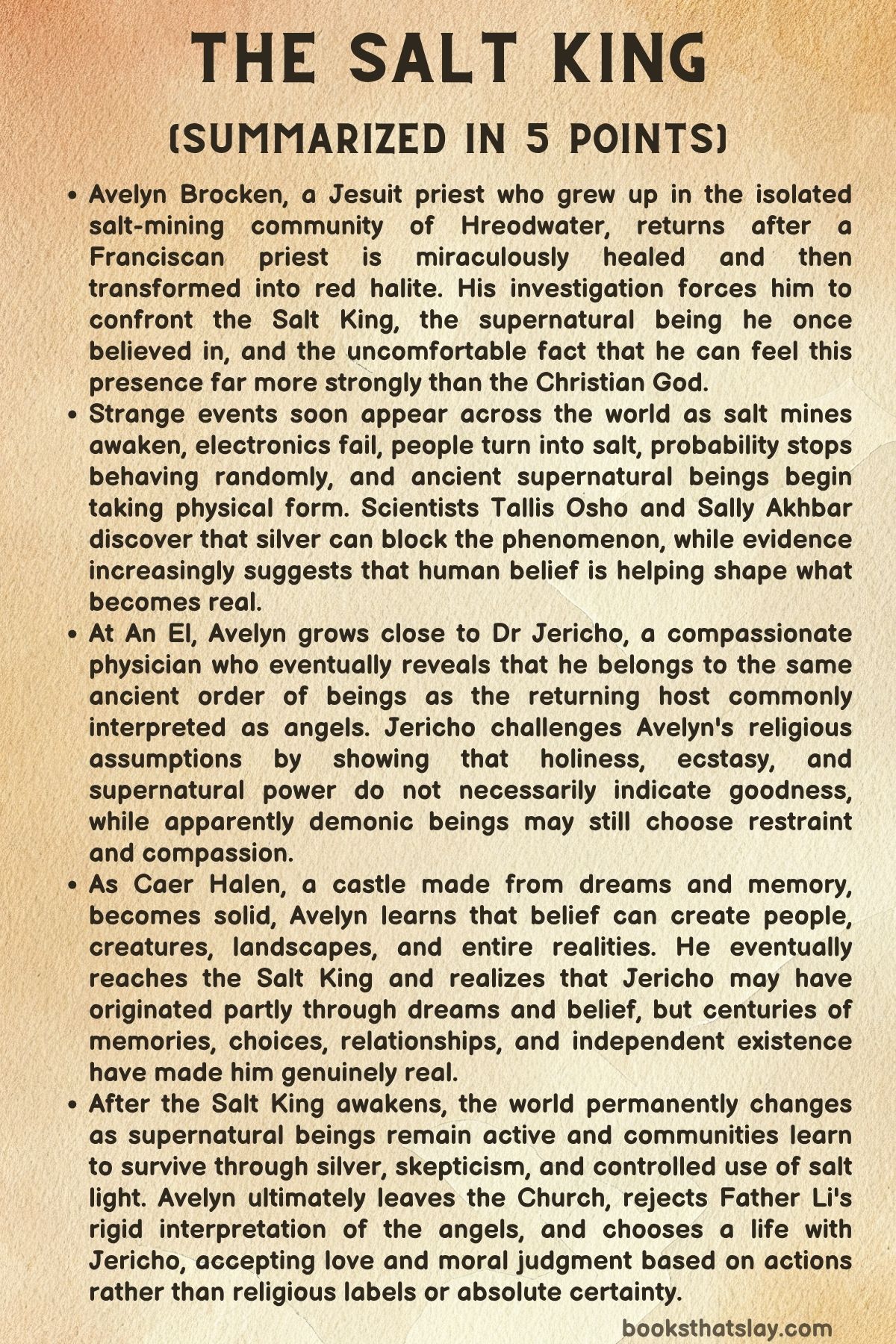
Avelyn Brocken returns to Hreodwater after twelve years away because the Vatican has received evidence of an impossible event. A Franciscan priest named Matthew has apparently been healed of a serious spinal injury at An El abbey before transforming into a pillar of red halite, joining the strange group of salt figures traditionally associated with the legendary Salt King.
Avelyn is uniquely qualified to investigate because he grew up in Hreodwater, speaks its old language, and was once being trained as a witch before abandoning the community. He later became a Jesuit under the guidance of Father Cai Li, the man who removed him from Hreodwater after a mine disaster killed much of Avelyn’s family.
Returning home immediately destabilizes the identity Avelyn has created in Rome. He sees the glowing phenomenon known as salt light, feels the overwhelming sensation called the ras, and experiences once again the profound sense of love associated with the Salt King.
This creates a theological crisis because Avelyn has never experienced the Christian God emotionally. He understands Catholic doctrine and practices his faith sincerely, yet the only supernatural presence that has ever made him feel directly loved is the being his religion encourages him to regard as demonic.
At An El, Avelyn meets Dr Jericho, the gentle and eccentric physician overseeing the abbey. Jericho explains that Matthew’s healing was only one example of a larger phenomenon. Cancer patients, people with disabilities, and others suffering from serious illnesses are recovering at extraordinary rates as the salt light grows stronger.
Avelyn begins documenting the effects through silver-protected instant cameras because ordinary electronics fail around Hreodwater salt. His photographs show visible halos around certain people, while Jericho strangely appears to repel the salt light rather than attract it.
Events elsewhere reveal that Hreodwater is only one part of a worldwide transformation. At the Dead Sea, nuclear safety inspector Tallis Osho and Jordanian inspector Saloman “Sally” Akhbar investigate an archaeological site where electronics fail and workers show symptoms resembling radiation exposure despite the absence of detectable radiation.
The excavation contains an ancient gateway surrounded by massive quantities of silver. Photographic film records a luminous, anatomically impossible figure near the structure, suggesting that silver was deliberately used in antiquity to contain or repel whatever lies beyond it.
In Tibet, Brother Kalden witnesses probability behaving impossibly around an ancient salt well. Children repeatedly toss coins that always land the same way, while Kalden senses a vast benevolent presence beneath the monastery and later experiences extraordinary healing.
Similar disturbances appear in Russia and Ukraine. People become salt statues, electronics fail inside deep mines, and forgotten underground spaces begin producing phenomena resembling those in Hreodwater.
The growing crisis is not limited to salt mines. In New York, banker Rachel and her colleague Harry discover that genuine randomness appears to be disappearing. Because modern encryption depends upon unpredictable mathematical processes, secure banking and communication begin collapsing.
Back at An El, Avelyn’s personal investigation becomes more disturbing. During Mass, consecrated bread and wine appear to transform physically into human flesh and blood. Instead of interpreting this as comforting evidence of Christianity, Avelyn suspects that an unknown supernatural force is reproducing religious miracles because people believe in them.
He also becomes increasingly attached to Jericho. Their conversations challenge Avelyn’s assumptions about faith, morality, sexuality, desire, and religious authority. Jericho refuses to classify the Salt King automatically as either holy or evil, insisting that actions matter more than categories.
Avelyn’s buried Hreod identity resurfaces as he travels deeper into the mine. He remembers that he was once intended to become a witch, someone unusually sensitive to salt light and capable of influencing the King’s dreams.
The deeper tunnels reveal that those dreams are becoming physically solid. Forests, extinct creatures, sacred animals, and impossible landscapes emerge beneath the earth as the distinction between imagination and matter weakens.
Avelyn eventually realizes that belief itself is becoming an active physical force. Things believed strongly enough can acquire substance, while disbelief can sometimes weaken or destroy supernatural manifestations.
The worldwide situation deteriorates quickly. People transform into red salt, transportation systems fail, digital banking collapses, and religious communities interpret the returning supernatural beings according to their own traditions.
Father Li discovers that enormous luminous formations are moving through Earth’s atmosphere toward Britain. They resemble vast hosts of angels and appear to be converging specifically on Hreodwater.
At the Vatican, thousands of people suddenly experience overwhelming religious joy and speak the same ancient phrase without understanding how they know it: “Rejoice, for we have returned.” The phenomenon spreads across the world.
Avelyn experiences the same ecstasy but discovers that Jericho does not. This difference becomes crucial because Jericho recognizes that the supernatural joy is not necessarily evidence of goodness. It may instead be a mechanism used by the returning beings to suppress resistance.
Avelyn and Jericho travel through Caer Halen, an impossible castle produced by the Salt King’s dreams. Rooms open into different historical periods, remembered places, and imagined landscapes, proving that salt light can convert thought into physical reality.
A historical account involving Saint Hildegard reveals that similar events occurred centuries earlier. Hreodwater’s inhabitants already understood silver as protection and had survived previous manifestations of Caer Halen, suggesting that later Christian traditions misinterpreted fragments of much older encounters.
Avelyn then remembers the mine disaster that transformed his own life. As a teenager with unusually powerful witch abilities, he experimented with salt light and encountered a lonely supernatural figure whom he instinctively tried to help.
After the disaster, Father Li rescued Avelyn and brought him toward the life that would eventually lead to Rome. Yet Avelyn now realizes that the mysterious doctor present shortly after the catastrophe was Jericho.
The revelation changes everything. Jericho eventually admits that he belongs to the same ancient class of entities as the returning host. Such beings become physically real through human belief, gaining strength where cultures preserve memories and expectations surrounding them.
Jericho nevertheless opposes the returning beings. Their ability to inspire overwhelming joy does not mean they are morally benevolent, and their worldwide arrival has already caused enormous death and destruction.
During an argument, Avelyn calls Jericho unreal. Because Avelyn’s own capacity for belief is exceptionally powerful, the statement has devastating consequences. Jericho loses physical form and disappears.
Avelyn travels alone into the deepest part of Hreodwater and finally reaches the Salt King. He discovers not a simple monster but an ancient intelligence with a degree of reality far greater than that of the temporary manifestations spreading across the world.
The encounter allows Avelyn to understand Jericho differently. Even if Jericho’s earliest existence emerged from dreams and belief, centuries of memories, relationships, decisions, suffering, and independent choices have made him a person.
Avelyn therefore restores his belief in Jericho, bringing him back into physical existence. He also chooses to release the Salt King’s power despite knowing that the resulting confrontation with the angelic host may permanently transform the world.
The conflict leaves Avelyn nearly or completely blind, but it also changes his understanding of reality. He no longer believes that something’s origin determines whether it is meaningful or morally worthy.
Meanwhile, Tallis and Sally learn how to survive by combining scientific investigation with the new rules of belief. Silver provides strong protection from salt light, aluminium offers weaker protection, and determined disbelief can suppress certain supernatural manifestations.
Their relationship becomes increasingly intimate as civilization changes around them. Tallis repeatedly worries about their age difference, but Sally refuses to accept her assumption that this makes their connection inappropriate or temporary.
Three months after the Salt King’s awakening, Tallis and Sally reach Hreodwater wearing improvised silver protection. They find Caer Halen transformed from a dreamlike apparition into a functioning community.
Tallis finally meets the Salt King. Unlike the beings that impose ecstasy and demand belief, he appears controlled and does not attempt to overwhelm her consciousness.
A year later, society is slowly rebuilding under radically altered physical conditions. London has finally been made safe, Hreodwater has adapted to life alongside salt light, and Tallis, Sally, Avelyn, Jericho, and the surviving witches have established new roles within the changed world.
Father Li eventually comes to Hreodwater, creating one of Avelyn’s final emotional crises. After prolonged exposure to angelic ecstasy, Li continues to interpret the angels as righteous and the Salt King as demonic, even though their actions suggest a more complicated moral reality.
Avelyn tells Li that he has left the Church. Li responds by questioning whether rescuing Avelyn years earlier was itself a mistake, devastating the man he once treated almost like a son.
Avelyn’s pain causes his belief to manifest destructively, but Jericho protects him. Their relationship finally becomes explicit when Jericho offers to return to the deep, a sacrifice that could restore Avelyn’s eyesight but would make Jericho less physically real again.
Avelyn refuses. He chooses Jericho over his lost sight and over the certainty offered by the Church.
Their final kiss represents the conclusion of Avelyn’s transformation. He no longer defines reality according to whether something originated in religion, science, mythology, or dream, and he no longer allows inherited categories to decide whom he is permitted to love.
The ending of The Salt King therefore presents belief not as automatic truth but as a form of power and responsibility. Avelyn reaches a morality based on action, consent, loyalty, and compassion, accepting that uncertainty is preferable to certainty imposed by forces that demand unquestioning devotion.
Characters
Avelyn Brocken
Avelyn is the central figure of The Salt King, and nearly every major philosophical conflict passes through him. He begins as a Jesuit priest who has deliberately reconstructed himself after escaping Hreodwater, creating a life based on Catholic theology, scholarship, discipline, and emotional restraint.
His return exposes how incomplete that reconstruction has always been. Hreod language returns instinctively, the ras affects him immediately, his witch abilities reawaken, and his body itself begins reverting toward the appearance he might have developed had he remained among the Hreoda.
Avelyn’s greatest internal conflict concerns faith. He sincerely wants Christianity to provide the spiritual certainty other believers describe, yet he cannot feel the Christian God in the same direct way that he feels the Salt King.
This absence does not make Avelyn intellectually hostile to religion. Instead, it makes him intensely cautious because he knows firsthand how pleasurable supernatural influence can be and worries that emotional certainty may simply be manipulation.
His instinct to mistrust pleasure influences his understanding of desire as well. His priesthood and celibacy have given him a framework in which avoiding romantic intimacy appears safer than confronting his own vulnerability.
Jericho gradually breaks through those defenses. Avelyn initially responds by intellectualizing his attraction and treating it almost as another supernatural danger, but the relationship eventually forces him to distinguish between manipulation and freely chosen emotional dependence.
Avelyn’s development also concerns identity. He tries to choose between mutually exclusive categories—Catholic or Hreod, priest or witch, rational investigator or supernatural participant—but eventually discovers that none of them alone can contain him.
His final transformation comes when he judges individuals by their actions instead of their theological classifications. By choosing Jericho and trusting the King while rejecting the murderous certainty represented by the angelic host, Avelyn accepts moral responsibility without demanding perfect metaphysical knowledge.
Dr Jericho
Jericho initially appears to be an eccentric but compassionate doctor at An El. Within The Salt King, however, his apparent ordinariness gradually becomes one of the story’s greatest mysteries because salt light behaves differently around him and because his knowledge frequently exceeds anything his background should explain.
His gentleness is genuine but should not be mistaken for weakness. Jericho is patient with Avelyn’s fear, protective of his dignity, capable of fierce anger when others are threatened, and willing to confront ideas that Avelyn has spent years treating as unquestionable.
Jericho’s most important quality is his refusal to confuse identity with morality. He repeatedly challenges Avelyn’s assumption that an angel must be good or that something classified as a demon must be evil.
His own existence eventually proves the inadequacy of those categories. Jericho belongs to the same ancient class of beings as the returning host, yet he chooses compassion while many of those beings bring destruction.
The revelation that Jericho may originally have gained reality through dreams and belief raises questions about personhood. Avelyn briefly interprets this origin as evidence that Jericho is unreal, but Jericho’s disappearance proves how destructive that reasoning can become.
Jericho has memories, relationships, preferences, fears, loyalty, humour, anger, and the capacity to choose. His development shows that a constructed beginning does not erase an independently lived existence.
His love for Avelyn is also marked by restraint. He repeatedly allows Avelyn to decide what he wants rather than using supernatural influence to secure affection, making his behaviour a direct contrast to the host’s coercive ecstasy.
His final offer to become dreamlike again so Avelyn can recover his sight demonstrates the extent of his devotion. Avelyn’s refusal completes their relationship because he finally values Jericho’s continued existence above physical restoration or religious approval.
Tallis Osho
Tallis serves as the scientific and skeptical counterpart to Avelyn. Her work as a nuclear safety inspector gives her a professional framework based on evidence, measurement, risk assessment, and the assumption that physical phenomena should behave consistently.
Her epilepsy gives that skepticism an intensely personal dimension. She has spent years learning that extraordinary things appearing before her eyes may be neurological events rather than objective reality.
The global crisis therefore attacks the exact method she normally uses to orient herself. When impossible events begin leaving photographic, physical, and measurable evidence, she loses the reassuring rule that impossibility indicates hallucination.
Tallis adapts rather than abandoning science. She changes her model when evidence demands it, eventually recognizing that belief and observation have become part of the physical system she is studying.
Her discovery that disbelief can weaken manifestations is especially appropriate. Skepticism, once simply her intellectual disposition, becomes a practical force capable of protecting others.
Her relationship with Sally exposes another form of insecurity. Tallis repeatedly defines herself through age and assumes that Sally must eventually see their age difference as a reason against intimacy.
She gradually learns that this judgment belongs primarily to her rather than to him. Their relationship becomes important because it develops through voluntary affection and companionship rather than supernatural certainty.
By the end, Tallis remains recognizably scientific even in Caer Halen. She continues questioning architecture, energy, matter, silver, and salt light, showing that accepting new evidence does not require abandoning critical thinking.
Saloman “Sally” Akhbar
Sally begins as Tallis’s Jordanian counterpart at the Dead Sea site and quickly becomes one of the book’s most practical characters. He is curious, socially confident, technologically capable, and unusually willing to communicate scientific uncertainty publicly.
His use of social media initially appears almost casual, but it later becomes crucial. As institutions collapse, Sally recognizes that ordinary people need trustworthy explanations delivered in language they can understand.
He also complements Tallis emotionally. Where she repeatedly worries about how others might judge her, Sally tends to respond directly to what is actually happening between them.
His attraction to Tallis is not presented as grand destiny. It grows through shared danger, humour, food, conversation, professional respect, and mutual dependence.
That ordinary quality is important in a world where supernatural forces manufacture overwhelming feelings of certainty. Sally’s affection has value precisely because it is chosen rather than imposed.
He also displays considerable ingenuity after technological systems collapse. His practical contributions to protective equipment and survival show that human adaptability remains important even when reality itself changes.
Father Cai Li
Father Cai Li is both Avelyn’s mentor and surrogate parental figure. In The Salt King, his relationship with Avelyn provides one of the most painful examples of how sincere love can coexist with dangerous certainty.
Li genuinely rescued a traumatized teenager, gave him safety, helped him build a life, and maintained deep concern for him for years. Avelyn’s affection for Li is therefore rooted in real gratitude rather than simple institutional loyalty.
Unlike Avelyn, Li experiences religious certainty directly. He believes that God once told him to rescue Avelyn, and that experience becomes foundational to his understanding of both his faith and their relationship.
The returning host exploits precisely this vulnerability. Because its supernatural ecstasy resembles the divine presence Li has trusted throughout his life, he becomes increasingly incapable of separating emotional certainty from moral truth.
His later encounter with Avelyn therefore becomes tragic rather than simply antagonistic. Li continues to believe he is defending goodness even when evidence suggests that the beings he calls angels have caused enormous suffering.
When he concludes that saving Avelyn might have been demonic, he destroys something central to both of them. The statement converts what Avelyn regarded as unconditional parental love into something dependent upon theological agreement.
Tallis’s comparison of Li’s state to an addiction-like exposure to ecstasy helps explain his transformation without making him emotionally irrelevant. His story demonstrates how certainty can corrupt judgment even when the person experiencing it began from genuine love.
The Salt King
The Salt King spends much of The Salt King as an object of competing interpretations rather than an ordinary speaking character. Hreod tradition treats him as an ancient protective presence, while Christianity interprets him through categories associated with demons or fallen supernatural powers.
His influence appears through salt light, dreams, healing, transformed landscapes, and the ras. Because these effects can feel overwhelmingly pleasurable, Avelyn initially assumes that their emotional power is evidence of manipulation.
The King nevertheless differs significantly from the returning host. When Tallis finally encounters him, he does not impose ecstasy on her or force her to worship.
His restraint becomes morally significant. Power alone does not determine what kind of being he is; his treatment of others does.
The King also represents continuity. Hreodwater preserved belief in him for thousands of years through language, ritual, witchcraft, and cultural memory, preventing him from fading in the same way other supernatural entities apparently did.
His dreams can generate people, landscapes, extinct creatures, and architecture, yet the novel refuses to reduce those creations to meaningless illusions. Through Jericho especially, the King’s power raises the question of when something imagined becomes independently real.
Sister Annunciata
Annunciata is an intelligent, blunt, humorous nun whose presence gives Avelyn a valuable friendship inside An El. Her practical temperament allows her to discuss theology and danger without becoming overwhelmed by either.
Salt light behaves strongly around her, suggesting an unusual affinity with the phenomenon. Her proximity to Jericho also helps Avelyn recognize that different people interact with salt light in dramatically different ways.
Annunciata becomes especially important because her transformation into red halite turns an abstract investigation into personal grief. Matthew’s death can initially be approached professionally, but Annunciata is someone Avelyn and Jericho know and care about.
Her death proves that healing and destruction originate from related processes. The same force restoring bodies can also transform them completely, preventing Avelyn from interpreting miraculous cures as uncomplicated evidence of benevolence.
Lady Hringen
Lady Hringen represents Hreodwater’s political and cultural continuity. She understands the mine, its ancient practices, and the danger created by the strengthening salt light far better than most Outsiders.
Her relationship with Avelyn also reminds him that he once belonged to a network of clan obligations rather than existing solely as an individual. Returning to the Hreod community means confronting responsibilities connected with his Brocken inheritance.
She accompanies Avelyn into the deep mine and treats dream manifestations as dangerous realities rather than philosophical puzzles. Her knowledge helps bridge Avelyn’s childhood training and his adult investigation.
Through her, the story demonstrates that Hreod traditions are not merely superstitious remnants. Much of what Outsiders dismissed as folklore is actually accumulated survival knowledge.
Saint Hildegard
Saint Hildegard appears through the historical narrative set in 1067. Her experiences reveal that the current supernatural crisis has happened before and that earlier religious interpretations shaped later misunderstandings.
She approaches Hreodwater through the assumptions available to a medieval Christian but remains observant enough to record extraordinary events. Her encounter with Caer Halen preserves evidence of an earlier collapse between dream and physical reality.
Hildegard’s account also demonstrates how interpretation changes across cultures. Something she understands through Christian angelology may have existed long before Christianity developed the language used to describe it.
Her importance therefore lies less in personal development than in historical perspective. She proves that religious traditions can preserve accurate observations while attaching uncertain explanations to them.
Brother Kalden
Brother Kalden is a monk living near ancient Tibetan salt works. His chapters broaden the supernatural crisis beyond European and Christian traditions.
He begins by noticing small statistical impossibilities, particularly coins repeatedly landing the same way. Because the phenomenon initially appears harmless, it demonstrates how the transformation of reality begins through tiny violations of probability before escalating into global catastrophe.
Kalden also senses a benevolent song beneath the monastery and experiences physical healing. His encounters suggest that different cultures have preserved their own relationships with ancient supernatural presences.
His story reinforces the idea that no single religion possesses a complete explanation. Similar forces have been perceived through different sacred languages, images, and traditions.
Katerina
Katerina is a Russian police officer whose investigation of missing travel vloggers leads her into an abandoned salt mine. She initially expects ordinary recklessness and approaches the case with professional irritation.
Her discovery of human-shaped salt formations immediately changes the scale of the mystery. The figures appear frozen in motion while abandoned electronic equipment lies destroyed around them.
Katerina’s brief role is important because she provides independent confirmation that the Hreodwater transformations are occurring elsewhere. Her instinct to retreat also distinguishes her from characters who interpret dangerous supernatural phenomena as invitations to investigate further.
Artem
Artem is a former salt miner in war-damaged Soledar whose familiarity with underground passages becomes valuable during military operations. His perspective connects supernatural catastrophe with a landscape already shaped by human warfare.
He understands the mine as both workplace and shelter. When electronics fail and an unknown presence enters the tunnels, however, even his extensive practical knowledge becomes insufficient.
Artem’s experience expands the crisis geographically and symbolically. Ancient supernatural danger enters a place already carrying recent memories of artillery, drones, ruined homes, and military occupation.
Rachel
Rachel appears during the financial crisis caused by the disappearance of randomness. Her confusion and memory problems reflect how ordinary professionals experience the collapse of systems they previously assumed were stable.
Her role is less concerned with personal development than with illustrating the social consequences of altered reality. Through her workplace, the book shows that supernatural change can destroy civilization without any visible monster appearing.
Harry
Harry is Rachel’s colleague and the person who recognizes the catastrophic significance of disappearing randomness. His experiments reveal that devices designed to produce unpredictable results are instead generating patterns.
He understands immediately that modern cryptography depends on unpredictability. The disappearance of randomness therefore threatens banking, communication, passwords, state security, and digital infrastructure.
Harry functions as an intellectual bridge between supernatural events and modern technological collapse. He shows that changing the rules of probability can be more destructive than direct physical violence.
Matthew
Matthew is the Franciscan whose transformation initially brings Avelyn back to Hreodwater. Although he dies before becoming an active participant in the main story, his fate drives the investigation.
His miraculous healing followed by transformation into red halite establishes the central contradiction surrounding salt light. The same phenomenon appears capable of restoring damaged bodies and destroying individual human form.
Matthew therefore becomes the first major warning against interpreting healing as automatic proof of goodness. His transformed body is evidence that something extraordinary is happening, but it offers no simple answer regarding what that phenomenon wants.
Redspear
Redspear is the ferryman who recognizes Avelyn soon after his return. Her familiarity with Hreod traditions contrasts with Avelyn’s attempt to behave like an Outside investigator.
Her reaction to An El and her expectation that the King would eventually awaken reveal how ordinary Hreoda regard supernatural events as part of their cultural reality. She does not need the theological explanations Avelyn constantly seeks.
Through characters like Redspear, Hreodwater emerges as a functioning society rather than merely the location of a religious mystery.
Veronique
Veronique appears during Tallis and Sally’s hospital isolation in Amman. Her sudden transformation from an ordinary woman into red salt demonstrates how rapidly the phenomenon is escaping its original geographic boundaries.
Her death is particularly unsettling because Tallis initially cannot know whether she is witnessing reality or another epileptic hallucination. Veronique therefore intensifies Tallis’s central problem of distinguishing subjective perception from objective catastrophe.
Themes
Belief as a Force That Creates Reality
Belief in The Salt King is not simply a psychological attitude or religious commitment. As salt light intensifies, belief acquires measurable physical consequences, allowing expectations, dreams, myths, fears, and religious images to become material.
Caer Halen represents this principle on the largest scale. The castle contains different periods, people, landscapes, and memories because it has been formed from accumulated consciousness rather than ordinary construction.
The same mechanism explains the supernatural beings. Entities gain stability when humans believe in them, while neglected beings can weaken into dreamlike states.
Jericho’s existence creates the strongest personal example. Even if he originated partly through Avelyn’s witchcraft or the Salt King’s dreams, continued experience gives him identity, memory, choice, and emotional independence.
Avelyn’s temporary rejection of Jericho demonstrates the danger of treating belief as arbitrary fantasy. Because Avelyn possesses unusual supernatural power, declaring Jericho unreal nearly destroys him physically.
Disbelief possesses corresponding power. Tallis discovers that certain manifestations collapse when she genuinely refuses to accept them, turning skepticism into an active survival mechanism.
The novel therefore avoids presenting faith as automatically superior to doubt. Belief and disbelief become tools capable of creation, protection, destruction, manipulation, and liberation.
What matters is not simply whether a person believes, but what they choose to sustain through that belief. Reality becomes partly participatory, making every conviction potentially consequential.
Religious Certainty and Moral Judgment
The distinction between holiness and goodness becomes increasingly unstable throughout the story. Avelyn has been trained to interpret supernatural beings through Christian categories, particularly the opposition between angels and demons.
The returning host initially appears to confirm those categories. The beings resemble descriptions found in ancient scripture, inspire overwhelming religious awe, create visions associated with Heaven, and speak in language that sounds prophetic.
Their actions, however, contradict the assumption that spiritual ecstasy proves moral goodness. Their arrival causes widespread death, technological destruction, involuntary mental influence, and social collapse.
Jericho repeatedly challenges Avelyn to judge actions before labels. His argument becomes persuasive because he belongs to a similar supernatural category yet behaves with restraint, compassion, loyalty, and respect for human autonomy.
Father Li demonstrates the opposite danger. His lifelong experience of divine certainty makes him especially vulnerable when the host produces a stronger version of the same feeling.
Because the experience feels holy, Li increasingly treats that feeling as proof. He remains committed to calling the host righteous even after witnessing the destruction associated with its arrival.
Avelyn eventually reaches a different ethical position. He does not need absolute knowledge of whether the King fits a particular religious category before deciding whether the King’s behaviour deserves trust.
The theme therefore challenges the assumption that metaphysical identity determines moral value. Goodness becomes something demonstrated through conduct, especially through restraint, consent, protection, and the willingness to allow others freedom.
Identity, Belonging, and the Conflict Between Selves
Avelyn’s return to Hreodwater forces him to confront the identity he attempted to abandon. For twelve years, he has constructed himself as a Jesuit priest, scholar, teacher, and Vatican investigator, apparently separate from the witch apprentice and Brocken heir he once expected to become.
Hreodwater reveals that these identities have never been entirely separate. His language returns instinctively, his sensitivity to salt light reawakens, old cultural assumptions feel natural again, and even his physical appearance begins shifting.
His conflict is intensified because each community offers a different interpretation of who he should be. Rome understands him primarily through priesthood and Christian theology, while Hreodwater sees the surviving Brocken heir and unfinished witch.
Avelyn initially assumes that choosing one identity requires rejecting the other. His development gradually challenges this binary.
His years in Rome were not meaningless simply because he eventually leaves the Church. Father Li gave him education, safety, intellectual discipline, friendship, and experiences that become essential when he returns to Hreodwater.
Likewise, returning home does not erase the man he became outside it. His theological education gives him tools for interpreting supernatural phenomena even when he ultimately rejects some of its conclusions.
By the end of The Salt King, Avelyn accepts identity as cumulative rather than exclusive. He can be shaped by Hreodwater and Rome without allowing either institution complete ownership over him.
Leaving the priesthood therefore becomes less an act of destroying his former self than of accepting that the person he has become exceeds the available categories.
Love, Choice, and Freedom from Coercion
Love in the novel gains its meaning through choice rather than intensity. This distinction becomes especially important because supernatural beings can manufacture emotions far stronger than anything ordinary human relationships produce.
The returning host creates ecstasy so overwhelming that people interpret obedience as joy. Avelyn temporarily experiences ruined technology and spreading salt as beautiful because the emotional force acting upon him changes his moral perception.
Jericho’s relationship with Avelyn operates according to the opposite principle. He does not overwhelm Avelyn emotionally or demand that his affection be accepted as sacred truth.
Instead, their bond develops through conversation, irritation, humour, physical care, disagreement, vulnerability, and repeated acts of trust. Avelyn is allowed to resist, misunderstand, retreat, and eventually choose.
Tallis and Sally provide a parallel form of freely chosen attachment. Their relationship develops without supernatural revelation, growing instead through shared work and companionship during disaster.
Both relationships contrast with systems that demand surrender. Religious certainty, collective ecstasy, inherited duty, and even Avelyn’s own rigid interpretation of celibacy repeatedly threaten to make decisions for individuals before they can decide what they actually value.
Jericho’s final offer brings the theme to its clearest expression. He is willing to become dreamlike again if doing so restores Avelyn’s eyesight, but he does not decide that sacrifice on Avelyn’s behalf.
Avelyn refuses and chooses Jericho instead. The importance of that decision lies not simply in romance but in autonomy: after spending much of his life allowing institutions, theology, trauma, and supernatural sensations to define what he should want, he consciously chooses the person whose continued existence matters more to him than certainty, restored sight, or religious approval.