The Secret Dinner Summary, Characters and Themes
The Secret Dinner by Raphael Montes is a dark crime novel about four childhood friends whose financial desperation leads them into an underground dining business built around human flesh.
What begins as an outrageous joke becomes a profitable enterprise that steadily destroys the moral distinctions the characters use to defend themselves. Through Dante’s retrospective narration, the novel examines ambition, class privilege, guilt, consumption, friendship, deception, and the human ability to normalize almost anything when profit and desire are involved. Its central horror lies not simply in cannibalism, but in how ordinary business language, culinary sophistication, and self-justification can make extreme violence seem routine.
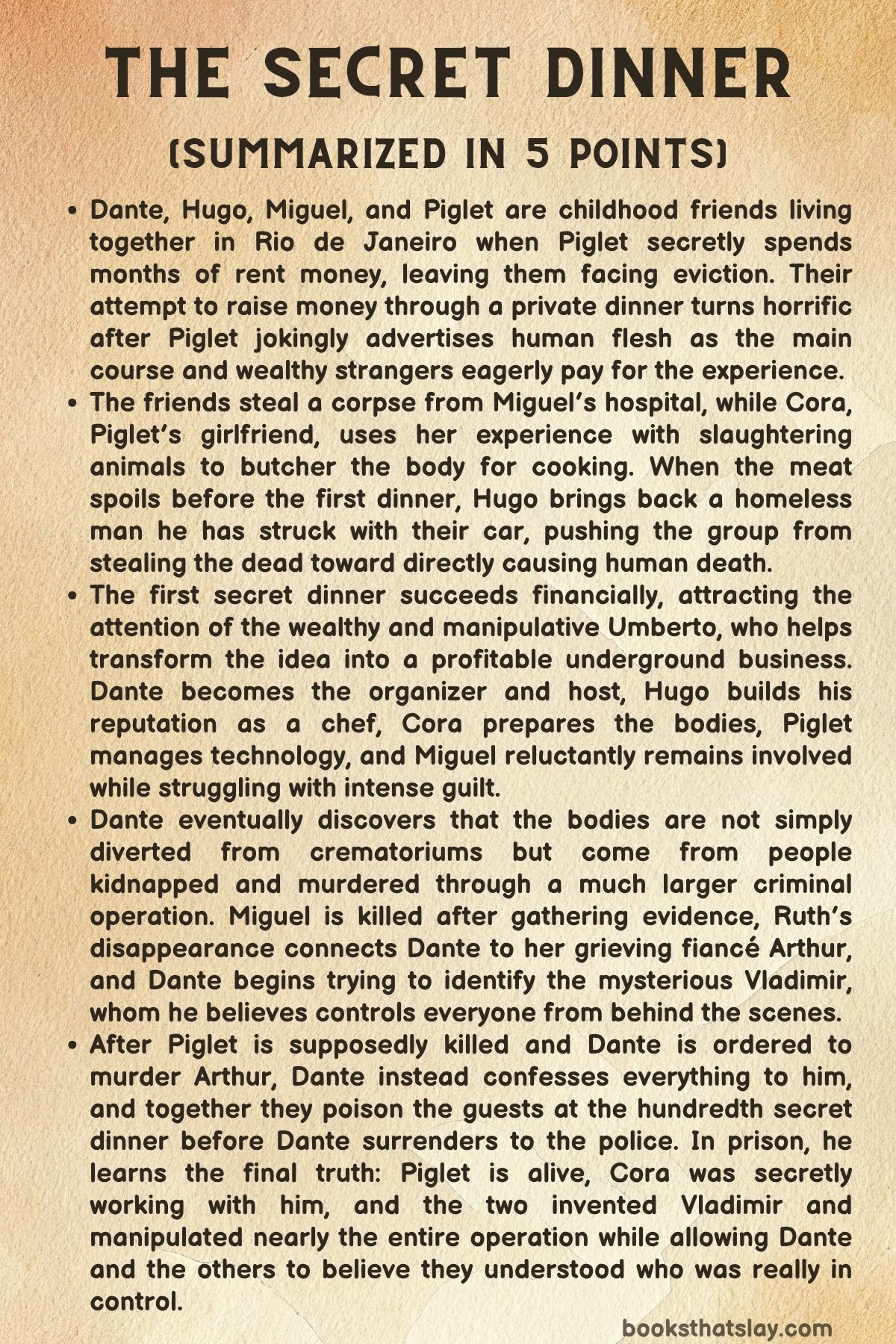
Summary
Dante begins his account after walking into a Rio de Janeiro police station in June 2024 wearing a blood-soaked tuxedo and announcing that he wants to confess what he and others have done. His story reaches back to 2018, when he leaves the small town of Pingo d’Água with his childhood friends Miguel, Hugo, and Piglet, hoping that Rio will offer independence, professional success, and a more exciting future.
The four eventually settle into a large apartment in Copacabana. Their personalities and ambitions differ sharply: Dante dreams of financial independence, Hugo wants recognition as a chef, Miguel pursues medicine, and Piglet drifts through life with little conventional direction.
Years later, none of them has achieved the future they imagined. Dante has earned a business degree but works unhappily in a bookstore while studying for government examinations, Hugo repeatedly loses restaurant jobs because of his arrogance, Miguel struggles through an exhausting medical residency, and Piglet has abandoned university entirely.
Their lives change after Hugo and Miguel decide that Piglet, whom they believe to be a virgin, should receive an escort as a birthday present. Dante reluctantly searches for someone willing to accept the unusual arrangement and meets Cora, an escort who immediately distinguishes herself through her confidence, bluntness, unusual appetite, and comfort discussing slaughter.
Cora eventually becomes Piglet’s girlfriend. Her entrance into the household seems personal rather than dangerous at first, but her childhood experience butchering livestock will later make her indispensable.
The real crisis begins when Dante discovers that six months of apartment rent has not been paid. The roommates have been sending their shares to Piglet, who was supposed to transfer the money to the landlord, but Piglet has spent much of it on Cora and other pleasures.
The confrontation becomes emotionally violent. Dante cruelly reminds Piglet that his mother is dead, causing him to suffer a severe breakdown because he has spent years psychologically reconstructing a version of reality in which she is still alive.
Piglet’s past is deeply traumatic. His mother died in a brothel fire in Pingo d’Água, and the event left him psychologically unstable. His friends generally protected him from the truth because medication and routine allowed him to function.
Desperate to pay the rent, Hugo proposes hosting an exclusive private dinner. Dante sees business potential in the idea and enthusiastically organizes an expensive menu, believing they can solve their financial emergency legitimately.
Piglet changes everything by altering the online menu as a joke. Inspired by a disturbing riddle Dante once told about a man unknowingly eating human flesh, Piglet advertises the main course as genuine human meat and raises the price dramatically.
Instead of rejecting the idea, wealthy strangers express interest and begin paying. The roommates initially treat the situation as absurd, but the amount of money available gradually shifts their discussion from whether serving human flesh is acceptable to whether they can obtain it safely.
Miguel strongly objects, yet Dante, Hugo, and Piglet outvote him. Because Miguel works at a hospital, they pressure him into helping them steal the body of an unclaimed patient from the morgue.
Their first corpse is an elderly woman. Bringing the body home forces them to face the physical reality they had previously treated as an abstract problem, and none of them knows how to butcher it properly.
Cora unexpectedly walks into the apartment, sees the corpse, understands what they are planning, and reacts with remarkable calm. Drawing on her slaughterhouse experience, she takes control of the dismemberment and transforms the body into usable cuts of meat.
Dante is simultaneously fascinated and repulsed. He wants the financial reward but remains disturbed whenever the meat reminds him that it once belonged to a person with a life, history, and relationships.
Hours before the first dinner, disaster strikes when the freezer fails and the prepared flesh spoils. Miguel argues for cancellation, but the others refuse because the money has already been spent or committed.
Hugo leaves in their car and returns with the body of a homeless man. He claims the man was accidentally struck by the vehicle, but his explanation is inconsistent, and Dante increasingly suspects that Hugo intentionally allowed the victim to die.
Cora rapidly butchers the new body, Hugo prepares the meat, and Dante converts the apartment into an elegant dining room. Wealthy guests arrive expecting a forbidden luxury experience.
Most eat enthusiastically. Two guests, Kássio and Gustavo, panic once they fully comprehend what they are doing, so Dante offers to replace their portions with ordinary beef.
Instead, he simply changes their plates and serves them the same human meat. They eat it believing his lie, recreating the central principle of the old seagull-meat riddle: people can consume something terrible without resistance when they believe it is something acceptable.
One guest, Umberto, notices the deception and is impressed rather than disgusted. He recognizes Dante’s ability to make decisions under pressure and later approaches him with an offer to expand the dinners into a permanent business.
Dante initially refuses. Yet the first dinner has already altered everyone involved. Hugo has finally received admiration for his cooking, Piglet enjoys the excitement, and Dante discovers that the risk and prestige satisfy ambitions his ordinary life never did.
Hugo eventually admits that he struck the homeless man, although Dante never becomes convinced the death was accidental. Dante condemns him while simultaneously protecting him, exposing the growing distance between Dante’s view of himself as morally superior and the reality of his complicity.
Umberto begins applying pressure. When Dante refuses further involvement, Umberto engineers his dismissal from the bookstore, weakening his ability to return to a conventional existence.
He then offers the group a seemingly safer supply chain through his family’s crematorium business. According to Umberto, suitable corpses can simply be diverted before cremation, preventing the need to kill anyone.
The roommates accept. Miguel joins reluctantly because his mother Mirtes has cancer and he desperately needs money for her treatment, while Hugo, Piglet, and Dante are increasingly attracted by opportunity rather than necessity.
The operation moves into an expensive villa in Jardim Botânico. Cora handles the bodies, Hugo develops increasingly sophisticated menus, Piglet manages technology, Dante becomes the polished host and administrator, and Umberto provides money, protection, and supposed access to corpses.
The dinners become successful beyond anything the friends imagined. Wealthy clients seek membership because rarity, secrecy, and prohibition make the experience desirable.
Money changes their lives rapidly. Luxury vehicles, parties, drugs, expensive possessions, and social access become normal. What once horrified the group gradually becomes another work routine.
Dante remains the only central participant who refuses to eat human flesh, yet that distinction offers less moral protection than he wants to believe. He profits from the deaths, organizes the events, deceives diners, launders money, and repeatedly chooses silence.
To hide the growing profits, Dante creates Seagull Press, supposedly a digital publishing company. The business also fulfills Cora’s dream of becoming a published poet, although its real function is to disguise illegal earnings as ebook sales.
Meanwhile, the mysterious name Vladimir begins appearing. Umberto seems frightened of this unseen figure and eventually admits that Vladimir is supposedly the true authority behind the operation.
Dante gradually realizes that Umberto does not possess enough personal wealth or influence to explain the cars, police cooperation, money, and steady supply of bodies. The idea that an even more powerful criminal controls the business makes Dante feel increasingly trapped.
The greatest shock arrives when a man named Arthur approaches Dante’s group with a missing-person flyer for his fiancée, Ruth. Dante recognizes Ruth as a young woman whose body was recently delivered to the villa and served at a dinner.
The discovery destroys the lie that their supply consists of already dead people. Dante confronts Umberto and learns that the operation requires far too many bodies for crematorium theft alone.
Umberto takes Dante to see the truth. Corrupt highway police abduct travelers, murder them, and transport victims to a hidden industrial facility where living human beings are held, selected, killed, butchered, and processed like livestock.
The sight devastates Dante. The elegant dinners are merely the final stage of a system based on organized kidnapping and murder.
When Dante returns home, another catastrophe awaits him: Miguel is dead. Miguel had secretly collected evidence and planned to expose the enterprise, and Umberto later confirms that the organization killed him after discovering his intentions.
Returning to Pingo d’Água for Miguel’s funeral exposes another buried history. Dante learns that before Piglet’s mother died, men had disappeared around the brothel with which she was associated, and rumors claimed that some had been butchered and served as food.
Dante begins to understand that Piglet’s fascination with cannibalism may come from childhood experiences he never consciously processed. Piglet may even have eaten human flesh without knowing it, making Dante’s old seagull-meat riddle disturbingly personal.
After Miguel’s death, Dante’s drug use becomes severe. He nevertheless begins trying to discover Vladimir’s identity, partly from guilt and partly because he hopes removing the hidden leader could free everyone.
During this period, Dante becomes close to Arthur. Initially he contacts Ruth’s grieving fiancé only to learn what Ruth had discovered before her death, but their relationship slowly becomes genuine.
Arthur believes Dante is helping him find the people responsible for Ruth’s disappearance. Dante knows that he is actually one of those people.
Ruth had been investigating secret cannibal dinners before she vanished. Her notes contain references to “seagull meat,” Copacabana, informants, and Vladimir, bringing Arthur increasingly close to the truth.
Dante’s attempts to identify Vladimir lead nowhere. Piglet eventually proposes an unsettling possibility: Vladimir may not exist at all and could simply be a fictional authority invented to frighten everyone into obedience.
Before Dante can resolve the mystery, Umberto and Hugo confront him. They know he has been helping Arthur, and Dante is ordered to prove his loyalty by murdering him before the upcoming hundredth dinner.
The confrontation brings even worse news. Piglet has supposedly been murdered, and his body will be served at the hundredth dinner as “suckling pig.”
Cora appears devastated and eventually leaves the apartment. Dante believes that Miguel and Piglet are dead, Cora has abandoned him, and Hugo has fully sided with the organization.
Arthur calls Dante and invites him to dinner. Dante arrives knowing that killing Arthur could save his own life and seriously considers using a knife on him.
Arthur’s simple kindness stops him. Unable to continue deceiving the man, Dante finally confesses everything, including Ruth’s fate and his own involvement.
Arthur does not forgive him. Instead, he decides they should use the hundredth secret dinner to destroy the organization.
They devise a plan to poison the guests. Arthur secretly enters the villa before the event and intends to contaminate the gravy served with the main course.
Their plan becomes violent when Hugo discovers that something is wrong. Arthur attacks him, and Hugo is killed.
Dante then hosts the hundredth dinner without him, maintaining the appearance of normality while wealthy diners celebrate their exclusive culinary tradition. The poisoned sauce is served with the human meat.
One by one, the guests begin bleeding, vomiting, collapsing, and dying. The elegant celebration turns into chaos.
Umberto realizes Dante has betrayed them, and violence spreads through the villa. Arthur survives long enough to confront Dante one final time but makes clear that helping destroy the organization does not erase Dante’s responsibility for Ruth.
Arthur tells Dante that remaining alive with his guilt will be his punishment. He then kills himself with a chainsaw.
Dante walks away from the villa wearing the blood-covered tuxedo seen at the beginning of the story. He goes directly to a police station and confesses.
He is eventually convicted and sentenced to thirty years in prison. His family rejects him, his fortune disappears, and the scandal turns him into the public face of the cannibal dinners.
Dante begins writing his story in prison, believing that the nightmare has finally ended. Then Cora unexpectedly visits him.
She reveals the final deception. Piglet is alive.
Piglet and Cora invented Vladimir together. Piglet secretly controlled Umberto while Cora disguised herself as a woman named Virgínia and helped maintain the illusion of an invisible criminal mastermind.
Cora also reveals that she deliberately caused the freezer failure before the first dinner. By destroying the original meat, she forced Hugo to find a fresh victim and ensured that the enterprise would cross from corpse theft into direct killing.
Piglet never truly wanted the operation to stop after the rent was paid. His apparent laziness and foolishness concealed the person who understood the enterprise more deeply than anyone else and manipulated events from behind the scenes.
Many clues Dante followed while searching for Vladimir had been staged. The man he believed was the ultimate authority was a fiction created by the friend everyone underestimated.
Piglet and Cora have continued the dinners after the destruction of the others. They have accumulated enough wealth to return to Pingo d’Água, purchase the old religious property connected to Piglet’s childhood, and establish a new operation there.
Cora warns Dante that exposing them would endanger his family. She then gives him a business card and suggests that employment may be waiting for him when he eventually leaves prison.
Dante is left with the final humiliation of understanding that he was never the brilliant entrepreneur he imagined himself to be. The entire enterprise began with Piglet, expanded because Piglet wanted it to continue, and ultimately consumed nearly everyone who believed they were controlling it.
Characters
Dante
Dante is the narrator and moral center of The Secret Dinner, although the novel steadily exposes how unreliable his sense of his own morality becomes. He begins as an ambitious young man frustrated by financial failure and convinced that education, discipline, and entrepreneurial thinking should lead to success.
His defining weakness is rationalization. Dante repeatedly recognizes that an action is wrong while finding reasons to participate anyway, allowing him to preserve an image of himself as more decent than Hugo, Umberto, or the diners even when his decisions directly sustain their crimes.
He is also highly adaptable. His business training, social intelligence, and ability to perform under pressure make him an excellent organizer and host, but the same abilities that might have supported a legitimate career instead allow him to professionalize exploitation.
His relationship with Arthur ultimately breaks through some of his defenses. Confessing Ruth’s fate does not redeem him, but it represents the moment when he finally chooses truth despite knowing that honesty may destroy him.
Piglet
Piglet appears for much of The Secret Dinner to be the least capable of the four childhood friends. He is overweight, undisciplined, dependent, impulsive, addicted to online distractions, and responsible for the missing rent that initiates the crisis.
That appearance becomes the novel’s greatest deception. His joke about selling human flesh begins the enterprise, while the final revelation shows that he was far more strategic than Dante ever understood.
Piglet’s childhood provides the psychological background for his behavior. The brothel fire, his mother’s death, his altered memories, and the possibility that he unknowingly consumed human flesh create an association between food, love, family, death, and denial that predates the Rio dinners.
By inventing Vladimir with Cora, Piglet turns the weaknesses others attribute to him into camouflage. Everyone assumes he is too foolish or unstable to control them, allowing him to become the hidden architect of events.
Cora
Cora becomes one of the most unpredictable figures in The Secret Dinner because her apparent openness conceals an extraordinary ability to manipulate others. Introduced as an escort hired for Piglet, she rapidly becomes his girlfriend, Dante’s confidante, the group’s butcher, and eventually Piglet’s secret partner in controlling the enterprise.
Her comfort with blood and bodies initially comes from practical experience with livestock rather than abstract cruelty. She does not share Dante’s need to disguise physical processes from himself, which makes her invaluable once the group begins handling corpses.
Cora is also defined by reinvention. “Cora” is itself a created identity, replacing Deusdete da Silva, just as her literary ambitions and later role as Virgínia allow her to construct new versions of herself whenever circumstances demand them.
Her final revelation radically changes earlier scenes. Actions that appeared supportive, accidental, or reactive become evidence that she was actively moving the others toward deeper criminal involvement.
Hugo
Hugo embodies ambition without moral restraint in The Secret Dinner. His talent as a chef is genuine, but conventional restaurants never provide the status and freedom he believes he deserves, partly because his arrogance repeatedly damages his career.
The secret dinners therefore offer more than money. They give Hugo an audience willing to treat him as an extraordinary culinary artist, and that recognition gradually becomes more valuable to him than friendship or legality.
His decision to obtain the homeless man after the freezer failure reveals how quickly artistic ambition can become a justification for violence. Even after the group no longer needs money, Hugo wants to continue because human flesh has become the medium through which he believes he can achieve greatness.
Miguel’s death barely changes his commitment. By the final confrontation, Hugo has become almost completely identified with the enterprise, making his conflict with Dante unavoidable.
Miguel
Miguel functions as the clearest moral counterweight within The Secret Dinner. From the beginning, he is the friend most disturbed by the idea of serving human flesh and repeatedly argues that financial desperation cannot justify what they are doing.
His weakness is not lack of conscience but lack of resistance. He votes against the first dinner yet remains involved after losing the vote, helps the others access a corpse, and later accepts the expanded operation because his mother’s cancer treatment requires money.
The psychological consequences are severe. His profession as a doctor intensifies the contradiction between preserving human life and participating in a business that treats human bodies as commodities.
Eventually, Miguel tries to correct his failure by gathering evidence. His murder demonstrates that moral recovery becomes more dangerous once an individual has helped build a system capable of protecting itself.
Umberto
Umberto initially appears to be the sophisticated patron who recognizes the commercial potential of the first dinner. Wealthy, confident, manipulative, and apparently well connected, he transforms a chaotic event into an organized criminal enterprise.
His greatest talent is identifying vulnerabilities. He understands Dante’s ambition, Hugo’s desire for recognition, Miguel’s financial desperation, and the group’s fear of exposure, allowing him to push each person toward continued involvement for different reasons.
Umberto also represents the institutional layer of the crime. Through him, the dinners acquire property, protection, transportation, bodies, money laundering, and corrupt connections.
The final revelation reduces his apparent authority. He believed that Vladimir controlled him, demonstrating that even a powerful manipulator can himself be controlled by fear.
Arthur
Arthur enters the story as Ruth’s grieving fiancé and initially represents an innocent person directly harmed by the dinner business. His relentless distribution of missing-person flyers forces Dante to confront a victim not as anonymous meat but as someone loved and desperately missed.
His friendship with Dante becomes emotionally complicated because it begins through manipulation. Dante wants information, while Arthur believes he has found a sympathetic ally.
Arthur’s discovery of Ruth’s investigation turns grief into a desire for revenge. When Dante finally confesses, Arthur does not offer forgiveness; instead, he chooses violent retaliation against the people involved.
His final actions prevent him from becoming a simple symbol of moral goodness. Loss pushes him toward mass killing and suicide, showing how the violence created by the dinners continues reproducing itself even among those who were originally victims.
Ruth
Ruth is largely absent physically, yet her influence becomes central during the later part of the story. As a journalist, she had been investigating the secret dinners and the mysterious Vladimir before her disappearance.
Her murder exposes the lie on which Dante had relied to tolerate the expanded operation. Until he recognizes her photograph, he can imagine that the meat comes from people who were already dead.
Ruth therefore restores individuality to the victims. She had a career, an investigation, a fiancé, questions she wanted answered, and plans for a future, all of which are erased when the organization reduces her body to a product.
Hilda
Hilda is Dante’s mother and represents the ordinary life from which he desperately wants independence. Her willingness to help him financially repeatedly conflicts with his pride.
Dante’s refusal to accept her support becomes tragically ironic because he chooses extreme criminality partly to avoid feeling like a dependent son. A comparatively ordinary solution exists, but his conception of adulthood makes it emotionally unacceptable.
Hilda also preserves knowledge of Pingo d’Água that Dante lacks. Her revelations concerning Piglet’s mother allow him to understand that the origins of the nightmare extend much further into the past than he believed.
Mirtes
Mirtes, Miguel’s mother, becomes one of the emotional pressures that keep Miguel trapped in the enterprise. Her cancer treatment is expensive, and Miguel increasingly feels powerless within a medical system that cannot provide everything she needs.
The money from the dinners therefore acquires a compassionate purpose in his mind. That motive does not erase his involvement, but it distinguishes him from characters who continue primarily for pleasure, recognition, or wealth.
Her grief after Miguel’s death also intensifies Dante’s guilt because he knows circumstances surrounding the dinners ultimately destroyed her son.
Rachel
Rachel is connected to Miguel’s life outside the secret operation and represents the stable personal future he increasingly loses. As Miguel’s guilt worsens, his ability to maintain ordinary intimacy and professional functioning deteriorates.
His attempts to spend time with Rachel instead of participating in the first dinner show his desire to distance himself from the crime. Yet physical distance cannot remove his responsibility or psychological distress.
Detective Amóz
Detective Amóz briefly appears as a possible threat to the roommates after the homeless man is struck by Bukowski. His investigation initially seems capable of exposing everything.
The disappearance of evidence from the repaired car demonstrates that ordinary law enforcement cannot be trusted to interrupt the enterprise. Whether Amóz himself understands the wider conspiracy is less important than the revelation that evidence can be removed before police procedure matters.
Cecília
Cecília is Umberto’s lawyer and former lover, and her deteriorating relationship with him makes her an accidental source of information for Dante. While intoxicated, she reveals that Umberto supposedly answers to Vladimir.
Her disclosure fundamentally changes Dante’s understanding of the business. What he believed was a partnership suddenly appears to be part of a hierarchy controlled by someone he has never met.
Ironically, the information she provides is itself part of a false structure, since Vladimir is eventually revealed to be an invented identity.
Heitor
Heitor first appears as the real-estate agent who helps the friends obtain the Copacabana apartment. Years later, his call about the unpaid rent triggers the crisis from which the secret dinners emerge.
He is therefore an ordinary figure whose administrative role has enormous narrative consequences. Nothing about his actions is sinister; he simply forces Dante to confront the financial reality Piglet has concealed.
Mrs. Dores
Mrs. Dores is the household cleaner dismissed when the roommates begin cutting expenses. Her removal shows how financial insecurity affects people outside the central friendship before the crimes even begin.
Dante feels guilty about firing her but accepts it as necessary, establishing an early pattern in which he causes harm while describing himself as someone constrained by circumstances.
Demóstenes
Demóstenes is Dante’s manager at the bookstore and represents the unremarkable employment Dante increasingly despises. When Dante is fired, the humiliation makes the criminal enterprise seem even more attractive.
Although Umberto manipulates the circumstances behind the dismissal, Dante’s lateness, absences, and worsening behavior also show that the secret dinners have already begun destroying his ability to maintain ordinary work.
Kássio and Gustavo
Kássio and Gustavo become important because their reaction at the first dinner exposes the gap between fantasy and actual participation. They arrive willing to purchase the experience but become frightened when the reality of cannibalism becomes immediate.
Dante’s decision to deceive them into eating human flesh gives the original riddle physical form. Kássio later becomes particularly important when evidence from the dinner appears on social media, threatening the secrecy of the operation.
Virgínia and Vladimir
Virgínia and Vladimir appear for much of the story to be separate figures connected to an unseen hierarchy. Dante treats Vladimir as the hidden source of the organization’s power and Virgínia as a possible route toward finding him.
Neither identity exists in the way Dante believes. Cora performs the role associated with Virgínia, while she and Piglet jointly create Vladimir as an invisible authority capable of controlling people through fear.
Their success proves that perceived power can be nearly as effective as actual power. The characters obey Vladimir because everyone assumes someone else has confirmed his existence.
Madam Adélia and Piglet’s Mother
Piglet’s mother is tied to the traumatic origins of his relationship with food, death, and distorted memory. Accounts surrounding the old brothel suggest that men may have disappeared and been butchered there.
Whether every rumor is accurate matters less than the effect of that history on Piglet. His mother’s death in the fire destroys his ability to accept reality, while the possibility that he unknowingly consumed human flesh gives the adult dinner enterprise a disturbing connection to childhood.
Bishop Lygia
Lygia belongs to the religious conflict surrounding Pingo d’Água and the brothel where Piglet’s childhood tragedy occurs. The movement associated with her helps establish the atmosphere of moral condemnation, social hostility, and secrecy surrounding that earlier world.
Piglet later incorporates Lygia into his reconstructed memories of his mother, showing how his mind combines incompatible fragments into a version of reality he can emotionally survive.
Themes
Consumption, Violence, and Moral Distance
The distinction between a living being and a piece of meat drives much of The Secret Dinner. Dante repeatedly discovers that consumption becomes easier when the violence required to produce food is hidden from the consumer, whether the subject is an animal in an ordinary food system or a human being served at an exclusive dinner.
The seagull-meat riddle provides the clearest expression of this idea. A person’s emotional reaction depends not only on what he eats but on what he believes he is eating, and Dante deliberately proves this when he serves human flesh to Kássio and Gustavo after promising them beef.
The dinner business turns this psychological distance into an industry. Corpses are reduced to cuts, organs become ingredients, murders become supply problems, and victims disappear behind culinary vocabulary.
Dante constantly tries to maintain one moral distinction: he organizes the dinners but never personally eats the meat. The story gradually exposes how meaningless that distinction is when he still profits from the same bodies.
By showing butchery, cooking, serving, and consumption as separate stages, the novel asks how many layers of distance people require before suffering can be treated as ordinary commerce.
Ambition, Money, and the Corruption of Necessity
Financial desperation creates the first justification for the dinners, but the novel carefully removes that excuse. At the beginning, the roommates face eviction, debt, unstable employment, medical costs, and disappointment with adulthood, making quick money appear enormously tempting.
Dante repeatedly tells himself that the first dinner is a temporary emergency measure. Once the rent is paid, however, he discovers that ordinary life feels disappointing compared with wealth, danger, status, and power.
Each character develops a different reason to continue. Hugo gains artistic recognition, Dante gains entrepreneurial success, Miguel needs money for his mother, Piglet enjoys the deeper meaning of the operation, and Cora gains both financial independence and opportunity.
The transformation shows how necessity can become a convenient story people tell themselves long after necessity disappears. When one excuse is removed, another takes its place.
Their financial success therefore does not free them. It traps them more securely because wealth changes their standards, identities, habits, and sense of what they deserve, until returning to ordinary life feels like failure rather than rescue.
Guilt, Rationalization, and Personal Responsibility
Dante understands much of the horror around him, yet understanding does not automatically produce moral action. His central psychological habit is finding comparisons that reduce his sense of personal responsibility.
He blames financial conditions, wealthy customers, corrupt institutions, the meat industry, Hugo’s violence, Umberto’s manipulation, Vladimir’s supposed power, and the broader cruelty of society. Many of these observations contain truth, but Dante frequently uses them to avoid confronting the simpler fact that he repeatedly chooses participation.
Miguel offers a contrasting response. He also participates, but guilt increasingly destroys his ability to pretend that involvement can be separated from responsibility.
Arthur creates another variation. Once he learns the truth, his grief leads him toward revenge and mass killing, showing that recognizing injustice does not guarantee a morally clean response.
The story ultimately refuses easy absolution. Dante’s confession is meaningful because he finally stops hiding, yet confession cannot restore Ruth, Miguel, Hugo, or the many anonymous victims.
Responsibility remains even when a person was manipulated, pressured, frightened, or morally weaker than the people who designed the system.
Deception, Identity, and the Illusion of Control
Nearly every major relationship in The Secret Dinner depends upon someone believing an incomplete or false version of reality. Piglet lives for years inside a reconstructed memory of his mother, Cora hides behind a chosen identity, Dante lies to Arthur, Umberto lies about the source of the bodies, and the diners convert murder into an elite culinary experience.
The greatest deception is Vladimir. Dante spends much of the novel imagining that a powerful unseen man controls the organization because visible evidence seems to confirm the story.
Piglet and Cora understand that authority does not always require physical presence. Once people believe Vladimir exists, fear does the work for them.
Dante’s greatest illusion concerns himself. He believes his business education, strategic thinking, and administrative talent make him the person capable of understanding and managing the enterprise.
The ending humiliates that belief. The friend Dante considered irresponsible has been manipulating events, while the woman he thought he understood has been performing several identities at once.
Control therefore becomes a matter of perception. Characters feel secure when they possess explanations, titles, procedures, money, or apparent knowledge, but those structures often conceal how little they actually understand about the systems they have entered.