When Lemons Give You Life Summary, Characters and Themes
When Lemons Give You Life by Anna Johnston is a story about grief, family estrangement, ageing, love, memory, and the damaging consequences of secrets kept in the name of protection.
At its centre are Griff Barlow, a celebrated chef who has secretly faked dementia, and Lisa, the half-sister from whom he has been emotionally separated for decades. Their lives appear to have moved beyond repair until food, illness, friendship, and old family truths begin drawing them toward one another again. The novel balances painful subjects with humour and warmth while examining how people recover a sense of purpose after believing their most meaningful years are behind them.
Summary
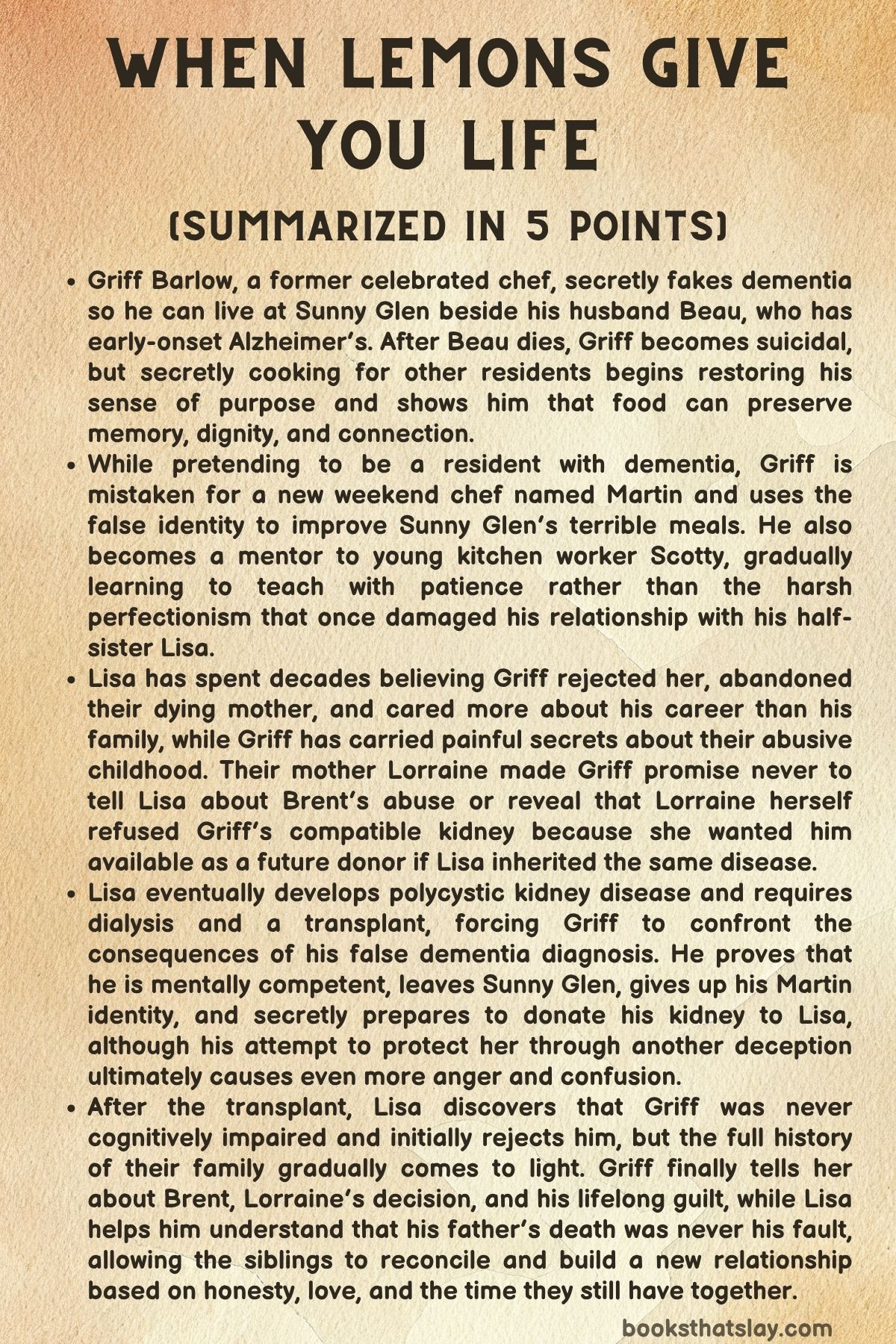
Sixty-four-year-old Griff Barlow begins the story at Sunny Glen Aged Care Facility, where everyone believes he has dementia. Once a renowned chef who ran the acclaimed restaurant Lorraine, Griff is actually completely lucid and has deliberately created the appearance of cognitive decline.
His deception began because his husband, Beau, developed early-onset Alzheimer’s and eventually required residential care. Griff could not legally move into the facility with him while healthy, and the nightly separation caused Beau terrible distress, so Griff studied dementia carefully, convinced doctors that he was ill, and gained admission to Sunny Glen.
By the time the story begins, Beau has died. Griff is crushed by grief and trapped inside the false identity he created for love, and he has prepared a notebook called the Death Menu containing possible methods of suicide.
His half-sister Lisa continues visiting him despite believing that he no longer recognises her. Their relationship had been damaged for decades, and Lisa carries deep resentment toward Griff for his emotional coldness, his apparent abandonment of their dying mother, and his refusal to forgive Lisa after a disastrous engagement party.
Lisa has recently been diagnosed with ADHD, which provides a new explanation for many of the traits she once regarded as personal failures. Her disorganisation, impulsiveness, unfinished tasks, intense emotions, and sensitivity to rejection have shaped her self-image, and she has named her cruel internal critic Ursula.
At Sunny Glen, Lisa meets Frank, a compassionate musician involved in activities for residents. Their attraction develops into a relationship in which Lisa gradually learns that being loved does not require hiding the chaotic parts of herself.
Meanwhile, Griff decides that before dying he wants one final proper meal. He secretly enters Sunny Glen’s commercial kitchen and makes the lemon tart associated with his happiest memories of Beau, including their disastrous but loving engagement.
Cooking awakens something Griff believed had died with his husband. When resident Rob wanders into the kitchen and tastes the tart, its familiar flavour briefly reconnects him with memories of his mother.
Watching food restore a moment of identity to Rob gives Griff enough purpose to postpone his suicide. Soon another resident, Gladys, asks him to help her make lenja pita for her husband Herb, and the experience again shows Griff that cooking can allow elderly people to reclaim dignity and express love.
A misunderstanding later gives Griff an unexpected opportunity. Kitchen employees Scotty and Nishan mistake him for Martin, a newly hired weekend chef whom they have never met, and Griff decides to maintain the false identity.
As Martin, he begins replacing Sunny Glen’s miserable institutional meals with carefully prepared food. He also discovers how little money is actually being spent on ingredients despite the substantial fees residents pay.
Griff becomes especially close to Scotty, a young worker who wants to become a chef. Griff initially treats him with the same impatience and perfectionism that once defined his professional kitchens, but he gradually recognises how often that attitude hurt Lisa when she begged him to teach her as a child.
Instead of dismissing Scotty, Griff becomes his mentor. His kitchen begins producing meals adapted thoughtfully for residents with different medical and dietary requirements, and food increasingly becomes part of the residents’ emotional lives rather than merely a daily necessity.
The changes are dramatic. Silvia, who constantly longs to return to Rome, tastes authentic carbonara and experiences a powerful connection to home, while Rob and other residents rediscover memories through familiar flavours.
Griff’s growing purpose exists alongside the unresolved pain of his past. Flashbacks reveal that his childhood was dominated by trauma, beginning with the death of his father in a traffic accident when Griff was eight.
Because his father had been driving to collect him, Griff convinced himself that the death was his fault. Lisa’s father Brent later reinforced this belief while physically and emotionally abusing Griff and their mother.
Griff spent much of his youth protecting Lisa from Brent without allowing her to understand what was happening. Their mother, Lorraine, eventually made Griff promise never to tell Lisa about the abuse, believing that preserving her daughter’s positive memories of her father would protect her.
That promise created a distorted family history. Lisa remembered Griff as angry, secretive, and rejecting, while Griff remembered himself as the person responsible for keeping her away from unbearable truths.
Their adult estrangement deepened when Lorraine developed hereditary polycystic kidney disease. Lisa believed Griff abandoned their dying mother to pursue his culinary career in Paris, never knowing that Griff had actually been tested as a kidney donor and was highly compatible.
Years later Beau became the emotional bridge between the siblings. He understood Griff’s hidden tenderness and repeatedly encouraged him to tell Lisa the truth, but Griff remained convinced that secrecy was safer.
At Griff and Beau’s engagement celebration, years of Lisa’s resentment erupted while she was drunk. She accused Griff of abandoning their family and kissed Beau without his consent, leaving Griff humiliated and confirming his belief that Lisa should remain outside his life.
Although Beau eventually forgave her, Griff did not. The siblings therefore carried different versions of the past for decades while still caring about each other far more than either comfortably admitted.
In the present, Lisa begins experiencing symptoms of the same kidney disease that killed Lorraine. Tests confirm autosomal dominant polycystic kidney disease, and Lisa learns that substantial kidney damage has already occurred.
Frank remains beside her as her condition worsens. When an infection causes further damage and dialysis becomes necessary, Lisa faces the possibility that she may follow the same path as her mother.
Searching Lorraine’s old medical documents, Lisa discovers that Griff had been an excellent donor match for their mother but withdrew from the donation process. Without the missing context, she concludes that Griff chose his career over saving Lorraine.
Griff eventually learns of Lisa’s illness by secretly calling her while pretending to be an old friend. He is horrified to discover that she needs a transplant and believes he would never have wanted to save her even if dementia had not made consent impossible.
At the same time, Griff discovers an old recording Beau made after receiving his Alzheimer’s diagnosis. Beau tells him that memory loss must never be confused with lost love and urges Griff to stop allowing Brent’s cruelty and old family secrets to determine his relationship with Lisa.
Griff decides to donate his kidney. To do so, however, he must destroy the dementia deception that once allowed him to remain with Beau.
He reveals the truth to Sunny Glen, undergoes medical assessment, and proves that he has no cognitive impairment. He also admits that he has been working secretly as Martin and leaves the facility after making arrangements intended to preserve its improved food program.
Griff still makes the familiar mistake of equating secrecy with kindness. He plans to donate anonymously, allow Lisa to believe he has died, and disappear after saving her.
During the transplant process, Frank unexpectedly encounters the lucid Griff and learns the truth. Although furious about the damage Griff has caused Lisa, Frank also sees that Griff has abandoned his false life and is willingly undergoing major surgery for his sister.
The transplant succeeds, but a hospital mistake leads Lisa to discover that her donor is her brother. She initially assumes Griff must have died, only to enter his room and discover him alive and fully conscious.
Griff finally admits that he never had dementia. Lisa is devastated that he allowed her to believe for more than a year that his mind had disappeared, and her anger becomes even stronger because she still thinks he deliberately refused to save Lorraine.
The truth is very different. Griff had wanted to donate to their mother, but Lorraine refused his kidney because she feared Lisa might someday inherit the disease and need it herself.
Lorraine then demanded another promise of silence. She believed Lisa would feel responsible for her death if she learned that her mother had sacrificed the possibility of transplantation to preserve Griff as Lisa’s future donor.
Griff finally recognises the destructive pattern governing his life. His mother taught him to treat secrecy as protection, and he repeated that approach with Brent’s abuse, the kidney decision, Beau’s illness, his false dementia and his attempt to donate anonymously.
After Lisa initially rejects him, Griff makes a different choice. Rather than disappearing, he publicly confesses that his dementia diagnosis was fabricated and explains why he did it.
He uses the resulting attention to criticise the treatment of elderly people, poor food standards in residential care and systems that can separate devoted couples. He admits the harm caused by his dishonesty without regretting his decision to remain beside Beau during his final months.
Scotty later visits Lisa and tells her about Griff’s secret life as a chef at Sunny Glen. Lisa learns that cooking for the residents was what stopped Griff from killing himself after Beau died and that the man she believed incapable of caring for her had been willing to sacrifice both his identity and his life to save hers.
Among Beau’s belongings, Lisa finds Griff’s suicide letter. She also discovers a childhood label she once made for his apron, preserved by Griff for decades, and realises that he did not reject her because he thought she was unworthy of love.
Griff believed that he himself was unworthy.
Lisa finally visits him before he can leave for Western Australia. Griff tells her the truth about Lorraine’s kidney decision and about Brent’s abuse, forcing Lisa to reinterpret many childhood memories she had never understood.
Lisa, in turn, tells Griff that his father’s death was never his fault. The reassurance attacks the belief that has controlled him since childhood: that people he loves suffer because of him.
The siblings finally acknowledge their mistakes, grief and love without hiding behind old promises. Griff cancels his plans to leave, and they decide that the years they lost do not have to determine the years still available to them.
In the epilogue, Griff has transformed his culinary life. Instead of pursuing prestige, he teaches nursing-home residents to cook, helping people recover confidence, memory, independence and ways of expressing affection.
Lisa finally receives the cooking lessons she wanted from her brother as a child, while Scotty continues building his career at Lorraine. Lisa and Frank become engaged, and she asks Griff to walk her down the aisle, giving the siblings a future based not on correcting the past but on finally being present for one another.
Characters
Griff Barlow
Griff is the emotional centre of When Lemons Give You Life, a man whose intimidating personality conceals decades of guilt, loyalty, tenderness, grief, and fear. His behaviour often appears selfish from the outside, but much of his adult identity has been shaped by the belief that people are endangered whenever they depend on him.
His father’s death establishes this pattern when eight-year-old Griff decides that requesting a lift indirectly caused the fatal accident. Brent later exploits that guilt, teaching Griff to regard himself as the source of every disaster surrounding the family.
Cooking becomes Griff’s safest form of communication because recipes offer order when relationships feel dangerous. He can express affection through lemon tart, Anzac biscuits, pork crackling, elaborate meals and carefully prepared dishes even when spoken affection feels almost impossible.
His relationship with Beau reveals the person hidden beneath his defensive exterior. Griff is loving, funny, attentive and fiercely devoted in private, ultimately surrendering his career and then his public identity because he cannot bear to leave Beau frightened and alone.
His false dementia diagnosis is morally complicated because it deceives Lisa, doctors and carers and consumes resources intended for genuinely impaired residents. Yet the lie also originates in a system that gives him no legitimate method of remaining with a husband whose illness has made separation traumatic.
Griff’s greatest development comes when he recognises that protection without honesty can become another form of control. By the end, he no longer assumes that loving someone gives him the right to decide which truths they can survive.
Lisa
Lisa is Griff’s emotional counterpart in When Lemons Give You Life, carrying her own distorted understanding of their family history. Where Griff responds to fear by withdrawing and controlling information, Lisa responds through attachment, persistence and an intense need for reassurance.
Her ADHD diagnosis gives her a new framework for understanding years of clutter, missed appointments, impulsive decisions, unfinished tasks and rejection sensitivity. Much of her growth involves separating neurological difference from moral failure and learning that disorganisation does not make her undeserving of respect or love.
Lisa’s resentment toward Griff is understandable because the information available to her consistently makes him appear cold. She believes he helped drive her father away, abandoned their mother, rejected her attempts at closeness and later withdrew into dementia before they could reconcile.
Her engagement-party behaviour toward Beau is one of her clearest failures. Lisa eventually accepts responsibility for the pain she caused rather than pretending Griff’s later cruelty erases her own wrongdoing.
Her kidney disease also forces her to confront her habit of caring for everyone except herself. Therapy, medical treatment and her relationship with Frank gradually help her build a sense of value that is not dependent on Griff finally approving of her.
Beau
Beau is one of the strongest moral and emotional influences in When Lemons Give You Life, even though much of his importance is revealed through memory. He sees Griff more clearly than almost anyone else and understands that the harsh chef and defensive brother are not the entirety of the man he loves.
His relationship with Griff is defined by acceptance rather than rescue. Beau does not pretend Griff is easy, but he repeatedly shows him that difficult emotions and painful history do not make someone impossible to love.
Beau also loves Lisa as a friend and recognises that both siblings are trapped by incomplete versions of their childhood. He repeatedly urges Griff to tell her the truth about Brent because he understands that silence has stopped functioning as protection.
His Alzheimer’s is especially painful because memory and communication deteriorate while his emotional nature often survives. Even when confused, Beau continues displaying kindness, humour and concern for other people.
The recording he leaves behind becomes his final intervention in Griff’s life. By insisting that forgotten memories do not equal forgotten love, Beau gives Griff permission to imagine himself as someone capable of continuing to love and live after Beau’s death.
Frank
Frank provides one of the healthiest adult relationships in When Lemons Give You Life because his affection for Lisa does not depend on an idealised version of her. He sees her clutter, anxiety, illness and emotional intensity without treating any of them as reasons to withdraw.
His experience caring for his own father gives him an understanding of the exhaustion and uncertainty surrounding illness. This allows him to support Lisa without pretending that optimism can eliminate genuine fear.
Frank is particularly important because he is willing to challenge people he loves. He confronts Lisa about delaying her kidney scan, and later confronts Griff about the harm caused by secrecy rather than accepting Griff’s explanations simply because his motives were loving.
His willingness to remain beside Lisa during appointments, dialysis and transplantation demonstrates practical commitment. At the same time, Lisa supports his professional ambitions, making their relationship reciprocal instead of presenting one person as permanent caregiver and the other as permanent patient.
Scotty
Scotty becomes the unexpected friend Griff desperately needs in When Lemons Give You Life. Initially a young kitchen employee with limited training, he gives Griff a chance to reconsider what knowledge and mentorship should mean.
Griff first treats Scotty as he once treated Lisa, assuming an inexperienced person will create problems and should therefore stay out of the way. Recognising the pattern allows Griff to change consciously, becoming patient enough to teach rather than using expertise to exclude.
Scotty, in return, provides companionship that is neither based on Griff’s celebrity nor Beau’s history with him. Their cooking lessons, conversations and movie nights allow Griff to discover that new relationships do not betray the people who have died.
Scotty also refuses to reduce Griff to either hero or liar. He is uncomfortable with the dementia deception but recognises the good Griff is accomplishing, allowing their friendship to contain moral disagreement without collapsing.
Lorraine
Lorraine is a loving mother whose decisions reveal how protective intentions can produce long-term damage. She suffers under Brent’s abuse and eventually apologises for failing to protect Griff, giving him an important affirmation regarding his sexuality.
Yet Lorraine repeatedly asks Griff to carry secrets that should never have belonged entirely to him. She demands that he hide Brent’s abuse from Lisa and later refuses Griff’s kidney while insisting that Lisa never learn why.
Her kidney decision comes from extraordinary concern for her daughter. She fears Lisa may inherit the disease and consciously preserves Griff as a potential future donor, a choice that eventually does save Lisa’s life.
The tragedy lies in Lorraine’s belief that truth itself will injure Lisa. By making Griff responsible for maintaining a false family history, she unintentionally helps create the resentment and estrangement she hoped to prevent.
Brent
Brent represents the destructive power of abuse that continues long after the abuser has physically disappeared. His violence, manipulation and homophobia shape Griff’s understanding of himself during the years when his identity is still developing.
He repeatedly reinforces Griff’s childhood belief that his father’s death was his fault. By linking ordinary family problems to Griff’s supposed defects, Brent teaches him to interpret guilt as an accurate measure of responsibility.
Brent’s effect on Lisa is different because Griff shields her from much of the violence. She retains comparatively positive memories of her father and therefore cannot understand why Griff behaves with such hostility around him.
The result is one of the story’s central ironies: Griff succeeds in protecting Lisa from witnessing much of Brent’s cruelty, but that success makes Griff himself appear cruel. Brent therefore damages the siblings’ relationship even after leaving their lives.
Allison
Allison manages Sunny Glen through rules, appearances and institutional priorities rather than genuine attention to residents as individuals. Griff understandably resents her patronising treatment and especially blames her for the destruction of Beau’s viola.
However, Allison is not presented solely as an abstract villain. Griff overhears her insecurities and recognises that some of her controlling behaviour resembles the intimidating management style he once used in professional kitchens.
That recognition matters because Griff cannot demand humane treatment from others without reconsidering his own past use of fear and authority. Allison therefore becomes both an antagonist and an uncomfortable reflection of traits Griff must reject in himself.
Gladys
Gladys helps interrupt Griff’s suicidal thinking by asking him to assist her in making lenja pita for Herb. Her blindness has limited her independence, but it has not erased the knowledge stored in years of habitual cooking.
Griff’s decision to let her perform the tasks herself is an important step in his changing understanding of care. Instead of doing everything for a vulnerable person, he helps create conditions in which she can continue doing meaningful things for herself.
Gladys also possesses an emotional directness Griff lacks. She senses that he is struggling and refuses to treat despair as a reason to stop participating in life.
Herb
Herb’s role is smaller than Gladys’s, but his reaction to her cake demonstrates why ordinary acts can carry enormous emotional weight. The familiar flavour represents years of marriage and allows Gladys to continue giving something personal even after blindness has changed her daily life.
His relationship with Gladys offers Griff a vision of enduring partnership after disability. Watching them helps him understand that love does not disappear when one partner becomes dependent on the other.
Rob
Rob is a resident with dementia whose response to Griff’s lemon tart first changes the direction of Griff’s life. A familiar taste briefly reconnects him with memories of his mother and gives Griff direct evidence that his culinary ability can still matter.
Rob also reveals Griff’s natural capacity for caregiving. Griff sings, talks and cooks for him with a gentleness that contradicts the harsh identity Griff has assigned to himself.
Through Rob, the novel shows that cognitive impairment does not erase personhood. Moments of recognition may be temporary, but the comfort created during those moments remains meaningful.
Mabel
Mabel is devoted to her brother Rob and understands the difficult ethical choices that accompany dementia care. Her decision not to tell him about Cottonmouth’s death comes from the belief that repeatedly rediscovering the loss would create suffering without lasting understanding.
Her reasoning influences Lisa when Lisa considers telling Griff about her kidney disease. Because Lisa believes Griff has dementia, Mabel causes her to question whether disclosure would help him or merely satisfy her own desire to be heard.
Mabel’s relationship with Rob also quietly affects Griff. Their visible sibling loyalty reminds him of the closeness he and Lisa might have had without decades of secrecy and resentment.
Nishan
Nishan begins as a kitchen worker operating within Sunny Glen’s low expectations. Griff’s arrival gradually encourages him to see residents not simply as recipients of meals but as people whose appetite, medical needs, memories and dignity should influence how food is prepared.
His development is important because Griff’s reforms cannot survive if they depend completely on one secret chef. By teaching Nishan and encouraging him to take greater responsibility, Griff creates the possibility that improved standards will continue after he leaves.
Silvia
Silvia is a resident whose dementia leaves her repeatedly longing to return to Rome. Her refusal to eat reflects not only physical decline but also a sense of displacement from the life through which she understands herself.
Griff’s authentic carbonara cannot literally return her to Italy, but its taste provides an emotional form of homecoming. Her response demonstrates that memory can be sensory and relational even when chronological understanding has become unreliable.
Ruth
Ruth meets Lisa during dialysis and provides companionship within an experience Lisa initially regards almost entirely with fear. Her humour and willingness to make the long treatment sessions more tolerable show Lisa that serious illness does not eliminate personality or ordinary pleasure.
At the same time, Ruth’s years on dialysis embody exactly what Lisa fears. She therefore represents both resilience and the possibility of a future Lisa desperately hopes to avoid.
Themes
Secrecy, Protection, and the Cost of Withholding Truth
Secrecy drives many of the central conflicts in When Lemons Give You Life because several characters confuse controlling information with protecting the people they love. Lorraine asks Griff to hide Brent’s abuse so Lisa can retain good memories of her father, then asks him to conceal the truth about the kidney she refused because she fears Lisa will blame herself.
Griff adopts the same reasoning throughout adulthood. He hides painful history from Lisa, refuses to explain his emotional distance, conceals Beau’s circumstances, fakes dementia and eventually attempts to donate his kidney anonymously.
None of these decisions begin with a desire to hurt Lisa. Griff repeatedly believes that he is absorbing pain on her behalf, but every secret creates an empty space that Lisa naturally fills with her own explanation.
Because she lacks the truth, she concludes that Griff does not love her, that he abandoned Lorraine for ambition and that his coldness reflects something deficient in Lisa herself. Protection therefore becomes destructive because it removes Lisa’s ability to understand events and make her own emotional choices.
Griff’s final growth depends on abandoning this habit. His public confession and later conversation with Lisa mark a shift from deciding what other people should know to trusting them with uncomfortable truths.
Food, Memory, and Human Dignity
Food functions as far more than nourishment throughout the story. Griff initially treats cooking as the professional achievement around which he built his reputation, but Sunny Glen teaches him that its deeper value lies in recognition, memory, autonomy and relationships.
The lemon tart that Griff prepares as his intended final meal becomes the first reason he chooses not to die. When Rob tastes it and briefly reconnects with his mother, Griff sees that culinary skill can reach someone even when ordinary conversation cannot.
Similar moments occur with Gladys’s cake, Silvia’s carbonara and the improved meals served throughout Sunny Glen. Familiar flavours return residents to marriages, childhoods, homes and identities that institutional routines often ignore.
The theme also challenges the idea that elderly or cognitively impaired people should simply be grateful for whatever food they receive. Griff insists that modified diets, pureed meals and restricted foods still deserve imagination and care because dignity should not disappear when physical independence does.
Cooking eventually changes Griff as much as it changes the residents. He begins the story using food as a final private comfort but ends by teaching others, sharing knowledge and allowing cooking to become a communal act rather than proof of his personal excellence.
Grief, Love, and Choosing to Continue Living
Grief initially convinces Griff that his meaningful life ended with Beau, making When Lemons Give You Life as much a story about continuing after loss as it is about reconciliation. Beau was Griff’s emotional home, the one person who consistently saw kindness beneath his anger and understood the childhood wounds governing his behaviour.
After Beau dies, Griff cannot imagine an identity that exists independently of being his husband. The Death Menu therefore reflects more than sadness; it shows Griff’s conviction that love’s ending has removed his reason to participate in the future.
His recovery does not occur through forgetting Beau or replacing him. Instead, Rob, Gladys, Scotty and the other residents gradually show him that continuing to live can carry Beau’s influence forward rather than betray it.
Beau’s recording reinforces this idea by separating memory from love and encouraging Griff to reconnect with Lisa. Even after Beau’s mind deteriorates, his love has consequences that continue affecting Griff’s choices.
By the end, grief remains part of Griff’s life, but it no longer dictates withdrawal. Teaching, friendship and reconciliation allow him to build a future that acknowledges loss without treating death as the only possible response to it.
Family Memory, Guilt, and Reconciliation
Griff and Lisa grow up in the same household but inherit radically different histories. Lisa remembers a brother who excluded her and a father whose disappearance seems connected to Griff’s hostility, while Griff remembers years spent trying to hide violence from a little sister he desperately wanted to protect.
Neither version is deliberately invented. Their memories are formed by age, incomplete knowledge, fear and decisions made by adults around them, showing how family conflict can survive for decades when people possess different pieces of the same past.
Guilt intensifies these divisions. Griff blames himself for his father’s accidental death, the pain surrounding Lorraine, the food-poisoning outbreak, Lisa’s unhappiness and nearly every tragedy within his emotional reach.
Lisa carries a different form of guilt, especially over the engagement party and her belief that her ADHD-related difficulties make her exhausting to love. Both siblings consequently interpret rejection as confirmation of negative beliefs they already hold about themselves.
Reconciliation becomes possible only when they stop treating those beliefs as unquestionable facts. Lisa can condemn Griff’s deception while recognising his suffering, and Griff can acknowledge Lisa’s mistakes without using them as permanent justification for abandonment.
Their reunion does not erase lost decades or excuse harmful choices. It gives both siblings something more realistic: the freedom to understand the past accurately and choose a different relationship while they still have time.