When She Was Ours Summary, Characters and Themes
When She Was Ours by Anna Nordberg is a novel about grief, family, moral judgment, and the difficult process of allowing other people to be imperfect. At its center is Astra Erickson, whose understanding of strength is shaped by her mother, Thea, a gifted surgeon dying of cancer.
Astra grows up believing that capability means remaining calm when others need you, yet adulthood repeatedly forces her to discover the limits of self-reliance. Across several years, relationships, betrayals, family changes, and unexpected danger challenge her ideas about guilt, forgiveness, vulnerability, and love. The novel ultimately asks how people continue living after losing someone who helped define them.
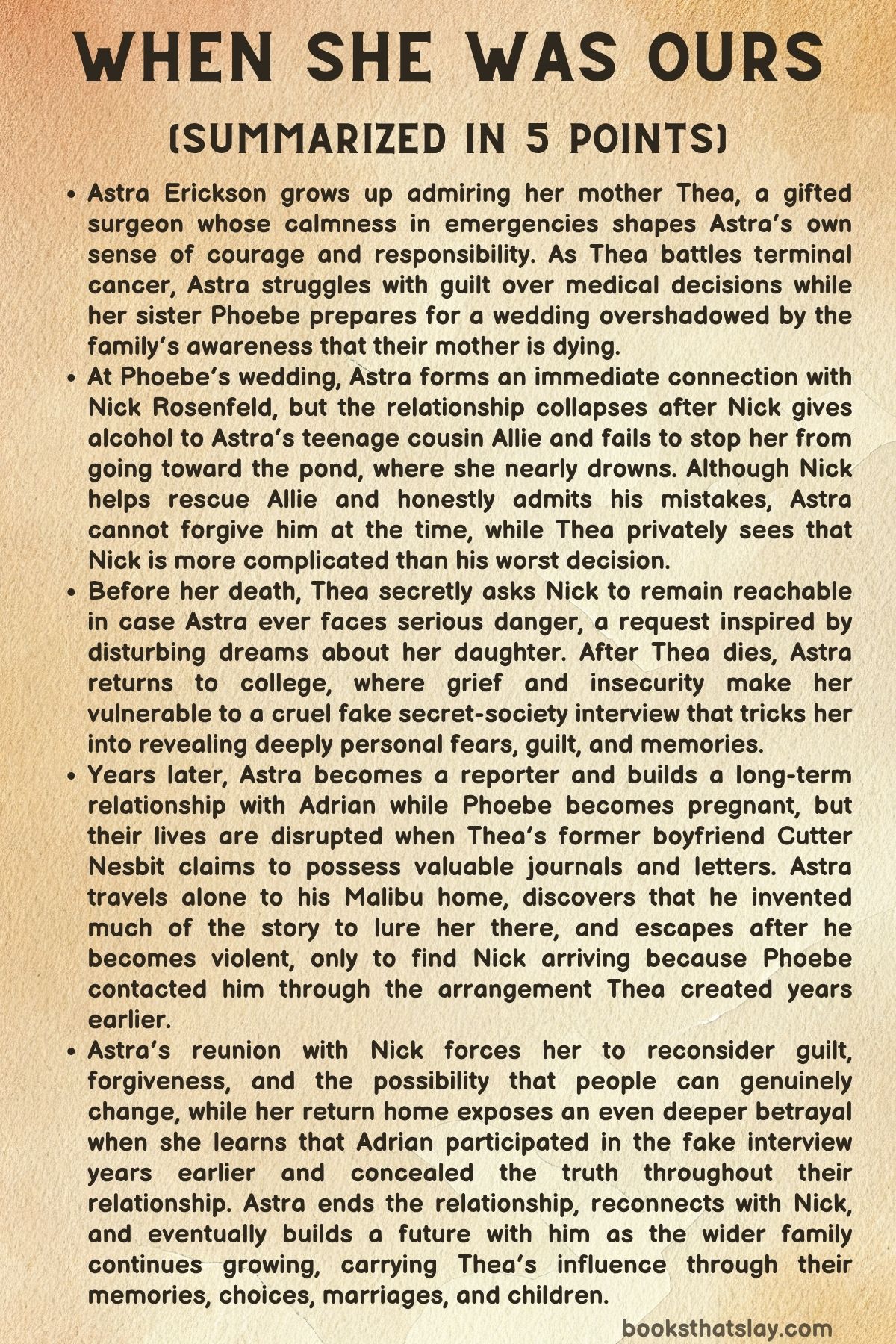
Summary
Astra Erickson grows up seeing her mother, Thea, as the person who always knows what to do. Thea is a talented surgeon whose composure in emergencies becomes almost legendary within Astra’s imagination, and Astra eventually recognizes the same quality in herself whenever another person is in immediate danger.
By the summer of 1995, however, Thea is dying from cancer. The family gathers at their New Jersey home for the wedding of Astra’s older sister, Phoebe, who is marrying Eli while trying to balance her happiness with the knowledge that her mother may not have much time left.
Thea remains determined to participate despite severe weakness. Her illness has reduced her physical independence, but it has not erased the intelligence, ambition, humor, and authority that shaped her career and family life.
Astra is especially close to her mother and has already taken an unusual position in Thea’s treatment. When an aggressive surgery is proposed as a final possibility, Astra argues against it because she believes survival is not worth any price if the procedure leaves Thea suffering without meaningful quality of life.
Thea understands that Astra’s resistance comes from love, although Astra privately fears she has somehow failed her mother. That mixture of responsibility and guilt becomes central to the way Astra responds to almost every later crisis.
At Phoebe’s wedding, Astra reconnects with Nick Rosenfeld, the son of one of Thea’s friends. Their attraction is immediate, and Astra is startled by how easily Nick makes her feel desirable and emotionally understood when she has long assumed romance might not be meant for her.
Their evening changes after Astra’s teenage cousin Allie becomes intoxicated. Nick, believing Allie is older than she actually is, gives her alcohol and later allows her to leave alone toward the pond despite recognizing that she is upset.
Allie ends up unconscious in the water after apparently striking her head beneath the dock. Nick pulls her out, and Thea takes command of the emergency despite her advanced illness, directing CPR while Astra retrieves an automated defibrillator from the wedding tent.
Their combined efforts revive Allie. Astra sees the rescue as confirmation of everything she has always believed about Thea, whose weakened body can still become secondary to her determination to save someone else.
Nick then tells Astra the truth about his earlier interaction with Allie. Although he helped save her life, he cannot ignore his own irresponsible choices, and Astra finds herself unable to separate his honesty and courage from the possibility that Allie might have died because he failed to intervene sooner.
She tells Nick not to contact her. Thea, however, sees the situation differently and worries about Astra’s tendency to divide people too rigidly into those who deserve forgiveness and those who do not.
As Thea’s illness worsens, she becomes increasingly concerned about what will happen to her family after her death. She tries to build traditions, strengthen connections between relatives, and make sure her daughters understand that life must continue without her.
She also contacts Nick privately. Disturbed by recurring dreams in which Astra appears to be running from danger, Thea asks Nick to make an unusual promise: he must remain reachable through Tom and come to Astra’s aid if she ever genuinely needs him, even if she never asks him herself.
Nick agrees. During the same conversation, he tells Thea he has decided not to attend law school and instead wants to become a doctor, and Thea cautiously encourages him while warning that medicine cannot simply become a way of punishing himself for Allie’s accident.
Thea dies in early 1996. Near the end, Astra becomes involved in discussions about whether treating an infection with antibiotics would only prolong her mother’s suffering, leaving Astra with another source of guilt even though Thea’s final illness could not have been reversed.
After Thea’s death, Astra returns to college carrying both grief and the belief that she must remain functional. She discovers that bereavement does not remove ordinary insecurity, and when she learns about Longfellow’s secret societies, she is embarrassed to realize that she still wants to be chosen.
That vulnerability is exploited. Astra receives what appears to be an invitation from Cross & Key and enters a darkened room for an interview, where supposed members gradually persuade her to reveal private information about Nick, relationships, her mother’s death, and her guilt surrounding Thea’s final treatment.
The interview is a cruel deception. When hidden participants reveal that the entire event is a prank, Astra realizes that strangers have deliberately used her desire for acceptance to obtain the thoughts she finds hardest to admit even to herself.
She returns home, where Tom helps her understand that she does not have to be the eternally capable daughter. For the first time, Astra begins to recognize that her father can carry some of her pain rather than needing protection from it.
She also discovers Thea’s old notebooks. The journals expose pieces of her mother’s earlier life, including a relationship with Cutter Nesbit, a former boyfriend who repeatedly wanted Thea to marry him even though she did not want the same future.
Several years pass. Astra becomes a reporter for the Associated Press and builds a serious relationship with Adrian, a man she met at Longfellow who initially appears to offer the patience and acceptance she needs.
Phoebe, meanwhile, struggles with infertility and with fear that she might die young like Thea if she becomes a mother. When she finally becomes pregnant, the sisters are forced to confront how deeply their mother’s death continues to shape even hopeful moments.
Cutter unexpectedly contacts them and claims to possess letters, journals, and other materials belonging to Thea. Because Astra and Phoebe remain desperate to discover more about the woman their mother was before motherhood, the possibility feels irresistible.
Cutter refuses to send the materials and insists that they visit his Malibu home. Phoebe plans to accompany Astra but develops complete placenta previa and is forbidden to fly, leaving Astra to meet Cutter alone.
At first Cutter appears welcoming. Soon, however, Astra notices contradictions in his stories, and the promised archive turns out to consist largely of meaningless scraps rather than the intimate journals he claimed to possess.
Astra realizes he fabricated the story to lure Thea’s daughters into his home. When she tries to leave, Cutter blocks the door, grabs her, and reveals his unresolved rage toward Thea for rejecting him decades earlier.
He attempts to force Astra to accept his version of Thea as a woman who betrayed him and owed him a different life. Astra refuses to apologize for her mother or allow Cutter’s resentment to replace the person she knew.
Cutter becomes physically aggressive and forcibly kisses her. Astra fights him, manages to unlock the secured front door, and escapes down the stone steps outside the house.
Waiting nearby is Nick.
After leaving law behind, Nick has become a medical student at UCLA. He has maintained the contact information Thea required, and when a frightened Phoebe realizes Astra has failed to call after visiting Cutter, the family reaches Nick.
Nick takes Astra to safety, and their reunion reveals how profoundly both of them have changed. Astra eventually learns about his secret dinner with Thea and the strange dreams that led her mother to create this unlikely safeguard years earlier.
The detail that affects Astra most is that Thea had imagined her running down stone steps from danger. Astra has just done exactly that, forcing her to reconsider the rational mother she thought she completely understood.
The discovery also answers the deeper reason Astra traveled to California. She wanted Cutter’s supposed journals to reveal an unknown version of Thea, but it is Nick who finally gives her that gift by describing a mother willing to take an irrational precaution because love mattered more to her than appearing perfectly logical.
Astra and Nick also revisit the wedding. Astra reveals that Allie eventually admitted she had deliberately tried to draw Nick away because of jealousy and that Nick had repeatedly tried to return to Astra.
Astra accepts that she once needed Nick’s mistake to make him completely unacceptable. If she admitted that he could behave badly, take responsibility, change, and remain worthy of love, she would also have had to admit that loving someone always creates the risk of disappointment.
Their unresolved attraction returns after Astra’s escape from Cutter, and Astra kisses Nick in her hotel room. Nick stops the encounter because she has just endured an assault, remains in a committed relationship, and is emotionally overwhelmed.
His restraint demonstrates the difference between who he was and who he has become. Astra returns to New York prepared to tell Adrian the truth rather than protecting herself through secrecy.
Her confession unexpectedly exposes a far greater betrayal. During their argument, Adrian reveals knowledge of private statements Astra made only during the fraudulent Cross & Key interview.
Astra realizes Adrian was one of the men in the blacked-out room.
Adrian admits that Cynthia organized the prank and recruited him and another student. He insists he regretted his participation, was the person who finally told Astra to escape, and genuinely fell in love with her afterward.
Astra does not deny that his love became real. What she cannot accept is that he spent three years benefiting from a relationship built partly upon knowledge obtained through deliberate deception while withholding the truth because confession might cost him the relationship.
The contrast with Nick becomes unavoidable. Nick confessed his wrongdoing at the wedding immediately, even when silence might have allowed him to keep Astra, while Adrian concealed his involvement precisely because honesty threatened what he wanted.
Astra ends the relationship. Soon afterward, she calls Nick, not because she has already solved her grief or decided exactly what her future will be, but because she no longer wants fear to determine whom she allows herself to need.
Years later, the family gathers at the New Jersey house for Thanksgiving. Phoebe and Eli have two children, Astra and Nick are together and planning to marry, and the extended family Thea deliberately tried to build has endured.
The pond where Allie almost died has accumulated new memories, and Phoebe can hold her baby daughter in Thea’s old room without being consumed by absence. Astra and Phoebe understand that continuing to live does not erase their mother; it allows Thea’s influence to remain active within the families, choices, memories, and relationships they have created.
Characters
Astra Erickson
Astra is the emotional center of When She Was Ours, and much of her development comes from reconsidering what strength actually means. As a child, she associates competence with Thea’s extraordinary ability to remain calm during emergencies, and Astra eventually discovers that she possesses a similar instinct whenever someone else is in danger.
Her greater difficulty lies in allowing herself to need other people. Astra is excellent at functioning during crises but often collapses only afterward, when nobody is watching, which reveals how thoroughly she has learned to separate usefulness from vulnerability.
Thea’s illness intensifies that habit because Astra becomes afraid of adding to the family’s pain. She speaks honestly about difficult medical decisions, yet the same honesty leaves her vulnerable to guilt when she later wonders whether opposing treatment or questioning antibiotics made her responsible for anything that happened.
Astra’s relationships with Nick and Adrian expose another part of this pattern. She wants emotional intimacy but fears that accepting another person’s flaws will make her foolish, so she initially finds safety in judging Nick’s mistake as permanently disqualifying.
Her later experiences teach her a more difficult form of moral judgment. Forgiveness does not require ignoring wrongdoing, and understanding another person’s complexity does not require remaining with someone who violated her trust.
By the end, Astra has not abandoned her independence. Instead, she has stopped treating self-sufficiency as proof of worth and has learned that being loved includes permitting other people to show up for her.
Thea Erickson
Thea is the defining parental presence in When She Was Ours, even though much of the story concerns what happens after her death. She is a brilliant surgeon, an ambitious professional, a devoted mother, and a woman whose authority was earned through years of training in environments where female physicians regularly faced skepticism.
Her illness forces her into the role she once controlled from the other side. Becoming a patient exposes fears that professional competence cannot eliminate, particularly her terror of leaving Tom, Phoebe, and Astra before she believes they are ready.
Thea also understands that her greatest strengths have consequences. Her habit of taking responsibility makes her want to organize holidays, preserve traditions, prepare her family for grief, and even arrange a distant safeguard for Astra through Nick.
Her relationship with Astra is especially complex because she recognizes qualities in her younger daughter that resemble her own. She admires Astra’s courage while fearing that Astra will interpret capability as an obligation to carry everyone else indefinitely.
Thea’s private dreams before her death broaden her character beyond the strictly rational physician Astra remembers. Her decision to act on an unprovable fear does not negate her scientific identity; it shows that love can make certainty less important than precaution.
Her continued presence after death comes through habits, journals, memories, stories, friendships, and decisions. The novel therefore presents Thea not as an idealized saint but as a complicated woman whose daughters continue discovering her long after she is gone.
Nick Rosenfeld
Nick’s importance in When She Was Ours comes from the way his life tests the distinction between guilt and permanent moral condemnation. At Phoebe’s wedding, he behaves irresponsibly by giving alcohol to Allie and failing to stop her from walking toward the pond, yet he also immediately risks himself to pull her from the water.
His most significant decision occurs afterward. Nick voluntarily tells Astra what happened even though he knows the truth may destroy his chance of being with her.
That willingness to accept consequences becomes the foundation of his development. Rather than demanding forgiveness, Nick lives with what he did and allows the experience to push him toward a more purposeful understanding of himself.
His decision to pursue medicine initially has some connection to guilt and admiration for Thea, but his medical training eventually becomes an authentic vocation. His careful observation of Mrs. Tannenbaum demonstrates that he has learned to transform attentiveness into useful action rather than treating medicine as personal punishment.
Nick’s promise to Thea also reveals his reliability. He keeps his contact information current for years without knowing whether anyone will ever call, and when Phoebe finally does, he immediately goes to find Astra.
His decision to stop the hotel encounter is equally important. Nick still loves Astra, but he refuses to use her fear, exhaustion, or temporary vulnerability to obtain what he has wanted for years.
By the end, his relationship with Astra becomes possible not because the wedding mistake is forgotten but because it no longer defines his entire identity. Nick shows that genuine change requires truth, responsibility, patience, and behavior sustained over time.
Phoebe Erickson Friedman
Phoebe provides a different response to grief within When She Was Ours. Where Astra often experiences responsibility through emotional restraint, Phoebe is more openly invested in building the conventional markers of adulthood that she fears her mother will not live to see.
Her marriage to Eli carries genuine love, but Thea’s illness undeniably affects Phoebe’s sense of urgency. She wants to establish a permanent family partly because death has made permanence feel precious and uncertain.
Phoebe also carries complicated guilt about being the older daughter. She worries that Astra was more present during Thea’s illness and secretly envies what she imagines as Astra’s status as the more dependable daughter.
Her pregnancy exposes the depth of her unresolved fear. Phoebe does not merely want a child; she fears becoming a mother without Thea available to teach her how, and she worries that her mother’s early death may somehow predict her own future.
The placenta previa diagnosis demonstrates how quickly joy can become attached to fear after major loss. Yet Phoebe gradually learns that grief does not need to disappear before she can become a capable mother.
Her relationship with Astra also matures through confrontation. The sisters finally admit jealousy, resentment, and old hurt instead of preserving an artificially harmonious version of sisterhood.
By the epilogue, Phoebe’s experience of holding Alice in Thea’s old room shows how memory has changed. The past still hurts, but remembering Thea as a mother now gives Phoebe comfort rather than only reminding her of what is missing.
Tom Erickson
Tom is one of the quiet emotional foundations of When She Was Ours. He spends much of Thea’s illness fearing the destruction of a life he once regarded as almost impossibly fortunate, and his grief is shaped by the knowledge that the woman around whom much of the family was organized is disappearing.
His style of care differs sharply from Thea’s. Where Thea often expresses love through conversation, insight, and direct emotional interpretation, Tom tends to care for people by cooking, preparing things, solving practical problems, and remaining physically available.
Astra initially underestimates him because she assumes he is another grieving person she must protect. After the fake interview, however, Tom becomes the parent who explicitly tells her that he can survive her anger, fear, and collapse.
That reassurance is crucial to Astra’s development. He gives her permission to stop behaving as though being a good daughter requires making herself emotionally easy to manage.
Tom also helps dismantle the idealized version of Thea that develops after death. His memories of her irritability, frustration, humor, and ordinary imperfections remind the daughters that loving someone fully does not require turning that person into a flawless symbol.
His continuing willingness to maintain Nick’s contact information also honors Thea’s final concern without interfering in Astra’s life. Tom learns to become the surviving center of the family not by replacing Thea but by allowing his own quieter form of devotion to become visible.
Adrian
Adrian initially appears to be evidence that Astra can build a secure romantic life without resolving her history with Nick. He is funny, attentive, patient about her sexual inexperience, and willing to make major changes in his own life so their relationship can continue.
Those qualities are real, which makes his eventual betrayal more difficult rather than less. Adrian is not revealed to have spent three years pretending to care about Astra; instead, the painful truth is that genuine love developed on top of an unethical foundation.
His participation in the fake interview becomes morally significant because of what he does afterward. He knows intimate information about Astra that she never knowingly chose to give him, yet he allows her to build a relationship with him without understanding the conditions under which he first encountered her vulnerability.
Adrian repeatedly considers confessing but continues postponing the truth because he fears losing Astra. His secrecy therefore becomes self-protective, even when his affection is sincere.
The difference between regret and accountability defines his role. Adrian regrets what happened and even helped Astra escape the dark room, but he does not voluntarily accept the consequences of full honesty until discovery leaves him no alternative.
Astra can acknowledge that he has changed while still leaving him. Through Adrian, the novel makes clear that understanding another person’s humanity does not create an obligation to continue a relationship after a fundamental violation of trust.
Cutter Nesbit
Cutter represents the dangerous transformation of rejection into entitlement. Decades after Thea chose not to marry him, he remains attached not simply to the memory of their relationship but to the belief that her choices wronged him.
His deception works because he understands Astra and Phoebe’s grief. By promising journals and letters, he targets their deepest desire: the chance to recover more of their mother and discover parts of her life that disappeared when she died.
Cutter wants more than attention. He wants Thea’s daughters to validate his version of history and, in effect, apologize for a woman who refused to build her life according to his desires.
His anger exposes a fundamental inability to accept Thea as an autonomous person. Whether every claim he makes about their relationship is accurate matters less than the coercive purpose for which he uses those claims.
When Astra rejects his interpretation, Cutter turns physically violent. The shift reveals that the courtesy with which he initially receives her is conditional upon her giving him the emotional submission he expects.
Astra’s escape is therefore more than physical survival. She refuses to surrender ownership of her relationship with Thea to a man who believes his disappointment gives him permanent authority over a woman who rejected him.
Allie
Allie plays a relatively brief but decisive role because her near drowning changes several lives at once. At the wedding, she is a troubled teenager dealing with her parents’ divorce, alcohol, jealousy, and resentment toward Astra’s apparently more stable family.
Her behavior toward Nick is deliberate. She lies about her age, draws him away from Astra, and later admits that jealousy motivated her efforts to test whether she could interfere with their connection.
That confession does not erase Nick’s responsibility for giving her alcohol or failing to stop her from going toward the pond. Instead, it complicates the event by showing that the disaster cannot be reduced to one person’s wrongdoing.
Allie’s later honesty matters because it forces Astra to reconsider the moral certainty she constructed around the wedding. Astra learns that Nick had repeatedly tried to return to her and that her earlier interpretation was incomplete.
Allie therefore becomes part of the novel’s broader rejection of simplified moral stories. People can be harmed and still make harmful choices themselves, just as people can behave irresponsibly without being permanently defined by their worst decision.
Eli Friedman
Eli provides stability within Phoebe’s life and gradually becomes an important part of the wider Erickson family. His love for Phoebe is open, enthusiastic, and largely free of the hesitation she sometimes brings to their relationship.
Phoebe’s decision to marry him is influenced by the instability created by Thea’s illness, but the book makes clear that grief does not manufacture her love. Instead, loss makes her pay closer attention to the kind of person she wants beside her when her original family inevitably changes.
Eli’s family also demonstrates that marriage can enlarge rather than replace family. Their willingness to support Phoebe during Thea’s illness becomes one of the structures Thea hopes will continue holding her daughter after her death.
By the epilogue, Eli is part of the ordinary continuity Thea wanted for her children. His marriage, children, and participation in the extended family show that survival after bereavement often depends on relationships that grow around the spaces left by loss.
Farris
Farris is Thea’s longtime friend and one of the strongest connections to the person Thea was before becoming primarily known to Astra and Phoebe as their mother. Their friendship began during medical training, when both women encountered prejudice and exclusion within institutions that were not designed to welcome them.
Farris helps reveal Thea as an ambitious professional rather than merely a dying parent. She knows the physician, friend, student, and young woman whose history extends far beyond what Thea’s daughters witnessed.
She is also willing to push Thea toward emotional help. By encouraging therapy, Farris gives her friend another way to confront fears and unresolved feelings that medical knowledge cannot solve.
Her importance lies partly in demonstrating that a person’s identity is distributed across many relationships. Astra and Phoebe can never possess every version of their mother because some parts of Thea belong to friendships that began before the daughters existed.
Sonia
Sonia is one of Astra’s most dependable friends at Longfellow. Her support is practical rather than dramatic, and that quality makes her especially useful to someone who dislikes becoming the center of concern.
After Thea dies, Sonia understands that helping Astra return to ordinary life does not mean pretending the death never happened. She encourages social activity while also creating ways for Astra to leave situations without having to explain herself.
Sonia is protective when Cynthia begins behaving strangely, and she later challenges Astra’s instinct to cut herself off from Nick merely because vulnerability has once again become frightening. She recognizes that Astra sometimes mistakes withdrawal for safety.
Through Sonia, the story shows the importance of friendships that do not attempt to solve grief. She cannot replace Thea or make Astra’s losses disappear, but she can remain available while Astra rebuilds an ordinary life around them.
Cynthia Wolf
Cynthia begins as an academic and social rival whose jealousy gradually becomes malicious. Her conflict with Astra intensifies after a literature discussion in which Atticus supports Astra’s interpretation, making Cynthia feel humiliated and threatened within a relationship Astra barely understands.
Her decision to organize the fake Cross & Key interview transforms ordinary jealousy into deliberate cruelty. She exploits Astra’s grief, insecurity, desire for belonging, and uncertainty about relationships.
Cynthia’s scheme is especially damaging because it does not merely embarrass Astra publicly. It encourages her to reveal private guilt under circumstances deliberately designed to make confession feel safe.
Her actions also become the hidden origin of Astra’s relationship with Adrian. Even after Cynthia disappears from the immediate story, the consequences of her retaliation continue shaping Astra’s emotional life for years.
Elizabeth
Elizabeth, Allie’s mother and Thea’s sister, offers another perspective on parenting during crisis. She worries that Allie’s anger after her parents’ divorce reflects failure, especially when she compares her daughter with Thea’s apparently composed children.
Thea challenges that assumption by suggesting that a child’s willingness to rage at a parent can indicate trust. The observation becomes especially meaningful because Thea misses the ordinary conflicts that disappeared once her daughters became frightened of upsetting their dying mother.
Elizabeth’s terror during Allie’s near drowning also mirrors Thea’s fear of losing her children. The emergency temporarily erases every disagreement and reduces parenthood to the unbearable possibility that a child can disappear in a matter of moments.
Jordan
Jordan is connected to Astra through both family friendship and Longfellow. As Farris’s son, he represents another link between Astra’s college life and the history her mother built long before Astra understood it.
His membership in a secret society helps intensify Astra’s complicated feelings about exclusion and belonging. When Astra believes Cross & Key has finally noticed her, part of the invitation’s power comes from her knowledge that such institutions helped shape relationships in the previous generation.
Jordan is also the person who finds Astra immediately after the fraudulent interview and simply holds her while she is shaking. Like Sonia, he demonstrates a form of friendship that does not demand explanation before offering comfort.
David Wanabo
David Wanabo is important both to Thea’s medical story and to Astra’s eventual release from guilt. As a surgeon willing to attempt highly aggressive operations on advanced cancer patients, he represents the possibility of extending life at enormous physical cost.
Thea initially considers his procedure because she cannot bear leaving her family without trying every possibility. Astra’s opposition makes her fear that she has somehow failed her mother by arguing against one last chance.
David later gives Astra an essential piece of information: Thea respected her objections and understood the courage required to say what others were afraid to say. His reassurance helps Astra separate loving someone from automatically supporting every available attempt to extend life.
Ed Sobel
Ed Sobel is a professional mentor whose advice becomes unexpectedly important during Astra’s trip to California. As an experienced reporter, he recognizes both her emotional investment in Cutter’s claims and the danger of approaching a situation with a predetermined story.
He encourages Astra to remain a daughter while also keeping part of her reporter’s attention active. That advice helps her notice contradictions in Cutter’s account instead of forcing scattered details into the hopeful narrative she and Phoebe want to believe.
Ed therefore represents a mature form of the competence Astra admires. Professional skill is not about knowing every answer in advance; it is about remaining observant enough to recognize when the evidence requires a different conclusion.
Charlie
Charlie first appears as one of Eli’s friends and initially leaves an unimpressive impression on Nick. Years later, their unexpected friendship in Los Angeles gives Nick companionship during the demanding isolation of medical school.
Charlie also recognizes that Nick never fully stopped loving Astra. His presence shows that Nick’s life does not simply freeze while he waits for the past to return; he develops friendships, professional commitments, and an independent identity.
Through Charlie, Nick’s continuing attachment to Astra is placed in a wider adult life. Nick can love her without making that love his only purpose, which is part of what eventually allows their reunion to occur on healthier terms.
Grandy
Grandy, Thea’s mother, initially appears emotionally restrained, and Thea carries a lifelong desire to hear affection stated more directly. Their relationship demonstrates that love can exist even when people fail to express it in the form another person most needs.
As Thea approaches death, mother and daughter finally speak more openly. Grandy tells Thea that losing her will break her heart, giving Thea the explicit acknowledgment she has wanted since childhood.
Her stories also reveal unexpected parts of her own past, including political activism that surprises the family. Like Thea’s journals, these revelations reinforce the idea that parents remain larger and less fully knowable than the identities their children assign to them.
Themes
Grief, Memory, and Continuing Bonds
Grief in When She Was Ours is not presented as a temporary emotional state that ends once enough time has passed. Astra and Phoebe continue encountering Thea inside ordinary experiences: romantic decisions, medical fears, family holidays, professional choices, motherhood, clothing, photographs, notebooks, and even imagined conversations.
The novel repeatedly rejects the idea that healthy survival requires severing this connection. Astra can move forward precisely because she gradually understands that remembering Thea and building a life without her are not opposing actions.
The sisters initially search for physical access to their mother through journals and letters because they hope enough information might compensate for the future conversations they can never have. Cutter exploits this longing by promising them an archive that appears capable of restoring the lost woman.
When the box proves nearly meaningless, Astra confronts a painful limitation. No collection of documents could ever reproduce a person completely, because Thea existed differently as daughter, sister, doctor, friend, wife, lover, mother, and private individual.
The epilogue shows a more sustainable relationship with memory. Phoebe can hold Alice in Thea’s room and imagine being held by her own mother without becoming trapped in despair, while Astra and Nick can visit the pond without allowing its worst memory to dominate the place forever.
Grief remains present, but memory becomes something the characters can carry rather than something that prevents movement. Thea’s absence is permanent, yet so is the influence of having been loved by her.
Responsibility, Capability, and the Burden of Strength
Astra grows up admiring capability because Thea appears able to act decisively when everyone else is frightened. That quality becomes part of Astra’s identity, particularly when danger requires immediate action.
The difficulty begins when Astra extends emergency competence into an everyday moral obligation. She starts believing that being strong means anticipating everyone’s needs, minimizing her own, making difficult decisions, and preventing her pain from becoming somebody else’s burden.
Thea recognizes the danger because she shares the same instinct. Her dying letter warns Astra that capable people are often expected to carry too much, and much of Astra’s later development proves how accurate that warning is.
Astra repeatedly assumes responsibility for events beyond her control. She feels guilty for opposing Thea’s surgery, questions her role in the decision about antibiotics, judges herself for what she revealed during the fake interview, and later worries about choices surrounding Cutter.
Phoebe eventually identifies the psychological appeal of this habit: blame can feel easier than randomness. If Astra caused something, then the world remains controllable; accepting that terrible events can occur without a single responsible person is more frightening.
Tom helps Astra redefine strength by insisting that he can handle her pain. Nick reinforces the lesson by appearing when she needs help without treating her need as weakness.
The novel therefore moves from capability as solitary control toward capability as something shared. Real strength includes judgment, courage, honesty, boundaries, and the willingness to let another person carry part of the weight.
Moral Judgment, Accountability, and Forgiveness
When She Was Ours repeatedly places Astra in situations where someone has done something genuinely wrong without becoming reducible to that act. Nick, Adrian, Allie, and even Astra herself force her to confront the difference between understanding wrongdoing and excusing it.
Nick provides the clearest example of accountable change. His behavior toward Allie at the wedding is irresponsible, but he confesses voluntarily, accepts Astra’s rejection, changes the direction of his life, and continues behaving according to the lessons he learned even when nobody is rewarding him for doing so.
Adrian offers a deliberate contrast. He also regrets a cruel act and becomes a more caring person, but he hides the truth because honesty might cost him the relationship he values.
Astra therefore does not conclude that one man is flawless and the other irredeemable. Instead, she recognizes that accountability is measured partly by what people are willing to sacrifice in order to tell the truth.
Her decision to leave Adrian demonstrates an equally important distinction between forgiveness and reconciliation. She can believe that his love was genuine and that he is no longer exactly the young man who entered the blacked-out room while still deciding that she cannot remain with him.
Astra extends the same principle inward. She learns to stop treating her own imperfect thoughts, mistakes, fears, and moments of selfishness as evidence that she is morally defective.
The novel presents mature judgment as the ability to see complexity without abandoning boundaries. Compassion becomes stronger, not weaker, when it exists alongside responsibility.
Vulnerability, Trust, and the Changing Meaning of Family
Astra spends much of the story fearing vulnerability because openness repeatedly creates opportunities for pain. Her attraction to Nick, the fake interview, her relationship with Adrian, and Cutter’s manipulation all involve people gaining access to parts of her that she normally keeps protected.
The dark-room prank is especially damaging because it teaches her that sincerity can be weaponized. Astra enters believing she has been chosen and leaves knowing that strangers deliberately manufactured safety in order to make her expose the parts of herself she most fears being judged for.
Yet the story refuses the conclusion that permanent emotional closure would make her safer. Sonia, Jordan, Tom, Phoebe, Nick, and others repeatedly demonstrate that trust is also how Astra survives experiences she cannot manage alone.
Family undergoes a similar transformation. At first Astra understands it primarily through Thea, Tom, and Phoebe, making Thea’s death feel like the destruction of the structure itself.
Thea deliberately resists that possibility by strengthening connections between the Ericksons, Eli’s family, old friends, and future generations. The large Thanksgiving gathering in the epilogue proves that this work succeeded.
Family therefore becomes less about preserving one fixed arrangement and more about allowing a network of care to expand. Eli’s relatives become Phoebe’s family, Nick returns in an unexpected role, children arrive, friendships endure, and Tom becomes more emotionally available to his daughters.
The final vision does not restore what death removed. It shows something more realistic: the family changes shape, carries its dead within memory, and continues creating relationships strong enough to make vulnerability possible.