Buyer Beware Summary, Characters and Themes
Buyer Beware by Catherine Ryan Howard is a psychological crime novel built around a house that carries decades of concealed violence.
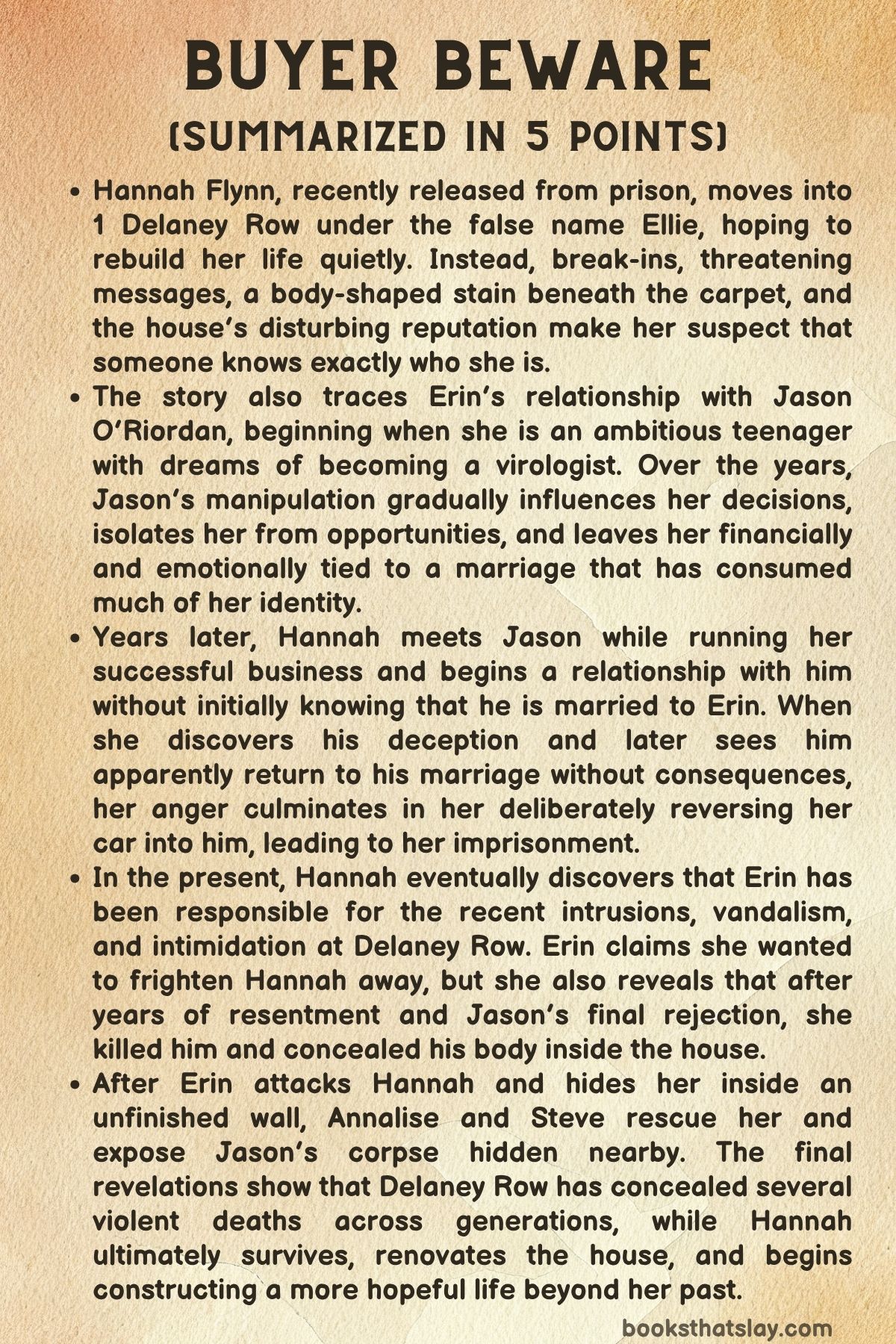
The story follows Hannah Flynn, a woman recently released from prison who moves into 1 Delaney Row under a false name, hoping to rebuild her life without attracting attention. Her arrival instead brings break-ins, threatening messages, suspicious neighbours and the return of people connected to her past. Running alongside Hannah’s present is the story of Erin, whose long marriage to Jason O’Riordan slowly strips away her ambitions and independence. The novel examines manipulation, rage, secrecy, female autonomy and the lasting consequences of abuse.
Summary
A woman calling herself Ellie arrives at 1 Delaney Row with little money, almost no belongings and an intense determination to remain unnoticed. The neglected house is the first property she has ever owned, yet instead of feeling secure, she chooses the unfinished office as her bedroom because its door locks, while her new neighbour Alex becomes concerned after seeing a suspicious man near the property.
Ellie quickly learns that privacy will be difficult to maintain. Alex adds her to a neighbourhood messaging group, his sister Sophie becomes curious about how Ellie supposedly bought a house that had recently been available to other bidders, and elderly neighbour Annalise posts a disturbing message suggesting that the house has been unhappy for a very long time.
The house itself soon provides an even more alarming clue. Beneath the loose carpet in an upstairs bedroom, Ellie discovers a large faded mark resembling the outline of a human body, while a nighttime intruder later enters through the patio door, climbs the stairs and violently attempts to open Ellie’s locked bedroom door before Alex frightens the person away.
Running beside these events is the earlier life of Erin, who at eighteen is ambitious, academically driven and determined to become a virologist. Her plans begin changing after she falls in love with Jason O’Riordan, an older student whose charm makes it easy for Erin to overlook inconsistencies in his stories and reinterpret uncomfortable experiences so that their relationship continues to fit the romantic version she wants to believe.
Jason’s influence gradually reaches beyond romance and into Erin’s choices. When she has an opportunity to work in Paris, his disappointment and guilt make her abandon the plan, and over the following years she gives up increasingly large pieces of the adventurous future she once imagined, eventually moving in with him, marrying him and accepting a life that she later realizes she never consciously chose.
Back at Delaney Row, Ellie becomes increasingly disturbed by questions surrounding the property. She discovers that the house has a reputation among a group called the Murder House Club, whose members discuss stories of disappearances, possible killings and violent incidents associated with the building, including an abusive man named Billy Creen who vanished decades earlier and a later incident involving a blood-covered woman fleeing the house.
The danger becomes more personal when Ellie’s house is deliberately wrecked. Garda Murphy becomes suspicious of Ellie’s refusal to report the attacks properly and demands identification, while Alex’s continued kindness finally persuades her to reveal part of the truth: Ellie is actually Hannah Flynn, and she has recently been released from prison.
Alex already suspects this because Sophie researched the house and discovered that Hannah has legally owned it since 2016. Hannah explains that she did not knowingly buy the property; Jason secretly purchased it during their relationship and registered it in Hannah’s name through fraudulent paperwork, leaving her with ownership after his later attempt to sell the house exposed what he had done.
Hannah’s connection to Jason began years earlier, when she was a successful entrepreneur running a homewares company called Curated. She had built an independent adult life and rejected the assumption that marriage or motherhood was necessary for fulfillment, but meeting Jason at a business event changed her routines when he presented himself as an intelligent, supportive businessman who appeared genuinely interested in her achievements.
Their relationship intensified quickly, and Jason eventually showed Hannah 1 Delaney Row as a house he claimed to have bought for himself. Only after months together did he confess that he was married to Erin, insisting that the marriage was effectively over and portraying his wife as difficult and unstable, while claiming financial complications connected to his successful company Shreddr prevented an immediate divorce.
Erin, meanwhile, had helped make Jason’s success possible. She supported the household financially, borrowed money so he could invest in the business he created with Thomas, and watched Shreddr become enormously successful while her role disappeared from the public version of Jason’s rise and Jason created a professional and social life from which his wife was increasingly excluded.
When Erin began suspecting that Jason was cheating, she visited Hannah’s shop without revealing her identity and found evidence supporting her fears. Jason nevertheless talked her out of trusting her own conclusions, turning the argument against Erin until she questioned herself, while Hannah remained unaware that the distressed customer she had met was Jason’s wife.
Hannah eventually ended the affair after Jason became physically threatening during an encounter at Delaney Row, but the emotional damage remained severe. Watching Jason apparently resume a happy married life with Erin while Hannah carried the shame of the affair enraged her, so she later approached Erin directly, revealed the relationship and arranged for both women to confront Jason at the house.
Erin believed Hannah’s account but pretended to side with Jason because she had decided to remain in the marriage temporarily and protect her financial interests before leaving him. Hannah misunderstood Erin’s performance, and when she saw Jason standing behind her car with the expression she associated with his arrogance and manipulation, years of anger erupted into one violent decision: she deliberately reversed into him.
Hannah was eventually convicted of dangerous driving causing serious bodily harm and sentenced to eight years in prison. The media reduced her life to the story of a jealous mistress trying to kill a married man, her company disappeared, most of her friendships collapsed, and after nearly seven years she emerged with almost nothing except the unexpected ownership of Delaney Row.
In the present, Hannah’s attempts to begin again become increasingly dangerous. Someone paints an insult on her bedroom wall, Jason suddenly appears to have returned from Australia, and Hannah begins suspecting several people around her, including Sophie, Annalise, members of the Murder House Club and Jason himself.
The body-shaped stain also proves more disturbing than expected. A crude chemical test carried out by the Murder House Club reacts with the stain, suggesting organic material may once have been present, and Hannah begins wondering whether Erin, who has largely disappeared since moving overseas with Jason, could somehow be connected to it.
At a neighbourhood party, Annalise gives Hannah an unexpected warning: she does not want Hannah driven out of the house at all. Instead, she desperately wants Hannah to stay, stop investigating and keep the police away, but before she can explain why, Hannah’s criminal history is anonymously posted to the entire neighbourhood group, exposing the identity Hannah had worked so hard to conceal.
Hannah assumes Jason is responsible and decides she can no longer hide anything from Garda Murphy. When she returns home, however, Erin appears and asks to speak privately, only for Murphy to send Hannah security footage revealing that Erin herself entered Delaney Row during the night of one of the major break-ins.
Confronted with the evidence, Erin admits everything about the recent intimidation. She entered the house using old keys, tried Hannah’s locked door, destroyed the kitchen, smashed the mirror, painted the insult on the wall and leaked Hannah’s criminal history, claiming that she had been trying to frighten Hannah away before the house and Jason could damage her further.
Erin then reveals a far darker truth. Years after Hannah’s conviction, Jason and Erin’s marriage finally collapsed completely, and when Jason told Erin that he had never truly valued her and had remained married only because it served his financial and legal interests, she confronted the devastating reality of having sacrificed two decades of her life to a man who considered her disposable.
Erin killed Jason with a heavy tool inside Delaney Row. She later concealed what she had done with Annalise’s assistance, but Hannah’s growing interest in the house threatened to expose the secret, leading Erin to attack Hannah with Sophie’s drill and hide her injured body inside the unfinished office wall.
Hannah wakes trapped inside the narrow wall cavity and realizes Erin expected her to die there. Annalise and Steve arrive, break through the wall and rescue her, but the opened cavity reveals something even more horrifying beside the place where Hannah had spent her first nights in the house: Jason’s wrapped corpse had been hidden only inches away from her.
The discovery also exposes the reason Annalise has spent years protecting Delaney Row from police attention. Annalise was once married to Billy Creen, a violently abusive man whom she killed in 1968 before burying him beneath the property, while Steve later killed his own abusive father there, leaving several generations of concealed deaths connected to the same address.
Annalise had previously discovered Erin after Jason’s murder and helped her hide his body because any police investigation might uncover the older crimes. Each concealed act therefore created another reason to protect the house, until Erin’s attack on Hannah brought the entire structure of secrecy close to collapse.
Hannah ultimately chooses not to reveal everything she has learned. Erin is charged with assault and placed in a secure psychiatric unit, while Hannah renovates Delaney Row, moves into a nearby apartment and begins rebuilding a life that finally includes work, friends and future plans rather than mere survival.
Characters
Hannah Flynn / Ellie
Hannah is the central perspective through which much of Buyer Beware examines reinvention, shame and responsibility. Before meeting Jason, she is financially independent, professionally successful and confident that marriage and motherhood are not requirements for a meaningful life, but her involvement with him damages her emotional stability, public identity, friendships and ultimately her freedom.
Her greatest complexity comes from the fact that she is both harmed and morally responsible for serious harm herself. Hannah spends years psychologically softening the truth of the collision, yet her conversation with Erin eventually forces her to acknowledge that reversing into Jason was a deliberate act of rage, even if it lasted only a few seconds.
Prison strips away the identity Hannah once built through career, friendships and material independence, making “Ellie” less a simple disguise than an attempt to construct a person who can exist beyond scandal. Her development lies in moving from defensive isolation toward a more honest acceptance of her past while still refusing to let that past become the only definition of who she can be.
Erin
Erin is one of the book’s most psychologically layered characters because the hopeful eighteen-year-old seen at the beginning is almost unrecognizable in the damaged woman who confronts Hannah years later. In Buyer Beware, her life demonstrates how repeated compromises can become a form of gradual self-erasure, especially when control is disguised as concern, romance or partnership.
Jason rarely needs to issue direct commands because Erin learns to reshape her own decisions around his reactions. She abandons Paris, reduces her professional ambitions, financially supports him, funds his business opportunity and gradually loses access to the independent identity she once imagined, while repeatedly rewriting painful experiences so that staying with him remains emotionally possible.
Her murder of Jason is therefore presented not as an isolated burst of anger but as the catastrophic endpoint of decades of accumulated resentment. That history explains Erin without excusing her, especially because her later treatment of Hannah shows that victimhood does not prevent a person from becoming controlling, deceptive and violent toward someone else.
Jason O’Riordan
Jason is frightening because much of his control operates through ordinary social charm rather than openly monstrous behavior. Different people experience different versions of him: Hannah sees an attentive businessman who respects her success, Erin once sees an exciting romantic partner, colleagues see a charismatic entrepreneur, and outsiders are repeatedly encouraged to view the women around him as difficult.
His main technique is reality management. When Erin becomes suspicious, he produces explanations for every clue, reframes her reasonable doubts as emotional instability and makes her apologize, while he similarly tells Hannah that Erin is unstable and that his marriage is effectively over.
Jason’s final cruelty toward Erin reveals the emptiness beneath years of manipulation. He admits that he remained with her not from loyalty but because doing so protected his finances and reputation, confirming that he repeatedly treated relationships according to their usefulness to him.
Alex
Alex functions as a counterpoint to Jason because his interest in Hannah is expressed primarily through practical care rather than possession. He notices danger, helps secure her house, offers furniture, provides shelter and repeatedly respects the fact that Hannah may not be ready to explain herself.
His kindness is especially important because Hannah initially interprets closeness as a threat to independence or as a debt she will eventually be forced to repay. Alex gradually demonstrates that support does not have to involve manipulation, and Hannah accepting his hand near the end suggests a cautious reopening toward trust rather than an immediate romantic resolution.
Annalise
Annalise first appears threatening because she knows too much about the house, communicates in warnings and repeatedly tries to prevent Hannah from involving the Gardaí. Her secrecy initially resembles complicity with whoever is frightening Hannah, but the final revelations show that Annalise has spent most of her adult life protecting a chain of hidden crimes.
Her origin as Billy Creen’s abused wife changes the meaning of her behavior without making it morally simple. She killed the man who brutalized her when meaningful protection was unavailable, then buried him beneath the property, after which every later crime connected to Delaney Row threatened to expose the first one.
Annalise therefore becomes both guardian and prisoner of the house. Her efforts to protect Erin, Steve and finally Hannah emerge from empathy for people pushed toward desperate violence, but that empathy also requires deception and the concealment of deaths.
Sophie
Sophie initially appears suspicious because she wanted to buy Delaney Row and reacts strongly when Hannah suddenly occupies it. Her investigation through the Land Registry causes her to suspect that “Ellie” is a squatter, leading indirectly to increased Garda attention and making her seem like a possible source of the harassment.
Yet Sophie’s actions are largely grounded in understandable suspicion rather than malice. She represents one of several characters whose ordinary behavior becomes threatening when filtered through Hannah’s fear, incomplete information and awareness that exposure could destroy her attempt at a fresh start.
Steve
Steve is introduced as the most openly hostile member of the Murder House Club and is identified by Alex as the man who trespassed at Delaney Row. His suspicious conduct makes him an obvious candidate for Hannah’s harassment, but his real connection to the house is older and more serious.
The ending reveals that Steve belongs to the family who once lived there and killed his abusive father. Like Annalise and Erin, he is connected to violence that developed inside an abusive domestic relationship, and his willingness to help repair the wall after Hannah’s rescue shows how deeply he remains committed to preserving the house’s accumulated secrets.
Sophie and Alex’s Relationship
The siblings respond to Hannah in opposite ways that help shape the uncertainty surrounding her arrival. Sophie investigates and distrusts, whereas Alex responds first to visible vulnerability and practical danger, creating a useful contrast between suspicion and empathy.
Their presence also demonstrates how little control Hannah has over the identity she tries to construct. Even without journalists or Jason appearing, ordinary curiosity and publicly available property information are enough to begin dismantling her cover.
Nicole
Nicole represents Hannah’s lost social world and the complicated possibility of repairing it. She admits that the old friendship group judged Hannah for continuing the affair and distanced themselves partly because supporting her publicly would have forced them to confront behavior they condemned.
At the same time, Hannah correctly identifies that the estrangement began earlier, when her friends increasingly treated marriage, children and domestic milestones as more significant than Hannah’s business achievements. Nicole’s return therefore does not erase the failures of the friendship, but it creates a path toward a more honest relationship based on acknowledging resentment rather than pretending it never existed.
Deirdre Harrington
Deirdre functions as a practical link between Hannah, Jason and the legal history of Delaney Row. As the estate agent, she provides information that repeatedly alters Hannah’s understanding of the house, including the limited number of keys, the public nature of property ownership and the house’s reputation among people fascinated by violent properties.
She also matters because Jason had been communicating with her during his relationship with Hannah, showing that his property deception was not impulsive but part of a sustained secret life.
Garda Murphy
Garda Murphy begins as a source of fear because Hannah associates official scrutiny with the possible destruction of her new identity. Her questions appear intrusive from Hannah’s perspective, but Murphy is actually responding to repeated inconsistencies surrounding break-ins, identity and ownership.
As the plot develops, Murphy becomes one of the few characters steadily working from evidence rather than rumor. The security footage she obtains ultimately exposes Erin as the intruder, making Murphy an important contrast to both Hannah’s increasingly elaborate suspicions and the Murder House Club’s speculative theories.
Garda Grennan
Garda Grennan plays a smaller role but contributes to the pressure surrounding Hannah’s false identity. His presence alongside Murphy reminds Hannah that every interaction with law enforcement could expose the gap between “Ellie” and the woman whose conviction once attracted public attention.
Thomas
Thomas is essential to Jason’s transformation from frustrated employee to successful businessman. His meal-preparation concept becomes the basis for Shreddr, while Erin’s borrowed money allows Jason to match Thomas’s investment and participate in the company.
Thomas also indirectly exposes Jason’s distorted self-image. Years later, when Shreddr collapses and Jason can no longer rely on its success, Erin realizes that the entrepreneurial brilliance Jason associated with himself may have belonged largely to Thomas.
Monica
Monica has a limited role but provides Erin with an important moment of recognition. At dinner in Thomas’s apartment, Monica knows details about Jason’s tastes, routines and shared experiences that Erin herself does not know, revealing how thoroughly Jason has constructed a life away from his wife.
Her significance lies less in her individual personality than in what Erin sees through her. Monica becomes accidental evidence that Erin is no longer a meaningful participant in Jason’s emotional or social world.
Lisa
Lisa is part of Erin’s younger life, when friendship, study and professional possibility still occupy significant space beside Jason. Her offer of work in Paris gives Erin a genuine chance to move toward the adventurous future she imagined, making Erin’s decision to abandon it one of the earliest visible sacrifices she makes for the relationship.
Later, Lisa tells Erin that she did not simply drift into her marriage but repeatedly chose Jason. The observation is uncomfortable because it restores agency to Erin at the very moment when Erin wants to view herself as someone carried passively into a life she never selected.
Sharon
Sharon recognizes the dangerous implications of Jason’s influence earlier than Erin does. When Jason pressures Erin to stop smoking, Sharon asks what would happen if the next thing he demanded she abandon were something more important.
Her question identifies the pattern before its consequences become severe. What initially looks like concern for Erin’s health contains the larger assumption that Jason is entitled to determine whether Erin’s choices make her worthy of being his girlfriend.
Mary
Mary, Hannah’s mother, embodies many of the social expectations Hannah has resisted throughout adulthood. Her assumptions about marriage and motherhood contribute to Hannah’s frustration with a culture that treats a woman’s relationship status as more meaningful than professional achievement or self-determined independence.
Mary later condemns Hannah’s affair, reinforcing Hannah’s sense of being judged from every direction. Yet Hannah’s reactions also reveal how strongly she wants acceptance from the very people whose standards she claims not to value.
Tara
Tara is one of Hannah’s long-standing friends and represents the gap that has developed between Hannah and women whose adult lives followed more conventional paths. Her drunken question about whether Hannah feels sad or lonely because she is single irritates Hannah because it assumes independence must conceal private disappointment.
Tara is therefore less an antagonist than an example of how ordinary assumptions can become alienating. She struggles to imagine a model of fulfillment different from her own.
Esther
Esther, Hannah’s employee at Curated, belongs to the professional life in which Hannah feels most fully recognized. Hannah talks to her about meeting Jason because Esther exists outside the older friendship group whose members have increasingly made Hannah feel that romantic developments matter more than business achievements.
Her small role helps establish the contrast between Hannah’s chosen adult community and the friendships she maintains largely because of shared history.
Bob
Bob is one of the Murder House Club members and initially appears knowledgeable enough for Hannah to take his ideas seriously. He explains theories about stigmatized properties and later gives Hannah information that shapes her thinking about the body-shaped stain.
The later realization that the group relies heavily on rumor and amateur investigation exposes the danger of confusing confidence with expertise. Bob is not malicious, but his speculation helps Hannah build theories that distract her from the actual threat.
Richard
Richard is another member of the Murder House Club whose presence contributes to the group’s appearance of collective authority. Because several men confidently repeat the same local stories and investigative claims, Hannah initially gives those stories greater credibility than they deserve.
His role reinforces the novel’s interest in how stories gain power through repetition. An uncertain rumor can begin to feel like established history when enough people discuss it with certainty.
Mikey
Mikey belongs to the same amateur circle and helps create the unsettling atmosphere surrounding Delaney Row. Like Bob and Richard, he participates in a community fascinated by violent places, turning private suffering into material for theories, meetings and investigation.
His limited characterization is purposeful because the club functions partly as a collective. Their fascination with hidden crimes is both useful and invasive, particularly for Hannah, whose own life has already been converted into public entertainment.
Billy Creen
Billy Creen never appears alive in the present story, but his violence establishes the oldest known layer of Delaney Row’s history. He brutally abuses Annalise at a time when she has little meaningful protection or social support, eventually driving her to kill him and conceal his body beneath the property.
His legacy matters because the first secret creates the conditions for later secrets to be protected. Decades after his death, fear of discovering Billy’s remains still influences decisions involving Erin, Jason, Steve and Hannah.
The O’Leary Father
The unnamed O’Leary father extends the pattern established by Billy Creen. His abuse ends when his son Steve kills him, creating another concealed death associated with the same property and another reason for people connected to the house to resist police scrutiny.
The absence of extensive personal detail keeps the focus on the repeating structure of domestic violence. Different families occupy the house, yet similar forms of domination produce similarly desperate reactions.
Olive Williams
Olive Williams is a successful entrepreneur encountered by Hannah at the business event where she meets Jason. Although Olive has little direct role in later events, the drunken behavior of her husband creates the social moment that allows Jason and Hannah to begin talking.
Her presence also places Hannah within a world of professional women whose success exists beside relationships that may be far less impressive from the outside than their public appearances suggest.
Themes
Control, Abuse, and the Erosion of Choice
Buyer Beware presents control as something that can operate long before physical violence appears. Jason rarely needs to order Erin directly because he learns to make disappointment, affection, self-pity and accusation do the work for him, gradually teaching her to anticipate his reactions before making choices of her own.
Erin’s abandoned Paris opportunity captures this process clearly. She technically decides not to go, yet Jason has structured the emotional situation so that choosing herself feels equivalent to betraying him, allowing control to masquerade as a voluntary sacrifice.
The same pattern continues through her career, finances and marriage. Erin supports Jason, pays household expenses and helps fund the venture that makes him successful, yet her contribution disappears from the story he tells about himself, while his growing power leaves her with progressively less influence over their shared life.
Physical violence eventually appears around several relationships connected to Delaney Row, but the story repeatedly shows that violence has a history before the actual blow. Annalise, Steve, Erin and Hannah each reach moments of destructive action after long periods shaped by fear, humiliation, manipulation or rage, forcing the reader to consider how domination alters a person’s sense of available choices without treating later violence as automatically justified.
Female Autonomy, Judgment, and Social Expectation
Hannah and Erin begin from very different positions but both encounter powerful expectations concerning what a woman’s successful adult life should look like. Hannah consciously resists those expectations, building a company, enjoying financial independence and rejecting the belief that marriage or motherhood is necessary, while Erin begins with ambitious professional dreams before gradually organizing almost every major decision around her relationship.
Hannah’s frustration with her oldest friends develops because their marriages, pregnancies, children and homes dominate conversation while her business achievements receive limited attention. Even people who care about her struggle to believe that being single could represent a complete choice rather than evidence that something is missing.
Yet the story refuses to make independence alone a guarantee of freedom. Hannah, despite having built a life on self-sufficiency, becomes emotionally dependent on Jason’s presence and later discovers that losing him has altered her experience of solitude, while Erin’s dependence becomes both financial and psychological after years of sacrificing possibilities for the marriage.
Both women are also publicly judged in ways that simplify them. Hannah becomes the jealous mistress who attacked a married man, while Erin is repeatedly treated by Jason as irrational or unstable, showing how easily complex female anger can be converted into a convenient stereotype when others control the story.
Reinvention, Identity, and the Stories People Tell
Nearly every major character depends on some version of a story in order to survive, manipulate others or live with past decisions. Erin repeatedly improves uncomfortable memories of her early relationship with Jason, turning awkward or troubling moments into romantic ones because the idealized version makes the relationship easier to preserve.
Jason takes this habit much further by constructing different identities for different audiences. To Hannah he is a practically single man trapped by financial complications, to Erin he is a faithful husband being unfairly suspected, and publicly he becomes a successful entrepreneur whose rise obscures the money and domestic support Erin supplied.
Hannah also lives through competing narratives. The public version of her is a discarded mistress who tried to murder Jason, the identity of Ellie is designed to escape that story completely, and Hannah’s private version of the collision initially softens the degree of intention involved because fully accepting her rage would force her to confront an uncomfortable truth about herself.
The story therefore treats self-invention as both necessary and dangerous. People need narratives to make experience coherent, but when those narratives become substitutes for reality, they allow manipulation, denial and resentment to continue until events make the preferred version impossible to maintain.
Houses, Secrets, and Cycles of Violence
Delaney Row operates as more than a setting because the physical structure of the house stores evidence that people have repeatedly tried to remove from public knowledge. A stain beneath carpet, a body inside a wall and human remains beneath the property convert hidden history into literal material concealed behind domestic surfaces.
The house becomes frightening not because it possesses supernatural power but because people repeatedly use it to hide what cannot safely be revealed. Annalise conceals Billy’s death, Steve’s history adds another protected act of violence, and Jason’s body becomes the newest secret, meaning that every attempt to preserve one past event increases the need to conceal the next.
This accumulation also connects several generations of abuse. Billy brutalizes Annalise, Steve kills an abusive father, Jason spends years controlling Erin, and Hannah becomes entangled in the consequences of Jason’s treatment of both women, so the house appears to repeat a pattern even though the cause is human rather than paranormal.
Hannah’s renovation changes the final meaning of the property. Instead of demolishing the place or allowing its history to define everyone connected with it, she makes it livable and then chooses a life nearby, suggesting that confronting a damaged past does not require remaining trapped inside it forever.