Book Club Boyfriend Summary, Characters and Themes
Book Club Boyfriend by Jenny Holiday is a contemporary romance about two creative people who initially seem built to dislike each other. Blair Kellermoon is a former romantic-comedy star turned producer and influential book-club host, while Jack Branksome is a guarded novelist who distrusts celebrity culture and carries the burden of being the son of a famous writer.
Their professional clash gradually becomes an unusual friendship built through text messages, shared stories, creative encouragement, and unexpected honesty. Beyond romance, the book examines anxiety, artistic insecurity, family influence, independence, loneliness, and the difficult process of allowing other people to become important without losing oneself.
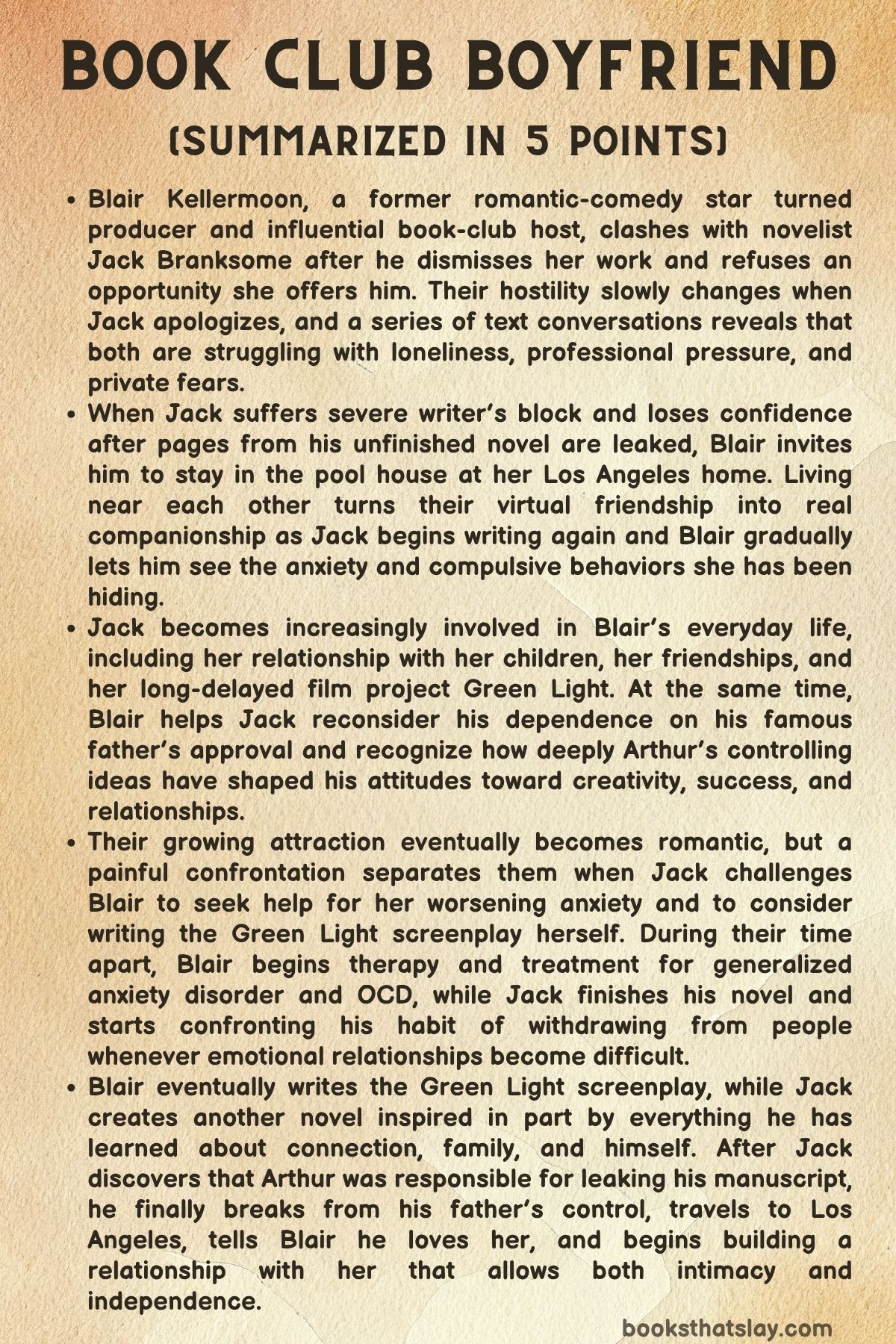
Summary
Blair Kellermoon expects her first meeting with novelist Jack Branksome to be a professional triumph. She loves his debut novel, In Time, and wants to feature it through Books with Blair, her influential book club, a decision that would greatly increase the novel’s exposure.
Instead, Jack treats the opportunity with skepticism and sarcasm. He barely knows who Blair is, dismisses the culture surrounding television celebrity, and ultimately refuses the offer, leaving Blair embarrassed and angry despite her determination not to let humiliation control her.
Their conflict becomes more public when Jack gives an interview in which his comments about Blair’s professional projects sound dismissive. What readers cannot see is that Jack’s carefully cultivated image as an aloof literary intellectual hides considerable insecurity.
His second novel has stalled, his deadline has already been extended, and he fears that his successful debut might have been an achievement he cannot repeat. The pressure is made worse by Arthur Branksome, his celebrated novelist father, whose approval Jack both resists and continues to crave.
Blair is struggling in a different way. Her divorce from producer Reggie Johnston has become entertainment news, her passion project Green Light appears close to collapse, and the departure of her children, Cal and Esme, has left her living alone for the first time.
She also suffers episodes of severe anxiety that she privately calls the cyclone. Although she presents herself publicly as cheerful, capable, and self-assured, she has begun withdrawing from friends and organizing more and more of her life around avoiding situations that might trigger distress.
Jack unexpectedly texts Blair to apologize for his public remarks. Their conversation begins defensively but quickly becomes entertaining, and each discovers that the other is considerably more interesting than expected.
Jack realizes that Blair is widely read, thoughtful, funny, and serious about storytelling. Blair discovers that his arrogance is partly armor and that beneath it sits a frightened writer who no longer knows whether he can produce another successful book.
Their messages soon become part of everyday life. Jack begins asking Blair questions whenever he gets stuck, while Blair responds with jokes, Southern expressions, observations, and questions that help him escape his creative paralysis.
He starts writing again. At the same time, their conversations make Blair’s evenings less lonely and give her a relationship in which she can speak without the expectations attached to being a mother, former actress, producer, celebrity, or ex-wife.
A leaked section of Jack’s unfinished manuscript destroys his newly recovered confidence. The pages receive a harsh response online, and Jack becomes convinced that his publisher has lost faith in him.
Blair responds with an extraordinary offer. She invites him to leave Minnesota and stay without rent in the pool house at her Los Angeles home until he finishes his manuscript, admitting that his presence would also make her feel less alone.
Jack accepts, but their first face-to-face meeting is awkward. The ease they developed through messages disappears when physical attraction, old assumptions, and differences in personality suddenly become impossible to ignore.
Jack initially plans to return home almost immediately. Yet a morning walk with Blair, combined with his realization that he cannot write comfortably around Arthur, convinces him that California may provide exactly the distance he needs.
His writing begins moving again. He settles into a routine of morning walks with Blair and her beagle Edward, develops an amusing fascination with neighborhood crows, shares meals with Blair, and reluctantly begins watching television with her.
These ordinary routines gradually become emotionally important. Jack, who has spent years treating isolation as a requirement for creativity, discovers that companionship does not necessarily interfere with serious work.
Blair also begins revealing more about herself. She describes growing up in a wealthy Savannah family that expected her to accept a conventional life after her debutante years and explains how her grandmother Mimi encouraged her to reject those expectations and pursue a future in Los Angeles.
Her earliest panic attacks began during the period when she felt trapped by the life others had chosen for her. Mimi’s support helped her leave, become an actress, build financial independence, marry Reggie, raise Cal and Esme, and eventually become a producer.
Her marriage ended gradually rather than through one dramatic betrayal. Blair increasingly felt that Reggie’s pursuit of wealth, status, possessions, and conventional success resembled the restrictive world she had escaped.
Jack’s family history also begins coming into focus. He admits that he once felt ashamed of his mother, a waitress who lacked Arthur’s education and prestige, because he had absorbed his father’s attitudes.
Yet his mother was actually the person who protected and encouraged his creativity. She bought him an important childhood notebook and sacrificed financially to send him to a writing course, leading Jack to recognize that she gave him precisely the kind of support he needed.
Following Blair’s advice, he calls his mother and tells her she has always been a good parent. Her response reminds him that his value is not determined by the success of In Time or any future novel.
As Jack becomes more comfortable in Blair’s world, he also begins noticing things she tries to hide. Her repeated checking, obsessive cleaning, insistence on particular arrangements, social avoidance, and need to control certain environments seem more serious than ordinary stress.
Their friendship nevertheless grows increasingly affectionate. Jack helps Esme secretly return home for Thanksgiving, and Blair is deeply moved by the care he gives her daughter and by his willingness to take Esme’s uncertain career ambitions seriously.
Blair, in turn, becomes the first person Jack trusts with unfinished pages from his new novel. When she tells him simply that the book is working, her judgment matters more to him than elaborate professional praise.
Thanksgiving exposes the seriousness of Blair’s hidden difficulties. As other people interfere with the cleaning routines she uses to maintain a sense of safety, she begins spiraling toward panic.
Jack quietly removes the others from the house rather than embarrassing her. Blair realizes that he has seen a part of her she has worked hard to conceal, and her embarrassment temporarily causes her to withdraw from him.
Their emotional distance does not last. They resume spending time together, begin holding hands, and share increasingly obvious attraction, although Jack repeatedly hesitates before allowing the relationship to become romantic.
At Blair’s Christmas party, Jack even agrees to sing despite his discomfort with public performance. His willingness to look foolish rather than disappoint Blair marks how different he has become from the man who arrived in California expecting to remain detached.
Later, however, Jack finds Blair distressed on her kitchen floor after broken glasses and compulsive cleaning have overwhelmed her. The unexpected arrival of Blair’s controlling parents makes matters worse.
Jack finally says what no one around Blair has said openly: her compulsions and anxiety are controlling her life. He also challenges her insistence that she cannot write the screenplay for Green Light, suggesting that certainty may be another form of avoidance.
Blair becomes furious because his observations are uncomfortably accurate. Their confrontation turns physical and passionate, but Jack later worries that he crossed a line while Blair was emotionally vulnerable.
Blair interprets his withdrawal as rejection and tells him to leave. Jack returns to Minnesota, finishes his second novel, and respects Blair’s silence even though he privately continues following developments in her career.
Three months later, Blair finally contacts him. She explains that she needed distance because she had to confront her problems without turning Jack into a substitute for proper support.
After recognizing the patterns he identified, she sought professional help and received diagnoses of generalized anxiety disorder and obsessive-compulsive disorder. She begins therapy, takes medication, reconnects with friends, and develops healthier strategies for managing anxiety.
Jack also apologizes for overstepping. Their renewed friendship soon brings Blair to Minnesota because Green Light has finally received funding and she needs to scout locations.
Jack arranges for her to visit a lakeside cabin owned by his childhood friend Allie. He also invites Blair to stay at his Minneapolis condo, reversing their earlier arrangement in California.
When Blair arrives, their relationship becomes romantic in a more deliberate way. The attraction that previously erupted during emotional chaos is now acknowledged openly, and they become lovers while still preserving the independence both value.
Their trip to Allie’s cabin also forces Jack to reconsider his childhood. Allie reminds him that her father Ed provided a safe refuge because Arthur frequently isolated Jack, demanded perfection, discouraged ordinary pleasures, and tried to mold his son into a younger version of himself.
Jack realizes that what he once regarded as strict intellectual parenting had deeper emotional consequences. His tendency to withdraw from relationships begins to look less like an independent personality trait and more like behavior he learned from his father.
Blair continues challenging Jack’s assumptions about discomfort, seriousness, creativity, and connection. Jack, meanwhile, gives Blair one of the most meaningful gestures of their relationship when he secretly installs a green light across the lake so she can see the image central to the story she has struggled for years to bring to the screen.
Their closeness is disrupted when Arthur unexpectedly arrives. His dismissive treatment of Blair and casual admission that he withheld news of Ed’s death because it might have distracted Jack expose the extent of his controlling behavior.
Blair tells Jack that Arthur still has enormous power over him. When she also accuses Jack of accepting friendship when he needs comfort and disappearing when relationships require responsibility, Jack reacts defensively and claims that he and Blair are nothing to each other.
Blair leaves Minnesota heartbroken. Yet rather than collapsing, she continues using the support systems she has built.
Something else changes as well. On her flight home, she begins writing the Green Light screenplay herself and completes it the next day.
For years Blair had accepted other people’s judgments that she was not a writer. Once she finally stops treating writing as a mysterious ability available only to certain chosen people, she discovers that she understands the story so completely that the screenplay has effectively been waiting inside her.
Jack undergoes a corresponding realization. He accepts that Blair was right about his habit of withdrawing and begins trying to become someone capable of maintaining relationships instead of merely seeking people when he needs them.
He writes again and sends Blair a new manuscript, American Crow, dedicating it to her. Blair responds by sending him the completed Green Light screenplay inside the enormous type of coffee mug he once disliked.
The exchanged manuscripts represent more than professional accomplishments. Each has completed the creative project the other believed was possible before they could believe it themselves.
Jack then reveals the final truth about the leak that nearly destroyed his confidence: Arthur was responsible. His father secretly obtained unfinished pages, decided Jack was writing the wrong novel, and leaked them in an attempt to redirect his son’s career.
The revelation finally destroys Jack’s remaining tendency to interpret Arthur’s control as concern. Rather than continue discussing everything safely through messages, Jack chooses direct human contact and travels to Los Angeles.
He and Blair meet in person and use their old word game to approach the truth they have avoided. After moving through playful alternatives for affection, Jack finally tells Blair that he loves her, and she tells him that she loves him too.
Their future does not require either person to surrender independence. Jack can spend time writing from Blair’s pool house, while Blair will travel to Minnesota for the production of Green Light.
The relationship works because they no longer treat closeness and autonomy as opposites. Blair finally tells Esme that Jack is her boyfriend, and their story closes with the former professional antagonists publicly together, creatively renewed, emotionally changed, and prepared to build a partnership that leaves room for both connection and individual purpose.
Characters
Blair Kellermoon
Blair is the emotional center of Book Club Boyfriend, and much of her character development concerns the difference between appearing capable and actually feeling secure. She has built a successful life through intelligence, determination, professional instinct, and social confidence, yet many of those same qualities allow her to conceal how frightened and isolated she has become.
Her public cheerfulness is not false, but it is incomplete. Blair genuinely loves books, people, conversation, movies, her children, and the work of turning stories into experiences for larger audiences, yet anxiety increasingly restricts how freely she can participate in the life she has created.
Her relationship with control is especially important. Blair once escaped a family that tried to prescribe the shape of her future, but after her divorce and her children’s departure, she gradually begins constructing restrictive rules of her own through checking, cleaning, arranging, avoidance, and compulsive routines.
The irony is that a woman who spent much of her youth fighting external control becomes trapped by internal demands she does not initially recognize as compulsions. Her later decision to seek treatment represents growth because she stops treating independence as the obligation to solve every problem alone.
Blair’s artistic development follows a similar pattern. She sees herself as a producer and champion of other writers but refuses to imagine herself as one because old judgments have become part of her identity.
Writing Green Light allows her to reject those inherited limitations. By the end, Blair has not become fearless or completely free of anxiety; she has become better at living alongside uncertainty without surrendering her choices to it.
Jack Branksome
Jack initially appears arrogant, solitary, judgmental, and excessively protective of literary seriousness. His contempt for celebrity culture, television, adaptations, social media, and commercial publicity allows him to imagine himself as independent, but the book gradually shows how much of this identity has been inherited from Arthur.
His isolation is therefore both preference and defense. Jack genuinely enjoys quiet and solitude, yet he has also learned to associate artistic legitimacy with discomfort, emotional distance, intellectual superiority, and self-denial.
Writer’s block exposes how fragile that structure is. Once Jack cannot write, he has very few other ways to understand his value, which makes Blair’s friendship especially transformative.
She does not merely help him produce pages. Through walks, television, food, animals, family gatherings, jokes, arguments, and ordinary companionship, she shows him that creativity can coexist with pleasure and human connection.
His greatest weakness is his tendency to accept intimacy while retaining the right to retreat whenever another person develops claims on him. The confrontation at Allie’s cabin forces him to recognize that this behavior resembles Arthur’s emotional selfishness more than he wants to admit.
Jack’s final development depends on action rather than self-awareness alone. He reconnects with people, acknowledges Blair’s importance, changes his relationship with his mother, confronts what Arthur has done, and eventually travels to Blair rather than hiding behind text messages.
Arthur Branksome
Arthur represents the destructive side of artistic authority in Book Club Boyfriend. He is a celebrated novelist whose success has allowed his personal preferences to acquire the appearance of universal rules about writing, discipline, seriousness, and character.
His relationship with Jack is particularly damaging because control is repeatedly presented as guidance. Arthur pressures Jack to meet professional expectations, discourages pleasures he considers frivolous, isolates him during childhood, and teaches him to associate discomfort with strength.
More seriously, Arthur repeatedly assumes that he has the right to decide which information Jack should receive and which creative choices he should make. His decision to conceal Ed’s death because grief might interfere with Jack’s work reveals how little space he allows for his son’s emotional life.
The manuscript leak makes this pattern impossible to rationalize. Arthur violates Jack’s privacy and risks damaging his career because he believes his own literary judgment overrides Jack’s right to determine what kind of writer he will become.
Arthur is therefore important not simply as an unpleasant father but as the model Jack must consciously refuse to reproduce. Jack’s maturity depends on recognizing that independence means separating from Arthur’s values, not merely arguing with him while continuing to live according to them.
Reggie Johnston
Reggie is not presented as a simple villainous former husband. Blair remembers genuine companionship, shared family language, years of parenting, and the comfort of a person who has known her for a large part of her adult life.
Their marriage ends because the values governing their lives gradually diverge. Reggie becomes increasingly attached to expansion, status, possessions, and conventional markers of success, while Blair recognizes in those ambitions something uncomfortably similar to the restrictive social world she escaped in Savannah.
His response to Blair’s decision to stop cosmetic treatments is especially revealing. What might seem like a personal disagreement becomes symbolic of a broader problem: Blair is trying to determine what she wants her own face, body, career, and future to mean, while Reggie’s discomfort suggests an attachment to the version of her that fits familiar expectations.
The continuing familiarity between them also allows the book to distinguish loneliness from romantic longing. Blair sometimes misses Reggie’s presence, but she eventually understands that missing shared history does not mean the marriage should have continued.
Esme Johnston
Esme is perceptive, direct, affectionate, and far more aware of Blair’s emotional condition than Blair initially understands. Her conversations with her mother challenge the comforting parental fiction that divorce has little effect on adult children simply because they are old enough to understand it rationally.
She explains that the divorce changed her interior world, giving Blair a more mature understanding of how family transitions affect children without turning that knowledge into an accusation. Esme can acknowledge disruption while still supporting her mother’s right to pursue a healthier future.
Her relationship with Jack also becomes significant. She quickly recognizes his importance to Blair and treats him as someone who might become part of the family’s future before either adult is prepared to admit that possibility.
Jack’s willingness to take Esme’s uncertain interests seriously helps her imagine a career involving criticism or journalism. Through Esme, the story shows how meaningful encouragement can be when it treats a young person’s interests as possibilities rather than frivolous hobbies.
Cal Johnston
Cal receives less narrative attention than Esme, but his interactions with Blair illuminate an important aspect of her personality. When he asks for advice about moving from a dormitory into an apartment, Blair deliberately helps him reason through the decision rather than imposing her preferred solution.
The moment demonstrates that Blair is capable of giving her children the freedom she herself was denied. She recognizes that good parenting does not mean removing uncertainty or controlling outcomes.
Jack’s observation that Blair is a good mother matters because motherhood is one of the identities Blair values most deeply. Cal therefore functions partly as evidence of the emotional labor and restraint involved in her parenting, especially as she adjusts to having adult children who need support without constant supervision.
Tiffany
Tiffany is both Blair’s professional partner and one of the people most willing to challenge pretension. Her presence frequently brings humor and social energy into situations that might otherwise become emotionally closed.
She understands Blair’s professional influence and refuses to treat her work in entertainment or book promotion as intellectually inferior. This places her in direct contrast with Jack’s early assumptions.
Tiffany also becomes one of the forces drawing Jack into Blair’s community. At the Christmas party, she refuses to let him hide from a social obligation that matters to Blair and reminds him that friendship involves showing up for other people.
Her importance lies in the normality of her loyalty. She is not responsible for rescuing Blair, but she is part of the network of friendships Blair must learn to stop avoiding when anxiety encourages isolation.
Jack’s Mother
Jack’s mother is one of the clearest examples of the difference between cultural prestige and genuine emotional value. Jack once judged her through Arthur’s standards because she was a waitress without the education or literary reputation he had been taught to admire.
As an adult, he realizes that she was actually the parent who most consistently protected his creativity. Her gifts and sacrifices gave young Jack practical evidence that his imagination mattered.
Her reaction to his career crisis also contrasts strongly with Arthur’s. Instead of treating failure as catastrophic, she reminds him that his life would continue even if he never completed another novel.
Most importantly, she values Jack for being her son rather than for producing a famous book. That unconditional perspective helps him separate personal worth from professional output and becomes an important step toward a healthier understanding of himself.
Allie
Allie is a connection to the childhood Jack has partly forgotten and partly misunderstood. Her friendship once provided ordinary companionship during periods when Arthur was emotionally or physically unavailable, and her family offered Jack a place where childhood did not have to be treated as preparation for literary greatness.
As an adult, Allie is direct enough to tell Jack truths that others might soften. She points out both the controlling nature of Arthur’s parenting and Jack’s own habit of neglecting relationships once he no longer needs immediate support.
Her importance therefore operates in two directions. She helps Jack see himself as a child who deserved greater protection, but she refuses to let that childhood become an excuse for his adult behavior.
Through Allie, Jack learns that understanding where a harmful pattern comes from does not remove the responsibility to change it.
Ed
Ed is largely present through memory, yet his influence on Jack is considerable. He functioned as a second father during Jack’s childhood summers and maintained contact with Arthur partly so that Jack would continue to have access to a safer and more ordinary household.
His care is especially meaningful because it is understated. Ed does not attempt to remake Jack or claim ownership over his potential; he simply helps provide a place where the boy can experience friendship, play, food, games, and everyday family life.
Jack’s discovery that Ed died years earlier also exposes the consequences of his own withdrawal from relationships. Missing the death of someone who mattered greatly to him becomes evidence of how thoroughly he allowed isolation to disconnect him from his past.
Mimi
Mimi represents rebellion, resilience, and practical permission. Blair grows up in a family governed by wealth, convention, and strong ideas about how a young woman should behave, but Mimi refuses to treat those expectations as sacred.
Her advice gives Blair language for imagining a life beyond what her family considers appropriate. Rather than warning Blair against ambition, she encourages her to move beyond the boundaries of her upbringing.
Mimi’s influence continues long after Blair leaves Savannah. Her sayings, humor, and refusal to worship respectability become part of Blair’s own personality.
She is also important because her support shows how a single accepting adult can alter the direction of a younger person’s life. Blair later offers Jack and her own children a similar form of encouragement by treating possibility as something worth pursuing rather than something to fear.
Mrs. Afonso
Mrs. Afonso initially appears eccentric and mildly threatening when Blair discovers that someone has been sabotaging her swimming pool. The eventual explanation is absurd: Mrs. Afonso has mistaken Blair for another actress connected to an old marital betrayal.
The misunderstanding gives her a comic role, but her later friendship with Blair carries greater significance. Someone who begins as a source of suspicion eventually becomes part of Blair’s social life.
This transformation reflects Blair’s broader recovery. Instead of narrowing her environment to prevent disruption, Blair becomes increasingly capable of allowing unpredictable people and experiences into her world.
Mrs. Afonso’s Double Gin Nights eventually become one of the signs that Blair has rebuilt an active social life rather than remaining protected inside an increasingly restricted home.
Angela Laredo
Angela Laredo never participates directly in the main events because she has already died, yet her absence shapes Blair’s professional and emotional life. Green Light matters to Blair partly because of the story itself and partly because it remains connected to Angela and the grief surrounding her death.
The failed adaptation therefore becomes more than a stalled production. Blair’s refusal to abandon it reflects loyalty, mourning, professional commitment, and a fear that letting the project change might somehow betray the person who created it.
Only when Blair begins claiming her own creative authority can Green Light move forward. Writing the screenplay does not erase Angela’s importance; instead, it allows Blair to honor the story through active creation rather than endless preservation.
Bjorn Ekberg
Bjorn primarily serves as the financial possibility that allows Green Light to move from a nearly dead project toward production. His interest demonstrates that Blair’s persistence has professional consequences even before she recognizes herself as capable of writing the screenplay.
Jack’s jealousy toward Bjorn also exposes the romantic feelings he is still trying to avoid. A person who might otherwise exist only as a potential investor becomes a mirror for Jack’s insecurity.
Bjorn therefore matters less through personal development than through what his presence reveals about the protagonists. He represents the external opportunity Blair needs professionally and the emotional competition Jack needs before he can recognize how invested he has become.
Oliver
Oliver provides Jack with one of his few uncomplicated relationships before California. Maud’s is a place where Jack can experience companionship without feeling pressured to explain himself, perform literary seriousness, or discuss his father’s expectations.
Oliver’s familiarity with Jack also gives Blair access to a version of him that existed before their relationship. The detail about Jack ordering martinis with olives when unhappy and a lemon twist when things are going well becomes a small but effective emotional indicator.
When Blair joins Jack at Maud’s and he orders the twist, Oliver indirectly helps expose something Jack has difficulty saying directly: Blair’s presence makes him happy.
Lyn
Lyn, Jack’s publicist, understands how the publishing industry converts personality into marketing. Her suggestion that appearing difficult fits Jack’s public brand irritates him because he does not want his character reduced to an image designed for commercial consumption.
Yet the idea also exposes an uncomfortable contradiction. Jack dislikes branding while behaving in ways that actively reinforce the persona associated with him.
Her brief presence therefore helps establish one of his early problems: he wants to believe his literary identity is completely authentic, even though he has partly constructed himself around recognizable ideas of what a serious writer should look and sound like.
Lucia Britton
Lucia Britton represents the professional publishing structure surrounding Jack at the beginning of the story. Her presence during the Books with Blair meeting makes Jack’s rejection more than a private disagreement because his decision occurs in front of people who understand the enormous promotional value of Blair’s offer.
Lucia also helps establish the gap between Jack’s personal stubbornness and the commercial realities of being a published author. He wants to treat literature as though it exists independently of publicity, institutions, sales, and audience-building, but his career is clearly supported by all of them.
Her role is limited, yet she helps create the professional conflict that begins Jack and Blair’s relationship.
Ava Gustafson
Ava Gustafson appears later as the director connected to Green Light and becomes one of the professionals who responds positively to Blair’s screenplay. Her approval matters because it gives Blair evidence that her writing ability is not merely a private emotional discovery.
Blair has spent years believing that writing belongs to a category of people fundamentally different from herself. The enthusiastic professional response to her screenplay helps dismantle that distinction.
Ava’s role therefore supports Blair’s final artistic transformation: she does not merely write something as a personal exercise but produces work strong enough to become part of the film she has fought to make.
Blair’s Parents
Blair’s parents embody the social expectations she spent much of her early life trying to escape. Their worldview emphasizes status, acceptable behavior, family tradition, and a particular image of how Blair should live.
Even after she has built an independent career and family, their presence can still reactivate old anxieties. Their unexpected Christmas visit immediately contributes to one of her most serious episodes because she continues to experience their judgment as a threat to the autonomy she worked hard to establish.
They are important precisely because Blair no longer needs their practical permission, yet part of her still responds as though she does. Her development requires recognizing that emotional independence can lag far behind financial and geographical independence.
Themes
Creativity, Identity, and the Fear of Failure
Creative work becomes dangerous when characters allow it to determine their entire sense of worth. In Book Club Boyfriend, both Jack and Blair struggle because they have accepted narrow definitions of who is allowed to create and what creative legitimacy is supposed to look like.
Jack’s crisis begins when he cannot reproduce the success of his first novel. Because he has built so much of his identity around being a serious writer, writer’s block feels less like a temporary professional problem than evidence that the person he believes himself to be may not exist.
Arthur intensifies this fear by teaching Jack that artistic seriousness requires discipline, suffering, discomfort, and exceptionalism. Even Jack’s rejection of television and popular culture reflects his attempt to maintain a protected identity in which certain forms of storytelling count more than others.
Blair has absorbed the opposite limitation. She works constantly with stories yet insists she is not a writer because people in her past convinced her that writing is a mysterious gift she does not possess.
Both characters improve when they stop treating creativity as proof of personal worth. Jack learns that he can fail professionally without becoming worthless, while Blair discovers that creative authority can emerge through knowledge, work, emotional investment, and willingness to begin.
Their exchanged manuscripts near the end make this transformation especially clear. Each person recognizes the other’s ability before fully trusting their own, and eventually that borrowed confidence becomes self-belief.
Independence, Intimacy, and Human Connection
Blair and Jack begin with opposite relationships to solitude. Blair has spent most of her life surrounded by family, colleagues, friends, children, and public attention, so living alone after her divorce feels unfamiliar and painful.
Jack has intentionally structured his adult life around solitude and believes that limited emotional obligation protects both his freedom and his writing. Their relationship gradually reveals that neither complete dependence nor complete isolation provides the answer they need.
Blair must learn that independence does not require refusing assistance. Her attempt to manage escalating anxiety privately turns self-reliance into another form of confinement because she begins cutting herself off from precisely the people who could support her.
Jack faces the reverse problem. He accepts support when it serves an immediate emotional or creative need but has difficulty accepting the continuing responsibilities that come with attachment.
His history with Allie exposes the cost of that pattern. He enjoyed the safety her family offered during childhood yet later allowed the relationship to disappear so completely that he did not know Ed had died.
The romance succeeds only when both characters develop a more flexible understanding of connection. Blair can receive love without surrendering autonomy, while Jack can maintain independence without treating every emotional obligation as a threat.
Their final arrangement respects separate work, separate spaces, travel, and individual preferences. Love becomes sustainable because neither character is required to disappear into the other person’s life.
Control, Anxiety, and Learning to Live with Uncertainty
Blair’s struggle with anxiety shows how attempts to create safety can gradually make a person’s world smaller. Her checking, cleaning, arranging, avoidance, and repeated need for exactness initially seem like manageable habits because each one offers temporary relief.
The problem is cumulative. Every ritual teaches Blair that uncertainty is dangerous and that safety depends on obeying increasingly rigid rules.
Her history makes this especially significant. As a young woman, Blair resisted a controlling family that wanted to determine her marriage, social role, career, and future.
As an adult, she escapes those expectations only to find herself controlled by compulsions generated from within. The source of control has changed, but the effect is similar: her range of possible choices begins narrowing.
Her recovery is meaningful because it is not presented as the disappearance of anxiety. Blair’s hurricane metaphor describes a more realistic goal: storms may continue, but medication, therapy, cognitive strategies, friendship, honesty, and practical support can reduce the damage they cause.
That distinction changes her relationship with fear. She becomes capable of eating in restaurants, traveling, socializing, working, loving, and taking creative risks while accepting that uncomfortable feelings may still occur.
The theme therefore moves away from the fantasy of perfect control. Blair becomes freer not because she learns to guarantee safety, but because she builds enough support to continue living when safety cannot be guaranteed.
Inherited Expectations and the Work of Becoming Yourself
Both protagonists carry assumptions inherited from powerful family figures. Their growth depends on recognizing that rebellion alone does not automatically free a person from the values they were taught.
Blair physically escapes Savannah, rejects the conventional future planned for her, succeeds in Hollywood, earns her own money, raises children differently, and eventually leaves a marriage that no longer fits. Yet the emotional influence of her upbringing continues through her sensitivity to parental judgment and her fear of claiming certain kinds of authority.
Jack believes himself to be independent of Arthur because he argues with him and resents his interference. In reality, many of Jack’s strongest convictions closely resemble his father’s ideas.
He distrusts popular entertainment, romanticizes discomfort, isolates himself, treats suffering as evidence of seriousness, and assumes that artists must protect themselves from ordinary human demands. Only gradually does he recognize that rejecting Arthur personally is different from rejecting Arthur’s worldview.
The supporting characters provide alternative models. Mimi gives Blair permission to exceed the limits of her upbringing, Jack’s mother values him independently of achievement, and Allie and Ed demonstrate a form of family life based on safety rather than control.
By the end, becoming oneself is shown as an active process rather than a single act of rebellion. Blair and Jack must repeatedly examine which beliefs truly belong to them, which were inherited, and which no longer deserve authority over their choices.