Candy Apple Kisses Summary, Characters and Themes
Candy Apple Kisses by Amy Clipston is a contemporary romance about friendship, homecoming, family responsibility, grief, and the courage required to begin again. Set around a century-old family orchard in Splendid Lake, the story follows Emily Carmichael and Jake Hughes, childhood best friends whose relationship begins changing when Emily returns home during a crisis at the orchard.
As they work together to protect the Hughes family legacy, both are forced to reconsider the futures they had imagined for themselves. The novel combines a friends-to-lovers romance with Emily’s return to art and Jake’s struggle to earn his father’s confidence.
Summary
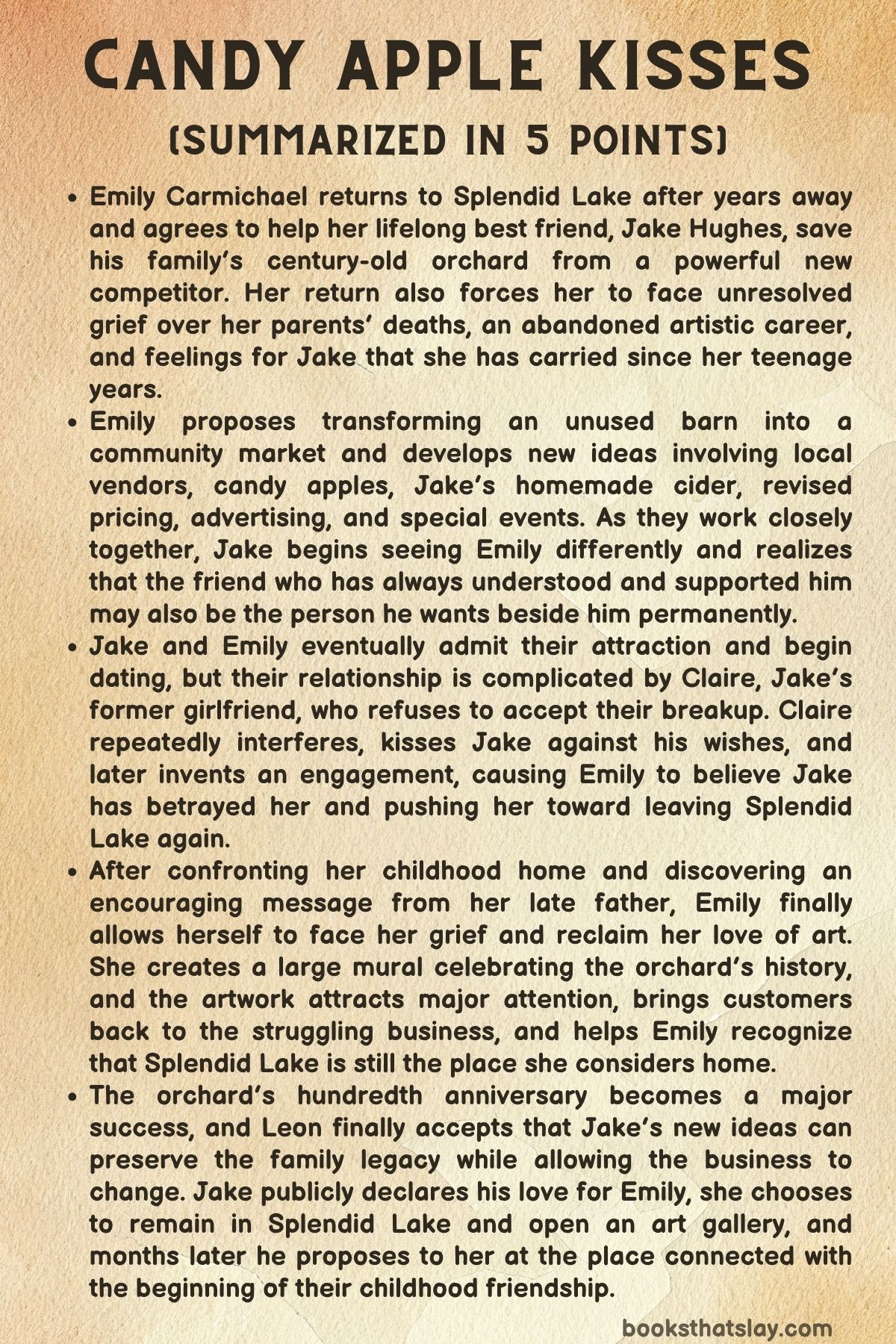
Emily Carmichael returns to Splendid Lake after Jake Hughes, her lifelong best friend, urgently asks for her help. Four years after losing her parents in a plane crash, Emily has spent much of her time trying to create a new life in Charlotte, but a series of unsatisfying jobs, failed relationships, and abandoned artistic ambitions have left her uncertain about where she belongs.
Jake welcomes Emily back into the Hughes family as naturally as if she had never left. His parents, Leon and Diane, have always treated her like family, yet Emily quickly discovers that Jake has been hiding serious worries: Leon recently suffered a heart attack, the family orchard is under financial pressure, and a powerful neighboring business called Apple Haven is preparing to compete aggressively for customers.
The Hughes Family Orchard is approaching its hundredth anniversary, and Jake believes the celebration could determine its future. He wants to prove to Leon that he is capable of eventually taking charge, but his father remains skeptical because he still remembers Jake’s mistakes when he was younger.
Jake asks Emily to help rethink the anniversary celebration because he trusts her creativity. She eagerly agrees, partly because the orchard and the Hughes family represent the closest thing she still has to a home.
Emily, however, carries a secret that complicates her return. She has loved Jake since she was a teenager, but for years he was committed to Claire, and Emily eventually convinced herself that Jake could never see her romantically.
Being back in Splendid Lake brings those feelings to the surface. Jake remembers small things about her, encourages her artistic ability, cares for people throughout the community, and treats her with the easy affection that has always made Emily love him.
When Jake and Emily inspect Apple Haven, they see how formidable the competition has become. The rival orchard offers activities, entertainment, low prices, and a polished fall experience that the traditional Hughes orchard cannot easily match.
Instead of accepting defeat, Emily proposes transforming an abandoned barn into a community market where local vendors can sell crafts, food, preserves, and other products. Jake likes the idea, although he fears the cost and knows Leon strongly resists changes to family tradition.
During these early planning sessions, Jake reveals that he and Claire have broken up. Claire wants him to leave Splendid Lake for Nashville, while Jake cannot imagine abandoning the orchard, and this difference has exposed how incompatible their futures have become.
The revelation gives Emily hope, but Claire continues calling Jake and remains connected to his family. Emily therefore hesitates to believe Jake could ever truly choose her.
Leon initially rejects the proposed barn market, yet Emily persuades him by presenting the project as a way of honoring rather than erasing the Hughes family’s history. When money becomes an issue, she even offers funds from the sale of her parents’ home, though Jake refuses because he wants to prove he can carry the orchard’s responsibilities himself.
Emily later admits why she has never touched much of the money associated with her parents. Spending it feels like accepting the permanence of their deaths, and that realization exposes how much grief she has kept locked away.
Jake comforts her, and the physical closeness between them suddenly feels different. Both recognize an attraction that has not previously been acknowledged, but neither is ready to risk the friendship that has defined most of their lives.
As work on the barn begins, Emily creates detailed designs and promotional ideas while Jake invests his savings and labor into the renovation. Their familiar teasing develops a romantic undertone, and people around them, particularly their friend Andi Wingate, begin noticing how naturally they behave like a couple.
Emily also learns that Jake has secretly spent more than a year experimenting with homemade nonalcoholic apple cider. He lacks confidence in the product, but Emily believes in it immediately and begins designing a label, much as Jake has always encouraged her to believe in her own artistic talent.
That artistic talent remains one of Emily’s deepest unresolved conflicts. After her parents died, she stopped painting because creativity became tied to pain, disappointment, and memories she did not know how to face.
Jake refuses to accept that her ability has disappeared. He reveals that he saved hundreds of napkin drawings she made during their school years and even preserved one of her award-winning paintings, proving that he has valued her art long after Emily stopped valuing it herself.
Trouble at the orchard continues. Employees leave for better offers from Apple Haven, costs rise, and Jake repeatedly hears rumors that the Hughes orchard will be forced out of business.
Yet community members begin helping. Seth Wingate volunteers his labor because Jake once supported him, Andi joins the renovation, Ms. Riley donates tools, and several residents demonstrate that the orchard represents more than a business to Splendid Lake.
Emily expands the anniversary plans with Diane’s candy apples, Jake’s cider, vendors, advertising, a revised apple-pricing system, and community entertainment. She continually pushes Jake toward innovation while also helping Leon understand that adapting the orchard does not mean rejecting the past.
Meanwhile, Jake realizes that Emily has become essential to his life. He asks her to consider moving permanently back to Splendid Lake, and their conversations increasingly approach romantic confession.
Their attraction finally becomes impossible to ignore when they are caught in the rain while walking through town. Jake kisses Emily, and she admits that she has wanted him since she was sixteen.
Jake is stunned by how long her feelings have existed, but he knows his own feelings have changed as well. They agree to begin dating quietly while concentrating on the orchard opening, and Jake soon understands that he has fallen in love with his best friend.
Their happiness is threatened by Claire, who refuses to accept that her relationship with Jake is finished. She repeatedly appears around the Hughes family, encourages Diane’s hopes for reconciliation, and treats Emily as though she is merely an obstacle.
The orchard crisis also worsens. Vendors are tempted away by Apple Haven, forcing Emily to search for replacements, and the grand opening attracts painfully few customers.
Only eight baskets of apples are sold on the first day. Jake begins believing that his attempts to modernize the orchard have endangered a family legacy that survived for generations, while Leon’s criticism deepens his sense of failure.
At the same time, Claire deliberately creates romantic confusion. After Jake firmly tells her that he has moved on, she suddenly kisses him against his wishes.
Emily sees the kiss from a distance but does not see Jake push Claire away. Already insecure about Jake’s history with Claire, Emily concludes that she has been foolish to believe their relationship could last.
Claire then escalates the deception by announcing during a family dinner that Jake has proposed to her. She even displays a family diamond ring and claims they will marry in Nashville on New Year’s Eve.
Jake immediately denies proposing, but the announcement devastates Emily. She leaves before he can properly explain, believing the fabricated engagement confirms everything she has feared.
Driving through Splendid Lake, Emily eventually arrives at the childhood home she has avoided since returning. Facing the house forces her to confront memories of her parents rather than continuing to escape from them.
Among old papers and keepsakes, Emily finds messages from her parents, including one from her father encouraging her to choose a career that gives her joy. She finally understands that her parents’ concerns about her future never meant they wanted her to abandon what she loved.
The discovery changes her relationship with grief. Instead of viewing art as something destroyed by her parents’ deaths, Emily begins seeing it as something that can connect her past with the person she still wants to become.
Her creative inspiration returns, and she begins working intensely. Jake, meanwhile, confronts Claire, rejects the false engagement, and repeatedly tries to reach Emily to explain that she is the only woman he wants.
Emily turns her renewed creativity toward the orchard by painting a huge mural celebrating its hundred-year history and its relationship with Splendid Lake. The work attracts local attention, then spreads widely through social media.
People begin arriving to see the mural. A newspaper covers it, television reporters interview Emily, customers return to the orchard, and vendors suddenly want to participate in the anniversary celebration.
The success also changes Leon’s attitude toward Jake. He finally recognizes that Jake’s willingness to modernize the orchard has protected rather than betrayed the family tradition, and he tells his son that he is ready for him to assume greater responsibility.
Jake settles matters with Claire once and for all, blocking further contact and openly declaring his feelings for Emily. Emily, after talking with Andi and examining what she truly wants, realizes that Splendid Lake is not simply a place associated with loss.
It is home. Jake, the Hughes family, her art, and the community all belong to the future she wants rather than merely to the past she mourns.
The hundredth anniversary celebration becomes an enormous success. The orchard fills with customers, the market thrives, the cider and candy apples sell out, and Leon publicly praises Jake for respecting family tradition while also allowing the business to change.
Jake then publicly acknowledges Emily’s role in saving the orchard and changing his life. Before the gathered community, he tells her that she is far more than his best friend and admits that he loves her.
Emily confesses that she has loved him for most of her life. They reconcile, promising not to allow insecurity, misunderstandings, or Claire to separate them again.
Two months later, Emily has permanently returned to Splendid Lake and opened the art gallery Jake encouraged her to pursue. The orchard has enjoyed a successful season, Leon’s health and relationship with Jake have improved, and Emily has begun using part of her inheritance to support a future rather than preserving the money as a symbol of grief.
After Thanksgiving dinner, Jake takes Emily back to the place associated with the beginning of their childhood friendship. He plays the song she once imagined as their wedding song, asks her to dance, and then proposes.
Emily accepts and suggests that they marry at the orchard. What began as a lifelong friendship has become a partnership in which both have finally found the confidence to choose the lives, work, community, and love they genuinely want.
Characters
Emily Carmichael
Emily is the emotional center of Candy Apple Kisses, and much of her development comes from the conflict between wanting a new life and remaining deeply connected to the life she left behind. Losing both parents has affected almost every part of her identity, including her career, relationships, attitude toward money, and ability to create art.
Her departure from Splendid Lake initially appears to represent independence, but it gradually becomes clear that leaving was also a form of avoidance. She was running from grief, from places associated with her parents, and from the pain of loving Jake while believing that he would always choose Claire.
Emily’s relationship with her inheritance demonstrates how strongly grief controls her. She refuses to spend the money from her parents because doing so would make their absence feel permanent, showing that she has transformed money into a physical connection with people she cannot emotionally release.
Her artistic crisis operates in a similar way. Painting was once central to her sense of self, yet after her parents died, she could no longer separate creativity from loss and uncertainty about whether they truly supported her ambitions.
What makes Emily an effective partner for Jake is her ability to recognize possibilities when he sees only threats. The barn market, candy apples, cider branding, new pricing strategies, vendor recruitment, advertising, and the mural all emerge partly or entirely because Emily refuses to accept that the orchard’s future has already been decided.
At the same time, she is far less confident when interpreting her own worth. She can insist that Jake believe in himself while remaining convinced that Claire is more desirable, more established in his life, and more likely to receive his permanent commitment.
This contradiction explains why Claire’s manipulations affect her so strongly. Emily does not distrust Jake simply because Claire lies; she is vulnerable to those lies because they confirm fears she has carried since adolescence.
Her visit to her former home becomes the decisive stage of her development. By facing the physical place she has avoided and discovering her father’s encouragement, she begins understanding that loving her parents does not require remaining trapped at the moment of their deaths.
The mural then becomes evidence of recovery rather than merely professional success. Emily takes memories that once silenced her creativity and transforms them into art that strengthens the community, rescues the orchard, and publicly reconnects her with the identity she had abandoned.
By the end of the book, Emily’s return to Splendid Lake is not a retreat from adulthood or independence. She returns because she has consciously chosen a life built around art, community, family, and love rather than allowing grief or fear to choose for her.
Jake Hughes
Jake is both Emily’s romantic counterpart and a character facing his own crisis of confidence in Candy Apple Kisses. His central struggle concerns whether he can become the person responsible for preserving a family legacy without simply repeating everything previous generations have done.
Jake cares deeply about the Hughes orchard, but that devotion makes every setback intensely personal. Competition from Apple Haven, rising expenses, lost employees, disappointing sales, and Leon’s criticism are not merely business problems to him; he interprets them as evidence that he may be the Hughes who destroys what generations of his family built.
His relationship with Leon contributes significantly to that insecurity. Jake wants his father’s approval, and because Leon continues judging him according to mistakes from his youth, Jake constantly feels that competence must be proven rather than assumed.
Yet Jake’s actions repeatedly show that he is already responsible, generous, and community-minded. He helps elderly neighbors, donates apples, supports friends, works physically on the orchard, invests his savings, and refuses to abandon his family even when easier choices are available elsewhere.
His secret cider project reveals another side of his insecurity. Like Emily with her paintings, Jake has created something worthwhile but hesitates to expose it to judgment, making their encouragement of each other an important form of emotional reciprocity.
Jake’s romantic development depends on recognizing something that has existed around him for years. Emily has always occupied an intimate position in his life, but he initially categorizes that closeness as friendship because it is so familiar that he has never questioned it.
Once his perception changes, details that once seemed ordinary become emotionally significant. He notices her beauty, misses her when she is absent, seeks her comfort during crises, shares private ambitions with her, and begins imagining a permanent future that naturally includes her.
His handling of Claire is one of his weaknesses. Although he repeatedly states that the relationship is over, he initially allows too much continued access because of their shared history, his mother’s expectations, and his discomfort with severing a long relationship completely.
That hesitation unintentionally gives Claire room to create confusion. Jake eventually learns that emotional boundaries must be demonstrated through action rather than merely stated, and his final decision to end contact shows that he has understood the cost of ambiguity.
Jake’s public declaration to Emily completes both sides of his development. By choosing her openly while also receiving Leon’s confidence in his leadership, he stops organizing his life around proving himself to other people and begins acting with certainty about the future he actually wants.
Leon Hughes
Leon represents tradition, authority, and the fear that change might destroy a valuable inheritance. His attachment to the orchard is understandable because he sees himself as the temporary guardian of something created by previous generations and intended for future ones.
This makes him suspicious of Jake’s new ideas. The barn market, revised apple pricing, and other innovations initially appear to Leon as unnecessary risks, especially when he already doubts whether his son has matured enough to carry the responsibility.
Leon’s criticism often becomes unfair because he continues evaluating the adult Jake through memories of the younger Jake. Instead of allowing present behavior to redefine his opinion, he repeatedly uses old mistakes as evidence that his son is not ready.
His heart attack and later fall also create a painful contradiction. Leon wants to remain the family authority, yet his declining health makes it increasingly obvious that the orchard must eventually operate without his constant control.
Emily becomes important in his development because she understands how to communicate change in language Leon respects. Rather than presenting modernization as a rejection of heritage, she shows him that adaptation can protect the very tradition he fears losing.
Leon changes only when he sees evidence rather than receiving arguments. The orchard’s eventual success proves that Jake’s ideas can preserve its identity while strengthening its future, allowing Leon to admit that his son was right.
His apology and public praise are therefore significant. Leon does not merely surrender control because of age or illness; he finally recognizes Jake as a capable successor and changes from a doubtful father into a supportive one.
Diane Hughes
Diane functions as the emotional center of the Hughes household. She welcomes Emily as family, worries intensely about Leon after his health problems, and wants stability for Jake because recent events have reminded her how quickly circumstances can change.
Her affection sometimes produces mistaken assumptions. Because Claire has been connected to Jake for years, Diane initially interprets reconciliation and marriage between them as the safest and most natural continuation of the family’s life.
This creates unintended pressure on both Jake and Emily. Diane does not understand that encouraging Claire is prolonging a relationship Jake has already emotionally left and reinforcing Emily’s belief that she will never occupy the same place in the family.
At the same time, Diane is more flexible than Leon. She supports Emily’s proposals when she believes they can help the orchard, challenges Leon when his pessimism becomes excessive, and recognizes Emily’s unique ability to calm and encourage Jake.
Once Jake explains the truth about Claire and Emily, Diane adjusts quickly. Her happiness about their relationship shows that her earlier attachment to Claire was based more on habit and expectation than on opposition to Emily.
Diane also represents the domestic traditions surrounding the orchard through her candy apples. What begins as a familiar seasonal treat becomes part of the orchard’s renewed public identity, showing how traditions can remain valuable when placed within new ideas.
Claire
Claire is the primary interpersonal antagonist because she refuses to accept that a long relationship can end simply because the people involved no longer want the same future. She interprets history with Jake as a form of ownership and treats his decisions as temporary resistance rather than choices she is required to respect.
Her original disagreement with Jake concerns a legitimate incompatibility. She wants a life in Nashville, while Jake refuses to leave the orchard, and neither desire is inherently wrong.
Claire becomes destructive when she stops accepting that incompatibility. She continues contacting Jake, inserts herself into his family after being asked to stay away, attacks Emily’s confidence, forces a kiss on Jake, and eventually invents an engagement in front of their families.
Her behavior is driven partly by entitlement and partly by certainty that social pressure will work in her favor. Because the families already expect marriage, Claire attempts to turn expectation into obligation by creating a public situation in which Jake will supposedly find it difficult to contradict everyone.
Her treatment of Emily is especially calculating. Claire recognizes Emily’s insecurity and deliberately tells her that Jake will never see her as more than a friend, later using the false engagement to make that fear appear true.
Yet Claire also serves an important structural purpose in Jake’s development. His experience with her forces him to learn that repeatedly saying a relationship is finished is insufficient when the other person refuses to respect boundaries.
By the end, Jake’s decision to block further contact represents his final rejection of the future Claire is trying to impose upon him. Claire consequently becomes the clearest contrast to Emily: one tries to force Jake into a predetermined life, while the other helps him become more confident about choosing his own.
Andi Wingate
Andi serves as Emily’s close friend, observer, and source of emotional perspective. She recognizes the romantic connection between Emily and Jake much earlier than Emily is willing to trust it and repeatedly encourages her to interpret Jake’s behavior more confidently.
Her role becomes particularly valuable because Emily’s judgment is distorted by years of insecurity. Andi can observe Jake without carrying Emily’s history of rejection, jealousy, and fear, allowing her to see signs that Emily repeatedly dismisses.
Andi is also an active member of the orchard effort rather than merely a romantic adviser. She helps with the barn renovation, supports Emily during the opening, assists with promotional thinking, and becomes part of the community network that allows Jake to continue when his own resources are strained.
Near the end, Andi again becomes important when Emily must decide whether to believe Jake’s explanation. Instead of making the decision for her, Andi pushes Emily toward the more important question of what she herself actually wants.
Seth Wingate
Seth represents reciprocity within the Splendid Lake community. When Jake needs help renovating the barn after losing workers and facing financial pressure, Seth volunteers his labor because Jake supported him when they were younger.
His decision provides Jake with more than practical assistance. At a moment when competition makes Jake feel isolated, Seth reminds him that years of kindness have created relationships that cannot be measured in wages or advertising budgets.
Seth also contributes to the relaxed social atmosphere surrounding Jake and Emily. His presence with Andi helps recreate the companionship of their teenage years, giving Jake opportunities to compare the ease of these friendships with the restrictions he experienced while dating Claire.
Through Seth, the story reinforces the idea that community strength is built over time. Jake’s past generosity returns to him when he needs it most, making Seth’s assistance evidence that the orchard’s greatest advantage is not financial power but human loyalty.
Ally Hughes
Ally is Jake’s younger sister and another person who demonstrates how completely Emily has been absorbed into the Hughes family. Even while away at school, Ally interacts with Emily naturally, without treating her as an outsider or temporary guest.
Her education is also part of the financial pressure Jake carries. The family’s obligations extend beyond the orchard itself, and Jake’s awareness of tuition and household expenses strengthens his fear that business failure could affect everyone he loves.
The video conversation involving Jake, Emily, and Ally is particularly revealing because their affectionate interaction resembles that of siblings and lifelong family members. It quietly demonstrates that Emily already belongs emotionally to the family long before her romance with Jake becomes permanent.
Vince
Vince is one of the dependable figures surrounding the orchard renovation. Although he receives less individual attention than Jake, Emily, Andi, or Seth, his continued presence contributes to the sense that the orchard is being saved through collective effort rather than through a single heroic action.
His importance becomes particularly clear when Emily begins painting the mural. Vince recognizes that she is creating something exceptional and directs Jake toward her, helping bring together two major developments: Emily’s artistic recovery and Jake’s realization that she is finally displaying her ability publicly.
Vince therefore functions as a steady supporting presence. His role emphasizes reliability, practical cooperation, and the quiet contributions that allow larger changes to occur.
Ms. Riley
Ms. Riley represents both memory and encouragement. As Jake and Emily’s former teacher, she remembers them before adult disappointments complicated their lives and can therefore identify qualities they themselves have stopped noticing.
She encourages Emily to return to art rather than treating her abandoned ambition as something permanently lost. She also recognizes the closeness between Emily and Jake and suggests that their connection has always appeared unusually strong.
Her later donation of her late husband’s tools to the barn renovation gives her symbolic importance to the orchard storyline as well. She contributes something connected to her own past so that another piece of Splendid Lake’s history can move into the future.
Emily’s Parents
Emily’s parents are deceased before the main events of the story, yet their influence remains central to Emily’s choices. Her grief over their deaths affects her willingness to spend inherited money, return to her childhood home, pursue art, and establish a permanent life anywhere.
For much of the book, Emily believes her parents were disappointed in her artistic ambitions. Whether or not this belief fully represents their intentions, it has become part of the emotional explanation she gives herself for abandoning creativity.
The message she later discovers from her father radically changes that understanding. His encouragement to choose work that brings her happiness allows Emily to separate parental concern from parental rejection.
Their role therefore changes after death. At first their memory keeps Emily emotionally suspended in the past, but eventually the same memory becomes a source of permission to continue living, creating, loving, and choosing for herself.
Steve
Steve, Emily’s former boyfriend, appears mainly through the information surrounding her return to Splendid Lake. The recent breakup helps establish that Emily’s attempt to construct a satisfying life away from home has not worked as she hoped.
His limited presence is itself meaningful. Emily does not return home consumed by the loss of Steve because that relationship was never emotionally comparable to her attachment to Jake.
Steve therefore functions as evidence of emotional displacement. Emily has tried other relationships, but her unresolved love for Jake and unresolved connection to Splendid Lake have continued shaping her life beneath those attempts.
Rico and Eddie
Rico and Eddie are orchard employees who leave to work for Apple Haven after being offered higher wages and benefits. Their decision is understandable from an employment perspective, but it significantly increases Jake’s fear that his family business cannot survive against a wealthier competitor.
Their departure turns the commercial threat into an immediate practical problem. Apple Haven is no longer merely attracting customers; it can also use superior resources to attract workers and weaken the Hughes operation internally.
Rico and Eddie therefore represent the economic reality Jake cannot overcome through tradition alone. Their departure strengthens the case for innovation because loyalty cannot reasonably be expected to compensate indefinitely for major differences in wages and benefits.
Mr. Tompkins
Mr. Tompkins is an elderly resident whom Jake helps when he has a flat tire. The interaction reinforces Jake’s instinctive generosity because his willingness to help appears before he knows that the conversation will relate to the orchard.
Mr. Tompkins also becomes a messenger for the anxiety spreading through the community. His reluctant admission that people believe Apple Haven may force the Hughes orchard out of business gives Jake evidence that his private fears have become public expectations.
The scene strengthens the emotional stakes by showing how heavily Jake reacts to other people’s doubts. Emily’s reassurance afterward becomes important because she offers him the confidence he cannot generate for himself in that moment.
Travis Johnson
Travis Johnson represents the long relationship between the Hughes orchard and local families. He offers his band, Carolina Dreamin’, for the anniversary celebration without demanding payment because the orchard has been part of his family’s own history.
His offer demonstrates that the orchard possesses forms of value Apple Haven cannot simply purchase. While the competitor can spend money on attractions and incentives, the Hughes family has accumulated goodwill across generations.
Travis therefore contributes to one of the story’s central contrasts: commercial scale against community attachment. His generosity shows why Jake’s family legacy matters beyond the property itself.
Lorna Cavanaugh
Lorna Cavanaugh strengthens the same idea of community loyalty when Jake and Emily attempt to purchase bushel baskets from her shop. After learning that the baskets are for the orchard, she refuses ordinary payment and instead accepts apples.
Her generosity reveals that local residents do not see their relationship with the orchard as a purely financial exchange. The Hughes business has participated in community life long enough that helping it survive feels personal.
Lorna’s scene also supports Emily’s new pricing strategy. A practical business innovation becomes possible through cooperation, showing that modernization and community tradition can strengthen one another rather than operate as opposites.
Jessica
Jessica has a small but consequential role because she is the nurse whose connection to Claire allows information about Leon’s accident to reach her. Claire’s unexpected arrival at the hospital then intensifies Emily’s fear that Claire still occupies a privileged place in Jake’s family life.
Jessica does not appear to participate deliberately in Claire’s manipulation. Instead, her role shows how social connections in a small community can allow information to travel quickly and sometimes produce consequences the original source did not intend.
Sherry Chapman
Sherry Chapman, Claire’s mother, represents the family expectations surrounding Jake and Claire’s former relationship. Her enthusiasm about their supposed future contributes to the social pressure that makes it harder for Jake to convince everyone that the relationship has genuinely ended.
She also unintentionally hurts Emily by discussing renovations to Emily’s former childhood home. The conversation demonstrates how ordinary remarks can become painful when another person’s private grief is invisible.
During Claire’s false engagement announcement, Sherry’s excitement helps create the chaotic situation Claire wants. The family’s readiness to celebrate before carefully listening to Jake shows how deeply the assumed marriage has become embedded in their expectations.
Claire’s Father
Claire’s father remains less individually developed than her mother, but his presence at family gatherings helps establish the longstanding connection between the Chapman and Hughes families. That history helps explain why ending the romantic relationship involves more than two individuals.
He is also part of the audience Claire deliberately uses when announcing the invented engagement. By involving both families, Claire attempts to turn a private romantic dispute into a public commitment, increasing the pressure on Jake to submit.
Mayor George Fairmount
Mayor George Fairmount appears when the anniversary celebration has transformed from a possible failure into a major community event. His decision to participate confirms that the orchard’s survival has become important at a civic level rather than remaining solely a Hughes family concern.
By officially honoring the occasion and recognizing the orchard’s century of service, the mayor gives public legitimacy to what Jake and Emily have fought to preserve. His presence marks the moment when community appreciation becomes formal recognition.
Themes
Grief, Memory, and the Permission to Move Forward
Grief in Candy Apple Kisses is shown not simply as sadness but as a condition capable of freezing important parts of a person’s life. Emily has survived the deaths of her parents physically, yet emotionally she continues organizing major decisions around the fear that moving forward will somehow weaken her connection to them.
Her refusal to use the money from their home is one of the clearest examples. The inheritance could give her freedom, but she treats it almost as preserved evidence of her parents’ existence, believing that spending it would acknowledge a finality she is not prepared to accept.
Her abandoned art reflects the same conflict. Painting once gave Emily identity and joy, but after the accident she loses access to that part of herself because creativity has become inseparable from her parents, their expectations, and the life she had before losing them.
Returning to her former home forces Emily to confront memories she has repeatedly avoided. Instead of destroying her, those memories eventually allow her to understand that remembering her parents and continuing her own life are not opposing choices.
Her father’s old message becomes especially important because it corrects the belief that following her artistic ambitions would betray what her parents wanted. Once Emily understands that her happiness mattered to them, art becomes possible again.
The mural demonstrates the final transformation of grief into creative energy. Emily uses history and memory to produce something new, proving that healing does not require forgetting the past but learning how to carry it without allowing it to control every future decision.
Tradition, Change, and the Survival of a Legacy
The struggle surrounding the Hughes orchard questions what it actually means to preserve tradition. Leon initially treats change as a threat because he believes maintaining the orchard requires continuing the methods that previous generations used.
Jake gradually recognizes that strict preservation may produce the opposite result. Apple Haven has greater resources, broader attractions, stronger employee incentives, and aggressive marketing, meaning that refusing to adapt could ultimately cause the family orchard to disappear altogether.
Emily becomes the person who helps bridge the conflict between the two positions. Her strongest proposals do not remove the orchard’s history; they find new ways to make that history useful and visible.
The renovated barn, community vendors, cider, candy apples, bushel baskets, anniversary events, and mural all modernize the customer experience while remaining strongly connected to the orchard’s identity. Innovation succeeds because it grows from what already makes the Hughes property distinctive.
Leon’s eventual acceptance of Jake therefore represents more than a father changing his opinion about his son. He accepts a broader definition of stewardship in which protecting a legacy may require altering the methods used to preserve it.
The orchard survives because Jake stops treating tradition as a fixed collection of practices and begins treating it as a set of values. Community service, quality, family continuity, and local identity remain intact even as the business model changes around them.
The story consequently presents adaptation not as the enemy of heritage but as one of the conditions that can allow heritage to remain alive.
Self-Belief and the Courage to Create
Emily and Jake repeatedly struggle with different forms of the same problem: both can recognize talent and potential in the other while remaining unusually critical of themselves. Their relationship becomes productive because each person temporarily provides the confidence the other cannot yet produce independently.
Emily immediately believes that Jake’s cider deserves to be developed and sold. Jake, however, has kept the project secret because he is uncertain whether other people will consider it good enough.
Jake responds similarly to Emily’s art. He saves her drawings, preserves her painting, encourages her to sketch again, proposes the possibility of an art gallery, and refuses to accept her belief that her creative ability belongs entirely to the past.
Their encouragement is important, but the book does not suggest that confidence can permanently depend on another person’s approval. Emily eventually has to paint because she herself feels compelled to create, just as Jake has to improve and sell his cider because he eventually accepts his own ability.
The mural becomes the clearest expression of Emily’s recovered self-belief. She does not begin it because she has received guaranteed praise, customers, or professional validation; she paints because the desire to make art has returned and she finally permits herself to follow it.
External success follows only afterward. Public attention, gallery opportunities, and sales confirm the value of her work, but her most important victory occurs before those rewards, when she chooses creation over fear.
Jake experiences a comparable shift when he begins trusting his judgment about the orchard. Both characters become more secure when encouragement from others is gradually transformed into confidence they can carry themselves.
Home, Belonging, and Chosen Family
Home is presented as something more complicated than a house or hometown. Emily spends much of the story believing that leaving Splendid Lake was necessary because the place contains too many painful memories, yet distance never produces the sense of freedom or belonging she expected.
Charlotte gives her physical separation from the past but not a stable identity. Her jobs, relationships, and creative ambitions remain unsettled because the deeper questions surrounding grief, Jake, art, and family have traveled with her.
Splendid Lake initially feels dangerous precisely because it matters so much. The orchard, lake, tree fort, farmhouse, and childhood home all remind Emily of people and versions of herself that she fears she has permanently lost.
Gradually, those places acquire new associations. The barn becomes a market, the orchard becomes a site of creative success, the town offers the possibility of a gallery, and the Hughes family becomes not merely a reminder of childhood but part of Emily’s adult future.
The idea of chosen family is central to this transformation. Emily has no surviving parents, yet Diane, Leon, Jake, Ally, and the wider community repeatedly demonstrate that belonging can continue through relationships that are built, maintained, and freely chosen.
Her final decision to remain in Splendid Lake is therefore not based solely on romance. Jake matters enormously, but Emily also chooses her art, her community, the orchard, the gallery, and the ability to participate actively in a place where her past and future can coexist.
Home ultimately becomes the place where Emily no longer has to choose between remembering who she was and becoming someone new. By accepting that combination, she is finally able to remain because she wants to, rather than leave because she is afraid to stay.