Where Her Secrets Lie Summary, Characters and Themes
Where Her Secrets Lie by Katie Tallo is a crime novel about family, buried violence, aging, and the destructive power of secrets. At its center is seventy-year-old Lenny Bird, a woman who has spent fifteen years investigating her daughter’s murder while concealing a killing of her own beneath the garden she shares with the memories of her dead husband.
What begins as Lenny’s private obsession expands into a dangerous confrontation with organized crime, police corruption, trafficking, and betrayals that reach deep into her family’s past. The story also becomes an account of reconciliation, as Lenny reconnects with her estranged grandson and learns that truth can both devastate a family and finally give it a chance to heal.
Summary
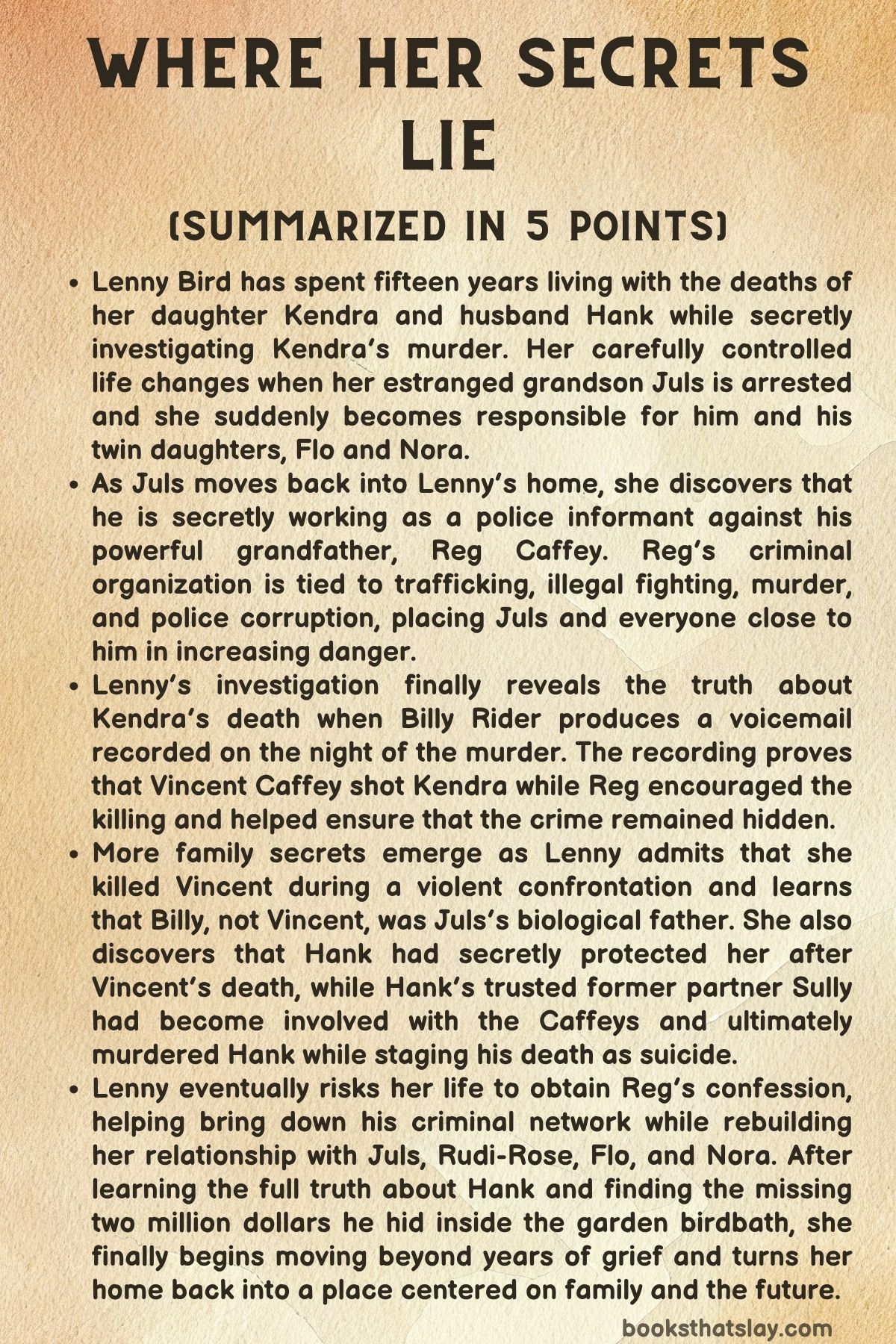
In 2010, fifty-five-year-old Lenny Bird drags the body of Vincent Caffey from her garden shed and buries him beneath a newly planted wisteria. Bruised after a violent encounter and desperate to protect her grandson Juls from further trauma, she cleans away the evidence and hides what she has done from everyone, including her husband Hank.
Fifteen years later, Lenny is seventy and still living in the same Ottawa house, surrounded by reminders of what she lost. Her daughter Kendra was murdered, Hank later died in what appeared to be suicide, and Juls has become estranged from her and closely connected to the Caffey family through Reg Caffey, Vincent’s powerful criminal father.
Lenny has never accepted the unresolved questions surrounding Kendra’s death. In her basement she has constructed an enormous evidence wall filled with crime-scene photographs, newspaper articles, maps, footwear, and other clues, endlessly comparing a bloody shoe print from Kendra’s murder scene against size-ten shoes she acquires.
Her lonely routine changes after she sees Juls apparently arrested during a major police raid. He calls from custody and asks her to retrieve his eight-year-old twin daughters, Flo and Nora, from Reg’s strip club, the Full Nelson, warning her not to allow anyone there to stop her.
Lenny successfully removes the girls and brings them home, where their energy disrupts the stagnant life she has built around grief. Practical Nora and impulsive Flo quickly discover parts of Lenny’s past, including her basement evidence display, while Lenny begins feeling again what it means to have family filling the house.
When Juls faces a bail hearing, Lenny unexpectedly volunteers to become his surety. He is released into her custody under conditions forbidding contact with Reg and people associated with his organization, creating an uneasy reunion between grandmother and grandson after years of distance.
Their relationship becomes even more strained when Juls discovers the evidence wall and sees the photographs of his murdered mother. He is horrified that Lenny has spent years studying Kendra’s dead body as evidence, but the resulting confrontation also breaks through some of their emotional distance when Lenny admits that investigating the murder became her way of surviving the loss of Kendra, Hank, and eventually Juls himself.
At the same time, someone begins searching Lenny’s property. Billy Rider, Reg’s longtime lieutenant, breaks into her house and damages her evidence wall, while Lenny receives increasingly threatening warnings to stop asking questions.
Lenny also learns that Juls is not simply a criminal working for Reg. Sugar, a woman associated with the Full Nelson, is actually an undercover police officer, and Juls has become a confidential informant helping police build a case against his grandfather. His dangerous position requires him to appear loyal to Reg while secretly gathering evidence against him.
Reg soon forces Juls into an illegal fighting event attended by organized-crime figures. Juls is brutally beaten while Reg turns the gathering into a demonstration of power, eventually murdering an injured fighter in front of the crowd.
Rudi-Rose, Juls’s partner and the twins’ mother, secretly records the event and finally reveals why she repeatedly disappears. Reg gained control over her after she was trafficked into Canada as a young teenager, confiscated her passport, trapped her in debt, and later forced her to recruit young women for criminal gatherings.
Lenny helps hide Rudi-Rose and the twins and brings journalist Christie Coote into the situation so Rudi-Rose can expose Reg’s trafficking operation. Her testimony becomes an act of resistance against the system that exploited her from childhood.
Meanwhile, Lenny starts uncovering Hank’s hidden activities after Kendra’s murder. She learns that her husband secretly followed Vincent, planted evidence in an attempt to imprison him, stole two million dollars connected to him, and investigated the suspicious death of Paul Choi, the man who supplied Vincent’s alibi for the night Kendra was killed.
Hank’s evidence leads Lenny to imprisoned contract killer Tony Boxcar. Boxcar denies killing Hank but admits that he murdered Paul Choi through an intermediary connected to Vincent, confirming that Hank had correctly uncovered a conspiracy to protect Vincent.
The most explosive evidence comes from Billy. He reveals that Kendra called him on the night she died and that he preserved the voicemail for fifteen years without giving it to police.
The recording captures Vincent breaking into the apartment and confronting Kendra after another violent argument. Reg is also present, ordering his son to finish what he started; Vincent shoots Kendra, and Reg then ensures that no one helps her as she lies dying.
Billy admits that he hid the recording because he feared Reg, who had previously forced him to participate in grotesque killings. In return for Billy’s confession, Lenny tells him that Vincent came to her house after his release and never left alive.
Juls overhears this revelation and discovers another devastating truth soon afterward: Billy, not Vincent, was his biological father. Kendra and Billy had been involved during one of the worst periods of her relationship with Vincent, and Billy had quietly watched over Juls from a distance ever since.
Before Juls can make peace with that knowledge, Reg kills Billy, believing him to be the informant threatening his organization. Juls is left grieving a father he discovered only moments before losing him.
Police then arrive at Lenny’s home after receiving information that Vincent is buried beneath the wisteria. Yet when they excavate the garden, no corpse is found, leaving Lenny stunned because she knows exactly where she placed him.
The danger increases when Flo and Nora disappear from the motel where Rudi-Rose has been hiding. Lenny eventually discovers that Sully, Hank’s former police partner and one of her closest friends, has taken them.
Sully’s betrayal reaches far beyond the kidnapping. Gambling debts had allowed Vincent to compromise him years earlier, and Sully had been leaking police information to the Caffeys while pretending to remain Hank’s loyal friend.
He admits sabotaging evidence involving Vincent and reveals that he knows Hank stole two million dollars. Believing Lenny knows where the money is hidden, Sully abducts the twins to force her to give it to him; when Juls arrives and Sully realizes his position has collapsed, Sully kills himself.
Lenny and Juls eventually deduce that Sully left Flo and Nora at Maplelawn Manor with Silas. The girls are found safe, but Juls still faces Reg, and Lenny decides she will no longer allow her grandson to carry that danger alone.
After secretly drugging Juls and Rudi-Rose so they cannot follow her, Lenny goes by herself to the abandoned mill where Reg expects to meet Juls. She deliberately allows Reg’s bodyguard to discover the phone she appears to be using as a recorder, distracting Reg from her real plan.
Lenny has concealed Juls’s phone in her hair and used it to establish a connection to her home answering machine. Believing he has defeated her recording attempt, Reg speaks freely enough to incriminate himself in Kendra’s death and Billy’s murder.
Lenny escapes the violent confrontation alive and gives the recording to Sugar, whose real name is Constable Laura Mastrangelo. Reg is arrested, while Christie’s reporting and police evidence expose the wider trafficking and criminal organization he controlled.
Reg later dies after being stabbed in prison. Around the same time, Silas dies peacefully in his sleep, ending Lenny’s difficult relationship with the father whose approval she sought for much of her life.
Yet one central mystery remains: Hank’s supposed suicide. Lenny and Juls discover the hidden security system Hank installed in 2010 and locate footage proving that he knew exactly how Vincent died.
The recording shows Vincent pursuing and violently attacking Lenny after she poisoned the cookie dough he was eating. Silas arrives and attempts to defend her, but Vincent attacks him as well, forcing Lenny to kill Vincent with a pitchfork to save both herself and her father.
Hank later discovered Vincent’s grave through his security footage. Without confronting Lenny, he removed the corpse, disposed of it in a quarry reservoir, erased incriminating footage, and preserved only the recording demonstrating that Lenny had acted in self-defense.
The final recordings solve Hank’s death as well. Hank had uncovered Sully’s connection to Vincent and Tony Boxcar and confronted his former partner in the garage; Sully attacked him, searched unsuccessfully for Vincent’s missing money, placed the injured Hank inside the Jeep, blocked the exhaust, and staged his death as suicide.
For Lenny, learning that Hank did not deliberately abandon her removes one of the deepest wounds she has carried for fifteen years. She can finally understand that his secrecy, however damaging, was tied to an effort to protect her and expose the betrayal surrounding their family.
By the following summer, Juls and Rudi-Rose have rebuilt their life with Flo and Nora, Maya has survived Sully’s attempt to kill her, and the remnants of Reg’s network are being dismantled. Lenny buys the neighboring house for Juls’s family, allowing them to live independently while remaining close to her.
One final secret remains. Studying Hank’s old footage, Lenny realizes that the pedestal of the garden birdbath contains the missing two million dollars he stole from Vincent.
She decides not to surrender it, reasoning that whatever Hank originally intended, the money can now help the family he tried so desperately to protect. After years spent living in a house defined by death, absence, and secrets, Lenny chooses to use one last hidden truth to support the living.
Characters
Lenny Bird
Lenny is the emotional and investigative center of Where Her Secrets Lie, a seventy-year-old woman whose apparent ordinariness conceals remarkable stubbornness, intelligence, guilt, and physical courage. Her age matters because other people repeatedly underestimate her, while Lenny herself is struggling with the unsettling realization that society increasingly treats her as fragile or irrelevant.
She once dreamed of becoming a forensic entomologist like Silas and later applied her analytical instincts to Hank’s police cases. Her basement wall demonstrates both her natural investigative talent and the unhealthy extent to which grief has consumed her life.
Kendra’s murder and Hank’s supposed suicide leave Lenny emotionally suspended for fifteen years. She drinks heavily, preserves Hank’s belongings, speaks to him inside his Jeep, refuses to alter parts of the house, and turns her daughter’s death into a mystery she believes she must solve before she can move forward.
Her killing of Vincent initially appears to be her darkest moral secret, but the complete footage radically changes its meaning. Vincent was strangling her and attacking Silas when Lenny used the pitchfork, making her action an act of survival rather than calculated vengeance.
Lenny nevertheless remains morally complicated because she lies, hides evidence, drives while suspended, drugs Juls and Rudi-Rose, manipulates people, and repeatedly places herself in extreme danger. What distinguishes her is not purity but an increasingly fierce willingness to accept consequences when protecting the people she loves.
Her greatest development is emotional rather than investigative. By reconnecting with Juls, Flo, Nora, and Rudi-Rose, she stops treating survival as the same thing as living and gradually allows the house that became a memorial to the dead to become a family home again.
Juls
Juls occupies one of the most difficult positions in Where Her Secrets Lie because almost every important adult in his childhood concealed something from him. He grows up believing Vincent was his father, loses Kendra violently, believes Hank committed suicide, becomes estranged from Lenny, and enters Reg’s world without understanding the full history that created his circumstances.
His intimidating appearance and criminal record initially encourage Lenny to fear that Reg has turned him into another Vincent. The revelation that Juls is secretly a police informant corrects that assumption without pretending he is completely untouched by the environment in which he has lived.
Juls demonstrates extraordinary endurance while maintaining his cover inside Reg’s organization. He accepts arrest, physical abuse, surveillance, and the risk of execution while trying to gather evidence against a man who has controlled his family for years.
His deepest motivation is fatherhood. Even when his own life is collapsing, Flo and Nora remain the standard by which he judges his decisions, and the twins’ disappearance nearly destroys the emotional control he has learned to maintain.
His relationship with Lenny moves from resentment toward renewed trust. Discovering the crime-scene wall, Vincent’s death, Billy’s identity, and decades of family deception gives him ample reason to reject her, yet he ultimately recognizes that her worst actions were often attempts to protect him.
By the end, Juls is no longer defined primarily as Kendra’s traumatized son or Reg’s apparent heir. He becomes a father building a more stable life, capable of loving Lenny again without denying the harm created by her secrecy.
Hank Bird
Hank is physically absent from most of Where Her Secrets Lie, yet his decisions influence almost every major mystery. Initially remembered as a respected police officer and devoted husband who apparently killed himself, he is gradually revealed as a grieving father whose determination to punish Vincent destroyed the boundaries he once believed in.
Kendra’s abuse and murder transform Hank from an officer who trusts procedure into a man willing to assault Vincent, track him illegally, plant evidence, trespass, steal criminal money, and conduct an unauthorized private investigation. His actions are understandable as expressions of paternal rage, but the book does not make them ethically clean.
His strongest quality is his devotion to Lenny and Juls. The fishing trip with Juls, his tenderness toward Lenny, and his final efforts to preserve evidence of her self-defense reveal that emotional distance never meant lack of love.
After discovering Vincent’s body, Hank quietly removes it and preserves only the footage capable of protecting Lenny. This act explains both the missing corpse and the extent to which husband and wife were simultaneously protecting one another while refusing to communicate.
The revelation of his murder fundamentally changes Lenny’s understanding of their marriage. Hank did not choose to abandon the family; Sully killed him while Hank was attempting to confront corruption and put the pieces of his investigation in order.
Kendra Bird
Kendra is the absent figure around whom much of the novel’s violence and grief revolves. Although she dies before the central present-day action, home movies, memories, police photographs, Billy’s voicemail, and the behavior of those who loved her keep restoring her humanity against the danger of reducing her to a murder victim.
Her relationship with Vincent demonstrates the complexity of prolonged intimate-partner abuse. She repeatedly returns to him despite beatings and humiliation, not because the violence is insignificant but because fear, emotional attachment, coercion, and family entanglement make leaving much more difficult than outsiders imagine.
Kendra also keeps important secrets. Her affair with Billy results in Juls, while Vincent continues believing himself to be the boy’s father.
The preserved voicemail finally allows Kendra’s own voice to expose what happened. Her fear, her awareness that Vincent is returning, and her concern that Juls will soon come home show that her final thoughts remain tied to protecting her child.
Her murder becomes the original injury from which nearly every later secret grows. Hank seeks illegal justice, Lenny becomes obsessed with solving the case, Billy lives with unbearable guilt, Juls grows up inside Reg’s influence, and Reg’s criminal control deepens because the truth remains hidden.
Reg Caffey
Reg is the principal embodiment of organized power in Where Her Secrets Lie, but his menace comes as much from manipulation as from physical violence. He presents himself publicly as a sober, reflective older businessman while controlling trafficking, illegal fighting, intimidation, murder, and a network of compromised associates.
His relationship with Vincent reveals one of his defining beliefs: family loyalty means protecting his own regardless of what they have done. Rather than restraining Vincent after years of abuse, Reg encourages him to kill Kendra and then helps manage the consequences.
Reg extends the same controlling idea of family toward Juls. He treats his grandson as property and repeatedly attempts to shape him through violence, praise, obligation, and criminal belonging.
His treatment of Rudi-Rose demonstrates another dimension of his power. He exploits her vulnerability from adolescence, traps her financially and legally, and later forces her to participate in recruiting other young women.
The illegal fight exposes Reg without his respectable mask. Killing an injured fighter in front of cheering criminals shows that violence has become both entertainment and political theater for him.
His eventual downfall occurs because the people he has controlled begin acting against him. Juls informs, Rudi-Rose speaks, Christie publishes, Sugar investigates, Billy finally reveals Kendra’s voicemail, and Lenny manipulates his arrogance into producing a confession.
Vincent Caffey
Vincent is the immediate source of much of the Bird family’s suffering. His prolonged abuse of Kendra establishes him as dangerous well before her murder, and his deliberate provocations toward Hank show that he takes satisfaction in the fear and helplessness he creates.
His violence is supported by Reg’s power. Vincent therefore behaves with the confidence of someone who expects consequences to be removed through intimidation, corruption, or family intervention.
Kendra’s voicemail confirms that he is the person who shoots her. His panic after the shooting also reveals that, unlike Reg, Vincent is not always emotionally controlled; he commits terrible acts but still relies on his father to manage the aftermath.
His final visit to Lenny’s house arises from Hank’s theft of the two million dollars. Lenny understands that Vincent represents a lethal threat, poisons the raw cookie dough he habitually eats, and tries to escape when the poison weakens him.
Even then Vincent pursues and nearly kills her before turning his violence on Silas. His death at Lenny’s hands closes his personal story but creates another chain of secrecy that survives for fifteen years.
Billy Rider
Billy is one of the novel’s most morally conflicted figures. He spends much of his life serving Reg and appears to outsiders as another dangerous member of the Caffey organization, yet fear, love, shame, and divided loyalty have been working beneath that allegiance for years.
His love for Kendra is central to understanding him. Their affair makes him Juls’s biological father, but he accepts Kendra’s decision to remain with Vincent and watches Juls from a distance rather than exposing the truth.
Billy’s most consequential failure is keeping Kendra’s voicemail hidden. He knows it contains evidence of Vincent and Reg’s responsibility, but terror prevents him from giving it to police.
His fear is grounded in extreme trauma because Reg previously forced him to participate in the decapitation of rival criminals. Billy therefore represents the psychological damage produced by long-term coercion inside violent organizations.
His decision to finally play Kendra’s voicemail for Lenny is an attempt, however late, to stop serving the lie. Tragically, he discovers that Juls is his son only in the same period that Reg begins suspecting betrayal.
Reg kills Billy before father and son can develop a genuine relationship. Juls is therefore forced to grieve not only Billy’s death but also the future relationship he has suddenly lost.
Rudi-Rose
Rudi-Rose initially appears in Where Her Secrets Lie through Lenny’s judgmental perspective as an unreliable mother who disappears repeatedly and leaves Juls responsible for the twins. The truth completely revises that impression by revealing that her absences are connected to coercion and exploitation by Reg.
Thrown out by her parents at thirteen, she becomes vulnerable to traffickers who bring her into Canada. Reg takes advantage of that vulnerability by controlling her passport, debt, employment, and eventually her freedom.
Her position becomes especially cruel after she becomes a mother. She hides what Reg is forcing her to do because she fears Juls would confront him and be killed.
Rudi-Rose nevertheless retains the ability to resist. Recording Reg’s illegal fighting event is dangerous, but the footage proves what he does when he believes himself untouchable.
Her decision to speak with Christie is even more significant because she reframes herself as more than Juls’s partner or the twins’ mother. She speaks for the abandoned thirteen-year-old she once was and for other girls placed in similar situations.
By the end, she is able to move toward a different life and work at a women’s shelter. Her development turns a character first viewed through suspicion into one of the clearest examples of survival becoming active resistance.
Flo
Flo is the more impulsive and openly expressive of Juls’s twin daughters. Her curiosity, humor, and willingness to treat Lenny’s strange house as an adventure immediately bring energy into a home that has been dominated by silence and grief.
She is fascinated rather than frightened when she discovers Lenny’s investigation, imagining her great-grandmother as a secret detective. That response illustrates how protected the twins initially are from the full meaning of the family history.
Flo also gives Lenny opportunities to experience uncomplicated affection again. Her jokes about Lenny’s age and later her rollerblading lessons show how the younger generation pulls Lenny toward the present.
Her vulnerability becomes clear during the kidnapping, when her usual confidence eventually gives way to tears. That emotional collapse reminds the adults that the twins cannot simply absorb endless danger because they appear resilient.
Nora
Nora is more serious, observant, and cautious than Flo. She notices disorder, inconsistencies, overheard conversations, and adult tension quickly, meaning that Lenny has much greater difficulty protecting her through comforting lies.
Her repeated questions about Juls reveal her greatest fear: that her father may actually be one of the dangerous men surrounding the family. Lenny’s assurance that Juls is fundamentally trying to do the right thing becomes especially important because Nora is already old enough to understand that arrest and violence have real meanings.
Nora often responds to chaos by becoming practical. This makes her appear unusually mature, but it also suggests a child adapting to instability by trying to control whatever she can.
Together with Flo, she represents the generation the adults are struggling to protect from inherited trauma. Their safety forces Juls, Rudi-Rose, and Lenny to consider whether secrecy really protects children or simply postpones the moment when they encounter the consequences.
Silas Flint
Silas is Lenny’s father, a once-distinguished forensic entomologist whose dementia has reduced his connection to the present without completely erasing the past. His profession explains much of Lenny’s fascination with evidence and her unrealized ambition to enter forensic science herself.
Their relationship is emotionally complicated because Lenny admired him intensely but rarely received the affection or encouragement she wanted. Even in old age, she continues visiting him with a mixture of love, duty, resentment, and guilt.
His fragmented nursery-rhyme references to secrets become especially unsettling because Lenny knows he shares her greatest secret. The later security footage reveals why: Silas tried to save her from Vincent and was present when she killed him.
Silas therefore carries both paternal failure and paternal protection. He may not have given Lenny the warmth she needed as a child, but when her life is threatened, he risks his own body trying to protect her.
His final interaction with Lenny is quiet rather than dramatic. Shortly before his peaceful death, he takes her hand, giving her one of the simplest expressions of affection she has received from him.
Terry “Sully” Sullivan
Sully initially occupies the comforting role of Hank’s former partner and Lenny’s longtime friend. Because he represents continuity with Hank and the police world Lenny once trusted, his eventual betrayal is among the story’s most personal revelations.
Gambling debts made him vulnerable to Vincent, and he gradually began trading police information for relief from those obligations. His corruption then expanded until protecting himself required further lies, sabotage, and violence.
Sully’s treatment of Hank is particularly destructive because genuine friendship appears to have existed alongside betrayal. He attempts to explain some of his actions as efforts to protect Hank from Vincent, but those justifications ultimately collapse when money and self-preservation become more important.
The garage footage removes the final ambiguity. After Hank confronts him, Sully attacks his former partner, searches for the missing money, and stages Hank’s death rather than seeking medical help.
His kidnapping of Flo and Nora shows how desperate he has become, though leaving them safely with Silas suggests that some moral boundary remains. When Juls corners him and escape becomes impossible, Sully kills himself rather than face exposure.
Sugar / Constable Laura Mastrangelo
Sugar first appears to be a dangerous member of Reg’s world. Her physical intimidation of Lenny reinforces the illusion, but her real identity as Constable Laura Mastrangelo reveals that she has been operating undercover within the organization.
She understands the danger Juls faces better than almost anyone because both of them are living behind false identities. Her warnings to Lenny are therefore motivated partly by operational necessity and partly by genuine concern that Lenny’s interference will get Juls killed.
Laura is disciplined but not emotionally detached. She helps the injured Juls after the illegal fight, follows developments surrounding Billy, and continues working the case even as Reg becomes increasingly unstable.
Her eventual arrest of Reg gives her a direct role in ending his control. Her decision to finally introduce herself to Lenny by her real name also marks the collapse of the false identities that have governed their relationship.
Maya Castillo
Maya is one of Lenny’s closest connections to legitimate law enforcement. Their boxing sessions give Lenny both physical strength and a space where she can discuss fears she does not easily share elsewhere.
Maya repeatedly warns Lenny that she is not a police officer and that confronting organized criminals is extremely dangerous. Her frustration is justified because Lenny consistently withholds information, follows suspects, visits convicted killers, and treats promises to stop investigating as temporary inconveniences.
Despite that frustration, Maya continues helping her. Her loyalty eventually makes her a target when Sully strikes her with a vehicle in an attempt to contain the investigation.
Maya survives, which gives her character a different ending from many people pulled into the Caffey conflict. She represents institutional law enforcement at its more honorable level, contrasting with the corruption of Sully and Detective Wyatt.
Christie Coote
Christie is an investigative journalist who refuses to accept the respectable public image surrounding Reg. Her repeated attempts to question Juls initially make her seem intrusive, especially because her presence could expose his secret cooperation with police.
Her importance becomes clearer when Rudi-Rose decides to tell her about the trafficking operation. Christie provides a route for information to become public rather than remaining trapped within police files or private family knowledge.
Her eventual reporting helps dismantle Reg’s wider network by turning individual experiences into a public record. The national and international attention surrounding her work also ensures that the crimes can no longer be contained through local influence.
Tony Boxcar
Tony Boxcar is a convicted contract killer whose reputation initially makes him appear to be the likely explanation for Hank’s death. His preferred method of asphyxiation strengthens that suspicion because Hank supposedly died through carbon-monoxide poisoning.
His conversation with Lenny complicates that theory. Boxcar says he refused contracts involving police officers, women, and children, presenting a personal code that does not erase his crimes but does show that even professional violence in this story operates through rules and hierarchies.
His admission that he killed Paul Choi becomes crucial because it validates Hank’s hidden investigation. The murder of Vincent’s alibi witness proves that someone was systematically protecting Vincent after Kendra’s death.
Boxcar also becomes the link that ultimately exposes Sully. Hank’s surveillance of the meeting between the two men gives him the evidence that leads to the confrontation in the garage.
Fender
Fender functions as more than background family detail because his long presence links the household before and after its tragedies. He belongs to Juls’s childhood, Hank’s life, Lenny’s lonely years, and the family’s eventual reunion.
His presence during several emotionally intense moments gives Lenny a form of companionship that requires no explanation. When she finally collapses after learning how Hank actually died, Fender curls beside her as she grieves.
He also contributes indirectly to the history of the garden and Hank’s hidden actions. As a constant witness who cannot explain what he has seen, Fender fits naturally into a story filled with houses, objects, recordings, and living beings that silently preserve the past.
Themes
The Damage Created by Secrecy
Secrets in Where Her Secrets Lie begin as acts of protection but repeatedly become sources of harm. Lenny hides Vincent’s death to protect Juls, Hank conceals his investigation to protect Lenny, Billy hides Kendra’s voicemail because he fears Reg, Rudi-Rose conceals her exploitation because she fears Juls will retaliate, and Juls hides his informant role because revealing it could get him killed.
Each secret has understandable motives, yet silence prevents characters from seeing the whole danger around them. Lenny spends fifteen years believing Hank willingly abandoned her through suicide because she does not know what he discovered, while Juls grows up with false ideas about his father, his grandfather, his mother’s death, and Lenny’s actions.
The novel therefore distinguishes privacy from destructive concealment. Information hidden temporarily for safety may be necessary, but secrets become damaging when they isolate people from those who could understand or help them.
The house itself becomes a physical representation of this pattern. Evidence is hidden in the basement, a body beneath the garden, money inside a birdbath, surveillance equipment behind walls, a phone in a glove compartment, and recordings inside forgotten technology.
Healing begins only when hidden knowledge is finally shared. Lenny and Juls become closer not because the truth is painless, but because they can finally respond to one another as people who understand the same history.
Family, Protection, and Moral Boundaries
Nearly every major character claims to act for family, but the novel repeatedly asks what protection permits a person to do. Hank attacks Vincent, plants evidence, conducts illegal surveillance, steals money, and hides a corpse because he believes conventional systems have failed Kendra and Lenny.
Lenny crosses similar boundaries. She kills Vincent in legitimate self-defense, but afterward she buries him, lies for years, interferes with investigations, drugs Juls and Rudi-Rose, and enters Reg’s criminal stronghold alone.
Juls risks death as an informant because he wants to escape Reg’s control and protect his daughters. Rudi-Rose stays silent about her exploitation because she believes telling Juls would lead him into a suicidal confrontation with Reg.
Reg provides the darkest contrast because he also invokes family loyalty, yet his idea of protection is possessive and corrupt. He protects Vincent from accountability, attempts to control Juls as his successor, and treats loyalty as obedience enforced through fear.
These parallel behaviors prevent the story from presenting family devotion as automatically virtuous. Love becomes morally meaningful only when it respects the humanity and freedom of the person being protected.
The strongest relationships eventually move away from control. Lenny learns that loving Juls means trusting the adult he has become, while Juls learns that understanding Lenny does not require pretending every decision she made was correct.
Grief, Memory, and the Inability to Move Forward
Lenny’s house is filled with objects that preserve grief: Hank’s Jeep, Kendra’s belongings, VHS recordings, the basement wall, old photographs, and the wisteria planted over Vincent’s grave. She lives among these objects because changing them would require accepting that the people connected to them are permanently gone.
Her investigation therefore serves two functions at once. It seeks justice for Kendra, but it also gives Lenny permission to remain emotionally attached to the moment when her family collapsed.
Hank responds to grief differently but just as destructively. Kendra’s murder transforms his commitment to law into a private campaign against Vincent, and each illegal decision becomes easier to justify because he believes ordinary justice has failed.
Juls carries grief from childhood into adulthood. He loses Kendra and Hank while still young, becomes separated from Lenny, grows up near Reg, and develops a hardened identity that helps him survive but makes emotional trust difficult.
The security recordings eventually change the characters’ relationship with memory because they replace assumptions with evidence. Lenny learns that Hank did not abandon her, Juls learns what truly happened to Vincent, and both can finally reinterpret experiences that shaped their lives.
By the end, remembering no longer means refusing change. Lenny can preserve Hank’s place in the family while repairing the house, rollerblading with the twins, and helping the younger generation build something new.
Survival, Agency, and Reclaiming a Life
Survival in Where Her Secrets Lie is not treated as a single moment of escaping danger. Lenny, Rudi-Rose, Juls, and Kendra all demonstrate that surviving violence can leave a person living for years inside fear, secrecy, guilt, or patterns created by the people who harmed them.
Rudi-Rose offers the clearest example of survival becoming agency. She spends years obeying Reg because he controls the conditions of her life, but recording the illegal fight and speaking to Christie allow her to turn private suffering into evidence against the system that exploited her.
Juls’s informant work represents another attempt to reclaim control. Reg expects family loyalty to determine his future, while Juls secretly chooses a path intended to dismantle that inheritance and protect his daughters from it.
Lenny’s transformation follows a similar movement. At first she survives by drinking, investigating Kendra endlessly, preserving Hank’s possessions, and maintaining emotional distance from the living.
Her later choices are still reckless, but they increasingly come from engagement rather than paralysis. She protects her family, reconnects with Juls, accepts Rudi-Rose, bonds with the twins, confronts Reg, and finally permits her home to change.
The final discovery of the money captures this complicated freedom. Lenny chooses not to let the past dictate every remaining decision and instead turns one of Hank’s secrets toward the future of the family that survived.