Tradwife by Michelle Brandon Summary, Characters and Themes
Tradwife by Michelle Brandon is a domestic suspense novel about performance, control, revenge, and the dangerous consequences of silence. Set in the seemingly idyllic community of Crystal Harbor, the story follows several women whose marriages and public identities conceal fear, resentment, addiction, manipulation, and long-buried guilt.
At its center is the mystery surrounding Tara Olsen, a teenager believed to have died in 2013, and the violent present-day events that force old witnesses to confront what they allowed to happen. The novel questions whether traditional domestic roles are freely chosen when money, reputation, marriage, and social pressure limit a woman’s ability to leave or speak.
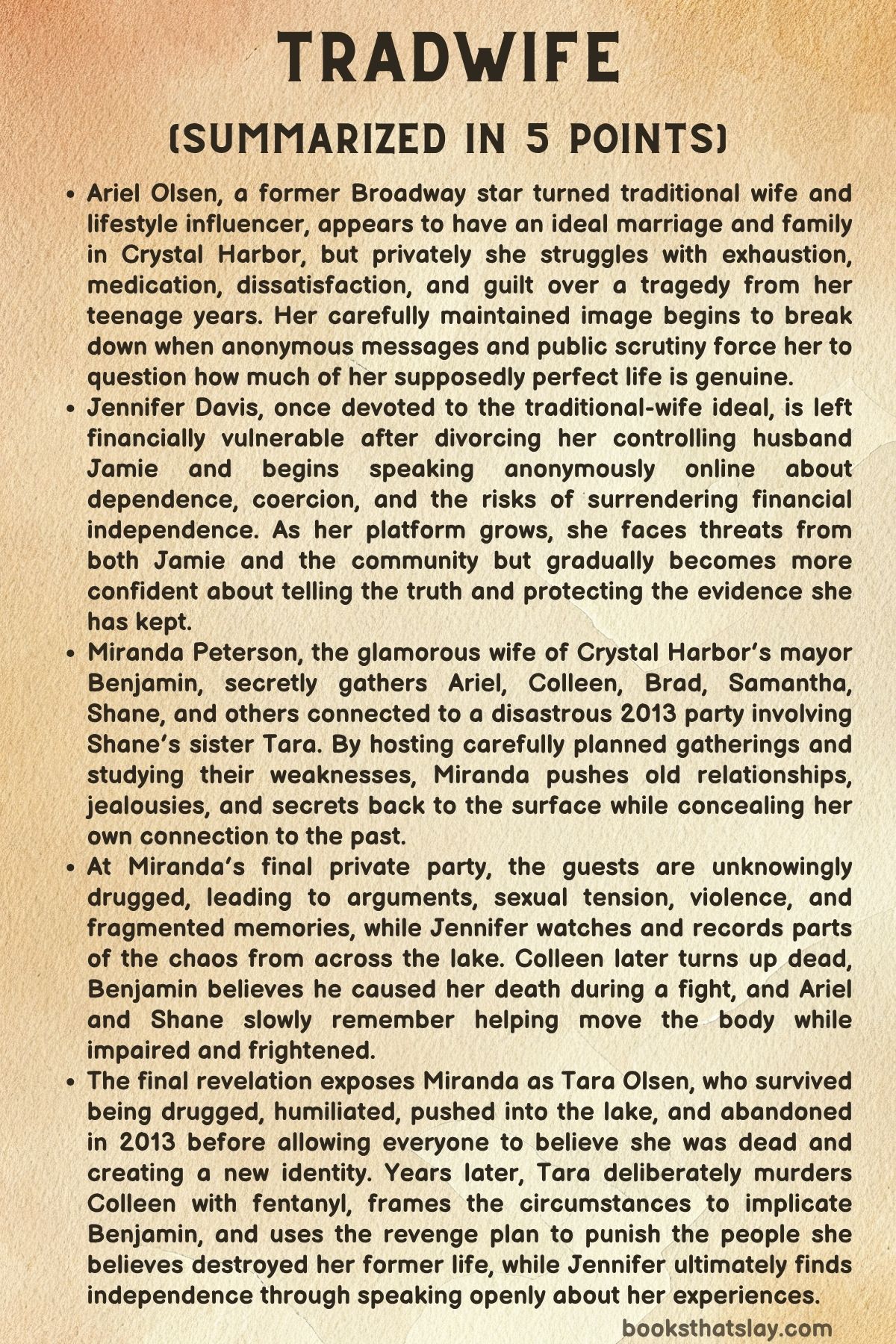
Summary
Crystal Harbor appears to be an attractive coastal community where beautiful homes, successful marriages, church involvement, family values, and carefully maintained reputations matter enormously. Beneath that orderly surface, however, several women are living private lives that bear little resemblance to the versions of themselves they display to husbands, neighbors, and social-media followers.
Ariel Olsen once had a celebrated career as a Broadway actress, but she has exchanged the stage for marriage to Shane Olsen, motherhood to five children, domestic work, and an online identity centered on traditional family life. From the outside, Ariel possesses almost everything Crystal Harbor admires, yet internally she feels exhausted, dissatisfied, and increasingly uncertain about who she has become.
Her everyday responsibilities resemble another performance. She cooks, bakes, raises children, produces lifestyle content, manages the house, supports Shane, and smiles for an audience that expects her marriage to represent domestic fulfillment.
Privately, Ariel relies on medication to survive difficult periods and hides the extent of her emotional struggles from Shane. She also carries a far older secret involving Shane’s twin sister Tara, whose supposed death during their teenage years remains an unspoken source of guilt.
Miranda Peterson occupies another privileged position in town as the glamorous wife of Mayor Benjamin Peterson. She appears wealthy, fashionable, sexually confident, and perfectly capable of performing the role expected from a respectable politician’s wife, although she privately dislikes nearly everything about Crystal Harbor’s domestic culture.
Miranda has concealed a much wilder past involving nightlife, alcohol, sexual freedom, and a previous life in New York. She also has motives for returning to Crystal Harbor that have nothing to do with settling peacefully into marriage.
Jennifer Davis stands outside the town’s celebrated model of successful womanhood. Divorced, financially insecure, raising four children, and working at a grocery store, she has become an uncomfortable reminder that obedience, domestic labor, and devotion to marriage do not guarantee security.
Jennifer once followed every rule expected of a traditional wife while married to Jamie. After the marriage ended, he retained financial stability and social acceptance while Jennifer was left with limited professional experience, economic pressure, childcare responsibilities, and the realization that years of dependence had made leaving extraordinarily costly.
Their apparently separate lives remain connected by events from 2013. Ariel, Jennifer, Colleen, Brad, Samantha, Shane, and others belonged to the same teenage social circle when Tara Olsen became the target of a cruel act at a party near Echo Lake.
Tara was an outsider compared with many of the wealthy teenagers around her. She had been tutoring Brad, and their growing attraction angered Colleen, who had been involved with him.
At the party, Tara and Brad were given a substance that badly impaired them. Other teenagers entered the boathouse, stripped them while they were incapable of properly defending themselves, photographed them, and treated their humiliation as entertainment.
The abuse continued after Tara emerged from the boathouse. Brad distanced himself rather than defending her, while Colleen confronted her with evidence that the nude photographs were already circulating and attacked the insecurities Tara had carried into the party.
Their confrontation moved onto the pier. Tara, still impaired and overwhelmed, fell into the lake after Colleen pushed her away, striking her head and apparently drowning.
Instead of ensuring that Tara received help, the people around the incident became part of a culture of silence. Different individuals knew different pieces of the truth, but fear, self-interest, social pressure, and the desire to protect reputations allowed the official story of Tara’s death to replace what actually happened.
Years later, Miranda quietly begins bringing these people back together. She hosts gatherings, studies relationships, observes weaknesses, forms strategic friendships, and encourages people to reveal things they normally hide.
Her interest is especially strong when she encounters Ariel, Colleen, Brad, Samantha, and others connected with the old party. Miranda frequently acts as though her curiosity is social, but her gatherings are carefully constructed situations meant to recreate instability among people who have spent years protecting themselves with respectable appearances.
Meanwhile, Ariel’s public identity begins to collapse. Anonymous messages criticize her appearance, domestic habits, former career, and lifestyle, while some messages contain references suggesting that the sender may know what happened in 2013.
Ariel becomes increasingly frightened because the messages are not merely ordinary online harassment. Their wording touches the hidden guilt she has carried since witnessing events surrounding Tara and remaining silent.
Her social-media audience also begins noticing how artificial her happiness appears. A brief moment in which Ariel stops smiling during a video is circulated online, with viewers joking that she resembles someone signaling for help.
Shane responds primarily by worrying about their family brand and business. His reaction forces Ariel to see that much of her distress has been treated as a problem of presentation rather than evidence that her life itself may need to change.
Jennifer begins her own transformation by creating an anonymous social-media account. She talks about how complete economic dependence, lack of education or work experience, and unquestioned service to a husband can leave women dangerously vulnerable if a marriage fails.
Her videos receive hostility, but they also attract hundreds of women who recognize themselves in Jennifer’s experience. For the first time, she understands that her failed marriage was not simply evidence that she personally failed at being a wife.
Jamie tries to intimidate her into silence, including by raising the possibility of custody problems. Jennifer nevertheless possesses evidence she gathered during the marriage, including recordings of abuse and material connected to the old Tara cover-up.
Although Jennifer fears what releasing everything could do to her children, she gradually becomes less willing to destroy evidence or protect people simply because telling the truth could be socially dangerous. Her rebellion becomes as much about recovering her voice as exposing Jamie.
Miranda’s own marriage becomes increasingly urgent when she repeatedly fails to become pregnant. Benjamin’s prenup makes her financial future partly dependent on producing a child, transforming what appears to be a traditional family expectation into another method of control.
Rather than accept the situation, Miranda searches for legal and strategic weaknesses in the agreement. Her marriage and her revenge plan begin moving toward the same objective.
She eventually hosts an exclusive party attended by Ariel and Shane, Brad and Kennedy, Colleen and Zachary, Samantha and Nathaniel, and others whose histories contain jealousy, resentment, sexual tension, and secrets. Guests surrender phones and keys, while Miranda quietly maintains access to the property’s surveillance system.
The drinks contain a substance intended to reduce inhibition. As the guests become increasingly impaired, sexual boundaries weaken, old attractions reappear, jealousy intensifies, and conflicts that had been hidden beneath respectable marriages become visible.
Ariel quickly realizes that something is wrong because her physical condition resembles the disorientation she experienced while using medication even though Shane has already taken her pills away. Her memories fragment as the party grows more chaotic.
Across the lake, Jennifer watches the gathering from her home. At first she observes out of curiosity and even a degree of resentment toward people who once excluded or judged her, but she eventually begins recording parts of what she hears and sees.
A violent argument erupts late in the night. Jennifer hears shouting and the sounds of a physical confrontation, yet fear prevents her from calling the police.
The decision disturbs her because it resembles what happened years earlier with Tara. Once again, Jennifer has witnessed signs that something dangerous may be happening and has chosen silence, although this time she preserves the recording.
The following morning, Ariel wakes in her own bed with no memory of how she returned home. Shane is missing, and Ariel has dirt beneath her nails, a scrape on her body, sand in her clothes, and part of a broken seashell.
Miranda awakens with incomplete memories of the party as well, although she is far more aware of what happened than the others. Benjamin is missing, abandoned belongings remain throughout the house, and black sandals appear among the unexplained evidence.
Jennifer takes her dog Shadow to the beach and discovers black sandals that she believes belong to Jamie. She then finds what appears to be a body hidden near the dunes, only for it to disappear after she leaves briefly to retrieve her phone.
Police later discover another body on the beach. Because Jennifer has a hostile history with Jamie and has publicly criticized their marriage, she immediately fears that investigators could interpret almost anything she says as evidence of motive.
The situation becomes stranger when Miranda repeatedly calls Jennifer asking whether Benjamin has gone to see her. Jennifer realizes that Benjamin Peterson and Jamie Davis are the same person: her former husband has reinvented himself socially and politically while building another marriage.
Ariel continues searching desperately for Shane until he eventually returns home bruised, scratched, filthy, and barefoot. His explanation is incomplete, and physical evidence indicates that both he and Ariel were somehow connected to the beach during the hours neither can properly remember.
Shane later admits that he hurt someone during the party and that a violent confrontation involved Benjamin. He then tells Ariel something even more frightening: he knows who died, and Ariel herself was present during what happened afterward.
Her memories begin returning in pieces. She recalls Colleen, blood, Miranda’s vehicle, the lake, and helping move a body while confused and drugged.
The dead woman is Colleen, and Benjamin believes that he killed her during the fight. He remembers striking her as violence erupted and accepts that her death must have resulted from the blow and subsequent head injury.
Miranda knows that this explanation is false.
She had deliberately injected Colleen with a fatal dose of fentanyl during the chaos. The drug caused Colleen to stagger into Benjamin’s swinging fist and collapse after striking her head, making his attack appear to be the direct cause of death.
Miranda then took control of everyone’s panic. Benjamin, Shane, and the severely impaired Ariel were convinced that Benjamin had accidentally killed Colleen, and Miranda helped direct the effort to move the body and create a misleading version of events.
The crime also serves Miranda’s financial interests. A clause in Benjamin’s prenup provides her with an opportunity to gain financially if his criminal behavior activates the relevant provision, allowing her to turn a contract intended to restrict her into a weapon against him.
The final revelation changes the meaning of Miranda’s entire presence in Crystal Harbor. Miranda is Tara Olsen.
Tara never actually drowned in 2013. After being left in the lake, she regained consciousness on the shore, injured and alone, and realized that the people around her had abandoned her without making certain she was dead.
Knowing that her nude photographs had spread and believing her former identity had been permanently destroyed, Tara chose not to return. She removed the necklace associated with her old life, threw it into the lake, and allowed Crystal Harbor to believe Tara Olsen had died.
Years later, she returned as Miranda with a new appearance, history, and identity. Her marriage to Benjamin gave her wealth, access, status, and proximity to people connected with the night that destroyed her adolescence.
Colleen’s murder therefore represents calculated revenge rather than an impulsive act. Miranda has arranged events so that Colleen dies, Benjamin is blamed, and many of the remaining participants are forced to confront fear, broken marriages, legal consequences, and memories they spent years suppressing.
Jennifer, however, moves in a different direction. Three months later, her social-media platform has grown substantially, and she openly discusses financial dependence, coercive relationships, and the importance of maintaining the ability to choose.
A publisher offers her the chance to write a book, giving her a measure of financial independence that would once have seemed impossible. She ultimately recognizes that divorce, despite its pain, freed her from a structure in which obedience mattered more than equality.
A year after the fatal party, Tara watches the surveillance footage she secretly preserved. It confirms that she injected Colleen before Colleen moved into Benjamin’s blow and that she then manipulated the confused witnesses into believing a different explanation.
Tara feels little remorse because she regards Colleen’s death and the destruction surrounding it as repayment for what was done to her. The novel ends by returning to her survival in 2013, showing that Miranda was not simply a disguise adopted for convenience but an identity created from Tara’s decision that the abandoned girl everyone believed dead would never return.
Characters
Ariel Olsen
Ariel is one of the central examples of how outward perfection can become a form of confinement in Tradwife. Her Broadway past gives her an especially important relationship with performance because she understands better than most characters what it means to adopt a role, repeat it convincingly, and give an audience what it expects.
The difference is that theatrical performance once belonged to Ariel by choice, while her later domestic performance gradually becomes inseparable from her marriage and public identity. Cooking, motherhood, homemaking, sexuality, social-media content, and even happiness become things she feels obligated to perform successfully.
Her medication use reflects the seriousness of the gap between appearance and reality. Ariel does not simply feel tired; she has reached a condition in which maintaining the expected version of herself requires secrecy, chemical assistance, and constant self-correction.
Her relationship with Shane makes this struggle more difficult because he frequently interprets unhappiness as something that should be overcome through gratitude or discipline. Even when he cares about Ariel, his instinct is often to manage the situation rather than fully accept that the life they built may itself contribute to her distress.
Tara’s disappearance forms Ariel’s deeper moral conflict. She has spent years believing silence protected Shane and their family, but the present-day crisis forces her to recognize that withholding truth can also preserve injustice.
By the end, Ariel is not completely liberated from guilt or consequence. Her importance comes from her growing ability to distrust the performance she once treated as reality and to question whether protecting the people she loves must always require protecting their secrets.
Miranda Peterson / Tara Olsen
Miranda is the hidden architect of Tradwife, but her character is deliberately constructed so that manipulation and victimization exist together without becoming morally equivalent. As Tara, she suffered humiliation, violation, social cruelty, physical danger, and abandonment from people who decided that their reputations mattered more than her life.
Her decision to allow the world to believe Tara died is psychologically significant. Rather than returning to a community that has already rewritten her identity through gossip and circulated photographs, she destroys her connection to the girl everyone thinks they understand.
Miranda represents that reinvention taken to its extreme. She becomes sexually confident, strategic, observant, wealthy, and skilled at presenting whatever version of herself a situation requires.
Her marriage to Benjamin is another performance, but unlike Ariel’s increasingly involuntary performance, Miranda uses domestic obedience strategically. She studies the expectations placed on a mayor’s wife and follows them when they give her access or concealment.
Her revenge against Colleen reveals how far survival has hardened into calculated cruelty. Miranda does not merely expose what happened in the past; she arranges a murder, drugs other people, manipulates witnesses, destroys evidence, and allows Benjamin to believe he caused a death she engineered.
The character therefore prevents the story from offering a simple revenge fantasy. Tara suffered a profound wrong, yet the adult identity she creates responds by reproducing coercion and violating other people’s agency, making her both the product of buried violence and the creator of new violence.
Jennifer Davis
Jennifer provides the clearest examination of economic dependence in Tradwife. She once embraced the traditional marital model almost completely, devoting herself to Jamie, their children, their home, and the belief that good service and obedience would produce security.
Divorce exposes the weakness of that arrangement. Jamie retains money, professional standing, social confidence, and the freedom to rebuild his image, while Jennifer discovers that years outside paid employment have left her struggling to support four children.
Her growth begins when she stops interpreting these consequences purely as personal failure. Through her anonymous videos, Jennifer realizes that many women have experienced similar combinations of dependence, control, limited options, and social judgment.
The platform also allows Jennifer to transform shame into language. She begins explaining distinctions that Crystal Harbor prefers to ignore, particularly the difference between freely choosing domestic work and being placed in a system where a woman lacks practical alternatives.
Jennifer is not immediately fearless after finding her voice. Threats, vandalism, Jamie’s custody pressure, her children’s vulnerability, and her own hesitation after hearing violence across the lake show how deeply years of control remain inside her decision-making.
Her final refusal to destroy evidence marks one of her strongest changes. Instead of assuming safety requires silence, she accepts that evidence and truth may be necessary protections against people who depend on intimidation and secrecy.
Shane Olsen
Shane occupies a complicated position in Tradwife because he is neither presented as a simple villain nor allowed to remain an unquestioned good husband. His affection for Ariel and devotion to family coexist with assumptions that repeatedly minimize the amount of invisible labor and emotional accommodation demanded from his wife.
He treats his role as the family’s stable center as natural. Ariel cooks, manages the children, supports the business, maintains the home, produces content, and regulates her emotions around his expectations, while Shane frequently notices the final result rather than the labor required to create it.
His response to Ariel’s medication is particularly revealing. Concern is present, but concern quickly becomes interrogation and control because Shane believes that identifying the problem gives him authority over how it should be handled.
Tara’s supposed death is the unresolved wound beneath his adult identity. His inability to know the complete truth has allowed grief to remain fixed in place while people around him, especially Ariel, have built their choices around protecting him from information.
The present-day fight and body disposal force Shane into a new relationship with moral responsibility. Even though he does not intentionally kill Colleen, his willingness to participate in concealment shows how quickly loyalty, fear, and confusion can reproduce the old pattern that followed Tara’s disappearance.
Colleen
Colleen is the person most directly associated with Tara’s original destruction in Tradwife. Her behavior as a teenager combines jealousy, social power, cruelty, and the confidence of someone who believes the group around her will support her interpretation of events.
She participates in circumstances that leave Tara drugged and humiliated, attacks her socially after the photographs circulate, and ultimately pushes her during the confrontation on the pier. The fact that Tara survives does not lessen Colleen’s responsibility for abandoning a situation in which Tara could easily have died.
As an adult, Colleen has built the respectable life Crystal Harbor rewards. Marriage, children, social position, domestic participation, and community involvement allow her to exist inside a public identity that does not visibly contain what she did as a teenager.
Yet her breakdowns suggest that the past has not disappeared simply because no one speaks about it. Alcohol use, emotional instability, resentment, and uncontrolled moments expose cracks in the life she presents to others.
Her death completes Tara’s revenge plan, but it also demonstrates the destructive logic of private justice. Colleen’s past wrongdoing is real, yet Miranda denies her any possibility of confession, legal accountability, change, or defense by secretly deciding that death is the appropriate repayment.
Benjamin Peterson / Jamie Davis
Benjamin’s two names express one of the novel’s strongest ideas about social reinvention. As Jamie Davis, he was Jennifer’s controlling husband; as Benjamin Peterson, he becomes a respected mayor who appears to embody stability, wealth, civic leadership, and traditional family values.
The change in public identity does not mean the underlying patterns disappear. His prenup with Miranda, expectations surrounding pregnancy, and earlier control over Jennifer reveal a continuing belief that relationships can be structured through unequal power.
Jamie repeatedly presents control as responsibility. When Jennifer begins speaking publicly about marriage, he frames threats involving reputation and custody as concern for the children, much as controlling behavior during their marriage was presented as reasonable authority.
His connection to the Tara cover-up also links marital control with a broader pattern of silence. Jennifer remembers him discouraging truth years earlier, showing that his instinct to manage narratives existed before their marriage fully developed.
Benjamin’s eventual imprisonment is based on a manipulated version of events rather than the complete truth. This creates an uneasy outcome because he has caused substantial harm, yet Miranda deliberately constructs evidence so that he faces consequences for a murder she herself committed.
Brad
Brad represents cowardice disguised by charm and social ease. As a teenager, his interest in Tara gives her a brief sense of acceptance, but he abandons that connection when association with her becomes socially inconvenient.
His behavior after the boathouse humiliation is especially damaging because Tara had reason to believe he cared about her. Instead of defending her after they were both victimized, he distances himself and allows status anxiety to determine his response.
As an adult, Brad appears unconventional by Crystal Harbor standards because he stays home with the children while Kennedy pursues a demanding legal career. This role reversal shows that domestic dependence and identity are not exclusively female issues.
Yet old patterns remain visible in his flirtation and unresolved history with Colleen. Miranda recognizes that attraction, insecurity, and a desire for validation still make him easy to provoke.
Brad’s character demonstrates that passive participation can have serious moral consequences. He is not the central architect of Tara’s humiliation, but his failure to defend her contributes powerfully to the isolation that convinces her no one will stand beside her.
Kennedy
Kennedy has less direct involvement in the central historical secret, but she contributes to the novel’s examination of marriage and gender expectations. As a successful defense attorney married to a husband who stays home with their twins, she reverses the arrangement Crystal Harbor normally treats as natural.
Her marriage to Brad nevertheless contains tensions that professional success cannot erase. Miranda deliberately notices jealousy, flirtation, insecurity, and the possibility that Brad’s dependence on Kennedy has created complications similar to those the town usually associates with wives.
The chaotic party exposes how easily hidden resentments can surface when normal restraints disappear. Kennedy becomes part of Miranda’s broader experiment in proving that apparently respectable marriages often depend upon rules, routines, and selective silence.
Her character therefore broadens the social argument. Changing which spouse earns the money does not automatically guarantee equality, communication, or trust; power still depends on how two people understand dependence and autonomy.
Samantha
Samantha belongs to the group whose adult respectability rests beside unresolved involvement in Tara’s past. Her presence at Miranda’s gatherings matters because Miranda is deliberately assembling people who were connected to the summer of 2013.
Like Brad and others, Samantha has been able to move forward without publicly accounting for what she knew or did. That ability becomes part of Tara’s anger because survival forced Tara to abandon an identity while everyone else was allowed to mature into socially acceptable adulthood.
At the final party, Samantha’s marriage and private behavior become vulnerable to exposure. Miranda’s revenge is therefore directed not only toward physical punishment but also toward destabilizing the polished lives that grew over buried wrongdoing.
Samantha illustrates the moral danger of collective silence. When responsibility is distributed across a group, each individual can convince herself that someone else knew more, did more, or should have acted first.
Harper
Harper functions as an observer of Ariel’s manufactured domestic image. Because she works behind the scenes of Ariel’s content, she sees the labor required to create what viewers interpret as effortless homemaking.
Her role becomes especially important when she shows Ariel the clip in which Ariel’s public smile briefly disappears. Harper understands that the audience has noticed something Ariel herself has spent years attempting not to acknowledge.
Unlike many Crystal Harbor characters, Harper is not primarily defined by the 2013 secret. Her importance lies in connecting Ariel’s private exhaustion to the modern machinery of online performance, where moments of genuine distress can become public entertainment within hours.
She also reminds the reader that an influencer’s supposedly private domestic life is produced through cameras, editing, assistance, products, schedules, and commercial expectations. The ideal being marketed is therefore not simply a lifestyle but a carefully constructed product.
Themes
Performance, Identity, and the Cost of Appearing Perfect
Performance governs nearly every major relationship in Tradwife. Ariel’s history as an actress makes the idea literal, but the book gradually shows that almost everyone in Crystal Harbor is performing some version of respectability for neighbors, spouses, followers, voters, or themselves.
Ariel once performed on a stage where everyone understood that the role was fictional. Her domestic life becomes more psychologically damaging because she is expected to insist that the role is completely authentic even when exhaustion, depression, sexual dissatisfaction, and regret contradict the image.
Miranda uses performance differently. She knows her identity as the mayor’s elegant wife is artificial and treats the role as camouflage, giving people the version of herself that makes them least likely to question her motives.
Benjamin performs civic virtue after reinventing himself from Jamie, while Colleen performs stable motherhood despite guilt and instability. Jennifer’s failed marriage initially removes her from the community’s acceptable script, yet that exclusion eventually gives her the freedom to speak more truthfully.
Social media intensifies the theme because performance becomes measurable through followers, criticism, products, and public reaction. The novel repeatedly suggests that the danger begins when maintaining the image becomes more important than acknowledging the person beneath it.
Financial Dependence, Domestic Labor, and Choice
The novel does not treat homemaking itself as inherently oppressive. Instead, it repeatedly examines whether domestic life can genuinely be called a choice when one partner lacks money, employment history, education, legal protection, or the practical ability to leave.
Jennifer provides the clearest example. Her years of unpaid labor supported Jamie and their family, yet the economic value of that labor becomes almost invisible once the marriage ends and she is forced to rebuild her life with limited earning power.
Ariel experiences dependence differently because her family brand generates income and public success. Even so, her identity has become so entangled with Shane, motherhood, domestic content, and the household that questioning the marriage also threatens the life she has spent years constructing.
Miranda’s prenup exposes economic power in a more explicit legal form. Benjamin expects her future security to depend partly upon motherhood, turning reproduction into a financial condition within their relationship.
Through these women, the story separates domestic preference from structural vulnerability. A person may sincerely want marriage, children, homemaking, or a traditional division of labor while still needing access to money, legal knowledge, education, and independent decision-making.
The issue is therefore not whether women should choose careers or homes. It is whether a choice remains meaningful when the cost of changing one’s mind becomes financial disaster.
Silence, Complicity, and the Survival of Secrets
Silence functions almost like a second crime in Tradwife. Tara’s suffering becomes possible not only because Colleen and others mistreat her but because multiple people respond afterward by protecting themselves instead of ensuring that the truth is known.
No single character possesses complete responsibility for everything that happened in 2013. That fragmentation makes the group especially dangerous because every person can minimize personal involvement while the combined result is abandonment.
Ariel convinces herself that silence protects Shane. Jennifer learns through Jamie that speaking may create consequences for her, while Brad allows social fear to override loyalty and others continue with their lives because public discussion would threaten reputations.
The present repeats the pattern when Jennifer hears violence across the lake and hesitates to call police. Ariel, Shane, and Benjamin later become involved in moving Colleen’s body because fear and confusion once again make concealment feel safer than immediate truth.
Technology complicates the theme by preserving what people hope silence will erase. Jennifer’s recordings, Miranda’s surveillance footage, online posts, photographs, phones, and digital traces all show that refusing to speak does not guarantee that evidence disappears.
The novel ultimately presents silence as active rather than neutral. Choosing not to intervene can protect wrongdoing just as effectively as an intentional lie.
Revenge, Justice, and the Reproduction of Harm
Tara’s transformation into Miranda raises the story’s most difficult moral question: what happens when someone who was denied justice decides to create justice entirely on her own terms? Her anger is rooted in genuine injury, including sexual humiliation, social cruelty, abandonment, and the knowledge that people who left her for dead continued their lives without meaningful accountability.
Her return therefore carries understandable motives even when her actions become indefensible. She wants the people who treated her suffering as disposable to experience fear, exposure, broken relationships, and consequences.
The problem is that revenge gradually reproduces the same violations of agency that once devastated Tara. Miranda secretly drugs people, manipulates sexual and emotional situations, records guests without meaningful consent, murders Colleen, moves evidence, and constructs a false account that pushes Benjamin toward responsibility for a death he did not intentionally cause.
Her strategy makes her powerful, but it does not restore the girl she once was. Every successful act of revenge creates additional victims, secrets, lies, and damaged relationships.
The ending therefore refuses to make survival identical to moral victory. Tara survives an experience that could have killed her and builds a formidable new identity, yet her refusal to seek any form of accountability beyond personal retaliation allows past violence to generate new violence.
Justice asks what people genuinely did and what consequences properly follow from those acts. Revenge allows Miranda to decide both guilt and punishment herself, demonstrating how easily a demand for consequences can become another system of control.