Under the Falls Summary, Characters and Themes
Under the Falls by Richard Russo is a novel about returning to the place that formed you and discovering that distance has not erased guilt, loyalty, resentment, or unfinished love.
At its center is Tyler Sinclair, a successful musician whose reluctant homecoming to economically struggling Stone Mountain forces him into relationships and memories he has avoided for eighteen years. What begins as a benefit concert becomes a story about a disastrous accident, buried affairs, corruption, addiction, friendship, and the moral compromises people make for those they love. The novel repeatedly asks whether escape is possible when the past remains part of one’s identity. It’s the 2nd book of the Falls series.
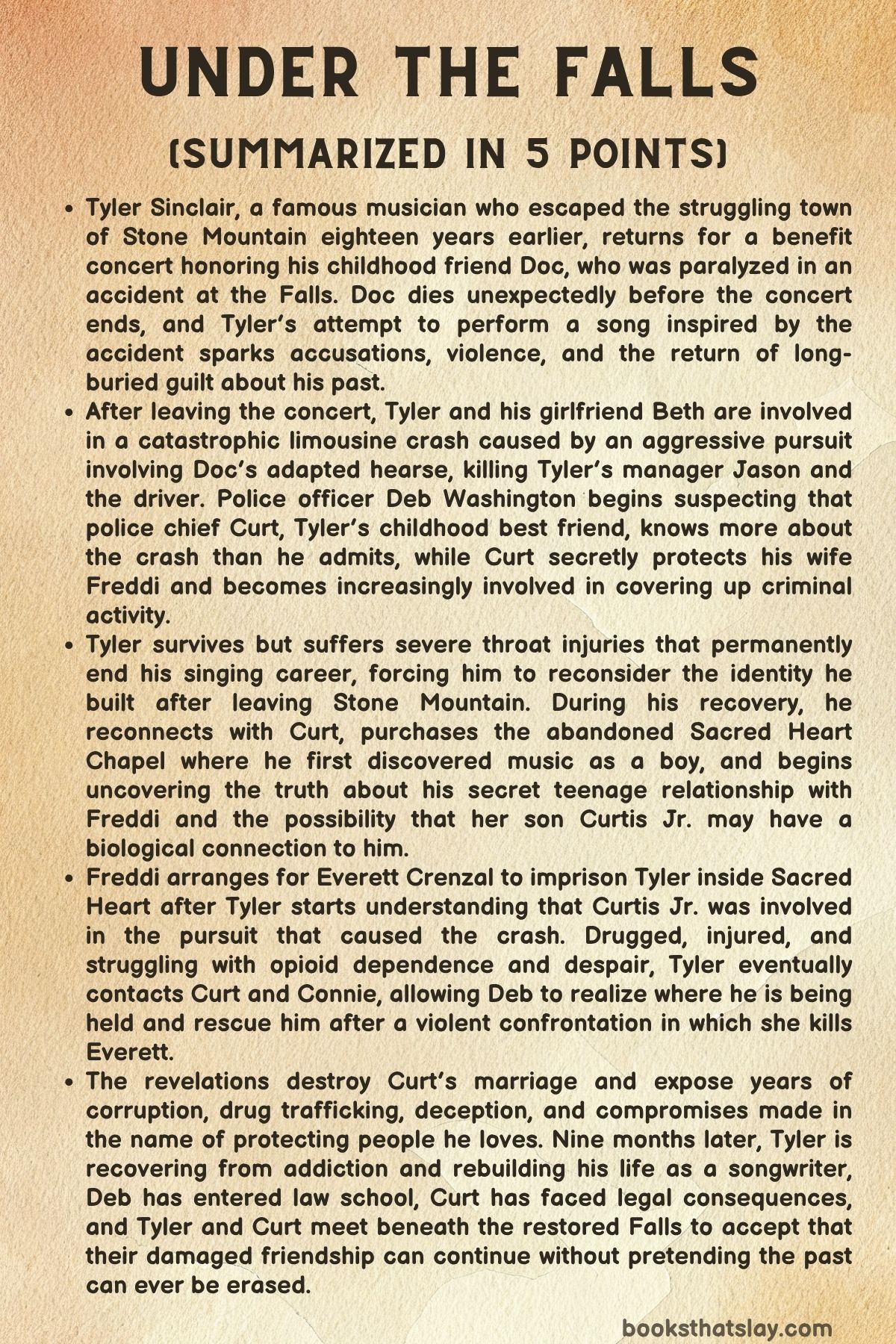
Summary
Stone Mountain is a declining community in upstate New York, geographically close to prosperous tourist destinations but economically and socially far removed from them. Its abandoned amusement park, shrinking school, disappearing businesses, and struggling year-round residents create a place where opportunity seems scarce, while wealthy seasonal visitors occupy another version of the same landscape.
Tyler Sinclair is the rare person who escaped and became famous. Eighteen years after leaving, he returns as the successful leader of a band also called Stone Mountain, bringing his girlfriend and songwriting partner Beth Delaney, his manager Jason, and the rest of his touring group for a benefit concert honoring his childhood friend Tim “Doc” Dockery.
Doc has been paralyzed since a teenage accident at the Falls. Tyler helped launch him from a rope swing, after which Doc struck an iron pipe and sank into the water; Tyler rescued him, but he has carried guilt about the incident ever since.
During a televised interview, Doc unsettles Tyler by discussing local resentment toward him. Some residents believe Tyler became wealthy by converting Stone Mountain, its people, and their suffering into songs, while Doc also suggests that Tyler may have contributed to the accident more directly than Tyler wants to remember.
The benefit concert initially gives Tyler the familiar protection of performance. Beth recognizes that music allows him to become confident and commanding, even as she senses that their personal and creative partnership is changing because she has developed into a stronger artist in her own right.
Then Doc unexpectedly dies before he can attend. When the audience demands Tyler perform “The Long Fall,” the famous song inspired by Doc’s accident, Tyler reluctantly returns to the stage, only to encounter years of accumulated resentment.
People accuse him of causing Doc’s paralysis, abandoning the community, and profiting from Stone Mountain’s pain. Arguments turn violent, Officer Deb Washington is struck, the mayor is injured, and Tyler becomes psychologically overwhelmed as the riot combines his present danger with memories of his abusive childhood.
Inside the school afterward, Tyler admits to Beth that he feels as though Stone Mountain has trapped him again. He escaped at eighteen without saying goodbye because he believed remaining there would destroy his chance at another life, but returning has revived the fear that he never truly freed himself.
Tyler then reunites with Curt, his childhood best friend and now the local police chief. Curt insists that Doc’s accident was unintentional because Tyler stumbled during the launch, and the two men recover some of their old affection, symbolized by the childhood habit of linking pinkies.
Yet their reunion contains a hidden source of tension. Curt is married to Freddi, the girl both boys loved as teenagers, and Tyler has never told him the full truth about his own relationship with her.
As Tyler leaves Stone Mountain, he receives a phone number from Curtis Jr., Curt and Freddi’s teenage son, who urgently wants him to call. Tyler refuses, despite Beth’s insistence, because the request touches a secret he is not emotionally prepared to face.
The limousine is then pursued down the Mountain by another vehicle. Its headlights and aggressive movements frighten Tyler and Beth, and the limousine eventually breaks through a guardrail and crashes into a ravine, killing Jason and the driver while severely injuring Tyler and Beth.
Deb discovers the wreck after an anonymous report. She soon notices something troubling about Curt: dried mud on his clothes suggests he visited the ravine before sending her to investigate, raising questions about what he knew and why he did not immediately report the crash.
The truth is that Freddi was driving Doc’s adapted orange hearse in pursuit of Tyler. She wanted to stop him before he could leave again, and Curt chooses to protect her, arranging to hide evidence and beginning the series of compromises that will eventually destroy his career.
Curt is already compromised in other ways. Doc and Freddi have been involved in transporting illegal drugs, their profits have indirectly supported Curt’s comfortable lifestyle, and after Doc’s death Curt moves from passive knowledge to active participation by making drug runs himself.
Tyler meanwhile survives with catastrophic injuries to his throat. Doctors believe he may eventually speak again, but his singing career is almost certainly finished, leaving him without the identity through which he has understood himself for most of his adult life.
During his hospitalization, pain, medication, memories, and hallucinations blur together. Tyler begins separating what he calls the world of “Is,” the undeniable reality of events, from the world of “Meaning,” the human attempt to impose fairness, purpose, or explanation upon those events.
One reality becomes impossible to avoid: Jason is dead, Beth is badly injured and emotionally withdrawing from him, and the career that allowed Tyler to leave Stone Mountain has effectively ended. Yet his strongest need is not simply professional recovery but companionship, especially the childhood reassurance he once received from Curt.
Curt visits Tyler partly from love and partly from fear that Tyler will remember the pursuing hearse. Tyler’s memories remain incomplete, and Curt repeats the same reassurance he gave him as a child when Tyler blamed himself for failing to stop his father’s violence: what happened was not his fault.
Their renewed bond encourages Tyler to remain near Stone Mountain after leaving the hospital. Nashville no longer feels completely like home, while Sacred Heart Chapel, an abandoned church where Tyler once escaped his father and discovered the power of music, begins to represent the possibility of reclaiming rather than merely rejecting his past.
Tyler decides to purchase the chapel. He also becomes more interested in helping people around him, including Deb, whose ambition to attend law school might be supported by his foundation.
Deb, however, is becoming increasingly suspicious of Curt. His behavior after the crash, his relationship with Everett Crenzal, and rumors about drug activity make it difficult for her to reconcile the mentor she admires with the evidence accumulating before her.
At the same time, Curtis Jr.’s reaction to Tyler becomes disturbing. The boy becomes physically ill when he sees him, while Freddi reacts with anger and anxiety whenever Tyler enters the family’s life.
Tyler eventually reconstructs the crucial memory from the crash: Beth had been shouting at him to call the boy who gave them the telephone number. Because only Doc, Freddi, and Junior could operate Doc’s adapted hearse, Tyler begins to believe Junior drove the vehicle and wanted to stop him because the boy suspects Tyler may be his biological father.
Tyler knows the possibility cannot be easily dismissed. Before leaving Stone Mountain as a teenager, he and Freddi had a secret sexual relationship, including meetings inside Sacred Heart, and their affair overlapped with Freddi’s involvement with Curt.
Before Tyler can confront the truth, Everett attacks him and imprisons him inside the chapel. Tyler is physically weak, dependent on pain medication, and vulnerable to the opioids Everett repeatedly gives him.
Tyler gradually realizes Freddi arranged the captivity. Her motive combines protection of Junior, fear that the crash will be exposed, unresolved anger toward Tyler, and emotions left unfinished since adolescence.
Freddi eventually visits Tyler and reveals more of the truth. Junior was driving the hearse, protecting him is central to her actions, and she herself remains uncertain whether Curt or Tyler is his biological father.
Their confrontation leads to another sexual encounter inside the chapel. Tyler is drugged and emotionally compromised, but he also recognizes that his feelings for Freddi have never disappeared completely, making the event another destructive collision between past desire and present consequence.
Tyler begins secretly refusing some of his medication so that he can regain enough awareness to act. He recovers his phone and calls Curt and Connie, speaking in a manner that sounds like an apology and farewell rather than directly revealing his location.
Meanwhile Deb finally confronts Curt about the crash, the dried mud, and the drug rumors. Curt does not convincingly deny her suspicions, and their relationship changes when Deb realizes professional duty can no longer remain subordinate to personal loyalty.
Connie remembers hearing music from inside Sacred Heart when the building was supposed to be empty. After Tyler’s disturbing telephone call, Deb realizes that he may still be imprisoned there and drives toward the chapel while requesting state-police assistance rather than trusting Curt with the information.
Curt receives his own alarming call from Tyler and confronts Freddi. Under pressure, she reveals Tyler’s continued presence on the Mountain, their recent sexual encounter, and the possibility that Junior may biologically belong to Tyler rather than Curt.
The revelation devastates Curt. During the confrontation he strikes Freddi and is immediately horrified by what he has done, while Freddi then orders Everett to act because someone is approaching Sacred Heart.
Deb reaches the chapel before backup. She finds Tyler barely conscious from an apparent overdose, but Everett confronts her with a gun and insists Tyler wants to die and should be allowed to do so.
When Everett fires, Deb’s protective vest saves her from the bullet. She returns fire and kills him, surviving the confrontation and ensuring Tyler receives medical attention before the overdose becomes fatal.
Curt, meanwhile, reaches a different crisis at home. Faced with the possibility that Junior is not biologically his son, he concludes that biology cannot erase years of fatherhood, love, responsibility, and shared life.
Instead of killing Freddi or himself, Curt fires his revolver through the windows of their expensive house. The act destroys the visible symbol of a life partly financed and protected through silence, compromised loyalty, and drug money, after which he orders Freddi to leave.
State investigators soon begin examining Curt’s conduct. He falsely claims that he was the person who pursued Tyler’s limousine, apparently attempting to protect Freddi and Junior, but his fabricated account cannot explain Tyler’s later kidnapping or the wider network of misconduct.
Deb later visits him and hears his clearest explanation of how corruption develops. In Curt’s understanding, people rarely begin by consciously choosing criminality; instead they make one exception for someone they love, then another, until all available choices have become compromised.
Nine months later, the Falls and the surrounding campground have been restored with Tyler’s financial assistance. Tyler is recovering from physical trauma, opioid addiction, depression, and the permanent loss of his singing voice, while Beth has resumed collaborating with him and has taken the central performing role that Tyler once occupied.
Deb has left policing and entered law school with support from Tyler’s foundation. Curt has faced legal consequences for his misconduct, although Tyler has assisted him, and Curt continues to believe that some form of punishment was justified because he knowingly benefited from criminal activity and lied to investigators.
Freddi has disappeared, while Junior has returned to Curt. Curt refuses to allow biological uncertainty to redefine their relationship and requires Tyler to state plainly that he is not Junior’s father.
The final meeting between Tyler and Curt occurs beneath the restored Falls. Their friendship cannot return to the innocent promise of childhood, because too much betrayal, silence, guilt, and disappointment stands between them, but they accept a more modest truth: they are friends in the present, and neither has to confront the damaged future entirely alone.
Characters
Tyler Sinclair
Tyler Sinclair is the central figure of Under the Falls, and his journey is defined by the difference between outward success and inward escape. He has achieved the unlikely dream of leaving Stone Mountain, becoming wealthy and famous through music, yet his return demonstrates that professional success has never resolved the fear, shame, and guilt created during his childhood.
His sense of responsibility is one of his most persistent burdens. He believes for years that his actions contributed to Doc’s paralysis, just as he once blamed himself for being unable to protect his mother from his violent father, showing a tendency to make himself morally responsible for events larger than his control.
Tyler is also capable of selfishness. His departure at eighteen protects his future, but he leaves Curt and Freddi without explanation, and he later admits that the story he has told himself about leaving so Curt and Freddi could be happy is partly an excuse for avoiding responsibility.
His relationship with Freddi exposes another side of him. Their teenage affair and later sexual encounter in Sacred Heart show that some of Tyler’s strongest desires remain tied to the identity he thought he had abandoned, and his refusal to pretend he no longer feels anything for her gives his eventual confrontation with Curt painful honesty.
The destruction of Tyler’s singing voice forces his deepest transformation. Once music can no longer function as performance, fame, and escape, he has to discover whether he possesses an identity apart from being the successful musician who escaped Stone Mountain.
His recovery from opioid dependence further complicates that transformation. Tyler reaches a point where physical pain, emotional exhaustion, and addiction make death seem attractive, but survival eventually requires accepting damaged circumstances rather than expecting a perfect restoration of his former life.
By the end of the novel, Tyler becomes less focused on getting away and more capable of giving something back. Restoring the campground, assisting Deb’s education, supporting Curt legally, and allowing Beth to occupy the performance role all suggest a man beginning to understand that generosity can replace the defensive isolation that governed much of his adult life.
Curt
Curt is the moral counterweight to Tyler throughout Under the Falls, but he is far from a simple symbol of loyalty or goodness. As Tyler’s childhood protector, he represents safety, constancy, and belonging, yet as an adult he becomes an example of how those same virtues can become dangerous when loyalty overrides judgment.
His bond with Tyler begins when both are boys. Curt is the person willing to sit beside Tyler when he is frightened, reassure him after his father’s violence, and later insist that Doc’s accident was not intentional, making their friendship part of Tyler’s emotional understanding of security.
Curt’s tragedy is that he keeps extending protection beyond reasonable moral limits. He ignores the drug activity involving Doc and Freddi, benefits indirectly from its proceeds, hides evidence after the limousine crash, participates in drug transportation himself, and lies to investigators in an attempt to protect his family.
None of these actions begins from a desire to become corrupt. Curt repeatedly convinces himself that a temporary exception is justified because someone he loves needs help, and his eventual explanation to Deb shows that he understands too late how each compromise reduces the possibility of making an ethical choice later.
His marriage to Freddi also reveals profound insecurity. Curt has spent much of his life living beside the possibility that Tyler was the person Freddi truly wanted, and learning about their sexual history finally destroys the comforting version of his marriage he maintained for years.
The uncertainty surrounding Junior’s paternity becomes Curt’s strongest moment of emotional clarity. Instead of surrendering fatherhood to genetics, he recognizes that years of care, presence, sacrifice, and love constitute the reality of their relationship.
Curt ends the story morally damaged but more truthful. His friendship with Tyler survives only after idealized beliefs about both of them are abandoned, allowing him to accept a relationship based not on childhood promises but on the imperfect people they have actually become.
Freddi
Freddi is one of the most volatile and emotionally complicated figures in Under the Falls. She stands at the intersection of Tyler and Curt’s friendship, Doc’s criminal activity, Junior’s uncertain paternity, and the limousine crash, making her both a source of hidden history and an active creator of the present crisis.
Her teenage relationship with Tyler has never been emotionally resolved. She marries Curt and builds an adult life with him, but Tyler’s return makes clear that anger at his disappearance is closely connected with feelings that remained active beneath eighteen years of silence.
Freddi’s pursuit of the limousine demonstrates how resentment can become catastrophic action. She wants Tyler to stop and acknowledge the people and consequences he abandoned, yet her aggressive chase contributes to two deaths and devastating injuries.
After the crash, her priorities become increasingly controlled by fear of exposure and determination to protect Junior. That protective instinct helps explain her choices without excusing them, because she moves from concealment to kidnapping and eventually becomes willing to contemplate Tyler’s death.
Her relationship with Doc adds another layer. Years of caregiving, criminal cooperation, and emotional closeness make his death genuine personal loss, while also demonstrating how much of Freddi’s life has existed beyond Curt’s understanding.
Freddi frequently uses intimacy as a form of power. Her sexual contact with Curt when their marriage is unstable and her later encounter with Tyler inside Sacred Heart blur affection, anger, nostalgia, manipulation, and desire, making it difficult to separate what she feels from what she wants to control.
Her disappearance prevents the story from offering easy moral closure. Freddi remains someone whose actions cause enormous harm but whose behavior grows from abandonment, secrecy, fear, and attachments that were never honestly addressed.
Beth Delaney
Beth functions as one of the clearest observers in Under the Falls because she knows Tyler both as a public performer and as a private man. From the beginning, she notices the difference between the commanding musician onstage and the frightened person who emerges whenever Stone Mountain threatens his emotional defenses.
Her relationship with Tyler is loving but undergoing a quiet shift even before the crash. Beth has become a stronger songwriter and performer, which means their partnership is moving away from an arrangement in which Tyler naturally occupies the center.
She also has a stronger instinct than Tyler for confronting difficult information. When Junior sends Tyler the telephone number, Beth repeatedly urges him to call because she recognizes that avoiding the boy will not erase whatever connection exists.
The crash changes their relationship by exposing the cost of Tyler’s secrecy and emotional avoidance. Beth survives but withdraws from him during his recovery, suggesting that love does not require immediate forgiveness or unlimited tolerance.
Her eventual return to creative collaboration is therefore significant. Beth does not simply resume the old relationship; she becomes the active performer while Tyler writes beside her, reversing the previous professional balance.
That change demonstrates growth for both characters. Beth receives space to develop the career her talent deserves, while Tyler must learn to participate in music without requiring himself to remain its visible center.
Deb Washington
Deb is the character whose moral development most directly contrasts with Curt’s in Under the Falls. She begins as a relatively inexperienced officer who admires Curt deeply and sees him as a mentor, yet the investigation forces her to decide whether affection can coexist with professional accountability.
Her intelligence appears almost immediately at the limousine wreck. Rather than accepting an ordinary accident explanation, she notices physical inconsistencies and pays particular attention to the dried mud on Curt’s clothing.
The difficulty is personal rather than investigative. Curt has treated her well, encouraged her abilities, and occupied something close to a fatherly role, so following the evidence means risking a relationship important to her sense of professional identity.
Connie’s skepticism helps Deb question the assumption that a person who has been kind to her must therefore be innocent. Deb gradually learns that personal goodness in one relationship does not erase misconduct in another.
Her decision to call state police rather than Curt before entering Sacred Heart marks the completion of this shift. She acts according to evidence instead of loyalty and ultimately risks her life to rescue Tyler.
Killing Everett deeply disturbs her, preventing the rescue from becoming a simple heroic victory. Her decision to leave policing for law school therefore feels less like failure than the recognition that the experience has changed what she wants from her future.
Tim “Doc” Dockery
Doc’s physical presence ends early, but his influence extends across nearly every major conflict in the story. His paralysis connects Tyler to long-standing guilt, while his adapted hearse, drug activity, relationships with Freddi and Curt, and final conversation with Tyler continue producing consequences after his death.
Doc possesses a sharp awareness of Tyler’s psychological vulnerabilities. Before dying, he deliberately raises uncertainty about whether Tyler caused the accident and even tells him that his greatest mistake may have been rescuing Doc from the water.
That statement reveals how complicated Doc’s relationship with survival has become. His life after the accident has contained friendship and connection, but it has also involved disability, dependence, resentment, criminal activity, and the awareness that one childhood moment permanently altered his future.
His bond with Freddi is especially important. She becomes caregiver, companion, and criminal partner, creating a level of intimacy that makes Curt jealous while giving Freddi a relationship independent of both Curt and Tyler.
Doc also represents the consequences that remain in Stone Mountain after Tyler leaves. Tyler can transform the accident into a famous song and continue his career elsewhere, but Doc must live permanently with the bodily reality from which the song originated.
Curtis Jr.
Curtis Jr. is burdened by secrets created before he was born. The uncertainty surrounding his biological father transforms him into evidence of the unresolved relationship among Tyler, Freddi, and Curt, even though he has no responsibility for the choices that produced that uncertainty.
His desperate effort to contact Tyler suggests a young man looking for certainty about his identity. When Tyler refuses to call, Junior helps pursue the limousine in Doc’s hearse, and the resulting crash leaves him carrying guilt connected to two deaths and serious injuries.
His physical reaction when he later sees Tyler communicates how overwhelming that guilt has become. Rather than functioning merely as evidence in an adult mystery, Junior is another person psychologically damaged by the secrecy surrounding him.
The eventual resolution wisely shifts attention away from biology. Curt’s decision that Junior remains his son regardless of genetics protects him from becoming nothing more than the object of a paternity dispute.
Junior’s return to Curt near the end therefore reinforces the distinction between biological origin and lived parenthood. His future remains uncertain, but he is no longer required to determine his entire identity through Tyler.
Everett Crenzal
Everett is initially presented as an unsettling outsider whose arrival immediately deepens Deb’s suspicions about Curt. His connection to the hearse repairs and later involvement in Tyler’s imprisonment reveal him as a participant in the criminal world that has developed around Stone Mountain.
He is capable of serious violence. Everett attacks an already injured Tyler, keeps him confined, administers opioids to control him, and eventually threatens Deb with a firearm.
At the same time, the story avoids making him completely mechanical. During the captivity he develops a limited attachment to Tyler, hides information from Freddi, and refuses to provide the additional pills Tyler appears to want for a potentially fatal overdose.
These choices do not erase his crimes, but they show that even Everett retains unstable moral boundaries. His refusal to assist Tyler’s possible suicide accidentally helps preserve Tyler until rescue becomes possible.
His death at Deb’s hands becomes important primarily through its effect on her. Everett is killed while creating an immediate lethal threat, yet Deb still experiences the psychological burden of having taken a life.
Connie
Connie serves as one of the story’s most practical moral voices. As Deb’s mother, she questions her daughter’s admiration for Curt long before Deb is comfortable considering that her mentor may be compromised.
Her skepticism is valuable because she refuses to confuse personal kindness with moral innocence. She recognizes that corruption may begin gradually and warns Deb that loyalty could eventually be used to pressure her into ignoring wrongdoing.
Connie also becomes important to Tyler’s recovery. Allowing him to stay with her gives him a temporary form of domestic stability at a moment when neither Nashville nor Curt’s household can safely function as home.
Her observation that music may be coming from Sacred Heart later becomes crucial. A seemingly small detail helps Deb realize Tyler may still be on Stone Mountain, contributing directly to his rescue.
Connie’s support for Deb’s legal ambitions further reflects her desire for a future beyond the compromised local police department. She is protective without being controlling and skeptical without becoming cynical about everyone around her.
Jason
Jason is Tyler’s manager, but his significance extends beyond professional organization. He understands Tyler’s career machinery, the expectations of audiences, and the practical consequences of public decisions, which is why he urges Tyler to return to the stage during the disastrous benefit concert.
His relationship with Beth introduces another quiet source of instability. Tyler believes Jason loves her and suspects that Jason might eventually become both her professional and romantic alternative, revealing Tyler’s insecurity about the changing relationships around him.
Jason’s death in the limousine crash permanently prevents those possibilities from developing. For Tyler, the loss also makes the disaster impossible to reduce to personal injury, because another person has died during a chain of events connected to Tyler’s return.
His absence contributes to the collapse of Tyler’s former life. Manager, singer, tour, romantic partnership, and professional future all begin disintegrating at once, leaving Tyler without the structures that previously defined him.
Tyler’s Father
Tyler’s father appears primarily through memory and hallucination, yet his violence is central to understanding Tyler’s adult behavior. His alcoholism and abuse create the childhood environment from which Tyler learns that home can be a place of fear rather than security.
Young Tyler feels responsible for failing to protect his mother, establishing the pattern of misplaced guilt that later shapes his response to Doc’s accident. He repeatedly assumes that if something terrible happens near him, he must somehow have been responsible for preventing it.
The father’s presence also explains Tyler’s instinct to flee rather than confront. Leaving Stone Mountain becomes a survival strategy developed long before fame gives him the means to maintain physical distance.
When Tyler encounters his father again through hallucination in the hospital, the past appears not as something concluded but as a psychological force still capable of defining him. Tyler’s recovery therefore requires more than surviving the crash; it requires understanding how childhood fear still governs his adult choices.
Tyler’s Mother
Tyler’s mother is less fully developed as an independent character, but her suffering has major psychological consequences for her son. Tyler’s memories of watching his father abuse her become one of the sources of his enduring shame and helplessness.
Her role helps explain why Curt becomes so important. When Tyler cannot protect his mother or rely on his father, friendship becomes one of the few forms of safety available to him.
The adult Tyler’s repeated desire for someone to reassure him that events are not his fault grows from this childhood experience. His mother’s victimization therefore remains part of the emotional structure beneath his guilt, avoidance, and dependence on Curt.
Themes
Escape, Return, and the Meaning of Home
Escape in Under the Falls is initially presented as the difference between survival and stagnation. Stone Mountain is economically declining, opportunities are disappearing, and Tyler’s departure at eighteen allows him to create the extraordinary life that almost nobody from his community appears able to achieve.
Yet physical departure does not produce emotional freedom. Tyler spends eighteen years away, but the moment he returns, the Falls, Curt, Freddi, Doc, Sacred Heart, and memories of his father immediately recover their power over him.
The novel gradually changes the meaning of return. At first Tyler experiences Stone Mountain as a trap attempting to reclaim him, but after losing his voice and much of his former life, he voluntarily stays because the place contains parts of himself that cannot be understood from a distance.
Sacred Heart captures this contradiction particularly well. As a child it is a refuge from violence and the place where music first gives Tyler a possible route outward; as an adult it becomes both the site of captivity and a symbol of reclaiming his past.
By the conclusion, Tyler does not simply move backward into his old life. Restoring the campground and sitting beneath the Falls with Curt show that return can mean changing one’s relationship with a place rather than surrendering to it.
Loyalty, Love, and Moral Compromise
Love repeatedly produces moral choices that become more dangerous because the characters describe them as loyalty. Curt’s decline illustrates this most clearly, beginning with his willingness to ignore troubling activity involving people close to him and ending with drug transportation, evidence concealment, and false statements to investigators.
The important distinction is that Curt does not suddenly become indifferent to right and wrong. He continues seeing himself as protecting Freddi, Junior, Tyler, or the fragile relationships holding his life together, which allows each new compromise to appear temporarily necessary.
Freddi follows a similar pattern in protecting Junior. Her fear that he will face responsibility for the limousine crash helps motivate Tyler’s imprisonment, demonstrating how parental protection becomes destructive when preserving one person requires endangering another.
Deb offers the counterexample. She cares about Curt and continues seeing value in him, but she eventually understands that affection cannot determine what evidence she accepts or which procedures she follows.
The theme therefore does not suggest that loyalty is inherently harmful. Instead, it shows that loyalty requires limits because love without accountability can become a justification for almost anything.
Guilt, Responsibility, and the Stories People Tell Themselves
Many characters survive by creating explanations that make painful facts easier to endure. Tyler tells himself he may have caused Doc’s paralysis, Curt tells himself Tyler left partly so he and Freddi could be together, and Curt later convinces himself that involvement in the drug trade can be justified by financial necessity and the idea that drugs would reach users anyway.
These personal stories exist beside the novel’s distinction between “Is” and “Meaning.” Facts occur without guaranteeing fairness, while people construct explanations because randomness, regret, and suffering are psychologically difficult to accept.
Tyler’s guilt illustrates the danger of confusing responsibility with proximity. He was present when Doc was injured and when his mother was abused, but his tendency to treat presence as culpability makes him carry burdens that exceed his actual control.
At the same time, the novel does not use uncertainty to eliminate responsibility. Curt is genuinely responsible for concealing evidence and participating in criminal activity, while Freddi is responsible for choices made during and after the pursuit.
Growth therefore requires learning the difference between guilt that belongs to a person and guilt that has merely been absorbed. Tyler must release responsibility that was never entirely his, while Curt must finally accept responsibility he spent years explaining away.
Identity, Friendship, and Life After Loss
The characters of Under the Falls repeatedly lose identities they assumed were permanent. Tyler loses his singing voice, Curt loses his position as respected police chief and the certainty surrounding his marriage, Deb loses her uncomplicated faith in her profession, and Junior loses confidence in the biological story of his family.
Tyler’s loss is especially severe because being a musician is not simply his occupation. Singing was the means by which he survived Stone Mountain, achieved independence, transformed suffering into art, and constructed a public self admired by thousands.
The novel’s response is not restoration of the original identity. Tyler does not regain his singing career; instead, he learns to write beside Beth while allowing her to perform, recover from addiction, contribute to his community, and understand himself through relationships rather than celebrity alone.
Curt undergoes a similar reduction. He can no longer be the flawless protector Tyler remembers or the respected chief Deb admired, but he can still choose to be Junior’s father and Tyler’s friend.
The final friendship between Tyler and Curt captures the larger idea. They no longer promise to remain best friends forever because adulthood has demonstrated the impossibility of such certainty, but they can truthfully say that they are friends now.
That smaller statement carries greater meaning because it accepts change, betrayal, damage, and uncertainty rather than denying them. Identity becomes something continually reconstructed through present choices, not something permanently secured by childhood promises, careers, family roles, or the stories people once believed about themselves.