Unprecedented Times Summary, Characters and Themes
Unprecedented Times by Malavika Kannan is a coming-of-age novel about Rishika “Rishi” Kumar, a young Tamil American woman trying to become an adult at the same moment the world itself seems to lose its sense of certainty.
Arriving at Stanford with a complicated history in climate activism, Rishi hopes to remake herself through friendship, romance, and writing. Her freshman year is abruptly transformed by the COVID-19 pandemic, forcing her into isolation, political upheaval, family conflict, grief, and later serious personal trauma. The novel examines what happens when youthful confidence meets events too large to control and when storytelling becomes both refuge and danger.
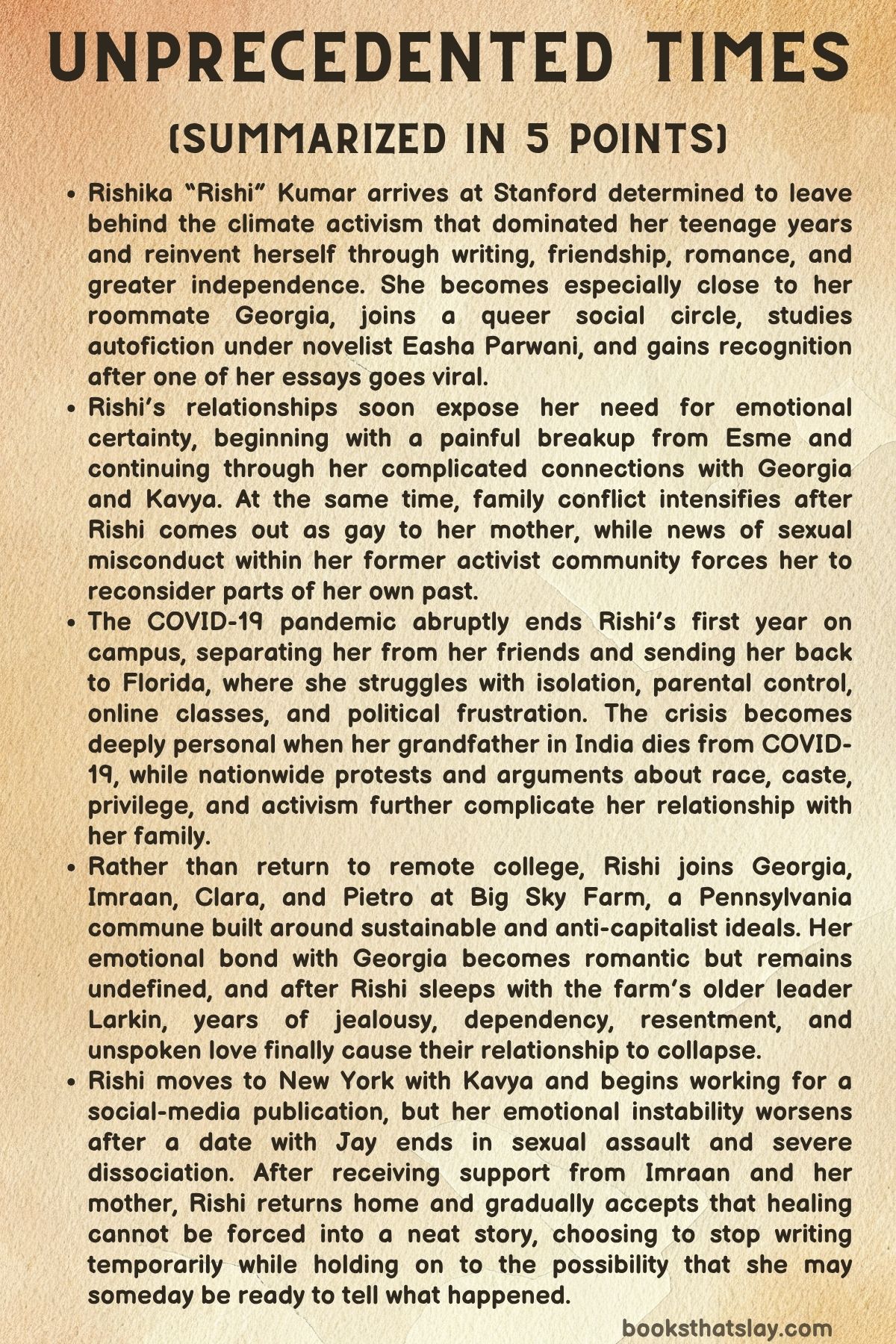
Summary
Rishika “Rishi” Kumar arrives at Stanford hoping that college will give her permission to become somebody different from the person she was in Okeechobee, Florida. As a teenager she had devoted herself to climate activism, organizing demonstrations and building an online following, but by the time she reaches college she is exhausted by the feeling that years of urgent political action have produced far less change than she once believed possible.
Instead of continuing to define herself through activism, Rishi wants to write, fall in love, and discover a life that does not revolve around saving the world or satisfying her parents. Her randomly assigned roommate, Georgia Becker, immediately becomes one of the most important people in her life, and their unusually intense friendship gives Rishi the companionship and emotional security she has been seeking.
Georgia studies environmental engineering and retains much of the idealism that Rishi has begun to distrust. Through campus life, Rishi also becomes close to Imraan, Pietro, Clara, and Esme, creating a queer social circle that makes Stanford feel like a place where she can openly explore parts of herself that remained constrained at home.
Rishi meets Kavya Varma, an Indian international student who already knows about Rishi’s history as a youth activist and regards her with admiration. That admiration makes Rishi uncomfortable at first because it represents an identity she is trying to leave behind, so she keeps Kavya at a distance even though their relationship will eventually become far more significant.
Writing becomes central to Rishi’s attempts at reinvention when she enrolls in Easha Parwani’s Asian American Autofiction class. Easha challenges Rishi to examine the difference between living an experience and turning that experience into art, particularly when Rishi’s instinct is to impose a clear meaning on events before she fully understands them.
Meanwhile, Rishi begins sleeping with Esme. Rishi wants increasing emotional certainty, while Esme resists defining what exists between them, leaving Rishi caught between the freedom she imagined for herself and her powerful desire to be chosen by another person.
Rishi also experiences early literary success when an essay about conservative provocateur Collin Barnett attracts widespread attention. The essay gives her a sense that writing may offer the recognition and identity she once received through political activism, strengthening her ambition to see herself as a serious writer.
Her relationship with Esme soon breaks down. Esme tells Rishi that her constant presence has become suffocating, and the rejection wounds Rishi badly, especially because Georgia refuses to respond with the unconditional condemnation of Esme that Rishi wants from her.
Rishi temporarily turns toward Kavya, whose admiration is comforting at a moment when her confidence has been damaged. Then she learns that her viral essay has won the Stanford Women’s Prize in Writing and discovers that Georgia secretly submitted her work, reminding Rishi that Georgia’s loyalty can take forms more meaningful than simply agreeing with her.
Rishi responds to her breakup by turning the experience into fiction for Easha’s class. Although others praise the piece, Kavya challenges Rishi over the ethics of using another person’s emotional pain as creative material, introducing a question that follows Rishi throughout the novel: whether transforming reality into a story can become a way of controlling people and events that remain uncontrollable in life.
Winter break returns Rishi to Florida, where old family videos make her newly curious about her parents as individuals who possessed full lives before she existed. Back at Stanford, Georgia arranges a nineteenth-birthday celebration for her and tries to teach her that her value does not have to depend entirely on achievement, praise, or public recognition.
Rishi is accepted into a funded summer program in Moscow, apparently confirming the exciting future she has imagined for herself. At nearly the same time, however, reports of a new virus are becoming increasingly alarming, while women from the youth climate movement contact Rishi about allegations of sexual assault and misconduct involving Trevor Yates, forcing her to reconsider memories from her activist years.
Family Weekend brings another rupture when Rishi tells her mother that she is gay. Rather than receiving acceptance, she encounters rejection, and the confrontation deepens the distance between them just before outside events make family dependence impossible to escape.
The coronavirus crisis rapidly transforms Stanford. Georgia’s epidemiologist parents recognize the danger early, and soon classes move online, university routines disappear, exams are canceled, and students are instructed not to return following spring break.
Rishi initially experiences the disruption almost as an unexpected suspension of ordinary obligations, but the uncertainty becomes frightening as it becomes clear that nobody knows how long the emergency will last. She reconnects with Kavya, learns about Kavya’s girlfriend Kristina, and discovers that Kavya plans to remain in the United States rather than return to India.
During a final trip to San Francisco, Rishi and Georgia visit the Castro and the National AIDS Memorial Grove. Encountering the history of another generation marked by illness, death, political failure, and fear gives the emerging pandemic a historical dimension that neither woman can ignore.
Rishi and her friends eventually spend one final night together before scattering. Her goodbye with Georgia is especially painful because neither knows when they will see the other again, and on the flight back to Florida Rishi finds herself longing for her mother despite their unresolved conflict.
Once home, Rishi reflects on how catastrophe shaped her long before COVID-19. Her newborn sister died when Rishi was four, giving her an early understanding that survival is arbitrary, while her teenage climate activism grew partly from a desire to act against threats that adults seemed unwilling or unable to control.
Lockdown strips away much of the independence Rishi briefly experienced at Stanford. Her parents monitor her routines, avoid direct discussion of her sexuality, worry constantly about relatives in India, and struggle to understand the young adult who returned from college, while online classes make the academic life she recently valued feel strangely unreal.
Georgia maintains their friendship through handwritten letters, but distance changes everything. Rishi watches activism revive online without recovering her former faith that political urgency automatically produces meaningful change, and the pandemic stops being an abstract global event when her grandfather in India becomes sick with COVID-19 and dies after a final video conversation with his family.
During the summer, Rishi struggles to write until Easha encourages her former students to record what they are experiencing. Rishi begins reconstructing her freshman year and consults Georgia about shared memories, only to discover that even two people who experienced the same events can remember them differently.
The nationwide protests following police killings of Black Americans intensify political tensions inside Rishi’s home. Rishi wants to protest, while her mother fears infection, and their conflict expands into arguments about race, caste, privilege, family sacrifice, political action, and whether younger people fully understand the systems they condemn.
When Stanford decides to remain remote for the coming term, Rishi and her friends consider gap years rather than continuing college from their childhood homes. Georgia finds Big Sky Farm, a Pennsylvania commune organized around sustainable agriculture and anti-capitalist values, and the group successfully applies to work there.
Rishi’s father unexpectedly supports her decision to go, but her mother strongly opposes it. Rishi leaves anyway, interpreting departure as a declaration that adulthood requires the freedom to make choices her family may dislike.
After visiting Georgia’s family in Maine, Rishi travels with her to Big Sky Farm, where Clara, Imraan, and Pietro also gather. The commune, led by Larkin Kwang, initially appears to offer an alternative to conventional institutions, yet the group quickly discovers that collective ideals cannot erase unequal labor, conflicting personalities, frustration, or ordinary human selfishness.
Rishi cooks communal meals, reduces her use of social media, thinks about writing a novel, and continues corresponding with Kavya. During a camping trip, Rishi and Georgia kiss, finally giving physical expression to emotions that have been developing beneath their friendship, but neither knows how to define what happened.
Rather than clarifying their relationship, they allow ambiguity to continue. Even as the pandemic, election, and national instability remain present beyond the farm, Rishi begins to believe that Georgia is the person around whom her emotional life is organized and assumes there will always be more time for them to understand what they mean to each other.
The new year exposes how fragile that assumption is. After receiving vaccinations through the farm, the group visits New York for Rishi’s twentieth birthday, where Georgia has worked with Kavya to arrange an elaborate celebration.
Rishi is deeply moved by Georgia’s effort, but their unresolved attraction and emotional dependency create tension throughout the visit. After drinking, Rishi contacts Larkin and sleeps with him, despite his being substantially older and already involved in a nonmonogamous relationship with the pregnant Desiree.
Georgia reacts with intense hurt, revealing that their supposedly undefined relationship has never been emotionally neutral. An argument finally forces both women to confront the jealousy, love, resentment, obligation, and dependency that have accumulated inside their friendship.
Georgia tells Rishi that she loves her but cannot continue giving so much of herself to a relationship that has become unhealthy. She asks for distance, and later says she no longer wants to live with Rishi, destroying the future Rishi had quietly assumed they would share.
Rishi responds defensively, attempting to convince their friends that Georgia is unfairly casting herself as the injured person. Eventually she decides to leave Big Sky Farm and accepts Kavya’s offer of temporary housing in New York, sending Georgia a farewell email but deleting Georgia’s response without reading it.
In New York, Rishi begins working remotely for Lucky Duck, a publication aimed at Gen Z readers. Living with Kavya gives her another chance to build a new version of herself, but loneliness and unresolved grief over Georgia make emotional stability difficult.
Rishi and Kavya become sexually involved, yet their expectations differ. Rishi wants greater intimacy while Kavya refuses commitment, leaving Rishi trapped in a familiar cycle of longing, jealousy, hope, and attempts to appear less emotionally dependent than she actually feels.
During a date with Jay, an Indian Columbia student, Rishi becomes intoxicated and realizes that she does not want to have sex. Jay disregards her efforts to stop the encounter and sexually assaults her.
Rishi initially minimizes the assault and tries to control it by privately recording factual details, taking emergency contraception, and refusing to tell Kavya. Yet the experience resists the orderly narrative she attempts to create around it, and her psychological condition deteriorates as she uses marijuana heavily and begins experiencing severe dissociation.
Imraan provides temporary safety when Rishi finally reaches out, but another dissociative episode results in an emergency-room visit. Doctors explain that her mind is reacting to overwhelming distress, and her mother immediately travels to New York to be with her.
For perhaps the first time since leaving for college, Rishi permits herself to depend on her mother without treating that dependence as defeat. Their relationship does not suddenly become uncomplicated, but crisis creates space for Rishi to reveal more of her inner life and for her mother to respond through care rather than argument.
Rishi seeks comfort from Kavya before leaving New York, but Kavya ends their sexual relationship. Back in Florida, Rishi experiences suicidal thoughts and recognizes how completely her earlier assumptions about adulthood, romance, achievement, political action, and personal control have collapsed.
Books and the possibility of writing eventually provide a reason to remain alive. Rather than immediately converting what has happened into art, Rishi accepts that recovery does not have to follow a clean structure and that she cannot force trauma into a satisfying ending simply because she wants to understand it.
She decides to stop writing for the moment, allowing uncertainty to exist without transforming it into a finished story. The ending leaves Rishi wounded but still capable of imagining a future in which she may eventually write again, not because she has solved everything that happened to her, but because she has learned that surviving an experience and making meaning from it do not have to happen at the same time.
Characters
Rishika “Rishi” Kumar
Rishi is the emotional and intellectual center of Unprecedented Times, and much of her development comes from the conflict between her desire to control the meaning of her life and the reality that people, politics, illness, and trauma refuse to follow the narratives she creates for them. She arrives at Stanford believing reinvention is possible if she simply chooses a different identity, exchanging exhausted teenage activist Rishi for writer, lover, independent college student, and eventually adult.
Her greatest strength and weakness come from the same source: she feels intensely and wants those feelings to mean something definite. Whether she is pursuing Esme, attaching herself to Georgia, seeking recognition through writing, arguing with her mother, or later hoping for commitment from Kavya, she frequently tries to turn uncertainty into certainty before the other people involved are prepared to do the same.
Writing gives Rishi a powerful method of understanding herself, but it can also become another form of control. Her decision to fictionalize Esme’s pain and her later attempt to record the facts of her assault demonstrate two very different moments in which she hopes language can place boundaries around emotionally chaotic experiences.
By the end, Rishi has not achieved the independence she once imagined adulthood would bring. Instead, her survival depends partly on accepting dependence, ambiguity, unfinished stories, and the possibility that she may need to live through an experience before she can understand or write about it.
Georgia Becker
Georgia becomes Rishi’s closest companion almost immediately and serves as one of the most emotionally significant characters in Unprecedented Times. Her generosity appears repeatedly in concrete actions: nominating Rishi for a writing prize, planning celebrations, working alongside her, writing letters during lockdown, sharing her family home, and helping create a sense of continuity during a period when nearly every institution in their lives becomes unstable.
Yet Georgia is not simply a selfless friend whose purpose is to support Rishi. Her eventual anger reveals the cost of repeatedly placing herself in a caretaking position, especially when Rishi expects loyalty to mean agreement, constant availability, and emotional reassurance.
The kiss between them does not create their emotional bond so much as expose a bond that has already become difficult to classify. Georgia eventually recognizes that love does not automatically make their closeness healthy, and her decision to ask for space represents an act of self-preservation rather than proof that she does not care.
Her separation from Rishi is especially painful because there is no clear villain. Georgia loves Rishi, but she also understands that continuing their relationship in its existing form would demand more emotional labor than she can sustain.
Kavya Varma
Kavya occupies a complicated position in Unprecedented Times because she first enters Rishi’s life as an admirer and later becomes someone capable of challenging Rishi’s assumptions. Her early fascination with Rishi’s activist reputation makes Rishi uncomfortable, since Kavya appears to value precisely the public identity Rishi wants to escape.
Kavya gradually proves that she is capable of seeing weaknesses in Rishi’s behavior that others sometimes avoid confronting. Her criticism of Rishi’s decision to turn Esme’s private pain into fiction is especially important because it raises ethical questions about whether artistic freedom allows a writer to convert another person’s vulnerability into material.
Later, Kavya becomes Rishi’s refuge after the collapse of her relationship with Georgia. Their sexual relationship, however, repeats an emotional pattern familiar from Rishi’s experience with Esme: Rishi develops stronger expectations while Kavya explicitly refuses a committed relationship.
Kavya is neither cruel nor perfectly sensitive. She offers Rishi shelter and connection, but she also establishes boundaries when their intimacy becomes unsustainable, making her another person through whom Rishi is forced to learn that affection does not create an obligation to provide the kind of relationship she desires.
Esme
Esme is Rishi’s first major romantic and sexual attachment at Stanford, and their relationship establishes patterns that later repeat in altered forms. Rishi interprets physical intimacy as something that should naturally move toward emotional definition, while Esme resists labels and ultimately experiences Rishi’s constant need for closeness as suffocating.
Esme’s decision to end their arrangement is painful for Rishi because it attacks one of her deepest fears: that her desire to be loved can become overwhelming to the person she loves. The breakup therefore matters beyond the loss of a relationship because it exposes Rishi’s difficulty accepting emotional limits set by somebody else.
Esme also becomes central to the novel’s concerns about writing and consent when Rishi transforms their breakup into fiction. Once Kavya questions the morality of using a real person’s pain as artistic material, Esme’s role continues indirectly through Rishi’s developing understanding that other people cannot simply become characters in the story she wants to tell about herself.
Imraan
Imraan is part of the queer friendship network that gives Rishi a sense of belonging away from home. Although he is less central to the romantic conflicts surrounding Rishi, his presence represents the importance of chosen community during the transition from adolescence into adulthood.
His significance becomes especially clear after Rishi’s sexual assault and worsening dissociation. When Rishi finally reaches out, Imraan offers care at a moment when she is struggling to trust her own perceptions and has been trying to manage the experience alone.
Unlike relationships in which Rishi is seeking recognition, romance, or validation, her connection with Imraan becomes valuable because it offers temporary safety without demanding that she immediately explain herself. His response demonstrates a form of friendship based less on dramatic declarations than on being present when another person can no longer carry everything alone.
Clara
Clara connects Rishi’s Stanford friendships with the political and communal ideals that continue following the group into the pandemic. She participates in the social world surrounding Rishi and later joins the move to Big Sky Farm, where abstract beliefs about sustainability and anti-capitalism are tested against the practical realities of shared labor.
Her role helps demonstrate that political communities are still made of ordinary people with habits, frustrations, competing needs, and uneven contributions. Even in a setting built around collective ideals, Clara and the others encounter interpersonal problems that cannot be solved merely by agreeing on broad principles.
Clara also helps preserve continuity between the life Rishi loses when Stanford shuts down and the alternative life the friends attempt to construct afterward. She therefore represents one strand of the larger chosen family that keeps Rishi connected to a world beyond her parents and romantic attachments.
Pietro
Pietro is another member of Rishi’s close queer social circle and participates in both the final period at Stanford and the later experiment at Big Sky Farm. Like Clara and Imraan, he helps give Rishi a community whose importance extends beyond any individual romantic relationship.
At the farm, Pietro becomes part of the everyday reality of communal living: shared chores, agricultural work, disagreements, recreation, drinking, camping, and the effort to create a meaningful life while the larger world remains unstable. His presence contributes to the novel’s rejection of the idea that political alternatives automatically remove ordinary social tension.
Pietro is important partly because he helps show that friendship can provide continuity even when Rishi’s strongest attachments become unstable. His place in the group reminds readers that Rishi’s life is broader than the romantic relationships that often dominate her attention.
Easha Parwani
Easha is one of the most intellectually important influences on Rishi in Unprecedented Times because she challenges the young writer’s assumptions about what art is supposed to accomplish. Rather than simply encouraging Rishi’s ambition, she criticizes writing that imposes meaning too quickly, forcing Rishi to confront the difference between recording experience and controlling its interpretation.
Her criticism initially wounds Rishi because Rishi is accustomed to achievement functioning as proof of identity. Easha therefore becomes a teacher not simply of technique but of patience, uncertainty, and artistic responsibility.
During lockdown, Easha’s encouragement to document an extraordinary historical moment pushes Rishi back toward writing. Yet the final stage of Rishi’s development also requires her to recognize that she does not have to turn every painful event into literature immediately.
Easha’s influence survives even when Rishi decides to stop writing temporarily. The lessons Rishi absorbs from her ultimately become less about producing work and more about learning when an experience is not yet ready to be shaped into a story.
Rishi’s Mother
Rishi’s mother is one of the most emotionally complicated figures in Unprecedented Times because love and conflict remain inseparable in her relationship with her daughter. She represents family expectations, cultural continuity, parental fear, and the frustration of watching a child claim an adulthood that the parent does not fully recognize or understand.
Her rejection of Rishi’s sexuality during Family Weekend causes profound damage. At home during lockdown, her refusal to openly engage with that part of Rishi’s identity preserves the distance between them even as physical proximity makes them more dependent on one another.
Their political conflicts are equally complicated. When Rishi wants to protest, her mother’s opposition comes from fear of COVID-19, but their arguments quickly widen into disagreements about privilege, race, caste, sacrifice, and the tendency of younger people to judge previous generations without fully understanding their circumstances.
The relationship changes after Rishi’s crisis in New York. Her mother immediately comes to her, and Rishi finally allows herself to accept maternal care, showing that their bond cannot be reduced either to rejection or unconditional acceptance; it contains injury, dependence, resentment, fear, and enduring attachment at the same time.
Rishi’s Father
Rishi’s father is less confrontational than her mother and often occupies a quieter position inside the family. His unexpected support for Rishi’s decision to spend her gap period at Big Sky Farm becomes significant because it gives Rishi permission from within the family at a moment when her mother is strongly opposed.
His response suggests that the parental relationship is not completely unified against Rishi’s independence. By supporting the farm plan, he acknowledges that his daughter needs experiences beyond the family home, even when those experiences may appear uncertain or unconventional.
He also exists within the larger immigrant family structure through which Rishi thinks about sacrifice, obligation, generational expectation, and belonging. His quieter role contrasts with the more explosive mother-daughter conflict while still contributing to the novel’s examination of how parents respond when children begin constructing lives that do not match the futures imagined for them.
Paola
Paola appears during Rishi’s return to Florida and helps reconnect her with the world she inhabited before Stanford. Her presence matters because returning home does not simply mean returning to Rishi’s parents; it also means confronting earlier friendships and earlier versions of herself.
Through this reconnection, Rishi begins to consider how much she has changed and how much of her old life remains accessible. Paola functions as a link between past and present, reminding Rishi that reinvention never completely erases the person who existed before.
Larkin Kwang
Larkin leads Big Sky Farm and embodies the charisma attached to the commune’s promise of a more sustainable and anti-capitalist way of living. His position places him at the center of a community that Rishi and her friends initially approach as an alternative to the institutions and routines disrupted by the pandemic.
Rishi’s decision to sleep with him during her birthday trip becomes emotionally consequential primarily because of what it reveals about her relationship with Georgia. Larkin is substantially older and already in a nonmonogamous relationship with the pregnant Desiree, making the encounter part of a complicated network of age, authority, sexuality, and communal boundaries.
For Rishi, the encounter initially appears casual. Its larger significance emerges from Georgia’s reaction, which forces Rishi to confront the fact that the emotional expectations between them were far stronger than either had openly acknowledged.
Desiree
Desiree is Larkin’s pregnant partner and exists within the consensually nonmonogamous structure surrounding his relationship life. Her presence makes clear that Larkin sleeping with Rishi cannot simply be interpreted through conventional assumptions about infidelity.
At the same time, Desiree’s position emphasizes how complicated the farm’s alternative social arrangements can become. Ideals of openness do not automatically eliminate jealousy, power differences, emotional consequences, or uncertainty, which reflects the broader lesson Rishi learns repeatedly about the gap between abstract principles and lived relationships.
Jay
Jay becomes responsible for the most severe personal violation Rishi experiences in the story. During their date, Rishi becomes intoxicated, realizes she does not want sex, and attempts to stop the encounter, but Jay ignores her boundaries and sexually assaults her.
The importance of this event lies not in giving Jay psychological complexity but in showing the consequences of his refusal to respect consent. Rishi’s subsequent efforts to minimize what happened, record facts, and force the experience into a manageable account reveal how profoundly the assault disrupts her relationship with her own body, memory, and identity.
Jay therefore functions as a source of trauma rather than as a figure whose motives require interpretation. The novel centers Rishi’s experience and aftermath, especially her dissociation, substance use, emergency-room visit, and eventual decision to accept support.
Trevor Yates
Trevor belongs to Rishi’s earlier climate-activist life and returns to her consciousness when women from the movement contact her about allegations of sexual assault and misconduct. Their disclosures force Rishi to reconsider her own past interactions with him and to recognize that experiences she once understood one way may look different when placed beside other women’s accounts.
His role also connects Rishi’s political history with the novel’s later treatment of gender, power, and consent. A movement committed to changing society can still contain people capable of causing harm, meaning political virtue at the collective level does not guarantee ethical behavior within personal relationships.
Trevor therefore contributes to Rishi’s growing distrust of simple moral categories. The institutions and communities she once idealized cannot protect their members automatically, just as political commitment cannot substitute for personal accountability.
Rishi’s Grandfather
Rishi’s grandfather makes the pandemic emotionally immediate. Before his illness, COVID-19 can still be understood partly through news, university closures, statistics, political arguments, and distant anxiety, but his infection collapses the distance between global catastrophe and family life.
Rishi speaks with him by video before his death, and afterward his photograph joins the family shrine. That image becomes a quiet expression of the way enormous historical events are eventually experienced through individual absences inside ordinary homes.
His death also complicates Rishi’s relationship with activism and meaning. No political analysis can remove the personal reality that somebody she loved is gone, reinforcing the story’s insistence that not every form of suffering can be mastered simply by understanding its larger context.
Kristina
Kristina is Kavya’s girlfriend during the period when Stanford is shutting down. Her existence initially establishes that Kavya already possesses an emotional life beyond Rishi, complicating any tendency Rishi has to imagine herself as the central figure in another person’s world.
Kristina also joins the group during their final period together before the university disperses them. Her presence broadens the social community surrounding Rishi and reinforces the sense that each friend carries relationships, loyalties, and private histories that exist independently of Rishi’s perspective.
Collin Barnett
Collin Barnett functions primarily as the subject of the essay that gives Rishi her first major public success as a writer. The essay’s viral reception helps shift her sense of identity away from former climate activist and toward emerging literary figure.
His importance therefore lies less in his personal development than in what writing about him does for Rishi. Recognition from the piece confirms her belief that words can give her status, influence, and a new public identity, setting up the later tension between writing as creative expression and writing as a means of converting complicated reality into something she can control.
Themes
The Limits of Control and the Necessity of Uncertainty
Rishi repeatedly tries to organize uncertainty into forms she can understand, making control one of the central concerns of Unprecedented Times. Her teenage climate activism comes from the belief that determined action can force adults and institutions to respond to catastrophe, while her later commitment to writing gives her another method of arranging disorder into narratives with identifiable causes, meanings, and endings.
Romance produces the same desire for certainty: she wants Esme to define their relationship, wants Georgia’s devotion to remain permanent, and later wants Kavya’s intimacy to become commitment. Each situation teaches her that another person cannot be made predictable simply because uncertainty is emotionally painful.
The pandemic represents the largest challenge to this worldview because it exposes how little control anyone possesses. Universities close, travel plans disappear, illness reaches her family, political conflict intensifies, and the adults Rishi once assumed should know what to do are themselves responding to incomplete information.
Her assault creates an even more intimate crisis of control when she tries to record the facts as though accurate documentation could contain what happened. The ending changes her relationship with uncertainty: instead of immediately turning pain into a coherent story, she accepts that understanding may come later, allowing survival itself to remain unfinished and unresolved.
Storytelling, Memory, and the Ethics of Turning Life into Art
Writing offers Rishi both freedom and danger. She arrives at Stanford wanting to become a writer because literature appears to offer a new identity beyond activism, and early recognition confirms that storytelling can transform private observation into public significance.
Easha’s criticism complicates this ambition by warning against imposing meaning too aggressively. The lesson becomes concrete when Rishi fictionalizes her breakup with Esme and Kavya questions whether artistic achievement justifies using another person’s pain, forcing Rishi to confront the ethical difference between owning her perspective and owning the experiences of everyone who enters her life.
Memory creates another difficulty when Rishi reconstructs freshman year during lockdown and discovers that Georgia remembers shared experiences differently. There is no perfectly objective version waiting to be recovered; memory changes according to perspective, emotion, time, and the person doing the remembering.
After the assault, Rishi again attempts to create order through language, carefully recording events as though factual precision could stabilize her experience. Her eventual decision to stop writing becomes significant because silence is no longer artistic failure; it becomes recognition that some experiences need time before they can become material and that forcing suffering into narrative form can sometimes interfere with living through it.
Friendship, Love, and Emotional Dependency
The relationship between Rishi and Georgia gives Unprecedented Times its strongest examination of the unstable border between friendship, romantic love, and dependency. Their bond begins with extraordinary ease, but closeness gradually becomes expectation, and expectation becomes a structure in which Rishi increasingly relies on Georgia for reassurance, companionship, celebration, emotional regulation, and a sense of permanence.
Their kiss reveals feelings that already existed, but neither woman can comfortably define them. The ambiguity initially feels liberating because it allows them to avoid difficult conversations, yet it eventually makes jealousy and resentment more intense because emotional commitments exist without mutually agreed boundaries.
Georgia’s eventual decision to step away challenges the assumption that love is proven by unlimited availability. She can love Rishi sincerely while also deciding that the relationship demands more emotional energy than she can continue giving, making separation an act of boundary-setting rather than evidence that the friendship was false.
Rishi’s relationships with Esme and Kavya reinforce the same lesson from different directions. Again and again, she encounters people who care about her without wanting the exact form of connection she desires, forcing her to learn that intimacy does not guarantee permanence, commitment, or ownership over another person’s emotional choices.
Activism, Privilege, and Growing Up During Crisis
Rishi’s political development begins with the certainty of teenage climate activism and gradually becomes more skeptical without becoming indifferent. As a younger activist she believes that moral urgency, public demonstrations, and online visibility can compel institutions to act, but years of limited progress leave her exhausted and suspicious of political identities built around constant emergency.
The pandemic complicates this disillusionment because private life suddenly becomes inseparable from public policy. Her grandfather’s death, her parents’ fear for relatives in India, university closures, health restrictions, and economic privilege all demonstrate that political questions are lived through bodies, families, housing, mobility, and access to safety.
The protests against police violence create another confrontation between principle and circumstance. Rishi wants to participate, while her mother fears exposure to COVID-19, and their arguments expand into questions about race, caste, generational sacrifice, and whether comfortable young people fully understand the privileges from which they criticize society.
Big Sky Farm offers another political experiment, promising sustainability and resistance to capitalism through communal life. Yet disagreements over chores and relationships demonstrate that replacing one social structure does not automatically remove hierarchy, selfishness, or conflict, leaving Rishi with a more complicated understanding of political action: ideals matter, but they must survive contact with ordinary human limitations.