American Hagwon Summary, Characters and Themes
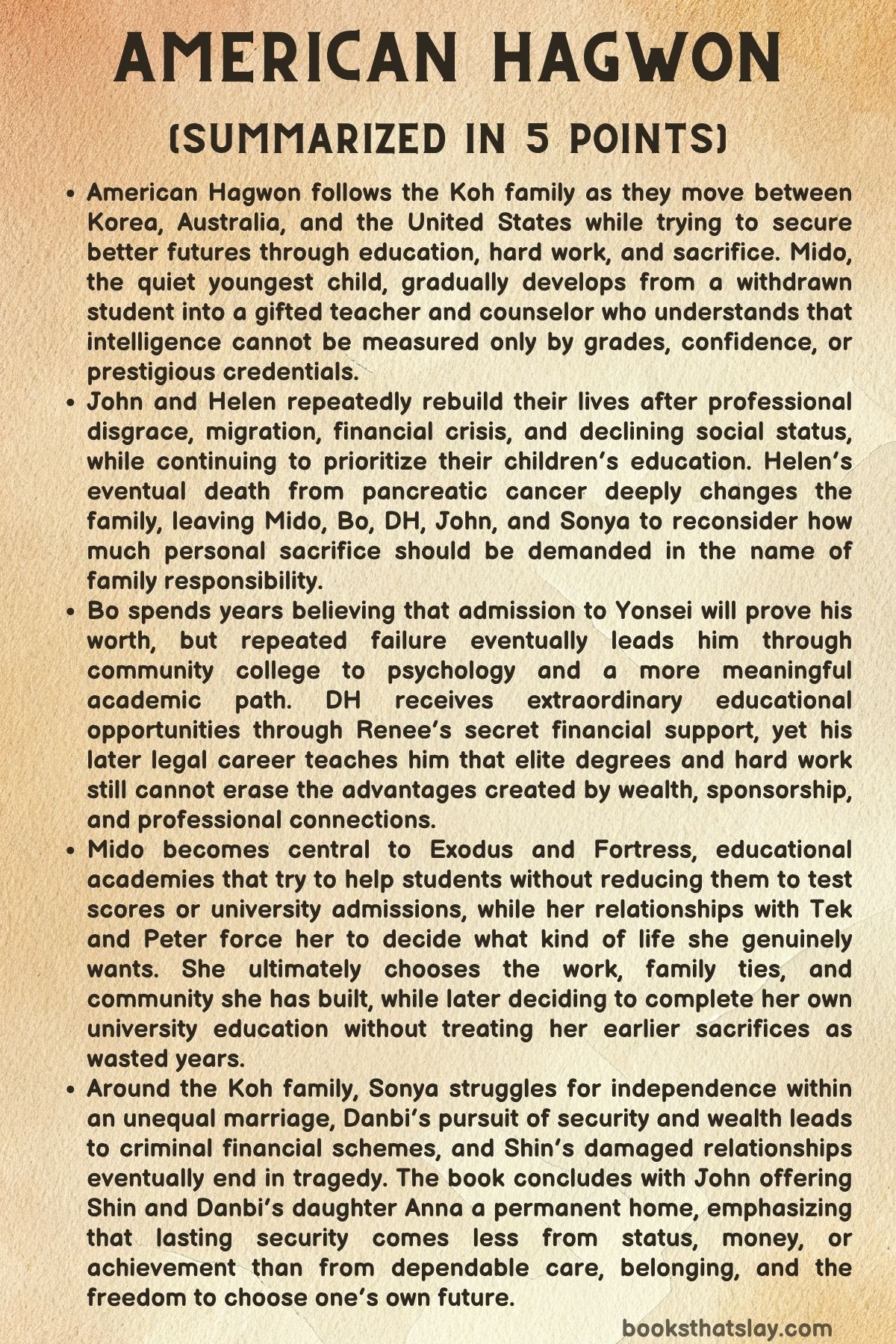
American Hagwon by Min Jin Lee is a multigenerational family novel about education, migration, class, ambition, work, and the difficult bargains people make for those they love.
Beginning with the Koh family’s return to Seoul in the early 1990s, the story follows parents and children across Korea, Australia, and the United States as schools, workplaces, marriages, financial crises, and social hierarchies repeatedly reshape their lives. At its center is Mido Koh, a quiet girl who gradually discovers that intelligence cannot be measured by confidence, credentials, or examination scores alone. Education becomes both a source of opportunity and a system capable of demanding enormous sacrifice.
Summary
When the Koh family returns from Sydney to Seoul, Helen and John immediately confront the educational pressures surrounding their three children. Their youngest, Mido, is intelligent but extremely quiet, and her difficult introduction to Korean school includes being struck by her mathematics teacher for correcting an error, an experience that teaches her how easily education can turn mistakes into shame.
Mido finds protection in her outspoken classmate Yun Kim, whose friendship becomes one of the defining relationships of her youth. Through Yun, the Koh family learns about Eagle Academy, an unconventional hagwon run by Tom and Clara Song that emphasizes thought, discussion, English fluency, and personal development rather than simple obedience and memorization.
At Eagle, teacher Sean Morgan becomes particularly important to Mido because he treats mistakes as information rather than evidence of failure. Her brothers also begin moving toward separate futures: Bo becomes intensely committed to entering Yonsei University, while athletic and socially confident DH receives an opportunity to attend Andover in the United States, secretly financed by Peter Son’s wealthy mother, Renee.
While the children struggle with education, John becomes trapped in a professional crisis created by his longtime friend and superior, Taehun Shin. Shin is having an affair with the ambitious young employee Danbi Jung and pressures John to force her out by assigning impossible work, but Danbi recognizes the scheme and retaliates by staging an accusation of sexual assault against John.
John refuses to resign because resignation would suggest guilt, yet defending himself fully would require exposing Shin and admitting his own participation in sabotaging Danbi. Helen eventually appeals to Shin’s wife, Mary, and through the influence of other powerful women John obtains work in Sydney, forcing the family into another international relocation.
At the same time, Yun’s family loses its Korean businesses because of fraud and debt and migrates to California. Mido and Yun spend a final period together in Sydney before the separation, and Mido meets Tek, a confident Korean-Australian student who becomes her first serious romantic attachment.
Bo remains in Korea trying repeatedly to pass the university entrance examination with a score worthy of Yonsei. His obsession begins to change when, on the eve of another examination, he helps Isul after a medical emergency and consequently performs badly, forcing him to confront the absurdity of judging an entire life through one test.
Bo eventually moves to California, attends community college, and later discovers psychology, gradually understanding that his fixation on Yonsei came from shame, belonging, and the need for social validation rather than pure intellectual desire. Failure, which once seemed to threaten his identity, unexpectedly opens the route toward work that genuinely interests him.
Mido attends the University of Sydney and studies primary education while becoming involved in theater. She discovers that although spontaneous public speech terrifies her, she can perform words she has written herself, suggesting that her silence has never represented an absence of thought but rather a particular relationship with language and exposure.
The Asian financial crisis then destroys the family’s renewed stability. Helen loses her retail job, John loses his position, their Australian residency becomes uncertain, and Mido leaves university rather than allow her parents to carry her expenses while also supporting Bo and DH.
The Kohs relocate to Orange County, where their former professional standing offers little protection. John takes exhausting kitchen work at Shrimp Castle, Helen proves herself again in retail at Mrs. Chung’s Emporium, Bo attends community college, and Mido begins working at Lion Han’s growing hagwon, Exodus.
Yun has meanwhile married Lion, a Princeton graduate who rejected the prestigious career his parents expected and instead built Exodus while continuing to love music. Their household eventually takes in Ginny, a Korean child whose parents can no longer afford her American boarding arrangement, and Lion pays the debt owed to her previous guardian so that helping one struggling person does not require harming another.
Mido becomes increasingly skilled as a teacher and counselor. Her ability to understand children who are frightened, overburdened, or misunderstood eventually leads her and Peter to create Fortress, a new academy focused on older students, test preparation, college applications, and personal guidance.
Peter becomes Mido’s closest professional partner and friend, while Tek continues imagining a future with her in Australia. Mido eventually refuses Tek’s proposal because his solution requires her to treat her obligations, her family, and Fortress as temporary problems that money can resolve, while she has come to see them as central parts of the person she has become.
The family’s sacrifices appear to be producing stability when Helen suddenly becomes gravely ill. Her pancreatic cancer has already spread by the time it is diagnosed, and even as death approaches, she continues worrying about John, her children’s education, money, and particularly Mido, whose university education has been postponed while helping her brothers.
Sonya, Helen’s wealthy older sister, buys the family a townhouse so Helen can see them established in a permanent home before she dies. Helen spends her final days distributing belongings, giving instructions, and asking Bo and DH to make sure that Mido eventually receives the educational opportunity she surrendered for them.
Helen’s death changes nearly everyone around her. John eventually leaves restaurant labor to manage the Rose Salon with Nari, Yun’s mother, while Sonya expands her involvement in American business and begins reconsidering the loveless Korean marriage that has given her wealth but little personal freedom.
Sonya herself has lived for decades inside the powerful Mun family, married to the repeatedly unfaithful Yong-gil while remaining emotionally close to Chairman Mun, the older man who originally arranged the marriage. Their suppressed attachment eventually becomes a sexual relationship, but Sonya discovers that even genuine love can become another structure of control when neither man is willing to recognize her full independence.
Fortress continues expanding, and Mido develops a reputation for understanding students and improving their application essays by persuading them to speak honestly rather than perform perfection. Peter’s philosophy increasingly matches hers: education should help young people understand themselves instead of simply converting parental money, anxiety, and effort into prestigious admissions.
Mido and Peter eventually become lovers after years of friendship. Their relationship introduces new tensions surrounding Peter’s extraordinary family wealth, Mido’s unfinished degree, marriage, and the judgment of elite Korean families, but Renee surprises Mido by valuing her competence, loyalty, and influence on Peter rather than dismissing her because she lacks conventional credentials.
Lion develops a broader critique of educational pressure through the Korean folk figure Hong Gildong. He argues that children should not be forced to become exceptional heroes capable of redeeming an entire family’s sacrifice, because demanding extraordinary achievement as proof of gratitude converts parental love into an impossible debt.
Meanwhile, Danbi turns from insurance into increasingly risky real-estate speculation with George Hong, another married man who becomes both her lover and financial partner. Her desire for security and status drives her to use client premiums and eventually money from a church building fund, while a weakening property market removes the rising prices on which her strategy depends.
Renee proposes a Seoul branch of Fortress that will combine American college counseling with scholarships for talented students who cannot afford elite services. Mido, Peter, and DH return to Korea, and the new academy attempts to protect its principles by using eligibility rules and lotteries rather than allowing money or influence to determine every place.
Mido encounters Tek again in Seoul, but his continuing argument that her abilities are wasted in hagwon education only confirms the distance between them. She finally tells him not to contact her and begins thinking seriously about returning to California to complete university while building a future with Peter.
Danbi’s financial system collapses when the real-estate market turns against her. George is arrested for misusing church funds, Danbi is arrested while attempting to leave with money and her passport, and Shin faces the possibility that he will be held responsible for misconduct occurring through the insurance operation he nominally controlled.
Mary finally seeks a divorce from Shin, while John agrees to meet his old friend only after ensuring that the papers are signed. Shin then asks John to watch his nine-year-old daughter Anna for several days, claiming that he needs to travel, but he instead takes his own life after concluding that those he loves will be better without him.
Anna is left among adults damaged by choices she did not make. Danbi remains imprisoned, Shin is dead, and his older sons have complicated feelings about the child, so John eventually gives Anna the security that so many adults throughout the story have tried to purchase through money, status, or achievement: he simply tells her that she can stay.
At the same time, Mido learns more about the ambitions sacrificed by the women before her. Helen once wanted to become an English teacher, while Sonya once wanted to become a doctor, and Mido understands that completing her own education can honor those unrealized lives without requiring her to reject the teaching work she already loves.
The final movement brings Mido back to the principle that has guided her best work with students. She intends to finish university, asks Peter to return to California with her, encourages him to reclaim his music, and continues helping young people who have been excluded from formal opportunities.
The story closes not with a prestigious admission, an examination result, corporate promotion, marriage, or financial victory, but with John and Anna quietly reading and eating ice cream together. After years in which nearly every adult has tried to secure the future through education, money, influence, sacrifice, or control, ordinary care becomes the clearest form of success.
Characters
Mido Koh
Mido is the emotional and intellectual center of American Hagwon, beginning as a thirteen-year-old whose extreme quietness makes adults worry that something is wrong with her. Her silence, however, is never equivalent to passivity or lack of intelligence; she observes people closely and gradually discovers environments in which speech becomes possible because she feels respected rather than judged.
Her early experience with Mr. Na shows why education can frighten her, while Sean Morgan offers the opposite model by treating mistakes as a normal part of learning. That contrast later shapes Mido’s own work with students, because she instinctively notices the child hidden behind the score, behavior problem, application, or parental ambition.
Mido’s development also depends on sacrifice. She leaves the University of Sydney when her parents lose their jobs, contributes income to the household, helps support her brothers’ education, and repeatedly postpones her own degree because immediate family needs seem more urgent.
Her work at Exodus and Fortress becomes more than temporary employment. She develops extraordinary skill with standardized tests, essays, counseling, and student relationships, eventually proving that professional ability can exist before formal certification recognizes it.
Her romantic life clarifies her changing identity. Tek offers affection, financial security, marriage, and a return to Sydney, but his future requires her to regard California, Fortress, and family duty as temporary interruptions; Peter, despite his wealth and occasional blind spots, increasingly respects the life Mido has already created.
By the end, Mido no longer has to choose between education and teaching, family and individuality, or sacrifice and self-development. Returning to university becomes her own decision rather than an admission that her existing life was inadequate, allowing her to pursue what Helen wanted for her without denying the value of everything she learned outside a classroom.
Helen Koh
Helen is the moral foundation of American Hagwon, although much of her influence comes through ordinary labor that other people barely notice. She budgets envelopes of money, works long hours, prepares food for children studying late, sells luxury goods, performs difficult caregiving work, and repeatedly rearranges her life around the opportunities her children might receive.
Her understanding of education grows from childhood poverty. Having seen how quickly gambling and instability can destroy a family, Helen views schooling as one of the few resources capable of giving her children durable independence, even when providing that schooling requires her own comfort to disappear.
She is also unusually attentive to dignity. When Nari loses everything, Helen does not reduce her to an object of pity because she remembers her own family’s humiliation; when John loses his career, she acts rather than allowing shame to isolate him.
Helen’s greatest strength can also become dangerous because she has difficulty treating her own needs as equally urgent. She works through physical exhaustion, accepts jobs beneath her previous circumstances, and dismisses alarming symptoms until advanced pancreatic cancer leaves little possibility of treatment.
Her final concern remains the future of others, particularly Mido, whose education has been postponed while helping the family. Helen’s death therefore does not remove her from the story: her values continue directing John, Bo, DH, Mido, Sonya, and the wider community long afterward.
John Koh
John’s journey in American Hagwon examines integrity without presenting integrity as moral perfection. He is fundamentally decent, loyal, hardworking, and modest, yet the disaster involving Danbi begins because he agrees to participate in something he knows is wrong when Shin asks him to undermine her professional career.
His downfall forces him to understand the danger of loyalty without boundaries. Because Shin has helped him for years, John initially experiences their friendship as a debt that requires obedience, only later recognizing that his own labor also contributed significantly to Shin’s success.
Migration strips John of status several times. The respected corporate manager becomes an unemployed middle-aged man, a restaurant kitchen worker, and eventually a salon manager, but he slowly separates dignity from occupational prestige and approaches each form of work with the same seriousness.
Helen’s death leaves him with enduring grief and guilt because he believes her labor for the family contributed to her physical decline. His later decisions are shaped by her memory, especially his increasing willingness to treat vulnerable people with the patience she would have shown.
John’s relationship with Shin reaches its final stage when he acknowledges both Shin’s betrayal and his own wrongdoing toward Danbi. After Shin’s death, John turns away from the adult accounting of guilt long enough to protect Anna, demonstrating that responsibility can begin where blame stops being useful.
Sonya Cho
Sonya is one of the most complicated figures in American Hagwon because wealth gives her tremendous practical power while leaving her emotionally constrained. As a girl, she protects Helen and Kenny through poverty and danger, establishing a lifelong habit of assuming that other people’s survival is her responsibility.
Marriage to Yong-gil appears to rescue her from insecurity, but the Mun household never truly belongs to her. Chairman Mun controls the family structure, Yong-gil repeatedly commits adultery, and Sonya learns to treat status and luxury as resources she can use without confusing them with freedom.
Her relationship with Chairman Mun grows from decades of mutual trust and suppressed affection. When it becomes sexual, Sonya receives tenderness she has never known in marriage, yet she eventually realizes that being loved secretly is not the same as being allowed an honest life.
The behavior of both men ultimately forces her to reconsider the arrangement. Yong-gil attempts to enforce marital possession, while Chairman Mun strikes her during a jealous conflict, destroying Sonya’s belief that he represents an entirely safe alternative.
Sonya’s movement toward independence is gradual rather than absolute. She builds American businesses, establishes separate living arrangements, maintains control of valuable shares, and refuses to resume the sexual relationship with Chairman Mun even though the love between them remains.
Her importance extends beyond her personal story because she repeatedly converts money into protection for others. Yet the novel also asks whether a woman who has spent a lifetime rescuing relatives, employees, and institutions can learn that her own life deserves protection too.
Danbi Jung
Danbi is the most destructive and morally unsettling figure in American Hagwon, but she is not portrayed as someone who acts without understandable motives. Poverty, humiliation, an unstable home, and early exposure to unequal gendered power teach her that beauty, intelligence, secrecy, and powerful men can function as tools of survival.
Her affair with Shin begins partly through calculation but develops into genuine attachment. The problem is that Danbi repeatedly experiences security as something that must be controlled, accumulated, defended, and increased, so affection never frees her from the fear that someone else can take away what she has gained.
Her false accusation against John demonstrates how ruthlessly she can act when she feels threatened. Later, her attempts to secure legitimacy through church status, marriage-like domestic arrangements, insurance, property, and wealth continue the same pattern at larger scales.
Danbi is highly intelligent and capable in business, which makes her collapse more significant. She does not fail because she lacks competence; she fails because competence strengthens her confidence that rules, boundaries, debts, and other people’s money can always be managed after the fact.
Her relationship with George becomes especially revealing because intimacy and finance become nearly indistinguishable. She uses his affection and expertise while he mistakes their arrangement for a deeper emotional commitment, and together they cross legal boundaries that rising property values initially conceal.
Even after imprisonment, Danbi insists that her actions were intended to protect her family. That claim contains both self-deception and truth, because Anna’s security genuinely matters to her, but fear of insecurity has transformed protection into possession and ambition into criminal risk.
Bo Koh
Bo begins as the sibling most thoroughly shaped by educational competition. He believes admission to Yonsei will confirm his intelligence, cultural belonging, and worth, and repeated failure therefore feels far larger than an ordinary academic disappointment.
His decision to help Isul before an examination exposes the conflict between the person he is and the system he has internalized. He knows saving another person matters more than test performance, yet he still experiences the resulting score as evidence against himself.
Community college becomes unexpectedly liberating because Bo encounters teachers interested in thought rather than rank. Psychology gives him a language for understanding how esteem, belonging, and identity influenced his earlier obsession, allowing him to reinterpret failure rather than merely survive it.
By the time he reaches graduate school, Bo has become a thoughtful teacher capable of recognizing the same anxieties in students that once controlled him. His relationship with Mido also changes as he becomes increasingly conscious that her sacrifices helped create his opportunities.
His development shows that changing direction need not mean lowering ambition. Bo becomes more intellectually serious after abandoning the prestige contest that once defined him.
DH Koh
DH is athletic, socially confident, ambitious, and initially the Koh child for whom international opportunity seems to arrive most naturally. Andover and Yale open doors that would otherwise have been financially impossible, though he does not initially realize that Renee has privately funded much of his education.
Learning the truth changes his understanding of achievement. What looked like individual success was partly produced by generosity, relationships, and Peter’s need for a trustworthy friend, forcing DH to recognize that no accomplishment exists entirely outside social support.
His later legal career produces a second education in inequality. Even elite credentials, extraordinary billable hours, and strong performance do not guarantee partnership when clients, inherited networks, and sponsorship determine advancement.
DH’s move to Seoul therefore represents adaptation rather than defeat. In Korea, his American legal training and Renee’s connections give him greater leverage, demonstrating that professional merit is often recognized differently depending on the institution surrounding it.
He also grows into the responsibility Helen expected of him. As his financial position improves, he becomes increasingly determined to help Mido obtain the education she delayed while supporting him.
Yun Kim
Yun begins as Mido’s first defender and closest childhood friend. Her confidence and directness draw speech from Mido after the traumatic encounter with Mr. Na, making their friendship central to Mido’s early emotional development.
Her apparent boldness is later complicated by family collapse. After her parents lose their Korean businesses and migrate to California, Yun watches Joonho become consumed by shame and eventually abandon the family, forcing her to grow up within circumstances she does not fully reveal in cheerful letters to Mido.
Marriage to Lion becomes partly an act of self-determination. Yun wants love, but she also wants to create a household that feels chosen and stable after witnessing the disintegration of her parents’ marriage.
Her decision to take in Ginny demonstrates how Yun transforms personal experience into care for someone else. Having known what it means for family security to disappear suddenly, she refuses to let a child become homeless merely because adults have suffered financial reversals.
Yun remains capable of anger, especially toward Joonho, and his return does not magically erase abandonment. Her eventual family life with Lion allows reconciliation to coexist with remembered injury rather than requiring instant forgiveness.
Peter Son
Peter is shaped by privilege but spends much of his adult life attempting not to be defined by it. His family wealth gives him opportunities, housing, elite education, and social connections, yet those advantages do not prevent alienation, academic disruption, romantic pain, or uncertainty about his own direction.
Teaching gives Peter a more convincing identity than inherited status. At Fortress, he cares deeply about curriculum, ethical test preparation, student development, and preserving small-scale attention even when expansion could generate far greater profits.
His relationship with Mido grows slowly from friendship and professional partnership. He sees her competence long before their romance begins, although his casual acknowledgement that his relatives may care about her missing degree exposes how difficult it is for even sympathetic privileged people to recognize every assumption created by class.
Peter also struggles with music and the fear of pursuing something that may never produce conventional success. Mido helps him recognize that an activity can matter even when it does not become a prestigious career, mirroring what he and Lion try to teach students.
His eventual willingness to move across the Pacific and later consider returning to California reflects a relationship based increasingly on negotiation rather than possession. Trust becomes one of his most important forms of commitment.
Lion Han
Lion challenges conventional definitions of success from the beginning. Despite graduating from Princeton, he chooses hagwon work and music rather than the professional career his parents imagined, making him an example of someone whose elite credential does not dictate the only acceptable future.
Exodus becomes financially successful, but Lion’s educational philosophy deepens through experience rather than remaining merely entrepreneurial. Ginny especially teaches him how easily gratitude can turn children into anxious performers who believe they must justify every sacrifice made for them.
His reflections on Hong Gildong lead him to argue that children should not have to become extraordinary heroes to deserve ordinary parental love. His public lectures expose the contradiction faced by parents who recognize educational pressure as damaging but fear that reducing it will disadvantage their own children.
Lion is also generous in concrete ways. Paying Mrs. Chiu the money Ginny’s parents owe prevents his rescue of Ginny from simply transferring financial harm to another struggling household.
His marriage to Yun provides one of the story’s more stable partnerships because both make deliberate choices rather than merely obeying inherited expectations. They create a family that increasingly becomes a refuge for other people as well.
Nari Kim
Nari’s life demonstrates how rapidly class position can change. In Korea she belongs to a prosperous family with property and businesses, but financial disaster removes that security and sends the household to California.
Restaurant labor takes a physical toll on her while Joonho becomes increasingly consumed by shame. When he abandons the family, Nari continues working because survival permits little room for collapse.
Her move to Rose Salon reveals capabilities that poverty and limited English had obscured. Sonya recognizes that Nari’s judgment, discipline, social intelligence, and ability with people matter more than formal credentials, allowing her to reconstruct her identity through work.
Her decision to travel to Brazil for Joonho is particularly significant because she does not wait passively for the man who left her to recover his pride. She chooses reunion on new terms, telling him that his economic usefulness is no longer the measure by which he will be allowed to return.
Joonho Kim
Joonho is defined by the destructive relationship between masculinity, status, and economic failure. Losing his businesses does not merely reduce his income; it destroys the identity through which he understands himself as husband and provider.
Instead of adapting as John does, Joonho experiences lower-status labor as humiliation. His eventual flight to Brazil transfers the burden of his shame onto Nari and Yun, making his disappearance both understandable in psychological terms and deeply selfish.
Years later, he has not rebuilt the prestigious life he imagined. Nari’s decision to retrieve him forces him to accept a difficult truth: returning home may require admitting that he has nothing impressive to offer.
His reunion does not erase the past, especially for Yun, but it opens the possibility that a person can reenter a family without first restoring the status he believes he lost.
Tek
Tek is intelligent, affectionate, professionally successful, and never reduced to a simple romantic obstacle. His desire for Mido to return to Sydney often makes practical sense because he can offer financial stability, legal status, education, and a secure partnership.
The conflict arises because Tek interprets Mido’s sacrifices as problems that should eventually end. He does not fully understand that Fortress, family responsibility, and the immigrant community around her have become positive sources of identity rather than unfortunate delays before her “real” life resumes.
His criticism of hagwon culture contains legitimate arguments about pressure, inequality, and the social cost of educational competition. Yet his insistence that Mido is too talented for teaching unintentionally reproduces the prestige hierarchy he claims to criticize.
Their separation becomes necessary because love cannot solve a disagreement over what constitutes a meaningful life. When they meet again in Seoul, Tek still imagines compromise through geography, while Mido has already chosen a different definition of fulfillment.
Taehun Shin
Shin begins as John’s benefactor, friend, and superior, making his betrayal especially damaging. He has helped John professionally for years, yet he eventually treats that history as justification for demanding unethical loyalty.
His affair with Danbi reveals a man unable to control either desire or consequences. He repeatedly knows that his choices are destroying Mary, his sons, John, and eventually himself, but recognition rarely becomes decisive action.
Later, his relationship with Danbi reverses the power structure he once enjoyed at work. He increasingly feels trapped inside the household and business he created with her, even as he recognizes that many of those conditions resulted from his own decisions.
His suicide is the final expression of this pattern: rather than endure humiliation, legal danger, fractured family relationships, and responsibility, he convinces himself that disappearance will help others. Yet his last decision to place Anna with John shows that he still trusts the integrity of the friend he once sacrificed.
Renee Cha
Renee represents the constructive possibilities of wealth when money is used without demanding ownership of the recipient. She secretly finances DH’s education partly because his friendship helps Peter, but she does not require DH to spend his life repaying her.
Her approach changes through Peter’s suffering. Elite schools and enormous financial resources fail to guarantee his happiness, teaching Renee that parental success cannot simply be measured by the prestige attached to a child.
She later recognizes Mido’s intelligence despite the absence of a degree and uses her networks to help DH professionally. Her proposal for a Seoul Fortress also combines privilege with redistribution by creating scholarships alongside full-paying enrollment.
Renee never becomes detached from class power, but she increasingly treats resources as tools for enlarging other people’s choices rather than controlling them.
Ginny
Ginny embodies the burden placed on children who know precisely how much adults have sacrificed for their education. Financial crisis leaves her dependent on guardians, ashamed of costs she did not create, and determined to become successful enough to repay everyone.
Living with Yun and Lion gives her security, but gratitude quickly becomes another source of pressure. Her wish to skip grades comes from the belief that finishing school faster will reduce the burden she imposes on others.
Lion’s refusal is crucial because he tells her that childhood itself has value. Ginny’s later determination to become a doctor and send money home shows that the savior mentality has not disappeared completely, but she grows within a household actively trying to teach her that love does not operate like an invoice.
Chairman Mun
Chairman Mun is both protector and patriarch. He has enormous economic authority and frequently uses it to secure the futures of Sonya and her relatives, yet his generosity exists inside a family system over which he expects to retain final control.
His love for Sonya is genuine and long suppressed. He understands Yong-gil’s mistreatment of her and eventually gives her money, stock, and influence, but even his devotion struggles to imagine a structure in which Sonya can determine the terms entirely for herself.
The moment he strikes her during a jealous confrontation reveals the limit of his self-image as her protector. His remorse matters, but it cannot restore the unquestioned trust that existed beforehand.
The later arrangement between them therefore becomes a compromise rather than romantic fulfillment. He remains important in Sonya’s life, but she refuses to resume intimacy simply because love still exists.
Yong-gil Mun
Yong-gil treats marriage as a stable entitlement while granting himself freedoms he would never accept from Sonya. His repeated affairs rest on the assumption that her loyalty, household role, and social position are fixed regardless of his behavior.
Discovering Sonya’s relationship with Chairman Mun forces him to experience the jealousy and humiliation he has imposed on her for years. Instead of producing empathy, however, his first reaction is an attempt to reclaim possession through marital authority.
Yong-gil is significant because he reveals how unequal systems survive through accepted double standards rather than through affection. Sonya’s growing independence threatens him not simply because she loves someone else but because she ceases to behave as property whose place has already been decided.
Mary Shin
Mary spends years enduring Shin’s infidelity while maintaining her household and raising their sons. Her apparent patience is not ignorance; she understands far more than Shin assumes and repeatedly acts with practical intelligence when crises require intervention.
She helps rescue John’s career after Danbi’s accusation because she recognizes that her husband created the circumstances that destroyed him. Years later, she finally seeks divorce when Shin’s business and legal troubles threaten to consume whatever remains of their shared life.
Mary’s willingness to consider helping Anna is especially important. Anna represents the affair that devastated Mary’s marriage, yet Mary can separate the innocence of a child from the wrongdoing of adults.
George Hong
George begins as a respected church figure whose dissatisfaction with marriage makes Danbi’s attention feel transformative. He interprets their affair emotionally, while she approaches it as a combination of attraction, usefulness, protection, and access to financial knowledge.
His greatest failure is allowing private longing to corrupt public responsibility. Once he uses church building funds to finance Danbi’s property deals, emotional weakness becomes institutional betrayal.
George also demonstrates that respectable credentials and religious standing do not prevent self-deception. He knows the money is not his, but anticipated profits allow him to imagine that temporary misuse will never become visible theft.
Anna Shin
Anna enters the story as the child produced by Shin and Danbi’s attempt to create a new family while the damage to the old one remains unresolved. She eventually inherits nearly every consequence of decisions made before she was capable of understanding them.
Her father dies, her mother is imprisoned, her half brothers remain ambivalent, and public scandal reaches her through other children. Her quietness and self-sufficiency suggest a child already learning not to make additional demands on unstable adults.
John’s offer of a permanent home therefore carries enormous significance. Anna’s ending rejects the idea that she must earn security or compensate anyone for taking her in.
Sean Morgan
Sean is one of the first adults to recognize Mido’s intelligence without treating her quietness as a defect. His teaching philosophy treats errors as useful evidence about what a student needs to learn.
That seemingly simple attitude stands in direct opposition to the fear created by Mr. Na. Mido later reproduces Sean’s approach at Fortress by asking what individual students need rather than demanding that everyone perform confidence in the same way.
Tom and Clara Song
Tom and Clara build Eagle Academy around an alternative vision of education. They value discussion, English fluency, problem-solving, individual attention, and the possibility that students with very different strengths may need very different paths.
Their influence continues long after Mido leaves Eagle because Fortress develops many of the same principles. Clara’s personal concern for students and Tom’s willingness to see potential beyond conventional rankings provide a model that later educators repeatedly adapt.
Kenny Cho
Kenny represents the more geographically distant part of Helen and Sonya’s sibling network. His Australian household provides Mido and Yun with a temporary refuge during a period when Yun’s family life is collapsing.
Near the end, Kenny becomes important because he preserves Helen’s words. By telling Mido about her mother’s unrealized hope of becoming an English teacher and her desire for Mido to finish university, he helps transform the degree from an obligation into a connection between generations.
Mr. Na
Mr. Na represents the punitive educational culture against which many later teachers are measured. His decision to strike Mido for correcting an error turns learning into fear and interprets uncertainty as moral weakness.
His importance is therefore larger than his presence in the story. Sean, Mido, Peter, Lion, Tom, and Clara gradually construct educational relationships based on almost the opposite principle: a mistake should reveal what needs attention rather than justify humiliation.
Themes
Education, Achievement, and the Meaning of Success
Education in American Hagwon functions simultaneously as opportunity, identity, business, family investment, and emotional burden. Bo’s attempts to enter Yonsei show how a university name can become attached to self-worth so completely that failure appears to invalidate intelligence, nationality, and years of effort, while DH’s later legal career demonstrates that even elite credentials cannot remove the influence of inherited networks and sponsorship.
Mido provides a different measure of ability because she becomes an exceptional teacher, counselor, test taker, and essay adviser before completing a university degree. Her career forces both characters and readers to ask whether credentials certify ability or merely provide institutions with an accepted language for recognizing it.
The hagwons themselves embody the contradiction. Eagle, Exodus, and Fortress participate in competitive systems, yet their best teachers repeatedly try to protect children from believing that admission is the final purpose of learning.
Lion’s lectures make this argument explicit by warning against raising children as heroic repayment projects. The story does not reject ambition or rigorous education; instead, it questions what happens when achievement becomes the condition for dignity, love, belonging, or gratitude.
Sacrifice, Debt, and Family Obligation
Nearly every major relationship contains some form of debt, but the story constantly distinguishes financial obligation from moral responsibility. Helen sacrifices work, health, comfort, and savings for her children, Mido postpones university to support the family, Renee finances DH’s education, Sonya uses wealth to stabilize relatives, and Lion pays Mrs. Chiu before taking Ginny into his household.
The danger appears when gratitude becomes an accounting system. Ginny believes she should finish childhood quickly because adults have spent money on her, DH initially wonders how he can repay Renee, and Mido risks allowing years of sacrifice to become a permanent reason never to pursue her own education.
The healthiest characters eventually learn to pass generosity forward rather than settle it precisely. Peter tells DH that Renee’s gift need not be repaid directly; helping another person someday would honor it more meaningfully.
This approach transforms obligation from a chain into a network. Family remains demanding, but the novel suggests that sacrifice becomes destructive when the recipient is expected to surrender autonomy as payment, while freely given care can create new choices across generations.
Migration, Class, and Reinvention
Movement between Korea, Australia, and the United States repeatedly destroys the illusion that status is permanent. John can be a corporate manager in one country and a restaurant worker in another, Nari can move from property ownership to exhausting kitchen labor and later become an effective salon manager, and Mido can leave university yet become indispensable inside an educational business.
Migration exposes how credentials depend on context. English ability, Korean schooling, American universities, Australian professional experience, family networks, citizenship, immigration status, and cultural knowledge all gain or lose value depending on where a character stands.
Class differences remain powerful even when friendships cross them. Peter can conceal his wealth through an old car, but he cannot erase the enormous safety net surrounding him, while the Kohs calculate household purchases and rely on combined labor simply to remain stable.
Reinvention therefore requires both personal effort and structural opportunity. The story respects hard work but repeatedly refuses the comforting claim that effort alone determines outcomes, emphasizing instead how family money, sponsorship, geography, economic crises, and social connections shape what choices become available.
Care, Control, and the Right to Choose
Many conflicts in American Hagwon arise because care can become difficult to distinguish from control. Parents want excellent schools for their children, lovers want security from one another, wealthy patrons offer opportunities, and family members sacrifice for relatives, yet good intentions become harmful when one person assumes the right to determine another person’s future.
Tek loves Mido but imagines that the sensible life he offers should outweigh the meaning she finds in Fortress. Chairman Mun loves Sonya but wants their hidden arrangement preserved on terms compatible with the existing family order, while Yong-gil treats marriage itself as authorization to possess her.
Educational pressure follows the same pattern. Parents insist that every advantage is offered for a child’s benefit, yet students such as Ginny, Sung, Susie, and Bo reveal the psychological cost of living inside plans created by adults who are frightened of failure.
The strongest acts of care gradually become those that enlarge choice rather than remove it. Mido tells Susie that quitting is genuinely possible, Lion tells Ginny she does not have to accelerate childhood, Renee allows Peter to define his own success, and John finally offers Anna a home without demanding anything in return.
The ending therefore gives unusual weight to a simple promise of belonging. Security is most humane when it gives another person enough safety to choose a life rather than prescribing the life they must choose.